Buddy and Merlyn behaved like a “tag team”, Pita Oates said
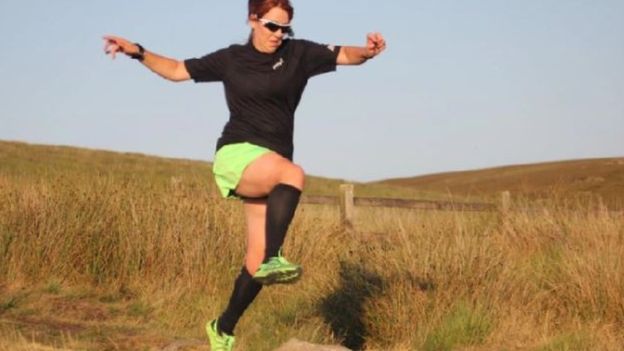
A runner who broke her leg on remote moorland was rescued after her dogs raised the alarm.
Pita Oates, 48, was left unable to stand after she fell on a three-mile run in Lancashire with her blue collies Buddy and Merlyn.
One of the dogs stayed with her as she inched down the hill, while the other ran around barking for help.
This attracted the attention of another dog walker who contacted emergency services.
Ms Oates, from Leyland, said: “They were like a tag team, Buddy never left me while Merlyn went for help.
“I would have died without a doubt, I wouldn’t have lasted the night.”
When help arrived Ms Oates, who had left her mobile phone in her camper van, was drifting in and out of consciousness and starting to suffer the effects of hypothermia.
She said: “It was the tail-end of Storm Gareth, it was freezing and I was soaking wet. The winds were horrendous.”
Ms Oates said she could have died on the moors without her dogs’ help
Ms Oates broke the femur behind her left knee and tore her anterior and cruciate ligaments on the run on Great Hill near Chorley on 12 March.
“I couldn’t stand up, I was having to bum-shuffle all the way down,” she said.
“Every time my leg touched the ground I was in pain so I rigged up a sling using the dog’s lead to keep my leg up.”
It took her 90 minutes to get down the hill by which time it had gone dark.
“Buddy never left me and Merlyn kept barking back at him – when this man came with his dog he knew something wasn’t right,” she said.
Paramedics and members of the Bowland Mountain Rescue Team, as well as two from Bolton Mountain Rescue, arrived to help rescue Ms Oates.
She spent eight days in hospital and had a titanium plate fitted but still needs another operation.
Pita Oates was on a three-mile run when she was injured
ooOOoo
Part of me is not surprised at the behaviour of Ms Oates’ dogs. Dogs show their care and attention in so many ways. But then again I was surprised because these two dogs knew exactly what to do. One to stay and one to seek help. Which is what they did.
It was a close-run thing (pardon the pun) as Pita was starting to fade away when help arrived.
Winner of the ‘I Love Dogs Because…’ category (Photo: Jade Hudson/Dog Photographer of the Year Competition.
Hugo the puppy is the subject of this winning image by 16-year-old Jade Hudson.
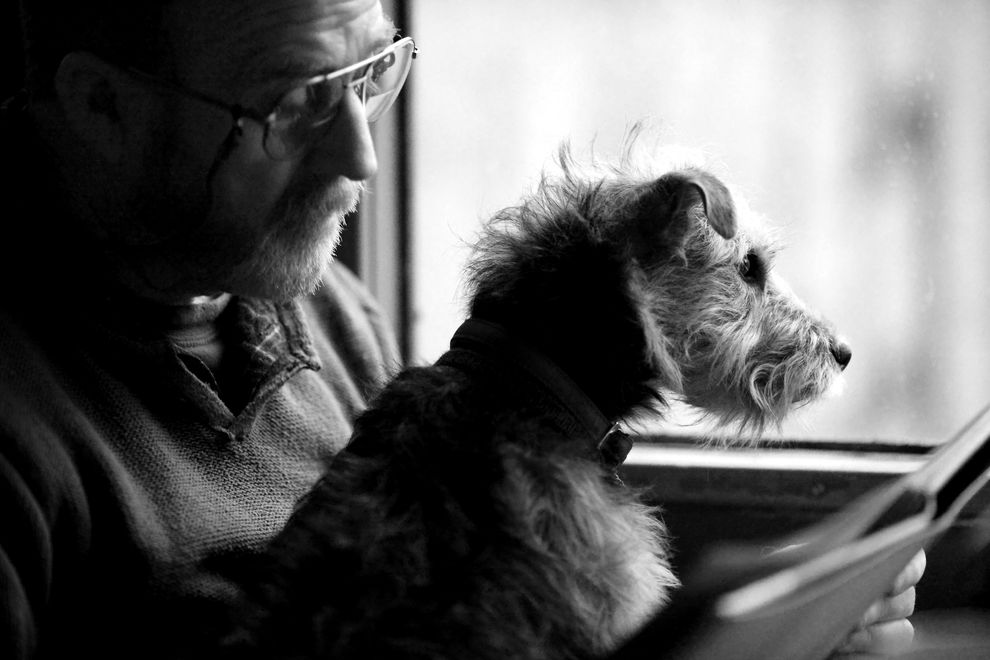
Winner of the Oldies category (Photo: Kevin Smith/Dog Photographer of the Year Competition)
The gray faces of old dogs speak to all the love and friendship they’ve provided over the years as Lizzie, a 12-year-old mixed breed dog, shows us. Curling up with a cracking fire and your four-legged BFF is one of life’s great joys.
Winner of the Dog Portrait category (Photo: Jamie Morgan/Dog Photographer of the Year Competition)
This portrait of two Afghan hounds named Ozzie and Elvis took first place for the Dog Portrait category. The setting is the idyllic Ashdown Forest in Sussex.
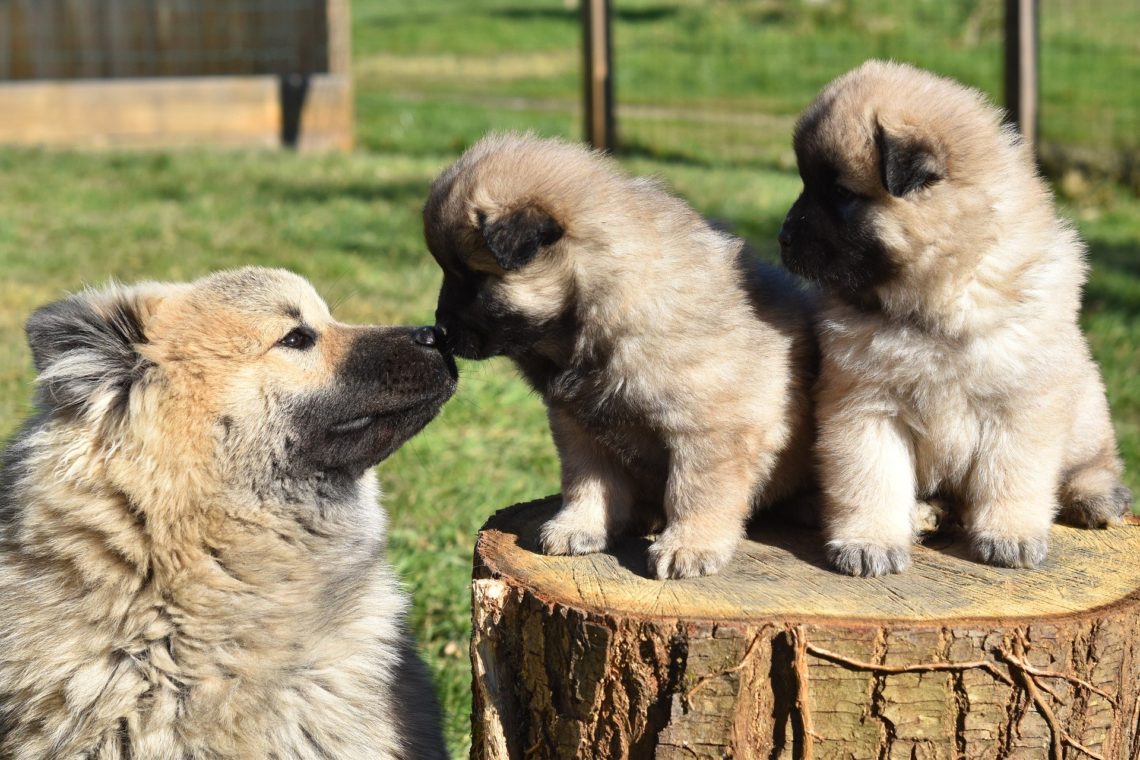
Winner of the Puppy category (Photo: Linda Storm/Dog Photographer of the Year Competition)
And finally, the winner of the Puppy category is little rescue puppy Buddy enjoying a bowl of milk. The photo was taken by Colorado-based photographer Linda Storm.
“The entries for this year’s Dog Photographer of the Year competition were some of the best we have ever seen,” says Rosemary Smart, Kennel Club chief executive. “Choosing the winners was an incredibly challenging task and we commend every photographer who entered. Each of the winning photographers beautifully captured the essence of their canine subjects on camera, demonstrating how important dogs are to us in every walk of life.”
If you’re a photographer who loves dogs as your subject, keep an eye on the opening date for next year’s competition!
ooOOoo
I should say so! These photographs are the very best of pictures taken by very talented photographers.
I’m Tony I have been interested in eating healthy for more than 35 years. Unfortunately, my actions haven’t always matched my aims. As Mae West said, “I used to be Snow White, but I drifted.”
I drifted too, for a long time, but after writing posts for this blog for nearly 10 years, I have gotten good at it. I used the Lose It! App for a while (iPhone, iPad, Touch) a calorie counter that also breaks down nutrients and gives you a daily weight chart to demonstrate your progress. It’s not the only tool like this around, but it’s a good one. I think you are better off using a tool than not using one, especially if you are just embarking on a weight loss program.
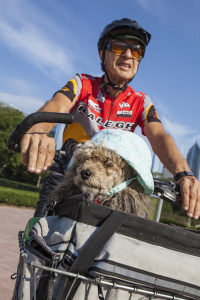
Using that tool and practicing some self discipline I now have complete confidence in my ability to maintain a healthy body weight. I still need to work on the lean muscle mass thing, though. I love riding my bicycle and have no problem logging lots of miles and putting calories into the bank to free up my eating. I average around 100 miles a week. That covers a multitude of sins at the table. Biking is a wonderful cardio workout. Few people realize, however, it is also very stimulating for the brain. It’s a lot more fun than working with weights, but ya gotta do that, too. I write about the benefits of cardio exercise on the brain often in this blog as it is usually misunderstood and/or completely overlooked in most fitness writing. I had an aunt who died of Alzheimer’s, my mother who suffered from dementia in her final years, and my grandfather on my father’s side also had cognitive problems in his later years, so I am dead serious about protecting myself from mental decline. Check out my Page – Important facts about your brain – and exercise to read more about it.
I retired 19 years ago. I spent 20 years as a Reuters Correspondent and Editor after starting my career in men’s magazines. I taught journalism at Medill for a while and then wrote in the investment department of a major U.S. philanthropy where I spent my last few years managing $900 million in bond investments.
Now that I am retired, I have complete control over what I eat. My heart goes out to you folks who go to work every day. It is much harder to control your caloric intake. There are business lunches and dinners to attend, late days at the office, working through lunch as well as traveling. I think if I were still working I would seriously consider bringing lunch from home a day or two each week to keep a handle on my intake. With a fridge and microwave where you work, you are good to go.
When I started writing for this blog in March of 2010 I weighed 165 pounds, the lowest I had been in 15 years. I thought I had arrived at fitness and health. Now, in 2019, I weigh 155 pounds. That’s right, I have melted off a further 10 pounds from my best weight in years. My resting heart rate is under 50 beats per minute (bpm), a result of my cycling, but significantly under the ‘normal’ of 65 to 90 bpm for a guy in his upper 70’s. I have less than 16 percent body fat and a 31 inch waist (the first time since high school). I have reached this state of fitness and health following the ideas and techniques I write about in this blog. You can, too
When the blog started, I was talking the talk, over nine years later I am walking the walk. You can do the same. I am just a regular guy. If I can do it you can, too. Check out my page How to Lose Weight and Keep it Off for a start. Lots of excellent, practical principles there that I have learned and now apply to my daily life.
Just over 20 years ago my weight got out of control and I ballooned over 220 pounds. I took off 50 pounds in a year, but that only got me down to the mid-170’s. You can read How I lost 50 pounds in 52 weeks if you want chapter and verse.
When I retired, I started taking courses from The Great Courses. They include “Nutrition Made Clear” by Professor Roberta Anding. She has an MS in Nutrition and is a registered Dietitian and a certified specialist in sports dietetics. Another superb course is “Lifelong Health: Achieving Optimum Well-Being at any Age” by Doctor Anthony Goodman. He also teaches “The Myths of Nutrition and Fitness.” By now, in 2019, I have probably taken more than a dozen courses on mental and physical health and wellness as well as healthy aging.
I have about 40 games of backgammon going on the web. I was born January 26, 1940. I am an Aquarius and a senior citizen. At 79 years of age, I am healthier by far than I was over 20 years ago when I was in the work force and a relatively young man in my 50’s.
As a senior who presently is winning the war of the waistline, I am also grappling with the experience of aging. As part of this blog’s focus on good health I look seriously into aging and what can be done about it. I know there is no fountain of youth, but there are techniques for aging gracefully and, more importantly, retaining one’s mental powers. I promise to share with you everything I can find out about it.
The masthead photo is a shot of me taken 40 years ago by a girlfriend when we were bike riding by the lakefront in Chicago. I had a lot more hair then.
Tony
Now Tony recently published a post that I found so interesting.
It’s all about improving one’s vision.
ooOOoo
Walking improves vision – Study.
By Tony, November 25th, 2019
As a big fan of walking I was thrilled to learn of this further benefit to the Cinderella of the exercise world. Walking leads to an increase of peripheral visual input, according to a study from the University of Wurzburg.
How do we perceive our environment? What is the influence of sensory stimuli on the peripheral nervous system and what on the brain? Science has an interest in this question for many reasons. In the long term, insights from this research could contribute to a better understanding of diseases such as ADHD and Parkinson’s disease.
The topography of the EEG response (l) and its localization in the brain (r) show visual sensory processing during the walking conditions slow and normal – green and red, and standing – black. The image is credited to Barbara Händel.
Perception and the underlying neuronal activities are usually measured while subjects are sitting or lying, for example while doing magnetic resonance imaging. As a rule, the head is fixed and people are encouraged not to blink. The measurements therefore take place under well-controlled but rather unnatural conditions.
Shift of visual preference
When processing visual stimuli, however, it makes a difference whether the person is sitting or moving: When walking around, the peripheral part of the visual field shows enhanced processing compared to the central part. This can be proven both by the behaviorally measured perception of the test persons and by their brain response.
This shift in visual preference makes sense. “It is above all the peripheral visual input that provides information about the direction and speed of our movement and thus plays an important role for navigation,” says Dr. Barbara Händel. The neuroscientist from Julius-Maximilians-Universität (JMU) Würzburg in Bavaria, Germany, and her colleague Dr. Liyu Cao have published their findings in PLOS Biology
“It was known from animals that increased body movements lead to an increased firing rate in visual areas of the brain,” says Dr. Händel. So far, there are only a few behavioural experiments available for humans that investigate the influence of movement on sensory brain areas. However, there is evidence that cognitive processes are linked to the behavioural state. “For example, some studies show that people learn better when they move,” says the JMU researcher. However, the underlying neuronal mechanisms have not yet been tested in detail.
Mobile EEG, sensors and video glasses
It is precisely such gaps in knowledge that Barbara Händel wants to close with her work. In order to explore the link between movement and perception, sophisticated technical equipment is necessary. While the test subjects walk around, they wear electrode caps and a small amplifier that records their brain waves. The EEG data are sent wirelessly to a laptop, which the subjects carry in a backpack. Motion sensors, video glasses, and a mobile device for recording eye movements complete the setting.
Quite an effort. “But we have to take this step if we want to understand human perceptual strategies during natural behavior,” says Dr. Händel. Research into perception during movement is still in its infancy. It is now up to science to ask clever questions and find out which of them can be answered with mobile technical equipment.
Many exciting research questions
Next, the JMU scientist wants to further investigate the effect of altered perception during movement. Does it only occur for visual input or possibly also in other sensory areas? Does it, in addition to navigation, perhaps also play a role in other cognitive processes such as memory and creativity?
All this is possible: experiments with rats have shown that these animals learn better, when they are in motion. And the idea that walking increases creativity has existed since ancient times. “For example, the Peripatetics, a philosophical school around Aristotle, usually were discussing while walking, from which their name derives,” says Barbara Händel.
There is also a connection between creativity and eye movements: “It is known that people blink more often the more creatively they solve a task. And we found that people also blink more often when they walk around compared to being at rest.” Obviously, there are many connections between the movements of the body, the eyes and the mental performance. Their research could reveal many more interesting aspects.
As I write this post, yesterday afternoon, it has been snowing for some hours at Hugo Road (ZIP 97532). In the anticipation that we might be snowed in at 8am we drove the short distance to our local Dollar General store to stock up on dog food and other bits and pieces.
So this story from the Daily Dodo seems really apt. I hope you enjoy it.
ooOOoo
Stray Dog Found Curled Up In Snow Keeping Orphaned Kittens Warm
Photo Credit: Pet and Wildlife Rescue
Last weekend, while driving on a freezing cold night in Ontario, Canada, a Good Samaritan spotted something that made her stop.
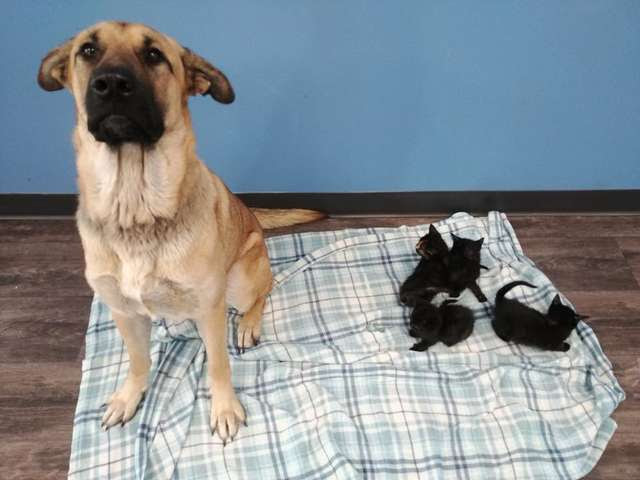
There, curled up on a snowy roadside, was a shivering stray dog.
But she wasn’t alone.
Though the dog could have found a safer place to pass the night, she wasn’t just thinking of herself.
Photo Credit: Pet and Wildlife Rescue
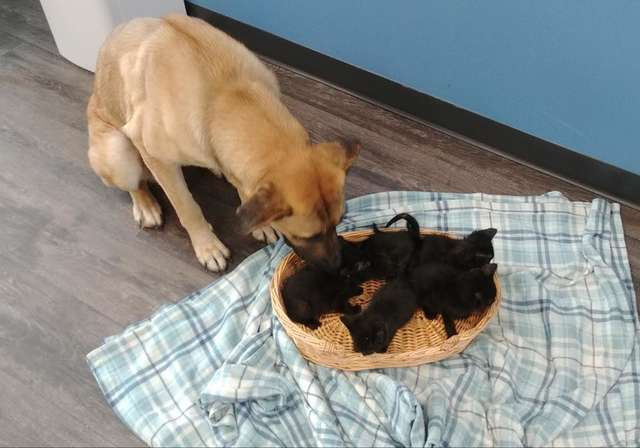
A closer look revealed the kind pup had wrapped herself around five orphaned kittens, whom she was cuddling to keep warm in the biting temperatures.
The Good Samaritan, in turn, saved them all from the freezing night by taking them to the Pet and Wildlife Rescue shelter. But by then, an incredible bond between the dog and kittens had already been formed.
For rescue staff, learning the circumstances of this case made one thing clear: the pup had saved the kittens’ lives.
“It’s truly heartwarming!” a shelter spokesperson told The Dodo. “It had been a very cold night so these kittens would have had a very hard time surviving.”
Photo Credit: Pet and Wildlife Rescue
The kittens are now safe, but require treatment for flea and worm infestations. Meanwhile, the sweet stray dog who saved them insists on overseeing their progress with regular visits — much like a proud mother.
It’s still unclear where the dog or kittens came from originally, or if they knew each other prior to that night. Pet and Wildlife Rescue is hoping an owner will come forward to claim them, but if not they’ll be put up for adoption.
Thanks to that brave pup, however, a sad ending for the kittens was transformed into a happy one.
“Our staff sees many difficult situations on a daily basis and stories like this one make every heartache worth it,” the shelter said.
ooOOoo
There may be someone who wants to follow this up by supporting the Pet and Wildlife Rescue in Ontario. So here is the website.
One dog year is not equivalent to seven human years, despite widespread use of the ratio for calculating the age of canine companions. Presumably, the ratio is based on the average lifespan of dogs being 10 years and humans being 70 years, it’s not quite so simple. The formula is not based on any real science and it was debunked by veterinarians years ago.
But geneticists digging into the mysteries of ageing have developed a new calculation to understand how our canine companions’ ages correspond to our own.
To understand how dogs age, the team looked at a phenomenon called DNA methylation. As mammals get older, their DNA picks up methyl groups that “stick” to their DNA. While these groups don’t change the DNA itself, they attach to the genetic molecule and can turn certain genes on or off, which is an important part of epigenetics, or the way environmental factors cause certain genes to express themselves.
Methlyation occurs at a relatively steady rate as humans age, which allows researchers to estimate a person’s age, a process they’ve dubbed the “epigenetic clock.”
In the new paper on dog years, which has yet to be peer reviewed and is currently posted on the preprint server bioRxiv, a team led by Tina Wang of the University of California, San Diego, compared the epigenetic clocks in people to canines to better understand the genes associated with aging. They picked dogs because most live in the same environments as humans and also receive some degree of medical care, like humans do.
The team looked at methylation rates in 104 Labrador retrievers between the ages of four weeks and 16 years old, reports Michelle Starr at Science Alert. They then compared them to published methylation profiles of 320 humans from age one to 103. (They also compared both to 133 mice methylation profiles.)
It turns out some parts of a dog’s life follows the same pattern as humans, though other longevity milestones don’t link up quite as nicely. For instance, the methylation rate showed a seven-week-old pup corresponds to a 9-month-old human baby, and both species begin to get their first teeth at this time.
But the comparison breaks down after early puppyhood. The dog clock ticks much faster with pups speeding through puberty and reaching sexual maturity within their first year. Then, the dog’s epigenetic clock slows down as the dog ages, and begins to match up with humans again in its later years.
Overall, the average 12-year lifespan of a Labrador lined up with the average worldwide lifespan of humans, which is about 70 years.
While the study complicates the concept of “dog years,” it does show that the animals experience similar methylation processes as humans.
“We already knew that dogs get the same diseases and functional declines of aging that humans do, and this work provides evidence that similar molecular changes are also occurring during aging,” Matt Kaeberlein, a biogerontologist at the University of Washington who was not involved in the study, tells Virginia Morell at Science. “It’s a beautiful demonstration of the conserved features of the epigenetic age clocks shared by dogs and humans.”
The new formula for a dog’s ages based on the study requires a little more math than multiplying by seven. You multiply the natural logarithm of a dog’s age by 16, then add 31 [human_age = 16ln(dog_age) + 31].
According to the formula, a 2-year-old dog is the equivalent of a 42-year-old human, but things slow down after that. A 5-year-old dog is the equivalent of a 56.75 year old human, and a 10-year-old dog is the equivalent of 67.8-year-old person.
Evolutionary biologist Steve Austad of the University of Alabama in Birmingham, who was not involved in the study, tells Morell that he’s not too surprised that the epigenetic clock applies to dogs, too. He says that by studying different dog breeds with different lifespans the researchers may find some interesting results.
This formula is not the last word on dog years, however, especially since it only looked at one breed. Erika Mansourian, writing for the American Kennel Club, reports that the American Veterinary Medical Association says the accurate way to calculate dog years for a medium-sized dog is to assume the first year is equivalent to 15 years and age two adds another nine years. After that, each year of a dog’s life is equivalent to five human years. It doesn’t perfectly line up with the new formula, but both acknowledge that dogs age rapidly in their first years of life.
Whatever the case, dogs’ lives are all too short. That may be why people are excited about a project by the Dog Aging Project, which is currently recruiting 10,000 pets and their owners to participate in a new study that will look at the dogs’ health, gut microbes, diet and exercise to understand aging. And 500 lucky dogs will test out a new drug that may help slow the aging process, which could help us someday, too.
ooOOoo
I hope you found it worthwhile to publish what is, in essence, a duplication of the same story!
I was recently contacted by John Brooks. He writes of himself:
John Brooks loves animals from the core of his heart. Whenever he gets time, he tries to write regarding animal health & condition so that all pet lovers like you don’t fall in any hazardous situation.
He went on to explain that:
One day, Findshadow helped me to find my lost dog. So that I wrote about Findshadow.
So with no further ado, here is John’s post.
ooOOoo
What Is Findshadow How It Can Help You Find Your Missing Dog
Dog owners share a lot of the same grievances, annoyances, and frustrations. From getting up to your pet barking in the wee hours of the night to cleaning up after your dog’s mess during walks around the neighborhood, raising and taking care of a pet comes with a host of responsibilities. And with those responsibilities come work, and with work comes grievance, annoyance, and frustration.
However, one of the worst, most gut-wrenching feelings that dog owners can relate to is the moment you realize your dog is missing. After searching every room, backtracking to the park you were at with your dog in the morning, asking your neighbors if they have seen them and posting flyers on every telephone you can find, the hopelessness begins to set in.
Luckily for you, Findshadow, a free app that helps dog owners locate their missing companions, is harnessing the power of community and technology to reunite you with your lost pets. And it is doing a pretty darn good job.
So, what is Findshadow? It is is a free smartphone app that walks owners who have lost their pets step-by-step through the process of finding their dogs.
The app offers a wide array of services and tips for their users, all for free. First, you post your lost or found dog to the community. Then, the app gives you a completely personalized, step-by-step plan on how to use the app and other resources to locate your dog. While you may think of some of these steps yourself, you’ll be surprised how thorough the process can be.
After going through these first introductory steps, you can use Findshadow to print or download personalized street flyers. Although posting your pup to the community in-app will definitely increase visibility far more than strictly putting up posters, having physical images of your dog around the neighborhood will still help you get in front of a demographic that doesn’t have Findshadow downloaded.
You can share your post on social media to easily reach friends and family. With just the three aforementioned features, Findshadow has already allowed you to reach three different populations: Findshadow users, people in your neighborhood and your connections on social media.
Getting your dog’s photo in front of as many people as possible is the recipe to success for finding your dog as quickly as possible. The more people who see it, regardless if they use Findshadow or not, the more people who will be able to identify your pet if they see it.
Findshadow also has a nifty feature that makes it easier to contact nearby shelters to ask if they have seen your dog. Even if you don’t directly contact shelters yourself, Findshadow volunteers can help snap pictures of dogs in shelters and send them to you in-app to see if they match.
The sense of community behind Findshadow is powerful. Past users of Findshadow who have successfully been reunited with their dog because of the app give back to the community by becoming active volunteers. This creates a culture where owners are helping each other out. Every dog is considered important.
The interface of the app is easy-to-use and allows users to quickly switch between different features and services. You can browse through found dog listings to double-check posts to see if someone on Findshadow has already found your dog.
The amount of positive reviews and testimonials from dog owners who gush over the app is well-justified. The app has reunited countless owners with their dogs, oftentimes within the same day they went missing.
Even if you haven’t lost your dog, it is a great app to have downloaded just in case something does come up.
ooOOoo
This is the essence of blogging and sharing.
I hadn’t heard of Findshadow before now but will surely put the app on my phone.
I don’t know. What with wood splitting ahead of the rain and snow, and working hard at editing the completed book, I didn’t seem to have the creative urge to publish a new Picture Parade.
So I’m once again republishing one that was first published on July 17th, 2016.
Enjoy!
ooOOoo
Incredible, prize-winning, images of dogs.
The following was read over on Mother Nature News on June 30th. The item, and especially the photographs, just had to be shared with you.
However, to ensure the integrity of republication and the identity of the photographers, I’m going to include the photographs and the words of the original MNN piece, and split it across today and next Sunday.
Trust me you will adore these photographs.
ooOOoo
These prize-winning images of dogs will steal your heart.
10th annual Dog Photographer of the Year competition drew entries from photographers in 90 countries.
Winner of the Man’s Best Friend category (Photo: Fiona Sami/Dog Photographer of the Year Competition)
The love of a dog is a universal joy, as the latest photography competition from The Kennel Club illustrates. The 10th annual competition drew over 13,000 entries from photographers in 90 countries. The photographs show the beauty, loyalty, companionship, dignity and, of course, the adorableness of dogs around the world.
The competition features eight categories, including Puppies, Oldies, Dogs at Work, Dogs at Play, Man’s Best Friend (winner pictured above), Assistance Dogs and Dog Charities, Dog Portraits and I Love Dogs Because.
Winner of the Dogs At Work category as well as overall winner of the competition (Photo: Anastasia Vetkovskaya/Dog Photographer of the Year Competition)
This image of Sheldon the English springer spaniel enjoying a mist-shrouded pond early one morning is the work of Anastasia Vetkovskaya from Russia. Not only did it win for the Dogs At Work category, but it also placed as the overall winner of the competition.
Vetkovskaya states, “I have loved animals from an early age, which is why I went to Moscow Veterinary Academy and became a veterinary surgeon in 2007. Around this period of time, my husband gave me my first SLR camera, and since then I have devoted all of my free time to photography. My specialty is pets, and I am inspired most by horses and dogs.”
Winner of the Dogs at Play category (Photo: Tom Lowe/Dog Photographer of the Year Competition)
Baxter the Westie inspired his photography-loving human, Tom Lowe, to snap this image of Baxter playing in the water of Loch Lomond in Scotland.
Winner of the Assistance Dogs and Dog Charities category (Photo: Michael Higginson/Dog Photographer of the Year Competition)
This poignant image was taken by Michael Higginson, and features his brother Dale with Esta the dog. The win not only benefits the photographer but also a charity of his choice. The Kennel Club is making a donation to Higginson’s favorite charity, Dogs for Good.
Higginson states, “Winning the Assistance Dog category has made it even more special. It’s an honor to be able to show the world what a difference a dog can make to someone else’s life.”
ooOOoo
Aren’t they breath-takingly beautiful!
The rest of these fabulous photographs in a week’s time.
Dear Dan and I recently had an email ‘conversation’ about the conversion of dog years to human years. Then, yesterday, as in Thursday, he sent me the following article from ZME Science.
Enjoy!
ooOOoo
Here’s a better way to calculate dog years – backed by science.
Lets’s face it, 1 for 7 years is not accurate.
November 21, 2019
By Mihai Andrei
The formula is about mid-way through the article, and it includes a simple calculator.
We learn, as kids, to approximate dog age thusly: one dog year for seven human years. That’s a decent approximation in some cases, but the more you think about it, the more it starts to fall apart.
All dog breeds tend to follow a similar pattern: they reach puberty at 10 months old. Right off the bat, it’s clear that the approximation doesn’t work here, as humans don’t really reach puberty at 6 years. Dogs can also reach 20 years or even more, and 140 years has never been recorded for a human. All in all, while it can give a ballpark estimate, the 7-for-1 approach falls short in many regards.
But now, researchers have come up with a much more accurate formula to assess dog age in human years. This one, at least, is backed by science.
It started as a way to detect factors associated with dog aging, and it focused on a relatively new concept: DNA methylation. The idea is that as we age, our DNA undergoes chemical modifications which can be used as a sort of genetic clock. It’s a way of looking at our body’s wear and tear, as the influence of diseases and unhealthy lifestyle can also be observed (to an extent) with this approach.
It’s not just humans that have epigenetic clocks. Other species have them too — including dogs. Geneticist Trey Ideker of the University of California, San Diego, and colleagues, analyzed the DNA methylation patterns in the genomes of 104 dogs (all golden retrievers), ranging from 4 weeks to 16 years of age. Although just golden retrievers were analyzed, the patterns are very similar for all breeds.
There were remarkable similarities between the DNA methylation of dogs and humans. Although the two species diverged a very long time ago, dogs live in similar environments to humans, and they even have access to similar healthcare.
Simply put, the patterns of DNA methylation in young dogs tended to be similar to those in young humans — the same goes for older dogs and older humans.
Finally, the study also demonstrates that these patterns can be used to translate the age-related physiology of one organism (in this case, dogs) to another organism (humans).
The formula is not linear, and is not exactly simple, but here it is:
Logarithmic function for epigenetic translation from dog age (x-axis) to human age (y-axis). Tom Hanks for scale. Image credits: Wang et al
The natural logarithm is used because dogs and humans don’t age similarly. Dogs seem to age very quickly in the first part of their life (which is why the age of young pups seem very weird translated into human years), but their ageing process slows down massively compared to that of humans. So the translation dog to human years cannot be linear — it is logarithmic. When your dog is 1 year old, he’s approximately 30 in human years. When he’s 2 years old, he’s 42. He’s around 60 human years by the time he’s 6, but only 70 by the time he’s 12.
It’s a weird thing to wrap your mind around and it is definitely not a perfect translation from dog years to human years, but it works much better than all existing alternatives. It also works to explain why some dogs reach sexual adolescence as early as 6 months old — the onset for that is around 10-14 years for humans. Dogs are adolescent until about 2 years, which in humans lasts until 25 years old. Then, maturity for dogs is around 2-7 years, and for humans around 25-50 years. Similar calculations (but with a slightly different formula) can be carried out for other animals, including cats and mice, researchers conclude.
The study can be read in its entirety for free on biorXiv.
ooOOoo
M’mmm, I think I need a little more time to absorb that!
I’m pleased to report there have been no recalls since September 26.
However, for the many dog owners who also own a cat…
Go Raw is recalling one lot of its “Quest Beef Cat Food”… because it may be contaminated with Salmonella. Missed any of the 11 other recalls we’ve sent since early July? Be sure to visit our Dog Food Recalls page for full details. 6 Best Dog Food Lists Updated
The Dog Food Advisor has recently updated the following best dog food pages:





 I have been interested in eating healthy for more than 35 years. Unfortunately, my actions haven’t always matched my aims. As Mae West said, “I used to be Snow White, but I drifted.”
 been in 15 years. I thought I had arrived at fitness and health. Now, in 2019, I weigh 155 pounds. That’s right, I have melted off a further 10 pounds from my best weight in years. My resting heart rate is under 50 beats per minute (bpm), a result of my cycling, but significantly under the ‘normal’ of 65 to 90 bpm for a guy in his upper 70’s. I have less than 16 percent body fat and a 31 inch waist (the first time since high school). I have reached this state of fitness and health following the ideas and techniques I write about in this blog. You can, too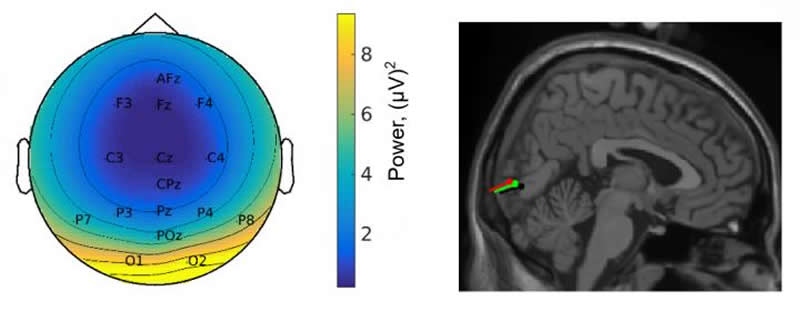



 Learning from Dogs