This is a guest Post from Chris Snuggs, a good friend of Learning from Dogs.
Dog Pack Attacks Alligator In Florida
At times nature can be cruel, but there is also a raw beauty, and even a certain justice manifested within that cruelty. The alligator, one of the oldest and ultimate predators, normally considered the “apex predator”, can still fall victim to implemented ‘team work’ strategy, made possible due to the tight knit social structure and “survival of the pack mentality” bred into the canines.
See the remarkable photograph below courtesy of Nature Magazine.
Note that the Alpha dog has a muzzle hold on the gator preventing it from breathing, while another dog has a hold on the tail to keep it from thrashing. The third dog attacks the soft underbelly of the gator.
This is not corny, this is at the heart of everything in life.
Nearly a month ago, I wrote a piece called The Power of Love. It was offered as a logical argument in favour of love – read it if you want to see what was written.
In line with the general Blog theme on here that we have much to learn from dogs and unconditional love is the BIG lesson we should take from these noble animals, here’s a lovely story that was sent to me by a dear friend.
WHOEVER DID THIS IS A VERY BEAUTIFUL PERSON
The ‘whoever’ being someone at a dead letter office within the US Postal System.
Here’s how it goes.
Our 14 year old dog, Abbey, died last month. The day after she died, my 4 year old daughter Meredith was crying and talking about how much she missed Abbey.. She asked if we could write a letter to God so that when Abbey got to heaven, God would recognize her. I told her that I thought we could so she dictated these words:
Abbey and Meredith
Dear God,
Will you please take care of my dog? She died yesterday and is with you in heaven. I miss her very much. I am happy that you let me have her as my dog even though she got sick.
I hope you will play with her.. She likes to play with balls and to swim. I am sending a picture of her so when you see her You will know that she is my dog. I really miss her.
Love, Meredith
We put the letter in an envelope with a picture of Abbey and Meredith and addressed it to God/Heaven. We put our return address on it.. Then Meredith pasted several stamps on the front of the envelope because she said it would take lots of stamps to get the letter all the way to heaven. That afternoon she dropped it into the letter box at the post office. A few days later, she asked if God had gotten the letter yet. I told her that I thought He had.
Yesterday, there was a package wrapped in gold paper on our front porch addressed, ‘To Meredith’ in an unfamiliar hand.. Meredith opened it. Inside was a book by Mr. Rogers called, ‘When a Pet Dies..’ Taped to the inside front cover was the letter we had written to God in its opened envelope. On the opposite page was the picture of Abbey &Meredith and this note:
Dear Meredith,
Abbey arrived safely in heaven.
Having the picture was a big help. I recognized Abbey right away.
Abbey isn’t sick anymore. Her spirit is here with me just like it stays in your heart. Abbey loved being your dog. Since we don’t need our bodies in heaven, I don’t have any pockets to keep your picture in, so I am sending it back to you in this little book for you to keep and have something to remember Abbey by..
Thank you for the beautiful letter and thank your mother for helping you write it and sending it to me. What a wonderful mother you have. I picked her especially for you.
I send my blessings every day and remember that I love you very much.
By the way, I’m easy to find, I am wherever there is love.
Love,
God
[The book is available on Amazon here. I have no financial interest in providing you with the link. Ed.]
Thanks Julie for sending that in – it’s a very moving example of unconditional love and generosity.
Your task is not to seek for love, but merely to seek and find all the barriers within yourself that you have built against it.Jala ad-Din Rumi 1207 – 1273
One would suspect that readers of this Post title would have many different responses to the word ‘love’. Perhaps in this harsh, economically challenged world, it seems a little quaint to think about love in anything other than a romantic sense.
But, trust me, there’s nothing quaint or ‘away with the fairies’ about reminding us all of both the power of love and the urgent need to bring that power further up the scale of human consciousness. Let’s even try and aim for where dogs are. Dogs intuitively demonstrate unconditional love to those around them that they trust.
Dog love!
Before we look at the effects of love, let’s remind ourselves of some of the outcomes from the stress and trauma generated by present times. A news item from the London School of Hygiene and Tropical Medicine published in July, 2009, said this:
Researchers at London School of Hygiene & Tropical Medicine and Oxford University estimated that soaring stress brought on by job losses could prompt a 2.4% rise in suicide rates in people under-64 years of age, a 2.7% rise in heart attack deaths in men between 30 and 44 years, and a 2.4% rise in homicides rates, corresponding to thousands of deaths in European Union countries, such as the UK.
Nor is the impact just economic. The sudden flipping from the wild optimism of the boom to the personal gloom and self-doubt of recession and system-wide financial crisis is bad for health and well-being.
So it appears as if there’s no shortage of reasons why engaging the power of love offers infinite possibilities for us all.
The BBC recently reported on research that shows that people in love can lower their levels of pain.
Love hurts, at least according to many a romantic songwriter, but it may also help ease pain, US scientists suggest.
Brain scans suggest many of the areas normally involved in pain response are also activated by amorous thoughts.
Stanford University researchers gave 15 students mild doses of pain, while checking if they were distracted by gazing at photos of their beloved.
He said: “One example is a footballer who has suffered quite a painful injury, but who is able to continue playing because of his emotionally charged state.”
He added that while the effect noticed by the Stanford researchers might only be short-lived in the early stages of a love affair, it may well be replaced by something similar later in a relationship, with a sense of comfort and wellbeing generating the release of endorphins.
“It’s important to recognise that people who feel alone and depressed may have very low pain thresholds, whereas the reverse can be true for people who feel secure and cared for.
Prof Gilbert states on his web page that “After years of exploring the processes underpinning shame and its role in a variety of psychopathologies,
Prof. Gilbert
my current research is exploring the neurophysiology and therapeutic effectiveness of compassion focused therapy.” (My italics.)
The old adage that you can’t love another if you don’t love yourself is based on very high levels of awareness. So the starting point to gaining the power of love is self-awareness. Here’s something from MIND:
Good mental health isn’t something you have, but something you do. To be mentally healthy you must value and accept yourself. This means that:
You care about yourself and you care for yourself. You love yourself, not hate yourself. You look after your physical health – eat well, sleep well, exercise and enjoy yourself.
You see yourself as being a valuable person in your own right. You don’t have to earn the right to exist. You exist, so you have the right to exist.
You judge yourself on reasonable standards. You don’t set yourself impossible goals, such as ‘I have to be perfect in everything I do’, and then punish yourself when you don’t reach those goals.
Finally, back to romantic love. The most glorious feeling in the world.
Again expressed so beautifully by Rumi: “The minute I heard my first love story I started looking for you, not knowing how blind that was. Lovers don’t finally meet somewhere. They’re in each other all along.”
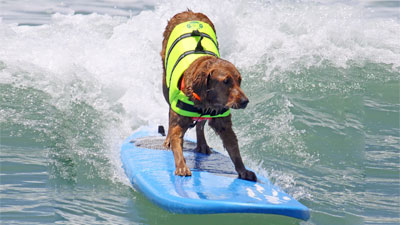
Yesterday, Learning from Dogs published a Post about Ricochet, the surfing dog.
Ricochet - follow this dog!
I was delighted to receive a ‘reply’ from this wonderful canine which is reproduced in full here.
Thank you for posting about my work. It really helps raise awareness of my causes, and I appreciate it!
Here is the latest video of me & little Ian with the brain injury. He experienced a huge milestone in this video, during the session. http://www.youtube.com/watch?v=-iIv5t2qKL4
Indeed, I have to offer my thanks for the reply from Ricochet because my travels over the last few days made it impossible to keep the Blog posts running. This reply, turned into a Post, prevented a day being missed which, if it would have happened, would have been the first missed day since the Blog started on July 15th, 2009!
This story has spread far and wide but, nonetheless, deserves a Post on Learning from Dogs because it is the essence of what dogs offer the world – unconditional love.
To gain the trust of a dog and enter the special relationship that humans have with dogs is to understand the significance of taking people at their face value and expect nothing in return, as dogs do.
Ricochet was born as a service dog and entered into the appropriate training. But there was a hic-cup in her learning, fortuitous as it happened and …. no, that’s enough from me. Watch it yourself ….
Now take a few minutes and understand what Ricochet and Ian McFarland demonstrated to the world.
(With thanks to Dan Gomez for forwarding the email from Bill Wells)
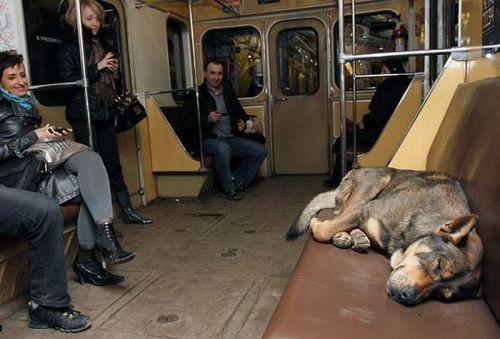
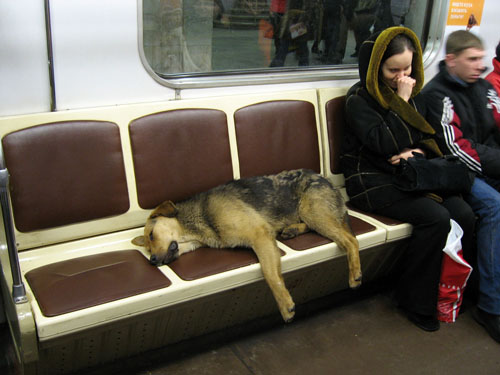
A quick Google search will find lots of links to stories about how stray dogs in Moscow are learning new ways of looking after themselves. My quotes and pictures have been taken from the English-Russia web site.
Russian scientists say that Moscow stray dogs became much smarter. The four legged oldest human’s friends demonstrate real smartness such as riding the Moscow metro every morning to get from their suburban places of living to the fat regions of Moscow center. Once they arrive to the downtown they demonstrate different new, previously unseen for the dog skills. Those skills can include “the hunt for shawarma” for example, the popular among Muscovites eastern cuisine dish. This hunt scene can be seen as this:
Regular Moscow busy street with some small food kiosks. A middle-aged man buys himself a piece of hot fast food and walks aside chewing it without a rush. Then just in a second he jumps up frightened – some doggy has sneaked up on him and barked out loudly. His tasty snack falls out from his hands down to the ground and the dog gets it. Just ten minutes later, on the same place, the teen youngster loses his dinner in exactly the same manner. The modern Russian dogs are on their urban hunt.
“This method of ambushing people from their back is widely exercised by Moscow dogs”, saying A. Poiarkov, working in Ecology and Evolution Institute of Moscow. “The main point here is to define who would drop the food scared and who won’t, but the dogs are great psychologists they can do it better than us”.
Cheap travelling!
Moscow ecologists think that dogs started acquiring this habits in 1990s, when the Soviet union collapsed and Moscow has fell into the hands of new class of Russian capitalists. They understood the true value of the downtown realty underestimated by previous Communist owners and became removing all the industrial complexes Moscow had in its centre to its outskirts. Those places were used by homeless dogs as a shelter often, so the dogs had to move together with their houses, so they had to learn how to travel Moscow subway – first to get to the centre in the morning then back home in the evening, just as us people.
The commercial revolution of Moscow made their usual feeding places like trash bins out of direct reach, so they had to get to know new ways of getting their piece of food. That’s how appeared those “Shawarma hunts”. Sometimes though they use more gentle methods. Young girl sits on the bench to eat her hot dog – a big cute looking dog appears from the surrounding bushes and puts her head on her knees. The girl can’t help herself sharing the hotdog with a dog.
Among some more amazing skill those Moscow dogs are the ability not to miss their stop while going on the subway train. Biologists say dogs have very nice sense of time which helps them not to miss their destination. Another skill they have is to cross the road on the green traffic light. “They don’t react on color, but on the picture they see on the traffic light”, Moscow scientist tells. Also they choose often the last or the first metro car – those are less crowded usually.
It’s funny but the ecologists studying Moscow stray dogs also tell the dogs don’t miss a chance to get some play while on their travel in the subway. They are fond of jumping in the train just seconds before the doors shut closed risking their tails be jammed. “They do it for fun, just they have enough food”, they conclude.
"Wake me up at the next stop, please!"
Here’s a video from YouTube courtesy of the Wall Street Journal – wet eye warning!
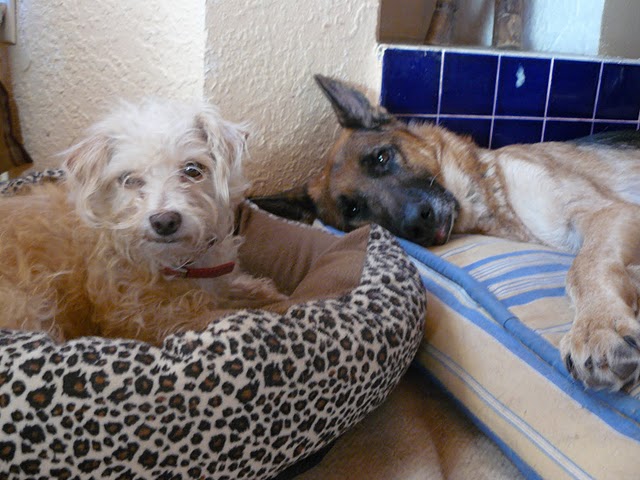
Jeannie and I would be helpless in Moscow! Reason? We have 12 ex-stray Mexican dogs living with us in Payson plus my beautiful German Shepherd dog, Pharaoh, that came with me when I left the UK in 2008. We can’t resist helping these wonderful creatures.
Pharaoh with little Poppy, a stray found on a Mexican building site
See more pictures from that English-Russia web site here.
Yesterday, I posted an article based on a lecture given by Dr Helen Fisher presented to the TED Conference in 2006. It included some fascinating evidence about the nature of love and why it is such a powerful human emotion.
Then in 2008, Dr Fisher gave a second lecture, again at the TED Conference, that continued to reveal more amazing findings about how the brain functions when in love. As the presentation summary says:
Why do we crave love so much, even to the point that we would die for it? To learn more about our very real, very physical need for romantic love, Helen Fisher and her research team took MRIs of people in love — and people who had just been dumped.
Included in the lecture is something that I had wondered about and was delighted to see confirmed – animals fall in love as well. Here’s the extract from that part of the presentation (min:sec 50:50):
I would also like to tell the world that animals love. There’s not an animal on this planet that will copulate with anything that comes along. Too old, too young, too scruffy, too stupid, and they won’t do it. Unless you’re stuck in a laboratory cage –and you know, if you spend your entire life in a little box,you’re not going to be as picky about who you have sex with –but I’ve looked in a hundred species,and everywhere in the wild, animals have favorites.
As a matter of fact ethologists know this. There’s over eight words for what they call animal favoritism: selective proceptivity, mate choice, female choice, sexual choice. And indeed, there are three academic articlesin which they’ve looked at this attraction, which may only last for a second, but it’s a definite attraction, and either this same brain region, this reward system, or the chemicals of that reward system are involved. In fact, I think animal attraction can be instant — you can see an elephant instantly go for another elephant. And I think that this is really the origins of what you and I call, “love at first sight.”
Do watch it.
And a quote to conclude this post.
True happiness and a fullness of joy can be found only in the tender and intimate relationships of the family. However earnestly we may seek success and happiness outside the home through work, leisure activities, or large bank accounts, we will never be fully satisfied emotionally until we develop deep and loving relationships.
~ by James J. Jones Ph.D. ~
Regular readers will have run out of counting the number of times that I applaud Yves Smith and her amazing blog, Naked Capitalism. Not only is it a fantastic source of many stories of real public concern, her daily antidote du jour is often delightful. Here’s the one that came from her Blog posting of the 19th September.
Clarence and Cindy
Cattle dog Clarence plays with an alpaca named Cindy in “Alpaca Land” in Goeming, Austria. The two have lived together on the farm since they were 3 months old. Eighty-seven alpacas, the largest flock in Austria, live on the farm.






 Learning from Dogs