It’s hard to believe, but some vets actually cut the vocal cords of dogs AND cats just to suppress their voices. We know because it happened to our dogs before we adopted them. They’re two very different breeds—a Newfoundland and a Chihuahua—and we live in two different states.
We joined with Coalition to Protect and Rescue Pets, which led the successful campaign to ban devocalization in Massachusetts, to make sure no other dog or cat anywhere suffers as ours have.
But until the American Veterinary Medical Association (AVMA) changes its position on devocalization, countless other dogs AND cats will be subjected to this inhumane, unnecessary surgery.
Though devocalization is so cruel it is illegal in many countries, the AVMA continues to condone it as a “final alternative” to manage barking.
That leaves animals vulnerable to and legitimizes devocalization.Here’s why:
No vet can possibly know if devocalization is a “final alternative,” and some won’t ask. Even receipts from a trainer or behaviorist don’t mean the advice was followed consistently or at all; devocalization is easier for lazy or impatient owners.
And just as devocalization didn’t keep our dogs from becoming homeless, it hasn’t prevented the abandonment and euthanasia of countless other dogs and cats.
HOW AVMA’S POSITION HURTS ANIMALS
Massachusetts currently has the only enforceable state devocalization ban in the US. Other state laws protect owners and vets but not animals, who are subjected to a dangerous surgery they don’t need but are helpless to refuse: http://cprpets.weebly.com/loopholes-that-hurt-animals.html
We wish veterinary associations had supported legislation that truly protects animals by prohibiting vocal cord surgery except to treat a physical illness, injury or birth defect.
Instead, these associations have opposed enforceable humane laws, using the AVMA’s “final alternative” position to justify cutting an animal’s vocal cords just to deal with barking or meowing.
Why would any vet condone such cruelty?It’s obvious that some devocalize dogs and cats because it’s profitable. Others won’t devocalizebut oppose banning it anyway. It could be they fear these laws would lead to prohibition of other unnecessary, mutilating surgeries like declawing, cropping ears and docking tails.
HOW DEVOCALIZATION HURT OUR DOGS
Please meet our dogs in the video on this page.
Though an experienced vet devocalized our gentle giant, Porter, in the least invasive way, scar tissue formed in his throat, making it hard for him to breathe and swallow; he rasps, coughs and gags throughout the day like a chain smoker. Because devocalization permanently damaged his larynx too, he’s at great risk for inhaling food, liquids, even vomit into his lungs.
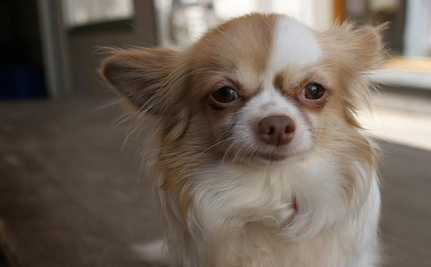
Tiny Lola struggles to force out a bark and doesn’t always succeed. Like other devocalized animals, she coughs and gags a lot. One day, she may have to face the same $2,000 surgery Porter needed to save his life after he was devocalized.
That’s brutal punishment for the “crime” of communicating!
Please don’t let this brutality continue. Tell the AVMA: There is no ethical reason to cut vocal cords just to stifle an animal’s voice—ever. Devocalization is an act of cruelty that no animal deserves, no vet should perform, no veterinary association should sanction, and no civilized society should allow.
I started writing this post back on the 25th September. Why so far back? Because that day something came into my in-box that deserved the widest circulation. It’s an event being held just under a month from today, November 14th. But it seemed worthwhile to give this amount of notice. However, the reason why I wanted to start it back in September was because in the last 24 hours of that day, the 25th, the UK offered very good evidence of the significant increase in severe weather.
From the UK’s Met Office blog on the 25th September, 2012, (I have included the inches equivalent of the mm figures)
Rainfall figures: over a month’s worth of rain in two days
Rainfall totals for the past few days – from 1:00 am Sunday morning to 8:00 am this morning [Tuesday] – show some areas have already had more than twice their usual September rainfall. Ravensworth, in North Yorkshire, has seen the highest total, with 107.8 mm [4.24 in] falling, over 200 % of its average September rainfall.
The rainfall has been widespread, with many areas across the United Kingdom receiving large totals. Killylane, in Antrim Northern Ireland saw 98.2 mm [3.87 in], and high totals were also recorded in the south-west, with 72.4 mm [2.85 in] in Filton and 65.2 mm [2.57 in] at Dunkeswell Aerodrome.
Dunkeswell Aerodrome in Devon was where I used to fly our group-owned Piper Super Cub, still in military markings.
Piper Super Cub at Dunkeswell AerodromeA carriage made for two!
Anyway, back to the plot!
Also on that day (September 25th) the website Think Progress released this item,
Markey/Waxman Report: Carbon Pollution Creating A ‘Cocktail Of Heat And Extreme Weather’
By Climate Guest Blogger and Stephen Lacey on Sep 25, 2012 at 3:31 pm
by Katie Valentine and Stephen Lacey
Two House Democrats have released a report that aims to connect the dots on climate change and extreme weather events.
The staff report, issued by Henry Waxman (D-Calif.) and Edward Markey (D-Mass.), outlines the past year’s record-setting temperatures, storms, droughts, water levels and wildfires, and is being circulated in an attempt to rebuild congressional momentum to address climate change.
“The evidence is overwhelming — climate change is occurring and it is occurring now,” said Rep. Waxman, a Ranking Member of the Energy and Commerce Committee, in a statement.
The report outlines the stunning array of record-breaking extreme weather events throughout 2012 within five categories:
Extreme temperatures
July was the hottest month ever recorded in the continental U.S. Some areas were 8 degrees warmer than average, with the average temperature in the lower 48 states at 77.6 degrees Fahrenheit, 3.3 degrees above the 20th century average.
Spring 2012 saw the warmest March, third-warmest April and second-warmest May in history, and was approximately 5.2 degrees Fahrenheit above average overall.
Through late June 2011, daily record highs were outnumbering daily record lows by 9-to-1.
Drought
As of September, 64 percent of the continental U.S. is experiencing drought, with August and September 2012 comparable to the worst months of the 1930s Dust Bowl.
By the beginning of August, more than half the counties in the U.S. had been designated disaster zones because of drought.
As of August, 51 percent of corn and 38 percent of soybeans grown in the U.S. were rated as poor or very poor by the U.S. Department of Agriculture. Some states’ corn fared worse – Indiana had 70 percent of its corn rated as poor or very poor, and Missouri had 84 percent.
Wildfires
This fire season 8.6 million acres – roughly the size of Connecticut and New Jersey combined – have burned in the U.S., with fires still burning in parts of the West.
Wildfires in Colorado have killed six people, destroyed 600 homes and caused about $500 million in property damage.
There has been nearly a four-fold increase in large wildfires in the West in recent decades, with fires burning longer and more intensely and wildfire seasons lasting longer.
Storms
Tropical Storm Debby caused Florida to have its wettest June on record. The storm killed at least seven people and also damaged more than 7,500 homes and businesses.
In July, the “derecho” storm system killed at least 23 people and left more than 3.7 million people without power.
In August, Hurricane Isaac caused storm surges of up to 15 feet in some places and contributed to Louisiana and Mississippi experiencing their second-wettest August on record and to Florida experiencing its wettest summer on record.
Extreme water levels and water temperatures
In July, water in the Great Lakes reached temperatures of 60 and 65 degrees Fahrenheit – more than 10 degrees warmer than the same time last year.
In August, water temperatures of up to 97 degrees and low water levels caused tens of thousands of fish to die in Midwestern lakes and rivers.
Low water levels in the Mississippi watershed have caused some barge companies to reduce their loads by 25 percent and have caused harbor closures in Tennessee, Missouri, Arkansas and Mississippi.
According to the report, 2012 natural disasters (not including wildfires or drought) have caused $22 billion in insured losses and more than 220 deaths as of August. The full cost of 2012’s extreme weather events isn’t yet known, but it’s expected to rival 2011’s record-breaking $55 billion.
The document outlines what scientists following the link between extreme weather and climate change have been saying for years: more carbon pollution adds extra energy in the atmosphere, thus warming the planet and making extreme weather events more likely.
We’ll move between our home studio in New York City and into each region of the world, bringing voices, news and multimedia content across all 24 time zones. We’ll feature videos from around the globe, man-on-the-street reports, music, and most importantly, stories from communities moving forward with solutions.
Most of all, we’ll generate new energy and urgency around the fact that we must — and we can — work together to address the climate crisis.
GET INVOLVED
Sign up today to be a part of the global community taking part in 24 Hours of Reality. RSVP on Facebook. Share this event with your friends. Submit your own videoabout the impacts of climate change where you live. And keep checking this page: We’ll post further details as the event draws closer.
Millions of people around the world know that the weather, their climate is changing. But if you can take some more powerful evidence of just how it’s all changing then go and read a recent report on the Grist website, entitled ‘Deadly connection: New report on extreme weather and climate change’
Scientists have given animals consciousness. Not through complex manipulation of the brain or through genetic manipulation, but by publicly acknowledging the consensus, for the first time in such a straightforward way, that non-human animals, including some of our evolutionarily distant cousins, have awareness and experience like we do.
The declaration, called The Cambridge Declaration On Consciousness, was signed at the Francis Crick Memorial Conference of Consciousness in Human and Non-Human Animals in the presence of Stephen Hawking in July in Cambridge, U.K. by an international group of scientists including cognitive neuroscientists, neuropharmacologists, neurophysiologists, neuroanatomists and computational neuroscientists.
What do they mean by consciousness? The Declaration treats it as the same as the phrase, “subjective experience.” Philosophers who share this view of consciousness with the scientists often say that something is conscious if there is “something that it is like” to be that thing. So, according to this, a rock is not conscious, because there is nothing “that it is like to be a rock.”
The signing marked the first formalization of the scientific consensus about the consciousness of several non-mammals, including birds, octopuses and even bees.
We declare the following: “The absence of a neocortex does not appear to preclude an organism from experiencing affective states. Convergent evidence indicates that non-human animals have the neuroanatomical, neurochemical, and neurophysiological substrates of conscious states along with the capacity to exhibit intentional behaviors. Consequently, the weight of evidence indicates that humans are not unique in possessing the neurological substrates that generate consciousness. Nonhuman animals, including all mammals and birds, and many other creatures, including octopuses, also possess these neurological substrates.”
The full document is really worth reading, by the way.
There is much more about the conference including some remarkable videos here, from which I will select two. The first one, in particular, is very moving, and upsetting! Be warned!
OK, forgive me but I’m going to state the obvious! Just read the entry on Wikipedia about Orangutans.
Orangutans are among the most intelligent primates and use a variety of sophisticated tools, also constructing elaborate sleeping nests each night from branches and foliage. The apes have been extensively studied for their learning abilities. There may even be distinctive cultures within populations. Field studies of the apes were pioneered by primatologist Birutė Galdikas. Both orangutan species are considered to be Endangered with the Sumatran orangutan being Critically Endangered. Human activities have decimated the populations and ranges of both species. Threats to wild orangutan populations include poaching, habitat destruction and the illegal pet trade. There are several conservation and rehabilitation organisations dedicated to the survival of orangutans in the wild.
‘Among the most intelligent primates‘! Yet again, an example of mankind treating the planet as a disposable item! A quick web search came across the Orangutan Foundation so as well as being saddened and angry, there is something we can do; support them.
The second video from that Conference website is about the intelligence of dolphins – enjoy!
The signatories have indicated that we cannot, at least certainly not for the reasons we have been giving, ignore the fact that animals have the same type of experiences that gives us a reason to treat other humans humanely.
Beyond the ethical ramifications, this declaration is another step in a long line of conclusions that the animal brain displays remarkable plasticity and is able to accomplish highly complex tasks in multiple ways.
While anyone who has gone to a zoo or owned a pet has at least temporarily thought of animals as conscious, there is still a large contingent that strongly believes that humans are exceptional in some morally and scientifically significant way. But, as Christof Koch, who co-presented the declaration notes, “The belief in human exceptionalism, so strongly rooted in the Judeo-Christian view of the world, flies in the face of all evidence for the structural and behavioral continuity between animals and people.”
A wonderful story that mustn’t be allowed to fade away.
Togo
A week ago, I wrote a post called Sticks and Stones. Towards the end of that post, I mentioned Togo,
In 1925, a ravaging case of diphtheria broke out in the isolated Alaskan village of Nome. No plane or ship could get the serum there, so the decision was made for multiple sled dog teams to relay the medicine across the treacherous frozen land. The dog that often gets credit for eventually saving the town is Balto, but he just happened to run the last, 55-mile leg in the race. The sled dog who did the lion’s share of the work was Togo. His journey, fraught with white-out storms, was the longest by 200 miles and included a traverse across perilous Norton Sound — where he saved his team and driver in a courageous swim through ice floes.
and added that I would write more about Togo. Here it is.
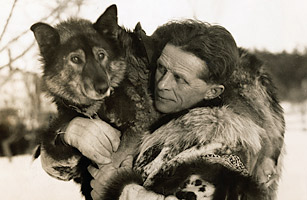
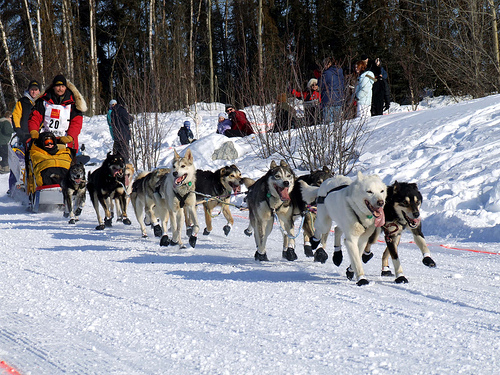
Togo (October 1913 – December 5, 1929) was the sled dog who led Leonhard Seppala and his dog sled team as they covered the longest distance in the 1925 relay of diphtheria antitoxin from Anchorage to Nome, Alaska, to combat an outbreak of the disease. The run is commemorated by the annual Iditarod dog sled race.
Annual Iditarod Trail Sled Dog Race
Togo was a Siberian Husky, his coat was black, brown, and gray, and he weighed about 48 pounds (22 kg). Seppala’s lead dog during the 1914 All-Alaska Sweepstakes, and was a precocious leader. At the time of the serum run Togo was twelve years old.
Within that entry, under the sub-heading of the Great Race of Mercy is this,
The first batch of 300,240 units of serum was delivered by train from Anchorage to Nenana, Alaska, where it was picked up by the first of twenty mushers and more than 100 dogs who relayed the serum a total of 674 miles (1,085 km) to Nome.
Togo and Seppala traveled 170 miles (274 km) from Nome in three days, and picked up the serum in Shaktoolik on January 31. The temperature was estimated at −30 °F (−34 °C), and the gale force winds causing a wind chill of −85 °F (−65 °C).
The return trip crossed the exposed open ice of the Norton Sound. The night and a ground blizzard prevented Seppala from being able to see the path but Togo navigated to the roadhouse at Isaac’s Point on the shore by 8 AM preventing certain death to his team. After traveling 84 miles (134 km) in one day, the team slept for six hours before continuing at 2 AM.
Before the night the temperature dropped to −40 °F (−40 °C), and the wind increased to 65 mi/h (105 km/h). The team ran across the ice, which was breaking up, while following the shoreline. They returned to shore to cross Little McKinley Mountain, climbing 5,000 feet (1,500 m). After descending to the next roadhouse in Golovin, Seppala passed the serum to Charlie Olsen, who in turn would pass it to Gunnar Kaasen and Balto.
A web search for ‘Togo’ including a mention on a website called Find A Grave that has this,
Birth: Oct., 1913
Death: Dec. 5, 1929, Poland Spring, Androscoggin County, Maine, USA
A sled dog for Leonhard Seppala. In 1925, When a diphtheria out brake happened in Nome Alaska. Seppala, Togo and a team of dogs ran to Nenana. He ran 10 times the distance of a average sled run. However another dog named Balto got nearly all of the fame. After the run, Seppala sold Togo to a friend in Poland Spring Maine were Togo was euthanized on December 5th 1929. He was stuffed and was put on display at Yale University. He was eventually moved to the Iditarod Trail Sled Dog Race Museum in Wasilla Alaska, where he is today.
Burial: Iditarod Trail Sled Dog Race Museum, Wasilla, Matanuska-Susitna Borough, Alaska, USA
Communication seems to be a bit of a theme just at present!
About 18 months ago, I wrote a piece on Learning from Dogs about Rupert Sheldrake’s fascinating book Dogs That Know When Their Owners Are Coming Home. The reason that this has come up again (and, as it happens, I’m rereading Sheldrake’s book just now) is a recent item on the Big Think website called Can We Have Brain-to-Brain Communication? Here’s what was written.
Dr. Michio Kaku addresses the question of Collective Intelligence. Some people think that the next big innovation in the coming decades is not going to involve the Internet because we can already connect computers to the human mind. Therefore, Dr. Kaku says this brain-to-brain communication would involve not just the exchange of information, but also the transmission of emotions and feelings, “because these are also part of the fabric of our thoughts.”
There’s also an interesting 4-minute video by Dr. Kaku that may be accessed here.
But then again, many pet owners would probably take it for granted that our cats and dogs can read our mind, as Dr. Sheldrake rather entertainingly explains below.
Before closing today’s post, the research that Dr. Sheldrake has undertaken is very impressive. His website is here, from which one learns that,
Dr. Sheldrake
Rupert Sheldrake, one of the world’s most innovative biologists and writers, is best known for his theory of morphic fields and morphic resonance, which leads to a vision of a living, developing universe with its own inherent memory.
He worked in developmental biology at Cambridge University, where he was a Fellow of Clare College. He was then Principal Plant Physiologist at the International Crops Research Institute for the Semi-Arid Tropics (ICRISAT), in Hyderabad, India. From 2005 to 2010 he was Director of the Perrott-Warrick project. , funded from Trinity College, Cambridge.
One of the seven experiments concerned unexplained abilities of animals, and I published a series of papers on the unexplained powers of animals, see Papers on animals .
My research with Aimée Morgana into the telepathic powers of her African Grey Parrot, Nkisi, led to the celebrated debate at the London RSA with Prof Lewis Wolpert, which is featured on this website The Telepathy Debate
More information is available on Nkisi, including a tape of one of his conversations with Aimée in The Nkisi project
So if your pet is looking at you as though they know what you are thinking – they probably are!
I make no apologies for today’s post being more emotional and sentimental.
The phrase ‘sticks and stones may break my bones but names will never hurt me‘ is well known throughout the English-speaking world and surprisingly goes back some way. A quick web search found that in the The Christian Recorder of March 1862, there was this comment:
Remember the old adage, ‘Sticks and stones will break my bones, but words will never harm me’. True courage consists in doing what is right, despite the jeers and sneers of our companions.
So if in 1862 the saying was referred to as an ‘old adage’ then it clearly pre-dated 1862 by some degree.
A few days ago, Dusty M., here in Payson, AZ, sent me a short YouTube video called The Power of Words. I’m as vulnerable as the next guy to needing being reminded about what’s important in this funny old world. Then I started mulling over the tendency for all of us to be sucked into a well of doom and gloom. Take my posts on Learning from Dogs over the last couple of days, as an example.
There is no question that the world in which we all live is going through some extremely challenging times but anger and negativity is not going to be the answer. As that old reference spelt out so clearly, “True courage consists in doing what is right, despite the jeers and sneers of our companions.”
So first watch the video,
then let me close by reminding us all that courage is yet something else we can learn from dogs.
Togo the husky
In 1925, a ravaging case of diphtheria broke out in the isolated Alaskan village of Nome. No plane or ship could get the serum there, so the decision was made for multiple sled dog teams to relay the medicine across the treacherous frozen land. The dog that often gets credit for eventually saving the town is Balto, but he just happened to run the last, 55-mile leg in the race. The sled dog who did the lion’s share of the work was Togo. His journey, fraught with white-out storms, was the longest by 200 miles and included a traverse across perilous Norton Sound — where he saved his team and driver in a courageous swim through ice floes.
Regular readers will know that I subscribe to the blog Naked Capitalism masterminded by Yves Smith. Some time ago, there was a link on NK to a story about how a tiny Chihuahua dog rescued some missing girls. It seemed like a good opportunity to take a closer look at this most magical aspect of a dog’s qualities.
First to that story.
I saw it on the Care2 website, from which I quote the following:
A 3-year-old chihuahua named Bell is an unexpected hero after finding three young girls who became lost for hours in the woods in Newnan, Georgia, on Monday.
CBS Atlanta reports that, on Monday, 8-year-old Carlie and 5-year-old Lacey Parga went for a walk with their dog Lucy down a cul-de-sac on trails near their neighborhood.
What started as a casual stroll became an unintended, and at times frightening, experience. As Carlie tells CBS, ‘”We tried to find our way out of the woods. We kept following paths and stuff and we got lost.” Indeed, they became scared that they were only to get more and more lost.
Carlie’s father, David Parga, noted that it wasn’t characteristic of them to wander off and, after searching for them but not hearing them respond, he contacted police and firefighters. Neighbors joined them including Carvin Young who thought to take Bell, who plays with the girls every day and knew their scent. Bell was able to lead searchers to the girls.
The full story on the Care2 website is here and on the CBS website here.
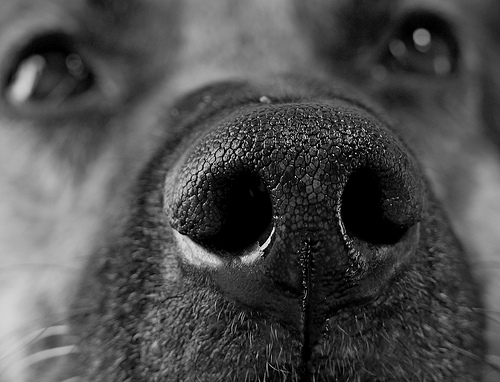
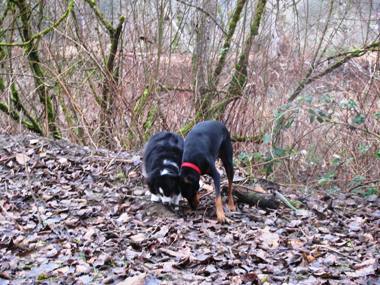
So what is it about the nose of the dog? A dog has more than 220 million olfactory receptors in its nose, while humans have only five million, making dogs’ sense of smell a thousand times greater. Frankly, trying to get one’s intellect around precisely what having a sense of smell one thousand times greater than a human means is tough! So on to another story.
17 Dogs, 3 Generations, 70 Years. There’s one constant… …the family dog.
After moving to Wellesley, Massachusetts for an anchor job with a major television sports network, Kevin began taking his German Shepherd, Beverly, for walks in the surrounding neighborhoods. They developed a route that included historic Atwood Street. Beverly kept veering toward one house in particular that had also caught Kevin’s eye previously, thinking it looked familiar but not knowing the reason.
After talking to a close family relative who had also once lived in Wellesley, Kevin was shocked to discover that the memorable house had once been a childhood home to his father, Bob Walsh, before WWII. After digging through old family photos that had been tucked away for years, Kevin uncovered a picture of his father as a toddler with his family on the house’s front porch, complete with their first family dog, Dee Dee.
Kevin’s father had been writing short stories about all of their family dogs through the years, but never knew about the photo. Its discovery was the pivotal moment that offered proof that the Walsh family’s journey with dogs had come back to the exact place where it started.
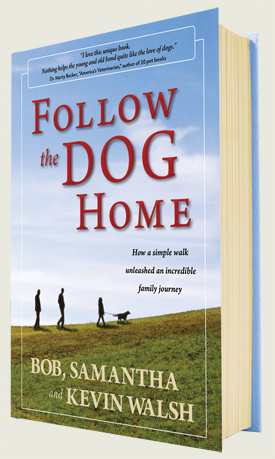
They’ve turned this story, along with other dog tales, into a book called Follow the Dog Home: How a Simple Walk Unleashed an Incredible Family Journey.
Dog’s nose leads family to back long lost old home, site unseen. German Shepherd, Beverly, is chronicled on WCVB TV’s news magazine show Chronicle. 70 years later, the family goes back “home” for stunning reunion and photograph.
Patience, yet something else we can learn from dogs!
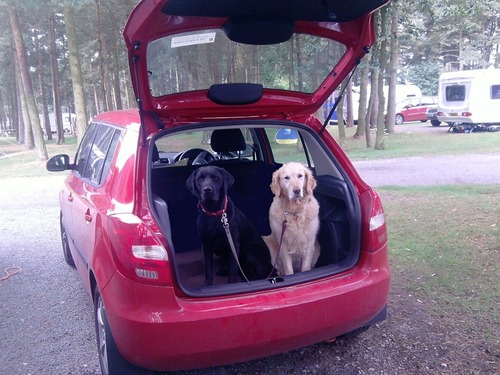
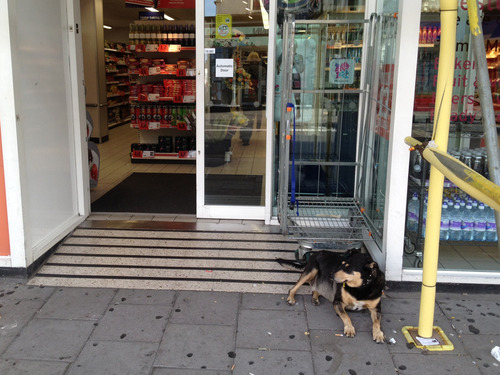
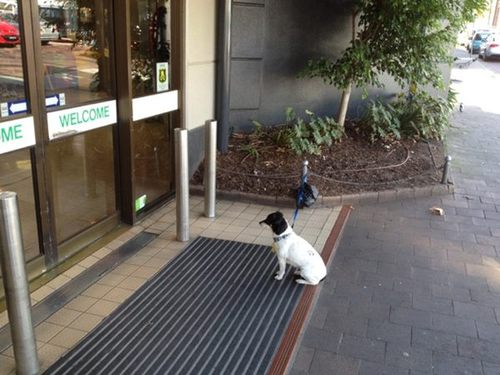
My friend, Neil, of many years back in South Devon, England, recently sent me a link to a website called Patient Dogs. From where one can view the following.
As I said, more lovely examples to be seen here. Thanks Neil!
















 Learning from Dogs