Back on the 10th we had a few days of cold, overcast weather that brought temperatures down below freezing and some snow.
Here’s a scene looking towards the North-East corner of the property, taken just before 11 am.
Then a few days later, on the 14th, the sun was out while the temperatures remained below freezing. Shown clearly as the sunlight catches the frost on the tree.
A few minutes later I swung the camera to take a picture of Dancer munching away in the morning sunshine, just a day after we collected her and Grace.
The horses settled in quickly, adapting to the dogs who were very curious.
Grace and Cleo being nonchalant with each other.
Jean unable to get her fill of her new companions.
And in a very different vein, a sneak photograph taken of yours truly who had collapsed in front of the fire early evening last Friday, quickly becoming a cushion for Hazel.
My reasoning was that the NCA report was such a stunning indictment of the madness, the myopic madness of mankind these last 100 years, that this appreciation of the wonder of dogs must act as a beacon for us all. I use the word ‘beacon’ because the qualities demonstrated by these nine dogs are just the qualities that we need to adopt.
Every living person on Planet Earth has to embrace the stark choice coming up on us like a runaway train. If we don’t change our values, our behaviours and our relationship with this one, finite planet, in the next ten years, at most, then the consequences will be beyond imagination; a world of unimaginable terror and chaos.
Forgive me if I repeat what the Home page of Learning from Dogs offers:
As man’s companion, protector and helper, history suggests that dogs were critically important in man achieving success as a hunter-gatherer. Dogs ‘teaching’ man to be so successful a hunter enabled evolution, some 20,000 years later, to farming, thence the long journey to modern man. But in the last, say 100 years, that farming spirit has become corrupted to the point where we see the planet’s plant and mineral resources as infinite. Mankind is close to the edge of extinction, literally and spiritually.
On the 30th December, 2012 The Week magazine published an item written by Editor Lauren Hansen. I ask Lauren if I might republish the article in full but that was denied. However, I was given permission to refer extensively to the piece. I will use it to underline just what we have to learn from dogs.
The 9 most newsworthy dogs of 2012
Dogs are the best. Here’s the proof… if you even need it
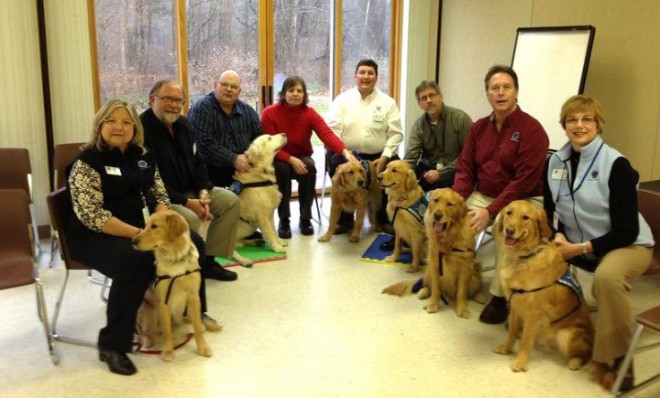
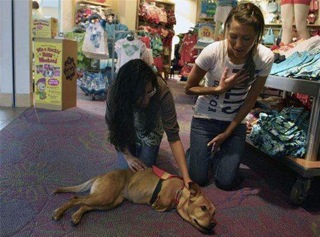
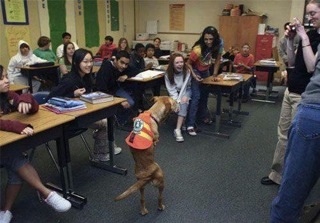
The K-9 Parish Comfort dogs (and their handlers) who helped the residents of Newtown, Conn., through their grief.
If you’re reading this, then you’re probably aware: Dogs rule. This year, a handful of canines rose above the rest, making headlines for their actions — whether facing imminent danger to save lives, enduring unimaginable physical hardships, or simply making us laugh. A look at nine of the year’s most newsworthy pups:
1. Chicago’s comfort dogs After the unimaginable events that befell Newtown, Conn., on Dec. 14 that left 27 people, including 20 children, dead at the hands of suspected gunman Adam Lanza, a team of golden retrievers was deployed from Chicago to the picturesque town. About 10 specially trained dogs, including Chewie, Ruthie, and Luther, made the 800-mile journey to sit with children and adults during masses and funerals. “Dogs are nonjudgmental. They are loving. They are accepting of anyone,” says one handler. “It creates the atmosphere for people to share.” The Chicago comfort dogs are notable not only for this caring venture but also for helping those who suffered through Hurricane Sandy and the tornado that hit Joplin, Mo., in 2011.
The next story was about the puppies that kept a lost boy warm.
That was followed by the hero dog that lost its snout saving two girls.
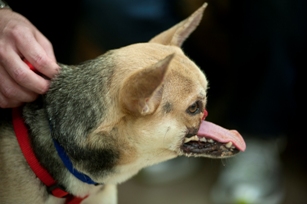
One dog’s heroism so disfigured her sweet little face that her photo is often preceded by a warning. This canine’s story started with a motorcycle careening through the streets of Zamboanga City, Philippines, earlier this year. Young cousins Dina Bunggal, 11, and Princess Diansing, 3, stepped unknowingly into its path. A mutt named Kabang came out of nowhere and jumped in front of the motorbike, stopping it in its tracks, and saving the little girls from serious injury. The driver and the girls emerged with superficial wounds, but Kabang wasn’t so lucky. Her head landed on the motorcycle’s front wheel and as the wheel rolled forward, Kabang’s upper snout was ripped right off. Her story quickly went viral and when local doctors could do no more to help her, specialty surgeons from the University of California, Davis, flew Kabang to their facilities, where she’ll endure six to eight weeks of treatment to repair her face. The cost of her surgeries, which could top $20,000, will be covered by her many supporters who have started an online fundraising campaign.
Vets at William R. Pritchard Veterinary Medical Teaching Hospital don’t plan to fullyy reconstruct Kabang’s snout, or fit her with a prosthetic. Instead, they are attempting to close the gaping wound on her face, preventing further infections.
Then my last dip into Lauren’s article is dog story eight.
8. The dog that saved its own life by calling the police
We’ve often heard the tale of the puppy that proves its “man’s best friend” status by saving its owner’s life. But this year, there was George, a 2-year-old basset hound in West Yorkshire, England, who reworked the well-worn script a bit, literally calling for help to save himself. Home alone, George had knocked the phone to the floor and was strangling himself with the handset’s cord when he apparently dialed 999 — England’s 911 equivalent — in a panic. The operator heard only frantic gasps and, assuming someone was desperately sick or reeling from an attack, sent police to the house. The dog was found and rescued from the cord. “Incredibly, you could see where his paw print was on the phone,” said the neighbor, “he literally saved his own life.”
Now, what fun-loving toddler can walk past a puddle without stopping for a little splash? Not this one!
Little Arthur was out for a stroll with his best mate, Watson the dog, when he noticed a tempting puddle. So he put down the leash and plunged straight in. And Watson? Well, he’s a more mature 12 years old, so he didn’t partake himself. But he was more than happy to wait while Arthur had his fun.
You know what this video is, don’t you? That’s right. Too. Cute. For. Words.
Here’s the video, seen over 4,800,000 times!
Finally, there’s the beautiful story of the dog befriending a Down’s Syndrome boy.
So what does this all add up to? That the qualities of the dog; integrity, unconditional love, patience, loyalty, and their ability to live in harmony with nature really do send us humans a message for the future.
This was sent to me by Dan Gomez. I take great pleasure in offering it to you, dear reader.
oooOOOooo
A dog named Faith.
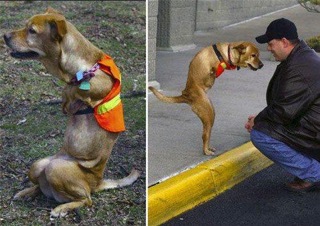
This dog was born in 2002. He was born with 2 legs. He of course could not walk when he was born. Even his mother did not want him.
His first owner also did not think that he could survive and he was thinking of putting him to sleep. But then, his present owner, Jude Stringfellow, met him and wanted to take care of him.
She became determined to teach and train this little dog to walk by himself.
She named him ‘Faith’.
In the beginning, she put Faith on a surfboard to let him feel the movement. Later she used peanut butter on a spoon as a lure and reward for him for standing up and jumping around. Even the other dog at home encouraged him to walk.
Amazingly, only after 6 months, like a miracle, Faith learned to balance on his hind legs and to jump to move forward. After further training in the snow, he could now walk like a human being.
Faith loves to walk around now. No matter where he goes, he attracts people to him.
He is fast becoming famous on the international scene and has appeared on various newspapers and TV shows. There is now a book entitled ‘With a Little Faith‘ being published about him. He was even considered to appear in one of the Harry Potter movies.
His present owner Jude Stringfellew has given up her teaching post and plans to take him around the world to preach that even without a perfect body, one can have a perfect soul.
oooo
oooo
oooo
oooo
oooo
oooo
In life there are always undesirable things, so in order to feel better you just need to look at life from another direction. I hope this message will bring fresh new ways of thinking to everyone and that everyone will appreciate and be thankful for each beautiful day.
Faith is the continual demonstration of the strength and wonder of life.
A small request: All you are asked to do is keep this story circulating.
The next couple of weeks are going to be ‘interesting’.
You will have been aware from my post last Saturday, The naming of creeks!, that heavy rains washed away the supports to the bridge that crosses Bummer Creek inside our property.
So apologies for taking a break from writing something more substantial for today but yesterday (I’m writing this at 5pm on the 6th, i.e. yesterday) the crew that will be repairing the damage arrived and got to work. It has not been a normal day!
Three pictures to explain why!
This seriously large digger was delivered around 9am!
Then in what seemed a matter of moments, the bridge was no more!
Pharaoh, of course, was getting involved. Let’s face it, even bridge construction people can always learn from dogs!
Last Thursday and yesterday have seen huge amounts of rainfall in this part of Southern Oregon. In fact it was a swipe from the massive storm that was featured in a recent Climate Crocks article, from which one can read:
Meteorologist Paul Douglas has more:
I’m seeing some signs of a potentially historic storm for portions of the western USA between Friday and Wednesday of next week as a series of very moist storms push inland from the Pacific. I expect some flash flooding (and river flooding) for the San Francisco Bay Area, but the most severe flooding (and mountain snows) will take place from Marin county into the mountains of northern California and the Coastal/Cascade range of Oregon.
The ECMWF model, which seems to be doing the best job overall in this new weather-on-steroids environment, prints out some 16-20″ rainfall amounts over northern California and southern/western Oregon by Sunday; two surges: one Friday, a second front pushing in Sunday. WSI’s high-res RPM model confirms this as well, which increases my confidence level. The ECMWF model prints out 4-5” for San Francisco, but 8-10” for Marin county, just north of SFO.
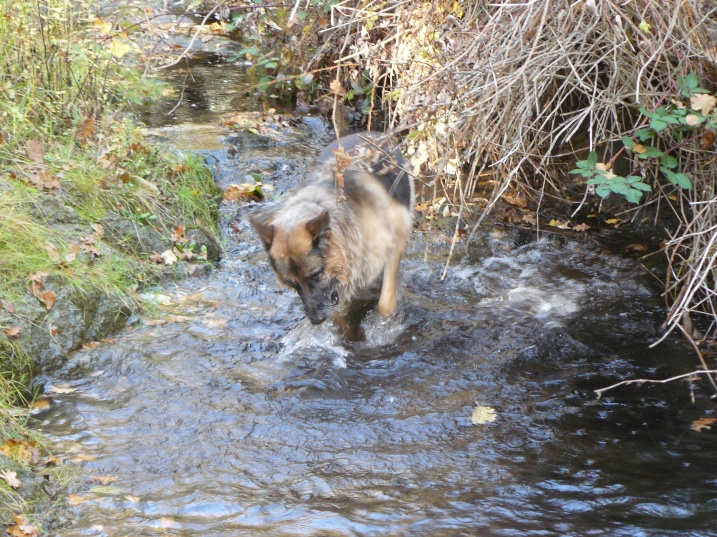
The driveway from our road to the house, about a quarter-of-a-mile long, within 300 feet crosses a creek that flows right across our property. Most of the time it’s a quiet, idyllic place for a dog to play.
But when the volume of water reaches the sorts of proportions that we have seen in the last 48 hours, it turns into a nasty torrent.
Not only that, the driveway across the creek relies on a bridge. Rather, it did rely on a bridge. But Mother Nature, as always, had her say!
Most, if not all, the wooden support structure that held up the steel platform has been swept away.
So all the well-laid plans for the week-end now on hold as we play Marooned! At least our dogs are taking an active interest …
More on the beautiful and inspiring ways of the dog.
Back at the beginning of July, I wrote a post about Jasmine. Jasmine was a rescue dog that turned out to be a natural ‘Mother hen’. That post was called Letting go; a dog lesson and, as the post explains, “Jasmine was truly one of a kind. She mothered many of the sanctuary’s residents back to health including Bramble the roe deer, Humbug the badger and two of the other sanctuary dogs, just to mention a few.“
But, guess what? More evidence of the benefits of having a dog in your life (or in our case make that 10 dogs!).
Babies who spend time around pet dogs have fewer ear infections and respiratory ailments than those whose homes are animal-free, reported a study.
The study, published in the US journal Pediatrics, did not say why but suggested that being around a dog that spends at least part of its day outdoors may boost a child’s immune system in the first year of life.
Cats, too, seemed to convey some protection to babies, though the effect observed was weaker than with dogs.
The article goes on to say,
The research was based on 397 children in Finland whose parents made diary entries each week recording the state of their child’s health during the infant’s first year, from nine weeks to 52 weeks of age.
Overall, babies in homes with cats or dogs were about 30 percent less likely to have respiratory infectious symptoms — which included cough, wheezing, rhinitis (stuffy or runny nose) and fever — and about half as likely to get ear infections.
And concludes,
The most protective association was seen in children who had a dog inside at home for up to six hours a day, compared to children who did not have any dogs or who had dogs that were always outside.
“We offer preliminary evidence that dog ownership may be protective against respiratory tract infections during the first year of life,” said the study.
“We speculate that animal contacts could help to mature the immunologic system, leading to more composed immunologic response and shorter duration of infections.”
The improvement was significant, even after researchers ruled out other factors that could boost infection risk, such as not having been breastfed, attending daycare, being raised by smokers or parents with asthma, or having older siblings in the household.
In addition to having less frequent ear infections and respiratory infections, babies near dogs tended to need fewer courses of antibiotics compared to those who were reared in pet-free households, it said.
Previous research has shown conflicting results, with some studies finding no benefit for young children being around furry pets and others finding that animal contact appears to offer some protection against colds and stomach ailments.
The study authors said their research differs from previous analyses because it focuses solely on the first postnatal year and does not include older children.
Dogs’ evolution shows why they ‘love’ gnawing on bones.
This is the second article on the BBC Nature website following yesterday’s item about why dogs enjoy a healthy breakfast.
oooOOOooo
Dogs’ evolution shows why they ‘love’ gnawing on bones
By Victoria Gill
Science reporter, BBC Nature, Ottawa, Canada
Social living drove dogs to evolve the “tools” for chewing bones, scientists say
Scientists say they have discovered why dogs love to eat meat and bones.
Ancient canines adopted pack-living about eight million years ago, to hunt larger prey, according to researchers.
The resulting evolution of their jaws gradually turned the ancestors of modern wolves, and ultimately our own pets, into “hypercarnivores”.
Dr Joao Munoz-Doran presented the findings at the First Joint Congress for Evolutionary Biology in Ottawa, Canada.
He and his colleagues from the National University of Colombia have created a canine “family tree”, piecing together the relationships between each of the more than 300 dog species.
“We compared species that have very different diets,” Dr Munoz-Doran explained to BBC Nature. “So we classified them as carnivores, hypercarnivores [animals that eat more than 70% meat] and omnivores [animals that eat meat and vegetation].”
The ancestors of modern wolves belong to this hypercarnivorous group.
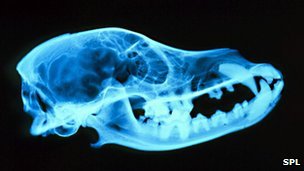
The team’s analysis showed that the skull features that now distinguish a wolf – strong jaw muscles and enlarged canine teeth – first started to develop when their ancestors first began hunting in groups.
“We found a common evolutionary history for these traits,” Dr Munoz-Doran explained. “Eight million years ago was when [less forested, more] open habitats were spreading through Asia, Europe and North America. And when there are open habitats, the big prey group together. So there will be more eyes watching for a predator.”
The only way that dogs roaming the open plains could snatch very large prey from a herd was to work together.
“And after many generations of this grouping behaviour, there are new selective pressures on their [skull shape],” said the researcher.
This pressure meant that animals with larger teeth and stronger jaws were more likely to succeed in hunting, and to survive to pass on their large-toothed, strong-jawed genes to the next generation.
Animals with stronger jaws and larger canine teeth would have been more successful hunters
“They developed strength in their muscles – especially the muscles that close their mouth,” said Dr Munoz-Doran. “And bones that are more resistant to bending, so they could support the mechanical strains of biting the prey. “Over time, they became adapted to be ‘hypercarnivorous’.”
The researcher pointed out that domestic dogs had “very good evolutionary reasons to enjoy chewing a bone”.
“They have the tools to do that,” he told BBC Nature, “and they want to use their tools.”
oooOOOooo
Finally, to the side of that BBC Nature webpage were a few canine facts, as follows:
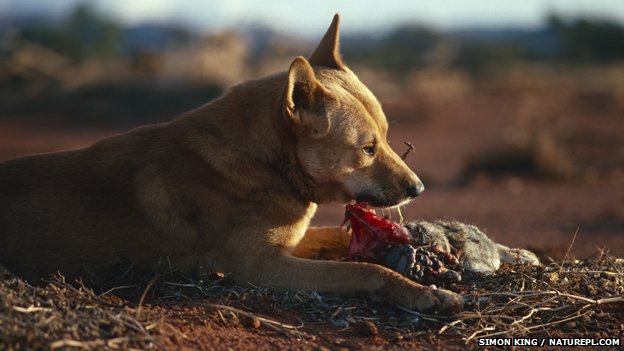
Common canines: Foxes, wolves, jackals, coyotes and dingoes are all members of this well-known group
Familiar faces: Wild canids are found on every continent except Antarctica
Communication is key: Previous studies of dog evolution have revealed that calls were essential for forming social groups and hunting larger prey
Pets’ past: All domestic dogs are descendants of the grey wolf
And don’t close without going here and listening to Steve Backshall howling with a wolf pack – (it’s a video as well – unmissable).
How a good breakfast is as relevant to dogs as it is to humans.
A little over three weeks ago, on the 10th October to be precise, there was a fascinating article on Nature news from the BBC. This was how it opened,
Dogs’ breakfasts boost search performance, says study
By Jeremy Coles
Reporter, BBC Nature
How important is breakfast for a wild dog?
Eating a morning meal increases search accuracy in dogs, a new study suggests.
Researchers at the University of Kentucky tested the search performance of trained dogs after either consuming breakfast or fasting.
The study found the canines searched more accurately 30 minutes after a meal than those that searched when hungry.
Findings from the research by Dr Holly Miller and colleague Charlotte Bender were recently published in the journal Behavioural Processes.
Studies demonstrating that children do better in cognitive exercises when they have eaten breakfast led Dr Miller to “wonder if a breakfast would also improve performance by dogs”.
So how on earth does one ‘study’ such a behaviour in a scientific manner?
So Dr Miller and Ms Bender tested trained domestic dogs’ (Canis familiaris) accuracy when finding hidden food, after either eating a morning meal or completing the task without eating.
To ensure that all dogs had depleted energy levels before the search test began, the dogs were required to exhibit self-control for 10 minutes in a ‘sit and stay’ exercise.
A previous study by Dr Miller demonstrated that the exertion of self-control depletes dogs’ energy levels as well as their ability to perform certain tasks.
The dogs were shown a treat that was subsequently hidden in one of six containers. Dogs that had eaten breakfast 30 minutes beforehand navigated to the treat more accurately than those that hadn’t eaten for 12 hours.
“The key finding here is rather simple: breakfast can aid performance by dogs,” Dr Miller told BBC Nature.
But is the same true for their wild relatives – the closely related wolves, coyotes and jackals?
“Here is where it gets a bit complicated,” she said.
A well-balanced diet
When “dogs eat a diet that is rich with carbohydrates [such as commercial dog food], their brains are more dependent on glucose and more affected by fluctuations in glucose levels,” explained Dr Miller.
But with a diet of hunted meat, where the carbohydrate level is low but fat content is high, the brain switches to its secondary fuel source of ketone bodies instead of the preferential glucose.
“If these animals are consuming a natural diet, that is not scavenged from the dump, they are probably in a state of ketosis where energy for neural processes does not fluctuate much,” Dr Miller explained.
This means that a single small meal may not have a big effect on problem-solving and may make “wolves and coyotes less impulsive and more cautious”.
But Dr Miller continued, “When hungry they become less able to control their behaviour and this might be why, when hungry, they are so much more dangerous and unpredictable.”


















 Learning from Dogs