Before you read any further please listen to Enya’s mesmerisingly beautiful track whilst reading the lyrics.
One look at love and you may see
It weaves a web over mystery,
All ravelled threads can rend apart
For hope has a place in the lover’s heart.
Hope has a place in a lover’s heart.
Whispering world, a sigh of sighs,
The ebb and the flow of the ocean tides.
One breath, one word may end or may start
A hope in a place of the lover’s heart.
Hope has a place in a lover’s heart.
Look to love you may dream,
And if it should leave then give it wings.
But if such a love is meant to be;
Hope is home, and the heart is free
Under the heavens we journey far,
On roads of life we’re the wanderers,
So let love rise, so let love depart,
Let hope have a place in the lover’s heart.
Hope has a place in a lover’s heart.
Look to love and you may dream,
And if it should leave then give it wings.
But if such a love is meant to be;
Hope is home, and the heart is free.
Hope is home, and the heart is free.
I have this notion in my head that we humans are predisposed to give priority to bad news over good news. I guess it does make sense especially when one reflects on likely times a few centuries back; or more.
However, I am certain that I am not alone in disliking intensely the predominance of ‘alarmist’ news headlines in all forms of media. We neither have broadcast television here at home nor subscribe to a daily newspaper although I do admit to dropping in regularly to the BBC News website.
The other morning I awoke a little before 5am and not wanting to awaken Jeannie decided to listen to some music using my iPod and earphones. I had a couple of Enya albums on the iPod and soon was listening to her album The Memory of Trees. Then up came track seven, Hope Has A Place, sung by Enya, composed by Roma Ryan.
I had forgotten how incredibly beautiful was the track.
Then my mind moved to reflecting on the life I have here at home with Jean and the dogs. There were three dogs sleeping on the bed while the track was playing: Hazel, Sweeny and Pedy.
How the love I receive from the dogs and the love I receive from Jean give me such freedom. Such emotional freedom to be the person I truly want to be. So perfectly expressed in the closing line of the lyrics: Hope is home, and the heart is free.
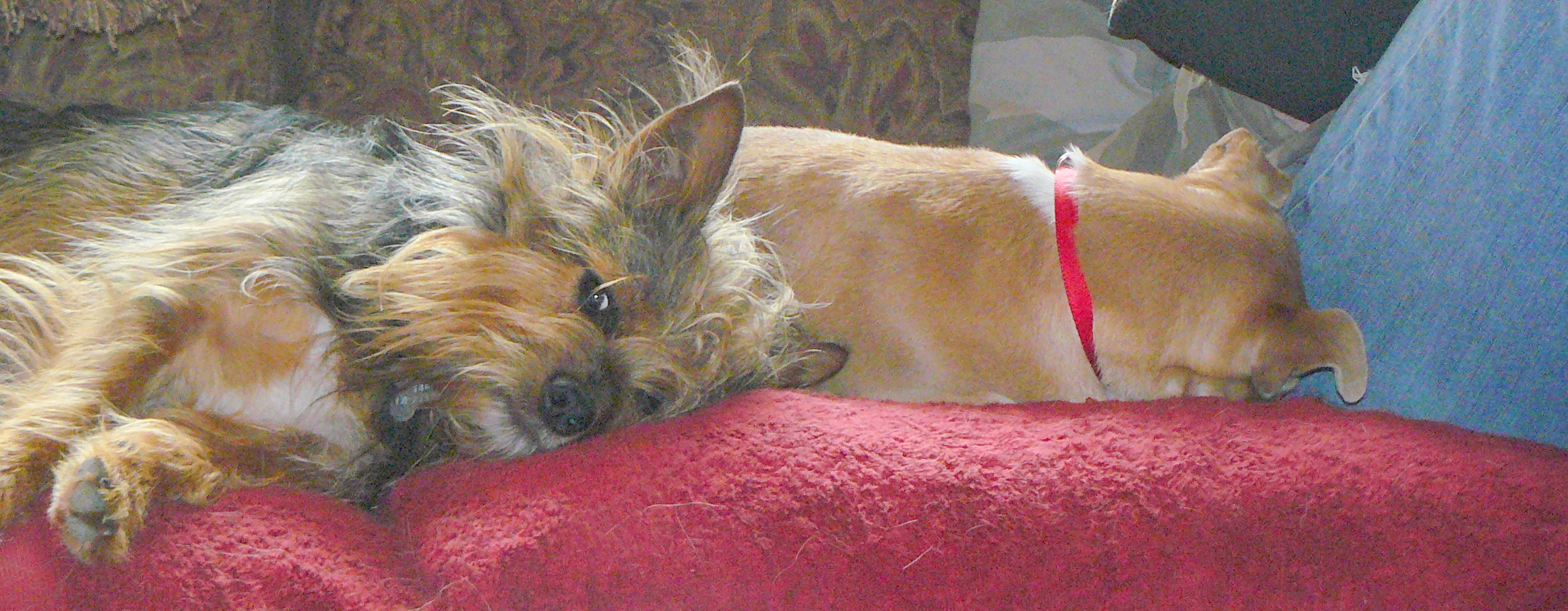
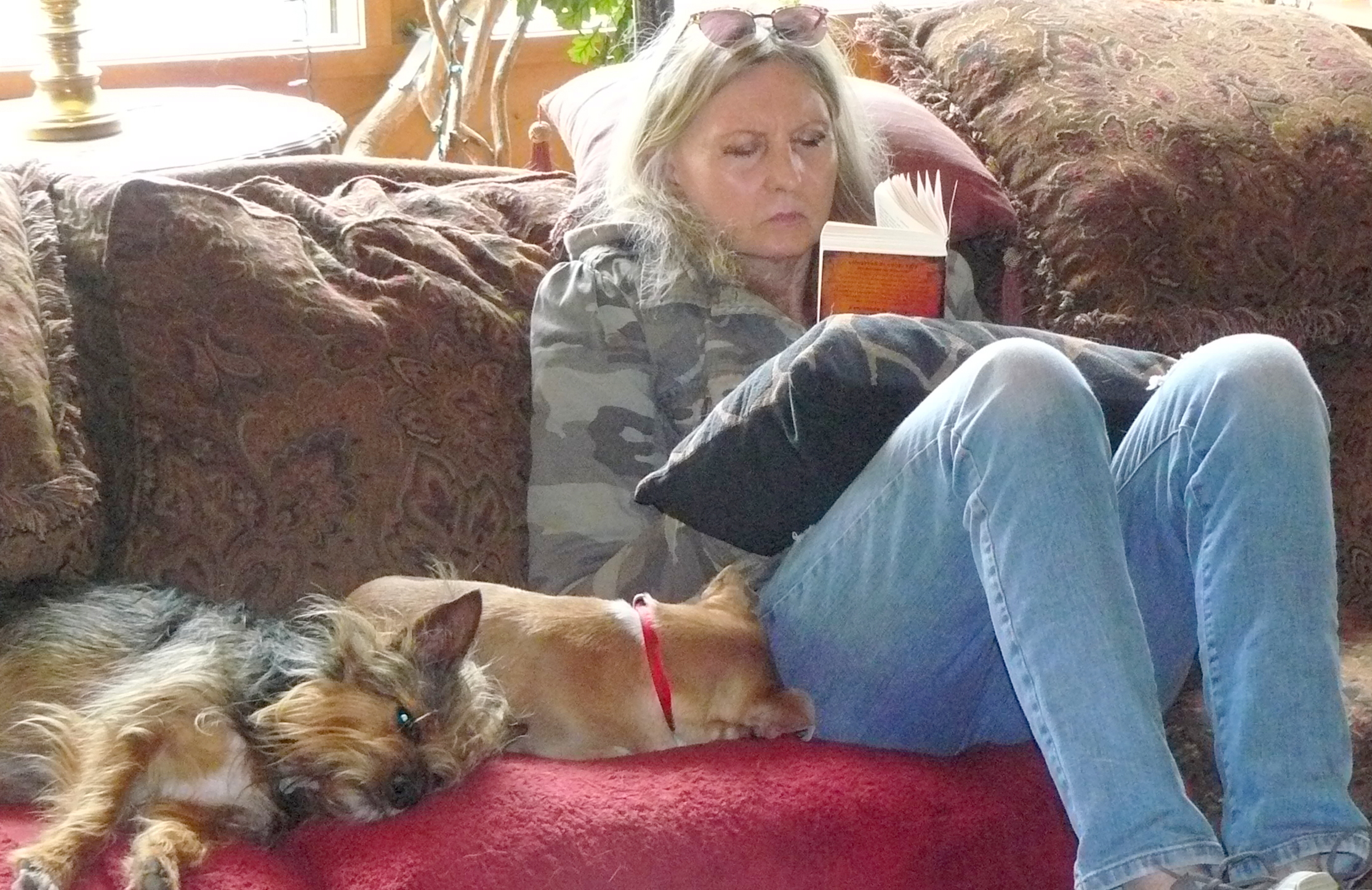
At this juncture I paused in writing this post, it was a little after 2pm yesterday, grabbed my camera and went into the living room. The two photographs below reinforce my message.
oooo
Sweeny, Pedy and Jeannie – bountiful, unconditional love!
Today’s Prompt: A man and a woman walk through the park together, holding hands. They pass an old woman sitting on a bench. The old woman is knitting a small, red sweater. The man begins to cry. Write this scene.
We encourage you to give fiction a try, even if that is not what you normally do — it can be a fun way to stretch. If fiction feels like a bridge too far, take some element from the scene that speaks to you, and write a non-fiction piece about that. Perhaps you are drawn to the old woman, and will write a piece about your grandmother, or the crying man will inspire a story about the last time you cried joyful tears.
Today’s twist: write the scene from three different points of view: from the perspective of the man, then the woman, and finally the old woman.
If point of view was an object, it would be William Carlos Williams’ infamous red wheelbarrow; everything depends on it.
Consider a car/pedestrian accident: the story differs depending on whether you’re the driver, the pedestrian, or the woman across the street who witnessed the horror. Everyone will tell a different story if asked to recount the event.
Shifting point of view can be your best friend if you’ve got writers’ block. If you’re stuck or you feel your writing is boring and lifeless, Craig Nova, author of All the Dead Yale Men, suggests shifting the point of view from which your story is told:
Take point of view, for example. Let’s say you are writing a scene in which a man and a woman are breaking up. They are doing this while they are having breakfast in their apartment. But the scene doesn’t work. It is dull and flat.
Applying the [notion] mentioned above, the solution would be to change point of view. That is, if it is told from the man’s point of view, change it to the woman’s, and if that doesn’t work, tell it from the point of view of the neighborhood, who is listening through the wall in the apartment next door, and if that doesn’t work have this neighbor tell the story of the break up, as he hears it, to his girlfriend. And if that doesn’t work tell it from the point of view of a burglar who is in the apartment, and who hid in a closet in the kitchen when the man and woman who are breaking up came in and started arguing.
Now my reaction upon first reading today’s theme was that this was both fun and inspiring. Then I realised that before I could commit words to the post I would need to let the fictional circumstances brew for a while amongst the aged brain cells and, if possible, it would be wonderful to include a dog in the story. 🙂
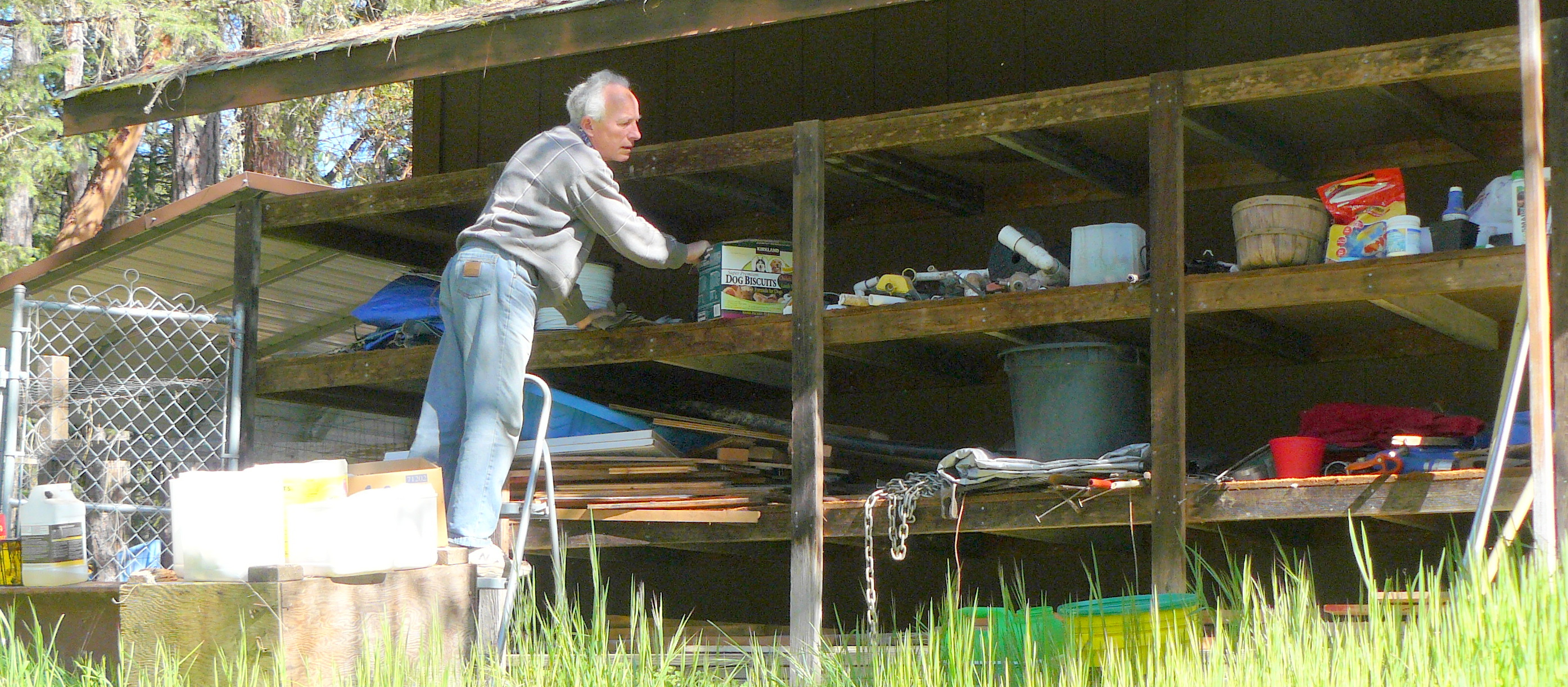
So for the next hour (I’m writing this at 10:30am) I shall use the wonderful weather we have today to continue my project of sorting out the grand mess around the back of the garage and see what creative thoughts come to mind!
Yet another point of view!
oooo
Echoes
“Jim, what’s the matter? You’ve seen this dear old lady sitting on the bench almost every time we’ve come walking. What’s brought on the tears today?”
Sandra thought that she knew her husband inside out, possibly better than he knew himself. Yet this quiet, sudden release of deep inner feelings from Jim had her perplexed.
Jim let go of Sandra’s fingers and fished around in his trouser pocket for a tissue. He blew his nose and wiped his eyes on his sleeve.
“Oh, it’s OK sweetheart, just some stirring of a place from too many years ago.”
Sandra re-engaged her fingers with Jim’s and they carried on walking through the park. Cleo bounded across the soft, green parkland grass, as ever looking so happy. She reflected that Cleo had always shown such happiness for being alive. Ever since they had cradled the young German Shepherd puppy in their arms. Gracious, Sandra reflected, nearly five years ago now.
What was it that had been stirred in Jim’s memories?
OK, it was the first time they had seen the old woman knitting but, otherwise, the woman was a familiar sight always sitting quietly on the park bench. Sandra struggled to recall exactly what the woman had been knitting; seemed like a tiny sweater, possibly for a very young grandchild. Why had that reduced Jim to tears? He was such an open man. That was what had attracted her to Jim all those many years ago when they had first met by chance. Jim’s previous wife, Diana, had been killed a few years before in a tragic car accident, her own husband had died of a coronary a couple of years before she met Jim.
Jim sensed that his sudden weeping would have raised some deep questions for Sandra. He struggled to rise above the pain of his recollection and decide what to do about that memory. That memory of his and Diana’s first child, a son, born with such hope yet with such tragedy written into his potentially short future. How the hospital staff had broken the news. Little Philip had been born with a massive brain aneurism and, at best, had a life expectancy of a few months. Philip never came out of hospital and died sixty days after he was born. Jim quietly ran the numbers through his mind; nearly eighteen years ago now.
He had never mentioned it to Sandra. A connection to the past that really should have died that same day as Philip died. First Philip and then Diana. After Diana died in that terrible road accident he thought that was the end of everything. Thought there was nothing that could ever happen in his future that would return a smile to his face, return the feelings of love to his heart. That’s when he started volunteering at the local dog shelter. There was something about helping those unfortunate dogs, dogs of all ages and circumstances, that, over time, spoke to him and made him discover reasons for living again. If these dogs, many of whom had had such terrible experiences, could so easily put their past behind them and enjoy living for each new moment then so could he.
That’s how he and Sandra had met. She had come in to the dog shelter carrying a small, lively little mongrel mix that she had found in the forest when out on a walk.
Their walk today, as usual, had brought them almost full circle and they were approaching the black, wooden park bench; the old lady still knitting away.
Doris had seen this couple on many previous occasions when the weather made it pleasant for her to sit on the bench here in the park. They seemed such a happy couple, unusually so in these complicated times. Every time she saw them it reminded her of the many happy years that she and Larry had had together. Still couldn’t accept that it was over five years ago now since he had died. That’s why, whenever the weather made it possible, she would come and sit on this park bench and remember the times when she and Larry would sit quietly here and just watch the world go by.
Today, for reasons only known to Cleo, as Jim and Sandra approached the park bench, Cleo went bouncing over to the old woman and next thing was sitting next to her on the seat.
Doris put out an arm to Cleo and ruffled the soft warm hair between Cleo’s gorgeous Shepherd ears. She watched as the man came over to her. “I’m so sorry but Cleo, for whatever reason, has taken a shine to sitting next to you today. Funny why today Cleo sensed the need to be with you on the bench. For we have seen you sitting out here in the park dozens of times before”
The man’s wife joined him and they both stood in front of the wooden bench. “My name’s Jim and this is my wife Sandra. I know we have seen each other frequently over the months.”
“Hi Jim and Sandra, my name is Doris and, yes, I have also seen you both out walking frequently. It looks as though your dog, Cleo is that her name, has instinctively sensed my good news.”
Jim and Sandra looked quizzically at Doris.
“Yes, I heard last weekend that my daughter and her husband successfully had the birth of their first child; a son. My grandson that is. I’m knitting him a sweater, as you can see.”
“Oh, that’s wonderful, Doris”, said Jim. “Wish we could stay a little longer and chat but we need to be home within the hour. When we next see you can we come across and here the good news in detail?”
“Of course you can! Go on, off you both go and take your gorgeous dog with you otherwise I will steal her away from you!” There was a soft laugh in the back of her throat.
“Come on, Cleo”, called Sandra and off they went.
Later when Jim and Sandra were back home and enjoying a hot tea after their walk, Jim apologised for his tears and quietly explained what had brought them on.
Sandra put down her cup of tea, came up to Jim and kissed him very slowly and tenderly on the lips.
“That was nice, sweetheart, what did I do to deserve that?”
“Jim, I didn’t want to mention it until I was certain. I have not had my period this month. I’m pretty sure that I’m pregnant. I’m going to town tomorrow to take a pregnancy test.”
For the second time that day Jim uncontrollably burst into tears.
oooo
I’m not sure how well I really captured each person’s point of view but it was fun writing it nonetheless!
Returning to a favourite story about one of our dogs.
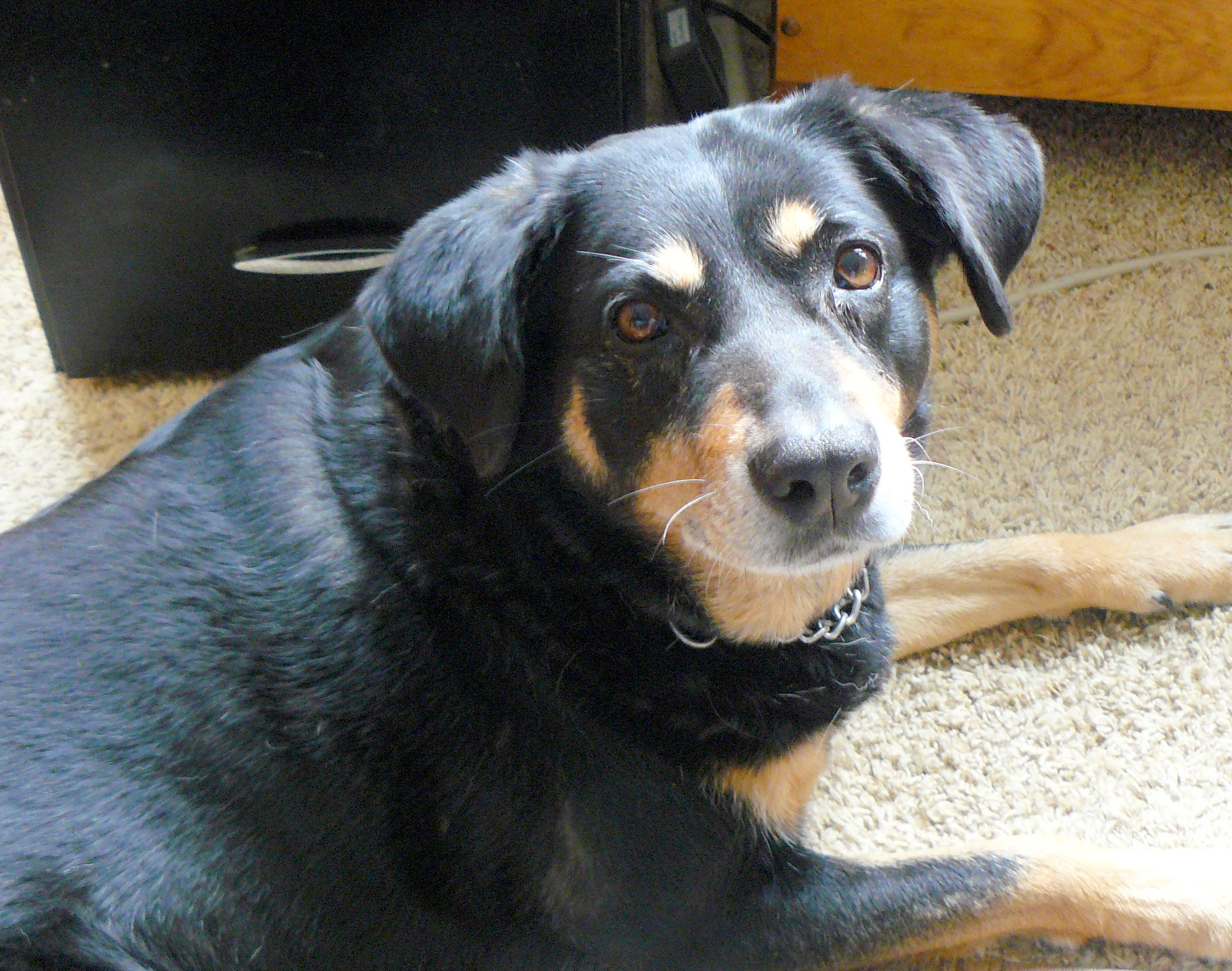
Yesterday’s post, the second this week about the long history of humans and dogs ended with me sharing a photograph of Hazel looking up at me as I was writing the post. Here it is again.
Dogs are such wonderful animals.
Later in the evening, thinking about how much we can learn from dogs (and, thank you so much, Deborah of Dog Leader Mysteries) my mind turned to the wonderful motivation dogs are for creative writing whether that is non-fiction, creative non-fiction or fiction.
In turn that reminded me of when, in the Summer of 2011, Jean and I attended a creative writing course at our nearby college in Payson, Arizona where we were then living. Here’s a story from that time that is fictional, in the sense that the event did not take place, but the names of all concerned, photographs and location are real!
ooOOoo
Messages from the Night
by Paul Handover
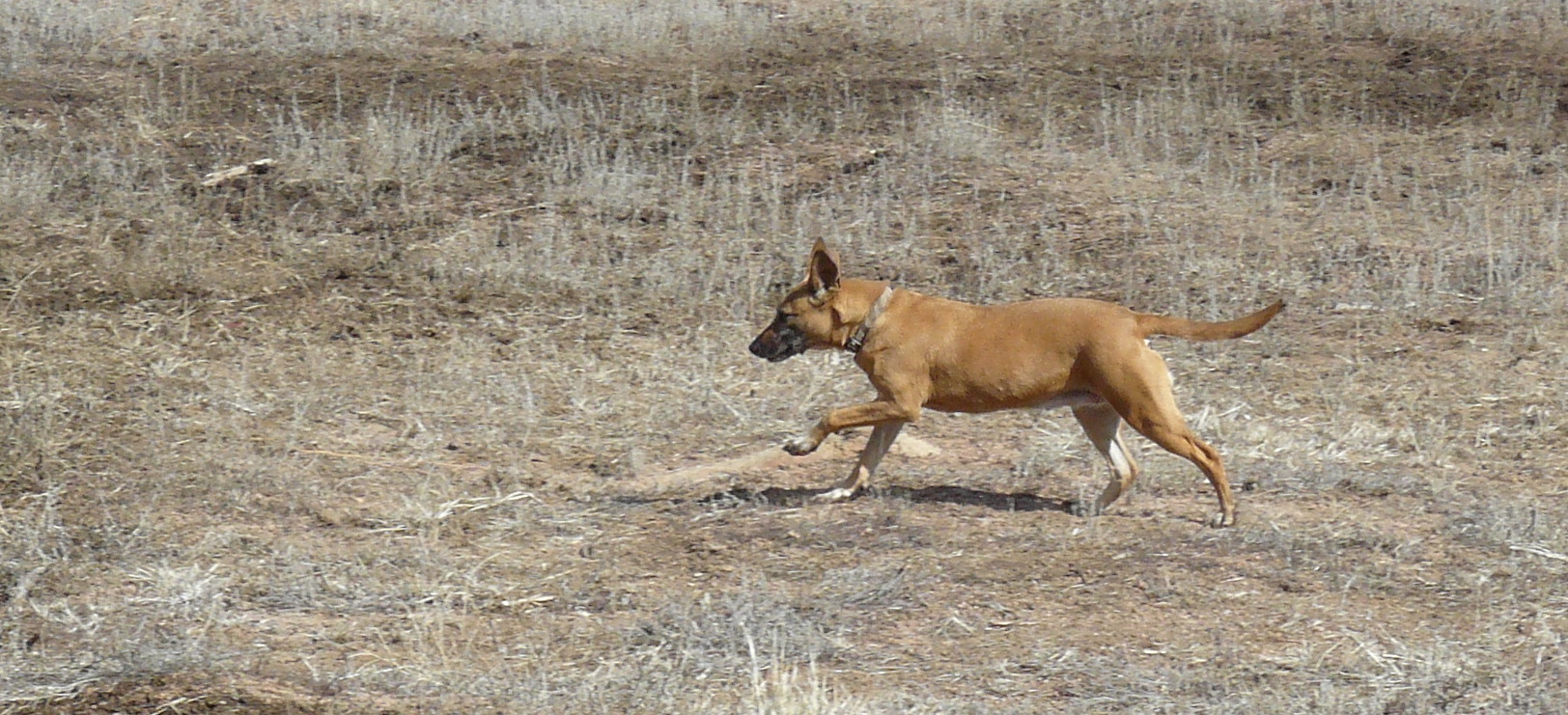
Dhalia heads for the hills!
“Jean, where’s Dhalia?”
“Don’t know. She was here moments ago.”
“Jeannie, You take the other dogs back to the car and I’ll go and scout around for her. Oh, and you better put Pharaoh on the leash otherwise you know he’ll follow me.”
“Paul, don’t worry, Dhalia’s always chasing scents; bet she beats us back to the car. Especially as it’s going to be dark soon.”
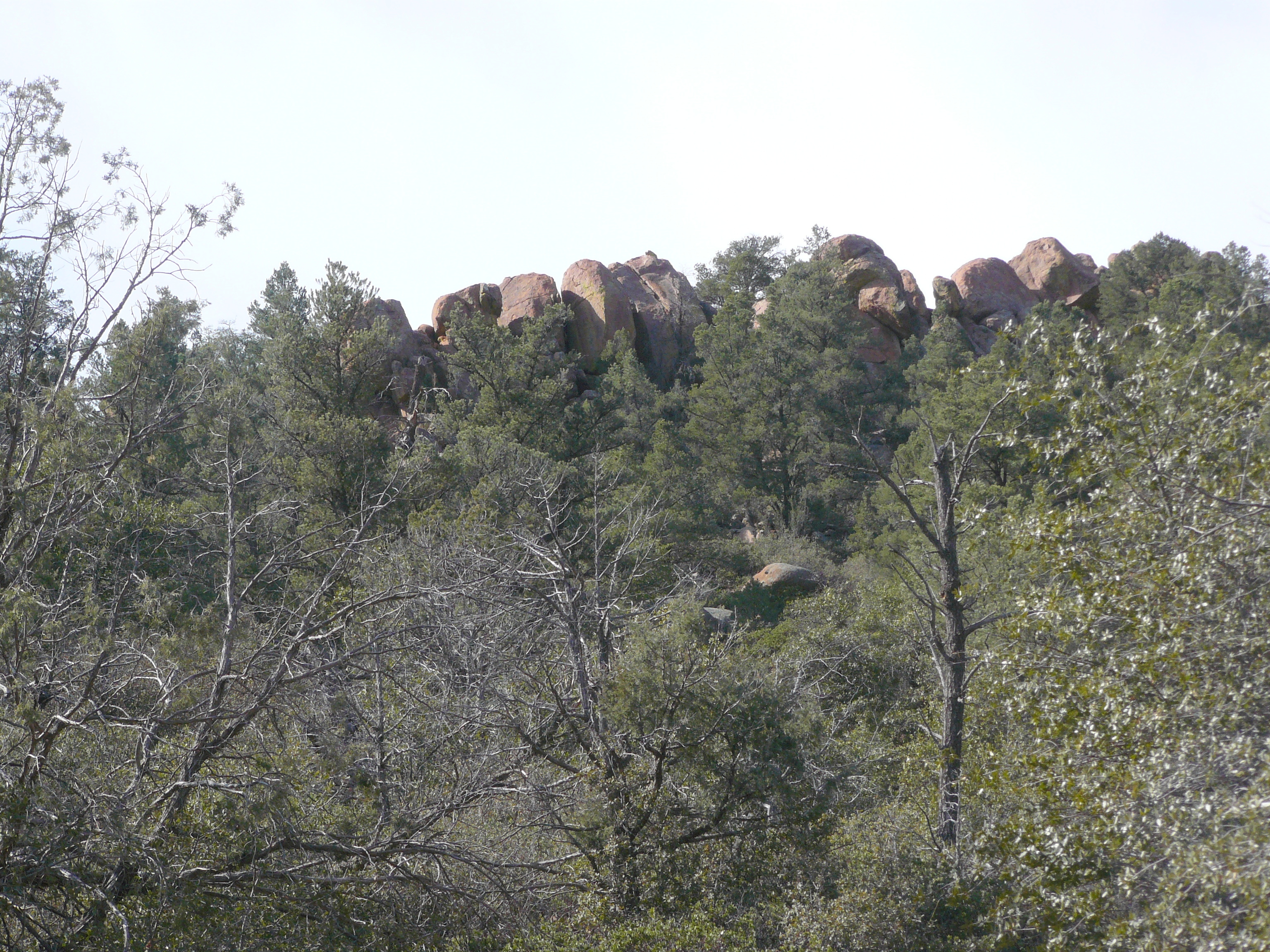
Nonetheless, Paul started back down the dusty, dirt road, the last rays of the sun pink on the high, tumbled cliffs of granite. This high rocky, forest plateau, known as the Granite Dells, just 3 miles from their home on the outskirts of Payson, made perfect dog-walking country and rarely did they miss an afternoon out here. However this afternoon, for reasons Paul was unclear about, they had left home much later than usual.
No sign of Dhalia ahead on the road so he struck off left, hoping she was somewhere up amongst the trees and the high boulders. Soon he reached the first crest, panting hard in the thin air. Behind him, across the breath-taking landscape, the setting sun had dipped beneath faraway mountain ridges; a magnificent sight. Suddenly, in the midst of that brief pause of admiring the perfect evening, a sound echoed around the cliffs. The sound of a dog barking. Paul bet his life on that being Dhalia. Just as quickly the barking stopped.
Challenging walking country.
The barking started up again, barking that suggested Dhalia was hunting something. The sound came from an area of boulders way up above the pine trees on the other side of the small valley ahead of him.
Perhaps, Dhalia had trapped herself. More likely, he reflected, swept up in the evening scents of the wilderness, Dhalia had temporarily reverted back to the wild, hunting dog she had been all those years ago. That feral Mexican street dog who in 2005 had tentatively turned away from scavenging in a pile of rubbish in a dirty Mexican town and shyly approached Jean. Jean had named her Dhalia.
He set off down to the valley floor and after fifteen minutes of hard climbing had reached the high boulders the other side. Paul whistled, then called “Dhalia! Dhalia! Come, there’s a good girl.”
Thank goodness for such a sweet, obedient dog.
He anticipated the sound of dog feet scampering through rough undergrowth. But no sound came.
He listened; no sounds, no more barking. Now where had she gone? Perhaps past these boulders down into the steep ravine beyond him, the one so densely forested with pine trees. With daylight practically gone he needed to find Dhalia very soon. He plunged down the slope, pushing through tree branches that whipped across his face, then fell heavily as his foot found empty space instead of the anticipated firm ground.
Paul cursed, picked himself up and paused. That fall had a message: the madness of continuing his search in the near dark. This terrain made very rough going even in daylight. At night, the boulders and plunging ravines would guarantee a busted body, at best! Plus, he ruefully admitted, he didn’t have a clue about finding his way back to the road from wherever he was!
The unavoidable truth smacked him full in the face. He would be spending this night alone in the high, open forest!
It had one hell of a very scary dimension. He forced himself not to dwell on just how scary it all felt. He needed to stay busy, find some way of keeping warm; last night at home it had dropped to within a few degrees of freezing. Paul looked around, seeing a possible solution. He broke a small branch off a nearby mesquite tree and made a crude brush with which he swept up the fallen pine needles he saw everywhere about him. Soon he had a stack sufficient to cover him, or so he hoped.
Thank goodness that when he and Jeannie had decided to give four dogs of their dogs this late afternoon walk, he had jeans and a long-sleeved shirt on, a pullover thrown over his shoulders. Didn’t make Dhalia’s antics any less frustrating but he probably wasn’t going to freeze to death!
The air temperature sank as if connected with the last rays of the sun. Paul’s confidence sank in harmony with the temperature. He lay down, shuffled about, swept the pine needles across his body, tried to find a position that carried some illusion of comfort. No matter the position, he couldn’t silence his mind. No way to silence the screaming in his head, his deep, primeval fear of this dark forest about him, imagination already running away with visions of hostile night creatures, large and small, watching him, smelling him, biding their time.
Perhaps he might sleep for a while? A moment later the absurdity of that last thought hit him. Caused him to utter aloud, “You stupid sod. There’s no way you’re going to sleep through this!”
His words echoed off unseen cliffs in the darkness, reinforcing his sense of isolation. He was very frightened. Why? Where in his psyche did that come from? He had spent many nights alone at sea without a problem, a thousand miles from shore. Then, of course, he knew his location, always had a radio link to the outside world. But being lost in this dark, lonely forest touched something very deep in him.
Suddenly, he started shivering. The slightest movement caused the needles to slip from him and the cold night air began to penetrate his body. He mused about how cold it might get and, by extension, thanked his lucky stars that the night was early October not, say, mid-December. So far, not too cold, but soon the fear rather than the temperature started to devour him. What stupid fool said, ‘Nothing to fear but fear itself!’ His plan to sleep under pine needles, fear or no fear, had failed! He couldn’t get warm. He had to move.
He looked around, saw an enormous boulder a few yards away, like some giant, black shadow. No details, just this huge outline etched against the night. Paul carefully raised himself, felt the remaining needles fall away, and gingerly shuffled across to the dark rock. He half-expected something to bite his extended hand as he explored the surface, as he ran his hand down towards the unseen ground. Miracle of miracles, the granite gently emitted the warmth absorbed from the day’s sun. He slowly settled himself to the ground, eased his back against the rock-face and pulled his knees up to his chest. He felt so much less vulnerable than when he had been flat out on the forest floor. Paul let out a long sigh, then burst into tears, huge heart-rending sobs coming from somewhere deep within him.
Gradually the tears washed away his fear, restored a calmer part of his brain. That calmer brain brought the realisation that he hadn’t considered, well not up until now, what Jeannie must be going through. At least he knew he was alive. Jeannie, not knowing, would be in despair. He bet she would remember that time when out walking here in the Dells they had lost little Poppy, an adorable ten-pound poodle mix, never to be found again despite ages spent combing the area, calling out her name. A year later and Jeannie still said from time to time, “I so miss Poppy!“. First Poppy and now him! No question, he had to get through this in one piece, mentally as much as physically.
Presumably, Jeannie would have called 911 and been connected to the local search and rescue unit. Would they search for him in the dark? He thought unlikely.
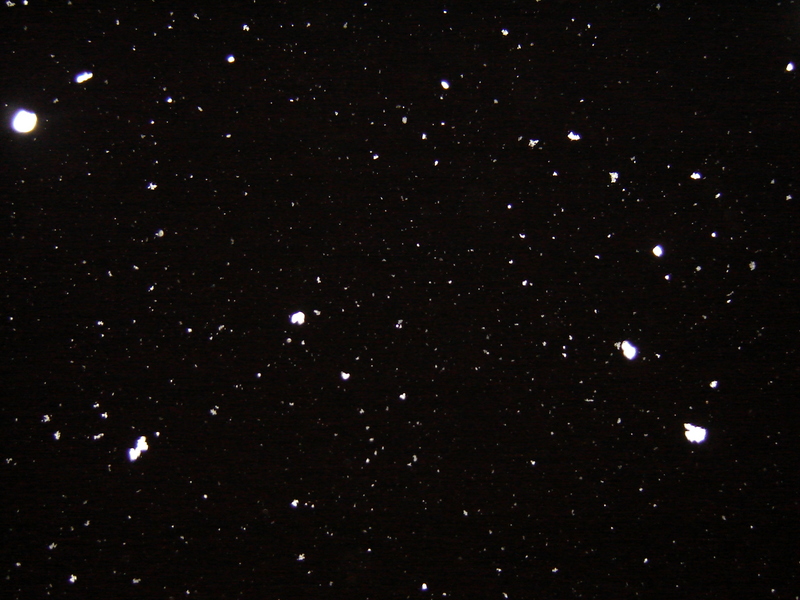
A vast stellar clock.
Thinking about her further eased his state of mind and his shivering stopped. Thank goodness for that! Paul fought to retain this new perspective. He would make it through, even treasure this night under the sky, this wonderful, awesome, night sky. Even the many pine tree crowns that soared way up above him couldn’t mask a sky that just glittered with starlight. Payson, at five-thousand feet, had many beautifully clear skies and tonight offered a magical example.
Frequently during his life, the night skies had spoken to him, presented a reminder of the continuum of the universe. On this night, however, he felt more humbled by the hundred, million stars surrounding him than ever before.
Time slipped by, his watch in darkness. However, above his head that vast stellar clock. He scanned the heavens, seeking out familiar pinpoints of light, companions over so much of his lifetime. Ah, there! The Big Dipper, Ursa Major, and, yes, there the North Pole star, Polaris. Great! Now the rotation of the planet became his watch, The Big Dipper sliding around Polaris, fifteen degrees for each hour.
What a situation he had got himself into. As with other challenging times in his life, lost in the Australian bush, at sea hunkering down through a severe storm, never a choice other than to work it out. Paul felt a gush of emotion from the release this changed perspective gave him.
Far away, a group of coyotes started up a howl. What a timeless sound, how long had coyotes been on the planet? He sank into those inner places of his mind noting how the intense darkness raised deep thoughts. What if this night heralded the end of his life, the last few hours of the life of Paul Handover? What parting message would he give to those that he loved?
Jeannie would know beyond any doubt how much he had adored her, how her love had created an emotional paradise for him beyond measure. But his son and daughter, dear Alex and Maija? Oh, the complexities he had created in their lives by leaving their mother so many years ago. He knew that they still harboured raw edges, and quite reasonably so. He still possessed raw edges from his father’s death, way back in 1956. That sudden death, five days before Christmas, so soon after he had turned twelve, that had fed a life-long feeling of emotional rejection. That feeling that lasted for fifty-one years until, coincidentally also five days before Christmas, he had met Jean in 2007.
His thoughts returned to Alex and Maija. Did they know, without a scintilla of doubt, that he loved them. Maybe his thoughts would find them. Romantic nonsense? Who knows? Dogs had the ability to read the minds of humans, often from far out of visual range. He knew Pharaoh, his devoted German Shepherd, skilfully read his mind.
Paul struggled to remember that saying from James Thurber. What was it now? Something about men striving to understand themselves before they die. Would that be his parting message for Alex and Maija? Blast, he wished he could remember stuff more clearly these days and let go of worrying about the quote. Perhaps his subconscious might carry the memory back to him.
He looked back up into the heavens. The Big Dipper indicated at least an hour had slipped by. Gracious, what a sky in which to lose one’s mind. Lost in that great cathedral of stars. Then, as if through some passing of consciousness, the Thurber saying did come back to him: All men should strive to learn before they die, what they are running from, and to, and why. As last words they would most certainly do for Alex and Maija!
Paul reflected on those who, incarcerated in solitary confinement, had their minds play many tricks, especially when it came to gauging time. What a bizarre oddment of information; where had that come from? Possibly because he hadn’t a clue about his present time. It felt later than 11pm and earlier than 4am, but any closer guess seemed impossible. Nevertheless, from out of those terrible, heart-wrenching hours of being alone he had found calm, had found something within him. He slept.
Suddenly, a sound slammed him awake. Something out there in the dark had made a sound, caused his whole body to become totally alert, every nerve straining to recognise what it might be. It sounded like animal feet moving through the autumn fall of dead leaves. He prayed it wasn’t a mountain lion. Surely such a wild cat preparing to attack him would be silent. Now the unknown creature had definitely paused, no sound, just him knowing that out there something waited. Now what, the creature had started sniffing. He hoped not a wild pig. Javelinas, those pig-like creatures that always moved in groups, could make trouble – they had no qualms at attacking a decent-sized dog.
Poised to run, he considered rising but chose to stay still and closed his right-hand around a small rock. The sniffing stopped. Nothing now, save the sound of Paul’s rapid, beating heart. He sensed, sensed strongly, the creature looking at him. It seemed very close, ten or twenty feet away. The adrenalin hammered through his veins.
He tried to focus on the spot where he sensed the animal waited; waited for what? He pushed that idea out of his head. His ears then picked up a weird, bizarre sound. Surely not! Had he lost his senses? It sounded like a dog wagging its tail; flap, flap, flapping against a tree-trunk.
A dog? If a dog, it had to be Dhalia!
Then came that small, shy bark! A bark he knew so well. Oh wow, it is Dhalia. He softly called, “Dhalia, Dhalia, come here, there’s a good girl.”
With a quick rustle of feet Dhalia leapt upon him, tail wagging furiously, her head quickly burrowing into Paul’s body warmth. He hugged her and, once more, tears ran down his face. Despite the darkness, he could see her perfectly in his mind. Her tight, short-haired coat of light-brown hair, her aquiline face, her bright inquisitive eyes and those wonderful head-dominating ears. Lovely large ears that seemed to listen to the world. A shy, loving dog when Jean had rescued her in 2005 and these years later still a shy, loving dog.
Dhalia licked his tears, her gentle tongue soft and sweet on his skin. He shuffled more onto his back which allowed her to curl up on his chest, still enveloped by his arms. His mind drifted away to an era long time ago, back to an earlier ancient man, likewise wrapped around his dog under a dome of stars, bonded in a thousand mysterious ways.
The morning sun arrived as imperceptibly as an angel’s sigh. Dhalia sensed the dawn before Paul, brought him out of his dreams by the slight stirring of her warm, gentle body.
Yes, there it came, the end of this night. The ancient sun galloping towards them across ancient lands, another beat of the planet’s heart. Dhalia slid off his chest, stretched herself from nose to tail, yawned and looked at him, as much to say time to go home! He could just make out the face of his watch; 4.55am. He, too, raised himself, slapped his arms around his body to get some circulation going. The cold air stung his face, yet it couldn’t even scratch the inner warmth of his body, the gift from the loving bond he and Dhalia had shared.
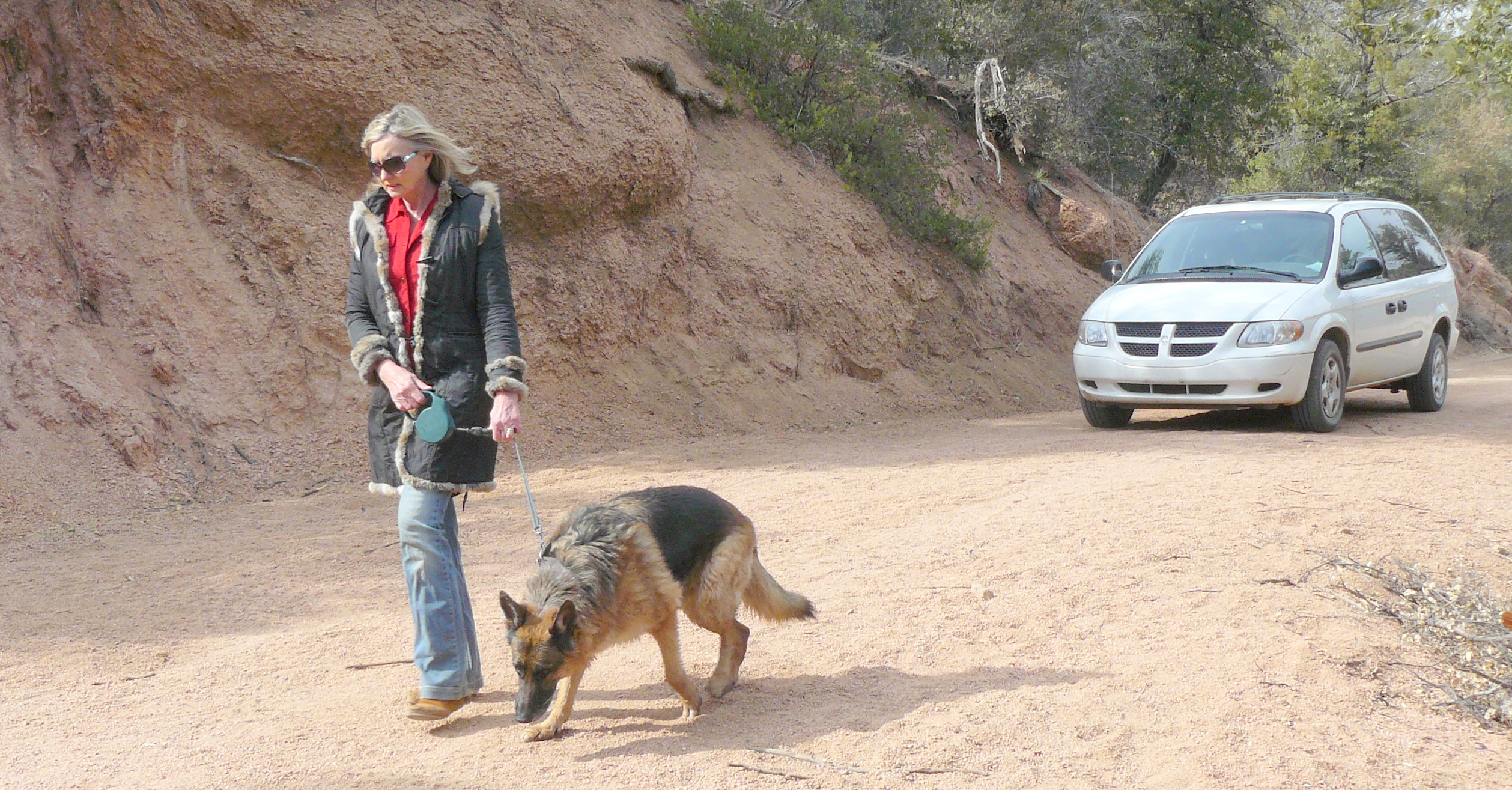
They set off and quickly crested the first ridge. Ahead, about a mile away, they saw the forest road busy with arriving search and rescue trucks. Paul noticed Jean’s Dodge parked ahead of the trucks and instinctively knew she and Pharaoh had already disappeared into the forest, Pharaoh leading the way to them.
Pharaoh and Jean heading up the search.
They set off down the slope, Dhalia’s tail wagging with unbounded excitement, Paul ready to start shouting for attention from the next ridge. They were about to wade through a small stream when, across from them, Pharaoh raced out of the trees. He tore through the water, barking at the top of his voice in clear dog speak, ‘I’ve found them, they’re here, they’re safe’. Paul crouched down to receive his second huge face lick in less than six hours.
Later, safely home, it came to Paul. When they had set off in that early morning light, Dhalia had stayed pinned to him. So unusual for her not to run off. Let’s face it, that’s what got them into the mess in the first place. Dhalia had stayed with him as if she had known that during that long, dark night, it had been he who had been the lost soul.
The message from the night, as clear as the rays of this new day’s sun, the message to pass to all those he loved. If you don’t get lost, there’s a chance you may never be found.
It is becoming an oft-repeated theme by me; the power of the connections that exist between the thousands of bloggers. Again, regular readers (thank you!) will not be surprised to hear me say that this power of connectivity may be the ultimate force that stops humanity from going past a point of no return in terms of the viability of our planet to sustain us and all of life. (And to reinforce that in spades, tomorrow I am republishing a recent item from Martin Lack; he of Lack of Environment.)
Let me just play a little more with this idea of the connectivity between us bloggers. Theoretically, if one had five bloggers all following each other then the number of permutations between those five bloggers would be factorial 5, or 120 connections. If there were ten bloggers all following each other, then the number of connections would be 3,628,800! (Background maths here.) I’m certain that there are more than ten bloggers whom I follow and who in turn follow me.
All of which is a preamble to a recent post from fellow blogger Mark M. Rostenko over on his wonderful blog Call Of The Wilderness. He recently published an item with the title of Dog Wisdom and I have the very great pleasure in reposting it here, with Mark’s kind permission.
ooOOoo
Dog Wisdom
We don’t have to live deep in the wilds at the end of a long dirt road to learn from Nature. She’s everywhere; in our hearts, our minds, our bodies… our pets. Frankly, I’ve learned more about living authentically from my dogs than from any authority, parent, classroom, job, book or so-called expert.
Sami’s old. Around ninety in people-years. She mounts the stairs one careful step at a time these days, however she must to curl up by her dad as she has almost every night since I rescued her from the shelter just yesterday… or was it thirteen years ago? It’s said that dogs sleep facing outward from the pack, positioned to notice and respond immediately to threats. Sami doesn’t anymore. Recently she’s taken to lying towards me, as if to say “I can’t protect you anymore… I’m old and weak and vulnerable… and I need you to watch out for me from now on.” But a glimmer of pride sparkles in her eyes as she leaps onto the bed unassisted; it’s been there a few months, ever since the night after her legs gave out and she crashed to the floor in her attempt. I think she felt my heart break, and bless her velvety, floppy Lab ears, she vowed to stay strong for her worried dad.
We don’t hike anymore; this terrain’s hard on her withering hinds. We just saunter casually down the dirt road a couple times a day, as far as makes her happy… not so far. But I still see remnants of her bouncy puppy-gait, that “stretch-and-stand-tall-so-I-can-see-as-much-of-this-deliciously-exciting-world-as-I-possibly-can” spring in her step unleashed only after time had carried away the neglect of her former life. And once in a while after a hardy dose of love she’ll still crouch down in the “let’s play!” chin-to-the-ground puppy posture before tearing off into a spastic circle of rambunctious frenzy like the young’uns do.
I like to watch her when we walk, the soft ripples of footfalls reverberating through her age-slackened flesh, how the slight bottom-curl of her ears unfurls with every bob of her moist snout. I take in as much of her as I can because any day now omens of finality will alight to the shadows and perch among the pines waiting to guide her back to the oneness from whence she came. And I see in her gait that no matter how old, no matter how tired, no matter how many tumors and aches, Sami’s as thrilled to walk as ever, her enthusiasm fading not one smidge.
Will I thrill so at ninety? Probably not. Likely I’ll dwell on aches and pains and look back at all I’ve lost, at what I no longer can, as we humans tend. But not Sami. Sami doesn’t think about what she’s lost; Sami just enjoys what’s still hers… fully and without reservation. Sami worries not of what she can’t, delighting only in what she still can.
Her joie de vivre is the effervescence of perpetual gratitude. Not submissive lip-service borne upon fears of eternal damnation but a physical affirmation of genuine grace and gratitude: living life fully, sans complaint, thoroughly consumed with blessings of the moment. Sami, I suspect, is the pride and joy of her creator who smiles fondly upon her antics, reveling in the satisfaction that at least this one critter got the point of it all: that life is to be lived.
Sami has little choice in the matter; she’s built to live here and now, to take what comes and make the best of it. We, however, have been gifted choice… a very clear choice, if you ask me…
ooOOoo
Thanks Mark. That’s a beautiful account of the wisdom and compassion of our dogs. They offer so many examples of grace and unconditional love to us humans!
Lack of sleep can have a role in obesity and diabetes.
Hazel asleep on the living-room couch at 2pm yesterday.
The sub-heading is taken from an item on the BBC News website that I read yesterday morning. (I’m republishing it in full so that readers are fully informed.)
Lack of sleep can have role in obesity and diabetes, study says
By James Gallagher, Health editor, BBC News website, San Diego
If you need a lie-in at weekends to make up for lack of sleep in the week, you may be at risk of obesity and type 2 diabetes, a study suggests.
The sleeping habits of 522 people found those losing sleep on weekdays were more likely to develop the conditions.
The findings, shown at the Endocrine Society‘s annual meeting, suggested increasing sleep could help patients.
Experts said the findings were interesting and called for the idea to be tested in large trials.
Studies have already shown that shift work can rapidly put healthy people into a pre-diabetic state.
The action of throwing the body clock out of sync is thought to disrupt the natural rhythm of hormones in the body, leading to a host of health problems.
But the pressures of work and social lives mean many people cut their sleep during the week and catch up at the weekend. Researchers are investigating whether there is a health impact.
Widespread
The study, by a team at the University of Bristol in the UK and Weill Cornell Medical College in Qatar, assessed “sleep debt” – a measure of the difference in the nightly hours asleep on weekdays and at the weekend.
“We found that as little as 30 minutes a day sleep debt can have significant effects on obesity and insulin resistance,” said Prof Shahrad Taheri from Weill Cornell.
He added: “Sleep loss is widespread in modern society, but only in the last decade have we realised its metabolic consequences.
“Our findings suggest that avoiding sleep debt could have positive benefits for waistlines and metabolism and that incorporating sleep into lifestyle interventions for weight loss and diabetes might improve their success.”
The study was funded by the UK’s Department of Health, where 10% of healthcare budgets are already spent on treating diabetes.
The disease can lead to blindness, increase the risk of heart attacks and strokes, as well as damaging nerves and blood vessels – dramatically increasing the risk of a foot needing to be amputated.
What the researchers do not know is the impact of improving people’s sleep so they get more on a weeknight and do not need a weekend lie-in.
Dr Denise Robertson, a senior lecturer from the University of Surrey, commented: “This work is interesting and consistent with prospective data found in healthy individuals without type 2 diabetes.
“However, before this association between sleep length, obesity and metabolic status can be used in terms of public health we need the next tier of evidence.
“To date there have been no randomised controlled trials where sleep debt is addressed and a metabolic benefit is observed. However, the potential for such interventions to impact on health is great.”
So while it might be regarded as a little ‘tongue-in-cheek’ to say that we need to learn to sleep more effectively from dogs, the BBC item suggests that it’s not as silly as one might think.
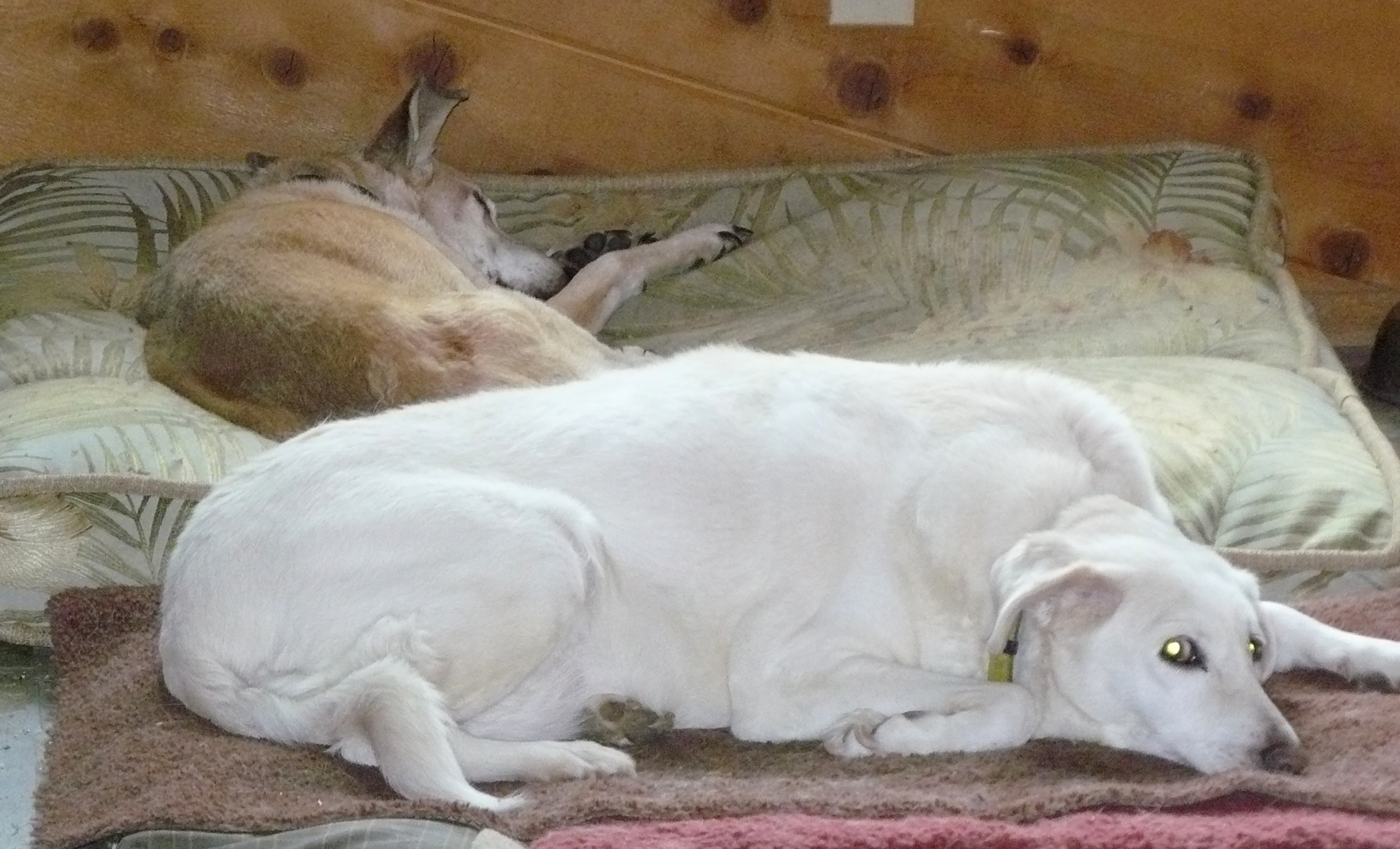
Lilly, to the rear of Paloma, sleeping soundly yesterday afternoon.
In the photograph above of Lilly and Paloma, both Mexican feral dogs rescued by Jean many years ago, sleep and a gentle life have allowed Lilly to achieve the grand old age of 17! In human terms that would be the equivalent of 136-years-old!
Because some of the things we humans do are insanely stupid!
Here’s a picture of Oliver taken yesterday afternoon.
Becoming a dear, smart dog. (And those eyes!)
A few days ago, I was sitting in our living room on one of our settees (more or less where Oliver was sitting when the photograph above was taken) with my knees up against a low coffee table; the table separates our two settees.
On the settee to my left lay Cleo and on the floor across my feet slept Hazel.
It was clear that Oliver wanted to join me on the settee but couldn’t work out if there was room. I shifted about two feet to my left leaving an Oliver-sized gap to my right. However, Oliver couldn’t come past my knees, from left to right as it were, because of Hazel. He very quickly worked out to run around behind the settee and jump up into the space I had newly created to my right.
Don’t worry if I lost you!
The point I am making is that Oliver, who has grown into the most delightful young adult dog, with a gorgeous temperament, demonstrates daily a keen intelligence and a nose for working things out quickly.
All of which is a preamble for me wondering if among the list of qualities that we humans should learn from dogs we should add intelligence.
For there’s been a few items around the ‘blogosphere’ that have highlighted how silly we can be.
Take this item that recently was featured on Grist.
A giant, 150-foot roll of bubble wrap may not be your idea of an environmentally friendly product, but over at Walmart.com this one-pound ball of plastic now boasts a special “Sustainability Leaders” badge. It’s one of more than 3,000 products tagged with this new green label, which Walmart executives unveiled last week, together with a web portal where shoppers can find these items.
Dozens of news accounts hailed the giant retailer’s move as a significant step toward clearing up the confusion and misleading information that often greet consumers trying to make ecologically responsible choices. “The world’s largest retailer took a major and important step toward helping all of us shop more smartly,” declared corporate sustainability consultant Andrew Winston in Harvard Business Review. Triple Pundit concurred: “It’s about to get a lot easier for Walmart.com shoppers to make the responsible choice.”
Actually, a green-minded online shopper is likely to find Walmart’s new badge confusing, murky, and downright misleading. I searched the bubble wrap’s product page high and low for its secret sauce, the invisible feature that makes it a smarter choice amid the many seemingly less harmful packing options available, but found no explanation.
It turns out that the key to this mystery lies in a remarkable disclaimer tucked into the middle of the home page of Walmart’s sustainability shopping portal: “The Sustainability Leaders badge does not make representations about the environmental or social impact of an individual product.” (my emphasis)
You can read the full item here, and you should! It’s unbelievably stupid, apart from being highly misleading, to my mind because when the word gets around it will damage the trust that all retailers need from their customers. And don’t even bring up the notion of integrity!
Then over on George Monbiot’s blogsite, there is a recent essay about the UN and progress on climate change. Here’s how it starts (and I’m republishing it in full tomorrow):
Applauding Themselves to Death
If you visit the website of the UN body that oversees the world’s climate negotiations, you will find dozens of pictures, taken across 20 years, of people clapping. These photos should be of interest to anthropologists and psychologists. For they show hundreds of intelligent, educated, well-paid and elegantly-dressed people wasting their lives.
The celebratory nature of the images testifies to the world of make-believe these people inhabit. They are surrounded by objectives, principles, commitments, instruments and protocols, which create a reassuring phantasm of progress while the ship on which they travel slowly founders. Leafing through these photos, I imagine I can almost hear what the delegates are saying through their expensive dentistry. “Darling you’ve re-arranged the deckchairs beautifully. It’s a breakthrough! We’ll have to invent a mechanism for holding them in place, as the deck has developed a bit of a tilt, but we’ll do that at the next conference.”
Humans have the potential to be incredibly smart thinkers, and down the ages there have been many such thinkers.
But!
Over on the Patrice Ayme blogsite there have been a couple of recent essays that highlight examples of both stupid thinking and the rewards that flow from smart thinking. In one essay, Added Value in the XXI Century, Patrice writes:
SUPERIORITY OF THE WEST?
Why did the West become so superior? Or China, for that matter?
Technology. Superior technology. Coming from superior thinking. Both the Greeks and the Chinese had colossal contempt for barbarians. (In both cases it went so far that the Greeks lost everything, and the Chinese came very close to annihilation).
Around the year 1000 CE, the Vietnamese (it seems) invented new cultivars of rice, which could produce an entire crop, twice a year. The population of East Asia exploded accordingly.
A bit earlier, the Franks had invented new cultivars of beans. The Frankish Tenth Century was full of beans. Beans are nutritious, with high protein.
Homo is scientific and technological. Thus, two million years ago, pelt covered (tech!) Homo Ergaster lived in Georgia’s Little Caucasus, a pretty cold place in winter. And the population was highly varied genetically (showing tech and travel already dominated).
A GREATER OBSESSION WITH FREEDOM MADE THE WEST SUPERIOR:
Here is the very latest. Flour was found in England, in archeological layers as old as 10,000 years before present. It was pure flour: there were no husks associated. The milling had been done, far away. How far? Well the cultivation of wheat spread to Western Europe millennia later. The flour had been traded, and brought over thousands of miles. Most certainly by boat. Celtic civilization, which would rise 5,000 years later, was expert at oceanic travel.
What’s the broad picture? Not just that prehistoric Englishmen loved their flat bread, no doubt a delicacy. Advanced technology has permeated Europe for much longer than is still understood now by most historians. Remember that the iceman who died in a glacier, 5,000 years ago, was not just tattooed, and had fetched in the lowlands a bow made of special wood. More telling: he carried antibiotics.
Some say that correct thinking has to do with avoiding “logical fallacies”. That is, of course, silly. Imagine a pilot in a plane. Suppose she avoids all logical fallacies. Where does the plane go? Nowhere. Thinking correctly is more than avoiding logical “fallacies”.
One needs more than logic, to proceed: one needs e-motion, or motivation (both express the fact that they are whatever gets people to get into action; the semantics recognizes that logic without emotion goes nowhere).
There is another, related, fallacy in thinking that correct thinking is all about avoiding “logical fallacies”.
I don’t have the answers to the conundrum of stupid thinking a la Walmart and the United Nations (not an exclusive list; by far) but I do believe that the only way for humanity to overcome what looks like a very dangerous era ahead is through smarter thinking!
Oh, nearly forgot.
Oliver will be happy to run classes on smart thinking!
I’ve written before about how our breath is connected with our wellbeing and emotional state. Noticing how we are breathing is a tool that we can use to monitor how we are doing.
There is another pause that comes with our breath which is also revealing. The pause at the end of the exhale before we take in more air. When we are distracted, stressed or in an anxious state, there is no pause. We don’t trust we have enough air and we don’t allow ourself to relax and let go.
Just take a moment to tune into how you are breathing right now. Just notice without judgment.
Pausing at the end of an exhale can only happen when we are relaxed and in tune with our mind and body. When our body and mind are aligned in the present moment.
I then left a reply in the comments section:
Excellent advice. For the last few weeks I have been using a biofeedback unit that through guiding one to breathe in harmony with a musical phrase allows one to slow the whole body down. Down to about 4.8 breaths per minute. It really underlines how slow one’s breathing rate can be and, supporting your post, the glorious pauses after each inhale and exhale.
And offered to write a post about the unit and my experiences. (Coming out tomorrow.)
However, what I wanted to do as a ‘lead-in’ to that post was to discover if there was any research into the benefits, as in scientific benefits, of slowing one’s body down in this fashion. What is surely nothing more than a form of meditation. Where to start looking? Needn’t have worried; there were many items on YouTube that covered the benefits of meditation.
There was a video from the AsapSCIENCE guys Mitchell Moffit and Gregory Brown, but I found it too jazzy and irritating, rather ironically! Then there was one from physicist John Hagelin that seemed much more appropriate to my tastes (and that is featured tomorrow as well).
By now it was coming up to 4:30pm and I had a dozen other things to do, plus try and fit in a biofeedback session – I could feel the stress rising within me.
Then I dipped into Terry Hershey’s latest Sabbath Moment and, guess what! Here’s what I read:
Learning to let go
January 26, 2015
Some of us think holding on makes us strong, but sometimes it is letting go. Herman Hesse
Uncertainty is the only certainty there is, and knowing how to live with insecurity is the only security. John Allen Paulos
When you let go of trying to get more of what you don’t really need, it frees up oceans of energy to make a difference with what you have. Lynne Twist
——-
Today I am sitting in a café (and bar) in Vaison-la-Romaine, in the Provence region of France, nursing my espresso.
No, wait… that was last week.
It just sounds sexier than saying, “Today I’m looking out my window at a gloomy winter sky, here in the Pacific Northwest, with a Thesaurus in hand hoping for a gushing synonym for gray.”
Welcome home. Home for me is always awaited and valued, but still elicits a bout of scotoma (selective vision), where we end up comparing the life we have, for the “life we deserve” (the actual wording for a recent advertised e-course).
My favorite part of my recent France trip was visiting family run wineries, spending time with the owner / wine-maker, with the permission to linger, sensing a comfort grounded in story and connection. Said one (when we asked him about being a small winery–in a world where big is everything), “I am glad. I am not alone. I work with family.” (Referring to his son and three daughters.)
And it makes me wonder about this mental sleight of hand we use, thinking about the life we are destined for, as somehow different (or better) from the life we now we live.
There is a Tibetan story about an earnest young man seeking enlightenment. (Earnest people must think this quite unfair–since they play a central role in most parables and stories about enlightenment.)
A famous sage passes through the man’s village. The man asks the sage to teach him the art of meditation. The sage agrees. He tells the man, “Withdraw from the world. Mediate every day in the specific way I will teach you. Do not waver and you will attain enlightenment.”
The earnest man follows the sage’s instructions to the letter. Time passes — and no enlightenment. Two years, five, ten, twenty pass.
It happens that the sage once again passes through the man’s village. The man seeks him out, grumbling that despite his best intentions and devotion and diligent efforts, he does not achieve enlightenment. “Why?”
The sage asks, “What type of meditation did I teach you?”
The man tells him.
The sage says, “Oh, what a terrible mistake I made! That is not the right meditation for you. You should have done another kind altogether. Too bad, for now it is too late.”
Disconsolate, the man returns to his cave. Staking his life on the sage’s instructions, and now believing he is without hope, the man abandons all his wishes and efforts and need to control his road to enlightenment. He does not know what to do. So, he does what he knows best: he begins meditating. And in a short while, much to his astonishment, his confusion begins to dissolve, and his inner world comes to life. A weight falls away and he feels lighter, and regenerated. When he walks out of the cave, the sky is bluer, the snow capped mountains whiter, and the world around him more vivid.
There is no doubt that all too often, our efforts–to succeed or achieve or attain–get in the way of our living. It brings to mind my favorite Robert Capon quote, “We live life like ill-taught piano students. So inculcated with the flub that will get us in dutch, we don’t hear the music, we only play the right notes.”
I understand. I was weaned on a spirituality that predicated itself on artifice. In other words, the importance is placed upon appearance, rather that just being. (It was vital to “look spiritual.” Which begs the question, “What do spiritual people look like?” As a boy, I always thought the “spiritual people” looked as if some part of their clothing was a size too small.)
What is it we are holding on to–so rigid, so firm, white-knuckled in our determination?
At some point, we’ve got to breathe.
Just breathe.
Without realizing it (and after the sage’s disheartening news), the man in the story “let go.”
He let go of the need to see life as a problem to be solved. He let go of the need to have the correct answers (or experiences) for his “enlightenment.” He let go of the need to see his spiritual life in terms of a formula. He let go of the restraints that come from public opinion.
Abandon your masterpiece, sink into the real masterpiece. Leonard Cohen
Without realizing it, he took Leonard Cohen’s advice. He abandoned his “masterpiece”–the perception of what he needed to accomplish, or how he needed to appear, or what he needed to feel–in order to allow himself to sink down into this life, this moment, even with all of its uncertainty and insecurity.
For the first many years, meditation or prayer was a requirement or compulsion. In his emptiness, meditation and prayer was an offering of thanks, freely given, and without constraint. True spiritual enlightenment, it seems, happens when you are not trying to impress anyone, or score any points with heavenly bookkeepers.
It sounds easy doesn’t it? But here’s the deal: My best intentions to play the right notes can fabricate an armor that keeps me from the vividness of life–whether it be to pray or meditate or notice or give or mourn or dance or play or grieve or laugh or celebrate or love… or just to walk.
I never did find a good enough synonym for the gray (although I’ll keep looking). Gladly, the sun has broken through. And there is enough warmth to persuade us that spring may arrive tomorrow. Daffodil shoots everywhere–up through the leaves and debris–help the ruse. So it’s garden time this afternoon, turning manure into the vegetable garden beds, beginning to cut back and clean some of the perennial beds. Enough work for the back to call a time out and request reprieve. I’m headed to the swing under the maple, when I look up to see the sun illuminating the red-twig dogwood shrubs, 10 foot canes glowing, a bright cranberry red. It catches my breath. And I am glad to be alive.
People say that what we’re all seeking is a meaning for life. I don’t think that’s what we’re really seeking. I think what we’re seeking is an experience of being alive… of the rapture of being alive. Joseph Campbell
Such power in those words. Then how moments later what I had read from Terry made so much sense to me. So perfectly connected with yesterday’s post Animals make us human. So relevant that quotation yesterday about animal happiness. This one:
Neuroscience key to animal happiness
“…research in neuroscience has been showing that emotions drive behavior, and my thirty-five years of experience working with animals have shown me that this is true. Emotions come first. You have to go back to the brain to understand animal welfare.”
Animals Make Us Human : Creating the best life for Animals
by Temple Grandin & Catherine Johnson
Such a close parallel with that well-known saying about us humans: ‘we are what we think‘. How our own happiness, just as it is with our animals, has its roots in our emotions.
How letting go, how staying in the present, is so good for us. How dogs do that so perfectly.
How we humans have so much to learn from our dogs.
Pure, deep peace radiating out from Hazel’s loving eyes.
I’m sure that the human psyche lives in a bubble of delusion. Not always and not extremely so; of course. Clearly, if the level of delusion were abnormal then we couldn’t function properly as social animals. However, just take a quiet moment of self-reflection to muse over the ways that you ‘shelter’ from reality. In directing that last point to you, dear reader, trust me I don’t exclude myself!
There are times when going beyond the self, going out of oneself, is the only way to see the reality of who we are and the world around us; to be able to brush away our delusions. Perfectly expressed by the author, Aldous Huxley: “Experience is not what happens to you; it’s what you do with what happens to you.” Wise words, indeed!
But these fine expressions representing the peak of common sense have one grinding, searing fault. They do not assume the end of a person’s life. I am speaking of death, of the inevitability of our death! That largely unspoken truth no better expressed than through the words[1] of Sharon Salzberg in her book Faith.
What does it mean to be born in a human body, vulnerable and helpless, then to grow old, get sick and die, whether we like it or not?
Anyone who has lost a loved one knows that it is tough; incredibly tough. It is full of pain and anguish amidst a great churning of emotions, all in a very deep-seated and personal manner. That’s the perspective from the loved ones left behind with more life ahead of them. But if one thinks of it in reverse, turns it on its head, what are our fundamental wishes with respect to those we love; what we would want to leave behind when we die?
Fond memories, naturally, but they wouldn’t be our fundamental wishes. This is what those fundamental wishes would be. That our death does not leave pain and anguish in the hearts and souls of those left behind. That it doesn’t leave a pain that cannot be dealt with in a healthy way. Our wishes would be that those whom we loved and who loved us may embrace their loss and move on.
Anyone who has loved a dog has most likely been intimately involved in the end of that dog’s life. It is, to my mind, the ultimate lesson that dogs offer us: how to be at peace when we die and how to leave that peace blowing through the hearts of all the people who loved us.
Our beloved dogs have much shorter life spans than we do, thus almost everyone who has loved a dog will have had to say goodbye to that gorgeous friend at some point in their lives. Very sadly, perhaps, saying goodbye to more than one loved dog.
I see the most precious of parallels in the tragic death of a loved dog and our own death. The parallel between coping with our grief for the loss of a loved dog and reaching out to our loved ones so that they may cope with their grief at losing us.
In other words, knowing what to expect in emotional terms at the loss of our loved dog is helpful, very much so, to us helping our loved ones when comes our time to die.
There are five stages of mourning[2], of dealing with our grief, when we lose our beloved dog: Denial; Anger; Guilt; Depression and Acceptance.
Compare those stages to the five stages of mourning[3], perhaps of dealing with the knowledge that oneself is dying, or a person is dying who is very emotionally close to us. Those five stages are: Denial and Isolation; Anger; Bargaining; Depression and Acceptance.
The parallels are almost perfect.
Whether it is the impending or actual death of a loved dog, a loved person, or ourselves, the similarities between embracing the loss of the loved dog, or the loved person, are powerfully obvious. So, too, are the many different ways each of us embraces the death of a loved dog or a loved person. Let me expand on this last point.
Namely, that each of us will experience each stage of mourning at varying levels of intensity, for varying lengths of time, and sometimes in a different order. Some of the stages may converge and overlap each other. But however you experience the mourning, it is incredibly important to remember that your feelings are completely normal.
As the website of the American Animal Hospital Association points out, on their webpage entitled Life after Dog[4], “… we almost always outlive our beloved companions. Learning to live with loss is an essential part of life.”
That webpage imploring us to honour our emotions, to honour the memory of our dog, and critically, when a child is involved, to help that child cope with the loss of their loved dog. For all, young and old, helping to ease the pain through learning to cope with the loss. Easing the pain through changing one’s schedule, moving furnishings around to help distance the memory of your dog’s favourite sleeping spots, or creating a memorial in one form or another, even writing a letter (or blog post!) to your dog in which one describes all the feelings you have for your recently departed, loved dog.
I was born in 1944. I am therefore the ‘wrong’ side of seventy years old. I was born an Englishman and, according to life expectancy tables from 2012, a male Englishman’s life expectancy is 79.5 years. I am living happily in the USA and, according to those same tables, a male American’s life expectancy is 77.4 years. My mother is alive and an amazingly fit and healthy ninety-five-year-old, at the time of writing this book. My father died at the age of 56 just 5 days before Christmas in 1956. I do not believe in any form of spiritual life after death.
So take your pick!
All that I do know is that loving our dogs, welcoming all the wonderful qualities that our dogs possess, striving always to live peacefully ‘in the present’, just as our dogs do, and, ultimately, as with our faithful companions, taking that last breath in the knowledge that ours was a beautiful life, is what learning from dogs is all about.
The last quality that I want to write about, as in the last quality that I see in our dogs that we humans should learn, is about stillness. There was a very deliberate reason to make it the last one. But, if you will forgive me, I’m not going to explain why until near the end.
Stillness! The dog is the master of being still. Being still, either from just laying quietly watching the world go by, so to speak, or being still from being fast asleep. The ease at which they can find a space on a settee, a carpeted corner of a room, the covers of a made-up bed, and stretch out and be still, simply beggars belief. Dogs offer us humans the most wonderful quality of stillness that we should all practice. Dogs reveal their wonderful relationship with stillness.
In the August of 2014, TED Talks published a talk by Pico Iyer. Despite the uncommon name, Pico Iyer was not a person I had heard of before. A quick search revealed that he was a British-born essayist and novelist of Indian origin. Apparently, Pico is the author of a number of books on crossing cultures and has been an essayist for Time Magazine since 1986. Pico Iyer’s TED Talk was called: The art of stillness.
It was utterly riveting. In a little over fifteen minutes, Pico’s talk touched on something that so many of us feel, probably even yearn for: the need for space and stillness in our minds. Stillness to offset the increasingly excessive movement and distractions of our modern world. Or to use Pico’s words:”Almost everybody I know has this sense of overdosing on information and getting dizzy living at post-human speeds.”
Now Pico has clearly been a great traveller and the list of countries and places he has visited was impressive. From Kyoto to Tibet, from Cuba to North Korea, from Bhutan to Easter Island; a man having grown up both being a part of, and yet apart from, the English, American and Indian cultures. Yet of all the places this man has been to he tops them all with what he discovers in stillness: “… that going nowhere was at least as exciting as going to Tibet or to Cuba.”
Here are Pico Iyer’s own words from that TED Talk. Firstly:
And by going nowhere, I mean nothing more intimidating than taking a few minutes out of every day or a few days out of every season, or even, as some people do, a few years out of a life in order to sit still long enough to find out what moves you most, to recall where your truest happiness lies and to remember that sometimes making a living and making a life point in opposite directions.
Then a few moments later, him saying:
And of course, this is what wise beings through the centuries from every tradition have been telling us. It’s an old idea. More than 2,000 years ago, the Stoics were reminding us it’s not our experience that makes our lives, it’s what we do with it.
….
And this has certainly been my experience as a traveler. Twenty-four years ago I took the most mind-bending trip across North Korea. But the trip lasted a few days. What I’ve done with it sitting still, going back to it in my head, trying to understand it, finding a place for it in my thinking, that’s lasted 24 years already and will probably last a lifetime. The trip, in other words, gave me some amazing sights, but it’s only sitting still that allows me to turn those into lasting insights. And I sometimes think that so much of our life takes place inside our heads, in memory or imagination or interpretation or speculation, that if I really want to change my life I might best begin by changing my mind.
Emails, ‘smartphones’, telephone handsets all around the house, television, junk mail on an almost daily basis, advertising in all its many forms, always lists of things to do; and on and on. It’s as if in this modern life, with the so many wonderful ways of doing stuff, connecting, being entertained, and more, that we have forgotten how to do the most basic and fundamental of things: Nothing! It’s as if so many of us have lost sight of the greatest luxury of all: immersing ourselves in that empty space of doing nothing.
Thus it wouldn’t be surprising to learn that more and more people are taking conscious and deliberate measures to open up a space inside their lives. Whether it is something as simple as listening to some music just before they go to sleep, because those that do notice that they sleep much better and wake up much refreshed, or taking technology ‘holidays’ during the week, or attending Yoga classes or enrolling on a course to learn Transcendental Meditation, there is a growing awareness that something in us is crying out for the sense of intimacy and depth that we get from people who take the time and trouble to sit still, to go nowhere.
Even science supports the benefits of slowing down the brain. In an article[1] posted on the Big Think blogsite, author Steven Kottler explains what are called ‘flow states’: “a person in flow obtains the ability to keenly hone their focus on the task at hand so that everything else disappears.”
Elaborating in the next paragraph, as follows:
“So our sense of self, our sense of self-consciousness, they vanish. Time dilates which means sometimes it slows down. You get that freeze frame effect familiar to any of you who have seen The Matrix or been in a car crash. Sometimes it speeds up and five hours will pass by in like five minutes. And throughout all aspects of performance, mental and physical, go through the roof.”
The part of our brain known as the prefrontal cortex houses our higher cognitive functions such as our sense of morality, our sense of will, and our sense of self. It is also that part of our brain that calculates time. When we experience flow states or what is technically known as ‘transient hypofrontality’, we lose track of time, lose our grip on assessing the past, present, and future. As Kotler explains it, “we’re plunged into what researchers call the deep now.”
Steven Kotler then goes on to say:
“So what causes transient hypofrontality? It was once assumed that flow states are an affliction reserved only for schizophrenics and drug addicts, but in the early 2000s a researcher named Aaron Dietrich realized that transient hypofrontality underpins every altered state — from dreaming to mindfulness to psychedelic trips and everything in between. Sometimes these altered states involve other parts of the brain shutting down. For example, when the dorsolateral prefrontal cortex disconnects, your sense of self-doubt and the brain’s inner critic get silenced. This results in boosted states of confidence and creativity.”
Don’t worry about the technical terms, just go back and re-read those last two sentences, “For example, when the dorsolateral prefrontal cortex disconnects, your sense of self-doubt and the brain’s inner critic get silenced. This results in boosted states of confidence and creativity.”
All from stillness!
Back to Pico Iyer’s talk and his concluding words:
So, in an age of acceleration, nothing can be more exhilarating than going slow. And in an age of distraction, nothing is so luxurious as paying attention. And in an age of constant movement, nothing is so urgent as sitting still. So you can go on your next vacation to Paris or Hawaii, or New Orleans; I bet you’ll have a wonderful time. But, if you want to come back home alive and full of fresh hope, in love with the world, I think you might want to try considering going nowhere. Thank you.
At the start of this chapter, I mentioned that I would leave it until the end to explain why I deliberately made this one on stillness the last one in the series of dog qualities we humans have to learn.
Here’s why. For the fundamental reason that it is only through the stillness of mind, the stillness of mind that we so beautifully experience when we hug our dog, or close our eyes and bury our face in our dog’s warm fur; it is that stillness of mind, that like any profound spiritual experience, that has the power to transform our mind from negative to positive, from disturbed to peaceful, from unhappy to happy.
The power of overcoming negative minds and cultivating constructive thoughts, of experiencing transforming meditations is right next to us in the souls of our dogs.
“Sanctuary is where you go to cherish your life. It’s where you practice being present. And it may not be that many steps from where you are, right now.” The Rev. Terry Hershey.
When I was pondering this part of the book, namely Part Five and the qualities we can learn from dogs, and before I started into the writing, when I was building the list of qualities of dogs that we humans need to learn, I was unsure if this chapter on acceptance, together with the previous one on openness, and the one coming up on adaptability, weren’t all too close to the same idea. But after having thought about it some more, I decided that these three qualities are sufficiently different to warrant them being three qualities that we should learn!
For openness is all about offering to others, whereas acceptance is, in a sense, the reverse current, allowing the outside world to flow in to one without too many mental and emotional ‘filters’ corrupting that inward flow and, finally, adaptability is all about change.
Let us start with what our dogs offer us when it comes to acceptance. Almost immediately comes the answer: dogs accept the humans around them and the human world, accept their life as a pet, and accept their world as a domesticated animal; accept it all as it is for what it is.
Just think for a moment of the vast range of life experiences that our dogs are embedded within. From the tiniest poodle who rarely is separated from its owner, to the sheepdog that ‘works’ the land and spends its nights outside in the barn, all the way to the German Shepherd guard dog that is hardly a pet. Dogs are authentic; in the full meaning of the term. They respond, react may be a better word, to their environment and to their natural instincts but totally within the human world in which each particular dog has been cast.
That is a level of acceptance that we humans can only dream about.
Nevertheless, even if that level of acceptance of the world outside us is most likely beyond reach for us humans, there is still an important lesson to be learnt.
Let me elaborate.
The quality of the relationships that we have with others revolves entirely around how we view those other people. And nowhere is that more important than how we view those close to us; our family and our spouses and partners.
If we use the wonderful way in which dogs accept the outside world and, most notably, the way they accept other dogs, as a model for that being the way we accept our partner, there is much research to underpin the fact that we will enjoy wonderful relationships.
If we quietly admit to ourselves that we do not accept our partners as fully as we should, then learning fully to accept them will transform our relationship miraculously.
For the acceptance of the person you share your life with is the biggest gift of respect you can give them. It underlines how much you love them and how much you respect them. It demonstrates that you know that the decisions your partner makes, from small ones to large ones, are based on what they believe is right. It doesn’t at all deny you offering support and guidance, of course not, but what it does guarantee is that you don’t stray into criticism of them, especially the genre of criticism that has its roots in your (false) belief that the other person is not thinking like you, not seeing something as you see it. For one very obvious reason: they aren’t you!
There is no question at all that acceptance is the greatest gift you can offer someone, especially someone emotionally close, because it is the greatest sign of respect. And respect is the cousin of trust and without trust there is no relationship. It applies equally to humans and dogs! Just because we accept our dog unconditionally, that our dog is completely authentic, because we know that it is a dog, and never expect them to be anything other than a dog, doesn’t in any way mean that the same approach, the same unconditional acceptance of a person in our lives, should not be our way of living with that other person.


 Learning from Dogs