Category: Culture

A beautiful story!

Rocky ends up getting rescued, and more..

For a while now I have been subscribing to The Dodo. As the website explains it’s for animal people and as you and I know that’s quite a great many people!

Until now I have been a little nervous of sharing articles from The Dodo with you. But then I noticed quite recently that there is a ‘share’ button at the end of the articles.

So I presume it’s alright to share these wonderful stories!

Try this one published in April, 2019!

ooOOoo

Fireman Shows Up To Save Puppy Trapped Under Concrete — And Immediately Falls In Love

“I knew he was coming home with me.”

By 
PUBLISHED ON 04/15/2019

A family was out riding their bikes one day in South Carolina when they suddenly heard what sounded like a puppy crying. They pulled their bikes over to the side of the road and went to investigate, and were shocked to find a little puppy trapped under a pile of dirt and concrete. Not knowing how else to help, they quickly called 911, and both the police and firefighters with the North Charleston Fire Department responded in hopes that they could free the trapped puppy.

North Charleston Fire Department

“They showed us where the dog was located,” Captain Paul Bryant, of the North Charleston Fire Department, told The Dodo. “It was piles of concrete 4 foot by 4 foot, some smaller, some bigger. One of the police officers said he could see the dog so we got on our hands and knees to look and saw his nose sticking out of the pile of rubble.”

After moving the concrete slabs out of the way with a pry bar, Captain Bryant attempted to pull the puppy, later named Rocky, out from the remaining dirt and rubble, but unfortunately there just wasn’t enough room. He then took a shovel and started digging, and finally was able to create enough space to pull the confused puppy out to safety. The whole rescue only took about 11 minutes, but no one has any idea how long Rocky had been stuck under there before everyone arrived.

North Charleston Fire Department

As soon as he was free, little Rocky couldn’t stop licking Bryant’s face in gratitude. The puppy clearly had so much energy and lots of love to give, and everyone immediately fell in love with him — especially Bryant. The family who had initially found Rocky said they would take him to a nearby animal hospital to get checked for a microchip so he could hopefully be reunited with his family, but after he was gone, Bryant just couldn’t get Rocky out of his head.

North Charleston Fire Department

Rocky was taken in by Charleston Animal Society, and ended up not being microchipped after all. The search for his potential family came up empty, and as soon as Bryant heard, he knew exactly what he had to do.

“I wanted to know if his owner was found, or if the person who found him was going to keep him,” Bryant said. “Once I found out he did not have an owner and the family who found him could not keep him, I knew he was coming home with me.”

North Charleston Fire Department

We go back a very long time

The ancient history of man and dog!

And when I say ‘man’ I am of course referring to the species.

For a couple of weeks ago Meilan Solly of The Smithsonian wrote about the relationship 4,500 years ago of man and dog.

In Neolithic times there was an important relationship, as there is today. Maybe our dogs have become more of the ‘pet’ rather than the working dog that they are assumed to be then.

But here’s the article.

ooOOoo

Thanks to Facial Reconstruction, You Can Now Look Into the Eyes of a Neolithic Dog

The collie-sized canine was buried in a cavernous tomb on Scotland’s Orkney Islands around 2,500 B.C.

Experts believe the Neolithic dog is the first canine to undergo forensic facial reconstruction (Santiago Arribas/Historic Environment Scotland)
By Meilan Solly
SMITHSONIAN.COM, 

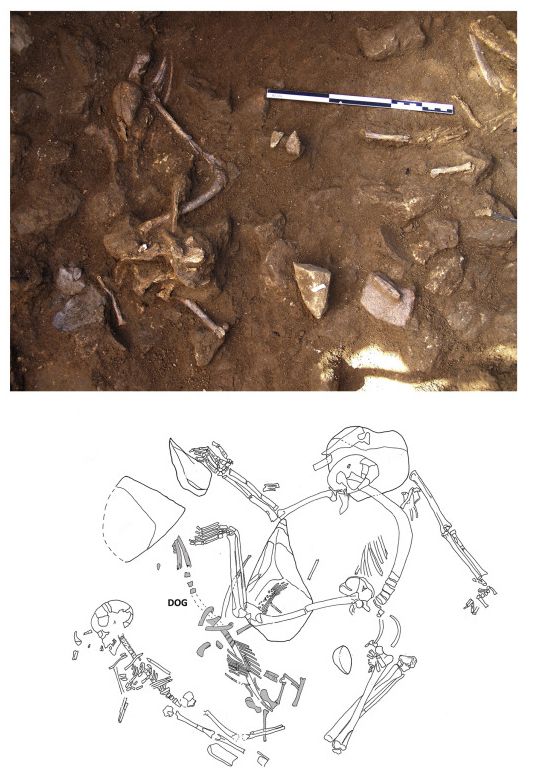
Some 4,500 years ago, a collie-sized dog with pointed ears and a long snout comparable to that of the European grey wolf roamed Scotland’s Orkney Islands. A valued member of the local Neolithic community, the canine was eventually buried alongside 23 other dogs and at least eight humans in a cavernous tomb known as the Cuween Hill Chambered Cairn.

Now, 118 years after archaeologists first chanced upon its resting place, the prized pup’s image is being reimagined. As Esther Addley reports for the Guardian, experts believe the dog is the first canine to undergo forensic facial reconstruction. Its likeness, commissioned by Historic Environment Scotland (HES) and the National Museum of Scotland, is set to go on view in Orkney later this year.

“Just as they’re treasured pets today, dogs clearly had an important place in Neolithic Orkney, as they were kept and trained as pets and guards and perhaps used by farmers to help tend sheep,” Steve Farrar, interpretation manager at HES, explains in a statement. “But the remains discovered at Cuween Hill suggest that dogs had a particularly special significance for the farmers who lived around and used the tomb about 4,500 years ago.”

It’s possible, Farrar adds, that the Neolithic group viewed dogs as their “symbol or totem,” perhaps even dubbing themselves the “dog people.”

Cuween Hill dates to around 3,000 B.C., Sky News reports, but radiocarbon dating places the dog’s actual interment some 500 years later. It remains unclear why the animal was buried so many centuries after the tomb’s creation, but archaeologists posit the timing may point toward the ceremony’s ritual value within the community. As HES observes, the fact that the Orkney residents placed canine remains alongside those of humans could also speak to their belief in an afterlife for both parties.

According to the Scotsman, forensic artist Amy Thornton drew on a CT scan to create a 3-D print of the animal’s skull. After layering clay approximations of muscle, skin and hair onto this base, she cast the model in silicone and added a fur coat designed to mimic that of the European grey wolf. Interestingly, Thornton notes, the process played out much as it would for a human facial reconstruction, although “there is much less existing data” detailing average tissue depth in canine versus human skulls.

The model is the latest in a series of technologically focused initiatives centered on Orkney’s Neolithic residents. Last year, HES published 3-D digital renderings of the chambered cairn on Sketchfab, enabling users to explore the tomb’s four side cells, tall central chamber and entrance passage. First discovered in 1888 but only fully excavated in 1901, the impressive stone structure held 24 canine skulls and the remains of at least eight humans.

In an interview with the Guardian’s Addley, Farrar explains that the reconstruction aims “to bring us closer to who [the dog’s owners] were and perhaps give a little hint of what they believed.”

“When you look at a Neolithic dog, it somehow communicates human relationships,” Farrar concludes. “… I can empathise with the people whose ingenuity made Orkney such an enormously important place. When this dog was around, north-west Europe looked to Orkney.”

ooOOoo

“When you look at a Neolithic dog, it somehow communicates human relationships,” Farrar concludes.

That’s a powerful statement.

Now if one goes across to the website for Cuween Hill Chambered Cairn one reads this:

History

An ancient site for burials

Built between 3000 and 2400 BC, this is an excellent example of a Neolithic chambered tomb. It has four cells opening off a central chamber, which is accessed down a passage. Entrance into the tomb today is through the original passage.

Secondary burials at the Cuween Hill could reflect a continued reverence for the site. A recently discovered settlement nearby is probably contemporary with the cairn, and would likely have been connected.

Tomb of the dogs

Exploration at the tomb in 1901 found:

  • Remains of at least eight humans – five skulls on the floor of the chamber, one at the entrance and two in side cells
  • The skulls of 24 dogs on the chamber floor

The dog remains suggest the local tribe or family perhaps had a dog as their symbol or totem, or there may have been a belief in an afterlife for animals.

The tomb is completely unlit, which serves to both add to the atmosphere and discourage vandalism and graffiti. It also means the tomb is largely free of green algal growth.

The stonework at Cuween Hill is of particularly high quality. The roof of one of the cells is likely to be original, elsewhere the walls and corbelled roofs have survived to a considerable height.

As I said, we go back a very long time!

Being in charge.

“Dogs have masters, cats have staff.”

That’s a well-known saying that, nonetheless, has a certain element of truth about it.

So what is the truth?

Well read the following and see for yourself.

ooOOoo

Pet owners want to be masters, not servants – which is why we value dogs more than cats

By

Assistant Professor of Marketing, New York Institute of Technology

Cat videos may rule the internet, but dogs possess mastery of their owners’ hearts – at least if spending is any guide.

Dog owners spend US$240 a month caring for their pets, compared with $193 for cats, according to the 2017-2018 National Pet Owners Survey from the American Pet Products Association. The extra money goes primarily toward vet visits and kennel boarding, but dog owners also spend more lavishly on treats, grooming and toys.

My new paper, “Dogs Have Masters, Cats Have Staff,” shines some light on why.

A cat would never let its owner do this. Reuters/Andrew Wong

A growing market

Americans are spending more on pet care as an increasing share of U.S. households own an animal.

A little over two-thirds of all U.S. households own at least one pet, up from 56 percent in 1988, the first year of the National Pet Owners Survey.

And almost half of households own a dog, while just 38 percent have a cat. Generational trends suggest this divergence is likely to grow, as millennials are more likely to adopt a canine, while baby boomers tend to be cat lovers.

This is resulting in a growing market for pet-related products and services, which hit an estimated $72 billion in 2018, up from $46 billion a decade earlier.

A willingness to pay

My study builds on earlier research showing that dog owners are willing to spend more on their pets than cat owners – including to save their lives.

One reason suggested was that dog owners had stronger bonds to their pets, which prompted them to spend more on things like veterinary care.

My research uncovered a key factor indicating why dog owners feel more attached to their pets: Dogs are famously more compliant than cats. When owners feel in control of their pets, strong feelings of psychological ownership and emotional attachment develop. And pet owners want to be masters – not servants.

Like other marketing researchers, my work uses “willingness to pay” as an indicator of the economic, rather than emotional, value owners place on their pets. It shows – and compares – how much pet owners would pay to save their animal’s life.

Dog owners are willing to pay twice as much as cat owners for a life-saving surgery. AP Photo/Angie Wang

Who’s in control?

So I carried out three online experiments to explore the role of psychological ownership in these valuations.

In the first experiment, I asked dog or cat owners to write about their pet’s behavior so I could measure their feelings of control and psychological ownership. Participants then imagined their pet became ill and indicated the most they would be willing to pay for a life-saving surgery.

Dog owners, on average, said they would pay $10,689 to save the life of their pet, whereas cat owners offered less than half that. At the same time, dog owners tended to perceive more control and psychological ownership over their pets, suggesting this might be the reason for the difference in spending.

Of course, correlation is not causation. So in a second experiment, I asked participants how much they would be willing to pay to save their animal’s life after I had disturbed their sense of ownership. I did this by asking participants to imagine their pet’s behavior was a result of training it received from a previous owner.

As expected, disrupting their feelings of ownership eliminated the difference in valuation between dogs and cats.

Since pet owners like to control their animals, and since cats are less controllable than dogs, the third experiment went straight to the point: Does the owner value the dog or cat for its own sake or for its compliant behavior?

To find out, I again asked survey respondents to describe how much they’d be willing to pay to save their pet’s life, but this time I randomly assigned one of four scenarios: Participants were told they either own a dog, a cat, a dog that behaves like a cat, or a cat that behaves like a dog.

Participants reported they would pay $4,270 to save the life of their dog, but only $2,462 for their cat. However, this pattern was reversed when the pet’s behavior changed, with dog-behaving cats valued at $3,636, but cat-behaving dogs only $2,372.

These results clearly show that the animal’s behavior is what makes people willing to pay.

When cats act more like dogs, people say they’d spend more money on them. pixfix/shutterstock.com

Master or servant

These findings establish that psychological ownership is a driving factor in dog owners’ higher valuations.

People feel ownership because they perceive that they can control their pets’ behavior. This research even distinguishes the type of control that probably most stimulates ownership feelings: It’s not just physical control, such as being able to pick up an animal or drag it by a leash. Rather, it’s the animal’s voluntary compliance with its owner’s wishes.

No matter how cute and cuddly your kitties may be, they can’t compete with dogs when it comes to giving pet owners the sense of mastery they seek.

ooOOoo

Taken from here.

What I find amazing are the figures for the US in terms of dog ownership. As in over half of households own a dog.

I suspect it will continue to grow.

Because the bond between a human and a dog is unique as well as being very beautiful!

It stretches the mind beyond imagination!

The most incredible story of all!

I first read the story early yesterday morning in The Guardian Newspaper.

But then I saw another version of the same story on the BBC News site, from which I republish it in its entirety.

ooOOoo

First ever black hole image released

By Pallab Ghosh
Science correspondent, BBC News

The first ever picture of a black hole: It’s surrounded by a halo of bright gas.

Astronomers have taken the first ever image of a black hole, which is located in a distant galaxy.

It measures 40 billion km across – three million times the size of the Earth – and has been described by scientists as “a monster”.

The black hole is 500 million trillion km away and was photographed by a network of eight telescopes across the world.

Details have been published today in Astrophysical Journal Letters.

Prof Heino Falcke, of Radboud University in the Netherlands, who proposed the experiment, told BBC News that the black hole was found in a galaxy called M87.

“What we see is larger than the size of our entire Solar System,” he said.

“It has a mass 6.5 billion times that of the Sun. And it is one of the heaviest black holes that we think exists. It is an absolute monster, the heavyweight champion of black holes in the Universe.”

The image shows an intensely bright “ring of fire”, as Prof Falcke describes it, surrounding a perfectly circular dark hole. The bright halo is caused by superheated gas falling into the hole. The light is brighter than all the billions of other stars in the galaxy combined – which is why it can be seen at such distance from Earth.

The edge of the dark circle at the centre is the point at which the gas enters the black hole, which is an object that has such a large gravitational pull, not even light can escape.

Taking the temperature of black holes

Hawking: Black holes store information

Dozen black holes at galactic centre

DR JEAN LORRE/SCIENCE PHOTO LIBRARY I have suspected that the M87 galaxy has a supermassive black hole at its heart from false colour images such as this one. The dark centre is not a black hole but indicates that stars are densely packed and fast moving.

The image matches what theoretical physicists and indeed, Hollywood directors, imagined black holes would look like, according to Dr Ziri Younsi, of University College London – who is part of the collaboration.

“Although they are relatively simple objects, black holes raise some of the most complex questions about the nature of space and time, and ultimately of our existence,” he said.

“It is remarkable that the image we observe is so similar to that which we obtain from our theoretical calculations. So far, it looks like Einstein is correct once again.”

But having the first image will enable researchers to learn more about these mysterious objects. They will be keen to look out for ways in which the black hole departs from what’s expected in physics. No-one really knows how the bright ring around the hole is created. Even more intriguing is the question of what happens when an object falls into a black hole.

What is a black hole?

  • A black hole is a region of space from which nothing, not even light, can escape
  • Despite the name, they are not empty but instead consist of a huge amount of matter packed densely into a small area, giving it an immense gravitational pull
  • There is a region of space beyond the black hole called the event horizon. This is a “point of no return”, beyond which it is impossible to escape the gravitational effects of the black hole
Presentational white space

Prof Falcke had the idea for the project when he was a PhD student in 1993. At the time, no-one thought it was possible. But he was the first to realise that a certain type of radio emission would be generated close to and all around the black hole, which would be powerful enough to be detected by telescopes on Earth.

He also recalled reading a scientific paper from 1973 that suggested that because of their enormous gravity, black holes appear 2.5 times larger than they actually are.

These two previously unknown factors suddenly made the seemingly impossible, possible. After arguing his case for 20 years, Prof Falcke persuaded the European Research Council to fund the project. The National Science Foundation and agencies in East Asia then joined in to bankroll the project to the tune of more than £40m.

The eventual EHT array will have 12 widely spaced participating radio facilities

It is an investment that has been vindicated with the publication of the image. Prof Falcke told me that he felt that “it’s mission accomplished”.

He said: “It has been a long journey, but this is what I wanted to see with my own eyes. I wanted to know is this real?”

No single telescope is powerful enough to image the black hole. So, in the biggest experiment of its kind, Prof Sheperd Doeleman of the Harvard-Smithsonian Centre for Astrophysics, led a project to set up a network of eight linked telescopes. Together, they form the Event Horizon Telescope and can be thought of as a planet-sized array of dishes.

KATIE BOUMAN Information gathered is too much to be sent across the internet. Instead the data was stored on hundreds of hard drives which were flown to a central processing centre.
JASON GALLICCHIO

Each is located high up at a variety of exotic sites, including on volcanoes in Hawaii and Mexico, mountains in Arizona and the Spanish Sierra Nevada, in the Atacama Desert of Chile, and in Antarctica.

A team of 200 scientists pointed the networked telescopes towards M87 and scanned its heart over a period of 10 days.

The information they gathered was too much to be sent across the internet. Instead, the data was stored on hundreds of hard drives that were flown to a central processing centres in Boston, US, and Bonn, Germany, to assemble the information. Prof Doeleman described the achievement as “an extraordinary scientific feat”.

“We have achieved something presumed to be impossible just a generation ago,” he said.

“Breakthroughs in technology, connections between the world’s best radio observatories, and innovative algorithms all came together to open an entirely new window on black holes.”

The team is also imaging the supermassive black hole at the centre of our own galaxy, the Milky Way.

Odd though it may sound, that is harder than getting an image from a distant galaxy 55 million light-years away. This is because, for some unknown reason, the “ring of fire” around the black hole at the heart of the Milky Way is smaller and dimmer.

Follow Pallab on Twitter

ooOOoo

One of the most remarkable things about this story is that it continues to validate the theories of Albert Einstein (1879-1955). That is doubly impressive.

The film, How to see a Black Hole: The Universe’s Greatest Mystery,    is a most interesting account of the skills that were utilised by the team, and the luck of that same group in pulling it all together.

This is clearly the start of a new journey in astronomy.

I will leave you by repeating the image of the black hole.

The first ever picture of a black hole: It’s surrounded by a halo of bright gas.

Dr. Dog!

The truth of having a dog in your life.

I really should have written having a pet in your life because the following story is about cats and dogs. Plus, it’s been copied from The Guardian Newspaper so I fully expect that it will be taken down fairly soon.

But here goes!

ooOOoo

Sometimes a dog can be better for a patient than hospital

Suffering patients may need to just be asked ‘tell me about your pet’

Photograph: IJdema/Getty Images/iStockphoto

‘I wonder how often doctors are cognisant of the silent distress of patients who are separated from their pets?’

An elderly patient is admitted to hospital after a fall at home. He is stunned after the fall but, thankfully, uninjured. It takes him a few days to recover but as soon as he is able, he wants to go home. The physiotherapist wants to work with him, the social worker wants to examine his support system, but all he wants to do is go home. We feel he is not yet safe. He acknowledges that a worse event could happen but still, he wants to go home. Theories are posited as to why.

Maybe the concussion is worse than we first thought. Maybe he is cognitively impaired and unable to make decisions about his safety, in which case a state-appointed guardian may be needed. Maybe he doesn’t like the other patients, in which case he could be placated by moving him to another room. It is the beginning of a month of medical rounds for me and he is the handover without a plan.

He is sitting out of bed, dressed and sipping his tea. He looks up at a new face with interest.

“I am the specialist taking over your care,” I say.

“Look, love, please just let me go home. I’m begging you.”

Something about his desperation moves me and I am struck by the imbalance of power between me and my patient twice my age.

“I really want to, but help me understand why you’re so eager.”

I expect to hear about the incessant noise in the hospital, the bad food or the lack of clear communication but instead, to my complete surprise, tears start rolling down his face.

“It’s my cat. I want to see my cat.”

The cat is a link to the years he shared with his late wife. Now it snoozes in his wife’s chair and responds to his reminiscences, as if to say it knows he is hurting. In the twilight of his life, when his children are too busy to visit and the residents in his retirement village keep falling sick, his cat is the constant in his life.

“You can’t fix an old man,” he pleads. “But send me back to my cat.”

“I am going to do just that,” I say.

Outside, his story touches a nerve. People band together, set up community services and get him home quickly. In the end, he turns out to be a simple discharge. Reuniting an old man with his cat turns out to be the best medicine, which leaves me wondering how often doctors are cognisant of the silent distress of patients who are separated from their pets. Not often, I suspect.

The very next week, the distress of another patient announces itself loudly and heartbreakingly. She is 50, her dog was 18. She was divorced and lonely. He was old and slow. When her work turned her out and her friends moved on, the dog proved her anchor.

Amid all the shifting circumstances of her life, he never stopped loving her and greeting her with delight every morning. He needed nothing more than a walk and a few biscuits to send him into raptures of delight. Suddenly he fell very ill and the vet suggested the kindest thing to do was to let him go. So she did. Then she came home and took an overdose. How could she face life without her dog?

The postman spotted her through the window and called an ambulance. She was successfully resuscitated and now she is on the medical ward, awaiting psychiatric intervention. When I meet her she is pleasant and remorseful, particularly for being a burden on the overstretched mental-healthcare system.

A psych consult won’t help her, she pleads, another dog will. In fact, she has found just the right one and even thought of a name. She just hopes it won’t be gone before she is cleared. I tell her that all my sympathies still won’t add up to a hasty discharge because she really does need to see the psychiatrist. She begins to sob.

I have an insightful resident with me.

“Tell me about your dog,” she asks brightly. “I love dogs.”

The patient pulls out a photo from under her pillow.

“He is so happy,” I remark as I start jotting some notes.

“He was all I had. I went months without talking to people.”

Her loneliness will need attention but that’s a topic for another day, easy to identify but difficult to fix.

“What was his favourite thing to do?” the resident smiles, leaning forward.

“He loved to walk, even as an old thing.”

We go back and forth, the standard questions about headache, pain and immobility replaced by an interest in a departed dog that was the life of his owner.

It feels intuitively right but somehow misplaced, as if we are breaking some established protocol that says we should be asking about the number of pills she took and whether there was alcohol involved and what she would do if her new dog got sick. We should be checking her vitals, ensuring her bloods are fine, that the drug screen is clear. And watching our every word in case something inopportune brings her grief crashing back and we are to blame.

Except, in that moment, it is clear that while the medical questions have merit, the most important thing for this patient at this time is to cast them all aside and create a common understanding to make her feel less lonely in her experience. I count 10 minutes spent at her bedside. In those 10 minutes, we watch her mood lift and fresh hope enter her tone. There are people who love dogs, she thinks. There are people who understand my grief. Why, they are even interested in my old dog.

Our time is limited, and we must move on apologetically. With dry eyes and genuine gratitude, she says, “Thank you for asking about my dog. It’s the nicest thing anyone has done.”

Really? Could it be this simple?

Amid the trappings of modern medicine, it’s hard to believe that the inexpensive 10 minutes spent at her bedside might have proved to be the most useful and cathartic treatment of all. All her tests turned out fine. A day later, she is deemed safe for discharge and is overjoyed at the reprieve.

The next time we meet an upset patient, I suspect we will be tempted to ask the same question as always, “What’s the problem?”

But with a better history and a little luck, these experiences will shape a more nuanced approach to the suffering of patients. For many of them, the best question may be a request. “Tell me about your pet.”

ooOOoo

It’s both a beautiful story and a powerful one. It explains how for many people having a pet in their lives is more than a nice thing, it’s the reason for living.

Wonderful.

Thank you Margaret for sending me the link to this news item.

Territtorio de Zaguates

A compelling Netflix documentary.

There is a series on Netflix called Dogs. It consists of a series of 1-hour films showing many different qualities of our special dogs.

Last Monday evening we watched the episode that took the viewer to Costa Rica.

Territorio de Zaguates – Land of the Strays

Territorio de Zaguates is an extraordinary dog shelter located in the mountains above Heredia Costa Rica an hour from downtown San José.

Dog Walk at Territorio Zaguates

It was incredible. Almost too much to put into words.

Firstly, there were the huge number of homeless dogs, in all states of health, that roamed Costa Rica.

Secondly, the dog sanctuary was founded by Lya Battle and Alvaro Saumet who are still hard at it.

Thirdly, they have somewhere between 700 and 1,100 dogs in the sanctuary.

Finally, let me let them say it in their own words.

WE ARE…

A non profit organization, founded by Lya Battle and Alvaro Saumet. During the last eight years we’ve been promoting well-being and respect for animals.
HOW WE DO IT?
Veterinarian: We take care of our mutts with deworming, sterilization and any other care they need. The cost of maintaining a dog healthy is $5 per month.

Shelter: Territorio is home for hundreds of doggies. We give them here a safe place to live, free of maltreatment, and full of love. The cost of providing a home is $11 per month for each of our unique specimens.

Food: Each mont we consume thousands of kilos of dog food, to keep our pack healthy. Giving a full small plate to each mutt cost us $20 per month.

There is much, much more on their website that I encourage you to go to. Here are some photographs of the dogs that they rescue.

oooo

oooo

oooo

oooo

oooo

oooo

There are a number of videos on YouTube to watch.

Here’s a short one.

And here’s a slightly longer one by National Geographic.

Finally, if you feel so minded here is the donate page. It’s a good cause and, for example, for just $36 you can sponsor one dog. That’s what Jeannie and I did.

Anyway, we hope you can spare something.


End the Yulin Dog Meat Festival – now!

This was forwarded to me by John Zande.

ooOOoo

Dogs in the cage in animal shelter.

Tens of Thousands of Dogs Die Each Year During China’s Dog Meat Festivals. This Is Our Chance To End The Slaughter!

John,

The yearly Yulin Dog Meat Festival is responsible for the slaughter of tens of thousands of dogs each year. Now, we have a chance to end it once and for all.

Two Chinese governing bodies plan to introduce new legislation that will provide special protections to canines by classifying them as companion animals. This would exclude dogs from being used for human consumption.

Sign and show your support for this new measure to protect dogs and help end the Yulin Dog Meat Festival.

If you are unfamiliar with the festival, it is notorious for its bloodshed and cruelty. Because dog meat consumers believe that the meat tastes better when dogs have more adrenaline in their blood, dog meat butchers torture the animals. Dogs are beaten, burned alive with blowtorches, or tossed into pots of boiling water.

Thanks to public outcry, the festival’s popularity has decreased and restrictions have been set, however, that hasn’t been enough to end the festival for good. Now’s our chance.

John, will you sign the petition today and help end the Yulin Dog Meat Festival and save thousands of dogs?

Thank you,
Ashley A.
The Care2 Petitions Team

ooOOoo

Now you will want to go to the page where you can sign this important petition.

You will go here.

Thank you, thank you, and thank you!

The equinox!

Have you seen the moon?

It’s a particularly beautiful moon and more so because it coincides with the equinox.

Taken from here.

ooOOoo

Full supermoon at March 2019 equinox

By in

Photo above: Bruce Tennant captured the March 2014 full moon rising over Santiago Peak, Alamitos Bay, Long Beach, California.

The March 20-21, 2019, full moon ushers in the first full moon of spring for the Northern Hemisphere, and the first full moon of autumn for the Southern Hemisphere. This full moon is also a supermoon, particularly close to Earth. It comes less than four hours after the arrival of the March 20 equinox.

This is the closest coincidence of a full moon with the March equinox since March 2000 – 19 years ago. The full moon and March equinox won’t happen less than one day apart again for another 11 years, or until March 2030.

March 2000 full Moon: March 20 at 4:44 UTC
March 2000 equinox: March 20 at 7:35 UTC

March 2030 full moon: March 19 at 17:56 UTC
March 2030 equinox: March 20 at 13:51 UTC

This month’s full moon also presents the third and final supermoon of 2019. Will it appear bigger in your sky? No, not unless you happen to catch the moon just after it has risen in the east, around sunset. Then its larger-than-usual size has less to do with the supermoon, but more from a psychological effect known as the moon illusion.

Supermoons don’t look bigger to the eye to most people, but they do look significantly brighter. If you’re in the suburbs or a rural area, notice the bright moonlight cast on the landscape at this full moon.

Also, supermoons have a stronger-than-usual effect on Earth’s oceans. Watch for higher-than-usual tides to follow the supermoon by a day or so, especially if a coastal storm is happening in your part of the world.

This March supermoon isn’t 2019’s closest supermoon, by the way. That happened last month. See photos of last month’s supermoon.

The Virtual Telescope Project will show the March 20 supermoon live, as it rises above the skyline of Rome. Click here for more info.

At U.S. time zones, the equinox arrives on March 20, at 5:58 p.m. EDT, 4:58 p.m. CDT, 3:58 p.m. MDT, 2:58 p.m. PDT, 1:58 p.m. AKDT and 11:58 a.m. HST.

At U.S. time zones, the full moon falls on March 20, at 9:43 p.m. EDT, 8:43 p.m. CDT, 7:43 p.m. MDT, 6:43 p.m. PDT, 5:43 p.m. AKDT and 3:43 p.m. HST.

In Universal Time, the equinox arrives on March 20, at 21:58 UTC, and the full moon comes on March 21, at 1:43 UTC. Here’s how to convert Universal Time to your local time.

At the equinox, the sun is at zenith (straight overhead) at the Earth’s equator. Because the Earth’s atmosphere refracts (bends) sunlight, a tiny bit more than half of the globe is covered over in daylight.Generally, the first full moon of a Northern Hemisphere spring heralds the imminent coming of the Christian celebration of Easter. Since Easter Sunday – by proclamation – occurs on the first Sunday after the first full moon in spring, some of us might expect the upcoming Sunday on March 24 to be Easter Sunday. However, by ecclesiastical rules, the equinox is fixed on March 21, so that places this year’s Easter Sunday (for Western Christendom) on April 21, 2019.

By the Gregorian calendar, the last time that an ecclesiastical Easter and an astronomical Easter didn’t occur on the same date was 38 years ago, in 1981. The next time won’t be until 19 years from now, in 2038.

(Easter Sunday for Eastern or Orthodox Christendom actually falls on April 28, 2019. That’s because the Eastern Church bases Easter on the old style Julian calendar, instead of the revised Gregorian calendar used by Western Christianity and most of the world.)

For our friends in the Southern Hemisphere, this March full moon counts as your Harvest Moon. The Harvest Moon is the full moon occurring closest to the autumnal equinox. On the average, the moon rises about 50 minutes later with each passing day. But for several days around the time of the Harvest Moon, the lag time between successive moonrises is reduced to a yearly minimum. For instance, at 40 degrees south latitude, the moon now rises some 30 to 35 minutes later (instead of the average 50 minutes later) each day for the next several days.

Like Earth, Saturn has equinoxes too! The ringed planet last had an equinox in 2009, and will have its next equinox in 2025. From Earth, Saturn’s rings disappear from view at a Saturn equinox, because these rings are then edge-on from our vantage point. But this near-equinox view of Saturn’s rings is readily visible from the Cassini spacecraft, because it’s 20 degrees above the ring plane. Image via NASA.

Here in the Northern Hemisphere, where it’s the closest full moon to the spring equinox, the lag time between successive moonrises is at a yearly maximum. At 40 degrees north latitude, the moon now rises around 70 to 75 minutes later daily. In the Northern Hemisphere, we ‘ll have to wait for the September full moon to bring forth our procession of early evening moonrises.

Last but hardly least, this March 2019 full moon gives us the first of four full moons in one season (between the March equinox and June solstice). Most of the time, a season – the time period between an equinox and a solstice, or vice versa – only harbors three full moons. But since this March full moon comes very early in the season, that allows for a fourth full moon to take place before the season’s end.

March 2019 equinox: March 20 at 21:58 UTC

March 2019 full moon: March 21 at 1:43 UTC
April 2019 full moon: April 19 at 11:12 UTC
May 2019 full moon: May 18 at 21:11 UTC
June 2019 full moon: June 17 at 8:31 UTC

June 2019 solstice: June 21 at 15:54 UTC

Some people call the third of four full moons in one season a Blue Moon. So our next Blue Moon (by the seasonal definition of the term) will fall on May 18, 2019.

The next Blue Moon by the monthly definition – second of two full moons in one calendar month – will come on October 31, 2020.

Resources:

Astronomical and Gregorian Easter Sunday
Phases of the moon: 1901 to 2000
Phases of the moon: 2001 to 2100
Solstices and equinoxes: 2001 to 2100
Equinox and solstice calculator

Bottom line: Enjoy the equinox full moon on March 20-21, 2019. It’s the third and final full supermoon of 2019, and the first of four full moons in the upcoming season (spring for the Northern Hemisphere, autumn for the Southern Hemisphere).

Bruce McClure has served as lead writer for EarthSky’s popular Tonight pages since 2004. He’s a sundial aficionado, whose love for the heavens has taken him to Lake Titicaca in Bolivia and sailing in the North Atlantic, where he earned his celestial navigation certificate through the School of Ocean Sailing and Navigation. He also writes and hosts public astronomy programs and planetarium programs in and around his home in upstate New York.

ooOOoo

It’s not about dogs. But then again maybe it is. For I’m thinking of dogs howling at the moon.

The Age of Denial

A fascinating programme on BBC Radio 4

All of this week BBC Radio 4 have been transmitting a very interesting programme. It is about denial and it is fascinating.

As the website for the first episode states:

From credit cards to climate change, we bury our heads in the sand. Isabel Hardman investigates our capacity to deny what’s in front of us.

It is counter-intuitive. But you be the judge!

The Age of Denial

And if you want all five episodes then they are here.


The End of Ice

Climate disruption at its worst!

Margaret K. recently emailed me a link to a recent Ralph Nader Radio programme.

As I said in my email to her after Jeannie and I had listened to it:

OK. Have listened to it just now.
I don’t know what to say.

Frankly, I’m overwhelmed. I need some time to let it settle down but it’s going to be featured on the blog very soon.
Thank you

Paul

I’m still ‘processing’ it but that doesn’t stop me from sharing it with you.

ooOOoo

Ralph spends the whole hour with independent journalist, Dahr Jamail, author of “The End of Ice,” his first person report on the front lines of the climate crisis.

In late 2003, award-winning journalist, Dahr Jamail, went to the Middle East to report on the Iraq War, where he spent more than a year as one of only a few independent US journalists in the country. Mr. Jamail has also written extensively on veterans’ resistance against US foreign policy. He is now focusing on climate disruption and the environment. His book on that topic is entitled, The End of Ice.

“So much of what we talk about is so dire and so extreme and so scary and also disheartening that I quote Vaclav Havel, the Czech dissident writer and statesman. And he reminds us that as he said, ‘Hope is not the conviction that something will turn out well but the certainty that something is worth doing no matter how it turns out.” And that’s where I get into this moral obligation that no matter how dire things look, that we are absolutely morally obliged to do everything we can in our power to try to make this better.”  Dahr Jamail, author of “The End of Ice”

ooOOoo

Now here’s the link to the radio programme: Link

(It’s a download so wait just a short time for it to play.)

Do put an hour to one side and listen to this important and compelling programme.

Please!