A look, courtesy of my daughter, at Sarah Nicolls’s 12 Years project.
Again, this is not about dogs, well not in a direct way. But, indirectly, it affects all of us, young and old, and, inevitably, it affects our dear dogs.
I’m writing this in response to something that came my way as an email sent from my daughter’s company, SOUND UK. The company holds to the view that: Sound UK produces extraordinary musical encounters for all.
Sarah Nicolls has her own website and on her About page this is what she presents.
My name is Sarah Nicolls. I am a visual artist who makes pictures with language, books with pictures, prints with type, and animations with words. I combine image, visual narrative, and time in prints, books, and ephemera that are often research-based. I am interested in urbanization, local history, climate change, the history of science and technology, alternative economies, found language, and the history of publishing. I have written a collection of self-help aphorisms, I publish a series of informational pamphlets, and I organize a range of participatory walks and programs around the series.
My recent books include an examination of the history of greenhouses, and a study of the stories we tell ourselves about disappearing islands, both real and imagined. My limited edition artist books are in the collections of the Brooklyn Museum, Stanford, UCLA, and the University of Pennsylvania, among others.
For twelve years, I ran the studio programs at the Center for Book Arts in NYC, organizing classes, public programs, readings, and talks, coordinating publications, running residency programs, and teaching interns. I learned everything I know about letterpress and bookmaking while I was there. Now I teach at Pratt Institute and Parsons School of Design, and work on a variety of projects.
I also do illustration and design work for individuals and institutions. Do you have an interesting project in mind? Contact me here, I welcome commissions and collaborations.
Well back to Sound UK. This is Sarah.
ooOOoo
“What she does should be happening every week of the year” The Guardian
Acclaimed pianist and composer Sarah Nicolls’ new Inside-Out Piano project 12 Years was inspired by the 2018 IPCC Special Report saying we had just 12 years to radically change our behaviour to save the planet. Starting on the second anniversary of the report, 8 October, Sarah launches 12 nights of online performances.
With her striking vertical grand piano, Nicolls combines original music and recorded speech in an absorbing performance. Piano melodies and textures interweave with phone calls between three fictional characters challenging each other to either worry less or do more. We hear from environmental experts, survivors escaping from a wildfire and a glacier melting, eloquent speeches from Greta Thunberg and finally the sound of hope emerging. There is humour and humanity as well as time for reflection.
On selected nights leading climate scientists will also join Sarah for exclusive post-show discussions online, specifically to talk about what we can all do.
See list of speakers below.
“This should be prescribed viewing/watching/listening for anyone even remotely concerned with the welfare of our planet.” Ciaran Ryan, Galway Jazz Festival
ooOOoo
Plus, if you would care to listen to a track on Sarah playing her piano, then feel free:
I’m bound to say that I am reasonably hopeful of living another twelve years but, at the same time, reasonably expectant that life could become very interesting indeed!
Funnily enough, Jeannie and I were speaking just recently about the creation of breeds, in particular because we were fascinated as to the breed origins of Oliver.
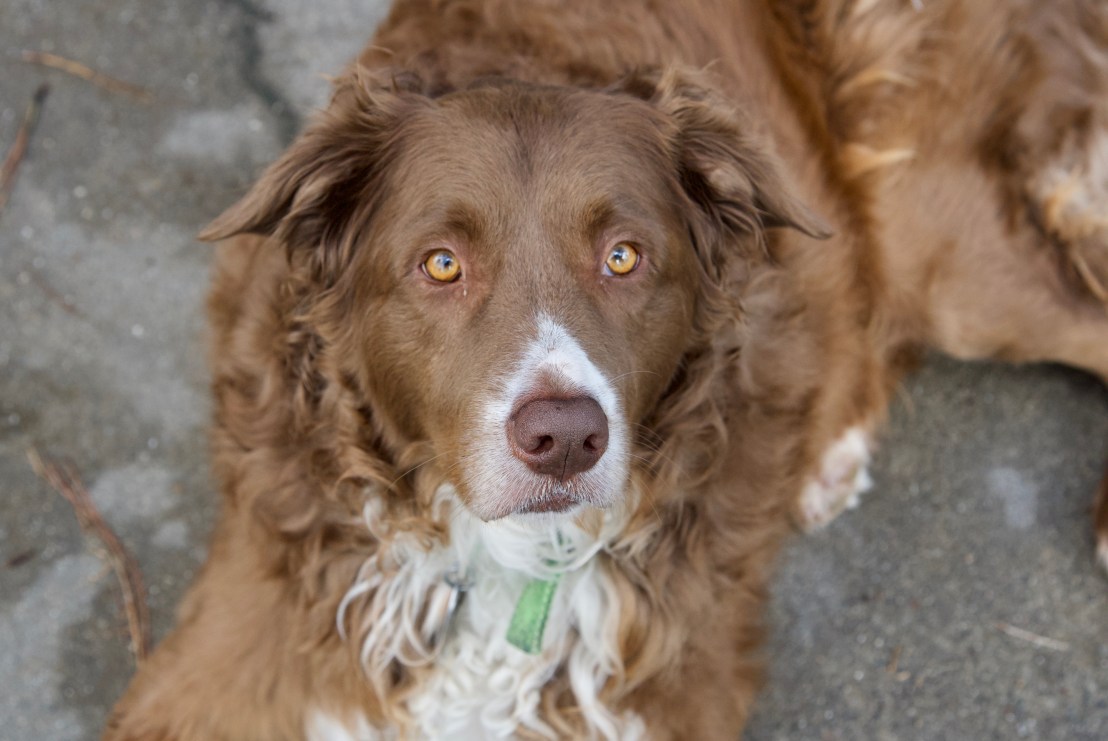
Oliver. Taken at home, 17th May, 2020.
Oliver’s eyes are to die for!
Well a recent article on the Treehugger blog threw some light on this.
I hope it is permissible to share it with you.
ooOOoo
Labradoodles Are More Poodle Than Lab
Study helps deepen understanding about how breeds are formed.
By Mary Jo DiLonardo
Published September 22, 2020
Australian Labradoodles aren’t officially recognized as a breed. Purple Collar Pet Photography / Getty Images
The Australian creator of the Labradoodle was trying to find the perfect guide dog for a blind woman whose husband was allergic to dog hair. He tried about a dozen poodles before breeding a poodle with a Labrador retriever. The resulting Australian Labradoodles became incredibly popular as a mix of two well-liked breeds.
But a new study finds that the breed that developed from that popular cross isn’t an even split of both breeds – it is primarily poodle.
Australian Labradoodles have been around for several decades and have been bred to each other and tinkered with since then. By contrast, many Labradoodles that are found in the U.S. are first-generation mixes of one Labrador and one poodle. These dogs were used as the control dogs in the study, researcher Elaine Ostrander, geneticist at the National Human Genome Research Institute of the National Institutes of Health, tells Treehugger.
“We were interested in taking a genomic snapshot of a breed in the making—the Australian Labradoodle. The breed has only been around since the 1980s as opposed to the many breeds we see at the dog park which have been around since Victorian times and were created in Western Europe,” she says.
The Australian Labradoodle has gone through several generations, with careful and thoughtful addition of Labradors and poodles added, reflecting what breeders and owners want. We wanted to see if genomics could be used to tell what was happening to the genome of these dogs as they evolved into a breed.
The Fédération Cynologique Internationale (FCI), an international federation of many national kennel clubs, recognizes about 350 dog breeds. The American Kennel Club (AKC) recognizes 195 breeds. The Labradoodle is not an official breed.
“We were also curious to see if the breed met the statistical definition of a breed. There are many measures in terms of genomic diversity and ability to ‘breed true’ that are taken into account when determining when a dog population is really a ‘breed’ at the genetic level,” Ostrander says.
Many of these breeds have been created through intense breeding programs focused on enhancing specific traits. When designer breeds are created, the genetic diversity is limited because there are a small number of animals being bred together. This often leads to a high incidence of disease and other problems. Lots of Poodle DNA
For the study, researchers analyzed genetic data from Australian Labradoodles, Labrador retrievers, poodles, and a number of other breeds. The results were published in PLOS Genetics.
Ostrander says they were somewhat surprised at what they found.
“First, the Australian Labradoodle meets the definition of a breed at the statistical level. Those arguing for it to have breed status with various registries have a good argument,” she says. “What we didn’t expect was the degree to which today’s Australian Labradoodle has such a large component of its genome from the poodle. While the breed started as a 50-50 mix, it is clear that poodle traits are highly valued and many more poodles than Labradors have been added to the breed at strategic points.”
That’s likely because poodles have a reputation for being hypoallergenic, she points out, and elicit a lower allergic reaction than many other dog breeds in people with allergies or asthma.
“Owners buy Labradoodles for many reasons including their trainability, family friendly traits, and, importantly, they want a dog that won’t make them sneeze or otherwise respond,” she says. “Interestingly, the Labrador is very much present in every Australian Labradoodle we tested. Likely people are seeking the family-friendly traits of the Labrador and breeders work hard to retain that as well.”
Labradoodles weren’t the first doodle dogs and definitely are not the last. The first poodle mixes were likely Cockapoos because Cocker spaniels and poodles were two of the most popular dog breeds in the U.S. in the 1940s. Today, you’ll find schnoodles (schnauzers), sheepadoodles (Old English sheepdog), and whoodles (soft-coated wheaten terrier). Poodles have been mixed with beagles, pugs, Australian shepherds, corgis, and even Saint Bernards.
The lore behind Australian Labradoodles is that English and American Cocker spaniels were mixed in with the breed early on.
“We did find some minor evidence for the addition of other breeds in some lineages of Australian Labradoodle. Likely this represents the historical relationship of those breeds with the poodle or Labrador more than anything else,” Ostrander says. “We did not see that in every lineage we looked at and where we did see it, the addition was very small and, likely, many generations ago.”
The findings are helpful, the researchers point out, because it shows how quickly genetics can be changed by thoughtful breeding.
“Imagine a breed has a significant risk for a disease. Careful breeding can reduce the incidence of those deleterious variants in just a few generations,” Ostrander says. “This is incredibly important to breeders who have taken very seriously the criticism they have received over the years regarding how established breeds are less healthy than mixes. We all want our dogs to be healthy, regardless of what breed they are.”
ooOOoo
This deserves a very careful read and, to those really interested in the subject, perhaps this will serve as an incentive to do more research. There are links in the article to the FCI and AKC.
And I will finish with the closing statement by Elaine Ostrander: “We all want our dogs to be healthy, regardless of what breed they are.“
I came upon Elizabeth when she left a comment to my post on the 26th August, The science of dog learning.
This is what she wrote:
Reblogged this on The Last Chapter and commented:
Please visit Paul’s website, something new to read and learn each day. Thank you Paul for bringing your site to the blogging world.
Naturally, I replied:
Elizabeth, thank you for leaving your response, and thank you so much for your republication of my post. I read a little about yourself and, I must say, found it fascinating. And your poem The Last Chapter – wow!
Now I will hopefully republish The Last Chapter for another day. (And I have now heard that I have permission to republish it!)
But today, I want to publish the words of Elizabeth in writing about her dear, dear, recently departed dog.
ooOOoo
Mason Murphree
A tribute
Mason Murphee
Mason Murphree was born on January 31, 2012; what can one say about Mason, I bought him off the back of a pick-up truck, only two pups left out of the litter I held both in my hands as they lay upon my chest; one yellow and the other white. I did not see their mother or father; I was told that the father was Bichon Frise and his mother Shih Tzu. The white one instantly begins to crawl into my sports bra, nuzzled himself against my warm flesh and I was instantly in love.
I did not believe that he was six-weeks-old he was still wobbly on his feet when trying to walk. I made him what the old folks call a “Sugar Tit”, a rag rolled on the end tightly and the tip soaked in warm sweet milk. I fed him laying on his back in my hand for a week, the second week I started him on baby food. Then, what I thought to be the seventh-week, he begins to walk with unsteady confidence and I thought was ready for the big world around him.
I found quickly that he had a set of razor-sharp teeth, yep, time for the hard bits of puppy food. I took him to the Vet when I brought him home, and he was given an “A” in health. But, I am getting ahead of myself. When I brought him home I sat him on a potty pad he used until he was six-months-old, then he discovered grass. I might add that in the nine years he was with me he never did his business in the house.
Alas, it was his six-month birthday, and his first time to the groomer, which I found that he had to be calmed down by medicine to get groomed. It was not too long until the Vet announced that he was out of this world’s atmosphere with anxiety. He had “MaMa” withdrawal big time when he was not with me. He would bark for half-an-hour before settling down to wait for me to come back from the store, gym, or anywhere I had gone! He disliked children, anyone less than teenagers. He loved every adult he met. He begins life attached to my hip and me to his.
Mason loved paper products; he would wait patiently to see if anyone would drop a Kleenex, paper towel, or napkin. The pursuit would begin chasing a four-legged speed demon around the floor, me never winning. We called him the Tasmanian devil, and he looked like it when he tried to defend his catch of the day. It was impossible to go on vacation without him; he would stay with one of his two-legged siblings. Of course, that was only for one day, he would accept his situation for about twenty-four-hours, then once again turn into the Tasmanian devil, the telephones would ring trying to find him another place to stay, he traveled back and forth from house to house until my return. A chore to his brothers and sisters, but finally he must have thought he had caused enough trouble for me to return home, and he did.
He loved everyone he met except children, let me explain; when he was six-months-old I took him to the park. On the playground were about a dozen small children, when they spied him, they came running. He jumped up for me to protect him, and that was that. He loved his favorite human friends and his family.
He was the best companion anyone could have; his personality was so individual those who would see him thought he would start talking at any moment. He look intently at you when you were talking, always smiling. He thought he was a Great Dane when in his protection mode, but a clap of lighting and boisterous thunder would send him under my feet. He loved to walk; he loved all the trees on his block and several other blocks.
I won’t describe Mason’s death other than it was quick and painless, he got to spend one day saying good-bye to his two-legged brothers and sisters. We covered our faces and our tears and sadness until we walked away, he knew. As his MaMa, I watched him go from a lively, wonderful, sweet little dog to one that was holding on to every minute waiting for his family to arrive. There are not enough words for me to describe the heartache and loneliness with him gone.
My heart feels much like a patchwork quilt, many little pieces sewn back together after being shattered. Saying good-bye, he took a piece of my heart and soul with him. I know that I will see him again, that is the only thing I have to hold on to this moment. And, that is how I am living my life one moment at a time until I see my four-legged fur baby again. He loved and he was loved.
Sweet dreams little boy.
ooOOoo
How we become so attached to our dogs. Elizabeth not only was beautifully attached to Mason but also wrote perfect words in her tribute.
So who is Elizabeth Ann Johnson-Murphree?
This is her biography but it doesn’t really tell me who she is; in a feeling, living, emotional sense. I suspect one has to read her writings to learn more.
Born in Alabama to a Native American father and an emotionally absent mother.
Raised by her father, her Native American Great-grandmother, her Aunt, and an African-American woman, all magnificent storytellers. Her childhood was filled with listening to the stories her great-grandmother would tell about the grandfathers and grandmothers that perished on the Trail of Tears, of she and the grandmother living in the slave quarters in northern Alabama.
Aunt Francis needed a home when her son went to prison, she would tell the stories of her parents being slaves and how she survived the Civil War. Aunt Vina, her father’s sister a fantastic storyteller; she could bring together characters and build a story that would have you at the edge of your chair, only to find it was all fiction.
As a child, Elizabeth ran free in the woods, fields, and the caves below Burleson Mountain where she grew up. Elizabeth has been writing all of her life, seriously since 2010. She has published a memoir about her daughter who passed in 2010; a small coffee table book filled with pictures of her precious Mason, and ten books of poetry. Her poetry is filled with happiness, sadness, spirit, and anger. The memoir is the private life of her daughter, living with bipolar, and schizophrenia. The books of poetry range from light to darkness that appeared during the creation of each book.
That is a special post, as I said at the start.
I look forward immensely to sharing with you Elizabeth’s poetry.
A very interesting article in The Smithsonian Magazine.
There are countless breeds of dogs and they represent thousands of years of breeding.
But recent work in determining the genetic background behind the many different features of dogs has revealed so much.
The Smithsonian Magazine published an article nearly a month ago and hopefully it is alright to share it with you.
ooOOoo
What a Crowdsourced Study Taught Us About How Dogs Learn
A new study looks at the genes that underlie traits from self control to communication
Three dogs sit at attention ( MediaProduction
By Viviane Callier, July 31, 2020
Thousands of years of selective dog breeding has created a fantastic diversity of domestic canine companions, from the workaholic border collie to the perky Pomeranian. In cultures around the world, humans bred different dogs to be good at tasks including guarding, hunting and herding. Later, in Victorian England, kennel clubs established breed standards related not only to their behavior, but also their appearance.
As genomic sequencing has become more affordable, scientists have begun to understand the genes behind physical features such as body shape and size. But understanding the genes behind dog cognition—the mental processes that underlie dogs’ ability to learn, reason, communicate, remember, and solve problems—is a much trickier and thornier task. Now, in a pair of new studies published in Animal Cognition and in Integrative and Comparative Biology, a team of researchers has begun to quantify just how much variation in dog cognition exists, and to show how much of it has a genetic basis.
To study canine cognition, the studies’ authors turned to publicly available genetic information from a 2017 study, and a large community science project, Dognition.com, in which dog owners tested their own pets. “These papers offer an exciting integration of two forms of big data,” says Jeff Stevens, a psychologist at the University of Nebraska-Lincoln who was not involved in the study.
Previous studies often compared cognition in one breed against another using small sample sizes of dogs from each. This study, by contrast, is the first to examine the variation in cognition across three dozen breeds, and the genetic basis of that variation, explains Evan MacLean, a comparative psychologist at the University of Arizona who oversaw the pair of new studies. MacLean says dog breeds may be an ideal way to study the heritability of cognitive traits because breeds—all part of the same species—represent close genetic relatives with an incredibly diverse range of appearances and behaviors.
To gather a sufficient amount of data on how dogs reason and solve problems, the researchers looked to the Dognition.com portal. The initiative, created by Duke University dog researcher Brian Hare, started with tests in the lab. Researchers developed methods to understand how dogs think. They then stripped those methods down, and simplified them for dog owners to do themselves. In an earlier project, the researchers tested dogs in the lab and compared their results to those from owners testing the same dog at home. The results were the same, giving them confidence that the results from the citizen science project were reliable.
To participate in this project, dog owners tested their pups on 11 standardized tasks used by animal behaviorists on a variety of species that reflect four aspects of cognition: inhibitory control, communication, memory and physical reasoning. One task that measured inhibitory control, for example, involved having an owner put a treat on the floor in front of the dog and then verbally forbidding the dog from taking it. The owner then measured how long the dog would wait before eating the treat. In a task to assess communication skills, the dog owner placed two treats on the ground and gestured towards one of them. The owner then determined if the dog approached the indicated treat. To assess memory, the owner visibly placed food under one of two cups, waited for a few minutes, and then determined if the dog remembered which cup the food was placed under. To test physical reasoning, the owner hid food under one of two cups, out of view of the dog. The owner lifted the empty cup to show the dog that there was no food and then assessed whether the dog approached the cup with the food underneath.
The participating dog owners reported their dog’s scores and breed, producing a dataset with 1,508 dogs across 36 breeds. The researchers analyzed the scores and found that about 70 percent of the variance in inhibitory control was heritable, or attributable to genes. Communication was about 50 percent heritable, while memory and physical reasoning were about 20 percent heritable.
“What’s so cool about that is these two traits that are highly heritable [control and communication] are those that are thought to be linked to dogs’ domestication process,” says Zachary Silver, a graduate student in the Canine Cognition Center at Yale who was not involved in the study.
Dogs are better at following humans’ communicative cues than wolves, and this is something that seems to be highly heritable, explains Silver. In contrast, there’s some evidence that wolves are better than dogs at physical reasoning.
Some of these traits are also influenced by environment and how the dog was handled as a puppy, so there are both genetic and environmental components. In fact, there is so much environmental and experiential influence on these traits that Gitanjali Gnanadesikan, a graduate student in MacLean’s lab and lead author of the new studies, cautions against the idea that these findings support certain breed restrictions or stereotypes. “Even the highly heritable traits have a lot of room for environmental influence,” she says. “This shouldn’t be interpreted as, ‘each of these breeds is just the way they are, and there’s nothing that can be done about it.’”
In the same way that women are on average shorter than men, but there’s quite a lot of overlapping variation within each sex, dog breeds also show a lot of variation within each breed that overlaps with variation among breeds.
Previous work has linked differences in inhibitory control to the estimated size of dogs’ brains. Comparative studies across many different species, ranging from tiny rodents to elephants and chimpanzees, also show that some aspects of self-control are strongly related to brain size. The bigger the brain size, the more self-control the animals seem to have, MacLean says.
Stevens notes that a lot of things—not just inhibitory control—correlate with brain size across species. And brain size, metabolic rate, lifespan, home range size are all correlated with body size. When many traits are correlated with each other, it is not clear which of these factors may underlie the cognitive differences. So there are a number of questions remaining to be explored.
After showing the degree to which different aspects of dog cognition are heritable, Gnanadesikan and MacLean used publicly available information on the genomes of dog breeds to search for genetic variation that was associated with the cognitive traits of interest. The researchers found that, like many other complex traits, there were many genes, each with small effect, that contribute to dogs’ cognitive traits. That is in contrast to morphological features in dogs; about 50 percent of variation in dog body size can be accounted for by variation in a single gene.
One of the limitations of the study is that the researchers did not have cognitive and genetic information from the same dogs; the genomes were breed averages. In the future, the researchers are planning to collect genetic data from the very same dogs that are completing the cognitive tests, to get measures of cognitive and genetic variation at the level of individual dogs. “This gives us a roadmap for places that we might want to look at more carefully in the future,” MacLean explains.
ooOOoo
Now this is an article that deserves to be read carefully so if you are in a hurry bookmark this and wait until you can sit and absorb the messages the article contains.
I was minded to look up Gitanjali’s details and I am glad I did. These are the details:
Gitanjali Gnanadesikan
I am an evolutionary biologist and comparative psychologist who is interested in social behavior and cognition. I work with Evan MacLean in the Arizona Canine Cognition Center studying the development and evolution of behavior and cognition in dogs and wolves.
I think I will reach out to her and see if she has more information she would like to share with us all.
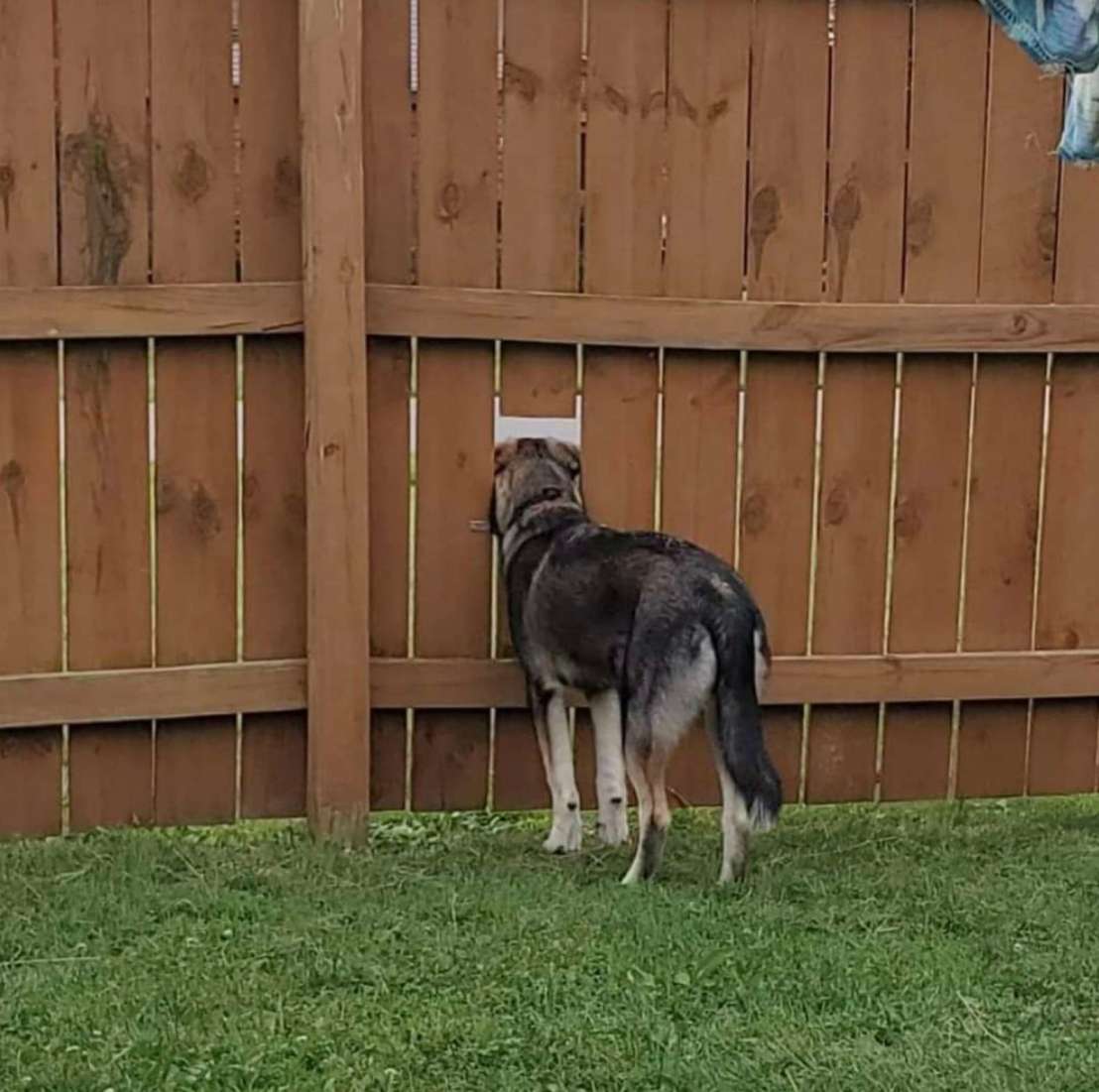
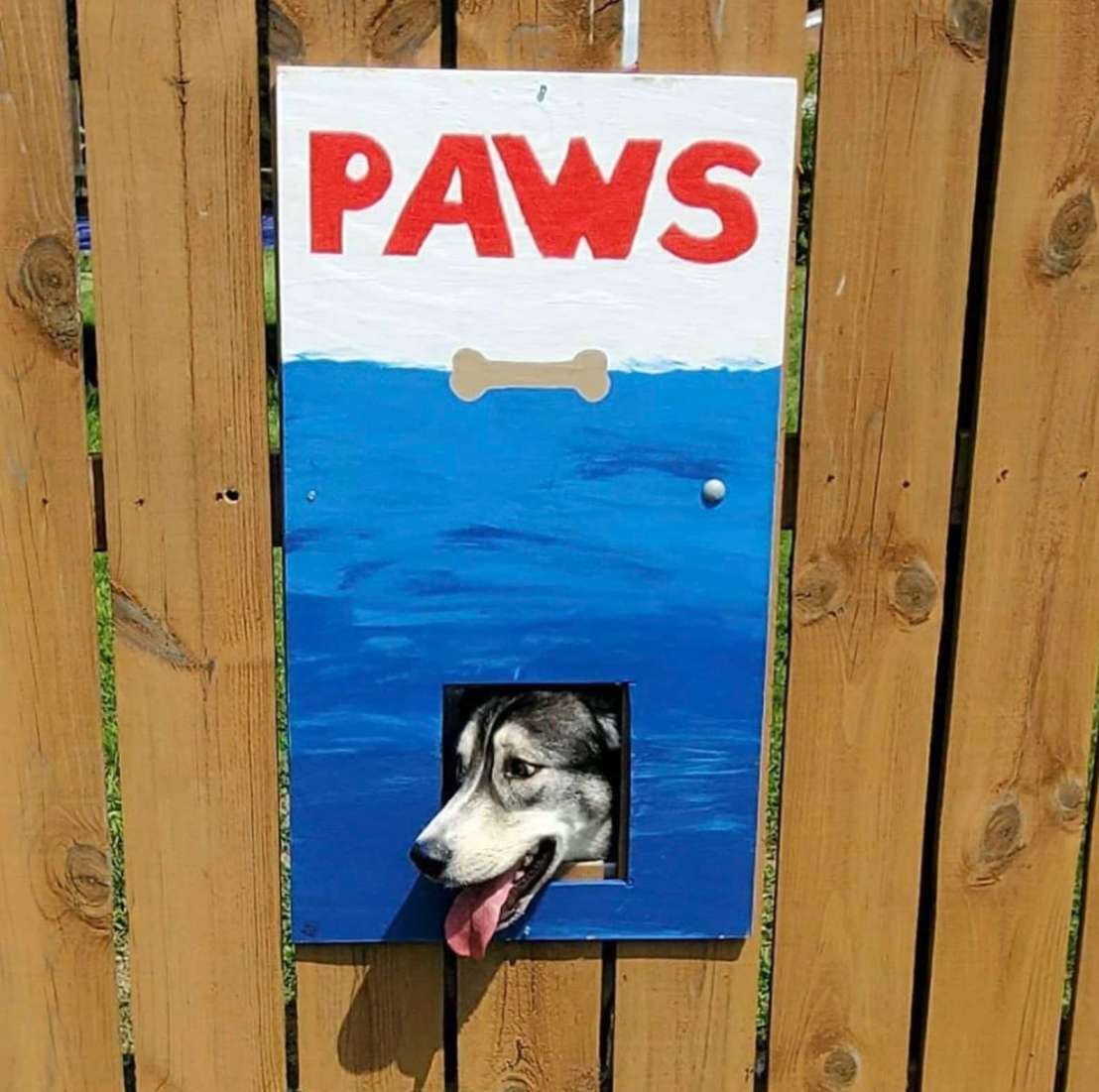
A few months after he was adopted last year, Burger started digging under his family’s fence. He wanted to be able to watch all the people going by, and after thinking about it for a while, his dad came up with the best idea.
He decided to cut a hole in the fence to make a little window for Burger so he could watch the world go by, and Burger instantly fell in love with it.
BRIAN STANLEY
“As soon as I was done, Burger had his head through it and immediately stopped digging,” Brian Stanley, Burger’s dad, told The Dodo. “Best decision ever!”
Now, every time he goes outside, Burger goes straight to his little window. He loves greeting people as they pass by, and he definitely brings a smile to all his neighbors whenever they see his little head peeking out through the window.
BRIAN STANLEY
When the coronavirus pandemic forced things to shut down in March, Stanley and his family noticed that there were suddenly a lot more people out and about walking past their fence than there had been before. The family hoped that seeing Burger would help bring a smile to everyone’s faces during such a hard time — and then Stanley had an idea to take it to the next level.
Brian Stanley
“At first it started as a joke with my wife that I was going to paint something on the street side of the fence around the dog window, but then the idea of painting an actual picture and hanging it up to frame the hole started to form in my mind,” Stanley said. “The shutdown brought an obvious black cloud along with it. Even though more people were out on the street walking or biking, we knew it was due to job loss and uncertain times. I first talked about it to my son who was 100% behind the idea of putting something up on the fence to hopefully bring a smile to people’s faces.”
BRIAN STANLEY
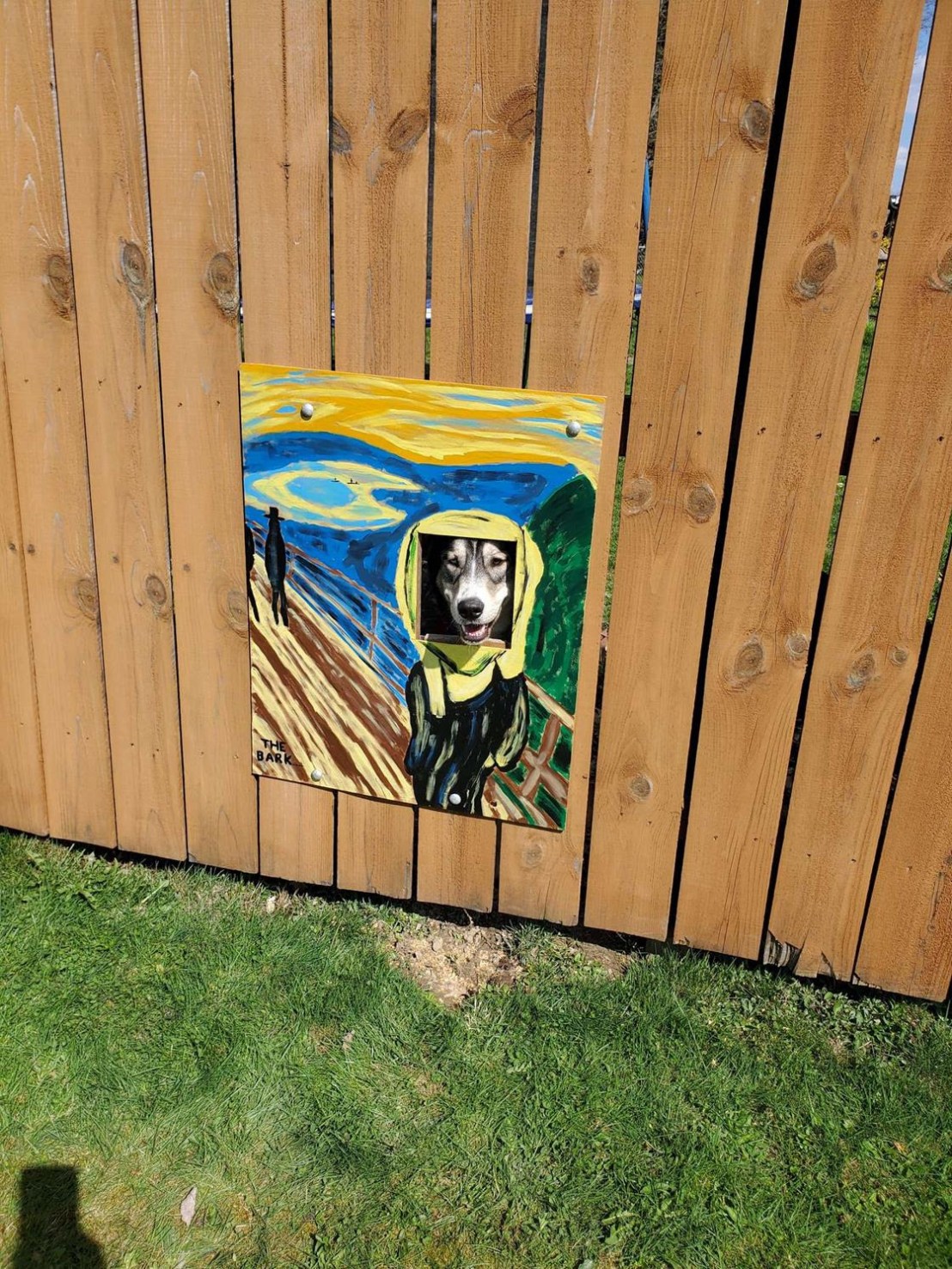
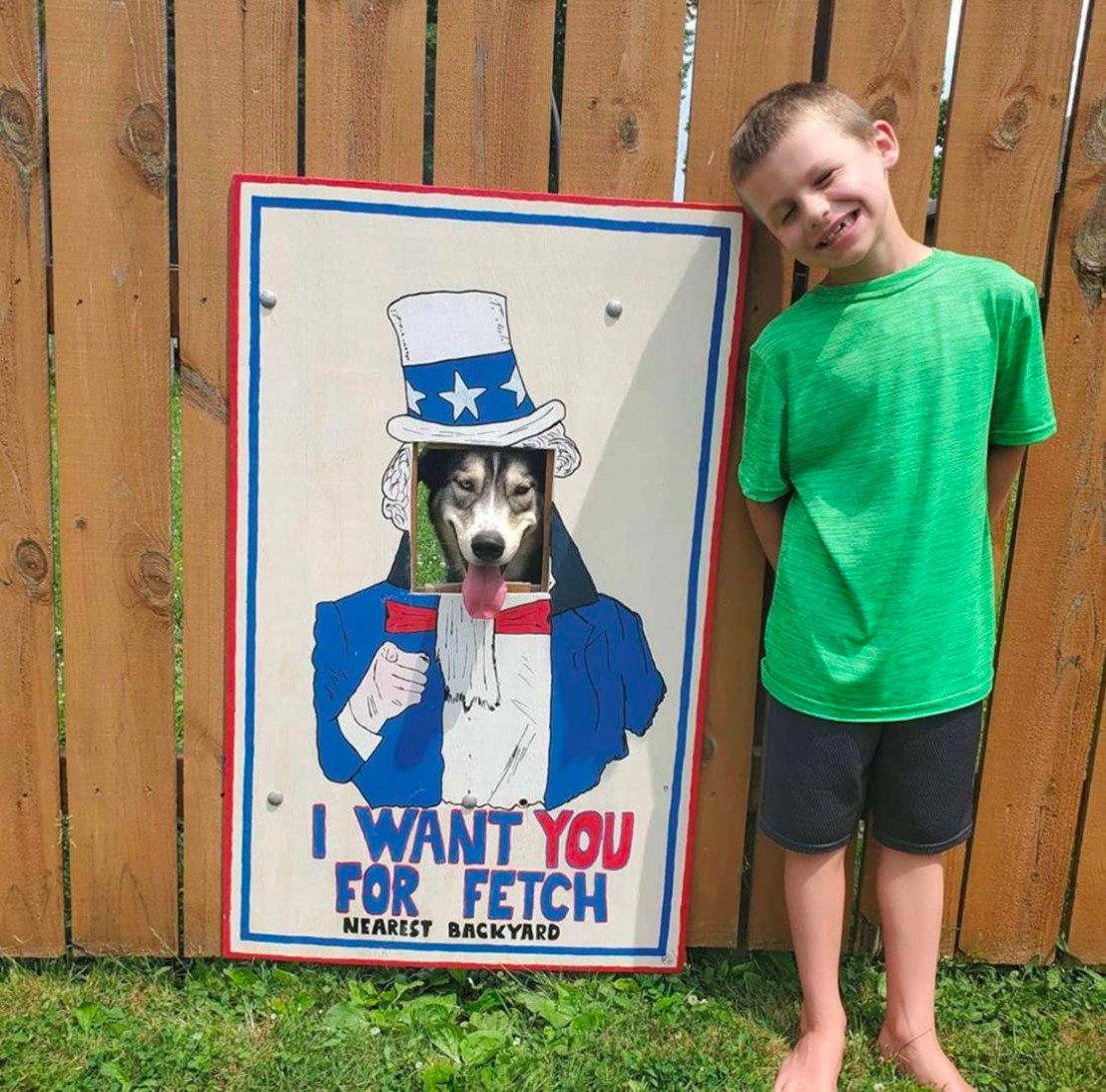
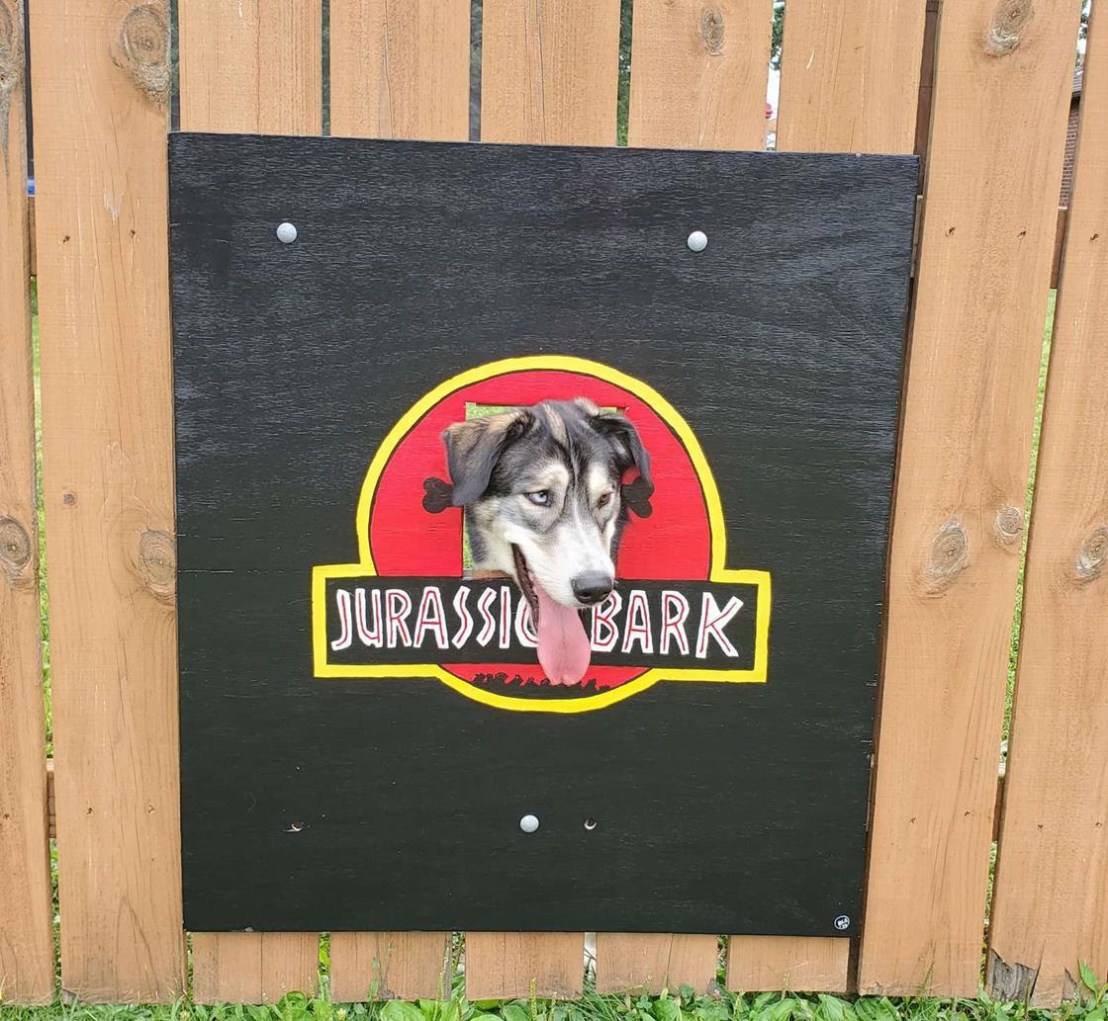
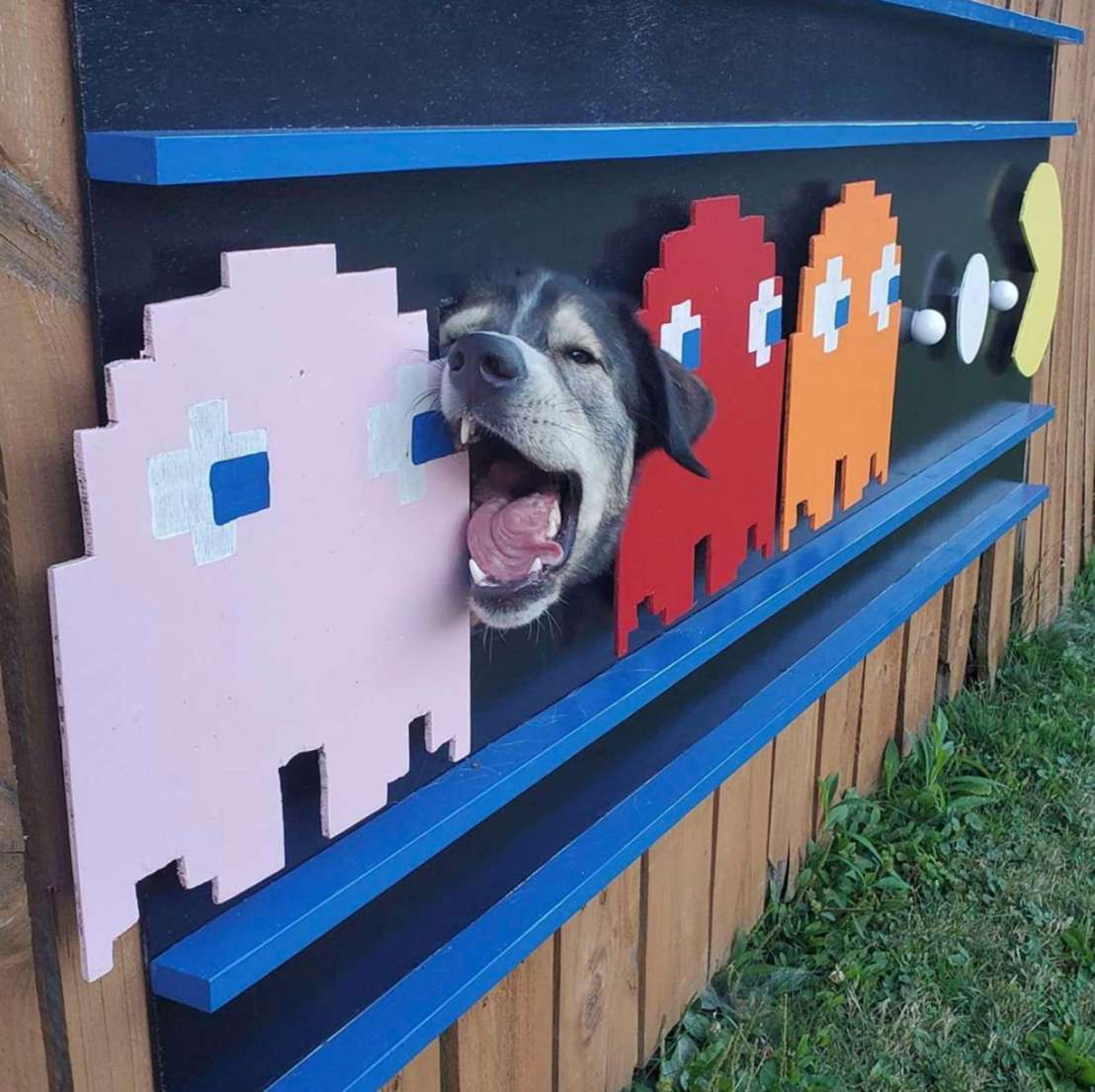
With the idea cemented in their minds, Stanley and his 7-year-old son Cameron got to work on their first painting. They decided to create a version of the famous painting “The Scream” and call it “The Bark.” They hung up the painting and admired their work. They hadn’t been planning on making any more paintings, but after the first one, the ideas just kept coming — and now the artwork framing Burger’s window is constantly changing.
So far they’ve done “Paws” …
Brian Stanley
… “Jurassic Bark” …
BRIAN STANLEY
… and even a Pac-Man-themed painting.
BRIAN STANLEY
Every time his family puts up a new creation, Burger is always right there, and quickly sticks his head out of his window to admire their work.
Of course, the initial goal of the paintings was to help brighten people’s days, and so far that’s absolutely been achieved.
BRIAN STANLEY
“People have told us that they plan their walks and bike rides to go by our fence and some people will even alter their drives so it takes them past it,” Stanley said. “I have been outside on multiple days with the dogs and see people walk up and take selfies with the fence and Burger. People bring treats to him and he just soaks up the attention. Both my wife and I have been stopped by people when they see us outside so they can tell us how much they love what we are doing and that they hope we don’t stop.”
BRIAN STANLEY
Stanley and his family currently have new painting ideas planned all the way through January 2024. They’re so happy that their paintings and Burger are able to bring a little joy to their community. Of course, Burger probably loves the paintings most of all, because they’ve brought so many new people to his fence who he can watch and say hello to.
“All in all, it’s brought us closer to the community and the community closer to us while making everyone happy … it doesn’t get much better than that,” Stanley said.
ooOOoo
This post comes with a good number of fabulous photographs. Makes one really think of Burger as the dog next door. And it shows the ingenuity of Brian Stanley and his wife and son, Cameron; first class!
It is a very nice article. A’hh, that’s too tame. It’s a brilliant article! Much better.
Thought this would get your attention but read on:
There is no end to the love that so many people bestow on their dogs. I have said it before and there’s absolutely no doubt that I will say it again; many times!
One could go deeper into the human psychology to understand why, about the joy of having an animal who is sensitive to our moods but never rejects us. About the devotion and loyalty that dogs give us, well the vast majority of us, and who never expect anything in return other than a stroke or a cuddle.
I’m minded to be in this mood because today (ergo yesterday) I had to deal with an infestation of ants in the house. Luckily we had an unopened packet of Diatomaceous earth and, hopefully, that has put a stop to it. One of the issues of living in a rural part of the world.
So the following post spoke to me!
ooOOoo
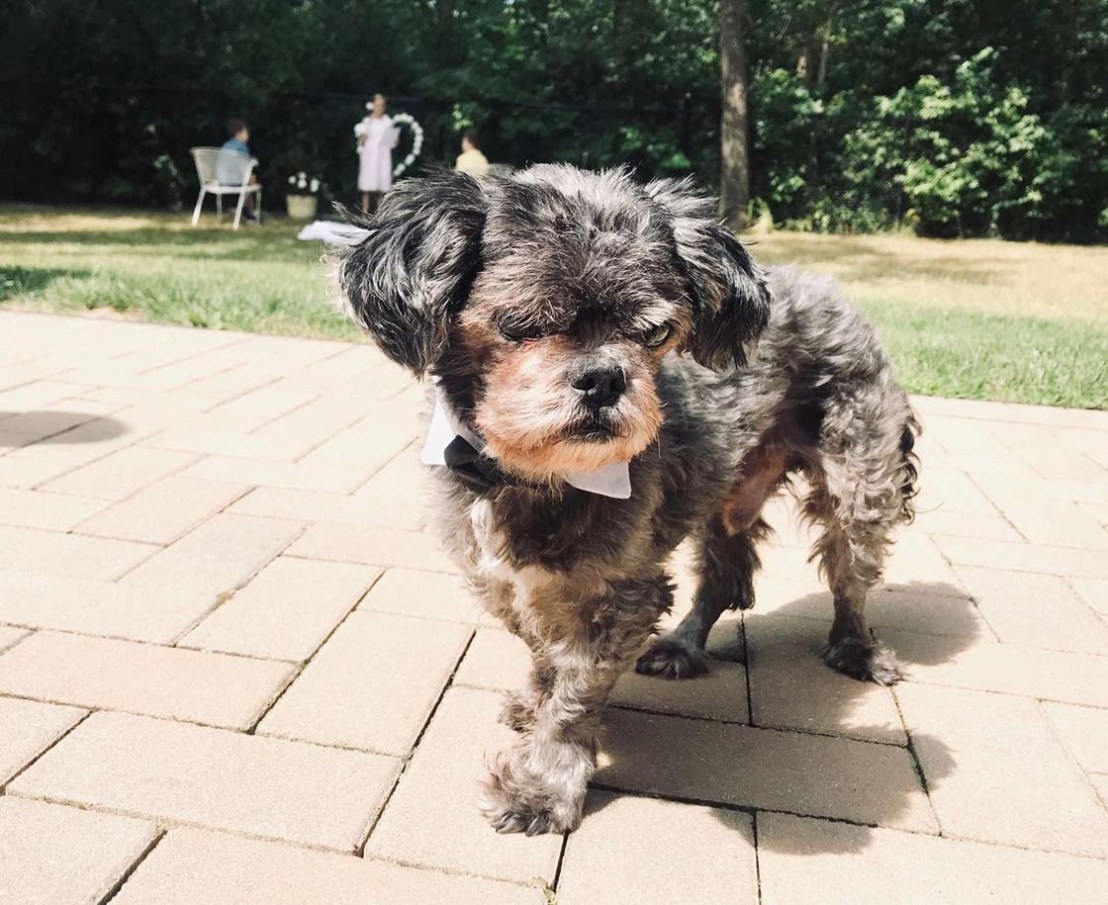
Kids Hold A Wedding For Senior Dog So He Can Marry His Best Friend
Photo Credit: Jennifer Burke
When Toby first arrived at Newman Nation: Senior Pets United, he needed a lot of help. He was 15 and had been severely neglected for most of his life. His fur was extremely matted. The rescue knew he would need a special family to foster him, and immediately thought of Jennifer Burke.
Burke and her family have experience with hospice animals, and were immediately on board to take in Toby.
“When Toby first joined our family, he was really scared and timid, in addition to being very sick,” Burke told The Dodo. “He was such a little pathetic mess and we fell in love with him immediately. Shortly after getting Toby, we discovered he was blind, and deaf, which was quite a surprise.”
They soon discovered that he had cancer, but the little dog recovered surprisingly well after treatment, and the family quickly decided he’d be staying with them forever.
Photo Credit: Jennifer Burke
Toby quickly fell in love with every member of his new family — especially Zoey.
Zoey was rescued from a puppy mill where she had been bred over and over again. She was never properly socialized so she’s often a little awkward around other dogs, but for some reason, she and Toby just work. Over the past two and a half years the two dogs have fallen completely in love with each other, and do absolutely everything together.
“It was really poignant to see two misfits start to figure out friendship and eventually fall in love,” Burke said. “They really are an awkward match made in heaven.”
Toby is now 17 years old, and his family recently discovered that he has cancer again. This time, he was only given a few months to live. His family knew this day would come eventually, but they were still so heartbroken — and then they had the best idea.
Photo Credit: Jennifer Burke
“After giving my kids the devastating news of his prognosis, my 8-year-old son, Dillon, said, ‘Well, I think Toby and Zoey should get married before Toby dies,’” Burke said. “Immediately, our family agreed. It was a perfect way to celebrate Toby and the really meaningful role he has played in our lives.”
All five family members began planning out the wedding together, as everyone wanted to be involved in making sure Toby and Zoey had the most perfect day.
“My daughter helped pick out Zoey’s wedding dress and she wrote the dogs’ vows,” Burke said. “My boys helped prep the backyard for the ceremony. My husband suggested throwing the wedding on the date of our 12-year anniversary, making the day even more special.”
Finally, everything was ready. The backyard was decorated, the cake was made and the entire family was dressed up and ready to celebrate the love of Toby and Zoey.
Photo Credit: Jennifer Burke
The wedding was absolutely perfect. While Toby and Zoey maybe weren’t as huge fans of getting dressed up and posing for pictures, they absolutely loved getting to kiss each other, eating cake and of course being together. That’s always been their most favorite thing of all.
Toby may not have a ton of time left, but his family is determined to make sure that what time he does have is filled with so much love. Toby has meant so much to his family over the past few years, especially to Zoey, and they’re so glad they were able to spend a day celebrating him and his best friend.
“Toby has enhanced our family so much in the last 2.5 years, but we had never realized the impact it could have on Zoey,” Burke said. “She is the one who has gained the most by having Toby in our lives. And I have no doubt that having Zoey in his life has enabled Toby to live so long. While I know Zoey will have a sad and difficult adjustment after Toby’s death, he has made her life so much fuller than we could have ever expected.”
ooOOoo
Just read that last paragraph again: “Toby has enhanced our family so much in the last 2.5 years, but we had never realized the impact it could have on Zoey,” That was said by Jennifer Burke. Then she said how beneficial Toby was on the life of fellow dog Zoey.
It is a very lovely story and, once again, we have to thank The Daily Dodo.
We tend to watch many of the TED Talks that come our way.
But this one had me riveted to my seat. It’s a very powerful, nearly 9 minutes long, talk given by a person who doesn’t have legal citizenship.
Speaking on a personal basis, I was a person who went through the Citizenship test, successfully I might add, in March, 2019. So I watched this video with more than just academic interest.
See if you sense the feelings I had.
At age 16, journalist and filmmaker Jose Antonio Vargas found out he was in the United States illegally. Since then, he’s been thinking deeply about immigration and what it means to be a US citizen — whether it’s by birth, law or otherwise. In this powerful talk, Vargas calls for a shift in how we think about citizenship and encourages us all to reconsider our personal histories by answering three questions: Where did you come from? How did you get here? Who paid?
Jose Antonio Vargas, author of “Dear America: Notes of an Undocumented Citizen,” is the founder of Define American, a nonprofit organization that uses stories to shift the narrative on immigrants.
In the 10th July issue of Science magazine there was an Editorial written by Sudip Parikh, CEO of the American Association for the Advancement of Science (AAAS).
I am taking the liberty of republishing that Editorial here. For I think it needs to be widely shared.
I am a scientist. I am an American. And I am the product of special expert visas and chain migration—among the many types of legal immigration into the United States. On 22 June, President Trump issued a proclamation that temporarily restricts many types of legal immigration into the country, including that of scientists and students. This will make America neither greater nor safer—rather, it could make America less so.
The administration claims that these restrictions are necessitated by the coronavirus disease 2019 (COVID-19) outbreak to prevent threats to American workers. This reasoning is flawed for science and engineering, where immigrants are critical to achieving advances and harnessing the resulting economic opportunity for all Americans.
For decades, the United States has inspired both immigrants and nonimmigrants to make substantial contributions to science and technology that benefit everyone. Preventing highly skilled scientists and postdocs from entering the United States directly threatens this enterprise.
My uncle, a geologist, came to the United States in the 1960s to work at NASA. He then taught at Appalachian State University in North Carolina and later served as lead geochemist for the state of California. He sponsored my father to come to America in 1968. Leaving Mumbai, a city of millions, and arriving in Hickory, a town of thousands in North Carolina, my father came home to a place he had never been before. My parents worked in furniture factories and textile mills to put us though college and ensure we had opportunities. Today, my sister works at the U.S. Centers for Disease Control and Prevention, and I have the privilege of leading the American Association for the Advancement of Science (AAAS, the publisher of Science). We exist because of the Immigration and Nationality Act of 1965 and our parents’ belief in the vision of the United States as a shining city on a hill. My family’s story is repeated by thousands of American scientists.
These stories include uncertainty when an immigrant’s status in America is in question. This uncertainty causes stress and the possibility that immigrants will leave and take their skills, talents, and humanity elsewhere. For the successful, these stories culminate with relief, celebration, and the pride of becoming a naturalized citizen. As President Reagan said, the United States is the one place in the world where “anybody from any corner of the world can come…to live and become an American.” Naturalized citizens love the United States deeply because they chose to be American. They and other immigrants make huge contributions to science and engineering.
According to the National Science Foundation, more than 50% of postdocs and 28% of science and engineering faculty in the United States are immigrants. Of the Nobel Prizes in chemistry, medicine, and physics awarded to Americans since 2000, 38% were awarded to immigrants to the United States. I don’t know the number of prizes given to second-generation Americans but Steven Chu—current chair of the AAAS Board of Directors—is among them. The incredible achievements of the American scientific enterprise speak volumes about the vision and forethought of the American people who have worked to create a more perfect union.
Suspending legal immigration is self-defeating and breaks a model that is so successful that other nations are copying it. As Thomas Donohue, chief executive officer of the U.S. Chamber of Commerce, said regarding the administration’s proclamation, “Putting up a ‘not welcome’ sign for engineers, executives, IT experts, doctors, nurses, and other workers won’t help our country, it will hold us back. Restrictive changes to our nation’s immigration system will push investment and economic activity abroad, slow growth, and reduce job creation.”
To develop treatments and vaccines for COVID-19, cure cancers, go to Mars, understand the fundamental laws of the universe and human behavior, develop artificial intelligence, and build a better future, we need the brain power of the descendants of Native Americans, Pilgrims, Founding Mothers and Fathers, Enslaved People, Ellis Island arrivals, and immigrants from everywhere. The United States has thrived as a crossroads where people are joined together by ideas and contribute by choice to the freedom and opportunity provided by this wonderful, inspiring, and flawed country that is always striving to live up to its aspirations.
Scientists, look around your labs and offices. Think about your collaborations and friendships. We must ensure that this “temporary” restriction on legal immigration does not become permanent. Now is the time to speak up for your immigrant colleagues and for America.














 Learning from Dogs