Three guest posts from Martin Lack of Lack of Environment, today Part One
Martin came to the attention of Learning from Dogs when making a comment to the second part of my Sceptical Voices essay. Since then, he and I have exchanged a number of emails. Over the next few days, I would like to re-publish an essay that Martin wrote that is worthy of deep consideration. Here is Part One. Part Two will be on Friday and Part Three next Monday, the 10th.
————————-
Can modernisation be “ecological”? – Part 1
This is the first of a series of posts based on an essay with this title that I wrote earlier this year as part of the requirements for my MA in Environmental Politics.
Introduction
There are two possible ways of understanding the question; as to require a critique ofEcological Modernisation (EM) as a school of environmental thought or perhaps, far more demandingly, a critique of modernity itself. Although the main intention of this essay is to do the latter; it will inevitably do the former as well.
Definitions
In order to answer this question, it is essential to define what is meant by ‘ecological’; ‘modernisation’; and the theory of EM to which it has given rise:
– In the context of the question, ‘ecological’ is taken to mean thinking, behaviour, and policy that are ‘environmentally-friendly’; rather than merely or predominantly anthropocentric (i.e. concerned with human needs and interests).
– To understand what is implied by the term ‘modernisation’, it is necessary to define what is meant by the word ‘modernity’ because people often conflate the term with industrialisation or even capitalism. However, whereas both of the latter were forged in the industrial revolution of the late eighteenth and early nineteenth century, modernity has its roots in the scientific revolution of “the Enlightenment” in the eighteenth century.
– The theory – if not the practice – of EM emerged from Germany in the early 1980s. Whereas the social scientists Joseph Huber and Martin Jänicke are most-commonly credited with having originated the term, it is probably Arthur Mol that brought it to the attention of the English-speaking world in 1996, when he quoted Huber as having (somewhat enigmatically) said, ‘…all ways out of the environmental crisis lead us further into modernity.’ Thankfully, Mol then went on to explain that EM theory therefore seeks to repair “…a structural design fault of modernity: the institutionalised destruction of nature.” (Mol 1996: 305).
In addition to the above, it is important to differentiate the terms ‘modernity’ and ‘civilisation’: Civilisation pre-dates the Enlightenment by several millennia; and is often equated with the development of agriculture, settled communities, and cities. However, since past civilisations have come and gone, is there any reason to think that our modern civilisation will be any different? This should not be seen as the question of a wannabe anarchist; as it is merely an acknowledgement of human history.
According to John Dryzek, the rhetoric of the EM discourse is reassuringly optimistic; and would have us believe that we can retain a healthy environment without having to sacrifice the benefits of progress (Dryzek 2005: 171). More recently, echoing both Mol and Dryzek, Neil Carter has defined EM as a “…policy strategy that aims to restructure capitalist political economy along more environmentally benign lines based on the assumption that economic growth and environmental protection can be reconciled.” (Carter 2007: 7).
It is in this context that Carter used the term “decoupling” to refer the idea of breaking any direct causal link between economic growth and environmental degradation; but also suggested that “dematerialisation” of manufacturing processes (i.e. the reduction of environmental resources consumed per unit of production) would be essential (2007: 227). However, if we take the manufacturing of motor cars as an example, the rate of fossil fuel consumption will always accelerate unless the percentage increases engine fuel efficiency is greater than the percentage increases in the number of cars. Therefore, since the former must exponentially decline towards zero, the logical conclusion is that we must control the demand for the latter.
—————
References:
Carter, N. (2007), The Politics of the Environment (2nd ed), Cambridge: Cambridge University Press.
Dryzek, J. (2005), The Politics of the Earth (2nd ed), Oxford: Oxford University Press.
Mol, A. (1996), ‘Ecological Modernisation and Institutional Reflexivity: Environmental Reform in the Late Modern Age’, Environmental Politics, 5(2), pp.302-23.
Maybe less is more is really at the heart of our thirst for something more
A number of disparate recent experiences seem to have an underlying common thread.
See if these strike you in a similar fashion.
Yesterday, Joelle Jordan wrote about joy, about the wonderful relationship that dogs have with the world around them. As Joelle wrote,
Joy is a difficult commodity to come by these days. I don’t mean entertainment, I don’t mean a good laugh, I mean pure joy, where, even just for a single moment, all worries and doubts, frustration and anger are lifted as though by Atlas.
Like so many other humans in our world, I often find myself in a constant state of stress. There always seems to be something to worry about, whether it’s money, job fulfilment, the state of my relationships, getting the house cleaned, finding time to get to the market, and more. If given the chance, I know we all could spend nearly all of our waking hours (and some of our sleeping hours, too) worrying about something. We spend so much time on the many things that inevitably work themselves out, and so little time on things that will create a memory and a crystal moment of joy.
My little dog Charlie spends his time in the completely opposite fashion; spending his waking hours seeking joy, and committing less time to things that worry him.
Charlie seems to exist normally in three states of being; content, happy and utterly joyful.
How many of us can echo Charlie’s existance in our own lives?
Then last Sunday, Father D’s sermon spoke about our tendency to develop habitual behaviours and rarely challenge the point of them.
The truth is that we get used to doing things a certain way and keep doing them without ever thinking of what we are doing. We say things in the liturgy without even thinking of what we are saying. I’m sure many people utter the words in the Book of Common Prayer without thinking of the theology behind the words, or the relationship between church and state that they express.
Later on,
There was a desire for “something more” but it was hard to put a finger on what it was. I realized from these conversations that we are involved today in a time of intense searching. Few of us are satisfied with what the church and society have served up.
The honest among us will readily admit we lead fractured lives – with a disembodied spirituality on one side, and a soulless daily existence on the other. We are desperate for something more, for a faith with the power to transform both ourselves and our world.
“…. we are involved today in a time of intense searching“! That smacked me right in the eye!
These are clearly challenging times with mankind facing increasing odds of an ecological disaster of Old Testament proportions, and much of the western world on the cusp of a long and difficult recession. It is so easy to go on “doing things a certain way and keep doing them without ever thinking of what we are doing” while we wait for the leaders of our societies to fix our problems.
The truth is that we have to be the first to change, to question what we do on a daily basis and amend it if it is not truly healthy for us and for the planet. As was said in that sermon, “It means bringing forth each day the fruits of the Spirit: Love, joy, patience, kindness, generosity, faithfulness, gentleness and self-control.”
Go back and read yesterday’s Post and reflect on how many of those ‘fruits’ are the ways of dogs.
My final connection with the theme of today’s essay is with a recent series from the BBC called ‘Status Anxiety’. The programmes are still on YouTube and the first 10 minutes is below,
Status Anxiety discusses the desire of people in many modern societies to “climb the social ladder” and the anxieties that result from a focus on how one is perceived by others. De Botton claims that chronic anxiety about status is an inevitable side effect of any democratic, ostensibly egalitarian society. De Botton lays out the causes of and solutions to status anxiety.
Or if you prefer, all 2 hours 23 minutes may be watched on Top Documentary Films, described thus,
De Botton's book
Why doesn’t money (usually) buy happiness? Alain de Botton breaks new ground for most of us, offering reasons for something our grandparents may well have told us, as children.
It is rare, and pleasing, to see a substantial philosophical argument sustained as well as it is in this documentary. De Botton claims that we are more anxious about our own importance and achievements than our grandparents were. This is status anxiety.
Alain quotes philosophical writings, such as Democracy in America, a report by Alexis de Tocqueville on his visit to the USA in 1831. De Tocqueville noted that American equality, notable in those times, was accompanied by a climate of envy.
We jump to present-day USA, and see what, to de Botton, are some awful examples ofThe American Way. A Christian preaches get rich. A steelworker tells of his insecure life in an industry being closed down through others’ love of money.
Our protagonist points out the advantage of high status: those with high status will enjoy the care and attention of the world. Then joins this advantage with the illusion, orattempt at meritocracy in the USA, mentioning Jefferson’s notion of an aristocracy of talent.
Some of the messages towards the end of the programme are very thought-provoking indeed. Let me draw this all together.
If you own a dog, or a cat, or any pet, stop a while today and see how their simplicity of life brings them so much more. Naturally, we can never live life in the same way that our pet does but there are strong metaphors that carry equally strong messages for us. Less is more.
Now watch the last part of Status Anxiety even if you didn’t watch the first segment above, Reason? Watch and it will become clear.
This is a guest post from Joelle Jordan. Let me broadcast my gratitude for this lovely story. For two reasons. The first is that Joelle is very generous in sharing her fine work and the second is that at the time of me putting this Blog post together, 4pm yesterday, I really needed a helping hand – have been short of time all week-end. So thank-you Joelle. Here’s her story.
————————-
Joy is a difficult commodity to come by these days. I don’t mean entertainment, I don’t mean a good laugh, I mean pure joy, where, even just for a single moment, all worries and doubts, frustration and anger are lifted as though by Atlas.
Like so many other humans in our world, I often find myself in a constant state of stress. There always seems to be something to worry about, whether it’s money, job fulfilment, the state of my relationships, getting the house cleaned, finding time to get to the market, and more. If given the chance, I know we all could spend nearly all of our waking hours (and some of our sleeping hours, too) worrying about something. We spend so much time on the many things that inevitably work themselves out, and so little time on things that will create a memory and a crystal moment of joy.
Jordan and Charlie
My little dog Charlie spends his time in the completely opposite fashion; spending his waking hours seeking joy, and committing less time to things that worry him.
Charlie seems to exist normally in three states of being; content, happy and utterly joyful. When I see him in an emotional state other than these, it nearly breaks my heart. I wonder why this little carefree being who brings such happiness to my life should be anything less than blissful at all times.
I notice something about how Charlie handles his stressful moments, however few and far between they may be. A recent example just occurred. My partner and I are teaching him how to behave on a leash. He has generally not given us any problems on a leash and took to the activity rather quickly. My partner can easily walk him to the corner and back, and he happily accompanies her, listening to her commands and responding, exploring his world in the safe company of his mama, creating a nice outing for them both.
However, his behavior closer to the house is less than stellar, barking at people (especially children who are frenetic and loud) and other dogs, generally forgetting that he is neither a big dog nor in charge of everyone, and just acting rather rude. A change in behavior from his human friend and he learned quickly that running after something and barking while on the leash earns him a very sudden and not so gentle stop, all powered by his own momentum, his harness jerking him off his paws and backwards. After the first incident or two, he ran back to me, the little boy that he is, placing his paws on my leg as I squatted down to him, burying his head in my chest. I assured him that he was fine and stroked him, and told him, “You can’t do that, buddy, see what happens?”
Here is where the story could turn into his utter contempt of the harness and leash. Rather, though, after a little stroking and encouragement, he became ready to try again. This time, instead of running and barking after the children at play in the neighbor’s yard, he calmly walked with me to the end of our driveway and then sat quietly and watched them shoot hoops. When it was time to go in, we walked back to the front door, accompanied by the cheering compliments of “Good job!” and pats from my partner. I saw him begin to walk a little taller and prouder, somehow understanding about a job well done and lesson learned. He trotted through the front door in search of his brother, our Chihuahua Jordan. His happy tongue dangled in wait for the promised treat. The stress he’d been seemingly engulfed in was simply released, gone. It was experienced and then just let go.
Perhaps I’m slightly jaded; after all, it was just a simple leash lesson. In truth, this little animal has no responsibilities except to be cute, not to pee in the dining room and not to chew on things. He has no bills to pay; his only worry is probably something vague about his supper. Sometimes, when letting them out of their crates, Charlie is less happy to see me (master, mama, food giver, spoiler) but is nearly bursting to get at and play with his big brother Jordan. Personal feelings (hurt and otherwise) aside, isn’t there a lesson to be learned here? He continues to teach me.
I watch his eyes. I have since I’ve known my little guy; I find them to be fascinating. In Merle’s Door, Ted Kerasote describes Merle as a “four eyed” dog; a dog that seems to have eyebrows (darker fur over his eyes ) that help express his feelings. Charlie is also a four-eyed dog.
Stanley Coren, the astute canine psychologist from the University of British Columbia, has also noted that these “four-eyed” dogs obtained their reputation for psychic powers “because their expressions were easier to read than those of other dogs. The contrasting-colored spots make the movement of the muscles over the eye much more visible.”
Case in point: the other morning Jordan had burrowed under an Indian blanket for it was a little chilly. Charlie, on the other hand, was in simple need of something: play. Jordan, however, was warming and had no interest. Charlie looked up at me, and held a conversation with me with only his eyes: Mom, make him play!
“He doesn’t want to play, bud, I’m sorry.”
He’s under the blanket! That’s the best time to play!
“But he doesn’t want to play right now, Charlie.”
Distraught. His eyebrows were high but off to the side, the classic cartoon expression of distress. If his lip could’ve quivered from holding back tears, it would have. A soft whimper.
How can that be?
It was a less than joyful moment for Charlie, but it was something out of my power to control. All I could do was redirect him. I enlisted him to come help me with the laundry. This is a favorite past-time of his because there are dryer sheets to be rooted out and torn to shreds. As I moved the clothes from the washer to the dryer, I saw that my boy had found his joy again but not in search of dryer sheets: he had jumped into the basket of dirty laundry and discovered a plethora of good and interesting smells, one of my t-shirts now covering his head like a scarf.
He was in heaven for probably the fourth or fifth time that morning.
————————-
Joelle in speaking about joy echoes a part of yesterday’s sermon that I hope to write a little about before the end of the week.
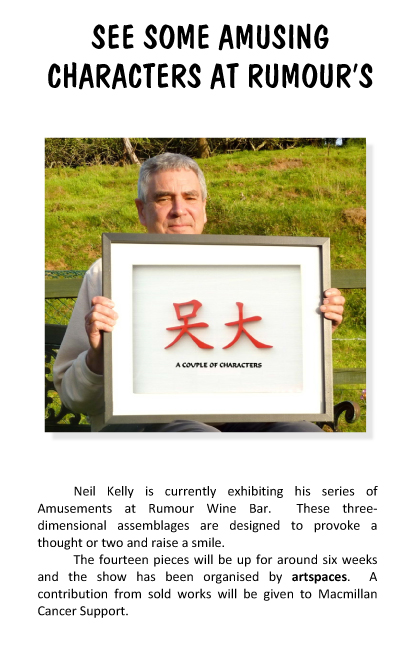
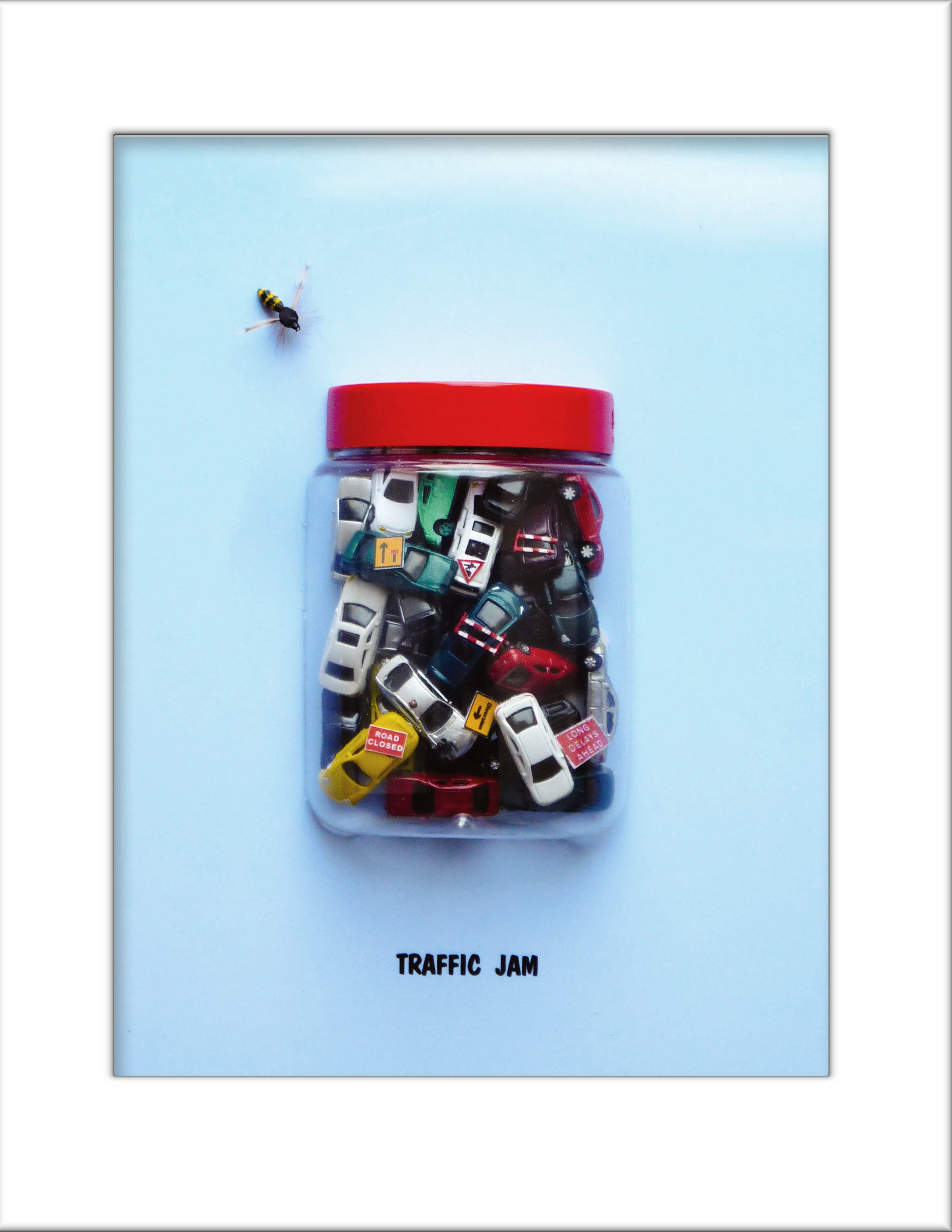
Chance to spotlight the very creative work of Neil Kelly
I have had the pleasure of knowing Neil for a good number of years. I can’t recollect how and when we met but, these days, that applies to so much that slips away from the memory cells! Neil has been a great friend of my sister, Corinne, and brother-in-law, John, who like Neil, have lived in South Devon for many years. Pretty sure that it was through John and Corinne that I first met Neil.
Anyway, Neil’s wonderful, slightly askew sense of humour comes out in his art. Rest is obvious. Enjoy!
Finally, if you are within reach of Totnes and want to see Neil’s work, details of Rumour’s Wine Bar are here.
Why should such an obvious concept, that of truth, be so very difficult to define?
Who in the world whose native tongue is English isn’t familiar with the words of the oath, “I swear to tell the truth, the whole truth and nothing but the truth,” often with the phrase, “so help me God.” It is the fundamental foundation of a working justice system. Probably the most famous of oaths is the American Presidential oath upon taking up office, “I do solemnly swear (or affirm) that I will faithfully execute the Office of President of the United States, and will to the best of my Ability, preserve, protect and defend the Constitution of the United States.”
Then just the other day I was exploring the blog Lack of Environment written by Martin Lack who made himself known to Learning from Dogs from a comment to the post Sceptical voices, part two, published on the 23rd. Martin’s blog carried an article about scientific scepticism (outcome being very little) in global warming being caused by man. There was reference to the book Climate Cover-Up written by James Hoggan and an extract from that book on the Desmogblog website, as follows,
Democracy is utterly dependent upon an electorate that is accurately informed. In promoting climate change denial (and often denying their responsibility for doing so) industry has done more than endanger the environment. It has undermined democracy. There is a vast difference between putting forth a point of view, honestly held, and intentionally sowing the seeds of confusion. Free speech does not include the right to deceive. Deception is not a point of view. And the right to disagree does not include a right to intentionally subvert the public awareness.
The sentence highlighted by me is fundamental to this essay. Perhaps the crux of why it feels so difficult to determine the truth is that the vast 24-hour output of news and information, the 24-hour fear machine as John H. calls it, carries no means of distinguishing the reliability of the source, no details of any affiliations that the person offering the information to that particular media outlet may have, and so on and so on. I wrote a piece on the 12th July called What Exactly is the Truth where I concluded that,
Despite my chest-beating on the subject of politicians and leaders deliberately lying in that recent piece about Juncker, there’s something much more fundamental. What defines lying is really not that important. It’s whether or not we trust that our leaders are doing their best for their constituents, to the best of their abilities.
Whether you support left-leaning or right-leaning policies is unimportant; indeed political differences and the ability to vote for one’s beliefs is at the heart of an open democracy.
But if we don’t trust that our leaders are doing their best for our country then that causes the destruction of faith. If we do not have faith in those that lead us then the breakdown of a civilised social order becomes a very real risk.
So examining the essence of the word ‘truth’ creates a conflict, well it does in my mind. A conflict between the idea that truth is a very simple concept and that peeling back the meaning of the word truth reveals many, many layers. Let me quote from the Stanford Encyclopaedia of Philosophy,
Truth is one of the central subjects in philosophy. It is also one of the largest. Truth has been a topic of discussion in its own right for thousands of years. Moreover, a huge variety of issues in philosophy relate to truth, either by relying on theses about truth, or implying theses about truth.
It would be impossible to survey all there is to say about truth in any coherent way. Instead, this essay will concentrate on the main themes in the study of truth in the contemporary philosophical literature. It will attempt to survey the key problems and theories of current interest, and show how they relate to one-another. A number of other entries investigate many of these topics in greater depth. Generally, discussion of the principal arguments is left to them. The goal of this essay is only to provide an overview of the current theories.
The problem of truth is in a way easy to state: what truths are, and what (if anything) makes them true. But this simple statement masks a great deal of controversy. Whether there is a metaphysical problem of truth at all, and if there is, what kind of theory might address it, are all standing issues in the theory of truth. We will see a number of distinct ways of answering these questions.
“Truth has been a topic of discussion in its own right for thousands of years.” So I’m not the first and certainly won’t be the last to ponder on how one gets to know the truth.
Do I have any answers? None! Except, perhaps, to muse that if truth can be so difficult to pin down then adopting a rigid stance based on assumptions of truth will carry risk. And, of course, to reflect that dogs don’t lie.
I’ll close with the quote from Oscar Wilde, “Truth is rarely pure and never simple.” Quite so.
My apologies but the demands on my time are a little challenging this week. All as a result of the creative writing course that is being undertaken at our local Gila Community College, a course that I am loving, by the way!
Last Saturday, John H. and I went down to Tempe, Phoenix to attend the nearest Moving Planet event. It was well-attended especially by people the right side of 40 years-old! After all it is the succeeding generation that is going to cope with the consequences of the present abuse of the planet’s resources.
The leader of the event down in Tempe was Doug Bland of Arizona Interfaith Power and Light and it was very encouraging to see such a strong ecumenical involvement.
Later this week, I want to respond to the views that came out in the first part of the Sceptical voices piece last week but for now let me just leave you with a 4-minute video that was shown to the group down in Tempe last Saturday. It is called Try not to Make Connections.
A fascinating point of view of the relationship between humans and animals.
Jean and I were at our regular gardening college class yesterday. It was all about the growing of vegetables. OK, I can hear you thinking, what on earth does that have to do with today’s topic? Simply because the tutor, Cayci V., mused at the start of her lesson how gardeners were great animal lovers and then proceeded to list all the animals she and her husband kept at their home in Globe, about an hour from Payson, Arizona. Cayci admitted to having 5 dogs, 15 cats, 2 emus, 2 llamas, numerous chickens. She also had 2 bison that recently died having been poisoned by Oleander cuttings. Anyway, to the article.
A recent article on the BBC News Magazine was about the need for humans to have contact with animals. It was presented by John Gray who is a political philosopher and author of the book False Dawn: The Delusions of Global Capitalism which argues that free market globalization is unstable and is in the process of collapsing! H’mmm. John is also the author of the book Straw Dogs: Thoughts on Humans and Other Animals, a book that was described by the British Observer newspaper thus,
There is unlikely to be a more provocative or more compelling book published this year than Straw Dogs. A long-time scourge of the delusions of global capitalism, John Gray is one of the most consistently interesting and unpredictable thinkers in Britain. He is unpredictable because, unlike most political commentators, he never ceases to question the underlying assumptions of his own beliefs and prejudices.
Anyway, I’m at risk of digressing, as many of you will regularly notice! The article by John Gray on the BBC News website was published over a couple of weeks ago and, therefore, I feel it not too great a copyright sin to reproduce it in full on Learning from Dogs. It’s a fascinating article.
Why does the human animal need contact with something other than itself, asks John Gray.
Many years ago an eminent philosopher told me he’d persuaded his cat to become a vegan. To begin with I thought he was joking. Knowing a bit about cats, I couldn’t take seriously the idea that they’d give up their predatory ways.
“You must have provided the cat with some pretty powerful arguments,” I said jokingly. “It wasn’t as difficult as you may think,” he replied rather sternly.
He never explained exactly how the transformation was achieved. Was his cat presented with other cats that had converted to veganism – feline role models, so to speak? Had he prepared special delicacies for his cat – snacks that looked like mice but were made of soya, perhaps?
Beginning to suspect that the philosopher might after all be serious, I asked if the cat went out. He told me it did. That answered a part of my puzzlement. Evidently the cat was supplementing its vegan diet by hunting, natural behaviour for cats after all.
I was still a little perplexed though. Cats tend to bring their hunting trophies back home and I wondered how the philosopher had missed seeing them. Had the cat hidden them out of sight? Or were the cat’s trophies prominently displayed but disregarded by the philosopher, marks of atavistic feline behaviour that would eventually disappear as the cat progressed towards a new kind of meat-free life?
The conversation tapered off and I never did get to the bottom of the mystery. The dialogue did set me thinking. Evidently the philosopher thought of the cat as a less evolved version of himself that, with a lot of help, could eventually share his values. But the idea that animals are inferior versions of humans is fundamentally misguided.
Each of the millions of species that evolution has thrown up is different and particular, and the animals with which we share the planet aren’t stages on the way to something else – ourselves. There’s no evolutionary hierarchy with humans perched at the top. The value of animals – or as I’d prefer to say other animals – comes from being what they are. And it’s the fact that they are so different from humans that makes contact with them so valuable to us.
Human qualities
Some philosophers – not many it must be admitted – have in the past understood this. The 16th Century French essayist, Michel de Montaigne, loved cats because he knew he would never be able to enter their minds. “When I play with my cat,” he asked, “how do I know she is not amusing herself with me rather than I with her?”
Montaigne didn’t want his animal companions to be mirrors of himself, he wanted them to be a window from which he could look out from himself and from the human world.
Never more than partly domesticated, cats are never fundamentally humanised. Montaigne found them lovable for precisely this reason, it wasn’t that he was suggesting we should emulate cats. Wiser than the philosopher who believed he’d converted his cat to veganism, he understood that the good life means different things for animals with different natures. What he questioned was the idea that one kind of life, the kind humans alone can live, is always best.
It’s true that cats don’t have some of the capacities we associate with morality. They seem to lack empathy, the capacity of identifying with the emotions of others. This may explain what has often been described as cruelty in their behaviour, toying with captured mice for example. Attributing cruelty to cats seems a clear case of anthropomorphism – the error of projecting distinctively human qualities onto other species.
Cats are not known to display compassion, but neither do they inflict pain and death on each other in order to gratify some impulse or ideal of their own. There are no feline inquisitors or suicide bombers. Pedants will say that this is because cats lack the intellectual equipment that is required to formulate an idea of truth or justice. I prefer to think that they simply decline to be enrolled in fanaticism, another peculiarly human trait.
Dogs seem to be capable of showing human-like emotions of shame, but though they are more domesticated they still remain different from us. And I think it’s their differences from us, as much as their similarities, that makes them such good companions.
Whatever you feel about cats and dogs, it seems clear that the human animal needs contact with something other than itself. For religious people this need may be satisfied by God, even if the God with whom they commune seems too often all-too-human. For many landscape gives a sense of release from the human world, even if the land has been groomed and combed by humans for generations, as it has in England.
The contemplation of field, wood and water intermingling with wind and sky still has the power to liberate the spirit from an unhealthy obsession with human affairs. Poets such as Edward Thomas and Ted Hughes have turned to the natural world in an attempt to escape a purely human view of things. Since they remained human and used human language in the attempt, it’s obvious that they couldn’t altogether succeed. It’s also obvious that searching for a way of looking at the world that’s not simply human expresses a powerful human impulse.
The most intense example of this search I know is that recorded by John Baker in his book The Peregrine. First published in 1967 and recently reissued, the book is seemingly a piece of nature writing which slowly reveals itself as the testament of someone struggling to shed the point of view of a human observer.
Renewed humanity
Baker records his pursuit of two pairs of peregrines, which had arrived to hunt in the part of East Anglia where he lived. Alone he followed the birds for over 10 years. Concentrating the decade-long quest into a single year in order to recount it in the book, he writes of the peregrine: “Wherever he goes, this winter, I will follow him. I will share the fear, and the exaltation, and the boredom of the hunting life.”
He tells us that he came late to the love of birds. “For years I saw them only as a tremor on the edge of vision. They know suffering and joy in simple states not possible for us. Their lives quicken and warm to a pulse our hearts can never reach. They race to oblivion.”
In time the human observer seemed to be transmuted into the inhuman hawk. “In a lair of shadow,” Baker writes, “the peregrine was crouching, watching me… We live, in these days in the open, the same ecstatic fearful life. We shun men.”
Note how Baker switches suddenly from describing the hawk watching him to describing how “we” flee from humans. Baker found a sensation of freedom in the feeling that he and the hawk were fused into one. Sharing in the “exaltation and serenity” of the birds’ life he could imagine that he’d shed his human identity, at least for a time, and could view the world through hawks’ eyes.
Of course he didn’t take this to be literal truth. He knew he couldn’t in the end be anything other than human. Yet he still found the pursuit of the peregrine deeply rewarding, for it opened up a temporary exit from the introspective human world.
John Baker’s devotion to the peregrine hadn’t enabled him to see things as birds see them. What it had done was to enable him to see the world through his own eyes, but in a different way. His descriptions of the landscape of East Anglia are exact and faithful to fact. But they reveal that long-familiar countryside in a light in which it looks as strange and exotically beautiful as anything in Africa or the Himalayas. The pursuit of a bird had revitalised his human perceptions.
What birds and animals offer us is not confirmation of our sense of having an exalted place in some sort of cosmic hierarchy, it’s admission into a larger scheme of things, where our minds are no longer turned in on themselves. Unless it has contact with something other than itself, the human animal soon becomes stale and mad. By giving us the freedom to see the world afresh, birds and animals renew our humanity.
A fascinating, beautiful and incredibly thought-provoking essay.
With great thanks to Dan G. for sending me the link.
Science educator James Drake built this amazing timelapse video from the perspective of the International Space Station as it flew over North and South America. He created this video by downloading a series of 600 photographs that were available online at theGateway to Astronomy Photograph of Earth, and then stitching them together into a complete video. You can see more of James work at his blog: infinity imagined.
Those who read yesterday’s part one will undoubtedly have seen the added comment from long-time friend of Learning from Dogs, Patrice Ayme. Yesterday, I promised to conclude Dan’s sceptical approach to climate warming with three articles that he had sent me. Here they are,
Global Warming
“Global warming” refers to the global-average temperature increase that has been observed over the last one hundred years or more. But to many politicians and the public, the term carries the implication that mankind is responsible for that warming. This website describes evidence from my group’s government-funded research that suggests global warming is mostly natural, and that the climate system is quite insensitive to humanity’s greenhouse gas emissions and aerosol pollution.
Believe it or not, very little research has ever been funded to search for natural mechanisms of warming…it has simply been assumed that global warming is manmade. This assumption is rather easy for scientists since we do not have enough accurate global data for a long enough period of time to see whether there are natural warming mechanisms at work.
The United Nation’s Intergovernmental Panel on Climate Change (IPCC) claims that the only way they can get their computerized climate models to produce the observed warming is with anthropogenic (human-caused) pollution. But they’re not going to find something if they don’t search for it. More than one scientist has asked me, “What else COULD it be?” Well, the answer to that takes a little digging… and as I show, one doesn’t have to dig very far.
But first let’s examine the basics of why so many scientists think global warming is manmade. Earth’s atmosphere contains natural greenhouse gases (mostly water vapor, carbon dioxide, and methane) which act to keep the lower layers of the atmosphere warmer than they otherwise would be without those gases. Greenhouse gases trap infrared radiation — the radiant heat energy that the Earth naturally emits to outer space in response to solar heating. Mankind’s burning of fossil fuels (mostly coal, petroleum, and natural gas) releases carbon dioxide into the atmosphere and this is believed to be enhancing the Earth’s natural greenhouse effect. As of 2008, the concentration of carbon dioxide in the atmosphere was about 40% to 45% higher than it was before the start of the industrial revolution in the 1800’s.
It is interesting to note that, even though carbon dioxide is necessary for life on Earth to exist, there is precious little of it in Earth’s atmosphere. As of 2008, only 39 out of every 100,000 molecules of air were CO2, and it will take mankind’s CO2 emissions 5 more years to increase that number by 1, to 40.
Earth's atmosphere
The “Holy Grail”: Climate Sensitivity Figuring out how much past warming is due to mankind, and how much more we can expect in the future, depends upon something called “climate sensitivity”. This is the temperature response of the Earth to a given amount of ‘radiative forcing’, of which there are two kinds: a change in either the amount of sunlight absorbed by the Earth, or in the infrared energy the Earth emits to outer space.
The ‘consensus’ of opinion is that the Earth’s climate sensitivity is quite high, and so warming of about 0.25 deg. C to 0.5 deg. C (about 0.5 deg. F to 0.9 deg. F) every 10 years can be expected for as long as mankind continues to use fossil fuels as our primary source of energy. NASA’s James Hansen claims that climate sensitivity is very high, and that we have already put too much extra CO2 in the atmosphere. Presumably this is why he and Al Gore are campaigning for a moratorium on the construction of any more coal-fired power plants in the U.S.
You would think that we’d know the Earth’s ‘climate sensitivity’ by now, but it has been surprisingly difficult to determine. How atmospheric processes like clouds and precipitation systems respond to warming is critical, as they are either amplifying the warming, or reducing it. This website currently concentrates on the response of clouds to warming, an issue which I am now convinced the scientific community has totally misinterpreted when they have measured natural, year-to-year fluctuations in the climate system. As a result of that confusion, they have the mistaken belief that climate sensitivity is high, when in fact the satellite evidence suggests climate sensitivity is low.
The case for natural climate change I also present an analysis of the Pacific Decadal Oscillation which shows that most climate change might well be the result of….the climate system itself! Because small, chaotic fluctuations in atmospheric and oceanic circulation systems can cause small changes in global average cloudiness, this is all that is necessary to cause climate change. You don’t need the sun, or any other ‘external’ influence (although these are also possible…but for now I’ll let others work on that). It is simply what the climate system does. This is actually quite easy for meteorologists to believe, since we understand how complex weather processes are. Your local TV meteorologist is probably a closet ’skeptic’ regarding mankind’s influence on climate.
Climate change — it happens, with or without our help.
And the next one,
Earth may be headed into a mini Ice Age within a decade
Physicists say sunspot cycle is ‘going into hibernation’
What may be the science story of the century is breaking this evening, as heavyweight US solar physicists announce that the Sun appears to be headed into a lengthy spell of low activity, which could mean that the Earth – far from facing a global warming problem– is actually headed into a mini Ice Age.
Ice skating on the Thames by 2025?
The announcement made on 14 June (18:00 UK time) comes from scientists at the US National Solar Observatory (NSO) and US Air Force Research Laboratory. Three different analyses of the Sun’s recent behaviour all indicate that a period of unusually low solar activity may be about to begin.
The Sun normally follows an 11-year cycle of activity. The current cycle, Cycle 24, is now supposed to be ramping up towards maximum strength. Increased numbers of sunspots and other indications ought to be happening: but in fact results so far are most disappointing. Scientists at the NSO now suspect, based on data showing decades-long trends leading to this point, that Cycle 25 may not happen at all.
This could have major implications for the Earth’s climate. According to a statement issued by the NSO, announcing the research:
An immediate question is whether this slowdown presages a second Maunder Minimum, a 70-year period with virtually no sunspots [which occurred] during 1645-1715.
As NASA notes [1]:
Early records of sunspots indicate that the Sun went through a period of inactivity in the late 17th century. Very few sunspots were seen on the Sun from about 1645 to 1715. Although the observations were not as extensive as in later years, the Sun was in fact well observed during this time and this lack of sunspots is well documented. This period of solar inactivity also corresponds to a climatic period called the “Little Ice Age” when rivers that are normally ice-free froze and snow fields remained year-round at lower altitudes. There is evidence that the Sun has had similar periods of inactivity in the more distant past.
During the Maunder Minimum and for periods either side of it, many European rivers which are ice-free today – including the Thames – routinely froze over, allowing ice skating and even for armies to march across them in some cases.
“This is highly unusual and unexpected,” says Dr Frank Hill of the NSO. “But the fact that three completely different views of the Sun point in the same direction is a powerful indicator that the sunspot cycle may be going into hibernation.”
Hill’s own research focuses on surface pulsations of the Sun and their relationship with sunspots, and his team has already used their methods to successfully predict the late onset of Cycle 24.
“We expected to see the start of the zonal flow for Cycle 25 by now,” Hill explained, “but we see no sign of it. This indicates that the start of Cycle 25 may be delayed to 2021 or 2022, or may not happen at all.”
Hill’s results match those from physicists Matt Penn and William Livingston, who have gone over 13 years of sunspot data from the McMath-Pierce Telescope at Kitt Peak in Arizona. They have seen the strength of the magnetic fields which create sunspots declining steadily. According to the NSO:
Penn and Livingston observed that the average field strength declined about 50 gauss per year during Cycle 23 and now in Cycle 24. They also observed that spot temperatures have risen exactly as expected for such changes in the magnetic field. If the trend continues, the field strength will drop below the 1,500 gauss threshold and spots will largely disappear as the magnetic field is no longer strong enough to overcome convective forces on the solar surface.
In parallel with this comes research from the US Air Force’s studies of the solar corona. Richard Altrock, in charge of this, has found a 40-year decline in the “rush to the poles” – the poleward surge of magnetic activity in the corona.
“Those wonderful, delicate coronal features are actually powerful, robust magnetic structures rooted in the interior of the Sun,” Altrock says. “Changes we see in the corona reflect changes deep inside the Sun …
“Cycle 24 started out late and slow and may not be strong enough to create a rush to the poles, indicating we’ll see a very weak solar maximum in 2013, if at all. If the rush to the poles fails to complete, this creates a tremendous dilemma for the theorists … No one knows what the Sun will do in that case.”
According to the collective wisdom of the NSO, another Maunder Minimum may very well be on the cards.
“If we are right,” summarises Hill, “this could be the last solar maximum we’ll see for a few decades. That would affect everything from space exploration to Earth’s climate.”
The effects on space exploration would be benign, as fewer or no solar storms would make space a much less hostile environment for human beings. At the moment, anyone venturing beyond the Earth’s protective magnetic field (the only people to have done so were the Apollo moon astronauts of the 1960s and ’70s) runs a severe risk of dangerous or fatal radiation exposure during a solar storm.
Manned missions beyond low Earth orbit, a stated aspiration of the USA and other nations, might become significantly safer and cheaper to mount (cheaper as there would be no requirement for possibly very heavy shielding to protect astronauts, so reducing launch costs).
The big consequences of a major solar calm spell, however, would be climatic. The next few generations of humanity might not find themselves trying to cope with global warming but rather with a significant cooling. This could overturn decades of received wisdom on such things as CO2 emissions, and lead to radical shifts in government policy worldwide.
And the last one,
On the Misdiagnosis of Surface Temperature Feedbacks from Variations in Earth’s Radiant Energy Balance
Roy W. Spencer * and William D. Braswell
ESSC-UAH, University of Alabama in Huntsville, Cramer Hall, Huntsville, AL 35899, USA
* Author to whom correspondence should be addressed.Received: 24 May 2011; in revised form: 13 July 2011 / Accepted: 15 July 2011 / Published: 25 July 2011
Abstract: The sensitivity of the climate system to an imposed radiative imbalance remains the largest source of uncertainty in projections of future anthropogenic climate change. Here we present further evidence that this uncertainty from an observational perspective is largely due to the masking of the radiative feedback signal by internal radiative forcing, probably due to natural cloud variations. That these internal radiative forcings exist and likely corrupt feedback diagnosis is demonstrated with lag regression analysis of satellite and coupled climate model data, interpreted with a simple forcing-feedback model. While the satellite-based metrics for the period 2000–2010 depart substantially in the direction of lower climate sensitivity from those similarly computed from coupled climate models, we find that, with traditional methods, it is not possible to accurately quantify this discrepancy in terms of the feedbacks which determine climate sensitivity. It is concluded that atmospheric feedback diagnosis of the climate system remains an unsolved problem, due primarily to the inability to distinguish between radiative forcing and radiative feedback in satellite radiative budget observations.
So back to me!
As you can see there is every opportunity to be confused. Not embracing contrary views to the ones that you believe, however, is not the way to determine the truth.
So let me close with a couple of my own contrary views.
We have a tiny window of opportunity to save something of the magnificence of the Earth so let’s all grab it, writes Bill McKibben, founder of 350.org
Asked to name the biggest thing that’s happened over Resurgence’s 45-year career, I think I’d have to say the melt of the Arctic. When this magazine began publishing, there was 40% more summer sea ice in the Arctic. Viewed from space, in those first pictures from the Apollo spacecraft, the planet looked very different than it does now. In recent summers both the north-west and the north-east passages have opened, allowing sailors to circumnavigate the Arctic through waters that no one thought, even a decade ago, humans would ever navigate.
Or maybe I would pick the rapid acidification of the planet’s seas – they’re 30% more acid than they were in 1966. Which means that the small creatures at the base of the marine food chain are having more trouble forming their shells, and that coral reefs – already stressed by warming waters – have a new trauma to deal with.
Another possibility: the Earth’s atmosphere is about 4% moister than it was 45 years ago, simply because warm air holds more water vapour than cold. This loads the dice for deluge, downpour, flood – it’s not surprising that we’re seeing record rainfall and unprecedented floods. Nor, since that water has to come from somewhere, should increasing drought and desertification come as much of a shock.
Here’s what I’m trying to say: when Resurgence began its run, we were still in the Holocene. Humans had altered much of the planet’s natural environment. We had dirty rivers and dirty air, spreading toxins and endangered species. But the basic operating system of the planet was running pretty much the same as it had for the 10,000 years of human civilisation.
Sometime in the intervening decades we moved out of that comfortable and remarkably stable world, and began the transition to What Comes Next?
Any date would be arbitrary, but if you wanted to pick one, you could say 1988. That was the year NASA scientist Jim Hansen warned the US Congress that global warming was indeed real – and it was the year that we passed the benchmark of 350 parts per million (ppm) of CO2 in the atmosphere. At the time we didn’t know it was a benchmark – it was 20 years later that scientists, again led by Hansen, declared that 350ppm was the absolute upper limit if we wanted a planet “similar to the one on which civilisation developed and to which life is adapted”. If we wanted, in other words, that older world we were born onto.
I could list at some length the various woes this new world is already causing: we see rising sea levels displacing farmers across the deltas of Bangladesh, and Aedes aegypti expanding its boundary and spreading dengue fever like wildfire. Speaking of wildfire, we see record amounts, in part because of more heat and drought, and in part because insects (once kept in check by cold weather) are now spreading.
We see millions still homeless from last year’s flood in Pakistan, and billions struggling to pay for food because a string of crop failures that began with last summer’s Russian drought have increased grain prices by 70–80%.
And I could list at even greater length the woes we expect as the century grinds on. After all, we’ve only raised the temperature about a degree so far, and the climatologists tell us to expect four or five unless we stop burning coal and oil and gas much faster than any government currently plans. Temperatures like that will guarantee the melt of Greenland; according to the agronomists they will cut grain harvests by a third or more; they’ll make current shortages of water seem barely worth mentioning.
But for the moment don’t think about consequences, current or future. Just think about the enormity of what we’ve managed to do: we’ve altered the most basic operations of the one planet we’ve got.
The air is profoundly different, the heat balance with our sun profoundly altered. It’s by far the biggest thing humans have ever done or ever contemplated doing, and were some alien watching from a great distance she’d be scratching her head-like appendage. It’s our head-like appendage that’s responsible, of course. That big brain turned out to be incredibly clever, and its cleverest trick was to figure out that buried carbon could make life easy. Everything that we know around us – the whole modern world – derives from that discovery. Much of it is good. But now we’re threatening to take down the good, and much else with it.
So here’s the question for the next 45 years of Resurgence: can the big brain bail us out?
It’s already provided us with the warnings we need, warnings that would not have been available at any other moment in human history. The scientific method, one of the greatest achievements of our civilisation, has produced a robust consensus on this difficult problem in chemistry and physics: since the mid-1990s the Intergovernmental Panel on Climate Change (IPCC) has said in unmistakably plain language that there is no doubt: we have to cut carbon, and quickly.
But so far that warning has had little or no effect: our national governments, with a few noble exceptions, have paid scant attention; our attempts at global governance have been pathetic failures. The chief reason, I think, is the remarkable power of the fossil-fuel industry to stifle change; for 200 years it has grown bigger and richer and more than able to deal with the threat that science now poses to its reign. It literally makes us stupid: earlier this winter the US House of Representatives, by a 60-vote margin, defeated a resolution that merely stated that global warming was real. Exxon has promoted its own version of physics and chemistry, and they’ve managed to fool a good many too.
The real question, then, is going to be: is there a big enough heart connected to that big brain? Will we be able to heed not only the warnings of science but those of our conscience? Will we, gazing out at the growing array of ‘natural disasters’, figure out that we’ve got to make change? Change in our personal lives, yes, but even more change in our political arrangements, since that’s the only chance that actual physics and chemistry really give us for meeting the deadlines they’ve set.
I think the answer is yes – a tentative and uncertain yes, but one based on just enough real-world data to give me hope.
Three years ago we founded 350.org, the first big global grassroots climate campaign. Rooted in science but expressed in imagination, it has grown to pretty mammoth size. Our first two big global days of action, in the waning months of 2009 and 2010, were what CNN called “the most widespread days of political action in the planet’s history”, with nearly 15,000 demonstrations in every country on Earth but North Korea.
And the good news is we didn’t really ‘organise’ it – our tiny staff worked feverishly, but ultimately it was like a potluck supper. People in every corner of the Earth heard the call and did the work, figuring out what would work in their place. (An underwater demonstration on the dying coral reefs of the Maldives; a giant image of King Canute, composed of thousands of volunteers, trying to hold the sea back on the Brighton seashore!)
It’s not enough yet to beat the fossil-fuel industry – our bodies don’t yet add up to their money. But we’re growing constantly (the next big chance to join us: 24 September 2011, a day we’re calling Moving Planet). And – sad, but true – the natural world is going to continue to give us openings to make the case more strongly. Sooner or later our leaders will listen – and we’re committed to making it sooner.
We’re not going to stop global warming: it’s already warmed and it will warm some more. Those Apollo images of our planet are forever sepia-toned. But we’ve got a tiny window left to save something of the Earth we were born onto – its beauty, its bounty, its safety.
That’s our task, and the next 45 years will tell the tale.
Bill McKibben wrote the first book for a general audience on climate change, The End of Nature, in 1989. He is a scholar in residence at Middlebury College in Vermont.
That value is 36% lower than the average minimum for 1979-2000.
NSIDC said the figure was preliminary, and that “changing winds could still push the ice extent lower” before final numbers are published in early October.
The preliminary value is 160,000 sq km – or 4% – above the record minimum seen in 2007.
The minimum level of cover is far below the average of 1979-2000
“While the record low year of 2007 was marked by a combination of weather conditions that favoured ice loss – including clearer skies, favourable wind patterns and warm temperatures – this year has shown more typical weather patterns but continued warmth over the Arctic,” they wrote.
“This supports the idea that the Arctic sea ice cover is continuing to thin.”
NSIDC director Mark Serreze said: “Every summer that we see a very low ice extent in September sets us up for a similar situation the following year.
“The Arctic sea ice cover is so thin now compared to 30 years ago that it just can’t take a hit any more. This overall pattern of thinning ice in the Arctic in recent decades is really starting to catch up with us.”
In fact, an analysis released last week by researchers at the University of Bremen in Germany, who use a different satellite to assess ice cover, indicated that 2011’s minimum was the lowest on record.
However, there is some controversy surrounding the result; the Bremen team’s higher-resolution data can detect small patches of water where the NSIDC team would not, but the Bremen record goes back only to 2003.
These analyses are for the extent, or area, of Arctic ice, but recent estimates released by the University of Washington’s Polar Science Center give an indication of the total amount of sea ice.
Their data indicate that the ice volume is at an all-time low for the second year in a row.
Analyses of Arctic ice in recent years consistently indicate a change in the nature of the ice itself – from one solid mass that melts and freezes at its edges towards more dispersed, piecemeal ice cover, and from robust “multi-year” ice toward seasonal floes that melt more easily.
The NSIDC data show ice cover extents consistently below earlier averages
You may want to refer to the worrying images of the Petermann Glacier that I published on the 14th September.
—oooOOOooo—
I hope this article, split over two days, has been useful. Hopefully, they underline the need to work it out for yourself and remain open-minded at all times.
Musings about the importance of challenging accepted wisdoms
Life is full of traps. In that sense our lives are little different to our ancient days of cavemen. But the traps are very different. They have changed from pits embedded with sharp sticks, covered with vegetation, to an avalanche of information, news and media output from which determining truth is challenging. The modern equivalent of the ancient pit trap.
My sense is that one way we embrace what we perceive as truthful is through pattern matching, a powerful aspect of the human brain. By pattern matching, I mean the tendency to place greater emphasis on information that matches our view of the world, that accords with our core beliefs, than that which doesn’t.
Thus if one is a liberal with leanings towards social engineering as a means of improving society then news and information that supports that philosophy will be accepted as validation of that view. Then again, if one is strong on the need for the individual to be independent and responsible for their own lives then the validation of that philosophy will be supported by a completely different stream of information.
A prologue to what follows.
Regular readers of Learning from Dogs will be clear that my view is that mankind is responsible for a range of issues that, if not resolved, will threaten the very ecology of Planet Earth that allows mankind to survive. My dear Californian friend of over 40 years, Dan, thinks otherwise. Let me add, Dan is not a mental slouch.
I wanted to share some articles that Dan recently sent me, not to prove who is right or wrong, but to underline the critical importance of never ceasing to question the truth of everything that is fundamental to our knowledge of the world, in the broadest sense, upon which we live.
New NASA Data Blow Gaping Hole In Global Warming Alarmism
NASA satellite data from the years 2000 through 2011 show the Earth’s atmosphere is allowing far more heat to be released into space than alarmist computer models have predicted, reports a new study in the peer-reviewed science journal Remote Sensing. The study indicates far less future global warming will occur than United Nations computer models have predicted, and supports prior studies indicating increases in atmospheric carbon dioxidetrap far less heat than alarmists have claimed.
Study co-author Dr. Roy Spencer, a principal research scientist at the University of Alabama in Huntsville and U.S. Science Team Leader for the Advanced Microwave Scanning Radiometer flying on NASA’s Aqua satellite, reports that real-world data from NASA’s Terra satellite contradict multiple assumptions fed into alarmist computer models.
“The satellite observations suggest there is much more energy lost to space during and after warming than the climate models show,” Spencer said in a July 26 University of Alabama press release. “There is a huge discrepancy between the data and the forecasts that is especially big over the oceans.”
In addition to finding that far less heat is being trapped than alarmist computer models have predicted, the NASA satellite data show the atmosphere begins shedding heat into space long before United Nations computer models predicted.
The new findings are extremely important and should dramatically alter the global warming debate.
This is not the full article, which may be read here.
I was interested in what had been published by Yahoo News and sought to verify it directly on NASA’s web site. I was unable to do so, and replied with links to two findings by NASA that man, indeed, was affecting global climate. One of those NASA links was here,
A new NASA-led study shows that human-caused climate change has impacted a wide range of Earth’s natural systems, from permafrost thawing to plants blooming earlier across Europe to lakes declining in productivity in Africa.
Cynthia Rosenzweig of NASA’s Goddard Institute for Space Science in New York and scientists at 10 other institutions have linked physical and biological impacts since 1970 with rises in temperatures during that period. The study, published May 15 in the journal Nature, concludes that human-caused warming is resulting in a broad range of impacts across the globe.
adding my own view that “There isn’t a serious scientist in the world who has published a peer-reviewed paper that disagrees with the core notion that man has affected the planet. ”
Dan responded thus,
Paul – This will be a good one.
The point I always try to make is that good science is always subject to change as new evidence is discovered. I believe that science is by nature, controversial; plus ça change and all that….
To state as a “Hard-Core Ideological Truth” that Anthropogenic Global Warming (now known as more PC “Climate Change”) is a fact is self-serving. To deny the disputative work of many highly regarded scientists and climatologists who challenge this construct, can only result in a politically charged and alarmist position serving, in the end, special-interests.
Being skeptical is a healthy process. This process should be followed in the “Climate Change” debate. Especially in the face of today’s political reality and the funding that special interest groups need to survive. Regarding the proclamations of “Man-Induced Global Warming/Climate Change Proponents” that Man is and will be single-handedly responsible for the global flooding of most of the world’s coastal cities, is arrogant, absurd and unprovable.
Moreover, to ask world governments to take billions and billions of dollars out of their economies to fund nutty programs like “Cap and Trade” in order to ostensibly “contradict” something that has been happening on its own for millions of years, is pretty much over the top.
For the last 2 million years, Earth cycles in and out of ice ages. It happens whether the planet supports 20 million people or 20 million dinosaurs. Glaciers grow and recede. Polar ice increases and decreases. The planet shifts its axis a few degrees and it gets cold. It shifts back, it gets hotter. Ocean currents change based on God’s unpredictable timetable causing local droughts and floods. A few volcanoes erupt and we get instant cloud cover drifting over the planet changing climatology drastically. The Sun, its relative position to Earth and its sunspot cycles adds a little flavor. How about putting the Earth’s wobble in the mix? Or, for that matter, without the Moon we would have no seasons?
Greenhouse gases are mostly water vapor. After that, CO2 and methane. All together, very small components of the Earth’s atmosphere. That should tell us something.
If you go to NASA scientist, Dr. Spencer’s website – http://www.drroyspencer.com -, you may find some interesting data from his studies that suggest that man-made caused CO2 entering the atmosphere is not all that important. At the very least, this is a controversial subject that should be treated that way and not as fact. And please, don’t tax me more to pay for unsubstantiated programs to make it snow more in the Arctic. What if it snows too much or get’s too cold and Hudson and the Thames freeze again. Rather be warm than cold.
And by “peel-back-the-onion”, I mean that any ardent, independent researcher should publish both sides of the story as a matter of course. Especially in regards to global warming.
For what it is worth, I personally believe that the “Anthropogenic Global Warming Crisis” is an attempt by “Political Man” to assign full blame to the “Global Industrial Sector” for increased CO2 emissions which, in turn, will rapidly create an atmospheric, hydrospheric and lithospheric catastrophe beyond anything Man has every seen (Love that one!). Once that blame can become an incontrovertible truth and that Man is proven Responsible, then the Industrial Enterprises of the Advanced Nations (they have all the money, or they used to) will pay billions to Create Government Managed Programs to Decrease CO2 Emissions and Prevent this World-Ending Catastrophe from ever taking place. Wow.
Instead, what we should really be focused on is something a little more banal like Jobs, freeing up Global Enterprises from regulations and taxes, adjusting our Social Entitlement Programs to fit revenues and paying back Debt. That’s the Red Meat of this era, in my humble opinion.
Paul, I gotta say, this is fun! See more below…..
Dan then included more background articles that will be the subject of Sceptical Voices, Part Two. Hope you can stay with it.






 Learning from Dogs