We are, above all, so intimately part of the natural world.
In yesterday’s post, I shared an email that I had sent to friend, Dan, that included:
I want to retreat from these areas and focus on what is most valuable to me.
Aspects of my life such as love, friendship with ‘old’ travelers, the natural world, being in the present, community, our animals (especially Pharaoh who is over 10), my writings, my book, our small world here at 4000 Hugo; you get my drift!
Well it didn’t take me long to come across an email that John Hurlburt had sent not so long ago recommending the following film.
Enjoy!
Published on May 5, 2012
Video by Scott Mckinley Productions, Produced for Rocky Mountain Elk Foundation for Ad campaign. Licensed music by Kenny G.. This short video won Best of Category at the International Wildlife Film Festival in Missoula Montana! The majority was shot on location in Yellowstone National Park, Grand Teton National Park and The National Elk Refuge in Jackson Hole, Wyoming.
Before you turn away from this, go across to the website of the Rocky Mountain Elk Foundation. Or do an image search on the ‘web’ where you will, for example, find this breathtaking picture:
*** If you are not into introspection, then look away and come back tomorrow! 😉 ***
Regular readers will know that quite frequently I write under a topic heading that could be regarded as within the classification of key subjects of our time. You know, such subjects as big government, big money, big power, and even climate change! 😉
Why has this been the case?
Well, because, a) most of my life I’ve tried to stay abreast of ‘current affairs’ and, b) within the broad label of ‘integrity’ it’s relevant to this blog. The sub-heading of the blog is after all: “Dogs are integrous animals. We have much to learn from them.” (Yes, I do know ‘integrous’ isn’t grammatically accurate! – Any suggestions for an alternative word?)
Stay with that while I go elsewhere.
Yesterday (Tuesday) a number of events ended up having a profound effect on me. On the face of it, utterly disconnected events.
The first was a post from Alex Jones on his blog The Liberated Way. The only common ground between Alex and me is that we both know Colchester in Essex, England. Alex because he lives there today, me because I used to have a business in Colchester in previous times. Other than that just a couple of bloggers separated by thousands of miles.
Anyway, the post was this one: Cycle of Life. Alex wrote:
Life seems like a cycle of birth, living and death.
I have the honour of following awesome bloggers on WordPress. I learn inspirational teachings from their intimate life experiences that they share with their readers. The cycle, for in my belief everything moves in cycles, of birth, life and death is if we are attentive to living life something we will often be reminded of in our interactions with others and nature.
Then later, adding:
Lijiun is a Buddhist who shares daily experiences from their own life with a Buddhist theme running through their blog. Lijiun has a cat called Little White who often acts as a teacher to them about the meaning of life and a reminder of Buddhist teachings. Little White two weeks ago brought home a stray kitten, which it adopted as like a surrogate parent. Yesterday Adik the kitten died, and a beautiful blog post by Lijiun in memory of Adik reminds us life is impermanent.
Almost absent-mindedly, I clicked on the link about the death of Adik and …… was shaken to my core; shaken by the power of the truth. I want to give you more than a link to the post – want to share some of the beautiful words.
IN MEMORY OF “ADIK”…
In memory of our little Kitten, “adik”….
Every moment in life is full of changes, this is a law of nature.
However, sometimes we might assume that everything unchanged.
“Adik”- Our stray kitten, so far, she was not showing a sign of sickness. Yesterday, in the evening, I discovered she was laid down under my neighbor car, not moving at all and look severe sick. We checked through her little body, no physical injuries and we tried our best to feed her water and Cat food. She refuse to take.
We need to send her to Veterinarian immediately as her condition was critical, however during Sunday, especially evening time. Most of the Veterinarian clinic is closed. We did our best to check through internet, we were able to locate one of the Vet and we rushed over.
In the journey, we played Mantra Chanting to our little kitten, We reached to the vet clinic, “Adik” was alive but in agony…. she was struggling for life. The only thing we can help was to keep chanting mantra, our only aspiration are for her to relieve from suffering, not to reborn in 3 lower realm, able to follow spiritual practice and attain enlightenment in the coming life.
“Adik” passed away in peace even before the Veterinarian came to treat her.
Then Lijiun went on to write that “This incident gave me a very clear insight on “death” and offered more of that insight: (These are extracts: Please read the full post.)
1. Impermanence Of life
Nothing is permanence , we need to live at now, not past or future.
When Death approached, no bargain time at all whether you are rich or poor, you are ready or not, you are healthy or sick, …
Do all good deeds when you are still alive, Follow spiritual path whenever you can, don’t give excuses that “I’ve plenty of time, I’ll do it when I am “FREE”? When You are Free, you might not able to do it…
2. Young or old…
Some of us, might assume that people died in old age. As such, we’ve a long journey in life.
Is It true???
I learned from “Adik” Sudden death – that death will happen in any age.
“Coffin is not meant for elderly people….” This is so profound.
Spend time with your family members, be filial piety to your parent, Pursuit your dream, Don’t wait until later day…. We are unsure we can survive until later day!
3. Breathing in & Out
Treasure every breath in & breath out…
Life is just in between Breath in & out.
Be Mindfulness in life!
4. What Can you bring???
What can you bring after death, “NOTHING”.
No matter, how much wealth, how much money, how many cars, how many bungalow, how high is your position, how lovely is your family… you can’t bring anything..
Ask yourself, “What is the purpose of life?”, “What do you want?”
5. Alone..
You, yourself need to face the death moment…
Nobody can help you… Don’t avoid the topic and say, “It’ll not happen to me so soon”..
Just get ready.
6. Love
“Adik” passed away at 8:30 pm.. according to my mom, Little White, Our lovely cat was “Meowing” loudly at home. He can sense that “Adik” was not longer around. Animals are just like us, they are loving. Please treat all beings well, no differentiation on form.
We are so touched that “Adik” came home before her death and spend her last moment with us.
Before we sent “Adik” to Vet, She “Meow” loudly to my mom as a good-bye & gratitude to my mom for taking care of her. It’s so touching!
Thank you to “Adik” for celebrating 16 happy day with us and leave behind a great lesson to us.
May “Adik” be relieved from suffering, not reborn in 3 lower realm and find the lasting happiness!
May all beings be Well and Happy!
Then also yesterday, I was chatting to someone who lives close to us; he and his partner-lady have become good friends. He was bemoaning the corruption of so much of his fine country and went on to say that the only way that he could function was to turn away from the big stuff, have no TV, ignore the constant news of this and that, the endless trials and tribulations in this world of ours. I listened in silence, only to find later that the words must have left a mark on me.
My dear friend, Dan Gomez, has known me for over 40 years. He was my Best Man at my wedding to Jean in November, 2010. He and I have been exchanging emails about the truth of the role of man in the raising of the temperature of the planet. I sent Dan the link to the death of Adik, the kitten. It seemed so much more important than the emails we had been exchanging about the ‘big’ subjects in life.
Then something happened overnight (Tuesday/Wednesday) because not long after I got to my PC this morning, I sent this email to Dan.
Dear Dan,
Yesterday was one of those days, one of those rare days I should have said, where my view of life was radically changed.
Partly because I’m still adjusting to Corinne’s death [my sister], partly because of something I read elsewhere, and other stuff best left for a phone call.
In essence, despite my anger at what is going on around us (big government, big money, big power, even climate change!) I want to retreat from these areas and focus on what is most valuable to me.
Aspects of my life such as love, friendship with ‘old’ travelers, the natural world, being in the present, community, our animals (especially Pharaoh who is over 10), my writings, my book, our small world here at 4000 Hugo; you get my drift!
I’m 70 in November, 2014. Corinne died in her 80th year. Time goes so quickly. No, life goes so quickly. Jean and I met 6 years ago this next December. I must turn away from the things over which I have little or no control and embrace the present. Just what dogs do so well. Live in the present.
It’s all about endeavouring to come to the end of one’s life hearing those immortal words of Edith Piaf, “Je regret rien.”
So dear reader of Learning from Dogs, if you are still ‘on frequency’ – Well done! You have stuck with my very long ramble!
Back to what gets written about in this place. If integrity means anything, it means I’m going to drop all the ‘big’ topics and focus entirely on what man can learn, nay, has to learn from dogs. Indeed, will close by republishing the full ‘home’ page below.
Pharaoh – just being a dog!
Dogs live in the present – they just are! Dogs make the best of each moment uncluttered by the sorts of complex fears and feelings that we humans have. They don’t judge, they simply take the world around them at face value. Yet they have been part of man’s world for an unimaginable time, at least 30,000 years. That makes the domesticated dog the longest animal companion to man, by far!
As man’s companion, protector and helper, history suggests that dogs were critically important in man achieving success as a hunter-gatherer. Dogs ‘teaching’ man to be so successful a hunter enabled evolution, some 20,000 years later, to farming, thence the long journey to modern man. But in the last, say 100 years, that farming spirit has become corrupted to the point where we see the planet’s plant and mineral resources as infinite. Mankind is close to the edge of extinction, literally and spiritually.
Dogs know better, much better! Time again for man to learn from dogs!
I first met Chris many years ago when he was working for a French educational college with the name of ISUGA, based in Quimper, France. As a result of being introduced to Chris, I had the very good fortune of becoming a guest teacher at ISUGA.
Classroom picture taken at ISUGA.
Anyway, Chris has his own blog Nemo Insular Est. If the title doesn’t immediately say very much to you, try Chris’ sub-title: Truth, Justice, Sanity & Brotherhood.
Thus it is with great pleasure I offer this guest post from Chris.
oooOOOooo
In Defence of “Politics”
by Chris Snuggs.
The most depressing thing I ever heard at school was: “I’m not interested in politics.” Even at the age of 10, this seemed to me bizarre, for politics is at the heart of everything. It decides what we can eat, how much money we have, what sort of shelter we have, health, education, defence, what it takes to get locked up, EVERYTHING – including in the USA of course gun control …….
“Politics” completely arranges the environment of our existence, within which we can be individuals and lead some kind of “private life”, but nothing can function in a civilised manner without politics.
There is only one circumstance I can imagine when the statement: “I’m not interested in politics.” might possibly be justified, and that is if you lived in a society where everything was perfect: no injustice, hunger, or discomfort; excellent health, education, shelter and sustenance in a peaceful environment with nothing to worry about ….
There remains a niggling doubt about whether such a society would be just a teensy bit boring. However, the point is, has there ever been one? Does anyone KNOW one? Are they accepting immigrants?
If we accept that politics decides everything, then there are certain conclusions to be drawn. If it is so fundamentally important, is it not then legitimate to oblige everyone to vote, as they do in Australia for example? Then again, is it acceptable that we so easily tolerate as “democracy” elections where only 30% of eligible voters actually vote? And is it acceptable that the teaching of “politics” and all it involves holds such little place in our schools?
I would say “NO!!” And in fact, the study of politics involves so many branches of knowledge. You can’t (or shouldn’t) be taught “politics” without teaching psychology. Why is X saying that? What are his motivations? What is the psychology of voting groups. Or without studying logic, so as to recognize false arguments, of which there is no lack. You need to study what evidence is, since a political policy should be based on evidence, not fantasy or demagoguery.
In fact, just as politics decides everything then a study of politics involves just about every branch of knowledge, too. You cannot vote sensibly for party X which wants to build zillions of windfarms or go full-steam ahead on shale-fracking if you don’t have a reasonable understanding of the science, and of course environmental consequences. You can’t sensibly vote for or against grammar schools without a sound knowledge of the social and psychological rationale behind them or indeed of their history. The same applies to religion of course, and almost any other area you care to mention.
No, politics as a subject of study, discussion and involvement is vastly undervalued in our society. And the fact that politicians are often venal and incompetent liars is not a reason to be LESS interested in politics but a compelling reason to be MORE involved!! If you don’t get informed and involved, the politicians will do it THEIR way, and you have to ask yourself one final question: Do you REALLY trust them to do it in YOUR interests?
New research shows the beauty of the bond between dog and man.
I was doing some research for another writing project and came across this on the NBC News website:
What prehistoric dog burials tell us about owners
By Jennifer Viegas
An analysis of ancient dog burials finds that the typical prehistoric dog owner ate a lot of seafood, had spiritual beliefs, and wore jewelry that sometimes wound up on the dog.
The study, published in PLoS ONE, is one of the first to directly test if there was a clear relationship between the practice of dog burial and human behaviors. The answer is yes.
Photo – Robert Losey. The ancient dog was buried in a resting position. It was part of a study to directly test if there was a clear relationship between the practice of dog burial and human behaviors. The answer is yes.
That PLOS ONE study, published March 2013, found that “dog domestication predates the beginning of agriculture about 10,000 years ago.”
Dr. Losey and his dog, Guiness
Dr. Robert Losey, Associate Professor in the Department of Anthropology, University of Alberta and the lead author, explained that,
Dog burials appear to be more common in areas where diets were rich in aquatic foods because these same areas also appear to have had the densest human populations and the most cemeteries,
If the practice of burying dogs was solely related to their importance in procuring terrestrial game, we would expect to see them in the Early Holocene (around 9,000 years ago), when human subsistence practices were focused on these animals.
Robert Losey continued.
Further, we would expect to see them in later periods in areas where fish were never really major components of the diet and deer were the primary focus, but they are rare or absent in these regions.
The PLOS ONE paper went on to report that researchers found that most of the dog burials occurred during the Early Neolithic period, some 7,000-8,000 years ago, and that “dogs were only buried when human hunter-gatherers were also being buried.” Dr. Losey went on to say,
I think the hunter-gatherers here saw some of their dogs as being nearly the same as themselves, even at a spiritual level. At this time, dogs were the only animals living closely with humans, and they were likely known at an individual level, far more so than any other animal people encountered. People came to know them as unique, special individuals.
Those interested in the research paper may find it here, and read the Abstract:
Ancient DNA Analysis Affirms the Canid from Altai as a Primitive Dog
Abstract
The origin of domestic dogs remains controversial, with genetic data indicating a separation between modern dogs and wolves in the Late Pleistocene. However, only a few dog-like fossils are found prior to the Last Glacial Maximum, and it is widely accepted that the dog domestication predates the beginning of agriculture about 10,000 years ago. In order to evaluate the genetic relationship of one of the oldest dogs, we have isolated ancient DNA from the recently described putative 33,000-year old Pleistocene dog from Altai and analysed 413 nucleotides of the mitochondrial control region. Our analyses reveal that the unique haplotype of the Altai dog is more closely related to modern dogs and prehistoric New World canids than it is to contemporary wolves. Further genetic analyses of ancient canids may reveal a more exact date and centre of domestication.
DNA testing indicates that the evolutionary split between dogs and wolves was around 100,000 years ago or more. The value of dogs to early human hunter-gatherers led to them quickly becoming ubiquitous across world cultures.
Thus it is in the order of 90,000 years, possibly a couple of decades longer, from the point where a bond was made between early man and the wolf to the era when man evolved from a tribal hunter-gatherer existence to farming the resources of the planet. Thousands and thousands of years of dogs being the greatest animal relationship we humans have ever experienced.
Back to that NBC news item:
Erik Axelsson, a researcher at Uppsala University’s Science for Life Laboratory, has also studied prehistoric dogs. He too found that human and dog diets, burial practices and more often paralleled each other, revealing how close the dog-human bond has been for thousands of years.
Axelsson said, “Dogs and humans share the same environment, we eat similar food and we get similar diseases.”
Based on the number of burials, we also often spend eternity together too.
Eons of time.
A hundred, thousand years of knowing man, and it shows in the eyes.
Last year, on this day, I published the transcript of the Declaration of Independence before Congress on July 4, 1776. Part of one of the comments, left by Patrice Ayme, was this:
That the trust is gone is actually a good thing. We cannot trust a system where a few lead hundreds of millions, if not billions. Even if they come from the People, and especially if they come from the People. Because the less power where they come from, the greedier they are, and thus, the more eager to be bought.
Two thousand years ago, any grouping of a few thousands Germans got enraged when someone would proclaim himself a king. Now people venerate those who think they can do all the thinking in place of billions.
Hence we are facing the reality of a vastly incomplete revolution: Athens, at her apex, had direct democracy (OK, no women, no slaves…). We don’t.
Perhaps, what has changed most in the last year is the realisation, the growing realisation, as to where real power lies.
This highly subjective conclusion comes to me as a result of reading, very recently, two essays.
In the wake of renewed interest in the Keystone Pipeline project and the likelihood that Obama will eagerly approve it unless we stop him, there’s a lot of interest in what actually flows through those pipes.
All of which produces a great bottom line. Click any of those links to jump to that section.
The primary source, though not the only source, of this information is a great article and slideshow at the Scientific American website. Feel free to click and read as we walk through this material.
It is a thorough and very disturbing explanation of what Keystone XL is truly about; please don’t hesitate to read it in full.
It includes this video:
However, I will republish the closing paragraphs:
SO WHAT FLOWS THROUGH THE PIPES?
If you thought that diluted bitumen, as produced by the upgrading plants, is now capable of flowing through a pipeline to the cash registers in Texas (or wherever), you’d be wrong. Even in diluted form, bitumen doesn’t flow. To make it flow, it has to be heated — often to 150°–160°F — and then forced through the pipelines under high pressure.
So what flows through the pipeline? Keeping those cash registers in mind, you now have all the pieces. Tar sand pipelines contain:
A carbon-rich colloidal suspension …
Made up of lighter-than-water, easily-evaporated toxic liquids (like diesel) …
And heavier-than-water solids (the tar or bitumen itself) that sink to the bottom of rivers and below the mud in fields …
Which has been heated hot enough to burn your hand — or accelerate the external corrosion of the pipeline itself, including pinhole breaks …
Which has been forced to move under high pressure …
And which contains poisons and toxins like sulphur, arsenic, nickel, lead and mercury …
That’s what flows through the pipelines. Or to put it more simply:
What flows through the pipes is the unmonetized assets of the try-and-stop-me CEO class, which if it spills, will poison everything it touches for decades or centuries, and if it gets into the air, will turn most of our grandchildren — the ones that survive — into hunter-gatherers.
Bill McKibben counts those unmonetized assets (proven reserves) at $27 trillion dollars. Add in reserves that are likely but not proven, plus the ones in the melting Arctic that are yet to be found, and you’re talking real money. The billionaire class won’t walk away from that in a hurry.
And that, kids, is Science Talk for today. We learned a little about a lot, didn’t we — everything from colloidal suspensions and bitumen “froth,” to billionaire psychopathology and cash registers in Texas. To those of you who got to this end of the post, my thanks!
So hold in mind the reference to the billionaire class as I cross the ‘pond’ to the old country for the second essay.
Recently, George Monbiot published an essay under the title of Robber Barons.
It opened, thus:
Why do we ignore the most blatant transfer of money from the poor to the rich?
It’s the silence that puzzles me. Last week, the Chancellor stood up in parliament to announce that benefits for the very poor would be cut yet again. On the same day, in Luxembourg, our government battled to maintain benefits for the very rich. It won. As a result, some of the richest people in Britain will each continue to receive millions of pounds in income support from taxpayers.
There has been not a whimper of protest. The Guardian hasn’t mentioned it. UK Uncut is silent. So – at the other end of the spectrum – is the UK Independence Party.
I’m talking about the most blatant transfer of money from the poor to the rich that has occurred in the era of universal suffrage. Farm subsidies. The main subsidy – the single farm payment – is doled out by the hectare. The more you own or rent, the more money you receive.
Later on mentioning:
The minister responsible for cutting income support for the poor, Iain Duncan Smith, lives on an estate owned by his wife’s family. Over the past ten years, it has received €1.5m in income support from taxpayers.
How much more obvious do these double standards have to be before we begin to notice?
Then Mr. Monbiot examines some of the cultural aspects such as how “A high proportion of the books aimed at very young children are about farm animals.” then closes with this thought.
Whatever the reason may be, it’s time we overcame these inhibitions and confronted this unembarrassed robbery of the poor by the rich. The current structure of farm subsidies epitomises the British government’s defining project: capitalism for the poor, socialism for the rich.
So examples from both sides of The Atlantic that reveal deeply disturbing issues. However …….
I celebrate America this day. I celebrate the power of the common man to achieve justice and fairness for the peoples of all nations. I celebrate the Constitution of the United States of America.
oooOOOooo
Preamble
We the people of the United States, in order to form a more perfect union, establish justice, insure domestic tranquility, provide for the common defense, promote the general welfare, and secure the blessings of liberty to ourselves and our posterity, do ordain and establish this Constitution for the United States of America.
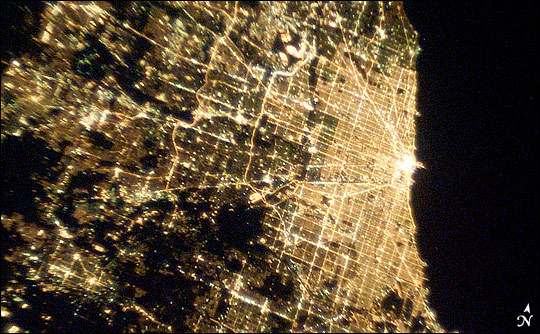
Last Friday, I published a post under the title of People, people, everywhere! Coincidentally, that same day over on Transition Town Payson‘s blog a post was published Urban Sprawl, a Vision from Space! It seemed like a fitting follow-on to that post on Learning from Dogs and is reproduced with the kind permission of the TTP team (thanks Rob).
Urban Sprawl has a major impact on all our Resources!
Urban Sprawl can be tracked
In the Sun Belt Areas of our country, phenomenal growth has occurred over the past 30 years. Satellite images from 1984 through 2012 show the impacts on the Landscape in a time lapse image that is a scary picture of what the next 30 years may bring.
A blog article from the Atlantic Cities website forwarded to me by my friend Dave H. It is a geographic time lapse of satellite images provided by Google. Their article titled “The Devastating Impact of 30 Years of Sprawl, as Seen From Space.” gives startling images of how our cities have grown.
“These GIFs were recorded from Google’s “Landsat Annual Time Lapse” tool by Samuel Aston Williams, a young Texas architect. Williams wanted to contribute something new to a startling series of showing three decades of human-landscape intervention recently produced by a collaboration of Google, NASA, TIME and others.”
The Atlantic Cities also published a blog titled “A Terrifying, Fascinating Time lapse of 30 Years Impact on Earth.” The images in this blog shows development in other places on the earth in a scary 30 year blink of an eye.
“Since the 1970s, NASA and the U.S. Geological Survey have been amassing satellite images of every inch of our planet as part of the Landsat program. Over time, the images reveal a record of change: of cities expanding, lakes and forests disappearing, new islands emerging from the sea off the coast of rising Middle East metropolises like Dubai.
If you could thumb through these historic pictures as if in a flip book, they would show stunning change across the earth’s surface, in both our natural environments and our man-made ones. Now, the digital equivalent of that experience is possible – three decades of global change as GIF – in a project unveiled today between NASA, the USGS, TIME, Google, and the CREATE Lab at Carnegie Mellon University.
Landsat images taken between 1984 and 2012 have been converted into a seamless, navigable animation built from millions of satellite photos. As Google wrote this morning on its blog: “We believe this is the most comprehensive picture of our changing planet ever made available to the public.”
“October 11, 2002: While space technology was undergoing its spectacular birth during the 1950s and ’60s, and visionaries were predicting the spread of human colonies into space, another kind of human colony was spreading rapidly–right here on Earth!
It was the dawn of the modern suburb, a time of post-war prosperity when housing developments popped up across the landscape like mushrooms after a rain.
A half-century later, we now understand that many environmental problems accompany the outward spread of cities: fragmenting and destroying wildlife habitat, for example, and discharging polluted runoff water into streams and lakes.”
Urban Sprawl in the United States is covered in Photos by Christoph Gielen
The photo below was taken by Christoph Gielen. There is a symmetrical beauty to his aerial photos of Urban Areas. Please go to his Twisted Sifter website for phenomenal aerial photos of our Urban Centers.
A Great Aerial photo by Christoph Gielen of an Arizona Neighborhood
Urban Sprawl is defined in detail at the Wiki website;
An interesting phenomena is that Sprawl is a term only used in America for Urban Growth, “The term “sprawl” is most often associated with USland use; outside the US (and especially outside the Anglosphere), the term “peri-urbanisation” is often used to denote similar dynamics and phenomena.”
Smart Growth is the alternative to Urban Sprawl, unfortunately many people argue against high density living and it is still a contentious point. Do we continue to grow outward or upward. Will we feel more like rats trapped in a cage or free range rats. Read the following National Institute of Health article for their take on the impacts of Urban Sprawl vs. Smart Growth.
Urban Sprawl
“Urban sprawl in the United States has its origins in the flight to the suburbs that began in the 1950s. People wanted to live outside of city centers to avoid traffic, noise, crime, and other problems, and to have homes with more square footage and yard space. As suburban areas developed, cities expanded in geographic size faster than they grew in population. This trend has produced large metropolitan areas with low population densities, interconnected by roads. Residents of sprawling cities tend to live in single-family homes and commute to work, school, or other activities by automobile.”
“Although there is considerable evidence that urban sprawl has adverse environmental impacts and contributes to a variety of health problems—including obesity, diabetes, cardiovascular disease, and respiratory disease implementation of policies designed to combat sprawl, such as smart growth, has proven to be difficult.”
Smart Growth
“Smart growth can be defined as a policy framework that promotes an urban development pattern characterized by high population density, walkable and bikeable neighborhoods, preserved green spaces, mixed-use development (i.e., development projects that include both residential and commercial uses), available mass transit, and limited road construction.”
From Wiki these are the Advantages and Disadvantages of Urban Sprawl
Advantages
– More single family residences on larger lots.
– Lower land prices.
– Less experience of noise and pollution.
– Suburban areas generally associated with “sprawl” tend to have lower crime and higher-quality schools.
– Perceived overwhelming consumer preference for sprawl-type developments.
Disadvantages
– High car dependence.
– Inadequate facilities e.g.: cultural, emergency, health, etc.
– Higher per-person infrastructure costs.
– Inefficient street layouts.
– Low diversity of housing and business types.
– Higher per-capita use of energy, land, and water.
– Perceived low aesthetic value
Our Human Colonies seem to be spreading about as fast as our ice caps are melting. I wonder if there is any correlation?
Is it time for mankind to adapt to a new future? No, it’s past time. We have a lot of catching up to do in implementing new technologies to provide sustainable growth options in all areas; industry, transportation, energy production, carbon footprints, food supply, to taking care of our precious fresh water supplies.
How do we make our cities more sustainable and resilient? Start with telling your national, state and local politicians that you want a sustainable future. Let’s work together and make this happen.
Back last November, not long after Jean and I had moved up to Oregon, I saw this on the PRI website: The Sufficiency Economy – Envisioning a Prosperous Way Down. Very quickly I realised the importance of the essay and contacted the author requesting permission to republish on Learning from Dogs. That author was Dr. Samuel Alexander and permission was quickly given, leading to two essays: The simpler life and Where less is so much more.
Now fast forward to nearly a month ago and in came this email:
Samuel Alexander here, from the Simplicity Institute. I’ve recently published a new book, Entropia: Life Beyond Industrial Civilisation. Was wondering whether you were interested in posting either a review or an excerpt on your website?
I was flattered to have been asked and delighted to review the book.
First, some background. Dr. Alexander is a part-time lecturer with the Office for Environmental Programs, University of Melbourne, Australia. He teaches a course called ‘Consumerism and the Growth Paradigm: Interdisciplinary Perspectives’ in the Masters of Environment.
After the review was completed, I forwarded it to Sam just to check that I hadn’t made any technical errors. Within Sam’s reply to that email was his acknowledgement that his book fell into a genre that was not easily classified. Ergo, the book being fiction yet not a novel. Sam went on to muse that perhaps he should have been clearer about what the reader was going to get. He wondered if my review should mention that aspect. I said that I wouldn’t amend my review but would include an introduction to that effect, as now witnessed!
So to the review. (Note: For some reason, I was unable to prevent the paragraph spacing from being deleted in the published version. Hence the insertion of a single ‘-‘ after each paragraph.)
oooOOOooo
Entropia – Life Beyond Industrial Civilisation by Samuel Alexander
–
A review by Paul Handover
–
The title of the book didn’t offer this reader any clue about what might be coming. Nevertheless, very soon an experience of an ‘ah-ha’ moment arrived. Right on page one of the Acknowledgements when this sentence jumped off the page: “Henry Thoreau has been by far the greatest influence on my worldview, for it was he who awakened me to the insight that ‘superfluous wealth can buy superfluities only’.” [my emphasis] Wow, what an intriguing turn of phrase about wealth.
–
I plunged into the Prologue:
After the poets were banished from Plato’s Republic it is said that they set sail into unknown horizons in search of a new place to call home.
–
Shortly later reading:
But life proceeds in twists and turns, not straight lines. After losing consciousness in the midst of this perfect storm, the lost poets found themselves washed ashore on a small,fertile island, which was uninhabited and isolated entirely from the rest of civilisation. The boundless opportunities presented by this merciful twist of fate were immediately clear to all.
–
Some people believe this simple living community flourishes peacefully to this day, lost to the world in its own harmonious, aesthetic existence. But like Atlantis, the Isle of Furor Poeticus, as it has come to be known, has never been found.
* * *
The Isle of Furor Poeticus is a utopian romance of course – a myth. But we should remember that human existence has always been shaped and guided by myths and stories, so let us not dismiss the story of the lost poets too quickly or proudly. After all, we may not be so free from superstitions of our own. Modernity’s ‘myth of progress’ might itself just be a story we have been telling ourselves in recent centuries, one in fact that could soon be dismissed as a story no longer worth telling. Indeed, perhaps that book is closing before our very eyes – has already closed – leaving us to reflect on its themes from beyond as we step forth into unknown pages. And yet, it seems we have not found a new story by which to live. We are the generation in-between stories, desperately clinging to yesterday’s story but uncertain of tomorrow’s. Adrift in the cosmos, without a narrative in which to lay down new roots, humanity marches on – lost and directionless. But then again, perhaps the new words we need are already with us. Perhaps we just need to live them into existence.
–
Beautiful, magical writing right up to the closing sentences of the Prologue:
By choosing to do so we could again become the poets of our own lives and of a new generation, instead of merely reading out a pre-written script to an audience that is no longer listening. So open your mind, gentle reader, for the future is but clay in the hands of our imaginations.
–
We are being called to make things new. [again, my emphasis]
–
The novel, for it is a work of fiction, opens in substance with the account of Mortimer Flynn, a wealthy Texas oil magnate and son and only child of a Welsh coal industrialist, who having achieved “everything of which he had ever dreamed” comes to the realisation that he has no idea at all as to the purpose of his life. From this life-changing reassessment of his journey, his profound crisis of conscious, comes the purpose of the book. A story of a group of people who settle down in a remote South Pacific island, the island of Entropia. A “story about a community that became isolated on its small island in the wake of industrial civilisation’s collapse, during the third decade of the twenty-first century.”
–
Now, it’s fair to say that at this point I was truly hooked on the book. This was going to be the read of my life. Because it reflected my own belief that humanity was at the point, perhaps beyond the point, where the growing threats to our natural world threatened our moral obligations to the generations that follow.
–
However, somewhere during the second chapter, the style of writing started to intrude into my absorption of the story. At first the intrusion was more like a fly buzzing around; a minor irritation. Then it got to the stage where I had to stop reading and ponder on why I felt so uncomfortable with this reading experience. I was by now well into the third chapter.
–
Still couldn’t put my finger on what the problem was. Returned to the book but noticed that I was skim reading and had forcibly to focus on fully reading each page. After all, I was reading the book for review purposes!
–
Then it struck me. There were no characters coming to life off the page. Consequently, there was no dialogue. It didn’t read like a novel, much more like a report. That was the key to me re-establishing my relationship with the story; the book. Because despite the unusual style for a work of fiction, the value inherent in the pages was beyond measure. Here was a book that described in great detail the way a community discovered the reality of a sustainable way of life. How this group of a couple of thousand souls reinvented a society, a sustainable society, out of the ashes of a failed industrial civilisation.
–
I read on.
–
Later on the book described how the community looked at the way they governed themselves, how they set up representative systems and then, on page 119, came something that really punched me in the face, figuratively speaking. It was introduced, thus:
Eventually a short constitutional document was drafted by the Advisory Council and put to a referendum by the People’s Council, and this document received 94 per cent support. It is reproduced in its entirety below, as it serves as the best summary of our social, economic and political vision.
–
And proceeded:
Charter of the Deep Future
ENOUGH, FOR EVERYONE, FOREVER
.
We affirm that providing ‘enough, for everyone, forever’ is
the defining objective of our economy, which we seek to
achieve by working together in free association.
.
We affirm that everyone is free to create as an aesthetic
project the meaning of their own lives, while acknowledging
that this freedom legitimately extends only so far as others
can have the same freedom. Freedom thus implies restraint.
.
We affirm that our inclusive democracy does not
discriminate on such grounds as race, ethnicity, gender,
age, sexuality, politics, or faith.
.
We affirm that generations into the deep future are entitled
to the same freedoms as present generations.
.
We affirm that respecting the deep future requires maintaining
a healthy environment.
.
We affirm that technology can help to protect our
environment only if it is governed by an ethics of sufficiency,
not an ethics of growth. Efficiency without sufficiency is lost.
.
We affirm that maintaining a healthy environment requires
creating a stationary state economy that operates within
environmental and energy limits.
.
We affirm that a stationary state means stabilising
consumption and population, transitioning to renewable
sources of energy, and adapting to reduced energy supply.
.
We affirm that strict limits on material accumulation are
required if a stationary state is to maintain a just distribution
of resources and avoid corrosive inequalities.
.
We affirm that property rights are justifiable only to the
extent they serve the common good, including the overriding
interests of humanitarian and ecological justice.
.
We affirm that a stationary state economy depends on a
culture that embraces lifestyles of material sufficiency and
rejects lifestyles of material affluence.
.
We affirm that material sufficiency in a free society provides
the conditions for an infinite variety of meaningful, happy,
and fulfilling lives.
___________________________
–
Well that had such an impact on this reader. For this reason. The contrast between the reality of our present 21st Century life and the lives of those souls on Entropia was like night versus day. Enough, For everyone, Forever. If ever we needed a new cry from the heart, a new cry of hope and purpose, it was now and those are the words of that cry.
–
Entropia is a book you should read. It is a book that offers much hope, much guidance and much direction. As Samuel Alexander wrote on page 148, “Tranquillity and angst are both contagious, so it matters which of them we feed.”
Back on the 16th June, I published a post under the title of Wonder and Awe. It featured Miyoko Shida Rigolo and a balancing act of such artistry with a most beautiful finale!
Without doubt, President Obama’s recent speech on climate change was very welcome. I fervently hope this is a genuine commitment to change the course of the biggest and most powerful nation on our planet. Abandoning the Keystone XL pipeline would be the proof to my mind. UPDATE: But read this!
But the runaway, exponential growth in CO2 has a brother; huge growth in the world’s population.
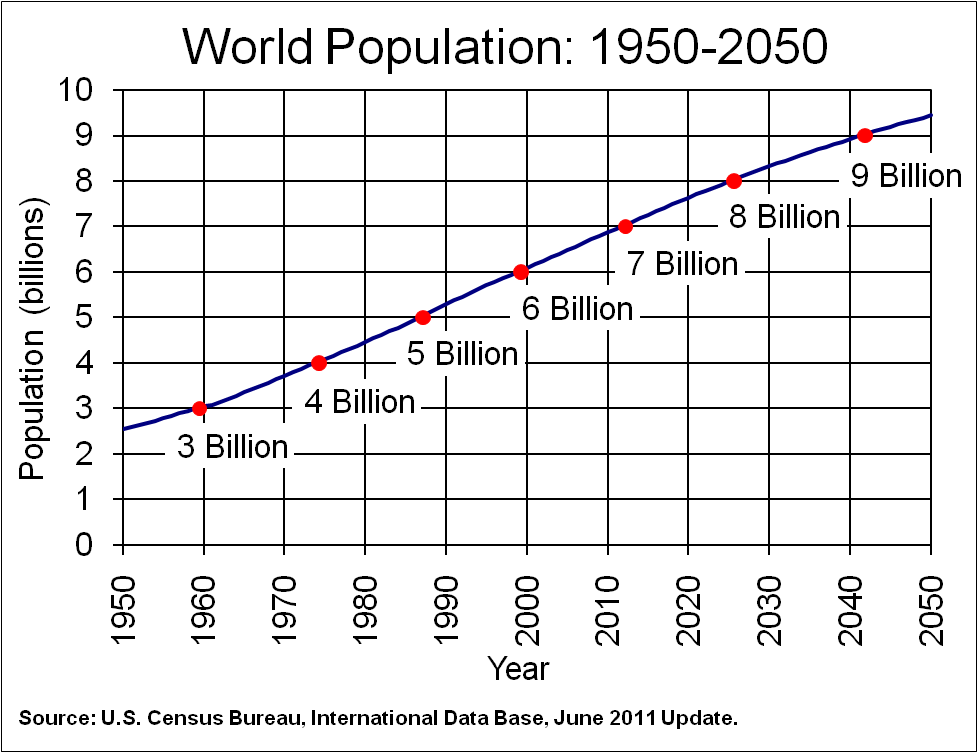
I’m going to ‘smack you in the face‘ with this population chart.
To put that into context from a personal perspective, when I was born in 1944 the global population was 2.5 billion persons. Some 4.7 billion fewer people than today!
But that prediction from the U.S Census Bureau in June, 2011 is already out of date!
13 June 2013 – The current world population of 7.2 billion is projected to increase by 1 billion over the next 12 years and reach 9.6 billion by 2050, according to a United Nations report launched today, which points out that growth will be mainly in developing countries, with more than half in Africa.
Now please humour me for a few moments. If the world population is presently 7.2 billion people and by 2050 the prediction is 9.2 billion people, that is an increase of 2,400,000,000 persons.
The end of 2050 is 438 months away. Now do the maths. That growth in population in that time period is the equivalent of an increase in population of 5,479,000 persons every single month!
Need to find a darkened room – I feel a headache coming on!
Just ran out of time yesterday, so enjoy the following:
(Sent to me by Dan Gomez.)
The beautiful strange-eyed kitten, taken in Lovech, Bulgaria in the summer of 2009 by Bobby Pfeiffer.
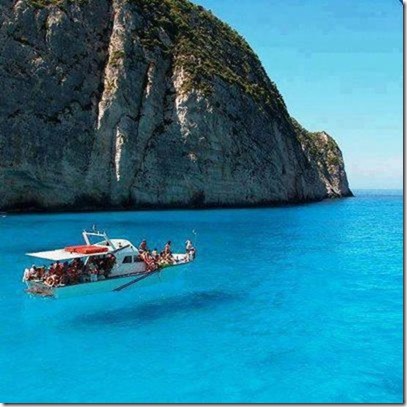
Zakynthos Island in Greece. The water is so clear, it looks like the boat is floating in the air.
This is what ocean sand looks like when it’s magnified 250 times.
California Red-Sided Garter Snake.
Zanjeer, The Golden Labrador Who Saved Thousands Of Lives.
In March 1993, a series of 12 bombs went off across Mumbai, India. The serial blasts left 257 dead and 713 injured. But in the aftermath, an unlikely hero emerged. According to Reuters, a golden labrador named Zanjeer worked with the bomb squad and saved thousands of lives by detecting “more than 3,329 kgs of the explosive RDX, 600 detonators, 249 hand grenades and 6,406 rounds of live ammunition.” He helped avert three more bombs in the days following the blasts.
The dog died of bone cancer in 2000. He was eight years old.
In the photo, a senior police officer lays a wreath of flowers on Zanjeer as he was buried with full police honors at a widely-attended ceremony.
The love of a woman for her horse!
The incredible story of one woman’s loyalty to her horse – she spent three hours holding its head above the tide after it got stuck in the mud on a beach in Australia. His owner, Nicole Graham, who was enjoying an afternoon ride, stayed with him as rescuers struggled for three hours to pull him out. With moments to spare, the 500kg horse, named Astro, was freed with the help of a tractor and harness at Avalon Beach in Geelong, Victoria, Australia .







 Learning from Dogs