Many will have read yesterday’s post about the slaughter of elephants by ivory poachers and felt, as I did, a feeling of despair in the pit of one’s soul. We seem to be living in such challenging times with so much madness about us. It’s incredibly easy to feel as if this is some sort of ‘end of times’ period.
Today’s post tells us that there is always hope.
Let’s remind ourselves that elephants are very intelligent animals. As I wrote last November in a post with the title of Smart Animals:
There was a fascinating article on the BBC news website a few weeks ago that went on to explain:
10 October 2013
Elephants ‘understand human gesture’
By Victoria GillScience reporter, BBC News
African elephants have demonstrated what appears to be an instinctive understanding of human gestures, according to UK scientists. In a series of tests, researcher Ann Smet, of the University of St Andrews, offered the animals a choice between two identical buckets, then pointed at the one containing a hidden treat.
From the first trial, the elephants chose the correct bucket.
In 2011, more African elephants were killed than any other year in history. The figures for 2012 and 2013 are not yet known, but are likely to be even higher. At current rates, in twelve years, there will be none left.
It is a familiar cause, but it has never been more urgent. Poaching has turned industrial. Armed militia fly in helicopters over jungle clearings, machine gunning down entire herds. Their tusks are then sold to fund war and terrorism throughout the continent and the wider world. Ivory is still illegal, but as China booms, it is more popular than ever.
This campaign will raise money to support rangers on the ground to protect Kenya’s elephants from armed poachers, together with Space for Giants’ longer term work to create new wildlife sanctuaries where elephants will be safe, forever. More can be found about the charity at Space for Giants
The article above includes two videos. A shorter one that can be viewed on the paper’s campaign website. Then there is a longer, five-minute, video also on YouTube and included below.
Then there is the David Sheldrick Wildlife Trust helping animals in Africa. And, finally, the campaign over at Bloody Ivory where one can sign a petition and donate towards stopping elephant poaching.
Thus, like so many aspects of life, never give up trying to help those less fortunate.
What a greedy, selfish race of people we can be at times!
I’m writing about the subject of elephants. Or, to put it more precisely and distastefully, the murder of elephants. For the ivory in their tusks.
The post was prompted by a recent item over on Chris Snuggs’ blog Nemo Insula Est. Chris and I have known each other for quite a few years now; since the time that he was Head of Studies at the French college, ISUGA, in Quimper, France and where I attended as a visiting teacher running a class on Sales & Marketing.
Chris has allowed me to republish the piece in full. Please read today’s post and then come back tomorrow to see in what ways we can all help.
ooOOoo
The Human Shame in Northern Kenya
03JAN
One of my NYRs was to stop reading bad news, but that lasted about 6 hours ….. there is of course so much of it, and so much that is utterly depressing. One of the first of 2014 was an article in “The Independent”:
Elephant Appeal: Few are willing to say just how bad the poaching crisis is – the elephant population may easily fall into terminal decline
Tragic, to the extreme!
You can get all the details from the article – which is pretty harrowing, with surviving elephants described as being “stricken with grief” as they cluster round their slaughtered brethren – but basically, elephants in the Tsavo East National Park in Northern Kenya are under threat of extinction from poachers from Somalia. This provoked a number of reactions on my part:
DEMAND
The price of ivory depends on the demand and supply. The former is very strong and apparently rising, especially in China. For extraordinarily moronic and selfish reasons, ivory is considered artistic and – for example – tiger and rhinoceros parts medicinal and/or possessing aphrodysiac properties.
Can China really do NOTHING to stop this cultural abomination? People in the west for the most part stopped acquiring ivory years ago.
If China – and other Asia nations – cannot or will not do anything, should the west not apply more pressure? Same applies of course to China’s support of North Korea. YES, sanctions are painful, but nothing NON-painful is likely to work.
THE POACHERS
They are execrable, of course …… and yet, many may be extremely poor, and indeed ignorant. There is no excuse in the strictest sense, but it may to some extent be understandable if they see a chance to make several years’ normal income in a single day. This is no different from City bankers, or indeed the Enron directors and many others: greed is sadly rampant on our planet.
There are insufficient funds to patrol the parks properly. Kenya is just one more corrupt African state where politicians earn a fortune while basic needs and services are severely underfunded.
MORALITY
So, there is a lack of funds to prevent the poacher-killers. Yet a few hundred miles away, vast sums of money are squandered on obscene luxuries.
I always wonder what if anything goes through the minds of those who spend these obscene sums on frippery and personal self-glorification. Do they ever think that their money could do immense good elsewhere? Would WE be just the same in their shoes?
Is there any solution to this greed?
ooOOoo
Chris wrote his post motivated by the article in The Independent UK newspaper. But that newspaper was not alone in promulgating the despicable killings of these smart and magnificent creatures. Here’s a story that was in the UK Daily Telegraph newspaper a year ago.
Horror as entire family of elephants slaughtered for ivory
Armed wildlife rangers on Tuesday night fanned out across eastern Kenya in pursuit of ivory poachers who killed an entire family of 12 elephants in the country’s worst single such slaughter since the 1980s.
Eleven adults and one infant calf died in a “targeted and efficient” attack highlighting the growing professionalism of poachers bankrolled by international criminals supplying soaring demand for ivory in the Far East.
Six of the animals lay in one heap, their tusks hacked out with machetes.
None of the family group managed to flee further than 300 yards before they were gunned down and their ivory removed.
The calf, less than a year old, is believed to have been crushed by its dying mother as she fell to the ground.
“It is unimaginable, a heinous, heinous crime,” said Paul Udoto, spokesman for the KenyaWildlife Service (KWS).
“We have not seen such an incident in recent memory, it’s the worst single loss that we have on record, and our records go back almost 30 years.
“These were professional killers. The attack was targeted and efficient.”
The poachers, armed with automatic rifles, had already fled but there were hopes last night that a massive search involving foot patrols, a dozen vehicles and three aircraft could still find them.
“Every possible resource is being deployed to track down these criminals,” Mr Udoto said. “They will feel the full force of the law.”
But the area where the elephants were killed, in the north of Kenya’s largest wildlife reserve, Tsavo East National Park, is sparsely populated, has few roads, and lies close to Kenya’s border with Somalia.
Privately, conservationists said they feared the poachers and their haul of 22 tusks, worth an estimated GBP175,000 on the Asian market, would already have escaped.
The attack was the latest in a surge of elephant deaths that has seen the number of the animals killed for their ivory in Kenya increase sevenfold in five years, from fewer than 50 in 2007 to 360 in 2012, according to KWS figures.
The increase has led many wildlife experts to declare the current situation a crisis worse even than the mass slaughter of Africa’s elephants in the 1970s and 1980s, which led to a global ivory trade ban in 1989.
I don’t have permission to republish the article so please go here and read the full piece and view a couple of harrowing photographs.
Then come back tomorrow and explore how you and I can do something to help. Please.
The first of the New Year and dedicated to Sue of Sue Dreamwalker.
A week ago, Sue left a nice comment about our ‘backyard’ here in Oregon. Specifically with regard to the two photographs of deer feeding in front of the house. I replied by saying that today I would offer a selection of views of our property.
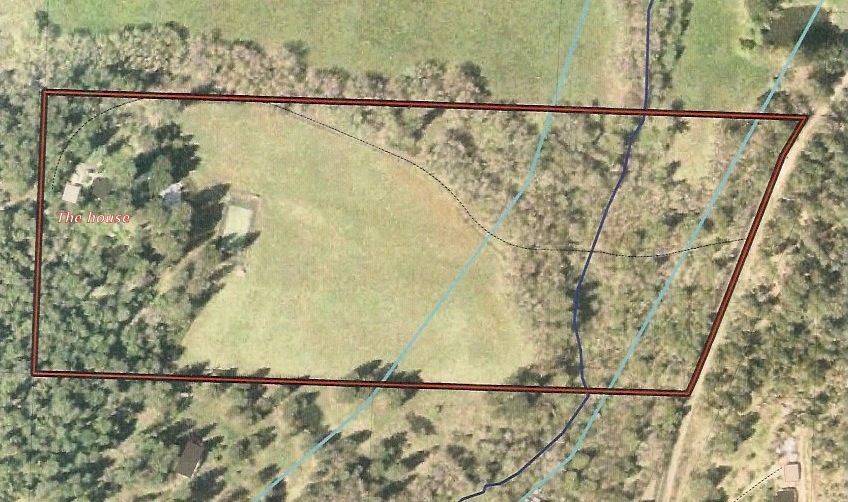
First off, an aerial view with the property boundary line overlaid, taken from the sale particulars. The right-hand, Eastern boundary follows the edge of Hugo Road. We are some four miles from Merlin in Southern Oregon.
Thirteen acres orientated West-East.
The solid blue line is the course of Bummer Creek that flows from top to bottom of the image. The thin, dotted blue line is the driveway that runs from Hugo Road up to the house, a distance of a 1/4 mile. The house is close to the Western boundary almost hidden from sight in this picture by the trees. There is a faint label ‘The House’ just below the building.
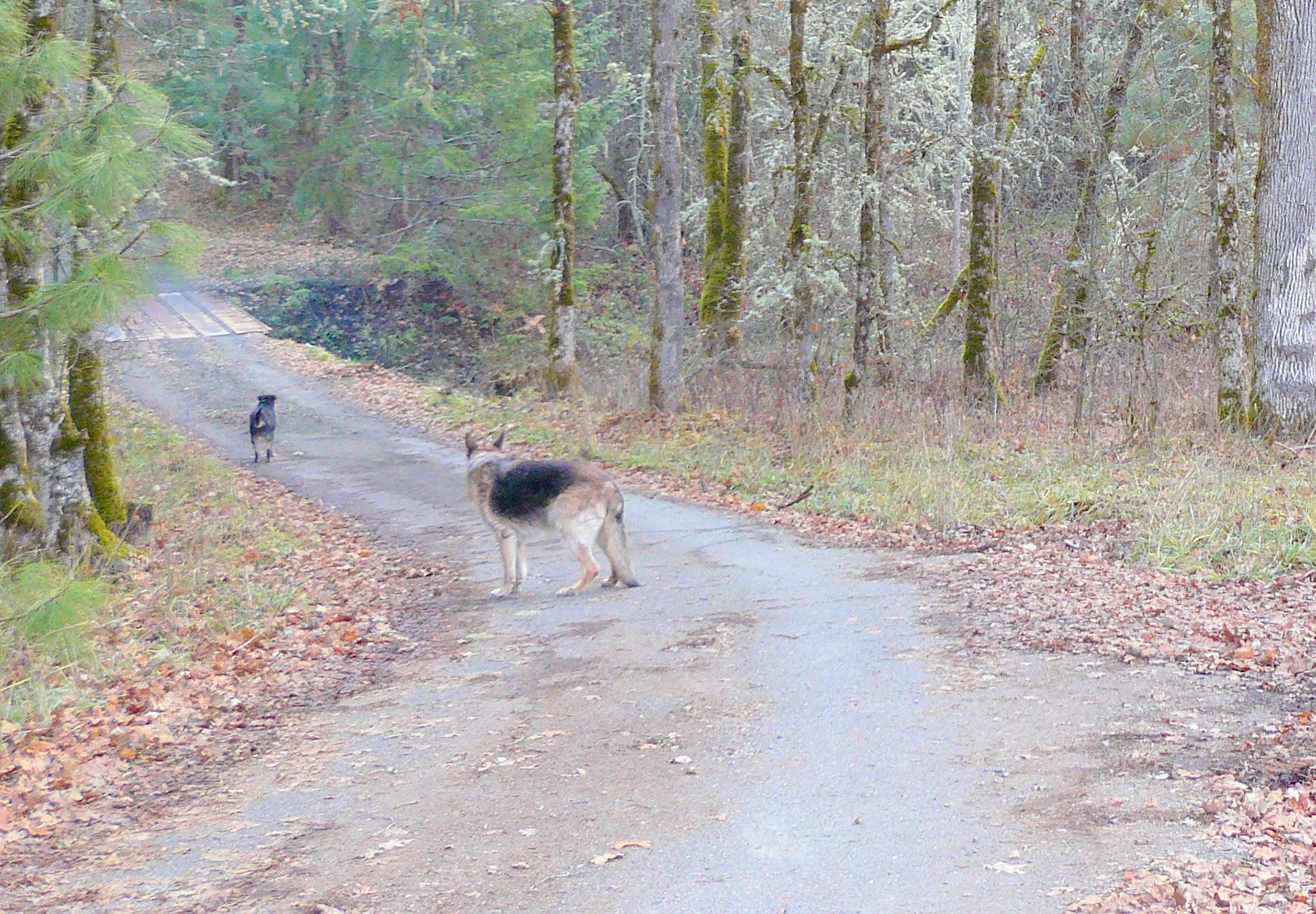
From left to right: Pharaoh, Sweeny, Cleo and Hazel.
The above photograph was taken from a point about half-way along the driveway, the house being behind the camera. Ahead, the driveway dips down to cross the bridge over the Creek, as the following picture reveals. Luckily the boundary fence is dog-proof!
oooo
Dogs and water!
Pharaoh in Bummer Creek just downstream of the bridge.
Looking further downstream from the bridge.
oooo
Looking upstream from the bridge.
The barrier across the Creek seen in the upper half of the photograph is a flood irrigation dam installed many years ago, presumably for agricultural purposes before the plot was sold for house building prior to 1977. One installs an iron pole on a centre bolt embedded in the dam and then places a stout plank across the flow on top of the dam. The plank can just be seen to the right of the dam, resting on the bank. Never tried the dam but going to some day!
Looking to the West up towards the house.
The above picture was taken close to where the previous one was shot. Simply by swinging around to the left and looking back up. The house is barely visible in the background behind the metal gate and wooden fence posts in the middle of the photograph.
Corinne’s field visible through the trees and undergrowth.
Again, the picture above is taken not far removed from where the previous two were taken. If one looks at the aerial view of the property in the first picture, in the top-right corner there is a small area of grassland; what would have been an offshoot of our neighbour’s grassland in previous times. After my sister, Corinne, died in the Summer of 2013 we named that area of grassland Corinne’s field.
A general view down over the main area of grass.
So now we are back standing just outside the Eastern side of the house looking South-East out over the main area where the dogs are walked twice a day. The picture was taken a little before noon and shows the low mist that has been with us for about two weeks.
Nature’s beauty.
Above, another photograph picking up on the mist that has been with us for some days. Until yesterday!
This is what I call a Winter day!
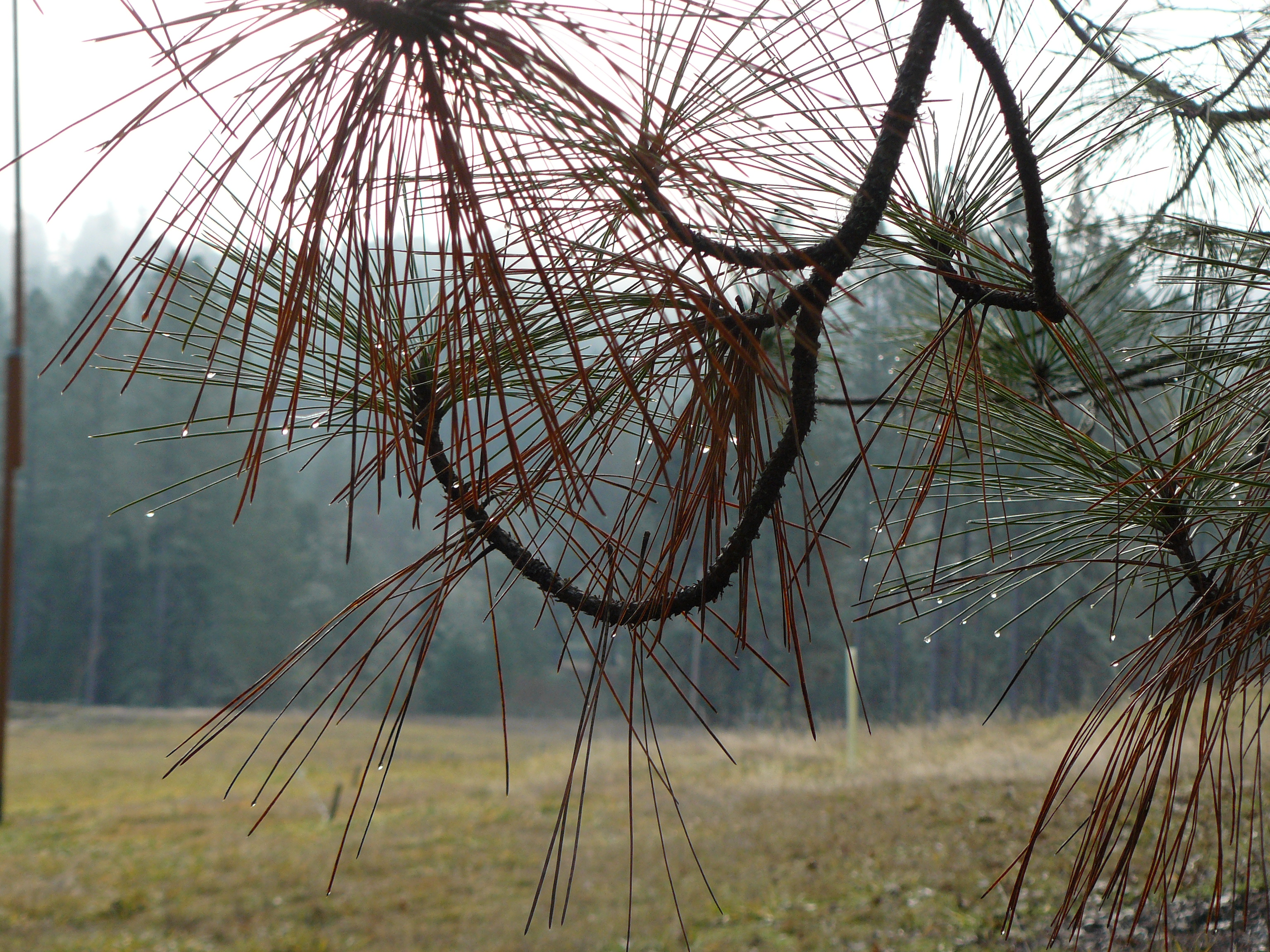
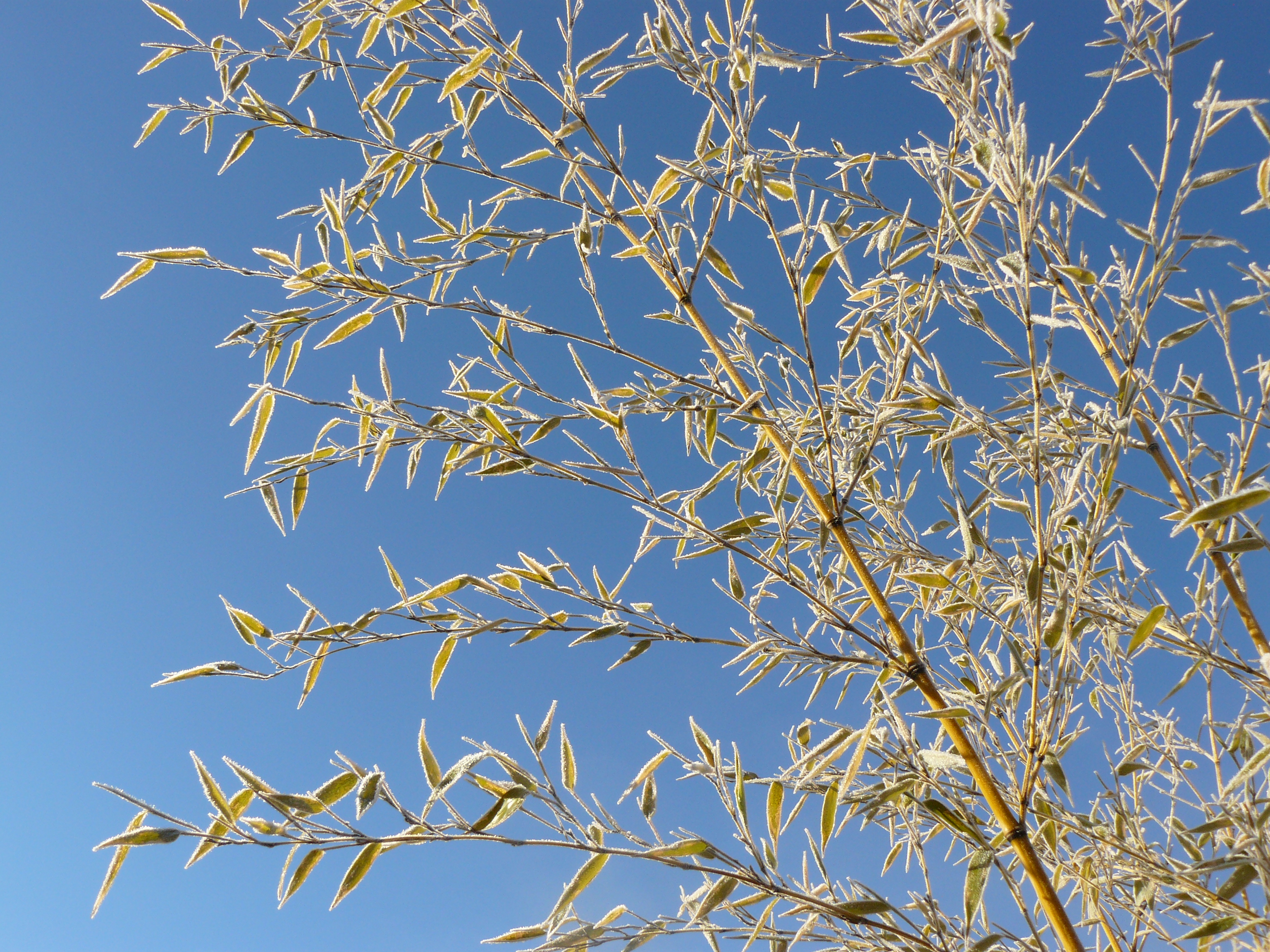
Yesterday dawned cold, clear and frosty. As this picture of one of our tall pine trees so vividly demonstrates. (The tree edges our driveway, about half-way to the house.)
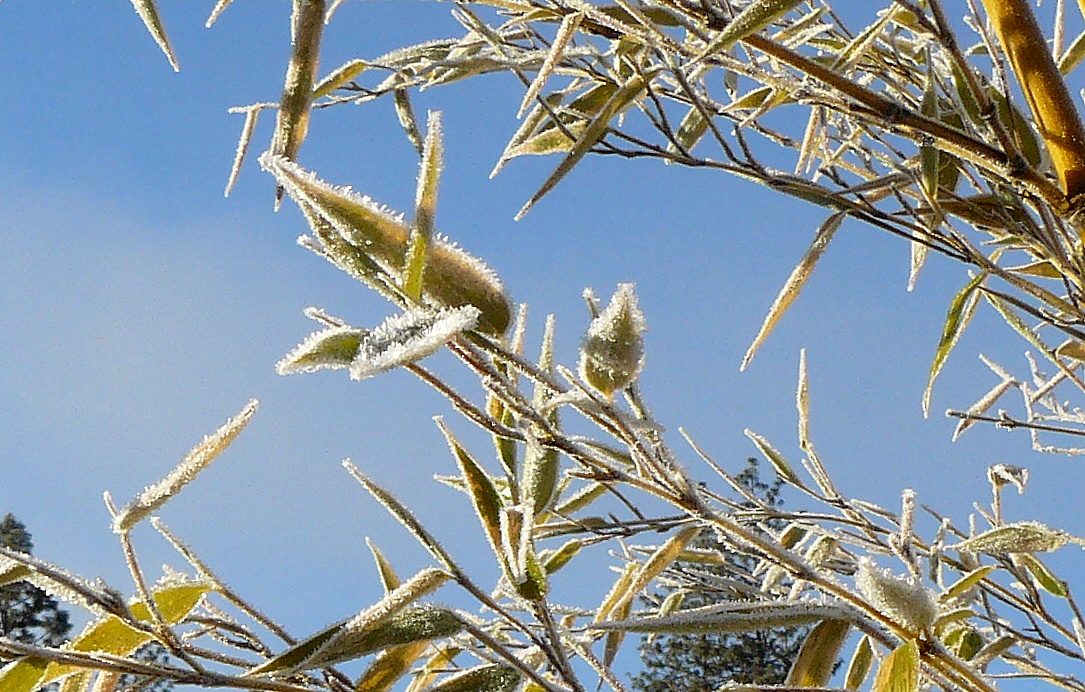
So will close today’s post with three more pictures of a frosty Saturday morning in Merlin, Oregon, USA.
A frosty yet sunny morning.
oooo
Frost on a bamboo tree.
oooo
It really is a beautiful world at times.
oooo
So there you are, Sue!
Needless to say, Jean and I are reminded almost daily how lucky we and all our animals are at finding such a beautiful place to live. I can’t ever imagine taking it for granted.
I can’t recall how I came across the story but it doesn’t matter. A story that was presented on the MNN website back in May, 2013. That had it’s origin in an episode of the Johnny Carson Show back in the year 1981. An episode where the late Jimmy Stewart read a poem about his dog, Beau.
Here’s the clip of that 1981 show.
Impossible not to be deeply moved by that clip.
oooo
A further web-search came across this item on WikiPedia:
Background
James Stewart owned a “willful but beloved” golden retriever named Beau, of whom he was extremely fond. Beau slept in the corner of Stewart’s bedroom, but would often crawl onto the bed between Stewart and his wife Gloria. Stewart recalled, “he was up there because he wanted me to pat his head, so that’s what I would do. Somehow, my touching his hair made him happier, and just the feeling of him laying against me helped me sleep better.”
While shooting a movie in Arizona, Stewart received a phone call from Dr. Keagy, his veterinarian, who informed him that Beau was terminally ill, and that Gloria sought his permission to perform euthanasia. Stewart declined to give a reply over the phone, and told Keagy to “keep him alive and I’ll be there.” Stewart requested several days’ leave, which allowed him to spend some time with Beau before granting the doctor permission to euthanize the sick dog. Following the procedure, Stewart sat in his car for ten minutes to clear his eyes of tears. Stewart later remembered:
After [Beau] died there were a lot of nights when I was certain that I could feel him get into bed beside me and I would reach out and pat his head. The feeling was so real that I wrote a poem about it and how much it hurt to realize that he wasn’t going to be there any more.
You can understand why I sub-titled this post ‘Millions will share these sentiments.’ because there are millions of dog-owners right across the world who have their dogs sleep with them in the bedroom. We have five do just that: Pharaoh, Sweeny, Cleo, Dhalia and Hazel. Hazel and Dhalia sleep in line pressed up against me and Sweeny sleeps in the crook of Jean’s legs. Yes, it can be a pain turning at night. Yes, it can be a pain going to the bathroom in the night. But would we miss them sleeping on the bed: YES!
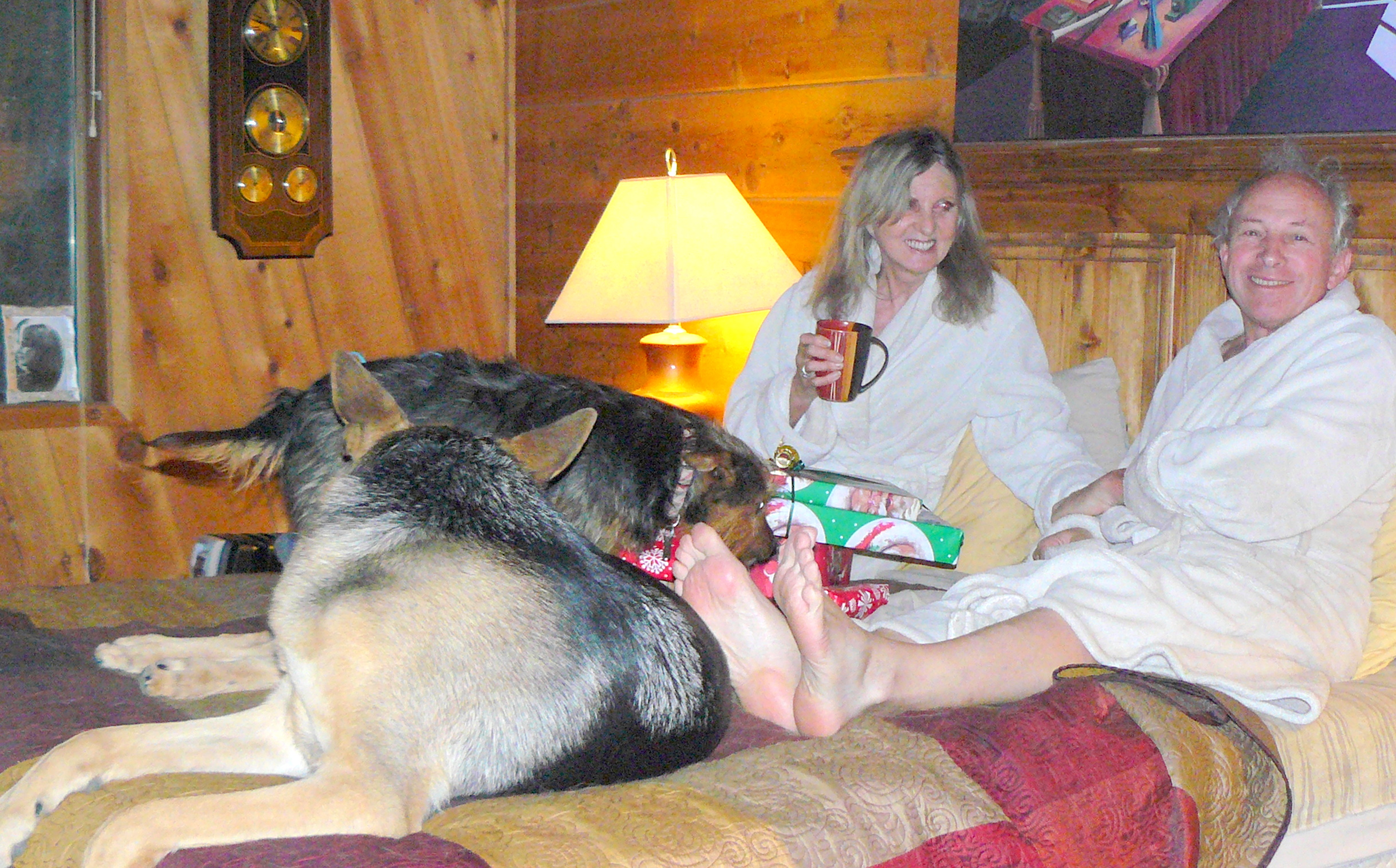
To reinforce that last point, here are two photographs of me and Jean on Christmas Day morning.
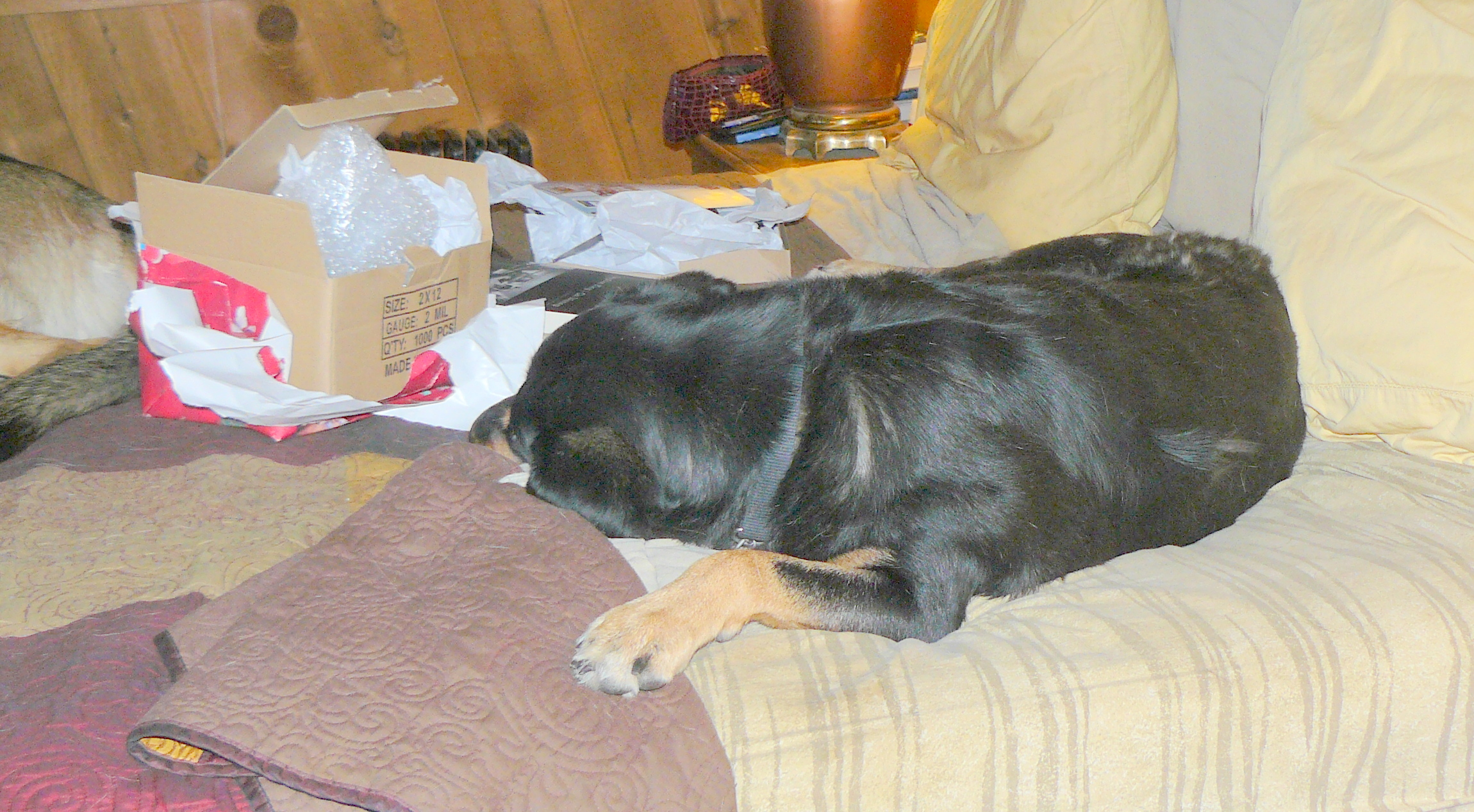
Hazel being very slow to get off the bed!
oooo
Cleo, foreground, and Sweeny helping open presents for Jean and me!
That web-search that found the WikiPedia item also found an excerpt from Professor Stanley Coren’s fabulous book Why We Love the Dogs We Do. I say fabulous because it’s a book that I have read and is on the book-shelf not four feet from where I am sitting. With Stanley Coren’s written permission, for which I say thanks, that excerpt is now republished:
While I was on a book tour a few years ago, I had the opportunity to meet with Jimmy Stewart. He was no longer the young Charles Linbergh character that I remembered from the film The Spirit of St. Louis, or the easy moving character that became a hero in The Man Who Shot Liberty Valance. His age had begun to show on him, and he appeared to be almost fragile. He was slow moving and even slower talking than I remember him being in the movies. However, when he started to speak about his dogs his face broke into a smile and the pace of his talking picked up. He told me:
“When I married Gloria she already had a German Shepherd named Bello. He loved her a lot and, after a while, he and I got along. Gloria really loves German Shepherds best of all, but sometime after we lost our second one, she decided that they weren’t the breed of dogs that I needed. Anyway, she went out and got me this Golden Retriever named Simba, and its been Goldens ever since for me. “We actually have three dogs now. Kelly and Judy, are Golden Retrievers, and then there is Princess who is some kind of a mixed breed that my daughter found and we sort of rescued. Princess had some behavior problems and I think that Kelly and Judy picked up some of her bad habits–figured that if Princess could get away with it so could they. We had met Matthew Margolis [who co- authored of a number of fine dog training books, such as When Good Dogs Do Bad Things, with Mordecai Siegal] and Gloria liked him. He runs the National Institute of Dog Training. Kelly and Judy were not behaving. They didn’t listen to anything we said, and they were always jumping up and barking and pulling on the leash–both were just imitating Princess, I think. Well, anyway, Matthew told us that he would have to take the dogs to his training kennel for six weeks to get them to behave. The reason that he wanted them at the kennel had something to do with ‘socialization’ and other dog things like that. It was supposed to help their shyness and excitability. Gloria and I didn’t like it, but she felt that we had to do something. Well that lasted just one day. You know I love my house, but without any dogs around it feels like some kind of mausoleum. I told Gloria ‘Get those dogs back home because I can’t put up with them not being here.’ Anyway, Matthew tried to set up a training program at the house, but it really didn’t work so well. In the end we compromised. We broke the three dogs up into squads, so we could send one or two of them to school for short sessions, and still have one or two at home for company. I still didn’t like it, even though we got to visit their school on weekends. Gloria made a lot of phone calls to make sure they were OK–to reassure me I guess. “I suppose the truth is that I’d rather have a happy dog than a trained one. My dogs have never been good at things like ‘sit’, ‘stay’ or even ‘come’. I think that we’ve given the tourists a few laughs, especially when the dogs hit the end of their leashes hard enough to drag Gloria down the street. I don’t even mind it when the dogs jump up. Matthew showed us how to jerk the leash to correct that kind of thing. I suppose that it does have to be done–you know to keep them from knocking someone down or messing their clothes–but it seems kind of cruel to me. If my dog jumps up on me I figure that he wants to kiss my face and tell me that he thinks that I’m a really nice person. I don’t believe that you should punish a dog for saying ‘I love you.’ When your dog’s face is up looking at yours like that I think that you should tell him just how nice you think that he is too. Gloria told me that Matthew says that we mother the dogs too much and that they’ll never really be well trained. Well, they’re a lot better now than what they were before, so some of the training must be working. The difference between ‘trained OK’ and ‘trained perfectly’ doesn’t really matter all that much to me. I once did a film with Lassie. When that dog got excited it jumped all over Rudd Weatherwax [Lassie’s trainer]. Now that’s the smartest dog in the world. If the world’s best trained dog can jump around to show he’s happy then my dogs should be allowed to do the same. “The truth is that it’s just really hard for me to get to sleep without a dog in my bedroom. It’s funny about that. I once had a dog named Beau. He used to sleep in a corner of the bedroom. Some nights, though, he would sneak onto the bed and lie right in between Gloria and me. I know that I should have pushed him off the bed, but I didn’t. He was up there because he wanted me to pat his head, so that’s what I would do. Somehow, my touching his hair made him happier, and just the feeling of him laying against me helped me sleep better. After he died there were a lot of nights when I was certain that I could feel him get into bed beside me and I would reach out and pat his head. The feeling was so real that I wrote a poem about it and about how much it hurt to realize that he wasn’t going to there any more.”
I later learned just how intense his feelings were for his dog Beau. At the time, Stewart was making a picture which was shooting on location in Arizona. One evening he got a phone call from his veterinarian, a Dr. Keagy. The call was about Beau. Keagy told him that Beau was very sick. He was having trouble breathing and was in considerable pain. The disease had progressed to the point that it was obvious to Keagy that the dog couldn’t be saved. He was calling for permission to end Beau’s life quickly. Stewart’s wife Gloria said that she couldn’t make that decision since Beau was Jimmy’s dog. “I can’t just tell you to put him to sleep like this,” Stewart said, “Not over the phone–not without seeing him. You keep him alive and I’ll be there.” Stewart was always known as an easy actor to work with, who never made excessive demands. So, the director was taken aback when he went to him to ask for a few days off to fly home to see to his dog. The leave was granted and Stewart got to sit with Beau for a long while before making the decision. He later admitted that when he left the veterinarian’s office he had to sit in his car for around 10 minutes, just to clear his eyes of tears, so that it would be safe to drive home.
NB: Please note that Professor Stanley Coren is the author of the above excerpt, the material is copyrighted by SC Psychological Enterprises Ltd and has been republished with permission. I would thoroughly recommend visiting the blog-site of Psychology Today, Canine Corner.
On New Year’s Day I published the first part of a film called Awakening the Dreamer: Changing the Dream. Then yesterday came the second part. I found it a remarkable film. Because, while the first part reminded the viewer of the list, the long list, of things that are wrong with these present times, the second part highlighted the many currents of positive changes that are taking place here and now.
Without hope there is nothing.
The film is available to watch on Top Documentary Films and here is the introduction offered in that place.
Of all the innumerable beliefs and hypotheses that make up our contemporary industrial perspective on life there is one that is dominant and very frequent. That’s the assumption that we are disconnected, from everyone and everything. This belief configures basically all our ideas and actions. There’s a crucial fallacy that we are separate. But, if there is only one, then whatever I do to you I’m actually doing it to myself, my family, and my children.
Spiritual attitude has long instructed that partition is actually an illusion. However, in the past, the narrative that’s been exchanged in the modern world, whether consciously or unconsciously, has been that the world functions like a huge machine made of separate parts like a big clock. For the past four centuries, the scientific established practice has been trying to take the clock apart, and figure out how it functions, so we can use it for our own ambitions.
This rigid aspect meant that instead of realizing the relation between things, we were analyzing and taking apart those very same things. So, what developed was kind of disintegrated view of the natural world. And we became entranced with the ability that came out of this technology, and we lost our relations to each other; we lost our connection to the enigma of the cosmos.
Although the modern worldview is superior on Earth, it’s valuable to identify that it’s not the only worldview. Traditional, native cultures are not so concentrated on “advancement”, rather they’re focused on their health and persistence of the community, and they see the interdependence of all things. They try to recognize that we’re related to everything… to the animals, fish, plants, trees, birds, and even to the microorganisms. Indigenous people of the world have a particularly important role to play at this moment in history. We need them to come forward and explain how they see things.
The film was produced by the Pachama Alliance, an organisation I hadn’t come across before. Their website is here and on the About page one learns:
Purpose
The Pachamama Alliance, empowered by our partnership with indigenous people, is dedicated to bringing forth an environmentally sustainable, spiritually fulfilling, socially just human presence on this planet. Our unique contribution is to generate, and engage people everywhere in, transformational conversations and experiences consistent with this purpose. We weave together indigenous and modern worldviews such that human beings are in touch with their dignity and are ennobled by the magnificence, mystery and opportunity of what is possible for humanity at this time. We are here to inspire and galvanize the human family to generate a critical mass of conscious commitment to a thriving, just and sustainable way of life on Earth. This is a commitment to transforming human systems and structures that separate us, and to transforming our relationships with ourselves, with one another, and with the natural world.
If you have read this post so far, then you will enjoy this video. More than enjoy it; you will find it inspiring and liberating.
Another organisation mentioned in the film was Bioneers, also not previously known to me. Their website is here. The organisation describes itself, in part:
Collective Heritage Institute – Bioneers is a non-profit New Mexico corporation founded in 1990 by Kenny Ausubel and Nina Simons. The overarching mission of Bioneers is the advancement of holistic education pertaining to global social, cultural and environmental issues. Bioneers identifies progressive yet nature-honoring solutions to rising challenges of instability, inequality, and unsustainable growth and disseminates this knowledge via independent media, events, and community action networks.
There is much on these two websites to offer hope.
Those of you who watched Part One of Awakening the Dreamer that was published yesterday could be excused for thinking that it was a very gloomy window on our world at the start of 2014.
Park those feelings and watch Part Two.
The Hope
[vimeo http://vimeo.com/52496263]
ooOOoo
Tomorrow, Friday, I will complete this run of four days by dropping in on a few of the organisations named in these films plus a few other items.
A very Happy New Year to you and all your loved ones!
Yesterday (I’m tempted to write last year!), I posted a little tale about the donkey in the well; essentially a message about being happy.
My original plan for today was to post a series of photographs of some animals next door that our neighbours, Larry and Janell, have recently adopted.
But then Jean and I watched a documentary two evenings ago that had us both spellbound. The documentary, Awakening the Dreamer, consisted of two 45-minute films. The first highlighting the precarious nature of our present times. The second showing the accelerating pace of people all across the world actively changing things for the better. Hence the title of the post The Pain and the Hope.
So here’s Part One. I do so hope you can find the time to watch it.
Depending on just where in the world you are, the New Year of 2014 is anything from a few to twenty-four hours away. How that year turns out will, to a very great extent, depend on millions and millions of behaviours. In other words, the behavioural choices each of us makes. Because, as millions of us already understand, our world on this, our only, Planet is facing changes potentially beyond our imagination. Caring for our Planet and all of life upon it is meaningless without those behavioural choices being the right ones for our Planet.
A couple of days ago, I read the following on Facebook. It seemed an appropriate tale for the start of 2014.
ooOOoo
Now what?
One day a farmer’s donkey fell down into a well. The animal cried piteously for hours as the farmer tried to figure out what to do. Finally, he decided the animal was old and the well needed to be covered up anyway; it just wasn’t worth it to retrieve the donkey.
He invited all his neighbors to come over and help him. They all grabbed a shovel and began to shovel dirt into the well. At first, the donkey realized what was happening and cried horribly. Then, to everyone’s amazement he quieted down.
A few shovel loads later, the farmer finally looked down the well. He was astonished at what he saw. With each shovel of dirt that hit his back, the donkey was doing something amazing. He would shake it off and take a step up.
As the farmer’s neighbors continued to shovel dirt on top of the animal, he would shake it off and take a step up. Pretty soon, everyone was amazed as the donkey stepped up over the edge of the well and happily trotted off!
MORAL :
Life is going to shovel dirt on you, all kinds of dirt. The trick to getting out of the well is to shake it off and take a step up. Each of our troubles is a steppingstone. We can get out of the deepest wells just by not stopping, never giving up! Shake it off and take a step up.
Remember the five simple rules to be happy:
Free your heart from hatred – Forgive.
Free your mind from worries – Most never happens.
Live simply and appreciate what you have.
Give more.
Expect less from people but more from yourself.
You have two choices … smile and close this page, or pass this along to someone else to share the lesson.
It sounds counter-intuitive but it may be the only way forward.
Regular visitors to Learning from Dogs will know that from time to time I refer to the essays of George Monbiot. I was recently browsing Mr. Monbiot’s website and learnt that in July 2013 he gave a TED Talk on Rewilding. It was called: For more wonder, rewild the world.
Wolves were once native to the US’ Yellowstone National Park — until hunting wiped them out. But when, in 1995, the wolves began to come back (thanks to an aggressive management program), something interesting happened: the rest of the park began to find a new, more healthful balance. In a bold thought experiment, George Monbiot imagines a wilder world in which humans work to restore the complex, lost natural food chains that once surrounded us.
The talk reminded me that a couple of months ago Patrice Ayme published an essay called REWILDING US. With Patrice’s permission that essay is republished here in full.
ooOOoo
REWILDING US.
REALITY IS WILD & FEROCIOUS. IGNORING IT IS INHUMAN.
And Presents A Civilizational Risk.
Princeton is freaking out. Flesh devouring aliens are lurking out in the woods, threatening academia’s fragile thoughts. Krugman:
A growing population of coyotes in the wooded area bordering the Institute for Advanced Study has motivated the Princeton Animal Control Advisory Committee to recommend that sharpshooters be hired to help handle the problem. “There is a big pack over at the Institute Woods,” officer Johnson said this week. “I’m having a lot of complaints that they follow people around.”‘
You Can’t Always Eat Who You Want
The “Mountain Lion”, is a relative of the Cheetah (erroneously put in the cat family, felis, until last year or so). It has 40 names, in English alone, and is found from the American Arctic to Patagonia, from the sea shore to the high mountains. The weight above is that of the female. Males are heavier (typically up to 100 kilograms). The heaviest puma shot in Arizona was 300 pounds (136 kilos).
The lion/cougar/puma is capable of jumping up twenty feet from a standstill (yes, 6 meters; horizontally, 14 meters). It is capable of killing a grizzly (pumas and ‘golden bears’ were famous for their naturally occurring furious fights to death in California). The feline’s crafty method consisted of jumping on top of the bear, and blinding him with furious pawing. Top speed: 50 mph, 80 km/h. (By the way, there used to be pure cheetahs in North America, recently exterminated by man. I propose to re-install the Asian cheetah in the USA, in a sort of cheetah diplomacy with Iran.)
The philosophical question here is: what is this world all about? Is it about living on our knees, or ruling among animals and wilderness?
Why would Princeton panic about small canids? Because they don’t obey the established order?
Coyotes are totally clever, and not at all dangerous (being so clever). They have very varied voices, when in packs. Going out and shooting them is really primitive, and misses the main point of having nature around. That is: to teach humility, and teach the richness of our planet, visit hearts with emotional diversity, and minds with complexity.
Bears and Mountain Lions are a completely different matter. They are both extremely clever too, but can be very dangerous.
Running and hiking in the Sierra, I got charged by scary bears several times. I view this dangerosity as a plus, but it never loses my mind, and I got scared nearly out my wits more than once.
Once, in a national Park on the coast, I literally ran into two large lions in 30 minutes! Then I got charged by a large elk before he realized I was not a lion. Other high notes were finding a bear cub on the trail in the near vertical mountain side, on the way down, as dusk was coming.
Another high point was the large bear by the trail, who was lying like a bear rug, at 9pm, in an apparent ruse to let me approach until he could jump at his prey, as he did, before realizing that I was not a deer, something that obviously infuriated him. He was torn between making the human into dinner, and the instinct that this would turn badly for him.
In Alaska I was charged by a moose with her progeny… although I did not go as fast as an experienced mountain biker who happened to be there too, the anti-grizzly cannister in my hand emboldened me to succeed in a circuitous move to proceed towards my distant destination, something facilitated by the calf’s crash into some obstacle, drawing his mother’s concern. Mountain running often requires to proceed, no matter the obstacles in the way, when one is too far to turn around.
Bears know rocks, they have been hurt by them, and so they fear airborn rocks (throw the rock on something noisy, to impress; I had to hit, with a very large rock, a charging bear directly, once; it fled; it was killed by rangers later after he caused a flesh wound to somebody else; some will find all this very violent; well, it is, that’s part of the whole point).
Mountain Lions are better charged and/or, roared or barked at. They fear insane behavior.
In general making lots of noise helps, with bears and lions. I don’t have clever tricks to suggest for bathing safely in the murky icy Pacific. Although I assume that the presence of sea lions bobbing on the surface placidly is indicative of the absence of an obvious white shark prowling… In any case the Pacific is so cold, you will probably die of cardiac arrest before you are devoured.
In Africa, there are about 500,000 elephants. 25,000 to 30,000 are killed, a year, to send the ivory to east Asia (China, Vietnam). So African elephants may disappear. This is beyond tragic, it’s irreplaceable. Elephants understand people’s gestures, without any learning (they apparently learn to use trunk gestures among themselves). One is talking about extremely intelligent animals here. (In contrast, chimpanzees have great difficulties understanding human gestures.)
Intelligence and culture are dominant among apex mammals. That’s what makes them so superior. Washington State had the smart idea to shoot full grown adult male mountain lions. Thus mountain lion society and culture collapsed, uneducated teenagers took over, and incidents with humans exploded (something about the quiet macho society!).
A Japanese specialist of chimpanzee intelligence who happens to have a bear in his lab, found that the bear did not underperform chimpanzees on mental tasks (that’s actually a problem with bears; being so clever, they can be unpredictable, one can never know what they have up their sleeve, like the one who mimicked a bear rug, above, or one who drove a car in Tahoe). A number of social mentally advanced animals (sea mammals, parrots) use advanced languages.
So what are my recommendations? The Princeton Institute for Advanced Studies ought to realize that, if it wants to become really brainy, it ought to give our fellow species a chance. They are part of what make our minds, in full.
Elephants and rhinoceroses used to be all over Europe and North America. They ought to be re-introduced right away, using Indian and African species (rare camels too; later, thanks to genetic engineering, part of those could be replaced by re-engineered ancient species, such as the Mammoth). Lions and leopard-like species ought to be reintroduced too.
It can work: in the San Francisco Bay Area, there is an impressive population of mountain lions. I had many close calls (in the most recent incident, a few weeks ago, a lion peed an enormous and dreadfully smelling amount on a trail I was making a loop on, obviously to show me he owned the territory, a total wilderness reserve a few miles from Silicon Valley… especially at dusk).
However, the lions are extremely good at avoiding people (although one got killed by police in downtown Berkeley in the wee hours of the morning). They will all be collared in the next ten years, to find out what is going on. With modern technology (collars!) and sophisticated human-animal culture, there is no reason why extremely dangerous, but clever species could not live in reasonable intelligence with humans.
So rewilding is possible. It’s also necessary. Why? So we humans can recover our hearts, and our minds.
Whether we like it or not, we are made for this wild planet. By forgetting how wild it is, by shooting it into submission, we lose track of the fact human life, and civilization itself, are much more fragile than they look.
And thus, by turning our back to the wilds, we lose track of what reality really is. Worse: we never discover all what our minds can be, and how thrilling the universe is. We are actually bad students who refuse to attend the most important school, that taught by reality itself.
Rewilding is necessary, not just to instill a mood conducive to saving the planet, but also to remake us in all we are supposed to be.
Expect Evil, And Don’t Submit.
These are the times when, once again, the plutocratic phenomenon is trying to take over. That’s when the few use the methods of Pluto to terrorize and subjugate the many (to constitute what is variously named an elite, oligarchy, or “nomenklatura“, or aristocracy, that is, a plutocracy).
And how is that possible? Because the many have been made into a blind, stupid, meek herd (I refer to Nietzsche for the condemnation of the herd mentality).
How do we prevent that? Nietzsche advocated the mentality of the “blonde beast“. That meant the lion (and not what the Nazis claimed it was; few were as anti-Nazi as Nietzsche). Why lion? Because lions are domineering. I learned in Africa that one could go a long way with wild lions, as long as one gave them respect, and time to get out of the way. However, disrespecting a lion means death.
Lions don’t accept to live on their knees. When abominable forces from the giant Persian theocratic plutocracy put the tiny Athenian democracy in desperate military situations, Athenians fought like lions. And democracy won.
Yet, 150 years later, when fascist, plutocratic, but apparently not as abominable, Macedonian forces put Athens in a difficult situation, Athenians surrendered. They did not fight like lions. Democracy would not come back to Athens for 23 centuries (and only thanks to the European Union).
We will not defeat plutocracy if we do not rewild ourselves. First: Let there be lions.
***
Patrice Ayme
ooOOoo
Yet something else we need to learn from dogs.
Photograph taken 25th April, 2012.
The above photograph was taken of young Cleo, just fifteen months old, showing that her innate skills of being in the wild were alive and well, despite thousands of years of dogs being domesticated animals. Ergo, humans could manage just as well.
Shakespeare wrote The Winter’s Tale in 1623. The title came to my mind following another tale written slightly more recently; just five days ago to be exact.
It’s a story published by George Monbiot that has a wonderful shape. When I read it on Christmas Eve it seemed yet another story that Learning from Dogs readers would enjoy. So, as ever, grateful for Mr. Monbiot’s permission to republish it. His story is called Unearthed.
ooOOoo
Unearthed
December 23, 2013
A winter’s tale of guns, gold and greed.
By George Monbiot, published in the Guardian 24th December 2013.
Perhaps I should have been more careful. Last year I decided that every Christmas I would tell a winter’s tale or two(1). Through a long history of doing stupid things, I’ve accumulated a stock of ripping yarns. But I failed to explain myself. Some people interpreted the tale I told last Christmas as making a political point about Travellers I had no intention of suggesting; a point that is in fact the opposite of what I believe(2). So please read what follows as a story and no more: true to the best of my knowledge and memory but without a polemical purpose.
I was told this tale by a gold prospector in the garimpos of Roraima: the illegal mines exacavated among the river gravels in the forests of northern Brazil. He and his friends swore it was true. Though parts of the story must have been filled in later, in the light of what I had seen I found it easy to believe.
To say that the mines were lawless is not quite correct. They stood outside the laws of the state, but had established their own codes, which were informed by power and honour and greed and lust. Every week, thieves were taken into the forest to be shot. Duels were fought on the airstrips, in which men took ten paces, turned and fired: the miners circulated Wild West comics and acted out scenes that might once have been mythical, but there became horribly real.
To illustrate the point, before we get to the tale itself: one evening João, a remarkable man from the north-east of Brazil, who, after leaving home at 14 then spending ten years crossing and recrossing the Amazon on foot, had found work as a minder for two prostitutes, took me and his charges to a bar at the end of the airstrip village in which I was staying. The bar and the strip of dirt were owned by Zé, a man who spent some of his vast earnings on causing trouble: roaming around with his band of pistoleiros, starting fights and roughing people up. Zé, in whose house I was staying (by his choice, not mine) was said to have killed five men, starting with his business partner: by this means he had acquired control of the airstrip, and the extortionate fees for landing and leaving.
The bar was a flimsy shack in which a ghetto blaster was turned up so high that you could scarcely hear the music. Ragged men swayed and lurched and sprawled across the more sober prostitutes. On every table there was a bottle or two of white rum and a revolver. The men who had stayed in their seats drummed their fingers nervously on the tabletops, halfway between their drinks and their guns. The door was shoved open, and Zé and his thugs walked in.
His was at all times an arresting presence: charming, mercurial and terrifying. A machete scar ran from one cheek, over his nose and across the other cheek. He wore a sawn-off denim jacket and two revolvers on his belt. He opened his arms and announced, in a voice loud enough to carry above the music, that he would buy drinks for everyone. Zé moved through the bar, slapping backs and shaking hands, flashing his gold teeth. João’s eyes darted around, watching people’s hands. Bottles of cachaça were passed down from the bar.
Suddenly João shoved me so hard that I almost fell off my chair. He grabbed my arm, managing at the same time to seize the two prostitutes, and propelled us towards the door. As we hurtled out of the bar it erupted in gunfire. Amazingly, only one man was killed: he was dragged onto the airstrip with a hole the size of an apple in his chest. He was one of an estimated 1,700 people murdered, in a community of 40,000, in just six months.
So here’s the story. Two men established a small stake in the mines, in a remote valley some distance from the nearest airstrip. They cut down the trees and began to excavate. They found the digging and hosing and sifting of the gravel exceedingly hard and, though they had discovered very little, they decided to hire two other men to do it for them. They agreed to split any findings equally with the workers. The two hired men dug for four months without success: with high pressure hoses they scoured great pits into which the trees collapsed; they turned the clear waters of the forest stream they excavated red with clay and tailings; they winnowed the gravel through meshed boxes; they dissolved the residues in mercury and burnt it off; but they produced almost nothing. Then they hit one of the richest deposits ever discovered in Roraima: in one day they extracted four kilos.
If you find a lot of gold in the garimpos you keep quiet – very quiet. A single shout of triumph can amount to suicide. You gather it up, hide it in your bag and explain to anyone who asks on your way out that months of work have brought you nothing but disease and misery. But first it must be divided.
The two men who owned the stake began to comprehend, for the first time, the implications of the deal they had done. “We risked our lives to establish this stake. We spent every cent we had – and plenty we didn’t – travelling here, buying the equipment and the diesel, hacking out a clearing in the forest, hiring these men. And now we have to split the gold equally with people who are no more than manual labourers, who would normally be paid a few dollars a day.” They told the two workers that they wanted a special meal that night, and sent them to the nearest airstrip to buy the ingredients.
As the two workers walked they began to ruminate. “We’ve nearly killed ourselves in that pit. We’ve been up before dawn every day and have worked until dusk. We’ve had malaria, foot rot, screw worm, sunstroke, while those two bastards have done nothing but lie in their hammocks shouting instructions. Now we’re expected to give them an equal share of the gold that we and we alone found.” When they reached the store, they bought cachaça, rice, beans, a packet of seasoning and a box of rat poison. They mixed the poison into the seasoning and set off back to the camp. Before they reached it, they were ambushed by the two owners and shot. The owners then picked up the bags and went back to the camp to celebrate over the first hot dinner they had had in weeks.
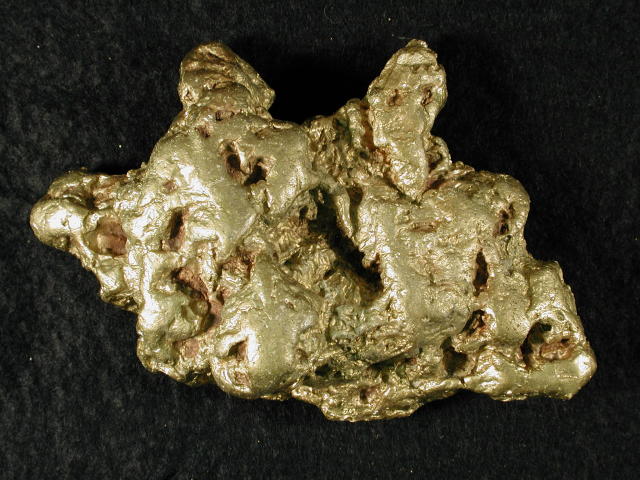
Some time later a party of men moving through the forest to look for new stakes walked into the camp. They found two skeletons over which vines were already beginning to creep. And four kilos of gold.









 Learning from Dogs