Let’s all pause for a moment (and my apologies for the late posting!)
The precise time of the summer solstice today is 17.16 Greenwich Mean Time (GMT/UTC).
Our sun, giver of life
In terms of local times that will be 10.16 here in Arizona and also in California, 13.16 in New York, 18.16 in London, and 03.16 (Wed) in Sydney, Australia, to pick just a few places.
What a year it has been so far!
So let’s just pause for a moment, as the Sun appears to pause, and put out our combined thoughts across this wonderful Planet Earth and pray for peace and tranquillity for all during the rest of this ‘interesting’ year.
Think you have had a bad day/week/month/year/life? Want to see your life in perspective? Go here and reflect. This is one very brave and incredibly inspiring young woman.
Those of you who see this and are in the UK, do read Alice’s Bucket List and help if you are at all able. If not, just hold Alice and all her family, and Mabel, in your prayers.
I love taking photographs but this takes the cake!
(Note: there’s an option in WordPress to insert a ‘read more‘ link, the effect of which is to limit what you, dear reader, can see when you first come to a Blog article. I prefer normally not to insert that link. But for reasons that will soon be very obvious, it has to be used in this Post.)
It was back in March, the 8th to be precise, when I first wrote about Peter Russell. Well just over a week ago, I came across another article by Russell from the Huffington Post. It was then a moment’s work to find it on Peter Russell’s own website. (This links to various essays on the topic.)
Science has had remarkable success in explaining the structure and functioning of the material world, but when it comes to the inner world of the mind science falls curiously silent. There is nothing in physics, chemistry, biology, or any other science that can account for our having an interior world. In a strange way, scientists would be much happier if there were no such thing as consciousness.
David Chalmers, professor of philosophy at the University of Arizona, calls this the “hard problem” of consciousness. The so-called “easy problems” are those concerned with brain function and its correlation with mental phenomena: how, for example, we discriminate, categorize, and react to stimuli; how incoming sensory data are integrated with past experience; how we focus our attention; and what distinguishes wakefulness from sleep.
It would be wrong to publish anything more so if you are interested in more, then go here and pick away or better still buy the book!
If you have a quiet 30 minutes, settle down and watch these videos
Last Friday (10th) I wrote about a recent article that appeared in the Newsweek magazine of June 6th and mused about there seeming to be a growing awareness of the changing of the Planet Earth.
I just wanted to add a few other important elements (pardon the pun) of the current awareness.
First, at the time of writing this (June 2nd) the website that shows the monthly level of CO2 in the atmosphere was still showing the figure for April. Here it is,
CO2 in the atmosphere
Go here and check out what it is for May 2011. We all know that it won’t be below 393.18, which is already over 12% above the maximum safe level that scientists have determined.
UPDATE (June 7th): The figures for May are now on the website CO2 Now and they are 394.35 up, as predicted, from the figure of 393.18 for April, 2011.
Then go and watch this, from Bill McKibben,
Then go to the CO2 Now website and read, and ponder and think about what is becoming increasingly obvious to us all.
Finally, read a article that Bill McKibben has recently written that seems to have been widely published. Here it is on the TomDispatch website. It starts thus,
Three Strikes and You’re Hot
Time for Obama to Say No to the Fossil Fuel Wish List
By Bill McKibben
In our globalized world, old-fashioned geography is not supposed to count for much: mountain ranges, deep-water ports, railroad grades — those seem so nineteenth century. The earth is flat, or so I remember somebody saying.
But those nostalgic for an earlier day, take heart. The Obama administration is making its biggest decisions yet on our energy future and those decisions are intimately tied to this continent’s geography. Remember those old maps from your high-school textbooks that showed each state and province’s prime economic activities? A sheaf of wheat for farm country? A little steel mill for manufacturing? These days in North America what you want to look for are the pickaxes that mean mining, and the derricks that stand for oil.
Yes, it all seems ‘doom and gloom’ around us at present but then consider that the only way we, as in mankind, can change to a truly sustainable relationship with this Planet is through better understanding and a global realisation that the time for change is now! That is a very positive message!
What even a lovely boy, just one year old, can offer the world.
I’m writing this around 5pm UK time on the 8th June. A little over 4 hours ago, at 1230 give or take, I witnessed a tiny event, something that for many of us wouldn’t have been seen as anything but trivial, albeit lovely.
Here’s what happened.
I had been to an introductory meeting with Richard White of The Accidental Salesman fame. We met in Pall Mall, just by Trafalgar Square, at the offices of The Institute of Directors.
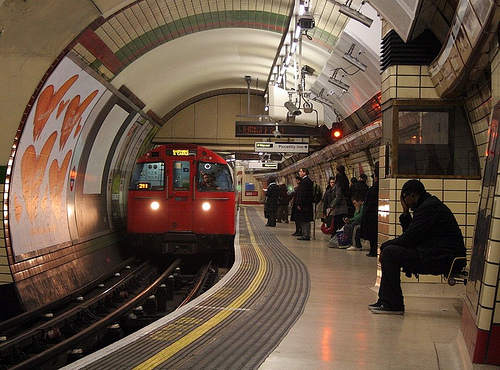
Shortly before 1230, after Richard and I had said our goodbyes, I jumped on a Bakerloo train at the London Underground station at Piccadilly Circus heading north for Baker Street.
Bakerloo line train at Piccadilly Circus station
I think it was one stop later that into my carriage entered parents with their small son. They sat down and the father, who had been carrying the young lad, was clearly beautifully bonded (not my favourite word, can’t think of a better one just now) with the small boy. The love and joy of the parents and their child just poured out into the ‘ether’ of the carriage. Result?
One man, middle-aged, sitting opposite to one side of the family beamed smiles in the direction of the young boy. You could sense that his emotional outlook had been transformed by the unencumbered joy flowing across the carriage. He really smiled more or less non-stop until I and this family got off at Baker Street station.
Another man, my guess upper middle-aged, was formally dressed in the business suit, tie and polished black shoes. He was reading a newspaper. But the boy’s joyful infectiousness touched him. He put the paper to one side and discretely looked across at the child bouncing on his father’s lap and a private smile crossed his face.
I was standing observing all of this and, of course, seeing the truth of something so core to the needs of humans. That is, the power of living beautifully in the present and how it demonstrates what my colleague Jon Lavin so often says, “The world reflects back what we think about most”.
Why do I write ‘of course’? Because what was so natural for this boy at the tender age of one is so natural for dogs throughout all their lives; wonderfully enjoying the present.
In a most un-English manner, I briefly caught up with the parents and established that the young boy’s name was Thomas.
Well done, Thomas, and may that joy in you be with you and all those around you for ever and ever.
Probably the best lesson dogs offer their human companions.
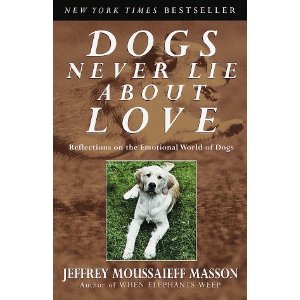
Having surfaced recently from being completely immersed in the writings of Dr. Rupert Sheldrake’s book, Dogs That Know When Their Owners Are Coming Home (start here and work backwards if you missed my musings on Sheldrake) I used the recent flight across to London to start into the book by Jeffrey Moussaieff MassonDogs Never Lie About Love.
Masson's book
While I might disagree with some minor aspects of the way that dogs relate to humans, the essential premise of the book is very powerful.
Indeed, the very last sentence of Chapter 2, Why We Cherish Dogs reads as follows:
Questers of the truth, that’s who dogs are; seekers after the invisible scent of another’s authentic core.
For me, any attempt to seek our own ‘authentic core’ can only come from understanding the power of remaining in the present. Dogs do this so naturally and instinctively. As Masson writes a little earlier in the above chapter,
A dog does not tremble at the thought of his own mortality; I doubt if a dog ever thinks about a time when he will no longer be alive. So when we are with a dog, we, too, enter a kind of timeless realm, where the future becomes irrelevant.
One could almost imagine this being the ancient wisdom of the teachings of Buddha!
Anyway, in a rather serendipitous manner, just before starting this essay, I read my weekly News and Notes from Terry Hershey. This is what he wrote about being in the present.
Did you see Mr. Holland’s Opus? About Glenn Holland’s lifetime of teaching music to a high school band. In one scene he is giving a private lesson to Gertrude. She is playing clarinet, making noises that can only be described as other-worldly. He is clearly frustrated. As is she. Finally Mr. Holland says, “Let me ask you a question. When you look in the mirror what do you like best about yourself?”
“My hair,” says Gertrude.
“Why?”
“Well, my father always says that it reminds him of the sunset.”
After a pause, Mr. Holland says, “Okay. Close your eyes this time. And play the sunset.”
And from her clarinet? Music. Sweet music.
Sometime today, I invite you to set aside the manual, or the list, or the prescription.
Take a Sabbath moment. . . close your eyes and play the sunset.
Mary Oliver describes such a moment this way, “. . .a seizure of happiness. Time seemed to vanish. Urgency vanished.”
Because, in such a moment, we are in, quite literally, a State of Grace. In other words, what we experience here is not as a means to anything else.
If I am to focused on evaluating, I cannot bask in the moment.
If I am measuring and weighing, I cannot marvel at little miracles.
If I am anticipating a payoff, I cannot give thanks for simple pleasures.
If I am feeling guilty about not hearing or living the music, I cannot luxuriate in the wonders of the day.
Living in the present is not specifically mentioned but how else could one interpret these beautiful concepts.
Travelling the 5,200 miles, give or take, between Payson (AZ) and London (UK)
Apologies for a slightly reduced service over the next 10 days but Monday 6th June finds me travelling from Phoenix to Dallas, and then Dallas to London Heathrow. This as a result of the U.S. Citizenship and Immigration Service (USCIS) granting me permanent residence (the Green Card) in April and thus me being able to travel back to England to see my new grandson for the first time.
So just a few thoughts, courtesy of Terry Hershey. I subscribe to his weekly Sabbath Moment and they always contain some beautiful sayings and other gems. Take these for example, from his Sabbath Moment of the 30th May.
Anything I’ve ever done that ultimately was worthwhile. . .initially scared me to death. Betty Bender
Betty Bender
Or what about this?
To dare is to lose one’s footing momentarily. To not dare is to lose oneself. Soren Kierkegaard
Søren Aabye Kierkegaard (b. 1813, d. 1855) was a profound and prolific writer in the Danish “golden age” of intellectual and artistic activity. His work crosses the boundaries of philosophy, theology, psychology, literary criticism, devotional literature and fiction. Kierkegaard brought this potent mixture of discourses to bear as social critique and for the purpose of renewing Christian faith within Christendom. At the same time he made many original conceptual contributions to each of the disciplines he employed. He is known as the “father of existentialism”, but at least as important are his critiques of Hegel and of the German romantics, his contributions to the development of modernism, his literary experimentation, his vivid re-presentation of biblical figures to bring out their modern relevance, his invention of key concepts which have been explored and redeployed by thinkers ever since, his interventions in contemporary Danish church politics, and his fervent attempts to analyse and revitalise Christian faith.
OK, dear readers, from somewhere over who knows where!
We really may be on the verge of a new geological period.
Just a couple of weeks ago, on the 16th May, I wrote an article called The Anthropocene period. It was based on both a BBC radio programme and a conference called “The Anthropocene: A New Epoch of Geological Time?”
So imagine my surprise when I collected this week’s copy of The Economist from my mail-box last Saturday. The cover page boldly illustrated a lead article within, as this picture shows.
US edition, May 28th
The leader is headlined, ‘Humans have changed the way the world works. Now they have to change the way they think about it, too.’ The first two paragraphs of that leader explain,
THE Earth is a big thing; if you divided it up evenly among its 7 billion inhabitants, they would get almost 1 trillion tonnes each. To think that the workings of so vast an entity could be lastingly changed by a species that has been scampering across its surface for less than 1% of 1% of its history seems, on the face of it, absurd. But it is not. Humans have become a force of nature reshaping the planet on a geological scale—but at a far-faster-than-geological speed.
A single engineering project, the Syncrude mine in the Athabasca tar sands, involves moving 30 billion tonnes of earth—twice the amount of sediment that flows down all the rivers in the world in a year. That sediment flow itself, meanwhile, is shrinking; almost 50,000 large dams have over the past half- century cut the flow by nearly a fifth. That is one reason why the Earth’s deltas, home to hundreds of millions of people, are eroding away faster than they can be replenished.
There’s also a video on The Economist website of an interview with Dr. Erle Ellis, associate professor of geography and environmental systems at the University of Maryland. That video link is here.
That Economist lead article concludes,
Recycling the planet
How frightened should people be about this? It would be odd not to be worried. The planet’s history contains many less stable and clement eras than the Holocene. Who is to say that human action might not tip the planet into new instability?
Some will want simply to put the clock back. But returning to the way things were is neither realistic nor morally tenable. A planet that could soon be supporting as many as 10 billion human beings has to work differently from the one that held 1 billion people, mostly peasants, 200 years ago. The challenge of the Anthropocene is to use human ingenuity to set things up so that the planet can accomplish its 21st-century task.
Increasing the planet’s resilience will probably involve a few dramatic changes and a lot of fiddling. An example of the former could be geoengineering. Today the copious carbon dioxide emitted to the atmosphere is left for nature to pick up, which it cannot do fast enough. Although the technologies are still nascent, the idea that humans might help remove carbon from the skies as well as put it there is a reasonable Anthropocene expectation; it wouldn’t stop climate change any time soon, but it might shorten its lease, and reduce the changes in ocean chemistry that excess carbon brings about.
More often the answer will be fiddling—finding ways to apply human muscle with the grain of nature, rather than against it, and help it in its inbuilt tendency to recycle things. Human interference in the nitrogen cycle has made far more nitrogen available to plants and animals; it has done much less to help the planet deal with all that nitrogen when they have finished with it. Instead we suffer ever more coastal “dead zones” overrun by nitrogen-fed algal blooms. Quite small things, such as smarter farming and better sewage treatment, could help a lot.
For humans to be intimately involved in many interconnected processes at a planetary scale carries huge risks. But it is possible to add to the planet’s resilience, often through simple and piecemeal actions, if they are well thought through. And one of the messages of the Anthropocene is that piecemeal actions can quickly add up to planetary change.
We are living in interesting times!
Finally, more of Dr. Ellis may be watched on the following YouTube video.
I’m normally pretty cautious about promoting the sorts of emails that circulate around the virtual globe carrying universal lessons for all and sundry but this one is an exception. It was sent to me last Monday by my dear friend, Dan G. from Southern California, with whom I have had the great honour and pleasure to be close friends for forty years. Here it is.
Burned Biscuits-author unknown
When I was a kid, my Mom liked to make breakfast food for dinner every now and then. And I remember one night in particular when she had made breakfast after a long, hard day at work. On that evening so long ago, my Mom placed a plate of eggs, sausage and extremely burned biscuits in front of my dad. I remember waiting to see if anyone noticed! Yet all
my dad did was reach for his biscuit, smile at my Mom and ask me how my day was at school. I don’t remember what I told him that night, but I do remember watching him smear butter and jelly on that biscuit and eat every bite!
When I got up from the table that evening, I remember hearing my Mom apologize to my dad for burning the biscuits. And I’ll never forget what he said: “Honey, I love burned biscuits.” Later that night, I went to kiss Daddy good night and I asked him if he really liked his biscuits burned. He wrapped me in his arms and said, “Your Momma put in a hard day at work today and she’s real tired. And besides – a little burned biscuit never hurt anyone!”
Life is full of imperfect things and imperfect people. I’m not the best at hardly anything, and I forget birthdays and anniversaries just like everyone else. But what I’ve learned over the years is that learning to accept each others faults – and choosing to celebrate each others differences – is one of the most important keys to creating a healthy, growing, and lasting relationship.
And that’s my prayer for you today. That you will learn to take the good, the bad, and the ugly parts of your life and lay them at the feet of God. Because in the end, He’s the only One who will be able to give you a relationship where a burnt biscuit isn’t a deal-breaker!
We could extend this to any relationship. In fact, understanding is the base of any relationship, be it a husband-wife or parent-child or friendship!
“Don’t put the key to your happiness in someone else’s pocket – keep it in your own.”
So, please pass me a biscuit, and yes, the burned one will do just fine. Be kinder than necessary because everyone you meet is fighting some kind of battle.





 Learning from Dogs