Category: Core thought

Copenhagen – that’s clear then.

Will we ever know the truth, the whole truth, and nothing but the truth?

It’s a week since the start of The United Nations Climate Change Conference – Copenhagen, 2009 and it’s clearly been a media success if nothing else.

My instinct has, for many years, been the assumption that mankind behaves in many ways that harm our environment and that, ultimately, harming the very planet upon which our survival depends could happen.  Stupid, yes!  But in line with some of the more strange behaviours of homo sapiens.

But like millions of people, I do not have either the scientific background or the time available to test the statements made by so many governments and other ‘wise’ bodies as to whether the science of climate change, global warming or whatever, is real and irrefutable.  One thinks that would be relatively easy to do and that after all the years and millions of dollars spent on climate research, the proof would be there.  Cause and effect were perfectly understood.

Read more of this Post

An interconnected world.

Bringing out the best in us.

As I visit some of my clients, I am becoming aware of an unusual phenomenon – I think some people are actually becoming less selfish. We are used to hearing stories of institutions reaching heights of greed and selfishness during this recession but not many that are about the other way round.

I don’t go to supermarkets very often because I’m usually out working when my wife goes but by a fluke, I kept her company recently. We have been trying to support the local farmer’s markets in the area but this is proving difficult as it’s much quicker to do a one-stop visit to a supermarket than lots of small visits since we both run our own businesses.

It is of course cheaper at the supermarket as they have systematically forced food prices down to a level that prohibits most small food producers from supplying them.

Anyway, I digress. In our local supermarket works an ex colleague and friend of mine. He was made redundant just over a year ago for the second time and decided that he would go for the stress-free, safe option. He used to organise procurement for a large, global communications company so he has his head screwed on around organising things. I guess the supermarket job means that he can just switch off away from work, something he could never do before.

I saw him with a large trolley, checking shelves and we stopped for a chat. He was fine and generally enjoying his work. He asked about mine and I mentioned that things were a bit tight at the moment. We got talking about how training is carried out at his work and how they work with developing employee’s interpersonal and communications skills. He mentioned that there was a new HR manager at the branch, or is it “in branch?”, and would I like an introduction as they were always recruiting new people and they needed training?

I was flabbergasted as we weren’t necessarily that good friends and he didn’t need to say or do anything but went out of his way to be helpful.

I have also noticed this phenomena in other companies from time to time, in the form of clients arranging meetings and spending time, something previously they really didn’t have time for. Maybe we get more of what we notice and by focusing on the positive, we attract more of the positive into our lives?

Is it because when the going gets really tough, for example, in times of national crisis or great hardship, that we remember that we are all interconnected?

By Jon Lavin

Housing and the Economic Recovery

Perhaps the housing market is the best economic indicator?

As an economist, I am frequently asked for my predictions on when the economy is going to turn around.  Have we reached the bottom?  Have we begun to recover?  Might we go into a second, perhaps more severe recession?

Those are tough questions to answer.  Business cycles are notoriously difficult to predict.  In fact, about the only thing we know for sure is that no two business cycles are alike. Each is unique in some significant way.

Changes in the housing market may be one of the most meaningful indicators of a recovery, because housing stability is such a fundamental indicator of how households are budgeting their income.  Notice that I did not say that the level of homeownership was a useful indicator; instead, I look to changes in the housing market, either away from or toward an apparently sustainable and affordable supply of homes, for evidence of where in the business cycle the economy may be.

Despite record low mortgage rates and first-time home buyer credits, the U.S. housing market remains anemic.  Rising foreclosures in several major metropolitan areas will keep housing prices low for some time to come.

The U.S. currently has about 1.7 million excess housing units available.  Typically, about 1.3 million new households are formed in the U.S. per year.  But with the unemployment rate topping 10%, new household formation will fall to about 1 million per year.  If new home construction remains at its current level of about 600,000 units per year, it will take over 4 years (1.7 million/400,000) for the excess supply of housing to be absorbed and housing prices to recover.

Recovery rates will be much slower in some markets, such as in Florida, Nevada, and California, but I believe that the rest of the U.S. along with most other developed economies are looking at a three- to four-year period of time before housing and thus the overall levels of output return to their pre-recession levels.

By Sherry Jarrell

The Mystery of the Disappearing Ethics

The Dubai debt crisis raises fundamental questions.


UK banks account for half the £60billion of global loans to the debt-laden emirate, new statistics show.

Well done British banks ….. loads of loans built on sand … I suppose the words “conservative” and “prudent” didn’t get printed in the Banking Terminology dictionary?

So Britain, that Global Giant of the banking world, has half the dodgy loans? British banks are therefore as daft as the rest of the world put together? (Can someone check my maths!)

Oh, and why exactly were the banks lending money to SORDID DICTATORSHIPS? Would we have lent billions to Hitler’s Germany in 1937? What on earth happened to ETHICS in the financial world? I suppose lending to POOR countries who need it rather than the nasty, venal, corrupt dictatorships of the Middle East was right off the radar?

There is an obsession with the “Human Rights” of immigrants and others in Britain, but a complete and utter turning of  blind eyes to the slavery going on in the Middle East, as if it doesn’t concern us because it’s in “another far-off country of which we know little”. (Neville Chamberlain’s shameful explanation of his inaction over Hitler’s annexation of the Sudetenland in Czechoslovakia in 1936.)

Sorry, but “No Man is an Island” …. we can’t sign the UN Declaration of Human Rights on the one hand and then blithely lend money (the PEOPLE’S money) to countries that are treating people so terribly.

I hope Dubai goes bankrupt and our cretinous banks with it so that we can start again with people’s banks that have a modicum of honour and decency and are prepared to invest in democracies, not insanely greedy property developments based on dictators’ idle fantasies.

It wasn’t much different with Sadaam Hussein, whatever you think of the invasion. This was a man who – just to take one example – gassed to death 5,000 innocent men, women and children in one single village alone. Yet countries in the “free world” were secretly queuing up to do deals with him. One British government MP even went there and shook his hand, the hand that consigned hundreds of thousands of people to a horrible death.

Ecology? Apart from anything else, Dubai’s carbon emissions are pro rata 250% higher than the US, so much power goes into air-conditioning and desalination. Once again, the left hand doesn’t know or care what the right hand is doing. A British minister tells us to stop eating meat to save the world while British banks simultaneously rush to finance a humongously-profligate and obscenely-elitist project in the desert.

I sometimes wonder if we really deserve to survive Global Warming. Will it be God’s way of cleansing the Earth of an aberrant experiment in free will?

By Chris Snuggs

Crimes and accidents

Confusion

For a long time, it has seemed to me that we confuse crimes and accidents.

This is such a substantial issue that more posts might flow from this, depending on the level of interest. Also, I should point out that I am no lawyer, so this is a personal, not a professional, view.

In both directions

When crimes are treated as accidents, criminal behaviour is appeased and no deterrent effect generated. Attempts to learn lessons are likely to be fruitless. So behaviour does not change and the crimes continue.

When accidents are treated as crimes, blame is allocated inappropriately and lessons are not learned. Innocent participants are punished for no purpose. So behaviour does not change and the accidents continue.

Issues

There are issues of causation, intent, blame and so on.

There are so many examples of this, that I am not sure where to begin. So, I won’t  … yet!

What do you think?

By John Lewis

Natural selection, at work?

I want to be like you!

Recently there was an event at which Bill Gates and Warren Buffett answered questions from students of the Columbia Business School in New York. I referred to the event recently when writing about Warren Buffett.

So why were these students interested in Messrs Gates and Buffett? It is, of course, because they are successful.

While different people define success in many different ways, we can be reasonably sure that, in the context of a business school, most of those business students would categorise Gates and Buffett as being among the most successful people alive.

So what did the students ask about? Well, of course, they asked about success! The questions were of two main types.

Read the rest of this Post

Are you there, but not present?

Communicating effectively means being totally mentally connected.

I have been working with a client recently through a very tough performance improvement plan.

As part of the plan, my client had to be videoed working with people in his workplace. I had to observe the video and then give feedback on it.

He seemed very efficient and made notes whilst he worked with each person. Occasionally though, something didn’t seem to be quite right. When I watched more closely I realised what was wrong. He wasn’t present. He wasn’t really connecting with the people he was working with.

It made me reflect on how much more effective he would have been if he had been able to connect with these people? I wondered if he was even able to understood about being present and what that meant?

By Jon Lavin

Aerial photography

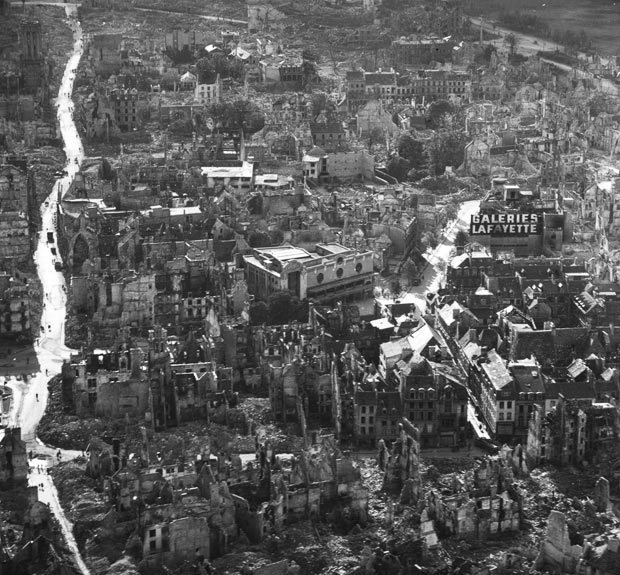
Some chilling reminders of the reality of war!

Britain has a National Collection of Aerial Photography.  It is held within the offices of the Royal Commission on the Ancient and Historical Monuments of Scotland – perfectly logical!

A summary of the different collections is listed here, many of them wartime photographs that bring a multitude of emotions to the surface: incredible bravery of the pilots; photographic standards of 70 years ago, man’s inhumanity to man; and so on.

I pondered a bit about writing this Post because, well ….. well…, see what you make of it!

Author's Mum

Being born in England in the early part of November, 1944, World War 2 still resonates within me.

Early home in an industrial part of West London meant that my mother and father had a ring-side view of the German V1 and V2 rockets that were being visited on London at that time.

My mother, 90, still recounts her enormous sense of relief when VE Day was announced (May 8th, 1945) because she then thought that her son’s future life was more or less assured.

So back to these aerial photographs held in those collections.

Here’s a picture of the visitation of war on the beautiful French town of Caen.

Linger a while and look at the damage, mostly to private homes.  The photograph was taken just slightly more than a month before I was born.

So where’s this Post leading to….?

Read more of this Post

Poetry and dogs

Thanks to Daniel Caride for pointing us to this poem from an unknown author.

It is called Inner Peace.

If you can start the day without caffeine,

If you can always be cheerful, ignoring aches and pains,

If you can resist complaining and boring people with your troubles,

If you can eat the same food every day and be grateful for it,

If you can understand when your loved ones are too busy to give you any time,

If you can take criticism and blame without resentment,

If you can conquer tension without medical help,

If you can relax without liquor,

If you can sleep without the aid of drugs,

You are probably the family dog!

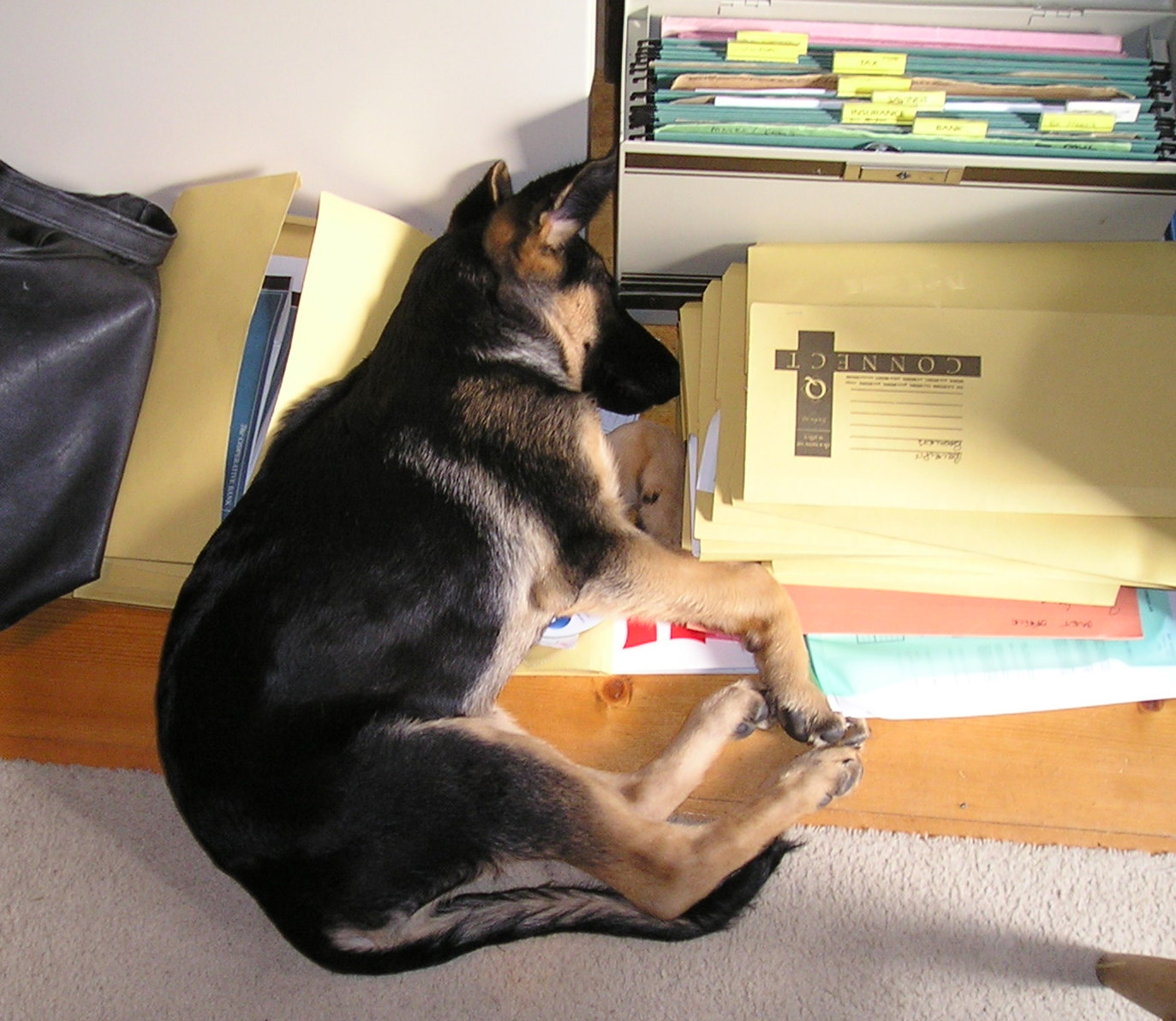
Pharaoh, 3 months, asleep oblivious to the world!

Yes, we certainly have much to learn from dogs!

By Paul Handover

Mind over Matter: does it matter?

An example of how we really do own our lives.

We were invited to our friend’s 25th Wedding Anniversary on Saturday, 21st November.

English pub

It was in a local pub and they had invited many friends, some of whom we had not seen for many years.

One friend had started his own architect business, built it up over the last 10 years and, although he had lost a large amount of work because of the recession, things seemed to be picking up.

I mentioned that my work had dropped off dramatically since the summer. He said:

Well, Jon. You can make your own mind up what you do. You can either decide you’re going to go bankrupt or you can decide that you’re going to succeed –  in spite of everything.

For some reason, that short conversation had a huge impact on me and I realised that it really is mind over matter and once we make our mind up about something, good or bad, it tends to happen.

By Jon Lavin