Category: Core thought

Happy Birthday, Hubble!

The Hubble Space Telescope (HST) has been in space for 20 years!

This week, twenty years ago, the HST was launched into orbit.  There’s much online if you want to read about it both on WikiPedia and on the Hubble web site so this post is going to offer just two items.

A beautiful picture

Nucleus of Galaxy Centaurus A

And an interesting audio slideshow tribute from the BBC – click here, introduced thus:

Take a look at some of the sights it has seen in that time with Professor Alec Boksenberg from the Institute of Astronomy in Cambridge – who was on the European team that helped build Hubble.

By Paul Handover (in awe of what is beyond our skies)

Remarkable people: Prof James Lovelock

The father of Gaia

A week or so ago, the BBC under their Beautiful Minds series, screened a programme about James Ephraim Lovelock, more popularly known as Professor Jim Lovelock.

Prof. James Lovelock

(Picture taken from this article – in itself well worth reading.)

The programme demonstrated that Lovelock’s mind is more than beautiful, it is still capable, at 90 years of age, of thinking in ways that are very rare in today’s societies where conformity is such a powerful force.

As always, WikiPedia has an excellent reference on Prof. Lovelock and I encourage you to read it plus Lovelock’s own website which makes up in content what it may lack for presentation!

Luckily there is an extract from the BBC programme on YouTube – please watch this and reflect on exactly what Lovelock is saying.

And if you are up for more, then settle down for thirteen minutes and watch this next video.

James Lovelock is the Darwin of our times.

Now to put this into some context (this is me speaking as a layman!).

Please read the rest of this post

It’s an ill wind that blows nobody any good!

Iceland’s ash casts an enigmatic spell over Japan

It seems that there has been nothing else on the news following the eruption of Mount Eyjafjallajokull
in Iceland, which was of particular interest to me  because on the 10th April I was flying from New York across the southern area of Iceland on my way to Rome, since which time I have passed through the UAE and Singapore on my way to Japan.

My work replacement was due to arrive on the 18th April after a holiday in the Mediterranean, but the flight which he was on was diverted into Paris because UK airspace was suddenly closed. He managed to continue his journey by train, ferry, car, taxi and bus but was then stuck in England. My duty had to continue but there seemed little point in propping up a hotel bar with other crews, so I decided to turn the situation into something positive.

After an exploratory trip into Tokyo, it was Paul, our Editor in Chief who put me in contact with his sister and her husband in the city, and another friend who suggested I should jump on a train and go to Hiroshima to see his son, who I know, so my travels started.

The transport system in Japan is extremely well organised with instructions and information well displayed in English along side Japanese. Everything is clean and modern, and runs to the second! At short notice I decided to make the journey to Hiroshima in this once in a life time opportunity, and there was the famous bullet train a monster of modern technology, which runs on banked rails at steady speeds of 400 kph.

Mount Fuji - Japan

We sped along through ever changing countryside. Initially the skyline was of mainly high rise buildings which changed to two story properties once we were out of town. The new leaves of spring and the famous blossom of the plum and cherry trees, and the quick glimpse of a Japanese water garden. Industry is mixed with small allotments, and tiny houses, roads and rail lines raised from ground level to make everything fit, and above that cables and wires, because of the threat of earthquakes, and past the stunning Mount Fuji, white with snow against a blue sky.

I never met such polite people, and on the train the guards and girls who pass through the carriage with drinks and food bow when they enter and leave. They are so well dressed and smart. No graffiti here!

Familiar Japanese trading names on local buildings, and strangely a huge Union Jack flag. I wonder how there can be so many buildings and parking areas full of cars ,but seemingly no people in view, but many large span bridges arching across hill sides to join places together.

Through Kyoto where there seemed to be a lot of energy being used, for purposes that were not immediately clear. College students in smart suits with white shirts and blue ties, passed quietly through the train. I noticed each time they had left the train at a station they took their rubbish with them, and put the seat back in the upright position!

The A-Bomb Dome

At last after four hours we arrived at Hiroshima, which today it is a lovely modern city of which to be proud. There is just one damaged building standing in a stark fashion at the waters edge which is all that it takes to remind us of such devastation and the Garden of Peace, there to allow some quiet reflection.

I took a 45 minute boat ride to Mijajima, now a World Heritage site. This beautiful island is probably 15 miles from Hiroshima, and there amongst the beauty of the trees and a 500 year old shrine wander the deer, quite happy to sit as people pass by.

My thought as I came away from Hiroshima was that all leaders of any country with any connection to Nuclear weapons or power should be made to attend the A-Bomb Dome and reflect. As all the plaques say this must never be allowed to happen again.

By Bob Derham

No, No, No – STOP IT!!!

A suit was filed last week in the US against Goldman Sachs by the US government’s financial watchdog, the Securities and Exchange Commission.

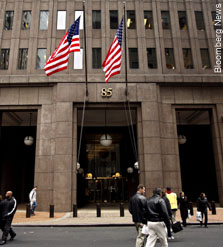
GS is an example of all that is morally and practically wrong with capitalism. This is an obscenely-rich company whose ludicrously-rewarded executives do not actually do anything that I would describe as “work”. Their activities do not in

Goldman Sachs HQ

my estimation benefit the world in any meaningful way. They are parasites which feed off the backs of real workers (nurses, police, teachers, firemen, bridge-builders, electricians and so on) and – as in the recent shambles – end up practically killing the host.

There is a good case for forcibly putting them out of business and completely reorganising financial services, with the accent on SERVICES. A functioning society needs investment and jobs. Banks should be there to look after money and provide investment to companies, not shuffle around paper to make themselves obscenely-rich.

GS and others apparently have some sort of electronic system that operates automatically and instantaneously to market movements, allowing them to make vast sums by doing no work. NO WONDER bright graduates seek to join such leech-like firms instead of becoming teachers, researchers or otherwise seeking to do something useful for society apart from themselves.

If they are guilty, I hope we see the company broken up and put out of business. The criminal deception is no different from that at Enron, where people pretending (with already vast salaries) to serve the public were conniving to do criminal damage to put up the cost of their product. They were given a severe  penalty, and it should be the same for any white-collar worker if found guilty. I don’t have much hope for the eventual down-to-earth-sizing of GS (they are well-connected and can afford good lawyers …), but I am not the only person angry about all this greed. Get past the cosy confines of Wall Street bars into the real America and there are plenty more who feel the same way.

By Chris Snuggs

This Month’s PAFF Award

Bob Dylan  a serious threat to ….. only China knows!

Congratulations China. You win this month’s Paranoid Fascist Fatuosity award by refusing to allow an ageing Bob Dylan to perform in Beijing and Shanghai.

It seems you are concerned that he might inspire people, and no doubt mostly your youth, to revolt. And (apart from political freedom of course) revolution is the last thing on your mind, even though a revolution spawned you 60 years ago.

So Dylan will live on for Asians only on CD, but thank goodness for that! Michael Jackson may have been the self-styled “King of Rock”, but Dylan was astonishingly and iconically original and unique.

I say “was” of course not out of disrespect to today’s version, but with those amazing years of the 60s in mind when protest was in our very soul and played its part in the revolutions of 1968 and later the big one, the fall of the Berlin Wall and the end of the USSR.

On second thoughts, perhaps the Chinese Communist Party is not so paranoid after all. As my psychiatrist once said to me: “No Mr Snuggs, you’re not paranoid; they really are out to get you.”

Still, what a pity. What a sad reflection on the so far failure of “globalisation” to penetrate far into CPP mindset. Where is the Chinese “Glasnost”? Where lurks the Chinese Gorbachev?

Just in case you’d forgotten, here are some of the words that apparently strike such fear into the Forbidden City. Just as in the British civil service, “change” is not something welcomed with open arms:

Come mothers and fathers throughout the land,
And don’t criticise what you can’t understand.
Your sons and daughters are beyond your command,
Your old road is rapidly aging.
Please get out of the new one if you can’t lend a hand,
For the times, they are a-changing.

The line it is drawn, the curse it is cast.
The slow one now will later be fast,
As the present now will later be past.
The order is rapidly fading,
And the first one now will later be last,
For the times, they are a-changing.

PS Most “serious” western newspapers did in fact report that the tour was cancelled because permission was refused by the authorities. However, just because the CPP is fascist – and of course all fascists maintain strong censorship – it doesn’t necessarily mean they are ALWAYS guilty. “The truth” is sometimes an elusive quantity. Well, re the Dylan tour, here is an alternative version of what happened …. perhaps the last page has not been told.

Bob Dylan

By Chris Snuggs

Captain Thomas Murray – RIP

Regular readers of Learning from Dogs will know that we usually only post a single article on week-end days.  But yesterday I received news that a business friend of many years standing had lost his battle against ill-health and died peacefully in the afternoon.  His name was Tom Murray and it’s my wish to celebrate his life by reproducing in full the email that was sent to me. It’s serendipitous that the planned posts by John Lewis for this week-end are aviation related.

Capt. Tom Murray

On Thursday afternoon the world lost a respected, influential, and creative aviator, one of the “Great Ones”.

Captain Thomas Murray was a pilot, artist, inventor, musician, and father.

A noted jet pilot, he explored the far corners of the globe, mapping out the Canadian Arctic, flying thousands of hours in Africa, Europe, the Himalayas, and the Americas.

Whether flying Gulf streams, Falcon, Hawkers, Learjets or old DC3s, Tom was a pilot’s pilot, the friendly, knowledgeable kind of guy who knew his craft so thoroughly that airmen the world over would “just call Tom”, whenever they needed answers.

He thrilled everyone he met with exciting stories of his travels…

…such as the time he found himself lost while flying over what should have been a large African lake, only to realize the lake had dried up. The only hope of finding civilization was to dead-reckon his way in a straight line and hope he hit the tiny “dot of a town” that was his final destination.

…Or the time his oxygen system failed in the Himalayas at 20,000 feet forcing him to dive the airplane into an 8000-foot valley to find out he was the only conscious crewmember.

…Or the time the entire front panel of his Hawker 800 fell onto his lap during takeoff because someone had forgotten to screw it in.

An adventurer to the max, he was also an inventor and visionary.

Tom took an ordinary problem such as converting hard-to-read aircraft performance charts into easy-to-read tables, and then turned that process into a successful business.

Tom created one of the first electronic documents to find its way into a cockpit – tables of aircraft performance data that minimized the chance of pilot error due to miscalculation that he called “EPADS”.

Constantly working to organize the cockpit, provide higher levels of safety and better information to the pilots, he invented one of the world’s first electronic flight bags, and established the process of managing aircraft electronic checklists, a process that the FAA later modeled their ECL guidelines after.

He joked that the entire cockpit should have a mode that turned it into a simulator during flight to alleviate boredom amongst pilots and give them a chance to train in truly challenging simulations during long flights.

He invented games for children, played flute, and wrote a storybook.

An accomplished artist, he relaxed by attending artist workshops and amazing all with his skill and precision. Just last summer, Tom held his first art exhibition.

His greatest creation with wife Daisy was his son, Thomas Alexander Murray, who was born with the charismatic smile and sense of mischief that characterized Tom at his best.

Tom’s inventions were his “other child”.  He would latch onto a design problem like a pit bull.

He cherished the fact that he would uncompromisingly focus on a design and refuse to leave it go it until it was “perfect”, even to his own financial detriment when those around him insisted he was losing sight of the “big picture”.

To this effect, during his last year, he asked me to form a foundation in his name, to offer an annual award (which I’ll see if it’s possible to do)…

“To the individual who focuses on solving difficult problems; who is clearly addicted to finding the solution; who is unrelenting in the face of opposition – which may seem to be (or genuinely be) to their own personal detriment”

Perhaps he wanted an award, he knew he’d win!

Tom was well known for acting as “pilot in command” in his daily life, often forcing people to act “my way or the highway” and insisting that his way was the “right way”.

While this trait was annoying and frustrating to colleagues and friends, what was possibly more frustrating was the number of times one was forced to humble oneself when he was indeed “right”.

In the last year of his life, Tom worked relentlessly to teach others his design philosophy and prepare several of us to run the company he’d created, the vessel that would carry his vision and concern for the safety of his fellow pilots into the future.

Tom loved life and spent his days on a personal mission to make the world a better place, a more interesting place, a more ordered place, a more beautiful place, a more fun place to live…

Tom wasn’t always too clear with his emotions, and though he often maintained a “business” exterior, at heart he was the artist, and his appreciation and depth of love for his family, fellow pilots, and the people who worked for him and with him, his friends — was endless.

You always knew when he respected you, he’d give you a big pilot’s “Thumbs up!”

We will miss him dearly.

Today, we salute a great airman, Captain Thomas Murray.

On behalf of Tom, I know he would wish you a warm, “Thumbs up!”

Charles Guerin President
On-Board Data Systems (OBDS)

Today’s No-Brainer

Bottled water …..

… in developed countries is not only an insanity but also an obscenity.

  • It is no healthier than tapwater. If it were essential to health then how come we oldies survived before? Logically, the Human Race should have died out.
  • It tastes no different, unless you buy it fizzy – but you could add your own fizz at home.
  • It costs VASTLY more than tapwater.
  • It is VASTLY more profitable to producers than gasoline for oil companies.
  • It is VASTLY more expensive to produce – around 1500 times more than an equivalent quantity of tap water.
  • Its transportation produces significant amounts of harmful emissions.
  • It is VASTLY wasteful; water is scarce, yet it takes 7 litres of water to make a 1 litre bottle plus the contents.
  • It leads to VASTLY-INCREASED pollution. ‘see “Giant Rubbish Dump Accumulating in the Pacific
  • It soaks up resources that could be better used, including to save lives of people dying from lack of or dirty water.

In short, it is absolute folly. What on earth is there going for it? At the same time, it is big business and very popular? Why?

  • Are people ignorant about all the above? That’s quite worrying …. not much future with so much ignorance about.
  • Are people paranoid about what comes out of their taps? Oh dear –  paranoia is not good for us.
  • Do people place their vanity and status-image before the above-mentioned points? Hmmmm …..
  • Are many people just suckers for slick advertising? I guess the answer to that one is a straight “Yes”.
  • Have millions of people no common-sense and/or social conscience? Oh dear, this time it’s a clear “No”.
This is pretty!

Bottled water is nonsense, except of course where there is no alternative.

If rich, fat Westerners really like bottled water they could export it to developing countries where millions die through lack of or poisoned/polluted water every year while at the same time pouring funds into building water infrastructure for these very same people.

Yes, I know the industry provides jobs, but so did making nerve-gas for the Nazis.

The point is, we should direct our energy and money into things which are not totally unnecessary and destructive. I’m not a great fan of the “nanny-state”, but in some areas – and this is one – the government should be taking a more forceful lead. Help us kick our silly, selfish, faddish and destructive addiction to bottled water.

Some excellent links on this topic:

By Chris Snuggs

A Teen’s Reflections

This is the second Guest post from AJ Easton, a 13-year-old girl from North Carolina, USA. AJ first wrote about Learning from Horses on January 17th this year. This is a more reflective essay that would have been a credit to someone with many, many more years.

Trust is a complicated thing…

You have to learn to trust, but it is not something that can be taught in schools. You also have to earn trust, by keeping secrets and not spreading rumors.

With the people you trust, you do things you wouldn’t do with other people . Your true self comes out with the people you trust. You don’t worry about being judged; you don’t worry about people disliking you for who you are.

AJ Easton

But, in our modern-day world, it seems as if everyone judges.

People seem to hate for reasons as stupid as one’s appearance. People don’t trust people anymore because it seems that we are constantly warned to avoid strangers because they might hurt you, murder you, or completely mess up your life in some way, shape, or form.

And in school, if you trust someone enough to tell them a secret, they don’t keep it. And then, in your point of view, the world has ended.

All because of some secret that got out about who you like, or what you did with the person you were dating, or something else that, in the end, isn’t all that important.

Then everyone will judge you based on that rumor until you leave the school or graduate. They do this to make themselves feel “cool” and “important.”  And you learn not to trust.

Social status has become such a big factor in everything we do these days. Everyone feels as though they have to be highly ranked socially to mean anything to the world.

But, truly, all you have to do is love what you do and respect yourself, to follow your dream and be determined. We should make decisions that help us move forward, not dwelling on the past.  Every second is different; everything is unique. Nothing is the same. Not a single person, or tree, or moment.  Each moment represents a new opportunity.

Don’t have regrets. What has happened has already happened and you can’t change it. Time travel is fictitious, not a reality. You can’t rewind your life to change what you have already done. There is a reason behind everything: remember this when you are having doubts about what you have done.  Learn from your past but don’t let it eat at you.

Live your own life. And learn to trust yourself, and those who love you.

By AJ Easton

Elliot’s schooling

Elliot Engstrom – Guest Author

Elliot was ‘exposed’ to the Learning from Dogs readership on the 22nd March as our first Guest author.  He wrote about the US Government and Poverty.

Elliot has one important distinction with respect to the other authors of this Blog; he is the right side of 30 years old!

He is going to use this perspective to reflect on schooling, something that most of us ‘aged’ peeps take for granted, assuming we can remember our school days! 😉

It promises to be a fascinating reflection.

———————————–

Setting the scene

I’ve had a plethora of experiences over the past 17 years of my life. I’ve made and lost friends, had romantic

Elliot Engstrom

relationships, read, traveled all around the world, lived in France, and done countless other things that I consider myself immeasurably blessed to have experienced.

Despite the fluidity of where these different experiences have taken me, my entire life since the age of four has had one characteristic in common – I have been a school student.

In the spirit of “Learning from Dogs,” I thought it might be interesting to reflect a bit upon the core dynamic between education (not learning, which is a far broader topic) and schooling.

I often ask myself just how effective the modern US schooling system is as a tool of education, and whether or not its costs outweigh its benefits. I hope to have at least a rough answer to this question in the final post of this series.

In the following three posts, I will examine three topics:

In what ways does the modern schooling system function as a positive tool for education?

What costs involved in modern schooling hinder its ability as an educative tool, and even make it a negative influence on students?

Considering the analyses put forth in the first two posts, do the costs or benefits or this system outweigh the other? On the whole, are school and education complements or antagonists?

This series is going to be exciting for me because, to be quite frank, I have no idea what my final answer is going to be. I guess I’ll just have to stay tuned to see where my brain takes me – and so for you!

By Elliot Engstrom

Why do we cheat?

Behavioral Economist concludes that most people cheat.

In a very interesting video on the website TED, Dan Ariely, Professor of Behavioral Economics at Duke University, explains his research into why people think it is okay to cheat and steal.

Here is Ariely’s presentation from YouTube:

From his research, he concludes the following:

  • A lot of people will cheat.
  • When people cheat, however, they cheat by a little, not a lot.
  • The probability of being caught is not a prime motivation for avoiding cheating.
  • If reminded of morality, people cheat less.
  • If distanced from the benefits from cheating, like using “chips” instead of actual money in transactions, people cheat more.
  • If your in-group accepts cheating, you cheat more.
Dan Ariely

I quibble with the interpretation of some of his findings, which may justify a separate post on how people perceive what they do and do not know, but there are always issues of this sort with a given research project.  Where I draw the line is when he expands his conclusions to include all of Wall Street and the stock market, which is totally beyond the scope and nature of his research.

On what basis does he draw this conclusion?  As explained in this short video (as I have not read his book, though I’ve read excerpts and am familiar with the study upon which the book is based), Ariely claims that because stocks and derivatives are not in the form of money, they “distance people from the benefits of cheating,” which leads individuals who engage in the stock market to cheat more.  He alludes to Enron as proof.

This is almost too silly to spend a lot of time on trying to discredit, but I fear that a lot of people who hear his talks or read his book may be lulled into accepting what he says about the stock market as true.  But it is not! Enron is the exception, not the rule.

Companies who issue stocks are raising money to provide a good or service that is valued by society; they are rewarded by profits.  Investors who buy and sell stocks, trade derivatives, and invest in portfolios are trying to make their money go further. They are trying to earn a return on their savings.  Cheaters do not survive in the stock market, unlike the “consequences-free” classroom in Areily’s experiment.

On the other hand, these factors are in glaring abundance in the government:  politicians never “see” the taxes they spend as the hard-earned income of the citizens. And the “benefits” of cheating, including power and privilege, are amorphous and vague, and couched in the so-called morality of “doing the greater good.”  I’m surprised Ariely does not condemn the federal government using the same logic as his does the stock market.

His last take-away from this research project?  That we find it “hard to believe that our own intuition is wrong.”

I think Dr. Ariely ought to apply that caveat to the conclusions he draws about his own research.  Very interesting, very compelling, but his interpretation of the results as they apply to the stock market falls victim to the very same biases that he claims to find in others.

by Sherry Jarrell