Category: Core thought

Happiness

That pre-frontal cortex is at it again.

Prof Gilbert

There’s a fascinating video on the http://www.TED.com website given by Prof Dan Gilbert.  Prof Dan is Professor of Psychology at Havard and there’s a good resume on WikiPedia.

Here’s how John Brockman describes Dan Gilbert.

Dan Gilbert doesn’t have an instruction manual that tells you how to be happy in four easy steps and one hard one. Nor is he the kind of thinker who needs Freud, Marx, and Modernism to explain the human condition.

Gilbert, the Director of Harvard’s Hedonic Psychology Laboratory, is a scientist who explores what philosophy, psychology, neuroscience, and behavioral economics have to teach us about how, and how well the human brain can imagine its own future, and about how, and how well it can predict which of those futures it will most enjoy.

There can’t be a human that hasn’t pondered on what makes them happy. Gilbert sets out some fascinating and possibly counter-intuitive ideas. Here’s the video

By Paul Handover

Greece and America — Similar crises?

Fiddling with gravity!

Financial crises can be very difficult events to understand.  Even for those who have spent a great deal of time studying such areas as finance and economics, comprehension of these disasters can be elusive.  However, analyzing shared elements in the recent American and Greek financial crises can help give even the economic layman insight into their common causes.

One word can be used to sum up the basic concept behind both of these crises – overextension.  Both the American and Greek governments attempted to take on a much heavier economic load than either could handle.  While, in both cases, this has been painted by some as a noble, humanitarian effort to help those in need, methods such as inflationary monetary policy tantamount to theft and the disguising of massive budgetary deficits (in both cases with the help of Goldman Sachs) would not justify the means employed even had these efforts been successful, and certainly should be taken to task considering the disastrous ramifications of these actions.

In both cases, many are citing unrestrained spending as the source of the problem.  For example, CNN wrote of the Greek crisis that “years of unrestrained spending, cheap lending and failure to implement financial reforms…whisked away a curtain of partly fiddled statistics to reveal debt levels and deficits that exceeded limits set by the Eurozone.”

Without suggesting that CNN was attempting to be deceptive in this explanation, as the points made certainly are important, it must be noted that things like unrestrained spending, cheap lending, and fiddled statistics are merely symptoms of the deeper disease.  Instead of asking the government to spend less, tighten lending laws, and implement financial reform, one should instead ask the deeper question – how does the government even have the power to cause such problems in the first place, and why are the results of such government power so often much more hurtful than helpful?

This deeper problem, whose symptoms we are now dealing with, is central banking.  The Federal Reserve System and its Greek counterpart, the Bank of Greece, each had a heavy hand in their respective nations’ financial collapses.  This is due to these banks’ attempts at economic manipulation – the Federal Reserve directly sets interest rates, while the Greek system uses more indirect methods to do nearly the same thing.   Note that it is due to their attempts at economic manipulation, as attempting to set economic law is about as useful as attempting to set gravity.

Consider this metaphor of setting gravity.  A man claims to be able to set the force of gravity on the earth.  He tells a stunt biker that he can set gravity to be half as much as normal.  So, the biker attempts to jump a distance that is much longer than he normally would attempt.  Upon jumping, the biker finds that, obviously, the first man never was able to set the nature of gravity at all, and he falls to the ground long before reaching his destination.

This is exactly what happened due to the actions of central banks in the cases of both the United States and Greece.  Interest rates and other natural economic restrictions were said to be more flexible than they truly were. Thus, individuals who based their actions on this information ended up engaging in activities that were far more risky than usual.  However, once they had “jumped,” so to speak, they found that, in fact, economic law was as strict as ever, and they “fell.”

However, if the answer is so obvious, why are we not hearing more about it?  Each of these financial crises is extremely complicated, and the above described scene is, it must be admitted, an oversimplification.  This is not to say that it is not accurate, but rather that this nature of the crises’ root cause is not immediately apparent to all upon examining the situation.

For example, a person who has been educated their entire life in an economic school that praises central banking, deficit spending, and government action in general would certainly seek to find another cause for the crisis, perhaps by blaming business owners for making risky investments or stating that government controls were not strict enough.  However, a person who has studied and understands the damage done by central banking and government economic controls will be quick to realize what has occurred.

People with such knowledge are becoming more and more common in both the United States and around the world.  “Even today, with an economic crisis raging, the response by our government and the Federal Reserve has been characteristic,” Ron Paul writes in his recent book, End the Fed.  “Interest rates are driven to zero and trillions of dollars are pushed into the economy with no evidence that any problems will be solved.  The authorities remain oblivious to the fact that they are only making our problems worse in the long run.”

While he may be one of the most popular adversaries of central banking, it is not just Ron Paul, or even Austrian economists, who are calling out government for its role in these financial crises.  In an e-mail to supporters, Democratic congressman Dennis Kucinich cited “the 1913 Federal Reserve Act, the banks’ fractional reserve system and our debt-based economic system” as major factors in the American crisis.

Such complex and important issues as economic crises need all the attention we can give them, and it is impossible here to provide the in-depth analysis that these situations merit.  It also must be noted that while both the United States and Greece have to an extent both engaged in central banking to their detriments, each country does have a different system.  Still, the general principles hold, always returning us to that first word – overextension.  As long as nations attempt to manipulate the laws of economics to engage in far grander pursuits than they can sustain, we can expect to see such economic crises as have been seen in the United States and Greece in the future.

By Elliot Engstrom

Letter from Payson – The Farmers Market

A foreigner but not a foreigner!

Despite the fact that we have now been living in Payson, Arizona, since the end of February and, therefore, a degree of familiarity exists in both directions, the local Saturday Farmers Market prompted this thought.

Why do I not feel a foreigner here?

There is no question that America, in general, and Arizona, in particular, is very different to England.  In many ways the differences are far greater than, say, England and Australia, or England and New Zealand (I’m picking other English speaking countries to avoid to obvious difference between countries of different languages).

Local goats' cheese

I love Farmers Markets.  They seem to encapsulate the wholeness of locals growing meat and produce for other locals. They seem to serve as a reminder of the integrity that is needed just as much in food as in all other areas of life.

Of course, I am not so naive to think that we could wind the food revolution back to before the days of supermarket chains – food is wonderful value nowadays especially for those families on tight incomes.

But I can’t be the only one that ponders what the long term effect of all those

Local jellies (jams to Brits!)

E-numbers and other strange ingredients that one reads on most packets of most items, and whether or not fruit is sprayed with anything that we should know about, and so on and so forth.

That’s why that place in my psyche is ‘stroked’ so well by wandering around the Farmers Market.

One would expect if there was going to be any place where yours truly, dressed and sounding like the Englishman that he is, is going to feel foreign, it would be at the Payson Farmers Market.  I don’t even try to hide my origins, responding to a “Howdy folks” from the stall-holder with a quintessentially English “Good Morning!

Inevitably there are reasons why I am made to feel welcome here in Payson, my hunch is that it is much to do with this being a pioneering town for most of the last 100 years, and therefore co-operation, collaboration and a welcoming attitude were key elements of sustaining a way of life, but, in the end, analysis is pointless.

What matters is how we are made to feel, and we are made to feel very welcome.

Indeed, Payson with it’s predominance of right-wing, independent thinking, tough ‘cow-boy’ inhabitants echoing a recent past, may have an important lesson for all of us, across the globe, as the forces of disconcerting change build and build: be local, think local, preserve local.

I’m very proud to be slowly but surely turning into a Payson local.

By Paul Handover

Whither the Internet?

A Force for Good may be becoming less good?

The Internet is clearly an extraordinary revolution, one almost as big as the invention of the printing press by Gutenberg. Amazingly, it also started out FREE and totally democratic – a fantastic boon to humanity.

However – as with everything else – it has inevitably become abused by the selfish minority that we seem unable or unwilling to deal with effectively, and for this we all must suffer.

So, because of this minority abuse the majority can expect more and more controls and bureaucratization and no doubt in the end it will be taxed as well. Indeed, I am astonished that greedy, incompetent, reckless governments haven’t already got their nasty paws on it as the next milch-cow to satisfy their insane rapaciousness.

But it is the potty EU (another giant institution that is currently sowing the seeds of its own demise through its arrogant grasping for power and control) where the most control-freakery is being displayed.

Firstly, we are apparently to have a new EU organism to “oversee” the Internet, and Estonia and France are currently vying for this lucrative (for its staff – not the EU taxpayer) little gravy-train.

Secondly, it seems that the EU now wants to log everyone’s Google searches for two years in a bid to ensnare paedophiles. Thankyou EU, but much as I hate paedophiles to be honest I do not want my Google searches logged, not even actually by Google. I have no faith whatsoever that someone, somewhere, sometime will not exploit this data even though I am completely innocent.

And anyway, as is pointed out in the above-mentioned article, this bit of overkill bureaucratization (no doubt another EU organism will have to be set up to actually do this – not of course in some run-down bit of Sicily but some posh and extremely expensive suburb of Brussels with loads of staff, secretaries, expenses and all the rest) will be totally ineffective anyway since paedophiles are far too cunning to use Google.

As for Google, is this yet another example of an organism overreaching itself? Have they gone too far for their own good with their street-level photography – amazing technology but one snoop too many nonetheless?

And returning to search monitoring, I am not sure I want to be the constant victim of oh so-clever targeted marketing all the time.  There comes a point when I simply want to be left alone and unmonitored. Sometime this data juggernaut has to be stopped, or where will it all end?

PS Is the Internet changing our brains? It is claimed people are losing the ability to concentrate. I certainly notice this in schoolkids I teach. This poses me three questions. If anyone out there is clever enough to provide answers I’d be most grateful.

A) Is it TRUE or another urban myth?

B) Does it MATTER?

C) If it does, can we DO ANYTHING about it?

By Chris Snuggs

A Way Forward?

Removing the fear of the unknown

I’ve been working with most of my clients recently through painful transformations brought about by the economic downturn.

An interesting metaphor really because since the first wave of uncertainty triggered panic, first noticed in the UK banking system, I have been picking up on that uncertainty that feels like it’s stalking the globe at the moment.

Interestingly, I, too, have been aware of an underlying fear that was difficult either to name or source.

It has been rather like a deep river in that whilst the surface feels slow moving, currents are moving things powerfully below.

So this ‘fear’ has caused a few household changes.

We now are the proud owners of 9 chickens. Our youngest son, Sami, and I have dug up the back lawn and planted vegetables and built a poly-tunnel.

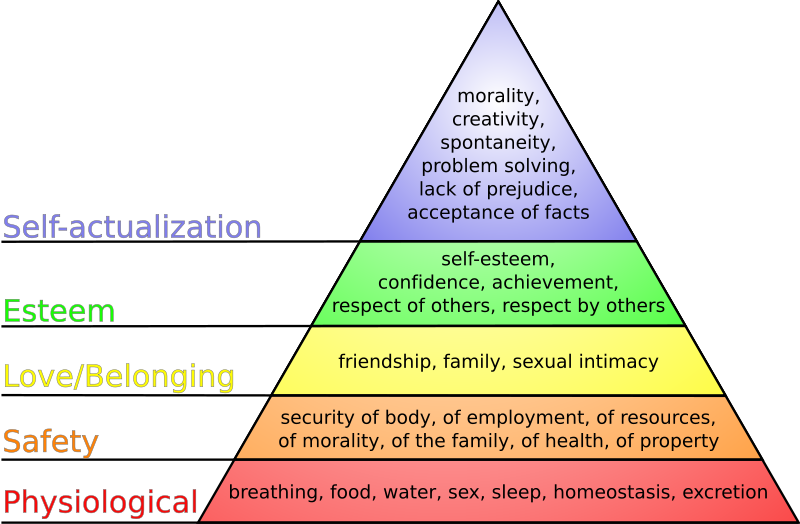
We have also installed a wood burning cooker. Right back down to the base of Maslow’s triangle really!

Maslow’s triangle of needs

These feelings have brought about such change everywhere and I wonder seriously whether we will ever return to what was; indeed would we want to?

I might not have mentioned it in previous blogs but as well as an engineering background, in latter years, I have focused on how interpersonal success in business is linked directly to relationships, integrity and vitally, self-awareness.

To inform this, some 7 years ago, I embarked on an MA in Core Process Psychotherapy, primarily to work on myself so that I could be the best I could be in my relationships, in and out of work.

The point I’m trying to make is that the same panic I notice in many of the companies I work in, and in me, is based on fear of the unknown and on a lack of trust in all its forms.  I’ve deliberately underlined that last phrase because it is so incredibly important.

The truth is that we get more of what we focus on.

So we can choose to focus on the constant news of more difficulties, hardship and redundancies, or we can focus on what is working.

In the workplace this positive focus has been pulling people together across functions and sites and pooling resources and ideas.

A farm evening

When we realise we’re not doing this alone it’s amazing how much lighter a load can feel and how much more inspired we feel.

I also notice how humour begins to flow and what a powerful antidote for doom and gloom that is.

Transformation is never easy but the rewards far exceed the effort put in ten fold.

So what is it going to be? Are we all going to bow down to the god of Doom & Gloom, fear and anxiety, heaping more and more gifts around it, or are we going to start noticing and focusing on the other neglected god – that of relationship, joy, trust, abundance and lightness?

Whatever the future holds for us all a belief in our inherent ability to adapt and change and focus on the greater good rather than fear, anxiety, greed and selfishness is the only sustainable way forward.

By Jon Lavin

[If you have been affected by this Post and would like to contact Jon, he would be delighted to hear from you. Ed.]

Elliot’s Schooling: The Role of Government

This continues the series of posts on education.

Abraham Lincoln

What is the role of government in education?  The problem of central government power and corruption in relation to education is a cause of great concern for me.  I still remember learning that Abraham Lincoln was a champion of civil rights who wanted to end slavery, and that American exceptionalism defeated the aggressive Soviet Union.  I also now realize that there were gaping absences from my education, like the complete absence of any classes concerning philosophy, even as an introduction that scratched the surface, or any study of the decline of empires such as Rome whose glories I studied so intensely.

Ancient Rome

If there is any quick fix for the problems I am noting, it would be decentralization of power in respect to our education system.  This becomes more problematic on a daily basis, as more and more federal stimulus funds are poured into local education systems.  While the beltway political community often paints this as government helping small communities, I see the benefit of a temporary boost in funding being far outweighed by the cost of our central government grabbing more and more local power.  Education systems will, in the long run, be forced to either permanently entrust more of their budgetary matters to federal power, or suffer the pain of doing away with an infrastructure that big government created and, consequently, only big government can support.  Decentralization would help the education system of the United States to be more diverse as well, as different regions would certainly have different educational programs, and these programs could compete in the form of their graduates to show which programs had the best results.

However, no discussion of education in the United States would be complete without taking a look at the intent of our country’s founders.  Here I must thank Professor Jarrell for injecting this concept into the current discussion.  In a recent LFD post addressed to me and interested others, she wrote:

The Federalist Papers made it clear, to me at least, that our founding fathers believed that the government, our federal government in particular, should have nothing to do with educating the populace.

I realize it sounds a bit radical now, but I believe that any discussion of what is right and wrong about public education today must begin with a healthy debate about whether the federal government should be involved in public education at all.

Your thoughts?  Thanks!

In a very soon-to-come post, I will begin yet another discussion,  one that I hope will heavily involve Professor Jarrell and many others, about the original intent of our founders in relation to public education, and whether or not there is any hope of returning to their proposed system at any point in the near future.

by Elliot Engstrom

Elliot’s Schooling

So where does this all end up?

Well, I am finally back from an eventful break from writing at Learning From Dogs that has entailed my graduation from Wake Forest University, some final preparations for the University of Georgia School of Law and my move to Athens, and the unfortunate passing of my grandfather, Paul Norman Engstrom.

Therefore, it has been quite some time since I wrote my original post — which at that point was posted by Professor Jarrell with me as a guest author — in which I laid out my goals pertaining to a discussion of the United States’ education system.  Since then I have discussed the positives of our system, the negatives of our system, and pointed out the view of Sir Ken Robinson, who believes that creativity should be given the same status as literacy in education systems.

We are often surprised after researching a topic to find our conclusions to be in opposition with our previous line of thought.  However, sometimes it can be equally as surprising to do a great deal of research and then wind up back where you started, simply with a larger factual foundation behind.  This has been the case for me throughout this entire discussion of the United States’ education system.  Despite the attempt I have made to challenge my own viewpoint and think critically about my own biases, I continue to see the costs of the United States’ education system as far greater than its benefits.

Brick and mortar school building

As I have stated before, there is a great difference between formal education and learning.  Or, to be more precise, perhaps I should say that formal education is merely one part, and perhaps not even that large a part, of what “learning” entails.  I would suggest that the problem is not so much that the United States’ education system is damaging merely because of its existence, but rather that the greatest damage comes from society expecting far too much from this system.  School is no replacement for the learning that entails integration into a complex and competitive global society that necessitates human interaction, critical thinking skills, and creativity.  Sure, one can force youths into cinder block rooms and force them to learn multiplication tables and historical dates.  And, to an extent, I think this is necessary in a mass society as we have today.  However, this formula of forcing youths to learn facts and then having these facts regurgitated has been entrusted with far too much of what we today consider “learning,” and if we are ever to have a positive shift in our society from one of idea-accepters to idea-creators, this must change.

Learning the multiplication tables

Perhaps high school could integrate into their programs a larger degree of extracurricular internships that count for course credit — I am sure that this is an experiment that could be undertaken by a few school districts quite easily, and then expanded if it proves successful.  Perhaps also school curriculum could be altered to include more classes on philosophy and economics, which I see as foundational for a solid understanding of our world.  However, this alteration of core curriculum would be a much more difficult task to accomplish, and would require some serious time and thought.

by Elliot Engstrom

Take your hands off the controls

Is that what I heard?

“Take your hands off the controls.”

We were climbing after take off in a Cessna 152, and I was applying significant control inputs to keep the aircraft level. Before the flight, there had been some conversation among other pilots on the ground about there being some turbulence at low level today, and I had just remarked that this seemed to be true.

In response to this gentle instruction, I took one hand off the control column, but continued to concentrate on maintaining the attitude of the aircraft in the bumpy conditions. Then the instruction was repeated, still gently, but with a little more emphasis:

“Take your hands OFF the controls”!

Now, whether one follows instructions like this does depend to some extent on who is issuing them! On this occasion, I was honoured to be flying with the most capable pilot and flying instructor I have ever met, or am ever likely to meet.

As it happens, I was not formally under instruction, being qualified to fly and my “passenger” having lost that privilege on medical grounds. Nevertheless, when flying with other people there is always something to learn and, when flying with someone as experienced and knowledgeable as Dickie Dougan, one is learning all the time! Dickie had a very long flying career during which very many people learnt a tremendous amount from him. Sadly, he passed away in 2007, at the age of 89.

So, in this case, the instruction was being issued by someone for whom I had the utmost respect and trust. Nevertheless, it was contrary to my instincts and seemed to me to be decidedly risky.

Very gingerly, I let go of the controls which, now free from my grasp, moved more violently and over a much wider range than I had been moving them. My instinct was to grab them again, but my trust in the instruction that I’d been given was just sufficient to hold that instinct at bay for a short while.

The aircraft seemed to be rolling more than it had under my control, but it was returning to level flight fairly consistently. It was, at least, stable and seemed to be flying satisfactorily without any input from me (to be accurate, I was continuing to apply some right rudder to compensate for the yaw effects of the single propellor in the climb, but it seemed to me that I was not controlling anything!)

After I had realised that the world was not turning upside down and my level of anxiety lowered slightly, Dickie then said quietly, in his soft Irish tones:

“There you are; you’re working too hard! The aircraft can fly itself!”

Incidents like that teach us something quite profound. The world functions without us.

We are not the centre of the universe!

Background:

This post was inspired by Trey Pennington’s description of his conversation with his daughter about Copernicus, as described in his interview of C.C.Chapman.

Further information about the legendary Dickie Dougan can be found in this document in an obituary for him written by Chris Martin who was the Chief Flying Instructor at Exeter Flying Club during the time that I was trained there.

By John Lewis

Derivatives are Not Evil

Are Derivatives Really to Blame?

Derivative securities are not inherently evil, though the media would have you think otherwise. It seems that any

Are they evil?

type of investment that does not directly involve commodities is an easy target these days.

But derivatives are just another type of investment, those whose value is derived from some underlying security or asset or event.   Insurance is a type of derivative investment, as a matter of fact. If the bad event happens (a car accident, flood, or fire, for example), then a claim is made against the policy.  If not, the policy expires.   The value of the policy is derived from the insured asset or event.

If derivatives are bad, then so too is insurance.  If derivatives are bad, then so too are leases with the option to own.  If derivatives are bad, then so too is the equity in any type of company, small or large, private or public, including those that produce real products and commodities, for stock is nothing more than an option to buy the underlying assets of the company for the price of the face value of its debt.  If derivatives are bad, then so too are convertible securities and most every other type of financial innovation we’ve witnessed in the last 30 years, and for decades to come.

by Sherry Jarrell

Question for Elliot About Public Education

Hello Elliot!

I’d love to engage in a discussion with you — and interested others — about the appropriate role of government in education.

The Federalist Papers made it clear, to me at least, that our founding fathers believed that the government, our federal government in particular, should have nothing to do with educating the populace.

The government providing public education? How did THAT happen?

I realize it sounds a bit radical now, but I believe that any discussion of what is right and wrong about public education today must begin with a healthy debate about whether the federal government should be involved in public education at all.

Your thoughts?  Thanks!

by Sherry Jarrell