Category: consciousness

It’s all too much, or it could be!

This year, 2020, has been unlike any other year.

I am not saying anything new but just reiterating what has been said before: 2020 is going to go down as the year from hell! And I don’t think that is too strong a word!

Part of it are the news stories that sweep the world: Covid-19; Brexit; Climate change; up until yesterday what was President Trump going to do in his last few weeks; etc; etc.

Also part of it is the way that news and more news and, yes, more news is flashed around the globe. Most of it bad news as we all know that bad news sells!

Finally, part of it is the new world of social media especially messaging on a smartphone. President Trump isn’t the only one to communicate greatly via Twitter.

Now, speaking personally, I couldn’t have got through this year without Jeannie and our dogs.
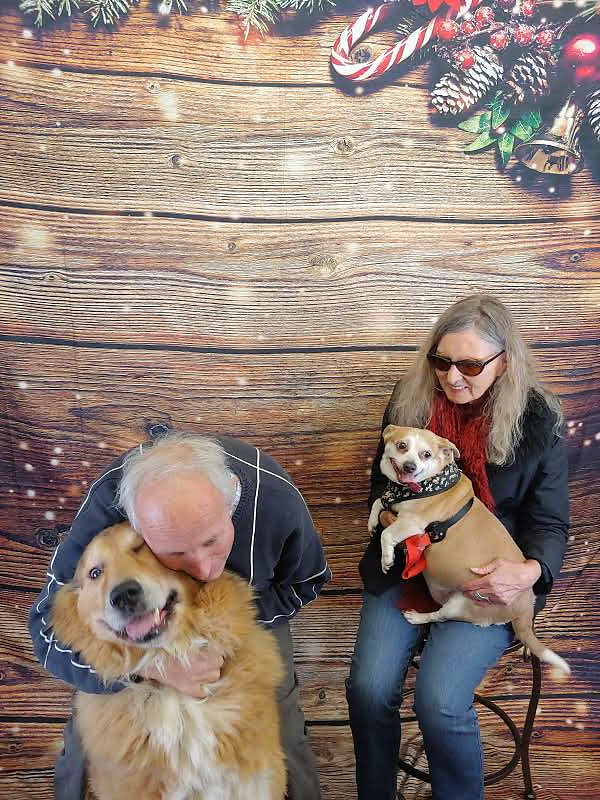
Pure bliss!

But, nevertheless, something has changed and Mark Satta has written an article that tries to explain things.

ooOOoo

Three reasons for information exhaustion – and what to do about it

By Mark Satta, Assistant Professor of Philosophy, Wayne State University.

November 18th, 2020

An endless flow of information is coming at us constantly: It might be an article a friend shared on Facebook with a sensational headline or wrong information about the spread of the coronavirus. It could even be a call from a relative wanting to talk about a political issue.

All this information may leave many of us feeling as though we have no energy to engage.

As a philosopher who studies knowledge-sharing practices, I call this experience “epistemic exhaustion.” The term “epistemic” comes from the Greek word episteme, often translated as “knowledge.” So epistemic exhaustion is more of a knowledge-related exhaustion.

It is not knowledge itself that tires out many of us. Rather, it is the process of trying to gain or share knowledge under challenging circumstances.

Currently, there are at least three common sources that, from my perspective, are leading to such exhaustion. But there are also ways to deal with them.

1. Uncertainty

For many, this year has been full of uncertainty. In particular, the coronavirus pandemic has generated uncertainty about health, about best practices and about the future.

At the same time, Americans have faced uncertainty about the U.S. presidential election: first due to delayed results and now over questions about a peaceful transition of power.

Experiencing uncertainty can stress most of us out. People tend to prefer the planned and the predictable. Figures from 17th-century French philosopher René Descartes to 20th-century Austrian philosopher Ludwig Wittgenstein have recognized the significance of having certainty in our lives.

With information so readily available, people may be checking news sites or social media in hopes of finding answers. But often, people are instead greeted with more reminders of uncertainty.

As Trump supporters denounce the 2020 election results, feelings of uncertainty can come up for others. Karla Ann Cote/NurPhoto via Getty Images

2. Polarization

Political polarization is stressing many Americans out.

As political scientist Lilliana Mason notes in her book, “Uncivil Disagreement: How Politics Became Our Identity,” Americans have been increasingly dividing politically “into two partisan teams.”

Many writers have discussed the negative effects of polarization, such as how it can damage democracy. But discussions about the harms of polarization often overlook the toll polarization takes on our ability to gain and share knowledge.

That can happen in at least two ways.

First, as philosopher Kevin Vallier has argued, there is a “causal feedback loop” between polarization and distrust. In other words, polarization and distrust fuel one another. Such a cycle can leave people feeling unsure whom to trust or what to believe.

Second, polarization can lead to competing narratives because in a deeply polarized society, as studies show, we can lose common ground and tend to have less agreement.

For those inclined to take the views of others seriously, this can create additional cognitive work. And when the issues are heated or sensitive, this can create additional stress and emotional burdens, such as sadness over damaged friendships or anger over partisan rhetoric.

3. Misinformation

Viral misinformation is everywhere. This includes political propaganda in the United States and around the world.

People are also inundated with advertising and misleading messaging from private corporations, what philosophers Cailin O’Connor and James Owen Weatherall have called “industrial propaganda.” And in 2020, the public is also dealing with misinformation about COVID-19.

As chess grandmaster Garry Kasparov put it: “The point of modern propaganda isn’t only to misinform or push an agenda. It is to exhaust your critical thinking, to annihilate truth.”

Misinformation is often exhausting by design. For example, a video that went viral,Plandemic,” featured a large number of false claims about COVID-19 in rapid succession. This flooding of misinformation in rapid succession, a tactic known as a Gish gallop, makes it challenging and time-consuming for fact checkers to refute the many falsehoods following one after another.

What to do?

With all this uncertainty, polarization and misinformation, feeling tired is understandable. But there are things one can do.

The American Psychological Association suggests coping with uncertainty through activities like limiting news consumption and focusing on things in one’s control. Another option is to work on becoming more comfortable with uncertainty through practices such as meditation and the cultivation of mindfulness.

To deal with polarization, consider communicating with the goal of creating empathetic understanding rather than “winning.” Philosopher Michael Hannon describes empathetic understanding as “the ability to take up another person’s perspective.”

[Deep knowledge, daily. Sign up for The Conversation’s newsletter.]

As for limiting the spread of misinformation: Share only those news stories that you’ve read and verified. And you can prioritize outlets that meet high ethical journalistic or fact-checking standards.

These solutions are limited and imperfect, but that’s all right. Part of resisting epistemic exhaustion is learning to live with the limited and imperfect. No one has time to vet all the headlines, correct all the misinformation or gain all the relevant knowledge. To deny this is to set oneself up for exhaustion.

ooOOoo

That last section, What to do?, is full of really sensible advice. In fact, the American Psychological Association has an article at the moment that appears to be freely available called Healing the political divide.

I intend to read it.

It finishes up saying:

Scientists must strive to share their research as broadly as possible. And they don’t have to do it alone. Organizations like More in Common work to conduct research and communicate findings to audiences where it can have the greatest impact.

Advocacy is essential as well. Other countries that have made strides in addressing the political divide relied heavily on government-led reconciliation efforts. The Truth and Reconciliation Commission, for example, in South Africa, has been fundamental in addressing disparities and conflict around Apartheid.

Were the United States to consider similar, government-backed efforts, psychologists must be part of the call to do so. And the behavioral expertise of the field would be central to success.

“The collective mental health of the nation is at risk,” says Moghaddam. “Just as we should rely on epidemiological science to tell us when there is a vaccine ready for mass use, we have to rely on psychological science to guide us through these mental health issues.”

And following an election that, for many, has felt like the most polarized of a lifetime, this piece seems critical. “ This is what our profession is all about,” says Moghaddam.

Good advice especially if you can take time off just losing oneself in nature.
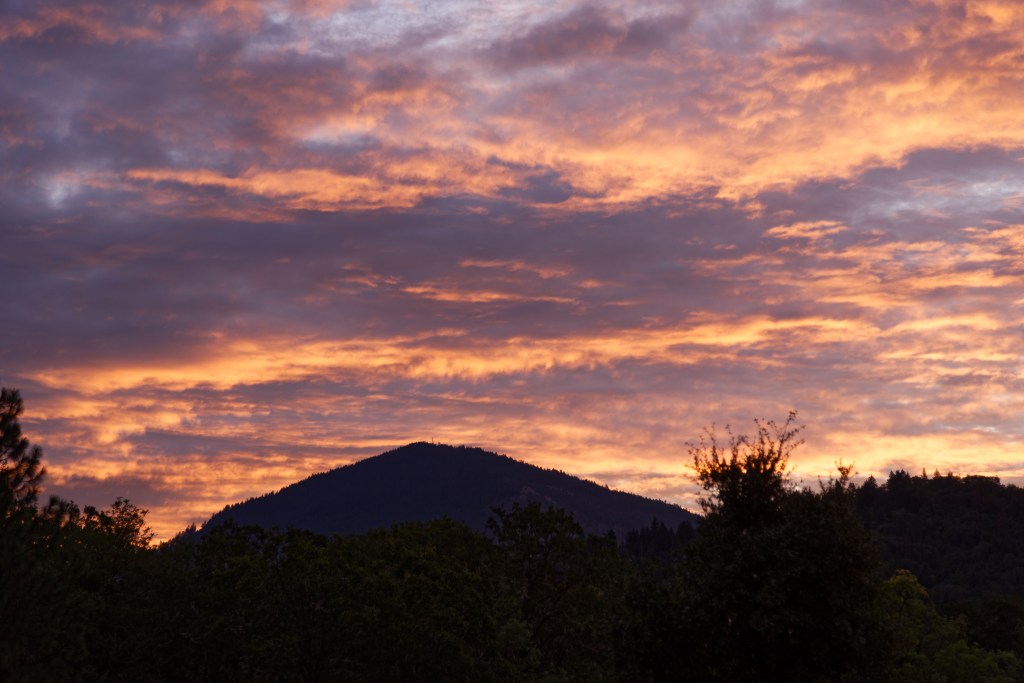
Dawn behind nearby Mt. Sexton. Taken from our deck on the 21st August, 2019.

Enough said!

Of dogs and men.

Ancient genomes reveal the common history of human and dog.

At the end of October, 2020 Science magazine published an article about the evolutionary genetics of humans and dogs.

I am not allowed to republish the full text, despite being an AAAS member, but I am sure that selected quotes will be alright.

The article was written by Pavlos Pavlidis and Mehmet Somel.

Dogs likely evolved from a wolf population that self-domesticated, scavenging for left-overs from Palaeolithic hunter-gatherers in Eurasia. However, the exact timing and geographic location where the dog lineage started remain unknown, owing to the scarcity of Palaeolithic dogs in the archaeological record. Analyses of genetic data suggest that dog-wolf divergence took place ~25,000 to 40,000 years ago, providing an earliest possible date for dog domestication.

The last paragraph in the short article is as follows:

For example, there is evidence that pigs were domesticated in both Anatolia and China. For dogs, however, the story is different. Dogs and modern-day Eurasian grey wolves appear as monophyletic groups; that is, any dog is genetically closer to another dog than to a wolf, and vice versa, Monophyly supports a single origin of dogs from a possible extinct wolf lineage.

Absolutely fascinating!

A couple of photographs, courtesy of Pexels, to close the piece.

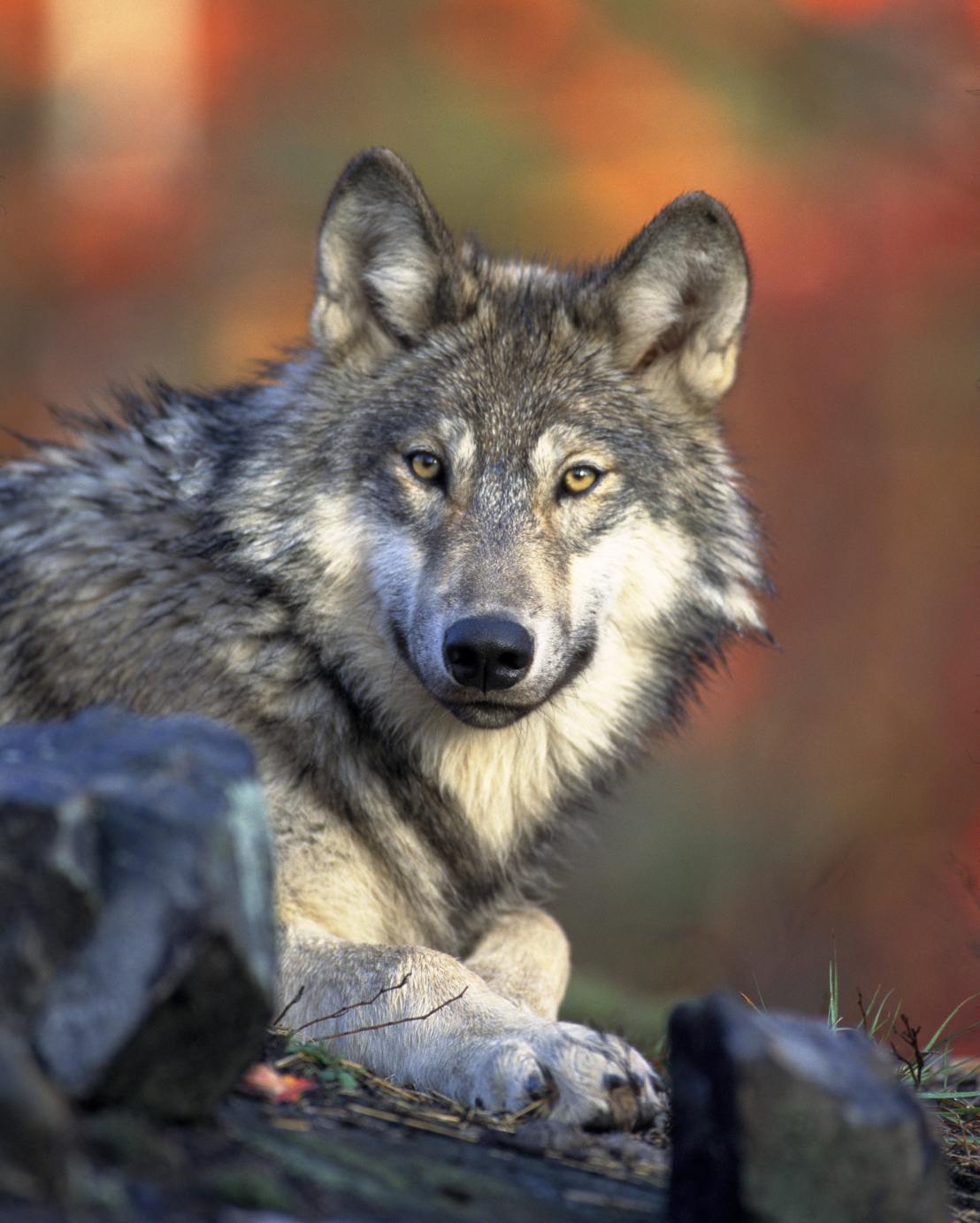
The wolf

oooo

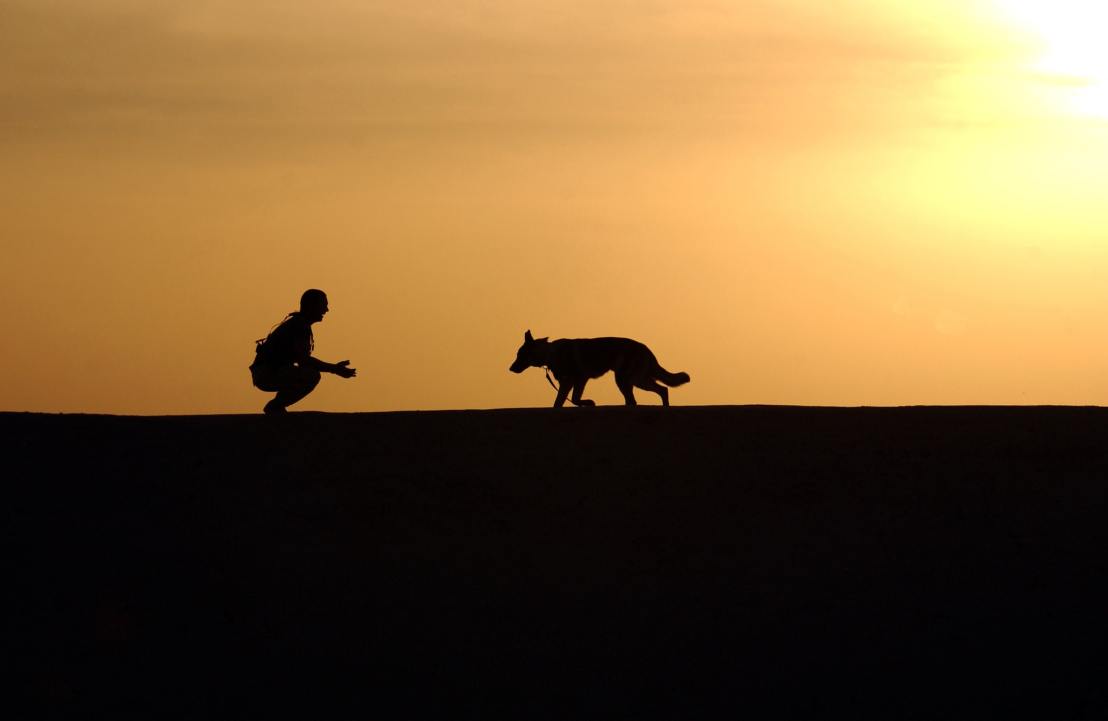
The dog.

See you tomorrow.

Picture Parade Three Hundred and Sixty-Four

There’s a theme to this week’s Picture Parade.

First of all I must again thank Pexels for providing these photographs. They are from a grouping called Man’s Best Friend.

This is the theme. That dogs are our closest and longest animal companions by far. Indeed, the era that humans befriended wolves is so long ago that an exact time is far from settled. Here’s a piece in the August 2020 issue of Scientific American magazine:

In the 14,000 to 40,000 years during which this domestication process occurred, wild wolves were probably doing better than dogs in terms of numbers – after all, our dogs were probably another food source for humans when times became lean. The first written record of a wolf hunt was recorded in the sixth century B.C.E., when Solon of Athens offered a bounty for every wolf killed.

So in all these photographs today there is a human with the dog!

oooo

oooo

oooo

oooo

oooo

oooo

oooo

Fabulous even though I say it myself!

Ageing gracefully applies to our dogs as well.

Another guest post from John Brooks.

This is an argument from John to consider dogs that are well past their prime.

It’s a good article. You will enjoy reading it and may learn something; I certainly did!

ooOOoo

Here’s Why Senior Pets Have Lots To Offer

As you may or may not know, we’ve recently celebrated Adopt a Less-Adoptable Pet Week. During this week, animal rescues around the globe join together to raise awareness about the benefits of adopting pets that society deems as ‘less adoptable’ – and sadly, senior pets make the list.

We think that senior pets are just as loving, sweet and great companions as their ‘adoptable’ counterparts. But despite the many benefits of owning a senior pet, most families choose younger pets when adopting. With that in mind, here’s why we believe seniors deserve a second look and a fur-ever home.

Why you should consider a senior pet
Since the onset of the pandemic, the number of families adopting and fostering pets since the enforcement of COVID-19 restrictions has risen dramatically across the globe. Near the commencement of stay at home orders, RSPCA received 1,600 adoption applications in a single week of April—a 45% increase in dog adoptions and a 20% increase in cat adoptions compared to 2019.

Senior pets (and other less-adoptable animals) typically spend four times as long in a shelter as a healthy, younger pet. In the U.S. alone, about 400,000 senior pets die in a shelter. Though most people do seek a puppy or kitten when adopting, families would benefit in many ways from choosing an older pet. Here’s why.

Better manners
Older pets are well past the playful, chew-everything, get-into-anything stage. Older dogs and cats sleep for 20 hours a day or more, rousing just long enough for a conversation, to greet visitors, or have a meal. They are also probably house-trained, dog-door trained, and have formal or informal obedience training.

They are much more likely to come when called, which means they are at less risk of danger younger pets encounter when escaping their yard and wandering the streets.

Easier to train
For the older dog with less than perfect manners, training is typically more straightforward. They are more focused and eager to please than puppies with short attention spans. Senior animals are smarter and more experienced, and this can mean they acclimate more quickly to the house and how the household operates.

Done growing
One of the best parts about adopting a senior is they have finished growing, and the new family knows exactly how large the pet is. When adopting a puppy, owners are often surprised at how large the dog becomes or how little it grows. With an older dog, there will be no surprises.

Seniors make better companions for seniors
Senior pets usually move at a slower pace, which makes them a better choice for older people, especially those with limited mobility or disabilities. The new owner is less likely to be toppled by a dog jumping up. It’s also safer for those that allow their pets to sleep with them. An older dog is less likely to be rambunctious and cause injury to a sleeping adult.

Laid-back company
Senior pets are content to stay close to home or in the house for the majority of the day. They are more likely to be found soaking up a sunbeam on a cosy patch of carpet than barking wildly at everything and everyone crossing past the front window.

Senior dogs are also far less distracted when out for a walk. Though they may perk up at the sight of another dog, they are less likely to drag the owner down the sidewalk in pursuit. They also walk slower, and at a pace their owner matches.

Gratitude and devotion
Senior dogs spend up to four times as long in a shelter, so when they finally find a furever home, their gratitude runs deep, and it shows. They give unconditional love and devotion and look after their families. Often they will attach to a family member and stay close at all times, moving with them from room to room. They take full responsibility for their welfare and provide comfort with a warm, wet kiss.

Years of happiness
At seven years old, most dogs and cats are considered senior. Cats often live to be 15 or even 20 years so that the owner can expect a long life with their new friend. Depending on the breed and size, dogs too can live 15 or more years. So while adopting a senior dog will mean you may spend slightly less birthdays together, you’ll still be blessed with some wonderful years and memories.

Despite the many benefits of owning a senior pet, families also worry about the costs associated with maintaining their pet’s health. Dental cleanings, blood work, and annual shots can quickly add up, but younger animals have just as many health risks and are more likely to be involved in accidents.

Final thoughts
Fostering helps many people feel fulfilled because they are making a significant contribution to a pet’s life. For them, seeing their foster move on to their forever family is reward enough. Don’t be surprised though if fostering leads to adoption. That’s always a great outcome for all involved.

ooOOoo

In the U.S. alone, about 400,000 senior pets die in a shelter.

Among the many interesting aspects of this post, for me the statement above that I have put into italics jumped off the page at me. What an appalling waste!

But coming back to the complete article it offers many aspects of something that I had hitherto not thought about. I suspect that I am not the only one!

We, too, have a senior foster dog. She is Sheena and is 12 years of age. We love her and there is no question of Sheena going back to the kennels.

Once again, let me offer a bit of background on John.

John Brooks is the Professional Content Marketer. He writes a lot of articles on his carrier. Last one year he is working with Orbeen.com as a digital marketing expert. The company provides various types of Digital Marketing services i.e, Search Engine Optimisation (SEO), Search Engine Marketing (SEM), Social Media Optimization (SMO), Web design & development, Link Building, Content Marketing & blogger outreach.

Fabulous!


Simply in awe!

It’s both beautiful and yet beyond comprehension.

When we have a clear night there are two occasions for me to gaze upwards and become lost in thought. One is in the evening when the dogs are outside just before going to bed. The other is in the morning because we are usually awake well before sunrise.

We are very lucky in that there is no light pollution locally.

So, in the evening, while I look at the broad expanse of stars, my eyes are drawn to the Big Dipper and to Orion.

In the morning, when we look to the East there is Venus sparkling bright in the night-sky over the hills.

I still vividly remember all those years ago when I was sailing in the Western Mediterranean coming on deck in the middle of the night to find the stars down to the horizon all 360 degrees about me. I am sure it will be one of the last memories of mine just before I die! I hope so!

But I speak of the solar system. Here’s an article that was recently published by EarthSky that goes way beyond the solar system. It is a wonderful essay and almost mystical.

ooOOoo

What is a galaxy?

Posted by in ASTRONOMY ESSENTIALS, September 25, 2020

We live in a galaxy called the Milky Way. But there is so much more to know about these grand and glorious star islands in space! Click in here, and prepare to have your mind expanded.

This is a giant galaxy cluster known as Abell 2744, aka Pandora’s Cluster, located in the direction of the constellation Sculptor. The cluster is about 4 million light-years across and has the mass of 4 trillion suns. It appears to be the result of a simultaneous pile-up of at least 4 separate, smaller galaxy clusters that took place over a span of 350 million years. Read more about this image at HubbleSite. Image via NASA/ ESA/ J. Lotz/ M. Mountain/ A. Koekemoer/ the Hubble Frontier Fields Team.

A galaxy is a vast island of stars in an ocean of space. Galaxies are typically separated from one another by huge distances measured in millions of light-years. Galaxies are sometimes said to be the building blocks of our universe. Their distribution isn’t random, as one might suppose: galaxies are strung out along unimaginably long filaments across the universe, a cosmic web of star cities.

A galaxy can contain hundreds of billions of stars and be many thousands of light-years across. Our own galaxy, the Milky Way, is around 100,000 light-years in diameter. That’s about 587,900 trillion miles, nearly a million trillion kilometers.

Galaxies are of widely varying sizes, too.

There are an estimated two trillion galaxies in the universe.

Illustration showing snapshots from a simulation by astrophysicist Volker Springel of the Max Planck Institute in Germany. It represents the growth of cosmic structure (galaxies and voids) when the universe was 0.9 billion, 3.2 billion and 13.7 billion years old (now). Image via Volker Springel / MPE/ Kavli Foundation.

Galaxies group together in clusters. Our own galaxy is part of what is called the Local Group, for example: a cluster comprising 55 galaxies that we know of so far.

In turn, galaxy clusters themselves group into superclusters. Our Local Group is part of the Virgo Supercluster.

The “glue” that binds stars into galaxies, galaxies into clusters, clusters into superclusters and superclusters into filaments is – of course – gravity, the universe’s construction worker, which sculpts all the structures we see in the cosmos.

Distances from the Local Group for selected groups and clusters within the Local Supercluster, which is called the Virgo Supercluster.

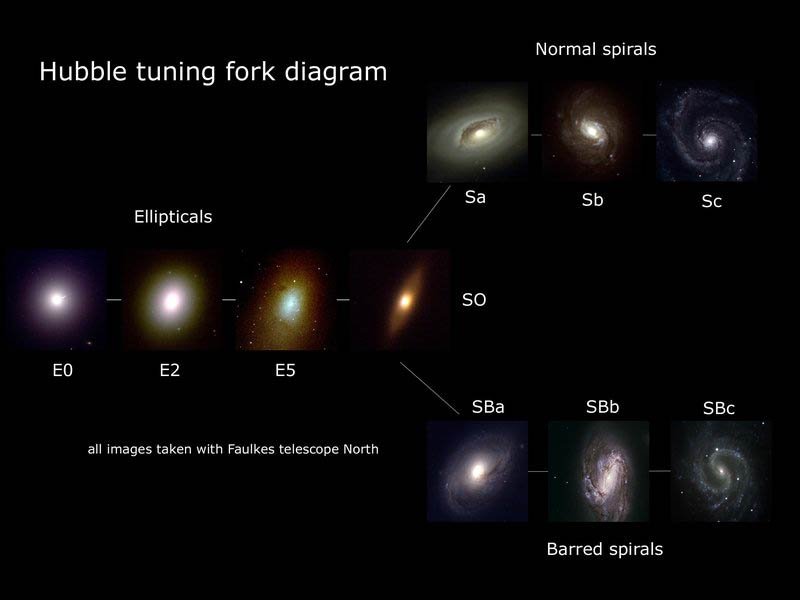
There are several basic types of galaxy, each containing sub-types. Galaxies were first systematically classified, based on their visual appearance, by the famous astronomer Edwin P. Hubble in the late 1920s and 30s, during years of painstaking observations. Hubble’s Classification of Galaxies, as it is known, is still very much in use today, although, since Hubble’s time, like any good classification system it has been updated and amended in the light of new observations.

Before Hubble’s study of galaxies, it was believed that our galaxy was the only one in the universe. Astronomers thought that the smudges of light they saw in their telescopes were in fact nebulae within our own galaxy and not, as Hubble discovered, galaxies in their own right. It was Hubble who demonstrated, by measuring their velocities, that they lie at great distances from us, millions of light-years beyond the Milky Way, distances so huge that they appear tiny in all but the largest telescopes. Moreover, he demonstrated that, wherever he looked, galaxies are receding from us in all directions, and the further away they are, the faster they are receding. Hubble had discovered that the universe is expanding.

A diagrammatic representation of Edwin Hubble’s “tuning fork diagram.” In the late 1920s and 30s, Hubble conducted the laborious observations needed to begin to classify galaxies. His original classification scheme was published in 1936 in a book called “The Realm of the Nebulae.” His original scheme is – like all scientific work – continually being modified. But his idea of a “tuning fork diagram” has continued to be useful. Image via Las Cumbres Observatory.

The most common type of galaxy is the one most people are familiar with: the spiral galaxy. The Milky Way is of this family. Spiral galaxies have majestic, sweeping arms, thousands of light years long, made up of millions upon millions of stars. Our solar system is situated about 2/3 of the way out from the galactic center towards the periphery of the galaxy, embedded in one of these spiral arms.

Spiral galaxies are also characterised by having a bright center, made up of a dense concentration of stars, so tightly packed that from a distance the galaxy’s center looks like a solid ball. This ball of stars is known as the galactic bulge. At the center of the Milky Way – within the galactic bulge – the density of stars has been calculated at 1 million per 34 cubic light-years, for example.

Meanwhile, in the vicinity of our sun, the stellar density has been estimated as 0.004 stars per cubic light-year. Big difference!

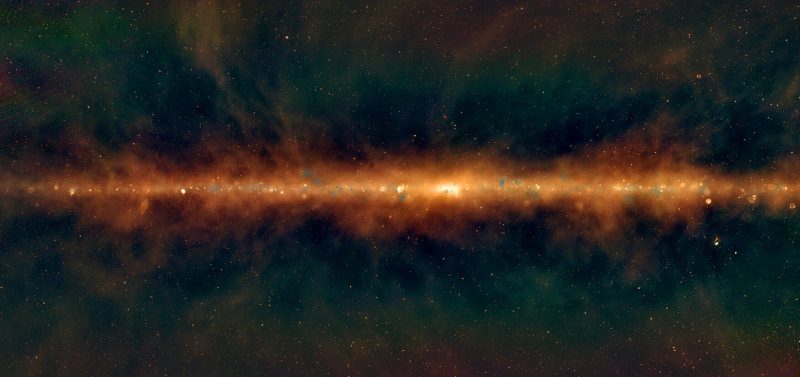
A stunning view of the center of our Milky Way galaxy as seen by the Murchison Widefield Array (MWA) telescope in Australia in 2019. Image via Natasha Hurley-Walker (ICRAR/ Curtin)/ GLEAM Team/ Phys.org.

The Milky Way is, in fact, in one of Hubble’s spiral galaxy sub-types: it’s a barred spiral, which means it has a bar of stars protruding out from either side of the center. The ends of the bar form the anchors of the spiral arms, the place from where they sweep out in their graceful and enormous arcs. This is a fairly recent discovery: how the bar forms in a galaxy is not yet understood.

Also established recently is the fact that the disk of the Milky Way is not, as most diagrams depict, flat: it is warped, like a long-playing vinyl record left too long in the sun. Exactly why is not known, but it is thought to be the result of a gravitational encounter with another galaxy early in the Milky Way’s history.

Artist’s illustration of our warped Milky Way. Image via Ogle/ Warsaw University/ BBC.

Elliptical galaxies are the universe’s largest galaxies. They are huge and football-shaped.

They come to be because – although most galaxies are flying apart from each other – those astronomically close to each other will be mutually gravitationally attracted. Caught in an inexorable gravitational dance, eventually they merge, passing through each other over millions of years, eventually forming a single, amorphous elliptical galaxy. Such mergers may result in the birth of new generations of stars as gravity’s shock-wave compresses huge clouds of interstellar gas and dust.

The Milky Way is caught in such a gravitational embrace with M31, aka the Andromeda galaxy, which is 2 1/2 million light-years distant. Both galaxies are moving toward each other because of gravitational attraction: they will merge in about 6 billion years from now. However, both galaxies are surrounded by huge halos of gas which may extend for millions of light-years, and it was recently discovered that the halos of the Milky Way and M31 have started to touch.

The two galaxies have had their first kiss.

Galaxy mergers are not uncommon: the universe is filled with examples of galaxies in various stages of merging together, their structures disrupted and distorted by gravity, forming bizarre and beautiful shapes.

Galaxies may take billions of years to fully merge into a single galaxy. As astronomers look outward in space, they can see only “snapshots” of this long merger process. Located 300 million light-years away in the constellation Coma Berenices, these 2 colliding galaxies have been nicknamed The Mice because of the long tails of stars and gas emanating from each galaxy. Otherwise known as NGC 4676, the pair will eventually merge into a single giant galaxy. Image via Wikimedia Commons.

At the lower end of the galactic size scale, there are the so-called dwarf galaxies, consisting of a few hundred to up to several billion stars. Their origin is not clear. Usually they have no clearly defined structure. Astronomers believe they were born in the same way as larger galaxies like the Milky Way, but for whatever reason they stopped growing. Ensnared by the gravity of a larger galaxy, they orbit its periphery. The Milky Way has around 20 dwarf galaxies orbiting it that we know of, although some models predict there should be many more.

The two most famous dwarf galaxies for us earthlings are, of course, the Small and Large Magellanic Clouds, visible to the unaided eye in Earth’s Southern Hemisphere sky.

Eventually, these and other dwarf galaxies will be ripped apart by the titanic maw of the Milky Way’s gravity, leaving behind a barely noticeable stream of stars across the sky, slowly dissipating over eons.

Lynton Brown captured this beautiful image of the Milky Way over Taylor’s Lake near Horsham, Australia, on April 22, 2019. The 2 objects on the right are the Magellanic Clouds. Thank you, Lynton!

It is believed that all galaxies rotate: the Milky Way takes 226 million years to spin around once, for example. Since its birth, therefore, the Earth has travelled 20 times around the galaxy.

At the center of most galaxies lurks a supermassive black hole, of millions or even billions of solar masses. The record holder, TON 618, has a mass 66 billion times that of our sun.

The origin and evolution of supermassive black holes are not well understood. A few years ago, astronomers uncovered a surprising fact: in spiral galaxies, the mass of the supermassive black hole has a direct linear relationship with the mass of the galactic bulge. The more mass the black hole has, the more stars there are in the bulge. No one knows exactly what the significance of this relationship is, but its existence seems to indicate that the growth of a galaxy’s stellar population and that of its supermassive black hole are inextricably linked.

This discovery comes at a time when astronomers are beginning to realize that a supermassive black hole may control the fate of its host galaxy: the copious amounts of electromagnetic radiation emitted from the maelstrom of material orbiting the central black hole, known as the accretion disk, may push away and dissipate the clouds of interstellar hydrogen from which new stars form. This acts as a throttle on the galaxy’s ability to give birth to new stars. Ultimately, the emergence of life itself may be tied to the activity of supermassive black holes. This is an area of much ongoing research.

While astronomers still know very little about exactly how galaxies formed in the first place – we see them in their nascent forms existing only a few hundred million years after the Big Bang – the study of galaxies is an endless voyage of discovery.

Less than a hundred years after it was realized that other galaxies beside our own exist, we have learned so much about these grand, majestic star cities. And there is still much to learn.

Bottom line: What is a galaxy? Learn about these starry islands in space.

ooOOoo

There are an estimated two trillion galaxies out there. It is beyond comprehension. Well it is to this mind sitting in front of his Mac in a rural part of Oregon. Two trillion! I can’t even get my mind around the fact that our local galaxy, our Milky Way, is 100,000 light years across. Although some would say that it is even larger; about 150,000 light years across. And what is a light year?

Here’s NASA to answer that:

A light-year is a unit of distance. It is the distance that light can travel in one year. Light moves at a velocity of about 300,000 kilometers (km) each second. So in one year, it can travel about 10 trillion km. More precisely, one light-year is equal to 9,500,000,000,000 kilometers.

Why would you want such a big unit of distance? Well, on Earth, a kilometer may be just fine. It is a few hundred kilometers from New York City to Washington, DC; it is a few thousand kilometers from California to Maine. In the universe, the kilometer is just too small to be useful. For example, the distance to the next nearest big galaxy, the Andromeda Galaxy, is 21 quintillion km. That’s 21,000,000,000,000,000,000 km. This is a number so large that it becomes hard to write and hard to interpret. So astronomers use other units of distance.

In our solar system, we tend to describe distances in terms of the Astronomical Unit (AU). The AU is defined as the average distance between the Earth and the Sun. It is approximately 150 million km (93 million miles). Mercury can be said to be about 1/3 of an AU from the Sun and Pluto averages about 40 AU from the Sun. The AU, however, is not big enough of a unit when we start talking about distances to objects outside our solar system.

For distances to other parts of the Milky Way Galaxy (or even further), astronomers use units of the light-year or the parsec . The light-year we have already defined. The parsec is equal to 3.3 light-years. Using the light-year, we can say that :

  • The Crab supernova remnant is about 4,000 light-years away.
  • The Milky Way Galaxy is about 150,000 light-years across.
  • The Andromeda Galaxy is 2.3 million light-years away.

So here we are. In a remote part of our galaxy, the Milky Way, far, far from everywhere, on a pale blue dot. As Carl Sagan put it in his talk from The Age of Exploration given in 1994:

On it, everyone you ever heard of… The aggregate of all our joys and sufferings, thousands of confident religions, ideologies and economic doctrines, every hunter and forager, every hero and coward, every creator and destroyer of civilizations, every king and peasant, every young couple in love, every hopeful child, every mother and father, every inventor and explorer, every teacher of morals, every corrupt politician, every superstar, every supreme leader, every saint and sinner in the history of our species, lived there on a mote of dust, suspended in a sunbeam. …
Think of the rivers of blood spilled by all those generals and emperors so that in glory and triumph they could become the momentary masters of a fraction of a dot.

Carl Sagan, Cornell lecture in 1994

It all seems impossible for us mortals to understand.

But it won’t stop me from peering up into the night sky and wondering about the universe with total awe.

And thank goodness for dogs!

Picture Parade Three Hundred and Fifty-Six

A republication of an earlier Picture Parade.

Stay Happy Good People!

Returning to the pictures sent in by ‘Captain Bob’.

oooo

oooo

oooo

oooo

oooo

More of Bob’s Happy-Making pictures next Sunday.

Dogs and understanding praise.

Life must go on!

I am referring to the smoke and fires in this part of the Western edge of the USA.

For a while it seemed as though evacuation was becoming closer but now, I hope, that we are nearing a change in the weather including some rain later on this week.

So time for another post.

This one about speech processing in the dog’s brain.

The article that I want to republish is in The National Geographic magazine but I do not have permission to reproduce it in full.

Luckily the video that is in the article is also available on YouTube.

So first some extracts of the article.

Dogs understand praise the same way we do. Here’s why that matters.

Dogs can’t speak, but their brains respond to spoken words, suggesting human language has deep evolutionary roots

By VIRGINIA MORELL, Published August 6th, 2020

Every dog owner knows that saying Good dog! in a happy, high-pitched voice will evoke a flurry of joyful tail wagging in their pet.

That made scientists curious: What exactly happens in your dog’s brain when it hears praise, and is it similar to the hierarchical way our own brain processes such acoustic information?

When a person gets a compliment, the more primitive, subcortical auditory regions first reacts to the intonation—the emotional force of spoken words. Next, the brain taps the more recently evolved auditory cortex to figure out the meaning of the words, which is learned.

Then later on the article goes on to say:

“It’s an important question, because dogs are a speechless species, yet they respond correctly to our words,” says Attila Andics, a neuroscientist at Eotvos Lorand University in Budapest, Hungary,and co-author of both the previous study and the new one, published this week in the journal Scientific Reports. For instance, some dogs are capable of recognizing thousands of names of individual objects, and can link each name to a specific object.

When the scientists studied scans of the brains of pet dogs, they found that theirs, like ours, process the sounds of spoken words in a hierarchical manner—analyzing first the emotional component with the older region of the brain, the subcortical regions, and then the words’ meaning with the newer part, the cortex. (Read how dogs are more like us than we thought.)

It’s much longer than I have presented so I do urge you to go to the article and read it fully; it’s fascinating.

And to close this post I insert the video that is in the article.

All the best to you!

Magnetic rivers!

Yes, you heard that correctly.

There was an article on the website EarthSky News yesterday that, literally, took me out of this world. It described the role of magnetic rivers in newly forming star clusters.

There’s not a dog in sight but nevertheless I wanted to share this article with you.

ooOOoo

Magnetic rivers feed star birth

Astronomers have learned that the pull of gravity can sometimes overcome the strong magnetic fields found in great star-forming clouds in space. The resulting weakly magnetized gas flow can feed the growth of new stars.

See the lines – called streamlines by scientists – in this composite image of the Serpens South star cluster? They’re from magnetic fields in this great star-forming cloud. Notice the lower left, where magnetic fields have been dragged into alignment with a narrow, dark filament. In that area, astronomers say, material from interstellar space is flowing into the star-forming cloud and fueling star formation. Image via NASA/ SOFIA/ T. Pillai/ JPL-Caltech/ L. Allen/ USRA.

Astronomers have known for decades that stars like our sun form when giant clouds of gas and dust in space – sometimes called molecular clouds – collapse under their own gravity. But how does the material from interstellar space flow into these clouds, and what controls the collapse? The image above helps illustrate an answer to these questions. It’s a composite, made with data from SOFIA – an airborne telescope designed for infrared astronomy – overlaid on an image from the now-retired Spitzer Space Telescope. This composite shows that the pull of gravity can sometimes overcome the strong magnetic fields found in great star-forming clouds in space. And it shows that, when that happens, weakly magnetized gas can flow – as on a conveyor belt – to feed the growth of newly forming star clusters.

A statement from the Max Planck Institute in Bonn, Germany, explained:

A major finding in the last decade has been that extensive networks of filaments permeate every molecular cloud. A picture has emerged that stars like our own sun form preferentially in dense clusters at the intersection of filaments.

Now look back at the image above, which shows the Serpens South star cluster, a star-forming region located some 1,400 light-years from Earth. In that image, you see a dark filament in the lower left. Now notice the “stripes” on the image, which astronomers call streamlines. They represent magnetic structures, discovered by SOFIA. The astronomers said these magnetic structures act like rivers, channeling material into the great star-forming cloud.

As you can see in the image, these magnetic streamlines have been dragged by gravity to align with the narrow, dark filament on the lower left. Astronomers say this configuration helps material from interstellar space flow into the cloud.

This is different from the upper parts of the image, where the magnetic fields are perpendicular to the filaments; in those regions, the magnetic fields in the cloud are opposing gravity.

Astrophysicist Thushara Pillai led the study showing that magnetic rivers feed star birth in the Serpens South star-forming region.

The scientists said in a statement from Universities Space Research Association (USRA) that they are:

… studying the dense cloud to learn how magnetic fields, gravity and turbulent gas motions contribute to the creation of stars. Once thought to slow star birth by counteracting gravity, SOFIA’s data reveals magnetic fields may actually be working together with gravity as it pulls the fields into alignment with the filaments, nourishing the birth of stars.

The results were published in the peer-reviewed journal Nature Astronomy on August 17. The lead author of the new study is Thushara Pillai of Boston University and the Max Planck Institute for Radio Astronomy in Bonn, Germany.

In 1835, the French philosopher Auguste Comte wrote of the unknowable nature of stars:

On the subject of stars, all investigations which are not ultimately reducible to simple visual observations are … necessarily denied to us. While we can conceive of the possibility of determining their shapes, their sizes, and their motions, we shall never be able by any means to study their chemical composition or their mineralogical structure … Our knowledge concerning their gaseous envelopes is necessarily limited to their existence, size … and refractive power, we shall not at all be able to determine their chemical composition or even their density…

He was, famously, wrong.

He couldn’t have envisioned the range of tools available to modern astronomers. It’s a beautiful thing that, nowadays, astronomers can not only learn about the compositions of stars via their studies of their spectra, but also probe the deeper mysteries, going all the way to the births of these colossal, self-luminous balls in space.

SOFIA, the Stratospheric Observatory for Infrared Astronomy. The HAWC+ polarimeter on board SOFIA was used for the observations of the magnetic field in the Serpens South star-forming region. Image via NASA/ C. Thomas/ Max Planck Institute.

Bottom line: Astronomers have learned that the pull of gravity can sometimes overcome the strong magnetic fields found in great star-forming clouds in space. The resulting weakly magnetized gas flow can feed the growth of new stars.

Source: Magnetized filamentary gas flows feeding the young embedded cluster in Serpens South

ooOOoo

Just read that paragraph just before the end of the article: “He couldn’t have envisioned the range of tools available to modern astronomers. It’s a beautiful thing that, nowadays, astronomers can not only learn about the compositions of stars via their studies of their spectra, but also probe the deeper mysteries, going all the way to the births of these colossal, self-luminous balls in space.”

What a long way we have come from just, say, 50 years ago.

It would be easy to get lost in the article in a scientific manner, and that would be entirely appropriate.

But there’s another beautiful way to get lost in the article; by dreaming of outer space and forgetting just for a moment or two this Earthly planet we all live on!


Kim’s loss

The death of a loved dog!

I am not a great Facebook user, more for the benefit of my blog than anything else.

But I couldn’t help seeing an entry from Kim Spann. This is what she wrote:

Today I lost one of the greatest dogs I’ve ever known. My constant companion, protector and friend. I will miss her always but am blessed to have had her in my life for 8 years.

Well over two hundred people clicked ‘Like’ and when I was writing this post (about 2.30 pm on the 5th) there were 179 comments; all of them wonderful.

I, in turn, offered to write a small tribute, and it now follows.

ooOOoo

A tribute

Dogs are special. Special beyond words.

They have been with us humans for thousands of years. They have played with us. They have stayed by our side. They have rescued us. And much more.

They do not live long enough but even in their death do we share precious times and precious memories.

So … goodbye you darling creature. I love you!

oooo

oooo

oooo

As Kim said: “My constant companion, protector and friend.”

Dog love

One can never turn off one’s heart to love

There was a story on the Daily Dodo yesterday that just says it all when it comes to us humans and our love for dogs. Now we don’t know the name of the Dad but so what! It’s a wonderful story nonetheless!

ooOOoo

Dad And The Dog He Didn’t Want Now Have The Sweetest Bedtime Routine

“He fell in love” ❤️

By Stephen Messenger,   Published on 7/27/2020

Believe it or not, there was once a time when Alice Garrido Gallardo’s dad didn’t want another dog at all — but now he pretty much epitomizes what it means to be a proud pet parent.

He and his pup, named Jean Grey, have the sweetest bedtime routine to prove it.

Alice Garrido Gallardo

Jean Grey started out life as a stray and was rescued by Gallardo’s friend. When Gallardo suggested to her dad that they adopt her, he was opposed to the idea at first.

“We had lost our old dog and he didn’t want to have another one anytime soon,” Gallardo told The Dodo. “He was still grieving.”

Gallardo, however, wasn’t deterred. She decided to arrange an introduction between Jean Grey and her dad. And sure enough:

“He fell in love the day I brought her home,” Gallardo said.

Alice Garrido Gallardo

As time went on, his love for the dog he didn’t want only grew stronger — and he found the most wonderful way to show it.

“He began to put her to bed every night,” Gallardo said.

Photo Credit: TikTok/alicegrgl

Each and every night now, Gallardo’s dad tucks Jean Grey into bed, placing a pillow under her head and toy close by.

“I love to see them, my dad being super loving and affectionate,” Gallardo said. “I love to see them and know that they love each other very much.”

ooOOoo

I used the sub-heading: “One can never turn off one’s heart to love.

To give that statement slightly more detail I should have said: “One can never turn off one’s heart to the love of a dog!