Category: consciousness

The Truth about Gods, part two

The concluding part of this essay by Patrice Ayme.

ooOOoo

Endowing aspects of the universe with spirituality, a mind of their own, is stupid in this day and age, only if one forgets there are natural laws underlying them. But if one wants to feel less alone and more purposeful, it is pretty smart.    

Patrice Ayme

Here is the inventor of monotheism: Nefertiti. Once a fanatic of Aten, the sun god, she turned cautious, once Pharaoh on her own, backpedalled and re-authorized Egyptian polytheism. (The sun-God, Sol Invictis, was revived by Roman emperor Dioclesian 17 centuries later, in his refounding of Romanitas and the empire. His ultra young successor and contemporary, emperor Constantine, used the revived monotheism to impose his invention of Catholicism. Funny how small the conceptual world is.)

***

The preceding part (see Part One yesterday} contains many iconoclastic statements which made the Articial Intelligence (AI) I consulted with try to correct me with what were conventional, but extremely erroneous, ill-informed data points. AI also use the deranged upside down meta-argument that it is well-known that Christianism is not like that, so I have got to be wrong. Well, no, I was raised as a Catholic child in two different Muslim countries, and also in a Pagan one; the Muslim faiths I knew as child were as different from Suny/Shiah faiths as Christianism is, overall, from Islamism. In other words, I know the music of monotheism. So here are:

***

TECHNICAL NOTES: 

[1] To speak in philosophical linguo, we capture two civilizational “ontologies” (logic of existence):

  1. Polytheistic-personal: relational, distributed, ecological.
  2. Monotheistic-fascistic: hierarchical, authoritarian, abstracted.

[2] Paganus, in a religious sense, appears first in the Christian author Tertullian, around 202 CE, to evoke paganus in Roman military jargon for ‘civilian, incompetent soldier‘ by opposition to the competent soldiers (milites) of Christ that Tertullian was calling for.

[3] ‘FAIR OF FACE, Joyous with the Double Plume, Mistress of Happiness, Endowed with Favour, at hearing whose voice one rejoices, Lady of Grace, Great of Love, whose disposition cheers the Lord of the Two Lands.

With these felicitous epithets, inscribed in stone more than 3,300 years ago, on the monumental stelae marking the boundaries of the great new city at Tell el Amarna on the Nile in central Egypt, the Pharaoh Akhenaten extolled his Great Royal Wife, the chief queen, the beautiful Nefertiti.

Nefertiti (‘the beautiful one has come‘) co-ruled Egypt with her older (and apparently famously ugly, deformed by disease) husband. Egypt was at its wealthiest. She was considered to be a DIVINITY. All her life is far from known, and revealed one fragment of DNA or old text at a time. She ruled as sole Pharaoh after her husband’s death, and seems to have offered to marry the Hittite Prince (as revealed by a recently found fragment: ”I do not wish to marry one of my subjects. I am afraid…” she confessed in a letter to the amazed Hittite emperor.). She apparently decided to re-allow the worship of the many Egyptian gods, and her adoptive son and successor Tutankhaten switched his name to Tutankhamen). Both her and Tutankhamen died, and they were replaced by a senior top general of Akhenatten who both relieved the dynasty from too much inbreeding (hence the deformed Akhenaten) and too much centralism focused on the sun-disk (‘Aten’)  

[4] Those who do not know history have a small and ridiculous view of FASCISM. Pathetically they refer to simpletons, such as Hitler and Mussolini, to go philosophical on the subject.. Google’s Gemini tried to pontificate that ‘labeling the structure of monotheism (especially its early forms) as fascistic’ is anachronistic and highly inflammatory. Fascism is a specific 20th-century political ideology. While the author means authoritarian and hierarchical, using ‘fascistic’ distracts from the historical and philosophical points by introducing modern political baggage. It would be clearer and less polemical to stick to Hierarchical’ or ‘Authoritarian-Centralized.

I disagree virulently with this cognitive shortsightedness of poorly programmed AI. The Romans were perfectly aware of the meaning that the faces symbolized (they got them from the Etruscans). So were the founders of the French and American republics aware of the importance of fascism and the crucial capabilities it provided, the powerful republics which, in the end, succeeded the Roman Republic (which died slowly under the emperors until it couldn’t get up); those two republics gave the basic mentality now ruling the planet.

Fascism is actually an instinct. Its malevolent and dumb confiscation by ignorant  morons such as Hitler and Mussolini ended pathetically under the blows of regimes (the democracies on one side, the fascist USSR on the other) which were capable of gathering enough, and much more, and higher quality fascism of their own to smother under a carpet of bombs the cretinism of the genocidal tyrants. It is actually comical, when reading old battles stories, to see the aghast Nazis out-Nazified by their Soviet opponents (discipline on the Soviet side was a lethal affair at all and any moment.) Or then to see SS commanders outraged by the ferocity of their US opponents. At Bir Hakeim, a tiny French army, 3,000 strong, buried in the sands, blocked the entire Afrika Korps and the Italian army, for weeks, under a deluge of bombs and shells, killing the one and only chance the Nazis had to conquer the Middle East. Hitler ordered the survivors executed, Rommel, who knew he was finished, disobeyed him.   

***

Early Christianism was highly genocidal. The Nazi obsession with the Jews was inherited from Nero (who, unsatisfied with just crucifying Christians (64 CE), launched the annihilation wars against Israel) and then the Christians themselves. There were hundreds of thousands of Samaritans, a type of Jew, with their own capital and temple (above Haifa). Warming up, after centuries of rage against civilization, the Christians under emperor Justinian, in the Sixth Century, nearly annihilated the Samaritans; a genocide by any definition.

Later, by their own count, at a time when Europe and the greater Mediterranean counted around 50 million inhabitants, the Christians, over centuries, killed no less than 5 million Cathars from Spain to Anatolia. Cathars, the pure ones in Greek (a name given to them by their genociders), were a type of Christian). In France alone, in a period of twenty years up to a million were killed, (not all Cathars, but that accentuates the homicidal character). As a commander famously said: ”Tuez les tous, Dieu reconnaitra les siens” (Kill them all, God will recognize his own). The anti-Cathars genocide drive in France, an aptly named ‘crusade‘,  something about the cross, lasted more than a century (and boosted the power of the Inquisition and the Dominicans). The extinction of Catharism was so great that we have only a couple of texts left. 

Want to know about Christianism? Just look at the torture and execution device they brandish, the cross. Christianism literally gave torture and execution a bad name, and it’s all the most cynical hypocrisy hard at work. 

And so on. To abstract it in an impactful way, one could say that much of Christianism instigated Nazism. That’s one of the dirty little secrets of history, and rather ironical as the dumb Hitler was anti-Christian, and still acted like one, unbeknownst to himself, his public, and his critiques; those in doubt can consult the descriptions of the Crusades by the Franks themselves, when roasting children was found to relieve hunger.

Chroniclers like Radulph of Caen (a Norman historian writing around 1118) described it vividly: “In Ma’arra our troops boiled pagan adults in cooking-pots; they impaled children on spits and devoured them grilled.” Other sources, such as Joinville, Fulcher of Chartres and Albert of Aachen, corroborate the desperation and brutality, though they express varying degrees of horror or justification.   These acts were not systematic policy but extreme responses to the hunger and chaos of war, and they were preserved in Frankish narratives as part of the Crusade’s grim legacy. (There were also cases of cannibalism in WW2).

Christianism, when not actively genocidal, certainly instigated a mood, a mentality, of genocide; read Roman emperor Theodosius I about heresy. Here is the end of Theodosius’ famous quote: ‘According to the apostolic teaching and the doctrine of the Gospel, let us believe in the one deity of the Father and of the Son and of the Holy Spirit, in equal majesty and in a holy Trinity. We order the followers of this law to embrace the name of Catholic Christians; but as for the others, we judge them to be demented and ever more insane (dementes vesanosque iudicantes), we decree that they shall be branded with the ignominious name of heretics, and shall not presume to give to their conventicles the name of churches. They will suffer in the first place the chastisement of the divine condemnation and in the second the PUNISHMENT OF OUR AUTHORITY which in accordance with the will of Heaven WE SHALL DECIDE TO INFLICT.

The ‘Men In Black‘ of the Fourth Century destroyed books, libraries and intellectuals, ensuring the smothering of civilization, as intended (destruction of the Serapeum in Alexandria, the world’s largest library) around 391 CE. Contemporary writers like Eunapius and Libanius lamented the ‘rage for destruction’ of the Men In Black. Some non-Christian texts were preserved in monasteries, true, but the point is that Christianism made possible the destruction of non-Yahweh knowledge. This is the problem king David himself already had, the fascism, the power obsessed little mind of Yahweh. Monasteries were often built with a covert anti-Christian mentality, things were complicated. When queen Bathilde outlawed slavery (657 CE), her closest allies were bishops, yet she had to execute other, slave-holding bishops. She also founded and funded four monasteries. Soon the Frankish government passed a law enforcing secular teaching by religious establishments.

The uniforms of the Men In Black were copied later by the Dominicans (‘Black Friars’) who led the genocide of the Cathars, in co-operation with the Inquisition, also dressed in black, and then the SS. Luther. Saint Louis expressed explicitly that nothing would bring them more joy than Jews suffering to death. Saint Louis was more descriptive, evoking a knife planted in the belly of the unbeliever and great pleasure. In Joinville’s Life of Saint Louis (c. 1309), Louis recounts a story of a knight who, during a debate with Jews, stabbed one in the belly with a dagger, saying it was better to “kill him like that” than argue theology.  Louis presented this approvingly as zeal for the faith, and wished he could partake. Although he warned, he wouldn’t do it, that would be illegal. With a faith like that Louis IX could only be canonized in 1297 CE. And, following Saint Louis’ hint, the Nazis removed his legal objection by changing the law in 1933, when they got to power.

Luther gave multiple and extensive ‘sincere advices‘ on how to proceed with the genocide of the Jews in his book: ”The Jews and their Lies”. Here is a sample: “If I had to baptize a Jew, I would take him to the bridge of the Elbe, hang a stone around his neck and push him over, with the words, ‘I baptize thee in the name of Abraham.” 

But Musk’s AI, ‘Grok’ informed me that its basic axiom was that Christianism was never genocidal, but instead ‘suppressive‘. Then it thought hard for ‘nine seconds‘ to try to prove to me, with biased context, that I had exaggerated.

I had not.  

***.  

The entire church was into assassination madness, glorifying in its own cruelty; the chief assassin of Hypatia, a sort of Charlie Manson to the power 1000, was made into a saint: Saint Cyril. Cyril’s minions grabbed Hypatia who had just finished giving a lecture, dragged her in the streets, and stripped her clothing, and then stripped her of her own skin, flaying her with oysters shells, causing her demise. She was the top intellectual of the age. Hypatia met her torturous end in 415 CE. Cyril was made into a saint 29 years later, in 444 CE! With saints like that, who needs Hitler?

Not to say Catholicism was useless; the jealous and genocidal, yet loving and all-knowing Yahweh was always a good excuse to massacre savages and extend civilization on the cheap. The Teutonic Knights, finding the Yahweh fanatics known as Muslims too hard a nut to crack, regrouped in Eastern Germany and launched a very hard fought crusade against the Prussian Natives, who were Pagans. After mass atrocities on both sides, the Teutons won.

The Franks embraced the capabilities of the cross, fully. Having converted to Catholicism, they were in a good position to subdue other Germans, who were Arians (and that they did, submitting Goths and Burgonds, Ostrogoths and Lombards). Three centuries later, Charlemagne used Christianism as an instrument to kill Saxons on an industrial scale, in the name of God, to finally subdue them, after Saxons had terminally aggravated Romanitas for 800 years, driving Augustus crazy

Charlemagne, in daily life, showing how relative Christianism was, and its true Jewish origins, used the nickname ‘David’ for king David, the monarch who refused to obey Yahweh, who had ordered David to genocidize a people (petty, jealous God Yahweh then tortured David’s son to death)

Charlemagne lived the life of a hardened Pagan, with a de-facto harem, etc. More viciously, Charlemagne passed laws pushing for secular, and thus anti-Christian education. Following in these respects a well-established Frankish custom. Charlemagne knew Christianism was a weapon, and he was careful to use it only on the Saxons; internally, there was maximum tolerance: Christians could become Jews, if they so wished.

PA

ooOOoo

I found the full essay quite remarkable. Jean has heard me rattle on about it numerous times since I first read the essay on November 2nd. I sincerely hope you will read it soon.

Finally, let me reproduce what I wrote in a response to Patrice’s post:

Patrice, in your long and fascinating article, above, you have educated me in so many ways. My mother was an atheist and I was brought up in likewise fashion. But you have gone so much further in your teachings.

Your article needs a further reading. But I am going to share it with my readers on LfD so many more can appreciate what you have written. Plus, I am going to republish it over two days.

Thank you, thank you, thank you!

The Truth about Gods, part one.

A brilliant essay by Patrice Ayme.

Patrice writes amazing posts, some of which are beyond me. But this one, The Personification Of The World, PAGANISM, Gives Us Friends Everywhere, is incredible.

My own position is that my mother and father were atheists and I was brought up as one. Apart from a slip-up when I was married to my third wife, a Catholic, and she left me and I thought that by joining the Catholic church I might win her back. (My subconcious fear of rejection.)

My subconscious fear of rejection was not revealed to me until the 50th anniversary of my father’s death in 2006 when I saw a local psychotherapist. Then I met Jean in December, 2007 and she was the first woman I truly loved!

Back to the essay; it is a long essay and I am going to publish the first half today and the second half tomorrow. (And I have made some tiny changes.)

ooOOoo

The Personification Of The World, PAGANISM, Gives Us Friends Everywhere

Abstract: Personification of the world (polytheism/paganism) is more pragmatic, psychologically rewarding, and ecologically sound than the hierarchical, abstracted structure of monotheism, which the author labels “fascistic.” [4]

***

Switching to a single fascist God, Ex Pluribus Unum, a single moral order replacing the myriad spirits of the world, was presented as a great progress: now everybody could, should, line up below the emperor, God’s representative on Earth, and obey the monarch and his or her gang. The resulting organization was called civilization. Submitting to God was the only way Rome could survive, because it provided a shrinking army and tax base with more authority than it deserved.

However peasants had to predict the world and it was more judicious to personalize aspects of it. The resulting logico-emotional relationship had another advantage: the supportive presence of a proximal Gods… All over!.[1]

*** 

personification

/pəˌsɒnɪfɪˈkeɪʃn/ noun

1.the attribution of a personal nature or human characteristics to something non-human, or the representation of an abstract quality in human form.

***

Before Christianism, Gods were everywhere. When the Christians took over, they imposed their all powerful, all knowing Jewish God. Some present the Jewish God as a great invention, symbolizing some sort of progress of rationality that nobody had imagined before. 

However, the single God concept was not that new. Even Americans had it in North America, as the chief of God, the Aztecs, had a similar concept, and even Zeus was a kind of chief God. Zoroastrianism had Ahura Mazda, who did not control Angra Manyu, but still was somewhat more powerful. The Hindus had Vishnu and his many avatars.

Eighteen centuries before those great converters to Christianism, Constantine, Constantius II, and Theodosius I, there was an attempt to forcefully convert the Egyptians to a single God. Pharaoh Akhenaten’s monotheistic experiment (worship of Aten) caused turmoil and was erased by his immediate successors.

According to the latest research it seems likely that the famous Nefertiti became a Pharaoh on her own, after the death of her husband, and retreated from monotheism by re-establishing Egyptian polytheism [3]. In the fullness of time, the infernal couple got struck by what the Romans, 15 centuries later, would call damnatio memoriae. Their very names and faith were erased from hundreds of monuments

Shortly after the Aten episode, there was another confrontation between polytheism and monotheism. The colonizers of Gaza were apparently Greek, of Aegean origin, and, as such, over more than a millennium of conflict with the Jewish states in the hills, Greek Gods confronted Yahweh. The Greeks obviously did not see Yahweh as a major conceptual advance, as they did not adopt Him (until Constantine imposed Him, 15 centuries later).

While the area experienced enormous turmoil, including the permanent eclipse of Troy after the war with Greece (see Homer), and later its replacement by Phrygia, then followed by the Bronze Age collapse, then the rise of Tyre, and the Assyrian conquest, the Greeks survived everything, and their civilization kept sprawling (the early Christian writings were in Greek).

Ultimately, the lack of ideological bending, the obsession with pigs and other silliness, helped to bring devastating Judeo-Roman wars. By comparison, the much larger Gaul bent like a reed when confronted with the Greco-Romans, absorbing the good stuff. Mercury, the God of trade, preceded Roman merchants. Gaul didn’t take religion too seriously, and went on with civilizational progress.

The lack of elasticity of the single God religion of the Jews brought their quasi-eradication by Rome; Judaism was tolerated, but Jewish nationalism got outlawed. By comparison, the Greeks played the long game, and within a generation or so of Roman conquest, they had spiritually conquered their conqueror. Christianism was actually an adaptation of Judaism to make Yahweh conquer the heart and soul of fascist Rome.

***

To have Gods everywhere? Why not? Is not the Judeo-Christian God everywhere too? Doesn’t it speak through fountains, and the immensity of the desert, and the moon, and the stars, too?

***

Yahweh, the Jewish God Catholic Romans called “Deus” was deemed to be also the ultimate love object. Yahweh had promised land to the Jews, Deus promised eternal life of the nicest sort – To all those who bought the program. 

Christians were city dwellers and their power over the countryside and barbarians came from those who had imposed Christianism, the imperial powers that be (at the time, more than 90% of the people worked in agriculture). Already as a teenager, Constantine, a sort of superman born from imperial purple, terrified the court which was supposed to hold him hostage. Such a brute and excellent general could only get inspired by Yahweh’s dedication to power.

The country dwellers, the villagers, disagreed that they needed to submit to a God organized, celebrated and imposed by the all-powerful government (god-vernment?). In classical Latin paganus meant ‘villager, rustic; civilian, non-combatant’. In late imperial Latin it came to mean non-Judeo-Christian (and later non-Judeo-Christo-Islamist) [2].

Christianism found it very difficult to penetrate the countryside, where the food was produced. It never quite succeeded (Even in Muslim Albania, Pagan rituals survived until the 20th century; much of the cult of saints is barely disguised Paganism).

Peasants knew that power was distributed throughout nature, and they had to understand those powers, thus love them – That enabled them to predict phenomena.

Peasants could ponder the mood of a river, and even predict it; flooding was more of a possibility in some circumstances, and then it was no time to indulge in activities next to the river. Peasants had to guess the weather, and the earlier, the better. Peasants had to know which part of the astronomical cycle they were in, to be able to plant crops accordingly; that was not always clear just looking outside, but the stars would tell and could be trusted to tell the truth.

We can be friends to human beings, and sometimes it’s great, but sometimes we feel betrayed and abandoned. But a mountain or a sea? They will always be there, they are not running away, they are never deliberately indifferent, and generally exhibit predictable moods. It is more pragmatic and rewarding to love them more rather than an abstract Dog in Heavens. Call them Gods if you want.

ooOOoo

Part two will be published tomorrow.

I am publishing the notes, on both days, so you can look them up now rather than waiting another day.

TECHNICAL NOTES: 

[1] To speak in philosophical linguo, we capture two civilizational ‘ontologies’ (logic of existence):

  1. Polytheistic-personal: relational, distributed, ecological.
  2. Monotheistic-fascistic: hierarchical, authoritarian, abstracted.

[2] Paganus, in a religious sense, appears first in the Christian author Tertullian, around 202 CE, to evoke paganus in Roman military jargon for ‘civilian, incompetent soldier‘ by opposition to the competent soldiers (milites) of Christ that Tertullian was calling for.

[3] ‘FAIR OF FACE, Joyous with the Double Plume, Mistress of Happiness, Endowed with Favour, at hearing whose voice one rejoices, Lady of Grace, Great of Love, whose disposition cheers the Lord of the Two Lands.

With these felicitous epithets, inscribed in stone more than 3,300 years ago on the monumental stelae marking the boundaries of the great new city at Tell el Amarna on the Nile in central Egypt, the Pharaoh Akhenaten extolled his Great Royal Wife, the chief queen, the beautiful Nefertiti.

Nefertiti (‘the beautiful one has come‘) co-ruled with her older (and apparently famously ugly, deformed by disease) husband, Egypt. Egypt was at its wealthiest. She was considered to be a DIVINITY. All her life is far from known, and revealed one fragment of DNA or old text at a time. She ruled as sole Pharaoh after her husband’s death, and seems to have offered to marry the Hittite Prince (as revealed by a recently found fragment: ”I do not wish to marry one of my subjects. I am afraid…” she confessed in a letter to the amazed Hittite emperor). She apparently decided to re-allow the worship of the many Egyptian gods and her adoptive son and successor Tutankhaten switched his name to Tutankhamen. Both her and Tutankhamen died, and they were replaced by a senior top general of Akhenatten who both relieved the dynasty from too much inbreeding (hence the deformed Akhenaten) and too much centralism focused on the sun-disk (‘Aten’).  

[4] Those who do not know history have a small and ridiculous view of FASCISM. Pathetically they refer to simpletons, such as Hitler and Mussolini, to go philosophical on the subject. Google’s Gemini tried to pontificate that ‘labeling the structure of monotheism (especially its early forms) as fascistic’ is anachronistic and highly inflammatory. Fascism is a specific 20th-century political ideology. While the author means authoritarian and hierarchical, using ‘fascistic’ distracts from the historical and philosophical points by introducing modern political baggage. It would be clearer and less polemical to stick to Hierarchical’ or ‘Authoritarian-Centralized’.

Beautiful silence!

For the mind, body and soul!

Four days ago I sent in a comment to Magic and Beauty. This is what I wrote:

My darling wife has Parkinson’s (PD). She has had it for many years. As a consequence we are awake early, usually between 4am and 5am. As soon as it is sufficiently light to see the trees I go and feed the wild deer, usually three or four of them but some mornings ten, twelve or a few more.

Then I return to our deck that faces East and just pause for five minutes just looking at Mount Sexton and the tree line nearby. It is a very beautiful sight and is my way of doing nothing! 
Im (that should be I’m) 81 in November and want to stat (that should be stay) as healthy as possible for as long as possible.

and this was replied by ‘Age45’.

Dear Paul, Many thanks for your comment and sharing with us the way of your life which is helpful (since all life experience is meaningful and significant). Wish your darling wife and yourself all the best.

Now to today’s post which is a republication of her article.

ooOOoo

Silence hides a space where thoughts can calm down. Silence helps a person reset and prepare for the challenges that a new day brings

  1. Silence therapy is always useful because nothing happens in silence and it is then that a person hears their own fears and repressed emotions, i.e. in silence. Silence is a rarity today in a world where various sounds are a constant part of everyday life. Silence can be unpleasant and sometimes frightening because it confronts a person with their own being.
  2. Silence is not an empty space but a space for breathing, connecting and regeneration, psychotherapists and psychologists explain. Silence is healing in partner relationships only if it is conscious and shared. If a person needs a little time to calm down and calm down their emotions and then return to the conversation, then silence is just a space for processing and not an obstacle to contacts.
  3. Silence therapy can be practiced in everyday life by taking micro-breaks, i.e. just 5 minutes a day without a phone, without music and sounds, i.e. just breathing. Or a conscientious walk without headphones with light steps and listening to sounds from the environment but deep breathing.
  4. Morning silence is part of silence therapy, ie take 10 minutes without speaking without a screen, because this kind of morning silence can positively change the entire course of the day.
  5. Silence during the conversation is also advised, i.e. you should not rush to answer because a pause between sentences can open up space for deeper contact. Healthy relationships do not run away from silence, but wisely use the silences to take a breath and not be silent about a painful topic. Research shows that just 2 minutes of silence can have a powerful relaxing effect from your favorite music.
  6. Medicinal silence lowers blood pressure, slows breathing and calms the mind. Regularly practicing silence is a gentle and powerful treatment and form of self-regulation. Silence is often understood as a loss or something that needs to be filled in today’s modern culture of hyperproduction and constant stimulation. But silence shows its function precisely in that discomfort. Silence exposes what we normally cover with noise. In silence, fears, unspoken thoughts, repressed emotions are heard. That is why people run away from silence and that is why people need silence.
  7. In silence, we listen to our own being and others because presence is born. Many therapeutic processes rely on the power of sharing silence, i.e. moments in which words are neither necessary nor sufficient. Silence becomes a bridge that connects in therapy and in interpersonal relationships, not an obstacle.
  8. Silence can also become a form of distancing, punishment, and control in interpersonal relationships (although it is a powerful tool for connection and presence).
  9. There is a difference between healing silence and silence that hurts. Passive aggression, withdrawal without explanation, silence that hangs in space after a conflict – these are situations in which silence becomes a wall and ceases to be space. The treatment of silence is a term used in psychology to explain this form of silence. Silence does not strengthen contact, but sabotages contact. Silent treatment is a form of emotional manipulation in which other people are punished by denying communication. Then silence is used like a weapon in communication.
  10. Silence is unhealthy in a relationship if silence is used as a means of punishment or manipulation. If a person feels discomfort, confusion and tension and does not know the reason. If there is no open communication after the conflict or the silence lasts too long and does not lead to clarification, it deepens the distance.

ooOOoo

Powerful words from her!

And a photograph from me that spells out peace and silence.

Yet more about Mindfulness

I am returning to this subject.

Simply because it is so important to us humans. For the world we live in has changed, and changed drastically. Now we are ‘wired up’ and that means less time to do nothing.

In 2010 I presented a book review Mindfulness by Ellen Janger.

Now I want to share an article presented by The Conversation.

ooOOoo

Mindfulness won’t burn calories, but it might help you stick with your health goals

Meditation exists on a spectrum, from mindful moments and bursts of mindfulness to building up to a formal meditative practice. d3sign/Moment via Getty Images

Masha Remskar, Arizona State University

Most people know roughly what kind of lifestyle they should be living to stay healthy.

Think regular exercise, a balanced diet and sufficient sleep. Yet, despite all the hacks, trackers and motivational quotes, many of us still struggle to stick with our health goals.

Meanwhile, people worldwide are experiencing more lifestyle-associated chronic disease than ever before.

But what if the missing piece in your health journey wasn’t more discipline – but more stillness?

Research shows that mindfulness meditation can help facilitate this pursuit of health goals through stillness, and that getting started is easier than you might think – no Buddhist monk robes or silent retreats required.

Given how ubiquitous and accessible mindfulness resources are these days, I have been surprised to see mindfulness discussed and studied only as a mental health tool, stopping short of exploring its usefulness for a whole range of lifestyle choices.

I am a psychologist and behavioral scientist researching ways to help people live healthier lives, especially by moving more and regulating stress more efficiently.

My team’s work and that of other researchers suggests that mindfulness could play a pivotal role in paving the way for a healthier society, one mindful breath at a time.

Mindfulness unpacked

Mindfulness has become a buzzword of late, with initiatives now present in schools, boardrooms and even among first responders. But what is it, really?

Mindfulness refers to the practice or instance of paying careful attention to one’s present-moment experience – such as their thoughts, breath, bodily sensations and the environment – and doing so nonjudgmentally. Its origins are in Buddhist traditions, where it plays a crucial role in connecting communities and promoting selflessness.

Over the past 50 years, however, mindfulness-based practice has been Westernized into structured therapeutic programs and stress-management tools, which have been widely studied for their benefits to mental and physical health.

Research has shown that mindfulness offers wide-ranging benefits to the mind, the body and productivity.

Mindfulness-based programs, both in person and digitally delivered, can effectively treat depression and anxiety, protect from burnout, improve sleep and reduce pain.

The impacts extend beyond subjective experience too. Studies find that experienced meditators – that is, people who have been meditating for at least one year – have lower markers of inflammation, which means that their bodies are better able to fight off infections and regulate stress. They also showed improved cognitive abilities and even altered brain structure.

But I find the potential for mindfulness to support a healthy lifestyle most exciting of all.

A senior couple sitting on the beach, pressing their feet together as the woman pulls the man's arms forward in a stretch.
Mindfulness meditation may enhance the psychological skills needed to follow through on exercise and other health habits. Maria Korneeva/Moment via Getty Images

How can mindfulness help you build healthy habits?

My team’s research suggests that mindfulness equips people with the psychological skills required to successfully change behavior. Knowing what to do to achieve healthy habits is rarely what stands in people’s way. But knowing how to stay motivated and keep showing up in the face of everyday obstacles such as lack of time, illness or competing priorities is the most common reason people fall off the wagon – and therefore need the most support. This is where mindfulness comes in.

Multiple studies have found that people who meditate regularly for at least two months become more inherently motivated to look after their health, which is a hallmark of those who adhere to a balanced diet and exercise regularly.

A 2024 study with over 1,200 participants that I led found more positive attitudes toward healthy habits and stronger intentions to put them into practice in meditators who practiced mindfulness for 10 minutes daily alongside a mobile app, compared with nonmeditators. This may happen because mindfulness encourages self-reflection and helps people feel more in tune with their bodies, making it easier to remember why being healthier is important to us.

Another key way mindfulness helps keep momentum with healthy habits is by restructuring one’s response to pain, discomfort and failure. This is not to say that meditators feel no pain, nor that pain during exercise is encouraged – it is not!

Mild discomfort, however, is a very common experience of novice exercisers. For example, you may feel out of breath or muscle fatigue when initially taking up a new activity, which is when people are most likely to give up. Mindfulness teaches you to notice these sensations but see them as transient and with minimal judgment, making them less disruptive to habit-building.

Putting mindfulness into practice

A classic mindfulness exercise includes observing the breath and counting inhales up to 10 at a time. This is surprisingly difficult to do without getting distracted, and a core part of the exercise is noticing the distraction and returning to the counting. In other words, mindfulness involves the practice of failure in small, inconsequential ways, making real-world perceived failure – such as a missed exercise session or a one-off indulgent meal – feel more manageable. This strengthens your ability to stay consistent in pursuit of health goals.

Finally, paying mindful attention to our bodies and the environment makes us more observant, resulting in a more varied and enjoyable exercising or eating experience. Participants in another study we conducted reported noticing the seasons changing, a greater connection to their surroundings and being better able to detect their own progress when exercising mindfully. This made them more likely to keep going in their habits.

Luckily, there are plenty of tools available to get started with mindfulness practice these days, many of them free. Mobile applications, such as Headspace or Calm, are popular and effective starting points, providing audio-guided sessions to follow along. Some are as short as five minutes. Research suggests that doing a mindfulness session first thing in the morning is the easiest to maintain, and after a month or so you may start to see the skills from your meditative practice reverberating beyond the sessions themselves.

Based on our research on mindfulness and exercise, I collaborated with the nonprofit Medito Foundation to create the first mindfulness program dedicated to moving more. When we tested the program in a research study, participants who meditated alongside these sessions for one month reported doing much more exercise than before the study and having stronger intentions to keep moving compared with participants who did not meditate. Increasingly, the mobile applications mentioned above are offering mindful movement meditations too.

If the idea of a seated practice does not sound appealing, you can instead choose an activity to dedicate your full attention to. This can be your next walk outdoors, where you notice as much about your experience and surroundings as possible. Feeling your feet on the ground and the sensations on your skin are a great place to start.

For people with even less time available, short bursts of mindfulness can be incorporated into even the busiest of routines. Try taking a few mindful, nondistracted breaths while your coffee is brewing, during a restroom break or while riding the elevator. It may just be the grounding moment you need to feel and perform better for the rest of the day.

Masha Remskar, Psychologist and Postdoctoral Researcher in Behavioral Science, Arizona State University

This article is republished from The Conversation under a Creative Commons license. Read the original article.

ooOOoo

Moments of rest are essential, grounding moments as written in the article. The article is great and has great motivation to abide by the recommendations.

Please read carefully the article and change your ways.

Be at peace.

A series on Meditation (not the first but this one seems better)

Listen. The first episode, broadcast on the 10th May, 2022, is about the benefits of Meditating. It is a reminder that a short, daily period of Meditation, just ten minutes a day, is so valuable. Here is the link:

https://www.bbc.co.uk/sounds/play/p0c4mpr4

The second episode is thirty minutes and speaks of Body Positivity. Here is the link:

https://www.bbc.co.uk/programmes/m0017dqh

The link to the first of the Ten Minute Meditations comes shortly. Here is the description:

Deepak Chopra leads a guided meditation to help us understand how we can adapt to change and make consciously informed choices. Deepak is a physician, world-renowned speaker and author on integrative wellbeing and spiritual intelligence who encourages us to welcome transformation within us. The music that soundtracks Deepak’s guided meditation was composed by Erland Cooper and recorded by the BBC Scottish Symphony Orchestra and violinist Freya Goldmark.

Check out the full episodes of The Music & Meditation Podcast now, the ultimate therapeutic podcast and your self-care toolkit for modern life. Violinist, writer and mum of three Izzy Judd welcomes expert guests to share simple guided meditations, support and advice, all soundtracked by a beautiful mix of classical music. Whether you’re just starting to meditate or you’re a seasoned meditator, this is the perfect podcast for you.

Here is the link:

https://www.bbc.co.uk/programmes/p0l971q7

As was written, this is our self-care kit for modern life.

The recycling of plastics.

It is not as straightforward as I thought it was.

ooOOoo

How single-stream recycling works − your choices can make it better

Successful recycling requires some care. Alejandra Villa Loarca/Newsday RM via Getty Images

Alex Jordan, University of Wisconsin-Stout

Every week, millions of Americans toss their recyclables into a single bin, trusting that their plastic bottles, aluminum cans and cardboard boxes will be given a new life.

But what really happens after the truck picks them up?

Single-stream recycling makes participating in recycling easy, but behind the scenes, complex sorting systems and contamination mean a large percentage of that material never gets a second life. Reports in recent years have found 15% to 25% of all the materials picked up from recycle bins ends up in landfills instead.

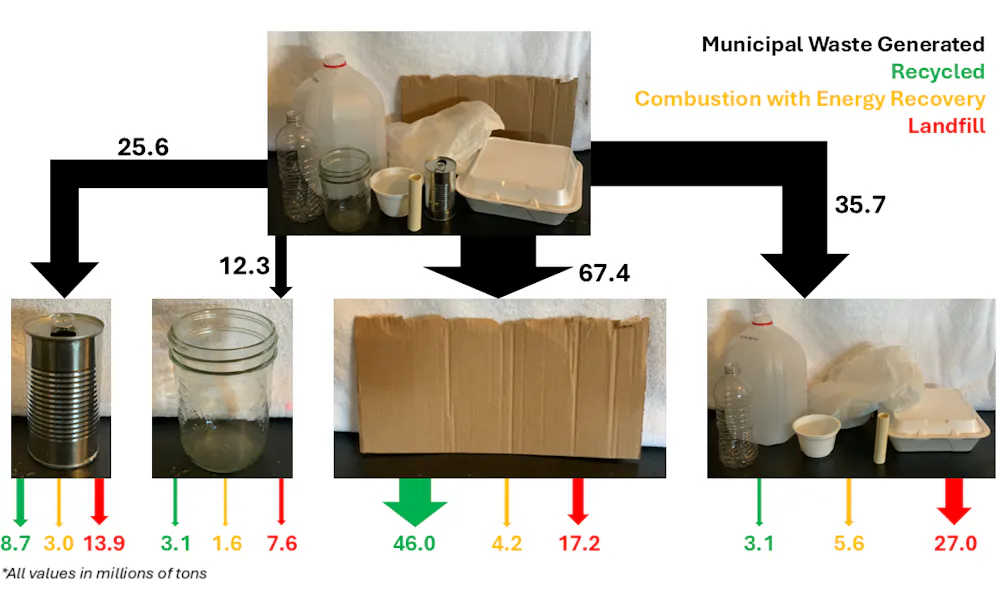
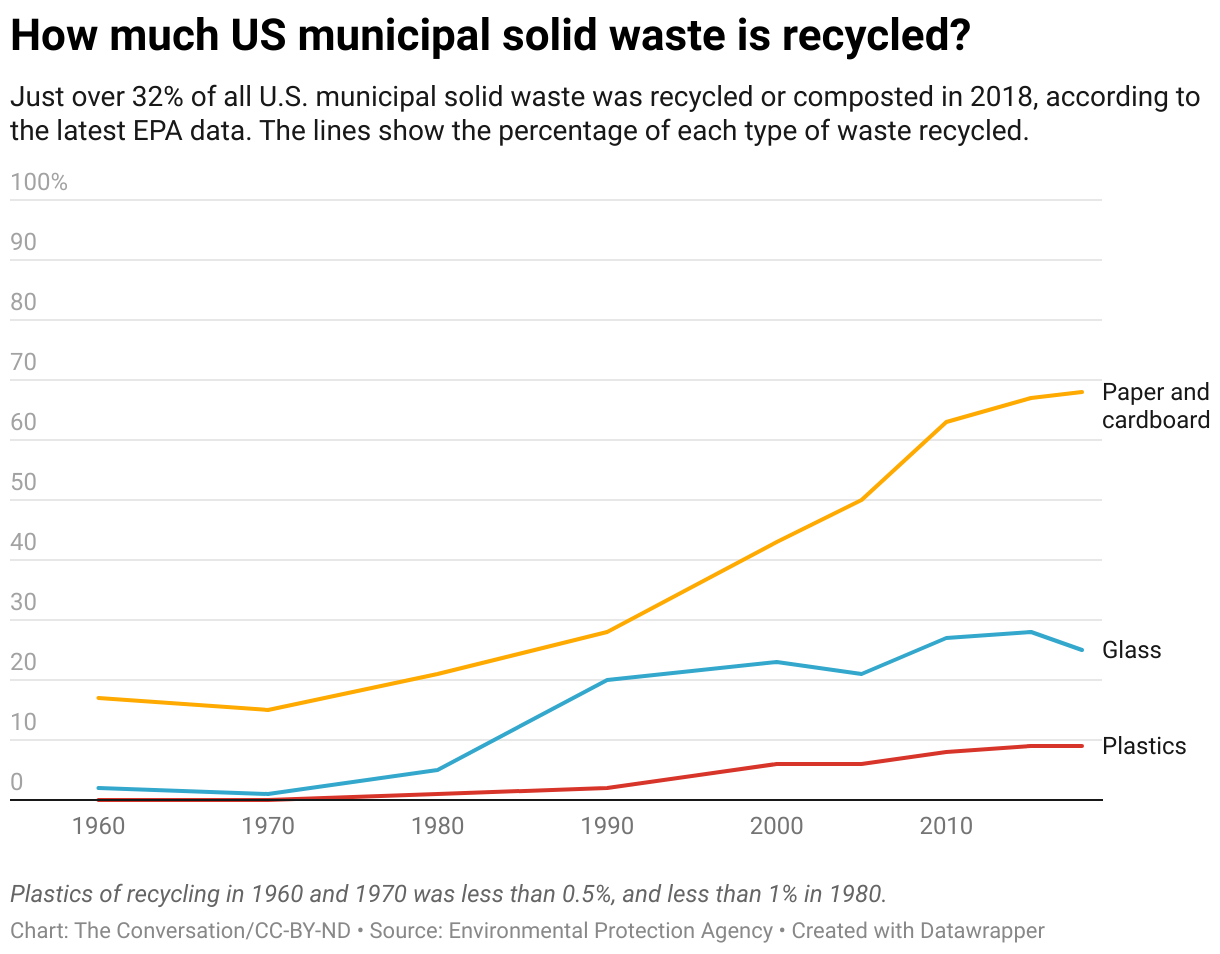
Plastics are among the biggest challenges. Only about 9% of the plastic generated in the U.S. actually gets recycled, according to the Environmental Protection Agency. Some plastic is incinerated to produce energy, but most of the rest ends up in landfills instead.

Photos and arrows show how much of each type of product is recycled.
A breakdown of U.S. recycling by millions of tons shows about two-thirds of all paper and cardboard gets a second life, but only about a third of metal, a quarter of glass and less than 10% of plastics do. Alex Jordan/University of Wisconsin-Stout

So, what makes plastic recycling so difficult? As an engineer whose work focuses on reprocessing plastics, I have been exploring potential solutions.

How does single-stream recycling work?

In cities that use single-stream recycling, consumers put all of their recyclable materials − paper, cardboard, plastic, glass and metal − into a single bin. Once collected, the mixed recyclables are taken to a materials recovery facility, where they are sorted.

First, the mixed recyclables are shredded and crushed into smaller fragments, enabling more effective separation. The mixed fragments pass over rotating screens that remove cardboard and paper, allowing heavier materials, including plastics, metals and glass, to continue along the sorting line.

The basics of a single-stream recycling system in Pennsylvania. Source: Van Dyk Recycling Solutions.

Magnets are used to pick out ferrous metals, such as steel. A magnetic field that produces an electrical current with eddies sends nonferrous metals, such as aluminum, into a separate stream, leaving behind plastics and glass.

The glass fragments are removed from the remaining mix using gravity or vibrating screens.

That leaves plastics as the primary remaining material.

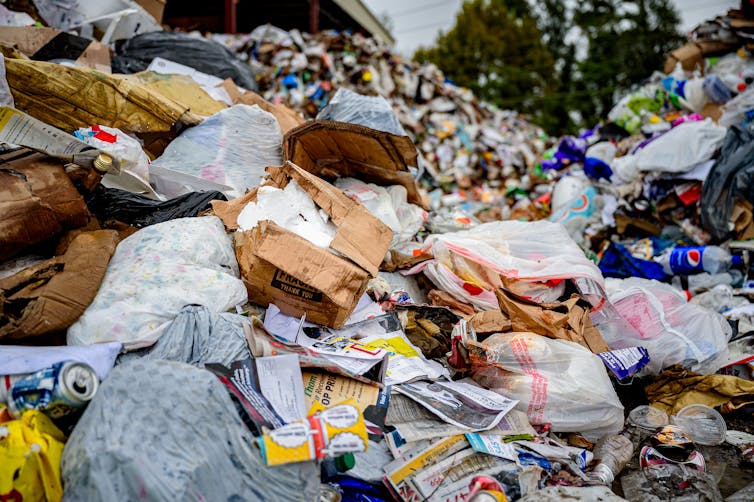
While single-stream recycling is convenient, it has downsides. Contamination, such as food residue, plastic bags and items that can’t be recycled, can degrade the quality of the remaining material, making it more difficult to reuse. That lowers its value.

Having to remove that contamination raises processing costs and can force recovery centers to reject entire batches.

A mound of items send for recycling includes a lot of plastic bags.
Plastic bags, food residue and items that can’t be recycled can contaminate a recycling stream. City of Greenville, N.C./Flickr

Which plastics typically can’t be recycled?

Each recycling program has rules for which items it will and won’t take. You can check which items can and cannot be recycled for your specific program on your municipal page. Often, that means checking the recycling code stamped on the plastic next to the recycling icon.

These are the toughest plastics to recycle and most likely to be excluded in your local recycling program:

  • Symbol 3 – Polyvinyl chloride, or PVC, found in pipes, shower curtains and some food packaging. It may contain harmful additives such as phthalates and heavy metals. PVC also degrades easily, and melting can release toxic fumes during recycling, contaminating other materials and making it unsafe to process in standard recycling facilities.
  • Symbol 4 – Low-density polyethylene, or LDPE, is often used in plastic bags and shrink-wrap. Because it’s flexible and lightweight, it’s prone to getting tangled in sorting machinery at recycling plants.
  • Symbol 6 – Polystyrene, often used in foam cups, takeout containers and packing peanuts. Because it’s lightweight and brittle, it’s difficult to collect and process and easily contaminates recycling streams.

Which plastics to include

That leaves three plastics that can be recycled in many facilities:

However, these aren’t accepted in some facilities for reasons I’ll explain.

Taking apart plastics, bead by bead

Some plastics can be chemically recycled or ground up for reprocessing, but not all plastics play well together.

Simple separation methods, such as placing ground-up plastics in water, can easily remove your soda bottle plastic (PET) from the mixture. The ground-up PET sinks in water due to the plastic’s density. However, HDPE, used in milk jugs, and PP, found in yogurt cups, both float, and they can’t be recycled together. So, more advanced and expensive technology, such as infrared spectroscopy, is often required to separate those two materials.

Once separated, the plastic from your soda bottle can be chemically recycled through a process called solvolysis.

It works like this: Plastic materials are formed from polymers. A polymer is a molecule with many repeating units, called monomers. Picture a pearl necklace. The individual pearls are the repeating monomer units. The string that runs through the pearls is the chemical bond that joins the monomer units together. The entire necklace can then be thought of as a single molecule.

During solvolysis, chemists break down that necklace by cutting the string holding the pearls together until they are individual pearls. Then, they string those pearls together again to create new necklaces.

Other chemical recycling methods, such as pyrolysis and gasification, have drawn environmental and health concerns because the plastic is heated, which can release toxic fumes. But chemical recycling also holds the potential to reduce both plastic waste and the need for new plastics, while generating energy.

The problem of yogurt cups and milk jugs

The other two common types of recycled plastics − items such as yogurt cups (PP) and milk jugs (HDPE) − are like oil and water: Each can be recycled through reprocessing, but they don’t mix.

If polyethylene and polypropylene aren’t completely separated during recycling, the resulting mix can be brittle and generally unusable for creating new products.

Chemists are working on solutions that could increase the quality of recycled plastics through mechanical reprocessing, typically done at separate facilities.

One promising mechanical method for recycling mixed plastics is to incorporate a chemical called a compatibilizer. Compatibilizers contain the chemical structure of multiple different polymers in the same molecule. It’s like how lecithin, commonly found in egg yolks, can help mix oil and water to make mayonnaise − part of the lecithin molecule is in the oil phase and part is in the water phase.

In the case of yogurt cups and milk jugs, recently developed block copolymers are able to produce recycled plastic materials with the flexibility of polyethylene and the strength of polypropylene.

Improving recycling

Research like this can make recycled materials more versatile and valuable and move products closer to a goal of a circular economy without waste.

However, improving recycling also requires better recycling habits.

You can help the recycling process by taking a few minutes to wash off food waste, avoiding putting plastic bags in your recycling bin and, importantly, paying attention to what can and cannot be recycled in your area.

Alex Jordan, Associate Professor of Plastics Engineering, University of Wisconsin-Stout

This article is republished from The Conversation under a Creative Commons license. Read the original article.

ooOOoo

Can we all learn to be better at recycling in the face of so much world ‘news’!

Improving equality

An extremely powerful new essay from George Monbiot.

While this post from G. Monbiot is about politics, I think it goes far beyond that. Hence my reason for republishing this essay, with George Monbiot’s permission. When I will die is not known but surely I will in the next ten years or so. I really want to leave this world seeing everything improving, from the lessening of the change in our climate, to a reduction in world fighting, to a greater equality for all.

Please, please be wrong, Mr. Monbiot.

ooOOoo

The Urge to Destroy

Posted on14th April 2025

It’s a cast-iron relationship: the more unequal a society becomes, the better the far right does. Here’s why. 

By George Monbiot, published in the Guardian  13th April 2025

“He’s really gone and done it this time. Now everyone can see what a disaster he is.” How many times have we heard this about Donald Trump? And how many times has it been proved wrong? Well, maybe this time he really has overstepped. After all, his clowning around with tariffs, sparking trade wars, then suddenly reversing his position, could provoke a global recession, perhaps even a depression. Surely his supporters will disown him? But I’m not banking on it, and this is why.

Already, Trump has waged war on everything that builds prosperity and wellbeing: democracy, healthy ecosystems, education, healthcare, science, the arts. Yet, amid the wreckage, and despite some slippage, his approval ratings still hold between 43 and 48%: far higher than those of many other leaders. Why? I believe part of the answer lies in a fundamental aspect of our humanity: the urge to destroy that from which you feel excluded.

This urge, I think, is crucial to understanding politics. Yet hardly anyone seems to recognise it. Hardly anyone, that is, except the far right, who see it all too well.

In many parts of the world, and the US in particular, inequality has risen sharply since the late 1970s. (The UK tracks this trend.) The world’s billionaires became $2tn richer last year, while the number of people living below the global poverty line is more or less unchanged since 1990.

There is strong evidence of a causal association between growing inequality and the rise of populist authoritarian movements. A paper in the Journal of European Public Policy found that a one-unit rise in the Gini coefficient (a standard measure of inequality) increases support for demagogues by 1%.

Why might this be? There are various, related explanations: feelings of marginalisationstatus anxiety and social threat, insecurity triggering an authoritarian reflex and a loss of trust in other social groups. At the root of some of these explanations, I feel, is something deeply embedded in the human psyche: if you can’t get even, get mean.

In the US, a high proportion of the population is excluded from many of the benefits I’ve listed. Science might lead to medical breakthroughs, but not, perhaps, for people who can’t afford health insurance. A university education might open doors, but only if you’re prepared to carry tens or hundreds of thousands of dollars of debt. Art and theatre and music improve our lives: good for those who can buy the tickets. So do national parks, but only if you can afford to visit them.

Democracy, we are told, allows people a voice in politics. But only, it seems, if they have a few million to give to a political party. As the political scientist Prof Martin Gilens notes in his book Affluence and Influence: “Under most circumstances, the preferences of the vast majority of Americans appear to have essentially no impact on which policies the government does or doesn’t adopt.” GDP growth was strong under Joe Biden, but as the economics professor Jason Furman points out: “From 2019 to 2023, inflation-adjusted household income fell, and the poverty rate rose.” GDP and social improvement are no longer connected.

All those good things? Sorry, they’re not for you. If you feel an urge to tear it all down, to burn the whole stinking, hypocritical, exclusive system to the ground, Trump is your man. Or so he claims. In reality his entire performance is both a distraction from and an accelerant of spiralling inequality. He can hardly lose: the more he exacerbates inequality, the more he triggers an urge for revenge against his scapegoats: immigrants, trans people, scientists, teachers, China.

But such killer clowns can’t pull this off by themselves. Their most effective recruiters are centrist parties paralysed in the face of economic power. In hock to rich funders, terrified of the billionaire media, for decades they have been unable even to name the problem, let alone address it. Hence the spectacular uselessness of the Democrats’ response to Trump. As the US journalist Hamilton Nolan remarks: “One party is out to kill, and the other is waiting for its leaders to die.”

In the UK, Labour, like the Democrats, has long assured itself that it doesn’t matter how wide economic disparities are, as long as the poorest are raised up. Now it has abandoned even that caveat: we can cut benefits, so long as GDP grows. But it does matter. It matters very much. A vast array of evidence, brought together in 2009 in The Spirit Level by Richard Wilkinson and Kate Pickett and updated in 2024, shows that inequality exerts a massive influence on social, economic, environmental and political outcomes, regardless of people’s absolute positions.

If there is a such a thing as Starmerism, it collapses in the face of a paper published by the political scientists Leonardo Baccini and Thomas Sattler last year, which finds that austerity increases support for the radical right in economically vulnerable regions. (My emboldening. PH) Austerity, they found, is the key variable: without it, less-educated people are no more likely to vote for rightwing demagogues than highly educated people are. In other words, Keir Starmer and Rachel Reeves are busily handing their core constituencies to Nigel Farage.

Of course, they deny they’re imposing austerity, using a technical definition that means nothing to those on the sharp end. Austerity is what the poor experience, while they must watch the rich and upper middle classes, under a Labour government, enjoy ever greater abundance.

Starmer and his minions suggest there’s nothing they can do: wealthy people are already taxed to the max. As private jets and helicopters cross the skies, anyone can see this is nonsense. Of all the remarkable things I stumbled across while researching this column, the following is perhaps the most jaw-dropping. On the most recent (2022) figures, once benefits have been paid, the Gini coefficient for gross income in the UK scarcely differs from the Gini coefficient for post-tax income. In other words, the gap between the rich and the poor is rougly the same after taxes are levied, suggesting that taxation has no further significant effect on income distribution. How could this possibly be true, when the rich pay higher rates of income tax? It’s because the poor surrender a much higher proportion of their income in sales taxes, such as VAT. So much for no further options. So much for Labour “realism”.

The one thing that can stop the rise of the far right is the one thing mainstream parties are currently not prepared to deliver: greater equality. The rich should be taxed more, and the revenue used to improve the lives of the poor. However frantically centrist parties avoid the issue, there is no other way.

www.monbiot.com

ooOOoo

George writes about Britain but my judgement is that this issue is not limited to that country; I suspect it is a far wider problem. Did you know that Finland is the world’s happiest country?

An extract of that article: “Finland has been ranked as the world’s happiest country for the eighth successive year, with experts citing access to nature and a strong welfare system as factors.

It came ahead of three other Nordic countries in this year’s UN-sponsored World Happiness Report, while Latin America’s Costa Rica and Mexico entered the top 10 for the first time.

Both the UK and the US slipped down the list to 23rd and 24th respectively – the lowest-ever position for the latter.”

A goodbye to Cleo

Cleo was put to sleep yesterday afternoon.

Cleo’s rear legs were really troubling her so we went with her to Lincoln Road Vet yesterday at 1:45pm.

Around 2pm the doctor injected Cleo with firstly a deep sleep injection then after Cleo was asleep then the final injection.

Cleo was thirteen and the staff at Lincoln Road remarked that was a grand age for a German Shepherd.

oooo

oooo

oooo

oooo

Goodbye sweet girl! You will be missed!

Venus and Valentine’s Day

The role of the planet today!

From that post: Venus, named for the Roman goddess of love, reaches its greatest brilliancy on Valentine’s Day, February 14. Venus is currently blazing, low in the west after sunset, with Saturn below.

Wherever you are, try spotting Venus.

Nutrition advice

An article on educating us on avoiding misinformation.

Many articles on nutrition are full of errors and for the lay person there’s no easy way to understand what is correct, or not.

That’s why a recent article appealed to me and I thought it worth sharing.

ooOOoo

Nutrition advice is rife with misinformation − a medical education specialist explains how to tell valid health information from pseudoscience

If a health claim about a dietary intervention sounds too good to be true, it probably is. Mizina/iStock via Getty Images Plus

Aimee Pugh Bernard, University of Colorado Anschutz Medical Campus

The COVID-19 pandemic illuminated a vast landscape of misinformation about many topics, science and health chief among them.

Since then, information overload continues unabated, and many people are rightfully confused by an onslaught of conflicting health information. Even expert advice is often contradictory.

On top of that, people sometimes deliberately distort research findings to promote a certain agenda. For example, trisodium phosphate is a common food additive in cakes and cookies that is used to improve texture and prevent spoilage, but wellness influencers exploit the fact that a similarly named substance is used in paint and cleaning products to suggest it’s dangerous to your health.

Such claims can proliferate quickly, creating widespread misconceptions and undermining trust in legitimate scientific research and medical advice. Social media’s rise as a news and information source further fuels the spread of pseudoscientific views.

Misinformation is rampant in the realm of health and nutrition. Findings from nutrition research is rarely clear-cut because diet is just one of many behaviors and lifestyle factors affecting health, but the simplicity of using food and supplements as a cure-all is especially seductive.

I am an assistant professor specializing in medical education and science communication. I also train scientists and future health care professionals how to communicate their science to the general public.

In my view, countering the voices of social media influencers and health activists promoting pseudoscientific health claims requires leaning into the science of disease prevention. Extensive research has produced a body of evidence-based practices and public health measures that have consistently been shown to improve the health of millions of people around the world. Evaluating popular health claims against the yardstick of this work can help distinguish which ones are based on sound science.

A white person's hands holding a smartphone with screen showing a health app, next to a cup of coffee.
To parse pseudoscientific claims from sound advice about health and nutrition, it’s crucial to evaluate the information’s source. tadamichi/Getty Images

Navigating the terrain of tangled information

Conflicting information can be found on just about everything we eat and drink.

That’s because a food or beverage is rarely just good or bad. Instead, its health effects can depend on everything from the quantity a person consumes to their genetic makeup. Hundreds of scientific studies describe coffee’s health benefits and, on the flip side, its health risks. A bird’s-eye view can point in one direction or another, but news articles and social media posts often make claims based on a single study.

Things can get even more confusing with dietary supplements because people who promote them often make big claims about their health benefits. Take apple cider vinegar, for example – or ACV, if you’re in the know.

Apple cider vinegar has been touted as an all-natural remedy for a variety of ailments, including digestive issues, urinary health and weight management. Indeed, some studies have shown that it might help lower cholesterol, in addition to having other health benefits, but overall those studies have small sample sizes and are inconclusive.

Advocates of this substance often claim that one particular component of it – the cloudy sediment at the bottom of the bottle termed “the mother” – is especially beneficial because of the bacteria and yeast it contains. But there is no research that backs the claim that it offers any health benefits.

One good rule of thumb is that health hacks that promise quick fixes are almost always too good to be true. And even when supplements do offer some health benefits under specific circumstances, it’s important to remember that they are largely exempt from Food and Drug Administration regulations. That means the ingredients on their labels might contain more or less of the ingredients promised or other ingredients not listed, which can potentially cause harms such as liver toxicity.

It’s also important to keep in mind that the global dietary supplements industry is worth more than US$150 billion per year, so companies – and wellness influencers – selling supplements have a financial stake in convincing the public of their value.

Misinformation about nutrition is nothing new, but that doesn’t make it any less confusing.

How nutrition science gets twisted

There’s no doubt that good nutrition is fundamental for your health. Studies consistently show that a balanced diet containing a variety of essential nutrients can help prevent chronic diseases and promote overall well-being.

For instance, minerals such as calcium and iron support bone health and oxygen circulation in the blood, respectively. Proteins are essential for muscle repair and growth, and healthy fats, like those found in avocados and nuts, are vital for brain health.

However, pseudoscientific claims often twist such basic facts to promote the idea that specific diets or supplements can prevent or treat illness. For example, vitamin C is known to play a role in supporting the immune system and can help reduce the duration and severity of colds.

But despite assertions to the contrary, consuming large quantities of vitamin C does not prevent colds. In fact, the body needs only a certain amount of vitamin C to function properly, and any excess is simply excreted.

Companies sometimes claim their supplement is “scientifically proven” to cure illness or boost brain function, with no credible research to back it up.

Some companies overstate the benefits while underplaying the hazards.

For example, wellness influencers have promoted raw milk over pasteurized milk as a more natural and nutritious choice, but consuming it is risky. Unpasteurized milk can contain harmful bacteria that leads to gastrointestinal illness and, in some cases, much more serious and potentially life-threatening diseases such as avian influenza, or bird flu.

Such dietary myths aren’t harmless. Reliance on nutrition alone can lead to neglecting other critical aspects of health, such as regular medical checkups and lifesaving vaccinations.

The lure of dietary myths has led people with cancer to replace proven science-backed treatments, such as chemotherapy or radiation, with unproven and misleading nutrition programs.

How to spot less-than-solid science

Pseudoscience exploits your insecurities and emotions, taking advantage of your desire to live the healthiest life possible.

While the world around you may be uncertain and out of your control, you want to believe that at the very least, you have control over your own health. This is where the wellness industry steps in.

What makes pseudoscientific claims so confusing is that they use just enough scientific jargon to sound believable. Supplements or powders that claim to “boost immunity” often list ingredients such as adaptogens and superfoods. While these words sound real and convincing, they actually don’t mean anything in science. They are terms created by the wellness industry to sell products.

I’ve researched and written about reliable ways to distinguish science facts from false health claims. To stay alert and find credible information, I’d suggest you follow a few key steps.

First, check your emotions – strong emotional reactions, such as fear and anger, can be a red flag.

Next, check that the author has experience or expertise in the field of the topic. If they’re not an expert, they might not know what they are talking about. It’s always a good idea to make sure the source is reputable – ask yourself, would this source be trusted by scientists?

Finally, search for references that back up the information. If very little or nothing else exists in the science world to back up the claims, you may want to put your trust in a different source.

Following these steps will separate the facts from fake news and empower you to make evidence-based decisions.

Aimee Pugh Bernard, Assistant Professor of Immunology and Microbiology, University of Colorado Anschutz Medical Campus

This article is republished from The Conversation under a Creative Commons license. Read the original article.

ooOOoo

Sound advice for the majority of us!