Category: Communication

Radio Caroline

A real blast from the past!

Recently we rented the film, Pirate Radio, a somewhat ‘true’ story about the days of broadcasting rock and roll from a ship moored just outside British waters.  Here’s the official trailer of the film (somewhat glitzy as is the manner of Hollywood):

Anyone of my sort of vintage living in England during the 1960s will recall the fun and excitement of Radio Caroline, the name of the radio station that started up in 1964.

Here’s a good extract from the WikiPedia entry:

Radio Caroline is an English radio station founded in 1964 by Ronan O’Rahilly, to circumvent the tight hold the record companies had on the broadcast of popular music in the UK. It originally commenced transmissions as an offshore radio station broadcasting from a ship anchored in international waters off the coast of South East England. Originally unlicensed by any government, for the majority of its early life, it was labelled as a pirate radio station.

Radio Caroline

Amazingly, at its peak Radio Caroline had an audience of 23 million listeners.  In a very real way Radio Caroline was another symbol of what became known as the Swinging Sixties, a transformation period for post-war Britain.

Tony Blackburn was just one of many famous disk jockeys who started life out on Radio Caroline, with Tony being the first presenter of the BBC’s Radio 1 station, broadcasting popular music, when it came on air on the 30th September, 1967.

Tony Blackburn, some while ago!

Anyway, if you are nostalgic towards the ‘good’ old days of the sixties, do watch the film.

By Paul Handover

The aroma of British politics!

Such a shame that British electioneering couldn’t be honest.

Well, the British General Election Campaign meanders along towards the final week before we are put out of our misery on May 6th.

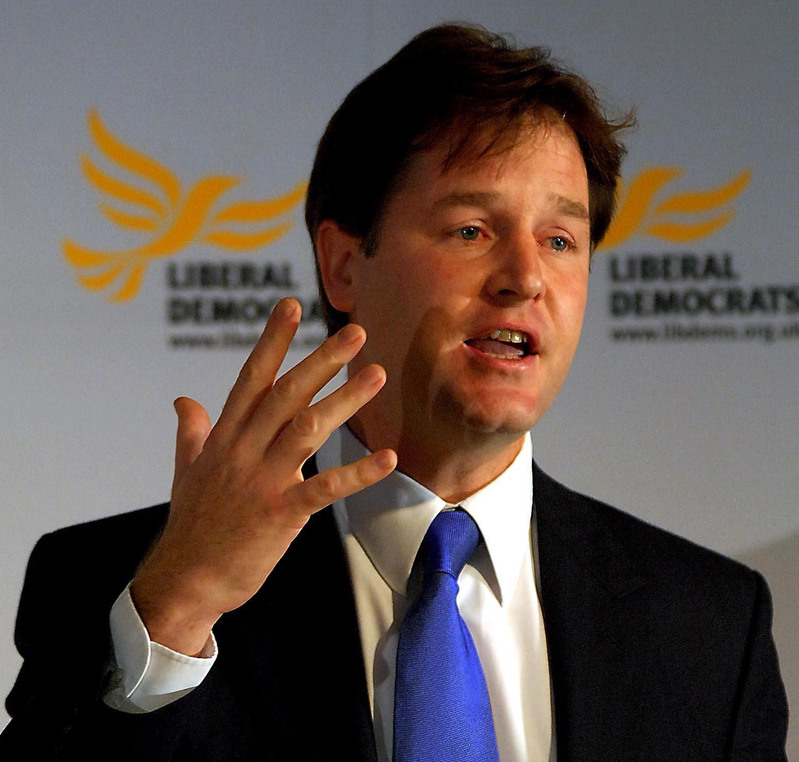
Sadly, the main topic of interest has been the success of Nick Clegg in the Leaders’ TV debates. The new young face on

Nick Clegg

the block has proved once and for all the huge power of television. Not one single Lib-Dem policy or personnel changed during the debate, yet the mere appearance on the telly of a new, personable kid on the block has rocketed his party up the ratings.

Well, not exactly rocket science, but sobering all the same. However, more importantly, most policy discussion seems mired in a series of scare-mongering ploys along the lines of, “Don’t vote for that lot or this terrible thing will happen.”

Yes, perhaps this is the stuff of all elections, but this one should have been a bit different since

A) it comes after a long period of power held by the Labour Party and whichever way it goes will mark a historic change and,

B) the stakes are so high as Britain hovers on the edge of joining the economically-challenged PIIGS [Portugal, Italy, Ireland, Greece, Spain, Ed.] of Europe.

We desperately need a government that can take us safely away from that particular event horizon, but to choose one rationally, we need the “truth” about what really needs to be done to reduce debt.

But sadly, we seem infected by the Greek syndrome, an ability to see the bleedin’ obvious, which is that nobody can live beyond their means for ever, much as they might like to.

So, we’re having to look for “the truth” further afield, to the Institute for Fiscal Studies (IFS), for example. According to them, the cuts in public costs will have to be as deep as any made since World War II. (Oh, and thank you to Labour and the banks for jointly getting us into this sorry mess.)

Here’s a brief quote from that BBC link:

The UK faces the deepest spending cuts since the late 1970s if the three main parties are to meet their budget commitments, new analysis suggests.

The years between 2011 and 2015 must see the largest cuts since 1976-80, according to a report from the Institute for Fiscal Studies (IFS).

Here’s Stephanie Flanders, the BBC’s Economics Editor writing in her blog:

They may disagree in public, but privately they couldn’t agree more. On the single most important issue facing the country after this election, our politicians think it’s better to keep us in the dark.

WHERE is the party explaining this clearly and unambiguously to the people? In other words, TELLING THE TRUTH?

I don’t see it. Neither of the big, old dinosaur parties are being straight with us. The Tories are proposing to spend even MORE on the NHS, (National Health Service) that sacred cow that nobody dare speak any ill of, while Labour seem to be promising to spend more on just about everything despite our £163 billion borrowing this year.

Why is this? It can – I submit – only be because they don’t think the public will understand and accept “the truth”.

If party A tells the truth and admits the cuts in public services will be deep and involve some pain and party B LIES and says it will “preserve frontline services” (the Labour line) then they (Party A) fears the public will not buy their version and opt for whoever promises them a fantasy instead, or in other words a gradual recovery without too much pain and in particular for themselves.

So, there is deep cynicism and an extreme economy with the truth from all parties who fear a voter backlash if they tell it. This is rather a sad reflection on the Labour Party’s proud boast of “education, education, education” of 1997.

Apparently, the British public is so stupid that they can’t be trusted to believe the truth when they get it. Of course, this could possibly be because they are so UNUSED to getting it and moreover because this policy of spinning smoke and mirrors worked so well in previous Labour victories.

Clear as mud!

By Chris Snuggs

Giving Up!

[With this Post, Jon introduces a series of forthcoming articles looking at the inner person and exploring ways in which each of us can enhance our feelings of contentment and happiness. Ed.]

Stop the world, I want to get off!

Starting again requires giving up

Whichever way we look, there appear to be huge problems. Not insurmountable but, metaphorically speaking, sheer vertical cliffs without any easy way up.

One might ponder if the last 50 years, that post-war period of growth and prosperity, have, in reality given society real, sustainable, core improvements or whether all the ‘gains’ have come at such a cost that the net benefit is questionable?

This could be seen as pessimism gone mad. Undoubtedly, there have been some huge gains from a scientific point of view and we now enjoy lives that are greatly enhanced and longer. But not to ask such a fundamental question is to assume the alternative, that everything in the garden is rosy.

Now this may seem a strange introduction to a topic that is going to be deeply personal and private.

But both the private, individual world of the ‘self’ and the great, interconnected world of the planet are indivisible. Every aspect of our lives, our livelihoods, our environment and the future of our children depends on how well, and how sustainably, we manage our personal, local, national and international interests.

For example, if Prof. Lovelock’s theory on the planet being a self-regulating organism is correct, his Gaia theory,  then possibly in the lifetimes of our children, and certainly in the lifetimes of our grandchildren, worrying about a job or repaying the mortgage will be irrelevant. Our descendants will be worrying about their very survival!

I called this piece Giving Up. Why?

Because the only way forward is to give up on the present. I will expand on this theme in future Posts.

The future depends on each of us being happy and contented with ourselves and avoiding looking out there for the magic cure to all our troubles. Being, as far as we are able, at peace with our circumstances and able to do the best, individually, as well as the best for our families, our friends and the larger world in which we work and play.

I have heard people ask the question before, “How can I best help the world?” The only truthful answer is to develop ourselves as individuals. In doing this, the field of consciousness that we are all connected to is also lifted or elevated to a higher level.

At this stage of history, either…the general population will take control of its own destiny and will

Noam Chomsky

concern itself with community interests guided by values of solidarity and sympathy and concern for others or alternately there will be no destiny for anyone to control.

-Noam Chomsky

By Jon Lavin

[Anyone who has been affected by this article and wishes to contact Jon may find his contact details here. Ed.]

Letter from Payson – the language barrier!

America and England are two Nations divided by a common language

The other day I was in Payson’s local Home Depot looking for what I call a torch.  As usual, if one has an air of not knowing where to look, it is only a matter of moments before a sales assistant asks if he or she may help.

The Home Depot - Payson, Az

Me: Excuse me but do you sell rechargeable torches?

Sales Assistant: I don’t think so, Sir, you would be best advised to ask at the Information Desk.

A few moments later, at said Information Desk … Do you stock rechargeable torches?

The young girl types on a keyboard, looks up at the screen and replies … I’m sorry Sir, we don’t stock those.

Surprised, I get on looking for the other items that I need.

About 10 minutes later, halfway down an aisle I notice – guess what – a decent selection of rechargeable torches! Pleased, I make my selection and on the way out to the tills pass by the original sales assistant who came to help me.

Me: You see you do sell rechargeable torches!

Sales Assistant:  Ah, we call them flashlights!

The point of this rather mundane story is to point out that the differences in language between American English and UK English are much more involved than the famous ones such as rubber and condom!

In fact there are so many different terms in the D-I-Y arena that I have stopped asking for items in what, to me, is the

Ace Hardware

obvious name and now tend to describe the problem that I am trying to fix.

Thank goodness, most of the assistants in Home Depot, and the equally efficient Ace Hardware, now see me coming and know that I’m still learning to speak American!

Is there a deeper element to this language difference?

I believe so.  Because the assumption is that you are going to be understood straight off.  If one was in a country where the natural language was other than English then, without doubt, you would know that verbal communication was going to be strained, to say the least.

In America we just take the language for granted. In practice, I suspect that verbal communications are much less effective than one assumes.

Finally, it’s interesting to note that Jean, who was married to an American for 30 years, effortlessly switches to both an American accent and vocabulary as soon as she is talking to the locals.  Will I, too, make the switch over time?

(If you are in need of a rechargeable torch yourself, here is a Home Depot coupon. Good luck!)

By Paul Handover

P.S. The quote that started this article appears to have been originated by George Barnard Shaw and not Winston Churchill as I previously thought.

A Teen’s Reflections

This is the second Guest post from AJ Easton, a 13-year-old girl from North Carolina, USA. AJ first wrote about Learning from Horses on January 17th this year. This is a more reflective essay that would have been a credit to someone with many, many more years.

Trust is a complicated thing…

You have to learn to trust, but it is not something that can be taught in schools. You also have to earn trust, by keeping secrets and not spreading rumors.

With the people you trust, you do things you wouldn’t do with other people . Your true self comes out with the people you trust. You don’t worry about being judged; you don’t worry about people disliking you for who you are.

AJ Easton

But, in our modern-day world, it seems as if everyone judges.

People seem to hate for reasons as stupid as one’s appearance. People don’t trust people anymore because it seems that we are constantly warned to avoid strangers because they might hurt you, murder you, or completely mess up your life in some way, shape, or form.

And in school, if you trust someone enough to tell them a secret, they don’t keep it. And then, in your point of view, the world has ended.

All because of some secret that got out about who you like, or what you did with the person you were dating, or something else that, in the end, isn’t all that important.

Then everyone will judge you based on that rumor until you leave the school or graduate. They do this to make themselves feel “cool” and “important.”  And you learn not to trust.

Social status has become such a big factor in everything we do these days. Everyone feels as though they have to be highly ranked socially to mean anything to the world.

But, truly, all you have to do is love what you do and respect yourself, to follow your dream and be determined. We should make decisions that help us move forward, not dwelling on the past.  Every second is different; everything is unique. Nothing is the same. Not a single person, or tree, or moment.  Each moment represents a new opportunity.

Don’t have regrets. What has happened has already happened and you can’t change it. Time travel is fictitious, not a reality. You can’t rewind your life to change what you have already done. There is a reason behind everything: remember this when you are having doubts about what you have done.  Learn from your past but don’t let it eat at you.

Live your own life. And learn to trust yourself, and those who love you.

By AJ Easton

Alistair Cooke

A tribute to Alistair Cooke of Letter from America

Many, many people of a certain age will remember with very fond affection the weekly BBC Radio broadcasts of Alistair Cooke under the title of Letter from America.

Alistair’s broadcast title, Letter from America, came to mind because I have been thinking for a couple of weeks about what to call my impressions about moving to Payson in Arizona.

Payson Perceptions? Pictures of Payson? Payson Profile?  No!  They all seemed naff!

But would it be too presumptuous to echo Cooke’s hugely famous programme title?  Hopefully not.

(And regular readers will know that yesterday, the first Letter from Payson was published.)

I did a Google search on Alistair Cooke and immediately found the BBC web page devoted to him.  For those that don’t know Cooke here are a few details from WikiPedia.

Born in 1908 in Salford, Lancashire, England, Cooke first started broadcasting for the BBC in 1946 and continued until the 20th February, 2004, a total of 58 years and making Letter from America the longest-running speech radio show in the world.

I hope the BBC will forgive me in reproducing here on Learning from Dogs the obituary that is on the Alistair Cooke website.  He was a wonderfully interesting man and his weekly Letter from America seems to have been part of my complete life (in a sense it was).

——————-

Reading Letter from America in the 1950s

He read his Letter from America for 58 years

Esteemed writer and BBC broadcaster Alistair Cooke, famed for his programme Letter From America, has died aged 95. BBC News Online looks back at his long and respected career.

For more than half a century, Alistair Cooke’s weekly broadcasts of Letter from America for BBC radio monitored the pulse of life in the United States and relayed its strengths and weaknesses to 50 countries.

His retirement from the show earlier this month after 58 years, due to ill health, brought a flood of tributes for his huge contributing to broadcasting.

Born in Salford, near Manchester, northern England, Alistair Cooke’s father was an iron-fitter and Methodist lay-preacher.

Alistair Cooke

Alistair Cooke: Consummate broadcaster

Winning a scholarship to Jesus College, Cambridge he read English, edited the undergraduate magazine, Granta, and founded the Cambridge University Mummers.

Alistair Cooke made his first visit to the United States in 1932, on a Commonwealth Fund Fellowship which took him to both Yale and Harvard universities.

Following his return to Britain, he became the BBC’s film critic and, in 1935, London correspondent for America’s National Broadcasting Corporation.

He returned to the United States in 1937 to work as a commentator on American affairs for the BBC. He made his home there and, in 1941, became an American citizen.

Alistair Cooke

A passion for jazz

March 1946 saw the first edition of American Letter, which became Letter from America in 1949.

The series was the longest-running series in history to be presented by a single person.

Alistair Cooke never decided what he was going to talk about until he wrote the script, made no notes during the preceding week and preferred to rely on his memory.

In an interview given at the time of the 3,000th edition of Letter from America, he appeared to have mixed feelings about the future of the United States.

“In America,” he said, “the race is on between its decadence and its vitality, and it has lots of both.”

Addressing Congress in 1973

He addressed Congress in 1973

Cooke led his listeners through the American vicissitudes of Korea, Kennedy, Vietnam, Watergate, Nixon’s resignation and Clinton’s scandals.

In all of this, Cooke pulled no punches. The lyricism of his broadcasting and the urbanity of his voice did not disguise his fears for America which he saw becoming a more violent society.

A liberal by nature, he reserved particular dislike for what he saw as the shallow flag-waving of the Reagan presidency.

Alongside working for the BBC and The Guardian, for which he wrote from 1945 to 1972, he developed a passion for jazz and golf and, as a film critic, he mixed with Hollywood stars.

As a commentator on history, Cooke was sometimes an eyewitness too. He was just yards away from Senator Bobby Kennedy when the latter was assassinated in 1968.

He was never as comfortable on television as radio but, by the 1970s, his hugely successful television series America recounted his personal history of his adopted homeland and won international acclaim, two Emmy Awards and spawned a million-selling book.

British or American?

The Queen awarded him an honorary knighthood in 1973 and the following year, for a journalist, he received the ultimate recognition – he was asked to address the United States Congress on its 200th anniversary.

He told his audience he felt as if he was in a dream, standing naked before them and there was only one thing he could find to say.

Teasing, he exclaimed to the assembled legislators, “I gratefully accept your nomination for President of the United States!”

Naturally, he brought the house down.

Many Britons thought he was American, but to the Americans he was the quintessential Brit, the man who brought them the best of British television as presenter of Masterpiece Theatre. For his part, he explained, “I feel totally at home in both countries.”

He impressed both audiences with his high quality work. With his unquenchable curiosity, Alistair Cooke remained for decades the consummate broadcaster, an elegant writer and a man of enormous wit and charm who made sense of the American Century.

By Paul Handover (still missing Letter from America on the radio.)

Let’s stop messing with the clocks!

Crazy, outdated concept – adjusting clocks twice a year!

The whole concept of adjusting the clocks with the seasons, “Daylight Saving” as the Americans call it, seems increasingly ludicrous the more that one thinks about it. In the UK, it is called British Summer Time and is abbreviated to BST; I call it British Silly Time.

The expensive consequences for computer systems, airlines, railways and many other systems and organisations having to mess about with times and schedules are completely unnecessary. And I have lost count of the number of times I have heard of people missing calls or online meetings due to misinterpretations of time zones and distortions in the name of “daylight saving”.

One would have thought that people who spend the most time involved with nature would find it the most ludicrous and that among those would be farmers. However, it seems that this is not the case as there is a discussion about introducing permanent BST or even “double BST” on the UK National Farmers Union (NFU) website.

The news article is titled “Should we change the clocks?”. My answer is a simple “no”. In case the answer is unclear, I mean “no”! That is “do not change the clocks”! That is “leave the clocks alone”! That is “stop messing with the clocks”! In the UK that means “leave the clocks on GMT, the correct time”!

Does no one else understand this? Well, thankfully, many people do. For example, the whole of the aviation industry uses Zulu time (UTC) worldwide. Let’s be clear what that means. When pilots get a weather reports from any airport in the world (whether it is Heathrow or Los Angeles airport), the times are in Zulu time which is UTC/GMT. Yes everyone uses UTC.

The really funny part is that the NFU news article even states “analysts have claimed an extra hour’s daylight could be worth £3.5 billion a year to the economy”. This is the ultimate fallacy.

Let us be clear about something, in case you had not noticed: THERE IS NO EXTRA DAYLIGHT!! Where, on earth, did farmers get the idea that there is?!

Chris Madden cartoon

By John Lewis

20 years of the WWW

And a neat idea from the BBC

BBC Broadcasting House, Portland Place, London

For those living outside the UK (well so far as our IP address is concerned) watching BBC television via the Web has always been a bit of a challenge.  Presumably because of the way that the BBC is funded, a Licence Fee (aka tax!) on those UK householders that wish to watch public broadcasted television, it is deemed ‘unfair’ if those outside the UK, who do not pay this Fee, have unfettered access to the Beeb’s programming.  Thus if one attempts to access the BBC online from outside the UK you are met with the following message:

Currently BBC iPlayer TV programmes are available to play in the UK only, but all BBC iPlayer Radio programmes are available to you. Why?

However, the BBC have made a wonderful exception with regard to a series of programmes under the title of The Virtual Revolution. All about 20 years of the World Wide Web.

Most of, if not all, the key players of this last 20 years have been interviewed and the uncut footage of these interviews is here.  Fascinating viewing.

And if you fancy making your own documentary using this material, under a unique BBC permissive licence, then here’s where to start.

Well done, the Beeb!

By Paul Handover

Perkins and “The Daily Mail”

Whitehall Ministry

Transcripts from our bug in the Ministry of Misinformation, Whitehall, London

Morning, Perkins! … Good grief, man! What’s that under your arm?

It’s today’s “Daily Mail“, Sir.

“Daily Mail”! What on earth are you doing with that?

Well, I thought I’d check it out, Sir.

Check it out?

Yes Sir. People have been attacking it.

Attacking it?

You keep repeating me, Sir …

I’m just stunned Perkins! Why on earth would anyone sane want to “check it out”?

Well, I’ve always been suspicious of situations where the establishment and so-called cognoscenti collectively attack something, Sir.

Why on earth is that, Perkins?

Well, they could have an ulterior motive, Sir.

Ulterior motive?”

You’re doing it again, Sir.

Look Perkins, the Mail is a ghastly, sensationalist rag.

When did you last read it, Sir?

Goodness me, Perkins. I have better things to do with my time.

How can you be sure then that you’re not just baying the mindless mantra of your peers?

Look Perkins. I don’t read the Mail because it appeals to the mob and has no analysis.

But “the mob” are the mass of the people, Sir.

Exactly, Perkins. Now you’re on the right track.

So you don’t believe in democracy, Sir?

Don’t ask silly questions, Perkins. Of course I do, just as long as the people don’t get their hands on government. But seriously, the Mail has little analysis; just a crude statement of facts.

But why are you so attached to “analysis”, Sir? Surely it’s the facts that are most important?

Well if you don’t have analysis then how do you know what’s really going on? You need analysis to explain the headlines.

But surely any analysis depends on the spin of the author? Why can’t people be given the facts and allowed to make up their own minds?

“Make up their own minds?” Be serious, Perkins. The mob hasn’t got a mind to make up; that’s why it’s called “the mob”.

I think you’ll find it was the mob that fought and died in two World Wars to protect freedom and democracy in Britain, Sir.

Aha! That proves my point! You don’t need to understand much to pop your head over the top and get it shot off, do you! The mob is ideally suited to it.

But “analysis” is overrated, Sir. People should be encouraged to think for themselves.

“Think for themselves!” Now Perkins, those who went to public school can be expected to think for themselves, but as for the rest …

I’m sorry, Sir; there is in fact too much analysis. I was put off at school at an early age. No sooner had we opened a Shakespeare play than we had FR Leavis shoved down our throats telling us what to think about it rather than being allowed to interpret and analyze it ourselves.

I’m sorry your education seems to have gone so seriously wrong, Perkins. Did you in fact go to a public school?

Only a poor man’s one, Sir …. but analysis in the press just seems to me a clever way of trying to tell people what they should think. I believe Goebbels was very good at analysis, and of course Tony Blair …

Now Perkins, analysis is all that differentiates us from unthinking morons who cannot understand the law.

You mean British MPs and their expense accounts, Sir?

No … errm …. perhaps I should rephrase that … but really Perkins, this “Defend the Mail” crusade is really a bit OTT, isn’t it?

Perhaps, Sir, but it’s because it is so heavily attacked by verbal diarrhoearists who support totalitarianism. My principle is that your enemy’s enemy is your friend, so to speak. If someone who supports dictatorship attacks it at every chance then it can’t be all bad, sort of thing.

I’m sorry, Perkins. I don’t think I will ever be able to follow the tortured meanderings of your mind.

I think that’s because deep down I identify with “the mob”, Sir, or as I prefer to call them; “the people” ……..

Hmm …… if I were you Perkins I wouldn’t go trumpeting that too loudly round Whitehall. It could put an end to a promising career.

By Chris Snuggs

Even more Tim Berners-Lee

The powerful spread of open data.

Sir 'Tim' Berners-Lee

Tim Berners-Lee was, or is, the father of the Internet, that remarkable network that has done to connect millions together.  Indeed, my personal view is that the Internet may be the only real tool that people have to protect and defend democracy.

I’m sure thousands know the background of Sir Timothy John “Tim” Berners-Lee, to give him his full name, an Englishman living in the USA.

There was an introduction to the the way that Sir Tim wants to see the web move in yesterday’s Post.

But Tim recently (February 2010) gave a talk in Long Beach, California, entitled The year open data went worldwide. This takes the concept much further.

It’s a fascinating presentation.

By Paul Handover