Category: Communication

Happiness = Ten minus five or thereabouts!

Brilliant mathematics without the need for a calculator!

Thanks to the bottomless resources of the Internet, I could quickly find a relevant quote or two to open up today’s Post.  Rene Descartes (1596-1650) was reputed to have said, “Perfect numbers like perfect men are very rare.

Sorry, couldn’t resist that!  It wasn’t the quote relevant to this essay but it was too good to miss.  (Descartes was also the person who coined the phrase: I think therefore I am!)

 The quote that I thought was relevant was this one from Descartes, “With me everything turns into mathematics.”  Well until I read something recently on the Big Think website I would have been certain that the emotions, such as happiness, were well beyond reach of the logical power of mathematics.  I was wrong!

Big Think recently reported on a new book from Mr. Chip Conley called Emotional Equations where he …….,

….. argues (against Einstein, as it happens), that everything that counts can and ought to be counted. A hotelier by trade, he says that GDP and the bottom line are blunt instruments for measuring the health of a society or a business. After the dot.com crash of 2001, and a visit to the Buddhist nation of Bhutan, which has a “Gross National Happiness” index, Conley and his team decided to create indices for measuring the well-being of their employees and customers.

And a paragraph later continues,

In Emotional Equations, Conley takes the mathematics of human happiness a step further, creating simple formulas like anxiety = uncertainty x powerlessness, which, when used systematically, he says, can give individuals and organizations a concrete method for addressing the human needs that drive them.

The description of the book on the Amazon website is thus,

Mr Chip Conley

Using brilliantly simple math that illuminates universal emotional truths, Emotional Equations crystallizes some of life’s toughest challenges into manageable facets that readers can see clearly—and bits they can control. Popular motivational speaker and bestselling author Chip Conley has created an exciting, new, immediately accessible visual lexicon for mastering the age of uncertainty. Making mathematics out of emotions may seem a counterintuitive idea, but it’s an inspiring and incredibly effective one in Chip Conley’s hands. When Conley, dynamic author of the bestselling Peak, suffered a series of tragedies, he began using what he came to call “Emotional Equations” (like Joy = Love – Fear) to help him focus on the variables in life that he could deal with, rather than ruminating on the unchangeable constants he couldn’t, like the bad economy, death, and taxes. Now this award-winning entrepreneur shares his amazing new self-help paradigm with the rest of us. Emotional Equations offers an immediately understandable means of identifying the elements in our lives that we can change, those we can’t, and how they interact to create the emotions that define us and can help or hurt our progress through life. Equations like “Despair = Suffering – Meaning” and “Happiness = Wanting What You Have/Having What You Want” (Which Chip presented at the prestigious TED conference) have been reviewed for mathematical and psychological accuracy by experts. Conley shows how to solve them through life examples and stories of inspiring people and role models who have worked them through in their own lives. In these turbulent times, when so many are trying to become “superhuman” to deal with our own and the world’s problems, Emotional Equations arms readers with effective formulas for becoming super human beings.

So it all seems not quite so daft as one might initially guess.  Indeed, settle down for twenty minutes and watch Chip eloquently explain his ideas captured at that TED Conference referred to above.

There’s also an audio conversation with Mr. Conley that you can download free from here.

Finally, let me close with yet another quote from Rene Descartes, “It is not enough to have a good mind. The main thing is to use it well.” Amen to that!

Having the dog of a day!

Maybe there’s a new twist to that rather derogatory phrase!

For the life of me, I can’t remember how this story came to my ‘in-box’ but most likely it was from my Big Think subscription.  But I do know that the story has spread like wild-fire (poor choice of simile for Arizona!) and not without good reason.

Here’s how it was promoted on Science Daily,

Benefits of Taking Your Dog to Work May Not Be Far-Fetched

Man’s best friend may make a positive difference in the workplace by reducing stress and making the job more satisfying for other employees, according to a Virginia Commonwealth University study.

Stress is a major contributor to employee absenteeism, morale and burnout and results in significant loss of productivity and resources. But a preliminary study, published in the March issue of the International Journal of Workplace Health Management, found that dogs in the workplace may buffer the impact of stress during the workday for their owners and make the job more satisfying for those with whom they come into contact.

The VCU researchers compared employees who bring their dogs to work, employees who do not bring their dogs to work and employees without pets in the areas of stress, job satisfaction, organizational commitment and support.

Then over at the New York Daily News, it was presented thus,

Bring your dog to work to lower stress; Companies that allow pooches have happier workers

Amazon, Ben & Jerry’s and Zynga all have pup-friendly policies

A new study supports the stress-reducing benefits of bringing your pooch to work — to play with, look at, and pet while working.

According to a Virginia Commonwealth University study, having a dog at work not only reduces the owners’ stress level but also increased the level of job satisfaction for other employees as well. The study, announced Thursday, was published in the International Journal of Workplace Health Management.

“Dogs in the workplace can make a positive difference,” said head researcher Randolph T. Barker. “The differences in perceived stress between days the dog was present and absent were significant. The employees as a whole had higher job satisfaction than industry norms.”

Here’s a great example.  The photograph below,

One hand for the desk and one for the dog!

comes from the website of Interior Design Hound (seriously) where the by-line is Good Design with a Canine Twist! (No, I’m not making it up!)

Anyway, back to that NY Daily News item,

The study took place at Replacements Ltd, a service-manufacturing-retail company located in North Carolina, which employs approximately 550 people. The company has a dog friendly policy, similar to other  companies such as Amazon, Ben & Jerry’s and Zynga, according to CBS News, with around 20 to 30 dogs romping through the office every day. The study took place over a period of one work week, and subjects completing both surveys and saliva samples to measure stress levels.

According to The Humane Society of the United States, there are numerous benefits to having dogs at work, including improved staff morale, worker productivity, and camaraderie among employees.

Numerous studies have shown that having a pet is a good investment for your health. One study found that having a pet lowered your risk factors for heart disease, and another found that dogs encourage more consistent walking and exercise.

Seems pretty obvious to me.

Another tough day at the office!

Mind you, going back to the metaphorical ‘having a dog of a day‘ here’s one woman who probably wished she hadn’t got out of bed that morning,

Woman has a dog of a day in court

Sydney – If you have a phobia about dogs and hurt yourself running away from one, is it your own fault or should the owner of the dog pay compensation?

An Australian judge on Wednesday ruled against a woman who had put that case to him and ordered her to pay substantial legal costs.

Mileva Novakovic took her brother, Michael Stekovic, and his wife to the New South Wales Court of Appeal to try to overturn a lower court verdict that found they were not liable for injuries she sustained at his house in 2008.

Novakovic slipped and fell in a panic over finding a dog in their lounge room. She admitted to a fear of dogs and said she was compelled to run despite Cougar, a mastiff, showing no aggression towards her.


Very scary!

Turning corners, en route to Plan B.

Nothing stays the same for very long!

I wanted to call this post Change out of hope but that title was used on March 17th so opted for Turning corners instead!

Either way, this Post is prompted by a recent item published on the Earth Policy Institute website.  While Lester Brown’s book World on the Edge is a tough read, Lester is President of the Earth Policy Institute, it’s all too easy to think that the future for humanity is wall-to-wall gloom.  So here’s the article that was recently published, reproduced here under the copyright terms of the Earth Policy Institute.

Hope turning on the wind!

Wind Tops 10 Percent Share of Electricity in Five U.S. States

by J. Matthew Roney

A new picture is emerging in the U.S. power sector. In 2007, electricity generation from coal peaked, dropping by close to 4 percent annually between 2007 and 2011. Over the same time period, nuclear generation fell slightly, while natural gas-fired electricity grew by some 3 percent annually and hydropower by 7 percent. Meanwhile, wind-generated electricity grew by a whopping 36 percent each year. Multiple factors underlie this nascent shift in U.S. electricity production, including the global recession, increasing energy efficiency, and more economically recoverable domestic natural gas. But ultimately it is the increasing attractiveness of wind as an energy source that will drive it into prominence.

Wind power accounted for just 2.9 percent of total electricity generation in the United States in 2011. In five U.S. states, however, 10 percent or more of electricity generation came from wind. South Dakota leads the states, with wind power making up 22 percent of its electricity generation in 2011, up from 14 percent in 2010. In 2011, Iowa generated 19 percent of its electricity with wind energy. And in North Dakota, wind’s share was 15 percent.

The two most populous U.S. states are also harnessing more of their wind resources. While adding more than 900 megawatts of new wind farms in 2011 to its existing 3,000-megawatt wind capacity, California was able to increase its wind electricity share from 3 to 4 percent. Texas has the most wind installations of all the states, with 10,400 megawatts. In fact, if Texas were a country, it would rank sixth in the world for total wind capacity. Figures from the Electric Reliability Council of Texas (ERCOT), the independent service operator that delivers 85 percent of the state’s electricity, show that wind’s share of electricity in the ERCOT region jumped from 2.9 percent in 2007 to 8.5 percent in 2011.

Even though the cost of generating electricity from the wind has fallen substantially, certain policies have been needed to help it compete with the longtime support and lack of full-cost accounting for fossil fuels. Through so-called renewable portfolio standards (RPS), 29 states now require a percentage of utilities’ electricity to come from renewables by a certain date. This includes 8 of the top 10 states in total installed wind power capacity. For example, California’s RPS requires one third of the state’s electricity to come from renewable sources by 2020. But the biggest policy driver of U.S. wind power growth thus far has been the federal production tax credit (PTC) for each kilowatt-hour of electricity a wind turbine generates. When Congress has allowed the PTC to expire, as it is scheduled to do again at the end of 2012, wind installations in the following year have plummeted.

In the short term, extending the PTC will be critical for the U.S. wind industry, which boasts more than 400 turbine component manufacturers and employs some 75,000 people. Ultimately, moving away from the recurring boom-bust threat by establishing a national RPS or a carbon tax would encourage even greater manufacturing growth and wind installations.

In a country where wind resources could power the entire economy, there is still great potential to be realized. Four states in northern Germany have set the mark, with each getting more than 40 percent of their electricity from the wind. Which U.S. state will get there first?

For more information and data on wind energy in the United States and around the world, see Earth Policy Institute’s Wind Indicator, “World Wind Power Climbs to New Record in 2011,” at http://www.earth-policy.org.

Copyright © 2012 Earth Policy Institute

This video is well worth watching as well as going to that link at the end of the essay above.

Lester Brown, Thomas Friedman, and Paul Krugman discuss the need for a carbon tax in order to price carbon emissions at their true cost.

The “Journey to Planet Earth” series continues with a special program, hosted by Matt Damon, which features environmental visionary Lester Brown and author of “Plan B.” This documentary delivers a clear and unflinching message — either confront the realities of climate change or suffer the consequences of lost civilizations and failed political states.

I will see how much material there is available online with regard to that programme hosted by Matt Damon and, maybe, present some of it on Learning from Dogs.

Finally, the picture of the wind turbine at the head of this Post came from a website called www.windgeneratorblog.com.  Fancy a home wind generator?

Nature’s voice.

A republication of a recent Post from Kate of Climate Sight.

Introduction

My apologies for a second republication of another’s Post in two days, but a number of things today (Tuesday) have robbed me of the time I usually have for writing for Learning from Dogs.  So the Post from ClimateSight that I had planned to bring to you on Thursday has been brought forward.

To Kate’s Post on ClimateSight but first a little of Kate’s background,

Kate is a B.Sc. student and aspiring climatologist from the Canadian Prairies.

She became interested in climate science several years ago, and increasingly began to notice the discrepancies between scientific and public knowledge on climate change. She started writing this blog when she was sixteen years old, simply to keep herself sane, but she hopes she’ll be able to spread accurate information far and wide while she does so.

Kate is getting into climate modelling, and presented the results of her first research project at the 2011 AGU Fall Meeting.

I subscribe to ClimateSight and, thus, on the 1st April, I received the following.  I republish it in full with Kate’s written permission.

March Migration Data

In my life outside of climate science, I am an avid fan of birdwatching, and am always eager to connect the two. Today I’m going to share some citizen science data I collected.

Last year, I started taking notes during the spring migration. Every time I saw a species for the first time that year, I made a note of the date. I planned to repeat this process year after year, mainly so I would know when to expect new arrivals at our bird feeders, but also in an attempt to track changes in migration. Of course, this process is imperfect (it simply provides an upper bound for when the species arrives, because it’s unlikely that I witness the very first arrival in the city) but it’s better than nothing.

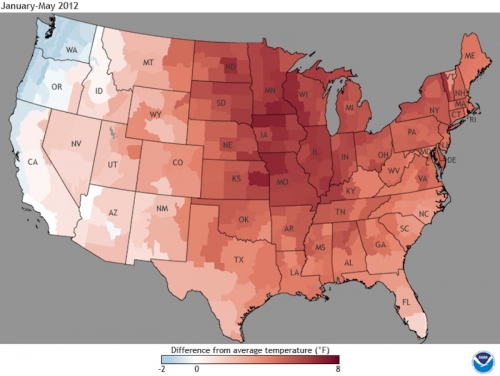
Like much of the Prairies and American Midwest, we’ve just had our warmest March on record, a whopping 8 C above normal. Additionally, every single bird arrival I recorded in March was earlier than last year, sometimes by over 30 days.

I don’t think this is a coincidence. I haven’t been any more observant than last year – I’ve spent roughly the same amount of time outside in roughly the same places. It also seems unlikely for such a systemic change to be a product of chance, although I would need much more data to figure that out for sure. Also, some birds migrate based on hours of daylight rather than temperature. However, I find it very interesting that, so far, not a single species has been late.

Because I feel compelled to graph everything, I typed all this data into Excel and made a little scatterplot. The mean arrival date was 20.6 days earlier than last year, with a standard deviation of 8.9 days.

Back to me.

What is equally interesting as Kate’s Post above are some of the comments.  Like this one,

Roger

Doesn’t always work…

Here in central Illinois the robins depart in the fall and arrive in the spring; that’s the way it’s always been and that’s the way it should be, right?

Not anymore. Some years recently we’ve seen robins nearly the entire winter, if we can still call it that.

Our Canadian Geese have forgotten how to migrate.

and these two from ‘Climatehawk1’.

climatehawk1

Thanks, interesting info. I heard a mourning dove here (Vermont) Feb. 6, which is extraordinary. Some other items on birds:

Link to Boreal ducks said hurt by global warming

Link to Climate change plays major role in decline of blackbird species

climatehawk1

And also, specifically relating to recent migration patterns:

Link to In an Unusual Winter–Where and Why Birds Traveled

Thank you Kate for that interesting article.

I am your dog!

A story about the bond between a dog and a human.

Introduction

I was clearing my desk yesterday (yet again) and came across an article that I wrote in 2007.  It’s a message of love; the love of a dog for a human.  But before going to that article, look at the photo below.  It’s a wonderful example of the joy of having Pharaoh in my life.  It was taken in July 2006 at the airfield in Devon, SW England, where a group of us shared a Piper Super Cub, about which I wrote in Learning from Dogs in August 2009.

If you think Pharaoh is smiling, I’m not going to argue with you.  First time in the Cub, first time strapped in to the rear seat, everything utterly strange and Pharaoh is clearly more joyful than the pilot!

Happiness is sharing life with your dog!

Anyway, to the article.  I wrote it in September, 2007, based on something that was sent to me from an unknown author, and modified to reflect the special relationship that I had, and still have, with my then four-year-old German Shepherd, Pharaoh.

I am your dog and have something I would love to whisper in your ear.

I am your dog and have something I would love to whisper in your ear.

I know that you humans lead busy lives. Some have to work, some have children to raise, some have to do this alone.  It always seems like you are running here and there, often much too fast, often never noticing the truly grand things in life.

Look down at me now. See the way my dark brown eyes look at yours.

You smile at me.  I see love in your eyes.  What do you see in mine?  Do you see a spirit? A soul inside, who loves you as no other could in the world? A spirit that would forgive all trespasses of prior wrongdoing for just a simple moment of your time?

That is all I ask. To slow down, if even for a few minutes, and be with me.

So many times, you have been saddened by others of my kind, passing on.  Sometimes we die young and oh so quickly, so suddenly it wrenches your heart out of your throat.  Sometimes, we age so slowly before your eyes that you may not even seem to know until the very end, when we look at you with grizzled muzzles and cataract-clouded eyes.  Still the love is always there, even when we must take that last long sleep dreaming of running free in a distant, open land.

I may not be here tomorrow.  I may not be here next week.  Someday you will shed the water from your eyes, that humans have when grief fills their souls, and you will mourn the loss of just ‘one more day’ with me.  Because I love you so, this future sorrow even now touches my spirit and grieves me. I read you in so many ways that you cannot even start to contemplate.

We have now together.  So come and sit next to me here on the floor and look deep into my eyes. Do you see how if you look deeply at me we can talk, you and I, heart to heart. Come not to me as my owner but as a living soul.  Stroke my fur and let us look deep into the other’s eyes and talk with our hearts.

I may tell you something about the fun of working the scents in the woods where you and I go.  Or I may tell you something profound about myself or how we dogs see life in general.  I know you decided to have me in your life because you wanted a soul to share things with.  I know how much you have cared for me and always stood up for me even when others have been against me.  I know how hard you have worked to help me to be the teacher that I was born to be.  That gift from you has been very precious to me.  I know too that you have been through troubled times and I have been there to guard you, to protect you, to be there for you always.

I am very different to you but here I am.  I am a dog but just as alive as you.

I feel emotion.  I feel physical senses.  I can revel in the differences of our spirits and souls. I do not think of you as a dog on two feet; I know what you are. You are human, in all of your quirkiness, and I love you still.

So come sit with me on the floor. Enter my world and let time slow down if only for a few minutes.  Look deep into my eyes and whisper in my ears. Speak with your heart and I will know your true self.

We may not have tomorrow but we do have now.

Postscript.

Just three months after writing the above, on December 17th, 2007, I flew in to Hemosillo Airport in Mexico to spend Christmas with Suzann, sister of dear friend Dan Gomez, and her husband Don down in the coastal town of San Carlos.  That’s when I met Jean, leading to me and Jean falling in love.  Jean then came to England and I came back to Mexico in June, 2008.  In September, 2008 Pharaoh and I left England permanently and travelled out to San Carlos to be with Jean and her dogs.  In February, 2010, Jean and I, Pharaoh and twelve other dogs, and six cats all moved to Payson, Arizona.

In November, 2010 Jean and I were married.  So the miracle for me and Pharaoh is that when I wrote that piece back in 2007 this most beautiful future was yet to unfold.    I never miss a day when I don’t, “… come sit with me on the floor. Enter my world and let time slow down if only for a few minutes.  Look deep into my eyes and whisper in my ears. Speak with your heart and I will know your true self.”  Now not just with Pharaoh but with Hazel, Dhalia, Sweeny, Casey, Loopy, Lilly, Ruby, and all the other beautiful dog souls.

Jean and me, Yecora, Sonora, Mexico. June 2008

A Ray of Sunlight

Great reminder of the power of a smile and a laugh!

With grateful thanks to Merci O. from here in Payson who emailed the link to me.  Apologies if you have seen it before; well over 1.8 million have!

Joining the dots?

A guest post from Perfect Stranger.

Introduction

Yesterday, I had the pleasure of publishing a guest post from Patrice Ayme about the important subject of Energy Question For The USA

One of the comments on that Post was from Per Kurowski, a former Executive Director of the World Bank.  He reported about a letter he wrote that was published in the Financial Times back in April, 2005.  That letter set out the case for,

A sensible country would raise tax on petrol, so what is US waiting for?

Sir, it is hard to understand the United States of America! It has a huge fiscal deficit; it has a huge current-account deficit; it is by far the world’s biggest oil consumers both in absolute and in relative terms; now willing to explore for oil and gas in Alaska, it shows itself to be aware of the difficult energy outlook the world faces; it seems aware and resolute about the environmental problems (ignore the Alaska part) as it imposes other expensive environmental regulations, such as recycling—which, as no one likes to do it, requires the hiring of Salvadoreans; it speaks all over the place about having to reduce the vulnerabilities of its oil supplies.

As any other sensible country would, in similar circumstances, increase the taxes on petrol consumption and substantially help to solve all the above-mentioned problems; and as the US has always shown willingness to pull together as a nation, recently even to the extent of going to war on shaky grounds, the big question remains: why is it that the leaders of the US do not even want to talk about a substantial tax on petrol?

The letter struck me as eminently sensible.  Then a while later Perfect Stranger emailed an equally valid alternative approach and that now follows as a guest post.

oooOOOooo

Many years ago while working for Lehman Bros I did a spreadsheet relating to oil profits based on government taxes, I can assure you that having the USA government (or any other government) raise taxes on oil will do the complete opposite to what everyone expects it will do.

Any taxes raised will only end up in the federal coffers, they will not harm the oil companies because they will simply marginally raise the price of fuel meaning they will still receive the same profits while the government gets even more. The consumers will hurt in the pocket and nothing else will happen.

If for some reason the government found a way to stop the oil companies from any marginal increases then the oil companies would simply raise their fuel transportation costs and lump the entire loss on the Petrol Station operators meaning the operators would lose out, the oil companies would still receive the same profit and the government would still end up with more money in their coffers.

But oil consumption would remain the same, in other words .. raising taxes (or lowering them ) will do no good whatsoever

So the answer to using less fossil fuels, as I keep on saying, is not up to any government nor is it up to the oil companies nor is it up to science, the blame lies entirely on the people who choose to drive to the shops to buy their bread and milk instead of walking whatever short distance that might require.

This is something I have found throughout the entire global warming movement, everybody tends to expect that it is up to governments and science to find solutions when in reality it is we who cause the problems and it is we who should be fixing them … THE GOVERNMENTS CANNOT HELP THOSE WHO WILL NOT HELP THEMSELVES, as long as we keep demanding the same lifestyle they have no choice but to provide us with it.

It is the same with coal, gas and oil in power plants, they only get burnt because we as consumers draw the power from the grid, in other words, we demand it, and if the companies don’t provide enough we get all sorts of blackouts,then we whinge, the companies get fined, directors get jailed for failing in their duty to the public and still .. more coal, gas and oil gets delivered to the power plants.

Spending less Energy and Wasting less Heat is actually the “only” solution that will work, anything else, any other form of debate or discussion on the issue is just another way of extending a debate that should have been over decades ago .. because that is the only possible solution, there really is no other solution, none whatsoever, there are no other answers.

The truth of the matter is that nobody wants to do anything about it except to continue the debate all the while expecting others to resolve the issue while they sit on their butts and talk about how things are going ever so slowly and that it must all be the fault of somebody else.

The oil companies cannot stop producing fuel nor should they be stopped as this would destroy our entire civilization, I am amazed at the ignorance in even discussing such an issue, it’s as if people imagine that by stopping oil and other fossil fuels over, say the next 10 years, that somehow some magical system would suddenly develop to replace them.

Do you realize that it took over a hundred years to build our existing fossil fuel based society and that currently only 3% of that has been replaced by alternative energy sources and that it has taken 3 decades for that to occur, all over the world?

There is no miracle technology that can be implemented fast enough to save us, there never has been, EVER, even nuclear power cannot be produced fast enough for our needs, we have to save ourselves.

So use some common sense and realize that the only possible solution to the global warming issue is for all of us to get into conserving energy and wasting less heat and above all … educating others into doing the same thing.

You leave it too long and we are all going to die ,,,,,, and it’s a guarantee we shall blame some else for it 😦

Footnote: This is a warning given to us by one of the greatest scientists who ever lived, comparable only to both Issac Newton and Albert Einstein.

Lord Kelvin

Within a finite period of time past, the Earth must have been, and within a finite period of time to come the Earth must again be, unfit for the habitation of man as at present constituted, unless operations have been, or are to be performed, which are IMPOSSIBLE under the laws to which the known operations going on at present in the material world are subject.” – Lord William Kelvin.

As they say, the solutions to the problems of the future may always be found in the lessons of the past.  As we can see by Lord Kelvin’s warning, this problem has never had a technical solution and we have little time to learn that one lesson.

oooOOOooo

As much as I respect Per’s opinion, indeed I wrote yesterday, “The points you make seem complete common sense.” the argument put forward by Perfect Stranger really does ‘join the dots’ for me and, I suspect, for many others.  Indeed, as Wen Scott commented on last Tuesday’s Post,

For my own personal experience, my husband and I have concluded that the only way we can make a contribution is to make our own grass-roots changes. We are solar, heat with wood (carbon neutral), composting toilets and kitchen scraps, and lately are choosing as much local food, goods and services as possible. The Transitions movements are a great example and well worth emulating for all of us.

I think it’s pretty clear that waiting around for governments and big business to solve environmental problems is dangerous to our health and well-being — it’s important to hear voices directly from our scientists, but I think we are very foolish (insane) to refuse to take action now. What are people waiting for, and at this date, does it really make much difference who or what is causing such environmental and climate devastation?

What’s the saying…. walk softly and leave nothing behind but your footprints. Even that may be too little, too late, but let’s hope not.

And it is thanks to Wen’s blogsite that I was linked to the following video,

We are living in exceptional times. Scientists tell us that we have 10 years to change the way we live, avert the depletion of natural resources and the catastrophic evolution of the Earth’s climate.

The stakes are high for us and our children. Everyone should take part in the effort, and HOME has been conceived to take a message of mobilization out to every human being.

For this purpose, HOME needs to be free. A patron, the PPR Group, made this possible. EuropaCorp, the distributor, also pledged not to make any profit because Home is a non-profit film.

HOME has been made for you : share it! And act for the planet.

Yann Arthus-Bertrand

HOME official website
http://www.home-2009.com

PPR is proud to support HOME
http://www.ppr.com

HOME is a carbon offset movie
http://www.actioncarbone.org

More information about the Planet
http://www.goodplanet.info

Questions are never stupid!

A powerful guest post from Patrice Ayme on where next for American energy.

Introduction.

I must have spent an age musing over what to call this Post.  Patrice called it simply ‘Energy Question For The USA’ and it’s a highly appropriate question.  But in the end I chose the title ‘Questions are never stupid’ because I was mindful of the well-known saying, “There is no such thing as a stupid question, only a stupid answer!

So the smart question raised by Patrice is not only very highly appropriate for 2012, it’s also a question that just has to have a smart answer.  Because we are on the brink of it being too late to be flirting with stupid answers.  What many scientists are saying, in one form or another, is that if we don’t embrace the journey of moving away from carbon-based sources of energy for society now and find those alternate sustainable sources by the end of this decade then the laws of unintended consequences will kick in with a vengeance.  The end of the decade is eight years away!

Here’s a picture of my grandson who was one-year-old just a week ago.

Trusting his elders!

That picture reminds me of the comment early on in James Hansen’s book, Storms of my Grandchildren, where he writes ‘I did not want my grandchildren, someday in the future, to look back and say, “Opa understood what was happening, but he did not make it clear.

So on to the Guest post from Patrice.  It’s not an easy, quick read but I’ll tell you what it is!  It’s the sort of ‘wake-up’ call this fine Nation and this even finer Planet should be getting from countless politicians and leaders.  So do read it and, even better, add your comments, and wonder why we seem so content on fiddling while Rome burns!

oooOOOooo

Energy Question For The USA

THE AGE OF OIL PRODUCED THE AMERICAN CENTURY. NOW WHAT?

No Vision, No Mission, No Energy

***

Another editorial of Paul Krugman firing volleys at republican “paranoia” for accusing Obama of driving up oil prices. As he observes in “Paranoia Strikes Deeper“: …“the president of the United States doesn’t control gasoline prices, or even have much influence over those prices. Oil prices are set in a world market, and America, which accounts for only about a tenth of world production, can’t move those prices much. Indeed, the recent rise in gas prices has taken place despite rising U.S. oil production and falling imports.”

American households tend to borrow as much as they can. Thus, when oil prices increase markedly, Americans have to cut in crucial budgets, such as house payments. I said at the time that it would lead to a peak in housing prices, and it did.

Why such a drastic influence of oil prices on the economy of the USA? Because Americans, except in a few places such as New York, commute by private car to work. So Americans have to feed the car, if they want to feed themselves.

It was not this way a century ago, or so. At the time public transportation systems using electric tramways and trains were found all over, even in Los Angeles. Car companies put an end to that outrage in the late fifties by buying, and then destroying, all the public transportation system they could put their greedy hands on.  Fossil fuel plutocrats were delighted.

But let’s set aside Krugman’s fake indignation. He is smart enough to know that Romney will do what Romney needs to do to win the Obama, I mean, the election. Waxing lyrical about Romney doing as Obama, does not beat going lyrical about sunrise.

Gasoline prices in the USA are way down in real dollars to what they used to be, decades ago. And so is the gas tax. This means that, far from adapting to the gathering multiply-pronged world ecological and energy crisis, the USA has gone the other way, denying there is any crisis. “What? Me worry?” That’s got to be anti-American indeed.  No, real blooded Americans are all into strip searches and the death panel at the White House.

In Europe, gas prices are more than twice that of the USA, thanks to heavy taxes (stations in France have sported two euros a liter, that is 8 euros per gallon, or more than $10.50). [UK unleaded petrol price, as of today, is the equivalent of $8.70 per gallon, Ed.]

This means that far from being down and out, Europe is efficient enough to operate at that high price level. It also means that Europe is much more motivated than the USA to get much more efficient. In other words, high gasoline prices in Europe are a safety margin. The high prices force the European free market to adapt to a situation that the free market of the USA will encounter someday. Adaptation takes decades: new energies take on the average, historically speaking, 50 years to become dominant. Same, one would guess, for energy efficiencies.

Basically, if oil prices doubled from here, gasoline prices would double in the USA. Whereas, even if the Europeans decided to keep the same high taxes, gasoline prices would only augment by 50%. And, in the much more efficient European economy, with plenty of public electric transportation available, the noxious effects on the European economy would be much less than one would expect from a 50% oil price rise.

The world gets 55 × 1018 joules of useful energy from 475 × 1018 joules of primary energy produced by fossil fuels, biomass and nuclear power plants. That tremendous inefficiency (less than 13%!)  needs to be corrected. It will be, if, and only if, prices are kept high. Thus energy taxes are necessary to adapt to the looming penury.

Why looming penury? Because the reserves of other fossil fuels may have been vastly overestimated (by a factor of 5 in the case of coal). Various fossil fuel lobbies have an interest to over-estimate the reserves (because it keeps the world addicted, as they present their industry as a long range solution, which it is not).

Looking at the raw production numbers, as exhibited below in the graphs, paints a completely different story: production from existing fields is going down dramatically (at 5% rate, per year).  In other words we are in the treachorous waters between the catastrophe of CO2 poisoning and the disaster of running out of energy to burn.

The unavoidable rise of fuel prices will be less grave in Europe than in the USA, because many Europeans would opt for the available electric-based public transportation system (the combination of much more efficient electric motors and central generation is much more efficient than distributing oil to put in SUVs all over, as done in the USA; SUVs, because there are too many holes in the asphalt. A problem partly related to high oil prices!).

Yet, the increase of the cost of imported oil corresponds exactly to the Italian deficit ($55 billion). Although that deficit increase had many causes, oil price increase was by far the most important. And the same for other Southern European countries. So the rise of oil prices was the barrel that broke the back of European debt.

In the USA, ten out of 11 post WWII recessions were followed by oil price spikes. Why are American minds so closed up to the looming strangulation of their economy by oil? Because the fossil fuel plutocracy is on a rampage in the USA. It uses a red hot propaganda to persuade the vast American public of undifferentiated sheep that there is no CO2 ecological crisis, and no energy crisis. (Although the latest polls indicate that two thirds of the public, in a splendid turn-around, believe that there is indeed a man-made climate change crisis; never mind that the New York Times had the latest tornado rampage, with 40 dead, presented as discreetly as possible.)

Why are the fossil plutocrats hysterical? Well we are past Peak Cheap Oil. Moreover, the “majors“, the world’s largest oil companies, have been pushed out of more and more countries, and replaced by national oil companies. Desperate, the majors have gone for riskier and riskier drilling in the deep ocean. Now Chevron, and Transocean, after a 4-day leak off Brazil, see prosecutors asking for lengthy prison sentences and enormous fines.

Most of these oil companies are American, so they have pushed forfracking (destroying the underground with poisons to extract fossil fuels). Superficially, it works: USA imports of fossil fuels went quickly from 60% down to 40%.

However, that did not make a dent in the world price situation, because the demand keeps rising, but the world, overall, is PAST PEAK OIL (as I have long argued and the Nature article alluded to below confirmed, using the obvious argument found in the graphs).

So, basically, American fracking finances Chinese oil consumption. Here are some graphs extracted from Nature and the USA government:

When the horrid sun of diminishing resources rises over the parched American oil desert, while fracking reveals itself to be an unfathomable catastrophe, the howling is going to be very great, and one more reason for a depression will blossom.

Much of the USA’s superiority, in the last 150 years, has come from abundant and cheap oil. First in the North-East, then down to Oklahoma, Texas, Colorado, California. Compare with Western Europe, which had basically no oil.

Oil was not just a question of cheap, convenient energy. Oil has, short of nuclear energy, the highest energy density of any material (OK, nuclear energy is millions of time more energy dense).

Oil gave the USA enormous diplomatic and conspiratorial leverage. American oil plutocrats helped Lenin and Stalin develop their colossal fields in the Caucasus and Caspian. One of those plutocrats, Harriman, son of a railroad magnate, and brother of another Harriman, was one of the main operators of the democratic party. Let alone banker to Hitler. He was decorated both by Stalin, and by Hitler. He then went on as U.S. ambassador to major European capitals, and stayed one the main operators of the government of the USA for decades. “Democrats” have long been impure.

Interestingly, I searched the Internet for a document mentioning Harriman’s Stalino-Hitlerian decorations, but could not find it (I have seen the pictures in the past). All I could read is how much Harriman resisted Stalin each time they met, and that was all the time (a total lie that Harriman resisted Hitler, or Stalin: Harriman was an accomplice of Stalin, and helped give him half of Europe, in exchange for manganese and other stuff. But now Internet agents are obviously paid to reconstruct a truth where American plutocrats look good,  knights in shining armor, fighting Stalin or Hitler, each time they met for tea, dinner, lunch, breakfast, and interminable conferences, for years on end, decade after decade).

A famous example of the clout oil provided the USA with: Texaco fueled Hitler’s conquest of the Spanish republic (this one is hard to hide, because the U.S. Congress slapped Texaco with a symbolic fine, well after the deed was done). That used to amuse Hitler a lot (Hitler gave elaborated reasons to his worried supporters for being in bed with American plutocrats; as the Nazi Party was officially socialist, and anti-plutocratic, that awkward situation may have led him to declare war to the USA on December 11, 1941, to ward off the German generals’ argument that he was just a little corporal in above his head).

Another example: Mussolini was hanged from an American gas station in Milan. Italian communists hanged him from his sponsors’ works.

The fueling of the fascists by American fossil fuel companies helped bring the American Century to the world in general, and Europe in particular. Without Stalin and American plutocratic oil, Hitler’s Panzers could not have moved in 1939 or 1940.

The dignified Elie Wiesel, instead of crying crocodiles tears, wondering how such a thing as Auschwitz was possible, should ask how and why the Nazi extermination machine was fuelled by American plutocrats, and how come he, himself, never talks about that.

Wiesel got the Nobel Peace Prize, just as Jimmy Carter (who launched the American attack on Afghanistan). Was it for disinformation? (And how come waging war in Afghanistan is a big plus for the Peace Prize? Is it related to the same mood which made Sweden help Hitler before and during WWII, and never having a serious look at that, ever since? I know the prize is ostensibly given by Norwegians.)

Wikipedia is big on the notion of “weasel words“, and rightly so. Deeper than that is what I would call weasel logic. And ever deeper, weasel worlds. To talk about Hitler without ever wondering who his sponsors were, and what they were after, is to live in a weasel world.

I like Elie Wiesel personally. Yet, just as I like Krugman, Obama, and countless others, such as the infamous Jean-Paul Sartre, he likes power even more than truth. OK, It is unfair to put Sartre, who really espoused the most abject terrorism, with the others… As long as individuals prefer power to truth, the spontaneous generation of infamy is insured.

Total oil sales, per day are about 100 million barrels (in truth the cap is lower, see graph above), at, say $100, so ten billion dollars a day, 3.6 trillion a year. The USA uses about 25% of that. Some have incorporated the price of the part of the gigantic American war machine and (what are truly) bribes to feudal warlords insuring Western access to the oil fields, and found a much higher cost up to $11 a gallon.

Ultimately, and pretty soon, in 2016, specialists expect oil prices to explode up, from the exhaustion of the existing oil fields. Then what?

Moreover, in 2016, the dependence upon OPEC, or, more exactly Arab regimes, is going to become much greater than now. What’s the plan of the USA? Extend ever more the security state, and go occupy the Middle East with a one million men army? To occupy, or not to occupy, that is the question.

Is it time for a better plan? And yes, any better plan will require consumers to pay higher energy prices. As consumers apparently want the army to procure the oil, they ought to pay for it.

***

Patrice Ayme

***

Note 1: Flying cost at least ten times more in CO2 creation than taking a train. And jet fuel is not taxed, at least until the carbon plan of the European Union starts charging next year, in 2013. In spite of the screaming from the USA and its proxies: it’s funny how attached to subsidies American society can be.

Note 2: Refusing to pay for necessary military expenses through taxation and mobilization, was a big factor in the downfall of the Roman Principate.

The Principate then tried to accomplish defense on the cheap, by using more and more mercenaries. Many of these mercenaries or their children and descendants were poorly integrated in Roman republican culture (say emperors Diocletian or Constantine, let alone Stilicho the Vandal, a century later), so they established theDominate, itself a negation of the Roman republic. Amusingly the Western Franks, those salt water (“Salian“) Franks remembered the Roman republic better than all these imports from the savage East… who could not remember it, they, and their ancestors, having never known it.

Guess what? The USA’s army presently employs 300,000 “private contractors” (aka, mercenaries). Curiously, in that case, it’s not so much to save money, than to extract more money from the system (but that’s another story). Still, it will have the same effect.

oooOOOooo

Is it me? Or are we all truly insane?

At times it does seem as though we, as in mankind, are truly beyond help!

If you detect a note of frustration in the title of today’s Post and the sub-heading above, then you are not mistaken.  It comes from a series of communications that have impinged upon my consciousness over the last twelve hours or so.

This morning Rob I., from here in Payson, emailed me a scan of an article in today’s (Monday) The Arizona Republic newspaper, written by Doyle Rice.  It was entitled Study: Global temps may jump 5 degrees by 2050

I’m going to take the liberty of reproducing it in full.

As the U.S. simmers through its hottest March on record — with more than 6,000 record-high temperatures already set this month — a new study released Sunday shows that average global temperatures could climb 2.5 to 5.4 degrees by 2050 if greenhouse-gas emissions continue unabated.

The study findings are based on the results of 10,000 computer model simulations of future weather overseen by researchers at Oxford University in the United Kingdom.

“These are the first results to suggest that the higher warming scenario could be plausible,” said study lead author Dan Rowlands of Oxford.

It is a faster rate of warming than most other models predict.

Most scientists say that increasing amounts of carbon dioxide in the atmosphere from the burning of fossil fuels such as oil, gas and coal are causing the planet to warm to levels that cannot be explained by natural variability.

The study was published online Sunday in the journal Nature Geoscience and backs up similar predictions from the Intergovernmental Panel on Climate Change in 2007.

The climate models used in the study accurately reproduced actual, observed temperature changes over the last 50 years. Assuming that models that simulate past warming realistically are the best candidates for future warming predictions, the authors conclude in the study that a warming of 2.5 to 5.4 degrees by 2050, compared with the 1960-90 average, is in the “likely range” of climate warming.

The Earth’s average temperature during the decade of 2000-10 was almost a full degree higher than the average from 1960-90, Rowlands said.

I don’t feel too bad at ‘borrowing’ the story above because I also subscribe to the UK’s Met Office News Blog and, guess what, in my ‘in-box’ this morning were two news stories from the Met Office.  Let me take them in this order.

The first one I want to refer to here is this Citizen science looks at future warming uncertainty  and includes the link to the Nature Geoscience magazine article that prompted the story in The Arizona Republic.

This is how it develops,

A project running almost 10,000 climate simulations on volunteers’ home computers has found that a global warming of 3 degrees Celsius by 2050 is ‘equally plausible’ as a rise of 1.4 degrees.

The study addresses some of the uncertainties that previous forecasts, using simpler models or only a few dozen simulations, may have over-looked.

Importantly, the forecast range is derived from using a complex Met Office model that accurately reproduces observed temperature changes over the last 50 years.

The results suggest that the world is very likely to cross the ’2 degrees barrier’ at some point this century if emissions continue unabated.

It also suggests that those planning for the impacts of climate change need to consider the possibility of warming of up to 3 degrees (above the 1961-1990 average) by 2050, even on a mid-range emission scenario. This is a faster rate of warming than most other models predict.

Just go and read that last paragraph again: “This is a faster rate of warming than most other models predict.

Then the next item from the Met Office blog was this,  Why is it so warm?  It’s referring to the specific weather conditions in the UK at present:

The last few days have been unseasonably warm but why is this happening so early in the year? The answer lies largely in the air flow directly above the United Kingdom but more importantly where that air has come from.

Just a few paragraphs down we read, “we have seen a new record high for Scotland in March as the temperature reached 22.8 °C  [73.04 °F] at Fyvie Castle in Aberdeenshire on Sunday 25 March.”  So another temperature record!

I had a quick call with Martin Lack about an hour before starting this Post and he pointed me to the Australian website of CSIRO.  There we find the latest State of the Climate report, from which we read,

The previous State of the Climate, released in March 2010 highlighted a multi-decadal warming trend over Australia’s land and oceans, an increase in record hot days and decrease in record cold days across the country, a decrease in rainfall in southwest and southeast Australia, an increase in global sea level, and increases in global greenhouse gas concentrations.

Do read the full report starting here.  Or if you want a video to watch, then here it is:

Dr Karl Braganza from the Climate Monitoring Section of the Bureau of Meteorology discusses the State of the Climate in 2012.

Also on the CSIRO website is a small piece saying,

Planet Under Pressure 2012

Scientists from around the globe are meeting in London in March to discuss ‘solutions, at all scales, to move societies on to a sustainable pathway’. Planet Under Pressure 2012 is designed to bring together senior policymakers, industry leaders, NGOs, young scientists, the media, health specialists, and academics from many disciplines.
25 March 2012

Meeting to discuss ‘solutions, at all scales, to move societies on to a sustainable pathway’.  Any rational thinking person on this planet if given a chance to reflect on the science knows we have to change our ways.  And the means to do it are clear; we are not talking rocket-science here.

So when Martin Lack catches my attention with a recent piece entitled The seven woes of the Tea Party and I am linked to this article by Rick Santorum, I feel as though it must be me!  This is what Mr. Santorum writes:

The Elephant in the Room: Challenging science dogma

As with evolution, the ‘consensus’ on climate change has become an ideology.

Questioning the scientific consensus in pursuit of the truth is an important part of how science has advanced through the centuries. But what happens when the scientific consensus becomes an ideology that trumps the pursuit of truth? Answer: Those making legitimate inquiries are ostracized, the careers of dissenters are destroyed, and debate is stifled.

Unfortunately, I am referring not only to the current proponents of the theory of man-made global warming.

With the penultimate paragraph reading thus,

Why? Well, maybe because Americans don’t like being told what to believe. Maybe because we have learned to be skeptical of “scientific” claims, particularly those at war with our common sense – like the Darwinists’ telling us for decades that we are just a slightly higher form of life than a bacterium that is here purely by chance, or the Environmental Protection Agency’s informing us last week that man-made carbon dioxide – a gas that humans exhale and plants need to live, a gas that represents less than 0.1 percent of the atmosphere – is a dangerous pollutant threatening to overheat the world.

Frankly, I am lost for words and probably best that I am!  Lost because irrespective of political ‘left’ or ‘right’ the science of where this so-called intelligent species we call homo sapiens is heading, is beyond question.  I use the phrase ‘beyond question’ not as a statement of fact but as a statement of truth.  For science, as this non-scientist understands it, is about distinguishing the truth from ‘non-truth’.

Our beautiful companions for thousands of years truly do know better.  That’s the truth you see in those eyes below.

The truth is always clear, Mr. Man. Just open your eyes!

The most important alarm ever heard.

The heading says it all.

In fact the heading was taken from an email that came in from Bill McKibben’s 350.org yesterday.  But before reproducing that email in full, let me take you back to the 6th January this year when I published a piece simply called Keystone XL pipeline.  This is how that Post opened up,

Yesterday, I had published a lecture given in Melbourne by Britain’s eminent Astronomer Royal, Lord Martin Rees.  Lord Rees concluded his lecture with the call for us to take better care of our own planet. He, like many others, recognises the unique place in history that we occupy. For the first time a single species is capable of exerting profound changes on the Earth’s natural and physical environments.

Over and over again, scientists are reporting the rise in climate temperature of Planet Earth and the implications thereof if we do not wakeup soon to changing our ways.  The Keystone pipeline is a huge potential mistake!

Bill McKibben of 350.org

Not easy to focus on a single sentence from Lord Rees but this one’s pretty direct, “For the first time a single species is capable of exerting profound changes on the Earth’s natural and physical environments.”

God only knows what money, power and influence is going on behind the scenes because no leader in their right mind ought to be supporting any major investment in the continuation of carbon-based energy.  So it was with deep dismay that around 2pm US Mountain Time yesterday afternoon the following email arrived in my in-box.  (Feel free to republish this Post, indeed please do so!)

Dear friends,

Earlier today, Barack Obama wrapped up his first trip to Oklahoma as President. He arrived just after a week of floods, capping off a winter that never came, which followed the hottest and driest summer Oklahoma had seen in thousands of years, perhaps ever.

But he wasn’t in Oklahoma to talk about these climate disasters. He was there to laud his administration’s fast-tracking of the southern leg of the Keystone XL tar sands pipeline. In his speech today, President Obama didn’t connect the dots between fossil fuel extraction, climate change, and the extreme weather that has reshaped so much of the American landscape this past year.

It’s a painful reminder that sometimes we must be leaders ourselves, before we can expect our elected officials to follow. It’s clearly up to us to connect the dots.

Today 350.org is launching a global day of action to call attention to these and other climate disasters, here on the same day as the President’s annoucement. Across the planet now we see ever more flooding, ever more drought, ever more storms. People are dying, communities are being wrecked — the impacts we’re already witnessing from climate change are unlike anything we have seen before.

If we’re going to do these communities justice, we need to connect the dots between these disasters and show how all of them are linked to fossil fuels. We’re setting aside May 5th for a global day of action to do just that: Connect the Dots between extreme weather and climate change.

Anyone and everyone can participate in this day. Many of us do not live in Oklahoma, the Philippines, or Ethiopia — places deeply affected by climate impacts. For those of us not in directly-impacted communities, there are countless ways to stand in solidarity with those on the front-lines of the climate crisis: some people will be giving presentations in their communities about how to connect the dots. Others will do projects to demonstrate what sorts of climate impacts we can expect if the crisis is left unchecked. And here in the US, it’s particularly important that we make the connections clear to our elected officials — beginning with President Obama.

However you choose to participate, your voice is needed in this fight — and you can sign up to host a local event here: www.climatedots.org/start

(For more general info about the day, check out our new website here: www.climatedots.org)

350.org has done giant global days of action before (over the last three years we’ve helped coordinate over 15,000 events in 188 countries) and they’re always beautiful moments when our movement stands together. This year we’ll use that same captivating tactic to draw attention to the struggles of our friends around the world  — the communities already feeling the harsh impacts of climate change.

These will also be beautiful events, we’re sure. But they will also have an edge. It’s right that we get a little angry at those forces causing this problem. The fossil fuel industry is at fault, and we have to make that clear. Our crew at 350.org will work hard to connect all these dots — literally — and weave them together to create a potent call to action, and we will channel that call directly to the people who need to hear it most.

May 5 is coming soon; we need to work rapidly. Because climate change is bearing down on us, and we simply can’t wait. The world needs to understand what’s happening, and you’re the people who can tell them.

Please join us — we need you to send the most important alarm humanity has ever heard.

Onwards,

–Bill McKibben for the whole 350.org team

P.S. This is news worth spreading — and it only takes a moment to share it. Click here to share it on Facebook, or click here to post it on Twitter.