The first picture comes from Merci O. from here in Payson.
Lost for words!
The next two are from the camera of ‘yours truly’.
Tough work being a puppy!
Cleo has settled in so beautifully and we can’t believe that these two weeks have gone so quickly.
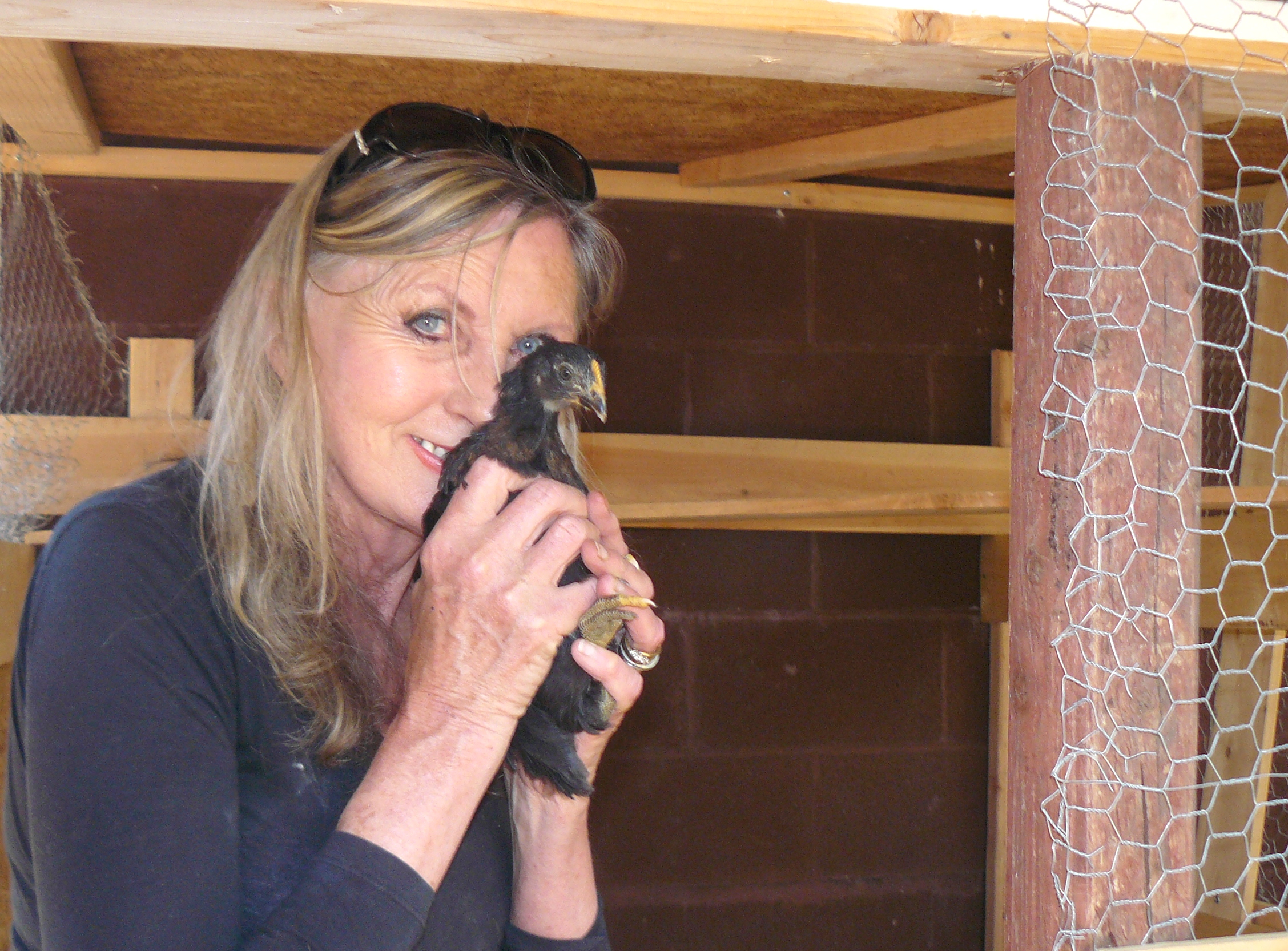
Finally, talking of settling in, our five young chicks have reached the stage where they could be housed outside in their new chicken house, the move taking place just five days ago.
The Western Arctic Reserve, also known as the National Petroleum Reserve-Alaska, is the largest tract of unprotected, relatively pristine public land in the United States. But Big Oil has the reserve in its sights and will not hesitate to turn this vast wilderness into a sprawling industrial complex to drum up massive profits.
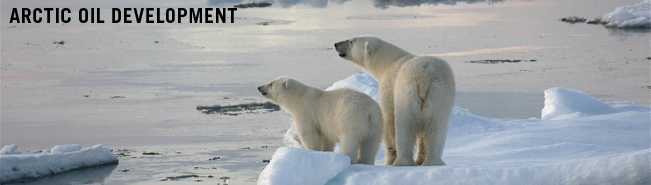
The 23.5 million-acre reserve is home to imperiled polar bears, seabirds and one of the densest populations of nesting raptors in the world. Its shores and lagoons harbor beluga whales, seals, walruses and other marine mammals.
In the rapidly warming Arctic, short-sighted oil and gas development will further stress the remarkable wildlife that lives and breeds there.The Bureau of Land Management (BLM) is now collecting comments on a planning document that will set the stage for oil and gas leasing in the western Arctic for decades to come.
You can help save this national treasure: Take action to tell the BLM to protect the Western Arctic Reserve from dirty fossil fuel development.
The action that is requested is to email or mail the following to the BLM (the link is here.) The email address for Bob Abbey, taken from the relevant BLM webpage is Director: Bob Abbey E-mail: Director@blm.gov
Director Bob Abbey
Bureau of Land Management
NPR-A IAP/EIS Comments, AECOM Project Office
1835 South Bragaw Street, Suite 490
Anchorage, AK 99508
US
Subject: Comments Regarding the BLM’s National Petroleum Reserve-Alaska Integrated Activity, DEIS
The National Petroleum Reserve-Alaska, or Western Arctic Reserve, comprises the largest unprotected tract of public land in the United States. It provides habitat for a wide variety of Arctic species, and its wilderness values are second to none. While the most environmentally protective alternative analyzed by the Bureau of Land Management (Alternative B) is an improvement over previous plans, it still allows over 11 million acres of ecologically intact wilderness-quality lands to be leased for oil development. As the BLM develops the “integrated activity plan” and “final environmental impact statement” for the reserve, I urge you to provide maximum protection for areas with high-value habitats by designating all of the Special Area contained in Alternative B, and to create additional protections for all other areas in the reserve that contain ecologically intact and/or wilderness-quality lands.
The BLM must also consider the long-term impacts of greenhouse gas emissions from oil and gas development, and any future impacts of climate change on the low-lying western Arctic. Arctic animals are already stressed by a melting and warming Arctic, and none of the alternatives considered go far enough to protect these species from the wide array of impacts from oil and gas development.
Among other things, the BLM must account for sea-level rise due to ice melt, permafrost collapse, coastal erosion and increased high-energy storm events that will degrade, or wipe out, critical coastal habitat, including the Teshekpuk Lake area. The BLM must also consider the impacts of ocean acidification, changes in circulation, increased freshening due to sea ice melt, and shifts in productivity to the marine environment and to marine species, including polar bears, ice seals, walruses, bowhead whales, and beluga whales.
Congress has required that “maximum protection” be given to Special Areas in the reserve. I encourage the BLM to adopt an alternative that provides protections for these areas, which include Teshekpuk Lake, the Colville River, Kasegaluk Lagoon, and the Utukok River Uplands. The BLM must also protect the Dease Inlet-Meade River area, Peard Bay and adjacent wetlands, and the Ikpikpuk River and adjacent wetlands.
I implore the BLM to adopt a management alternative that includes the strongest possible protections for the Western Arctic Reserve. This means designating Alternative B as the preferred alternative, and adding additional protective measures for important wildlife habitat and wilderness areas so they are not destroyed by ecologically devastating oil and gas development, or from the long-term impacts of greenhouse gas emissions and climate change.
Thank you.
But if that doesn’t work then there is a full webpage offering detailed information and which also has links relevant to letting the BLM know your views. That webpage starts,
ARCTIC OIL DEVELOPMENT
Alaska’s north coast and ocean waters are teeming with species found in few other places, and many of them are now under threat. The Western Arctic Reserve and the Arctic National Wildlife Refuge provide critical denning areas for polar bears, support vast caribou herds and are essential nesting grounds for thousands of bird species, including threatened eiders and yellow-billed loons. The sea ice of the Arctic Ocean is hunting and denning habitat for polar bears and a foraging platform for Pacific walrus and numerous Arctic ice seal species. Under the sea ice, endangeredbowhead whales and other whale species live off the biological richness of the Arctic Ocean.
Nearly all Arctic species are at risk from global warming. But that’s not the only problem: In a drastically changing environment, Arctic species must now contend with dirty, industrial fossil fuel development.
Please go here, read the the full information and do your little bit. It all makes a difference.
In fact the heading was taken from an email that came in from Bill McKibben’s 350.org yesterday. But before reproducing that email in full, let me take you back to the 6th January this year when I published a piece simply called Keystone XL pipeline. This is how that Post opened up,
Yesterday, I had published a lecture given in Melbourne by Britain’s eminent Astronomer Royal, Lord Martin Rees. Lord Rees concluded his lecture with the call for us to take better care of our own planet. He, like many others, recognises the unique place in history that we occupy. For the first time a single species is capable of exerting profound changes on the Earth’s natural and physical environments.
Over and over again, scientists are reporting the rise in climate temperature of Planet Earth and the implications thereof if we do not wakeup soon to changing our ways. The Keystone pipeline is a huge potential mistake!
Bill McKibben of 350.org
Not easy to focus on a single sentence from Lord Rees but this one’s pretty direct, “For the first time a single species is capable of exerting profound changes on the Earth’s natural and physical environments.”
Thailand has the worst flooding in its history, only a month after Central America has the worst flood in its history, a month after Vermont has the worst flooding in its history in the same year that the Mississippi river has the worst flooding in its history. And Queensland in Australia has its worst floods only a few months after Pakistan floods so badly that 20 million people are forced from their homes – it’s connected, folks.
Across the planet now we see ever more flood, ever more drought, ever more storms. People are dying, communities are being wrecked — the impacts we’re already witnessing from climate change are unlike anything we have seen before.
But because the globe is so big, it’s hard for most people to see that it’s all connected. That’s why, on May 5, we will Connect the Dots.
In places from drought-stricken Mongolia to flood-stricken Thailand, from fire-ravaged Australia to Himalayan communities threatened by glacial melt, we will hold rallies reminding everyone what has happened in our neighborhoods. And at each of those rallies, from Kenya to Canada, from Vietnam to Vermont, someone will be holding a…dot. A huge black dot on a white banner, a “dot” of people holding hands, encircling a field where crops have dried up, a dot made of fabric and the picture taken from above — you get the idea. We’ll share those images the world around, to put a human face on climate change–we’ll hold up a mirror to the planet and force people to come face to face with the ravages of climate change.
Anyone and everyone can participate in this day. Many of us do not live in Texas, the Philippines, or Ethiopia — places deeply affected by climate impacts. For those communities, there are countless ways to stand in solidarity with those on the front-lines of the climate crisis: some people will giving presentations in their communities about how to connect the dots. Others will do projects to demonstrate what sorts of climate impacts we can expect if the crisis is left unchecked. And still others of us will express our indignation to local media and politicians for failing to connect the dots in their coverage of “natural disasters.”
However you choose to participate, your voice is needed in this fight — and you can sign up here: www.climatedots.org
These will be beautiful events, we’re sure. But they will also have an edge. It’s important for all of us whose lives are being damaged to know that it’s right that we get a little angry at those forces causing this problem. The fossil fuel industry is at fault, and we have to make that clear. Our crew at 350.org will work hard to connect all these dots — literally — and weave them together to create a potent call to action, and we will channel that call directly to the people who need to hear it most.
May 5 is coming soon; we need to work rapidly. Because climate change is bearing down on us, and we simply can’t wait. The world needs to understand what’s happening, and you’re the people who can tell them.
Please join us–we need you to send the most important alarm humanity has ever heard:www.climatedots.org
Onwards,
Bill McKibben for the whole team at ClimateDots.org
Yesterday, I posted an item built around a visit by Prof. Nicole Darnall, ASU, outlining the practical ways that a society can respond to the present challenges.
That post prompted a email to me from a Environmental Specialist who did not have the authority to speak publicly. Nonetheless, it seems perfectly valid to voice those views, as follows:
Dear Mr. Handover:
I found your posting via a Google alert I’ve set up. I like your idea of trying to pull the high-flying concept of saving the planet down to a local level by referencing analysis from a local expert.
But I wonder whether you chose the right expert; e.g., if Dr. Darnall’s forecast is correct, then her recommendation of Meatless Mondays won’t go far and fast enough. It can’t even be said to be a good start — as its very name locks people into thinking that just one meatless day suffices. In fact, no consumer product is ever marketed by asking consumers to use it just one day a week; e.g., very little Pepsi-Cola would be sold by prodding consumers to drink it one day a week, conceding that Coca-Cola remains the drink of choice the rest of the week. A City University of London prof might be making more sense when he recommends one meat day per week, see Eat meat on feast days only to fight obesity, says adviser.
Producing meat is harmful for the environment as growing animals requires energy and water, and cows produce the greenhouse gas methane Photo: Christopher Jones
Preceding Dr. Darnall’s recommendation is her assessment, which states that methane has 21 times the warming effect of carbon dioxide. But climate authorities now say methane has 25 times the effect of CO2 over a 100-year timeframe and 72 over a 20-year timeframe — which many use because methane’s half-life in the atmosphere is only about 10 years — while others use even higher figures; e.g., see Cornell Gas Study Stirs Heated Debate
A study examining the greenhouse impacts of methane leaks in the unconventional natural gas industry has proved highly controversial.
Below you can see I’ve addressed some even more basic points to Dr. Darnall directly; I haven’t yet had any reply.
The Environmental Specialist also included some important and pertinent points that had been sent to Dr. Darnall but I have decided to delay including that ‘letter’ for a short while in the hope that Dr. Darnall will reply. But read the items that are linked to above.
Professor Nicole Darnall, ASU, outlines what can be done.
At home, we subscribe to the Payson Roundup, our local newspaper, and in the April 10th edition there was a full back-page article written by Pete Ayleshire, Editor, about …. well let me quote from the on-line copy,
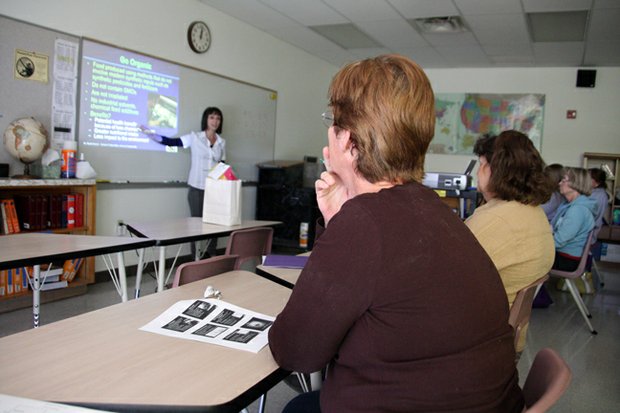
ASU professor Nicole Darnall taught a session on living a sustainable lifestyle at the Women’s Wellness Forum. Photo by Pete Aleshire.
Save money.
Get healthy.
Save the planet.
Why wait?
That’s the message Arizona State University professor Nicole Darnall delivered recently to a roomful of savvy planet
Prof. Nicole Darnall
huggers at the Women’s Wellness Forum. The daylong event drew about 240 women to listen to speakers on an array of topics.
Darnall offered a gripping presentation that started with global disaster, but ended with a reassuringly doable list of steps individuals can take to solve the seemingly overwhelming problems.
As I wrote at the end of last Friday’s article on Autism and bees, “I hope to publish a summary of a fascinating presentation given to a local women’s group here in Payson that shows the many obvious and easy steps we can all take to revert back to a resilient life on this planet.”
It’s so easy to be overwhelmed by the barrage of ‘doom and gloom’ stories that abound and, make no mistake, if each of us do nothing, the future does look ‘interesting’!
I don’t know about you but the degree of awareness of the changes we all need to make is huge and growing. So Prof. Darnall was right on the button when she spoke to that women’s forum. For instance,
“Livestock generates more greenhouse gases than all the planes, trains and automobiles on the planet,” said Darnall. In part, that’s because the methane from, well, the other end of cows, has 21 times the greenhouse gas warming effect as carbon dioxide.
Darnall’s solution? Meatless Mondays — to start curving that scary trend line.
A few paragraphs later,
The average person generates 4.5 pounds of trash daily. Of that, 75 percent can be recycled — but less than 30 percent actually ends up recycled.
Worse yet, we discard half of the food we produce, which works out to 474 pounds of wasted food per person.
Once again: The answer lies surprisingly close to home.
Start a composting bin: That would reduce discarded trash by about one-third — while increasing the health of your garden, not to mention averting the production of chemical fertilizers.
Then there’s this …..
Quit buying the plastic water bottles that add 25 million items to the waste stream every day. After all, tap water must meet higher health and purity standards than bottled water.
And not forgetting …..
Worried about all the bleach and other chemicals used in household cleaning products? No problem, said Darnall — before offering up a recipe for environmentally friendly scouring involving vinegar and baking soda. You can also ditch the ammonia in the window cleaner, with a mixture of corn starch — great for smudged mirrors and spots in the carpet.
Then this touched the spot for this part of Arizona with this year’s rainfall already far below the 30-year average.
Worried about the reckless use of fresh water, with predictions of longer deeper droughts well established?
Shorter showers can save 150 gallons each time — and a low-flow shower head can save 175 gallons a month. Get rid of the lawn, cut the water bill by 60 percent.
Rounding off by …..
But here’s the kicker, she said — you can save your wallet by saving the planet.
Make your cleaning products and you not only protect streams you also save money.
Change over to LED lights, you not only reduce greenhouse gas emissions — you save money.
Install solar tubes and you reduce greenhouse gases — and save money.
Eat less meat and reduce global warming — and also lose weight.
And heck: You might even make the cows happy.
Delightful close to the article that is Pete Ayleshire all over. (Pete teaches the creative writing class at the local extension college that Jean and I have been attending for two terms.)
It seems to me that one of the many lucky aspects of living in Payson is having the Arizona State University (ASU) School of Sustainability in the area and being able to draw on the expertise of people such as Prof. Darnall.
So look around and see what small steps you can take to make a difference, and start those small changes. As in the words of an old saying from my England days, ‘By the inch, it’s a cinch, by the yard it’s hard!‘
On April 14th, 1912, at 23.40 ships time, the Titanic struck an iceberg and the rest is history. I’m not going to add to the wealth of information available on this sad centenary except to say that 1,514 people lost their lives and they and their descendants should be held in our prayers. And to recognise that one of those who lost his life was young ‘Jack’ Phillips, Senior Wireless Operator, who persisted in sending out distress messages by Morse Code to the very last, thus enabling the RMS Carpathia to rescue 710 souls.
Rest In Peace
Below are some local times to assist you in offering up a quiet thought as one hundred years ago to the moment the sound of a liner hitting an iceberg reverberated around the world.
RMS Titanic Ships Time April 14th 2340 – 11.40 PM
GMT/UTC April 15th 0240 – 2.40 AM
British Summer Time April 15th 0340 – 3.40 AM
Arizona/California April 14th 1940 – 7.40 PM
New York April 14th 2240 – 10.40 PM
London April 15th 0340 – 3.40 AM
Paris April 15th 0440 – 4.40 AM
Moscow April 15th 0640 – 6.40 AM
Singapore April 15th 1040 – 10.40 AM
Sydney, Australia April 15th 1240 – 2.40 PM
More world times may be calculated from this website.
If you eat food, and hope to do so in the future, read this!
I subscribe to Food Freedom News and often read their articles when they appear in my ‘in-box’. Especially so yesterday morning when the headline jumped off the ‘page’ at me: Autism and Disappearing Bees: A Common Denominator?
So, in a sense, hand-in-hand with the article in yesterday’s Learning from DogsFood, glorious food! Because if trying to feed 9 billion people living on a planet where ‘farmers holding seeds that won’t sprout‘ means the even greater use of chemicals then ….. then, I don’t know what!
The Food Freedom website showed that the article came from Brian Moench of the Common Dreams website. Not a website I had come across before but one that quickly impressed me!
A few days ago the Salt Lake Tribune’s front page headline declared, “Highest rate in the nation, 1 in 32 Utah boys has autism.” This is a national public health emergency, whose epicenter is Utah, Gov. Herbert. A more obscure story on the same day read: “New pesticides linked to bee population collapse.” If you eat food, and hope to do so in the future, this is another national emergency, Pres. Obama. A common denominator may underlie both headlines.
A honeybee pollinates a flower in a citrus grove just coming into blossom. (Photograph: David Silverman/Getty Images)
A Stanford University study with 192 pairs of twins, with one twin autistic and one not, found that genetics accounts for 38% of the risk of autism, and environmental factors account for 62%.
Supporting an environmental/genetic tag team are other studies showing autistic children and their mothers have a high rate of a genetic deficiency in the production of glutathione, an anti-oxidant and the body’s primary means of detoxifying heavy metals. High levels of toxic metals in children are strongly correlated with the severity of autism. Low levels of glutathione, coupled with high production of another chemical, homocysteine, increase the chance of a mother having an autistic child to one in three. That autism is four times more common among boys than girls is likely related to a defect in the single male X chromosome contributing to anti-oxidant deficiency. There is no such thing as a genetic disease epidemic because genes don’t change that quickly. So the alarming rise in autism must be the result of increased environmental exposures that exploit these genetic defects.
During the critical first three months of gestation a human embryo adds 250,000 brain cells per minute reaching 200 billion by the fifth month. There is no chemical elixir that improves this biologic miracle, but thousands of toxic substances can cross the placenta and impair that process, leaving brain cells stressed, inflamed, less well developed, fewer in number and with fewer connections with each other all of which diminish brain function. The opportunity to repair the resulting deficits later on is limited.
The list of autism’s environmental suspects is long and comes from many studies that show higher rates of autism with greater exposure to flame retardants, plasticizers like BPA, pesticides, endocrine disruptors in personal care products, heavy metals in air pollution, mercury, and pharmaceuticals like anti-depressants. [my emphasis] (Utah’s highest in the nation autism rates are matched by the highest rates of anti-depressant use and the highest mercury levels in the country in the Great Salt Lake).
Doctors have long advised women during pregnancy to avoid any unnecessary consumption of drugs or chemicals. But as participants in modern society we are all now exposed to over 83,000 chemicals from the food we eat, the water we drink, the air we breathe and the consumer products we use. Pregnant women and their children have 100 times more chemical exposures today than 50 years ago. The average newborn has over 200 different chemicals and heavy metals contaminating its blood when it takes its first breath. 158 of them are toxic to the brain. Little wonder that rates of autism, attention deficit and behavioral disorders are all on the rise.
How does this relate to vanishing bees and our food supply? Two new studies, published simultaneously in the journal Science, show that the rapid rise in use of insecticides is likely responsible for the mass disappearance of bee populations. The world’s food chain hangs in the balance because 90% of native plants require pollinators to survive.
The brain of insects is the intended target of these insecticides. They disrupt the bees homing behavior and their ability to return to the hive, kind of like “bee autism.” But insects are different than humans, right? Human and insect nerve cells share the same basic biologic infrastructure. Chemicals that interrupt electrical impulses in insect nerves will do the same to humans. But humans are much bigger than insects and the doses to humans are miniscule, right?
During critical first trimester development a human is no bigger than an insect so there is every reason to believe that pesticides could wreak havoc with the developing brain of a human embryo. But human embryos aren’t out in corn fields being sprayed with insecticides, are they? A recent study showed that every human tested had the world’s best selling pesticide, Roundup, detectable in their urine at concentrations between five and twenty times the level considered safe for drinking water.
The autism epidemic and disappearing bees are real public health emergencies created by allowing our world to be overwhelmed by environmental toxins. Environmental protection is human protection, especially for the smallest and most vulnerable among us.
Please bring this to the notice of any couples who you know are planning for a family!
If all this sort of information makes you want to curl up and kiss your backside goodnight, then hold on. Next week I hope to publish a summary of a fascinating presentation given to a local women’s group here in Payson that shows the many obvious and easy steps we can all take to revert back to a resilient life on this planet.
A Biological Basis for the Unconscious? Surely not?
Ten days ago or thereabouts, I saw a piece on Big Think about the unconscious. The title of the piece was as the sub-heading: A Biological Basis for the Unconscious? I was intrigued, to say the least, and wanted to write about that on Learning from Dogs.
Today, the question of how people make decisions is an animated and essential one, capturing the attention of everyone from neuroscientists to lawyers to artists. In 1956, there was one person in all of New York known for his work on the brain: Harry Grundfest. An aspiring psychiatrist who was born in Austria in the 1930’s, Eric Kandel took an elective in brain science during medical school and found himself studying alongside Grudfest at Columbia University.
“What is it you want to study?” Grundfest asked Kandel. “I want to know where the id, the ego, and the super-ego are located in the brain,” Kandel replied. Grundfest looked at him as if he was crazy. “I haven’t got the foggiest notion whether these constructs exist,” he said. “But the way to approach the brain is to study it one cell at a time. Why don’t you study how the cells work?”
Now it would be improper to republish the whole article, not having permission to so do, and I thoroughly recommend you going to the article here and reading it completely from the Big Think website.
But there are a number of interesting videos on YouTube and the one I have selected is a great example of Kandel’s power of mind. As the short description of the video reveals, “A Conversation With Nobel Laureate Eric Kandel, Who Continues to Look Forward at 80.”
Brilliant mathematics without the need for a calculator!
Thanks to the bottomless resources of the Internet, I could quickly find a relevant quote or two to open up today’s Post. Rene Descartes (1596-1650) was reputed to have said, “Perfect numbers like perfect men are very rare.”
Sorry, couldn’t resist that! It wasn’t the quote relevant to this essay but it was too good to miss. (Descartes was also the person who coined the phrase: I think therefore I am!)
The quote that I thought was relevant was this one from Descartes, “With me everything turns into mathematics.” Well until I read something recently on the Big Think website I would have been certain that the emotions, such as happiness, were well beyond reach of the logical power of mathematics. I was wrong!
….. argues (against Einstein, as it happens), that everything that counts can and ought to be counted. A hotelier by trade, he says that GDP and the bottom line are blunt instruments for measuring the health of a society or a business. After the dot.com crash of 2001, and a visit to the Buddhist nation of Bhutan, which has a “Gross National Happiness” index, Conley and his team decided to create indices for measuring the well-being of their employees and customers.
And a paragraph later continues,
In Emotional Equations, Conley takes the mathematics of human happiness a step further, creating simple formulas like anxiety = uncertainty x powerlessness, which, when used systematically, he says, can give individuals and organizations a concrete method for addressing the human needs that drive them.
The description of the book on the Amazon website is thus,
Mr Chip Conley
Using brilliantly simple math that illuminates universal emotional truths, Emotional Equations crystallizes some of life’s toughest challenges into manageable facets that readers can see clearly—and bits they can control. Popular motivational speaker and bestselling author Chip Conley has created an exciting, new, immediately accessible visual lexicon for mastering the age of uncertainty. Making mathematics out of emotions may seem a counterintuitive idea, but it’s an inspiring and incredibly effective one in Chip Conley’s hands. When Conley, dynamic author of the bestselling Peak, suffered a series of tragedies, he began using what he came to call “Emotional Equations” (like Joy = Love – Fear) to help him focus on the variables in life that he could deal with, rather than ruminating on the unchangeable constants he couldn’t, like the bad economy, death, and taxes. Now this award-winning entrepreneur shares his amazing new self-help paradigm with the rest of us. Emotional Equations offers an immediately understandable means of identifying the elements in our lives that we can change, those we can’t, and how they interact to create the emotions that define us and can help or hurt our progress through life. Equations like “Despair = Suffering – Meaning” and “Happiness = Wanting What You Have/Having What You Want” (Which Chip presented at the prestigious TED conference) have been reviewed for mathematical and psychological accuracy by experts. Conley shows how to solve them through life examples and stories of inspiring people and role models who have worked them through in their own lives. In these turbulent times, when so many are trying to become “superhuman” to deal with our own and the world’s problems, Emotional Equations arms readers with effective formulas for becoming super human beings.
So it all seems not quite so daft as one might initially guess. Indeed, settle down for twenty minutes and watch Chip eloquently explain his ideas captured at that TED Conference referred to above.
There’s also an audio conversation with Mr. Conley that you can download free from here.
Finally, let me close with yet another quote from Rene Descartes, “It is not enough to have a good mind. The main thing is to use it well.” Amen to that!
Maybe there’s a new twist to that rather derogatory phrase!
For the life of me, I can’t remember how this story came to my ‘in-box’ but most likely it was from my Big Think subscription. But I do know that the story has spread like wild-fire (poor choice of simile for Arizona!) and not without good reason.
Benefits of Taking Your Dog to Work May Not Be Far-Fetched
Man’s best friend may make a positive difference in the workplace by reducing stress and making the job more satisfying for other employees, according to a Virginia Commonwealth University study.
Stress is a major contributor to employee absenteeism, morale and burnout and results in significant loss of productivity and resources. But a preliminary study, published in the March issue of the International Journal of Workplace Health Management, found that dogs in the workplace may buffer the impact of stress during the workday for their owners and make the job more satisfying for those with whom they come into contact.
The VCU researchers compared employees who bring their dogs to work, employees who do not bring their dogs to work and employees without pets in the areas of stress, job satisfaction, organizational commitment and support.
Bring your dog to work to lower stress; Companies that allow pooches have happier workers
Amazon, Ben & Jerry’s and Zynga all have pup-friendly policies
A new study supports the stress-reducing benefits of bringing your pooch to work — to play with, look at, and pet while working.
According to a Virginia Commonwealth University study, having a dog at work not only reduces the owners’ stress level but also increased the level of job satisfaction for other employees as well. The study, announced Thursday, was published in the International Journal of Workplace Health Management.
“Dogs in the workplace can make a positive difference,” said head researcher Randolph T. Barker. “The differences in perceived stress between days the dog was present and absent were significant. The employees as a whole had higher job satisfaction than industry norms.”
Here’s a great example. The photograph below,
One hand for the desk and one for the dog!
comes from the website of Interior Design Hound (seriously) where the by-line is Good Design with a Canine Twist! (No, I’m not making it up!)
Anyway, back to that NY Daily News item,
The study took place at Replacements Ltd, a service-manufacturing-retail company located in North Carolina, which employs approximately 550 people. The company has a dog friendly policy, similar to other companies such as Amazon, Ben & Jerry’s and Zynga, according to CBS News, with around 20 to 30 dogs romping through the office every day. The study took place over a period of one work week, and subjects completing both surveys and saliva samples to measure stress levels.
According to The Humane Society of the United States, there are numerous benefits to having dogs at work, including improved staff morale, worker productivity, and camaraderie among employees.
Numerous studies have shown that having a pet is a good investment for your health. One study found that having a pet lowered your risk factors for heart disease, and another found that dogs encourage more consistent walking and exercise.
Seems pretty obvious to me.
Another tough day at the office!
Mind you, going back to the metaphorical ‘having a dog of a day‘ here’s one woman who probably wished she hadn’t got out of bed that morning,
Woman has a dog of a day in court
Sydney – If you have a phobia about dogs and hurt yourself running away from one, is it your own fault or should the owner of the dog pay compensation?
An Australian judge on Wednesday ruled against a woman who had put that case to him and ordered her to pay substantial legal costs.
Mileva Novakovic took her brother, Michael Stekovic, and his wife to the New South Wales Court of Appeal to try to overturn a lower court verdict that found they were not liable for injuries she sustained at his house in 2008.
Novakovic slipped and fell in a panic over finding a dog in their lounge room. She admitted to a fear of dogs and said she was compelled to run despite Cougar, a mastiff, showing no aggression towards her.







 Learning from Dogs