I am indebted to my life-long friend, Dan Gomez, for this piece.
Background (Personal nostalgia warning!!!)
Dan and I go back too many years; I mean way too many! He and I met in Spring 1979 when I was addressing a national conference of US Commodore PC dealers in Boston, USA. I was there to promote a British Word Processing program called Wordcraft, written by Peter Dowson, that I had exclusive rights to. I was also a Commodore PC dealer in Colchester, Essex, England; indeed I was the 8th dealer appointed in the UK. The luck in finding Wordcraft is underlined by the fact that between 1970 and 1978 I was a salesman with IBM UK Office Products division and ended up as a word-processing specialist salesman for IBM.
Anyway, in my sales pitch to these US dealers, I used the word ‘fortnight’, a common term in England. From somewhere out in the audience, this Californian voice shouted out, “Hey Handover, what’s a fortnight?” Many readers will be aware that Americans don’t use that term. That Californian voice was Dan!
From that cheeky start came a great relationship including Dan being my West Coast distributor for Wordcraft. It was Dan’s sister, whom I have also known for countless years, who invited me to her Winter home in San Carlos, Mexico, to spend Christmas 2007 with her and her husband and which was the catalyst of me meeting Jean, who is now by most beautiful wife!

————————ooOOOoo————————
OK, to the theme of this article.
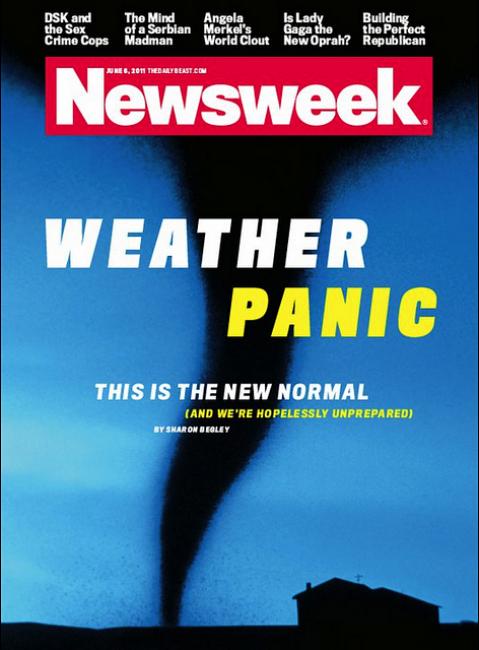
Shortly after the Newsweek ‘Weather Panic‘ article on the 10th, Dan sent me this email,
Paul – Saw your blog vis a vis Newsweek’s recent cover.
Don’t forget to publish the other side of this perennial story without all the sensationalism of selling newspapers and proselytizing to the unwashed masses or you could end up drinking your own cool-aid. The science of weather cycles, sun activity, ocean currents, high-altitude jet streams, colliding warm/cool fronts have been at work long before any creature walked the earth, let alone man. The facts demonstrate this time and time again. Good science is skeptical science and needs to be viewed carefully by way of verifiable and constant testing of hypotheses.
The below article, although not at all sexy, has a different view, in general, as to the vagaries of weather extremes. There are many like this and represent unbiased, and to some, unpopular scientific reasoning at work.
Just food for thought.
–DG
He then included this.
Recent Weather Extremes: Global Warming Fingerprint Not
by Chip Knappenberger
March 21, 2011
On occasion, I have the opportunity to assist Dr. Patrick J. Michaels (Senior Fellow in Environmental Studies at the Cato Institute) in reviewing the latest scientific research on climate change. When we happen upon findings in the peer-reviewed scientific literature that may not have received the media attention that they deserved, or have been misinterpreted in the popular press, Pat sometimes covers them over at the “Current Wisdom” section of the Cato@Liberty blog site.
His latest posting there highlights research findings that show that extreme weather events during last summer and the previous two winters can be fully explained by natural climate variability—and that “global warming” need not (and should not) be invoked.
This topic—whether or not weather extremes (or at least some portion of them) can be attributed to anthropogenic global warming (or, as Dr. Pielke Sr., prefers, anthropogenic climate change)—has been garnering a lot of attention as of late. It was a major reason for holding the House Subcommittee hearing last week, is a hot topic of discussion in the press, and is the subject of an in-progress major report from the Intergovernmental Panel on Climate Change (IPCC).
As such, I wanted to highlight some of the findings that Pat reported on. I encourage a visit to the full article “Overplaying the Human Contribution to Recent Weather Extremes” over at Cato@Liberty.
The Great Russian Heat Wave of 2010
A new paper by Randall Dole and colleagues from the Physical Sciences Division (PSD) of the Earth System Research Laboratory (ESRL) of the National Oceanic and Atmospheric Administration (NOAA) examined the events leading up to and causing the big heat wave in Russia last summer (which was also part of an atmospheric pattern that was connected to the floods in Pakistan). Here is what they found:
“Our analysis points to a primarily natural cause for the Russian heat wave. This event appears to be mainly due to internal atmospheric dynamical processes that produced and maintained an intense and long-lived blocking event. Results from prior studies suggest that it is likely that the intensity of the heat wave was further increased by regional land surface feedbacks. The absence of long-term trends in regional mean temperatures and variability together with the [climate] model results indicate that it is very unlikely that warming attributable to increasing greenhouse gas concentrations contributed substantially to the magnitude of this heat wave.”
As Pat commented, “Can’t be much clearer than that.”
Recent Winter Severity
From Pat’s article:
Another soon-to-be released paper to appear in Geophysical Research Lettersdescribes the results of using the seasonal weather prediction model from the European Center for Medium-Range Weather Forecasts (ECMWF) to help untangle the causes of the unusual atmospheric circulation patterns that gave rise to the harsh winter of 2009-2010 on both sides of the Atlantic. A team of ECMWF scientists led by Thomas Jung went back and did experiments changing initial conditions that were fed into the ECMWF model and then assessed how well the model simulated the known weather patterns of the winter of 2009-2010. The different set of initial conditions was selected so as to test all the pet theories behind the origins of the harsh winter. Jung et al. describe their investigations this way: “Here, the origin and predictability of the unusual winter of 2009/10 are explored through numerical experimentation with the ECMWF Monthly forecasting system. More specifically, the role of anomalies in sea surface temperature (SST) and sea ice, the tropical atmospheric circulation, the stratospheric polar vortex, solar insolation and near surface temperature (proxy for snow cover) are examined.”
In a nutshell, here is what Jung et al. found:
“The results of this study, therefore, increase the likelihood that both the development and persistence of negative NAO phase [an atmospheric circulation pattern that was largely behind the harsh winter conditions] resulted from internal atmospheric dynamical processes.”
Or, as Pat put it “Translation: Random variability.”
Pat also examined a third study by Roseanne D’Arrigo and colleagues who found an historical analog of the conditions responsible for the harsh winter of 2009-2010 way back in 1783-1784. The winter of 1783-1784 was a historically extreme one on both sides of the Atlantic and has long been associated with a large volcanic eruption that occurred in Iceland during the summer of 1783. Even Benjamin Franklin connected the winter conditions to the volcano. But D’Arrigo and colleagues now suggest a different mechanism. According to Pat:
But in their new study, Roseanne D’Arrigo and colleagues conclude that the harshness of that winter primarily was the result of anomalous atmospheric circulation patterns that closely resembled those observed during the winter of 2009-10, and that the previous summer’s volcanic eruption played a far less prominent role:
“Our results suggest that Franklin and others may have been mistaken in attributing winter conditions in 1783-4 mainly to Laki or another eruption, rather than unforced variability.
“Similarly, conditions during the 2009-10 winter likely resulted from natural [atmospheric] variability, not tied to greenhouse gas forcing… Evidence thus suggests that these winters were linked to the rare but natural occurrence of negative NAO and El Niño events.”
Bottom Line
The take home message of Pat’s post is worth repeating:
The point is that natural variability can and does produce extreme events on every time scale, from days (e.g., individual storms), weeks (e.g., the Russian heat wave), months (e.g., the winter of 2009-10), decades (e.g., the lack of global warming since 1998), centuries (e.g., the Little Ice Age), millennia (e.g., the cycle of major Ice Ages), and eons (e.g., snowball earth).
Folks would do well to keep this in mind next time global warming is being posited for the weather disaster du jour. Almost assuredly, it is all hype and little might.
Be sure to check out Pat’s full article which includes much more in depth coverage of these three soon-to-be-released scientific studies.
————————ooOOOoo————————
I need to mull over this when I am back home with more time. In the meantime, comments from readers most welcomed.