Category: Capitalism

Government Taxation Departments, don’t you just love them!

Sent in by John Lewis, an old (English) friend of this Blog.

Apparently this is a real reply from the (UK) Inland Revenue. The Guardian newspaper had to ask for special permission to print it.

Dear Mr Addison,

I am writing to you to express our thanks for your more than prompt reply to our latest communication, and also to answer some of the points you raise.   I will address them, as ever, in order.

Firstly, I must take issue with your description of our last as a “begging letter”.    It might perhaps more properly be referred to as a “tax demand”.    This is how we at the Inland Revenue have always,  for reasons of accuracy,  traditionally referred to such documents.

Secondly, your frustration at our adding to the “endless stream of crapulent whining and panhandling vomited daily through the letterbox on to the doormat” has been noted.    However, whilst I have naturally not seen the other letters to which you refer I would cautiously suggest that their being from “pauper councils, Lombardy pirate banking houses and pissant gas-mongerers”  might indicate that your decision to  “file them next to the toilet in case of emergencies”  is at best a little ill-advised.    In common with my own organisation,  it is unlikely that the senders of these letters do see you as a “lackwit bumpkin” or, come to that, a “sodding charity”.    More likely they see you as a citizen of Great Britain , with a responsibility to contribute to the upkeep of the nation as a whole.

Which brings me to my next point.   Whilst there may be some spirit of truth in your assertion that the taxes you pay  “go to shore up the canker-blighted, toppling folly that is the Public Services”,  a moment’s rudimentary calculation ought to disabuse you of the notion that the government in any way expects you to “stump up for the whole damned party”  yourself.    The estimates you provide for the Chancellor’s disbursement of the funds levied by taxation,  whilst colourful,  are,  in fairness,  a little off the mark.     Less than you seem to imagine is spent on “junkets for Bunterish lickspittles”  and  “dancing whores”  whilst far more than you have accounted for is allocated to,  for example,  “that box-ticking facade of a university system.”

A couple of technical points arising from direct queries:

1. The reason we don’t simply write  “Muggins” on the envelope has to do with the vagaries of the postal system;

2. You can rest assured that  “sucking the very marrow of those with nothing else to give”  has never been considered as a practice because even if the Personal Allowance didn’t render it irrelevant,  the sheer medical logistics involved would make it financially unviable.

I trust this has helped.   In the meantime,  whilst I would not in any way wish to influence your decision one way or the other,  I ought to point out that even if you did choose to  “give the whole foul jamboree up and go and live in India ”  you would still owe us the money.

Please send it to us by Friday.

Yours sincerely,
H J Lee
Customer Relations
Inland Revenue

Words fail one

Income inequality, when it becomes excessive, is very corrosive to a society.

This is clearly a complex subject because one man’s excess is another man’s just reward for building a successful business that employs his fellow citizens.

Nonetheless, I do want to touch on this sensitive area because, to my mind, they are connected with the tragic story that is the point of this article.

But first, a couple of quotes from an article by Prof. G. William Domhoff of the Sociology Department of the University of California at Santa Cruz.  It was entitled Wealth, Income, Power.

This document presents details on the wealth and income distributions in the United States, and explains how we use these two distributions as power indicators.

Some of the information may come as a surprise to many people. In fact, I know it will be a surprise and then some, because of a recent study (Norton & Ariely, 2010) showing that most Americans (high income or low income, female or male, young or old, Republican or Democrat) have no idea just how concentrated the wealth distribution actually is.

Later on, Prof. Domhoff writes:

The Wealth Distribution

In the United States, wealth is highly concentrated in a relatively few hands. As of 2007, the top 1% of households (the upper class) owned 34.6% of all privately held wealth, and the next 19% (the managerial, professional, and small business stratum) had 50.5%, which means that just 20% of the people owned a remarkable 85%, leaving only 15% of the wealth for the bottom 80% (wage and salary workers). In terms of financial wealth (total net worth minus the value of one’s home), the top 1% of households had an even greater share: 42.7%. Table 1 and Figure 1 present further details drawn from the careful work of economist Edward N. Wolff at New York University (2010).

That table and the whole article is powerful and a well-worth reading. Read it here.

Stay with me a little longer.  Here’s an extract from an article from Nicholos Kristof of the New York Times written in November last year.

Nicholas Kristof

In my reporting, I regularly travel to banana republics notorious for their inequality. In some of these plutocracies, the richest 1 percent of the population gobbles up 20 percent of the national pie.

But guess what? You no longer need to travel to distant and dangerous countries to observe such rapacious inequality. We now have it right here at home — and in the aftermath of Tuesday’s election, it may get worse.

The richest 1 percent of Americans now take home almost 24 percent of income, up from almost 9 percent in 1976. As Timothy Noah of Slate noted in an excellent series on inequality, the United States now arguably has a more unequal distribution of wealth than traditional banana republics like Nicaragua, Venezuela and Guyana.

C.E.O.’s of the largest American companies earned an average of 42 times as much as the average worker in 1980, but 531 times as much in 2001. Perhaps the most astounding statistic is this: From 1980 to 2005, more than four-fifths of the total increase in American incomes went to the richest 1 percent.

By the way, Kristof has his own blog site and added material from him about this topic and readers’ comments are here.

Now to the core of this article on Learning from Dogs which, I passionately believe, is closely tied in to the background theme already expressed here.  It’s from the blogsite Corrente and, once again, I am indebted to Naked Capitalism for having it in a recent set of links.

It concerns Jack, his family and their house.

The House that Jack’s Bank Took

Jack was a friendly man, who always had a pleasant word and a smile and handshake for everyone. The men hung with him at barbeques and discussed sports. He was strong, had a belly, and always wore a baseball cap. He was married to his high school sweetheart, Mary. He was good to his 4 kids and took care of his oldest child when he had a breakdown in his early twenties. He went to all school and family events and encouraged his children in their dreams. He took care of the family needs and finances. He was a small business owner and had invented his product, which a short while ago became outmoded. He always decorated the house with lots of Christmas decorations and candles. They are still up. He lost his house to foreclosure and the family was given 3 days to move out.

He drove into the deep woods and drank poison to make sure he was dead. I knew him. My family knew him; he lived within walking distance of one of us. At his funeral his childhood sweetheart and their children told a lot of Jack stories. The family did their best to resurrect him to our eyes. One of his kids sang and the eldest read a poem he’d written. Mary said she didn’t know what she was going to do and that she would now have to rely on those from town sitting in the packed chapel pews. There are other houses nearby that haven’t been foreclosed on but Jack’s house was nice and had a good view. The bank has now given Mary 3 weeks to move out.

It was written on the 15th February, 2011; you can read it here.  Click on the link and read some of the comments expressed – very powerful.

Wish I could think of something apt to say but I can’t.  All I can feel is great sadness and a horrible feeling in the pit of my stomach that this ‘Jack’ story is being echoed in many other places.

Food prices are up, up and up!

Interesting release from the Earth Policy Institute.

On the 3rd February I wrote a piece about the above Institute of which I had recently become aware.  That was in conjunction with the book World on the Edge that I had started reading.  Since then I have been summarising chapters on Learning from Dogs under the general heading of Total, Utter Madness.

So with food prices continuing to reach record levels around the world, with all the implications this carries for millions of families, I was interested to read the following which was emailed to me on the 15th from the EPI.

World One Poor Harvest Away From Chaos

www.earth-policy.org/plan_b_updates/2011/update91

By Lester R. Brown
Earth Policy Release
Plan B Update
February 15, 2011

Today there are three sources of growing demand for food: population growth; rising affluence and the associated jump in meat, milk, and egg consumption; and the use of grain to produce fuel for cars.

In early January, the U.N. Food and Agriculture Organization (FAO) reported that its Food Price Index had reached an all-time high in December, exceeding the previous record set during the 2007-08 price surge. Even more alarming, on February 3rd, the FAO announced that the December record had been broken in January as prices climbed an additional 3 percent.

Will this rise in food prices continue in the months ahead? In all likelihood we will see further rises that will take the world into uncharted territory in the relationship between food prices and political stability.

Everything now depends on this year’s harvest. Lowering food prices to a more comfortable level will require a bumper grain harvest, one much larger than the record harvest of 2008 that combined with the economic recession to end the 2007-08 grain price climb.

If the world has a poor harvest this year, food prices will rise to previously unimaginable levels. Food riots will multiply, political unrest will spread and governments will fall. The world is now one poor harvest away from chaos in world grain markets.

Over the longer term, expanding food production rapidly is becoming more difficult as food bubbles based on the overpumping of underground water burst, shrinking grain harvests in many countries. Meanwhile, increasing climate volatility, including more frequent, more extreme weather events, will make the expansion of production more erratic.

Some 18 countries have inflated their food production in recent decades by overpumping aquifers to irrigate their crops. Among these are China, India, and the United States, the big three grain producers.

When water-based food bubbles burst in some countries, they will dramatically reduce production. In others, they may only slow production growth. In Saudi Arabia, which was wheat self-sufficient for more than 20 years, the wheat harvest is collapsing and will likely disappear entirely within a year or so as the country’s fossil (nonreplenishable) aquifer, is depleted.

In Syria and Iraq, grain harvests are slowly shrinking as irrigation wells dry up. Yemen is a hydrological basket case, where water tables are falling throughout the country and wells are going dry. These bursting food bubbles make the Arab Middle East the first geographic region where aquifer depletion is shrinking the grain harvest.

While these Middle East declines are dramatic, the largest water-based food bubbles are in India and China. A World Bank study indicates that 175 million people in India are being fed with grain produced by overpumping. In China, overpumping is feeding 130 million people. Spreading water shortages in both of these population giants are making it more difficult to expand their food supplies.

Beyond irrigation wells going dry, farmers must contend with climate change. Crop ecologists have a rule of thumb that for each 1-degree-Celsius rise in temperature during the growing season, grain yields drop 10 percent. Thus it was no surprise that searing temperatures in western Russia last summer shrank the grain harvest by 40 percent.

On the demand side of the food equation, there are now three sources of growth. First is population growth. There will be 219,000 people at the dinner table tonight who were not there last night, many of them with empty plates. Second is rising affluence. Some three billion people are now trying to move up the food chain, consuming more grain-intensive meat, milk, and eggs. And third, massive amounts of grain are being converted into oil, i.e. ethanol, to fuel cars. Roughly 120 million tons of the 400-million-ton 2010 U.S. grain harvest are going to ethanol distilleries.

Encouragingly, President Sarkozy of France vowed to use his term as president of the G-20 in 2011 to stabilize world food prices. Thus far the talk has been about such measures as regulating export restrictions and speculation, but if the G-20 ends up treating the symptoms and not the causes of rising food prices, the effort will be of little avail.

What is needed now is a worldwide effort to raise water productivity, similar to the one launched by the international community a half century ago to raise cropland productivity. This earlier effort tripled the world grain yield per acre between 1950 and 2010.

On the climate front, the goal of cutting carbon emissions 80 percent by 2050—the widely accepted goal by governments—is not sufficient. The challenge now is to cut carbon emissions 80 percent by 2020 with a World War II-type mobilization to raise energy efficiency and to shift from fossil fuels to wind, solar, and geothermal energy.

On the demand side, we need to accelerate the shift to smaller families. There are 215 million women in the world who want to plan their families, but who lack access to family planning services. They and their families represent over a billion of the world’s poorest people. While filling the family planning gap, we need to simultaneously launch an all-out effort to eradicate poverty. Once under way, these two trends reinforce each other.

And in an increasingly hungry world, converting grain into fuel for cars is not the way to go. It is time to remove subsidies for converting grain and other crops into automotive fuel. If President Sarkozy can get the G-20 to focus on the causes of rising food prices, and not just the symptoms, then food prices can be stabilized at a more comfortable level.

Lester R. Brown is President of the Earth Policy Institute and author of 
World on the Edge: How to Prevent Environmental and Economic Collapse.

Additional data and information sources at www.earth-policy.org

Feel free to pass this information along to friends, family members, and colleagues!
*This piece was originally published through Global Viewpoint, LA Times Syndicate, on Monday, February 9, 2011.

Small update. Some few hours after writing the above piece, the BBC News Website had an item on soaring food prices.  Here’s a taste (pardon the pun!).

The World Bank says food prices are at “dangerous levels” and have pushed 44 million more people into poverty since last June.

According to the latest edition of its Food Price Watch, prices rose by 15% in the four months between October 2010 and January this year.

Food price inflation is felt disproportionately by the poor, who spend over half their income on food.

If you want to read the February Food Price Watch report published by the World Bank, then that link is here. http://www.worldbank.org/foodcrisis/food_price_watch_report_feb2011.html

People power

A lovely postscript to a recent campaign.

On the 9th February, there was a Post on Learning from Dogs about the flower industry.  Here’s a small extract.

At flower farms in Ecuador and Colombia — the countries that export the most to the U.S. — two-thirds of the workers are women. These women are routinely subjected to harassment and even rape from their male supervisors. They suffer eye infections and miscarriages from consistent contact with dangerous pesticides.

In the weeks leading up to Valentine’s Day and Mother’s Day, they’re routinely forced to work 80-hour weeks with no overtime pay. Attempts to form a union are met with opposition by police and armed forces.

Apparently some 40% of annual purchases of flowers are purchased for Valentine’s Day in the USA.  Anyway, in today’s in-box is this lovely update from Change.org

Dear Paul,

We are blown away by the incredible impact Change.org members have made around the world by starting, joining, and winning dozens of meaningful campaigns over the past few weeks. So we wanted to drop you a quick note to say thank you. And congratulations. And let’s keep fighting.

Here are a few of the top victories and successes we’ve had together:

  • Late last week, the largest florist in the world, 1-800-Flowers, responded to 54,000 Change.org members and agreed to begin selling Fair Trade flowers and insist on a strong code of conduct for all their suppliers to counteract the deplorable working conditions that thousands of female flower workers face in South America. They’ve promised to offer Fair Trade flowers in time for Mother’s Day, making 1-800-Flowers a leader in the industry. (Click here to write a thank you message on 1-800-Flowers’ Facebook wall.)

Nice one!  The website Change.org can be found here.

What a Way to Go

An interesting companion to the World on the Edge book

Regular readers of the Blog will know that yesterday an article was published, the first of a series, looking more closely at the book by Lester Brown of EPI called World on the Edge.  That article followed on from this Post, Group Human Insanity, and yesterday’s Post, Total, Utter Madness, Pt 1.

Today, if you will forgive the emotional battering that the book and this film create, I want to draw your attention to a film that was produced in 2007, called What A Way To Go: Life at the End of Empire.

It was lent to us by John Hulburt, who lives in Payson, and holds many views that are close to the views of the founders of Learning from Dogs.  John has offered to write the odd guest article for the Blog, which is fantastic.

Anyway, back to the film.  Here are a couple of trailers.

A 2-minute trailer giving an overview of the film ..

and another one dipping into more detail.

And if you still want more, then here’s an interview of the two behind the film, Producer Sally Erickson and Writer/Director Tim Bennett.  Twenty-seven minutes long but so what.  Watch it!

We really do have so much to learn from dogs! (Before it’s too late!)


Earth Policy Institute

An organisation that deserves wide support.

Read it!

My copy of Lester Brown’s book World on the Edge arrived on Tuesday and already it’s opening my eyes big time.  I do recommend that you think about purchasing the book, or you may download the entire book for free – details here.

Regular visitors to Learning from Dogs will remember that there was mention in a recent Post, Group Human Insanity about Lester Brown’s new book.  I have subscribed to regular updates from the EPI and recently received the following; it’s worth reproducing in full, with the permission of the EPI.

Restoring Food Security for All
Takes Action on Many Fronts

www.earth-policy.org/book_bytes/2011/wotech12_ss5

By Lester R. Brown

Today there are three sources of growing demand for food: population growth; rising affluence and the associated jump in meat, milk, and egg consumption; and the use of grain to produce fuel for cars.

Population growth is as old as agriculture itself. But the world is now adding close to 80 million people per year. Even worse, the overwhelming majority of these people are being added in countries where cropland is scarce, soils are eroding, and irrigation wells are going dry.

Even as we are multiplying in number, some 3 billion of us are trying to move up the food chain, consuming more grain-intensive livestock products. As incomes rise, annual grain consumption per person climbs from less than 400 pounds, as in India today, to roughly 1,600 pounds, as among those living high on the food chain in the United States, where diets tend to be heavy with meat and dairy products.

When the United States attempted to reduce its oil insecurity by converting grain into ethanol, the growth in world grain demand, traditionally around 20 million tons per year, suddenly jumped to over 50 million tons in 2007. Roughly 119 million tons of the 2009 U.S. grain harvest of 416 million tons went to ethanol distilleries, an amount that exceeds the grain harvests of Canada and Australia combined. This massive ethanol distillery investment in the United States launched an epic competition between cars and people for grain.

On the supply side of the food equation, several trends are making it more difficult to expand production rapidly enough to keep up with demand. These include soil erosion, aquifer depletion, more frequent crop-shrinking heat waves, melting ice sheets, melting mountain glaciers, and the diversion of irrigation water to cities.

Farmers are also losing cropland to nonfarm uses. Cars compete with people not only for the grain supply but also for the cropland itself. The United States, for example, has paved an area for cars larger than the state of Georgia. Every five cars added to the U.S. fleet means another acre of land will be paved over—the equivalent of a football field.

The implications for China of this relationship between cars and cropland are startling. In 2009, for the first time, more cars were sold in China than in the United States. If China were to reach the U.S. ownership rate of three cars for every four people, it would have over a billion cars, more than the entire world has today. The land that would have to be paved to accommodate these cars would be two thirds the area China currently has in rice.

This pressure on cropland worldwide is running up against increased demand for soybeans, which are the key to expanding the production of meat, milk, and eggs. Adding soybean meal to livestock and poultry feed sharply boosts the efficiency with which grain is converted into animal protein. This is why world soybean use climbed from 17 million tons in 1950 to 252 million tons in 2010, a 15-fold jump.

Nowhere is the soaring demand for soybeans more evident than in China, where the crop originated. As recently as 1995, China produced 14 million tons of soybeans and consumed 14 million tons. In 2010, it still produced 14 million tons, but it consumed a staggering 64 million tons. In fact, over half of the world’s soybean exports now go to China.

Demand is climbing, but since scientists have failed to increase yields rapidly, the world gets more soybeans largely by planting more soybeans. The soybean is devouring land in the United States, Brazil, and Argentina, which together account for four fifths of world soybean production and 90 percent of exports.

Ensuring future food security was once the exclusive responsibility of the ministry of agriculture, but this is changing. The minister of agriculture alone, no matter how competent, can no longer be expected to secure food supplies. Indeed, efforts by the minister of health and family planning to lower human fertility may have a greater effect on future food security than efforts in the ministry of agriculture to raise land fertility.

Similarly, if ministries of energy cannot quickly cut carbon emissions, the world will face crop-shrinking heat waves that can massively and unpredictably reduce harvests. Saving the mountain glaciers whose ice melt irrigates much of the cropland in China and India during the dry season is the responsibility of the ministry of energy, not solely the ministry of agriculture.

If the ministries of forestry and agriculture cannot work together to restore tree cover and reduce floods and soil erosion, grain harvests will shrink not only in smaller countries like Haiti and Mongolia, as they are doing, but also in larger countries, such as Russia and Argentina—both wheat exporters.

And where water shortages restrict food output, it will be up to ministries of water resources to do everything possible to raise national water productivity. With water, as with energy, the principal potential now is in increasing efficiency, not expanding supply.

In a world where cropland is scarce and becoming more so, decisions made in ministries of transportation on whether to develop land-consuming, auto-centered transport systems or more-diversified systems that are much less land-intensive will directly affect world food security.

In the end, it is up to ministries of finance to reallocate resources in a way that recognizes the new threats to security posed by agriculture’s deteriorating natural support systems, continuing population growth, human-driven climate change, and spreading water shortages. Since many ministries of government are involved, it is the head of state who must redefine security.

At the international level, we need to address the threat posed by growing climate volatility and the associated rise in food price volatility. The tripling of wheat, rice, corn, and soybean prices between 2007 and 2008 put enormous stresses on governments and low-income consumers. This price volatility also affects producers, since price uncertainty discourages investment by farmers.

In this unstable situation, a new mechanism to stabilize world grain prices is needed—in effect, a World Food Bank (WFB). This body would establish a support price and a ceiling price for wheat, rice, and corn. The WFB would buy grain when prices fell to the support level and return it to the market when prices reached the ceiling level, thus moderating price fluctuations in a way that would benefit both consumers and producers.

One simple way to improve food security is for the United States to eliminate the fuel ethanol subsidy and abolish the mandates that are driving the conversion of grain into fuel. This would help stabilize grain prices and buy some time in which to reverse the environmental and demographic trends that are undermining our future. It would also help relax the political tensions over food security that have emerged within importing countries.

And finally, we all have a role to play as individuals. Whether we decide to bike, bus, or drive to work will affect carbon emissions, climate change, and food security. The size of the car we drive to the supermarket and its effect on climate may indirectly affect the size of the bill at the supermarket checkout counter. At the family level, we need to hold the line at two children. And if we are living high on the food chain, we can eat less grain-intensive livestock products, improving our health while helping to stabilize climate. Food security is something in which we all have a stake—and a responsibility.

#   #   #

Adapted from Chapter 5, “The Emerging Politics of Food Scarcity” and Chapter 12, “Feeding Eight Billion” in Lester R. Brown, World on the Edge: How to Prevent Environmental and Economic Collapse
(New York: W.W. Norton & Company, 2011), available online at www.earth-policy.org/books/wote

Additional data and information sources at www.earth-policy.org

Feel free to pass this information along to friends, family members, and colleagues!

Not much I can add to that!

UPDATE:  Just a few hours after completing the Post, I saw this on the BBC News website.

The global consumption of fish has hit a record high, reaching an average of 17kg per person, a UN report has shown.

Fisheries and aquaculture supplied the world with about 145m tonnes in 2009, providing about 16% of the population’s animal protein intake.

The findings published by the Food and Agriculture Organization (FAO) also stressed that the status of global fish stocks had not improved.

It said that about 32% were overexploited, depleted or recovering.

“That there has been no improvement in the status of stocks is a matter of great concern,” said Richard Grainger, one of the report’s authors and FAO senior fish expert.

Full article on the BBC is here.


The learning curve.

A guest post from Dr John W Lewis.  John and I have known each other for some years now, both of us sharing a group aircraft that was based in Exeter, SW England.  His areas of interest and competence are described here.  But these days when John and I chat about the world in general and nothing in particular we often come back to the topic of innovation.  So bear that in mind as John muses on the rather gloomy nature of a recent post on Learning from Dogs.

John writes:

John Lewis

Having read the recent Post, Group Human Insanity, my first instinct is that I have nothing particular worthwhile to say that has not been said before.  But, of course, the time to apply minds is exactly when the answers don’t readily come to mind, so I will continue!

In a way, it’s probably a case of applying the sentiment on the old wartime poster, “Keep calm and carry on!” or as Winston Churchill said, “I’f you’re going through hell, keep going!”.

That doesn’t mean that we don’t need to change, because we do. It doesn’t mean that we don’t need to put a lot more effort into things that matter, because we do. But, as has been said before, “you can’t connect the dots looking forward, only looking backwards”. In other words, “it is very difficult to make predictions, especially about the future”.

Reading about this kind of thing in books, such as  “Freakonomics” or “Drive” or “Switch” suggests that we don’t really understand the mechanism by which behavioural changes happen in populations, although some of the discoveries of Everett Rogers about the diffusion of innovations is relevant here. To refer to another book, there is probably going to be a lot of “Who moved my cheese?” hemming and hawing behaviour going on too.

All we really know is that when the environment (in the most general sense) is changing rapidly, populations are much better off if they are diverse in their characteristics and behaviour; also I believe (but am not sure) that it’s true to say that increased communication assists populations in adapting to changes in the environment.

So the most important thing to do is to let lots of different people do lots of different things in search of ways forward.  If you like, we need to split up (within the multidimensional behavioural space in which we operate) into smaller groups to dodge the big boulders.

We need to communicate lots of information and lots of ways of interpreting and verifying not only the information itself, but also the operational implications of that information (which may be very different things). Hopefully this will reduce (but it will never eliminate) instances of mass movements (as in stampedes) based on partial information which misdirect substantial resources into activities that turn out to be dead ends.

If we don’t believe that there are any viable ways forward, then we might as well give up and just enjoy what’s left of the good times!

But if there are ways forward, then the way to find them is to have lots of people scouting ahead on lots of fronts and passing information around so that we maximise the chances of finding those ways forward, and having lots of other people striving to find ways to make use of that information and testing out those ways forward.

Whether this is all obvious, or not, I don’t know; but it probably is. One thing we do know is that telling people what to do is emphatically not going to work! Just look at some of the stories on the Breaking The Mould website.

Instead, we are better off when people are asking questions, gathering information and passing it around. I believe that if these behaviours are adopted in a population, as a result of ‘external’ pressures building up, then changes and innovations will inevitably occur, and this is about the best that we can do! Fortunately, I think that is what tends to happen anyway.

So, in a sense, as I referred to above: “Keep calm and carry on”  (By the way, a Google search on that phrase unearths a variety of interesting stuff and variations such as “Get excited and make stuff”)

Regards,
John

Dr John W Lewis
holosoft

Email: john.lewis@holosoft.com
Skype: john_w_lewis
Twitter: @JohnWLewis

Blog: http://observations.johnwlewis.info
LinkedIn: http://www.linkedin.com/in/johnwlewis
FriendFeed: johnwlewis

Afghanistan and truth!

“But better to be hurt by the truth than comforted with a lie.”

The quote is from the film, The Kite Runner, which was based on the book  of the same name written by Khaled Hosseini.

This Post is not about taking a position, at any level, about the West’s involvement in the war in Afghanistan – far too dangerous territory!  But it is a reflection on what truth means.

At first that proposition might appear bizarre, of course we know what truth means. My Thesaurus offers three meanings: Correspondence with fact or truth; Freedom from deceit or falseness; The quality of being actual or factual.  Clear?  H’mmm not really in this instance.

OK, to the motivation behind this article.

Last Sunday two outwardly disconnected actions came together, as often seems to happen, to cause me to ponder on how my opinions are formed.  The actions concerned Afghanistan.

The first was that a friend from the congregation gave me his copy of TIME Magazine for January 17th.  In it was an article about a Black Hawk Medevac unit in Afghanistan.  From the TIME website:

The Birds Of Hope: With A Black Hawk Medevac Unit In Afghanistan

By James Nachtwey Monday, Jan. 17, 2011

General William Tecumseh Sherman got it right. War is hell. But even within the cruelty of war, there exists mercy.

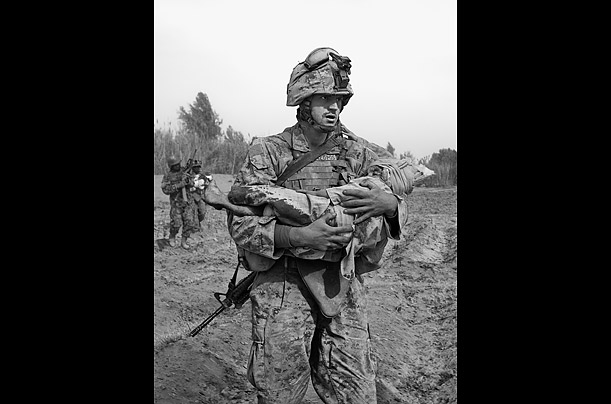
Across a dusty field, two U.S. Marines walk toward a helicopter, each carrying a bloodied and bandaged child. They hold the children as if they were their own. Although at this moment they appear as saviors, a few minutes earlier, they had called in air support in response to enemy fire. The shooter was among children, however (a fact that I have to believe was not known to the Marines), and two were seriously wounded by fragments from machine-gun rounds.

Innocent people are caught in the cross fire in all wars. That’s reality. The two Marines never signed up to hurt kids, and in the shock and confusion, their default reaction was to be protective of the children they indirectly had a hand in wounding. The kids were not left to die, as they might have been in another time and another place by other armies. Instead, a U.S. Army air-ambulance medevac crew was dispatched to fly them to the same medical facility that treats American casualties. If the shooter had survived, he too would have been helped.

Read more: http://www.time.com/time/magazine/article/0,9171,2041191,00.html#ixzz1Byu1S0xj

The article in TIME Magazine contained some emotionally powerful pictures, such as the one below.


A Marine carries an Afghan child.

The full description of the photograph, taken by James Nachtwey for TIME , is Helping Hand
A Marine carries an Afghan child, one of two wounded by coalition aircraft during an air support mission.

My reaction on reading the gruelling story was confused and difficult to articulate clearly but certainly not complimentary! Something along the lines of big and powerful nations, such as the USA, Russia and the United Kingdom, playing out their global strategies with no real insight into the pain and suffering caused by their big ‘war games’.

The second action was that Jean had returned a rental film to the local Blockbuster store and returned with another one that had caught her eye for us to watch on Sunday evening.  That film was The Kite Runner based on the book of the same name by Khaled Hosseini.

There’s a good summary of the plot of the film at WikiPedia.  Here’s a flavour.

In Kabul, prior to the Soviet invasion of Afghanistan, well-to-do young boy Amir and his loyal young Hazara servant Hassan are best of friends. Amir enjoys writing and literature, reading stories to the eager but illiterate Hassan. Amir’s Baba (father), is contemptuous of Amir’s writing and privately regards him as a weakling for letting Hassan protect him from bullies. Baba’s friend Rahim Khan demonstrates interest and encouragement to Amir. Assef, a bully with rancor towards Hazaras, and two accomplices confront Hassan and Amir, but Hassan prevents the attack with a slingshot, a birthday gift from Amir. Assef swears revenge, ridiculing their relationship as mere master and servant. .

Soon the Soviets invade Afghanistan; forcing Baba, a known anti-communist, to flee the country leaving Rahim Khan as property caretaker. En route to Pakistan, Baba bravely risks his life defending a female refugee from a Soviet soldier who demands to rape her in return for safe passage for all. Baba and Amir eventually reach the United States as humble refugees in Fremont, California. Baba tends a gas station while Amir attends community college and vends at a weekly flea market. There, Amir meets Soraya Taheri; Soraya is interested in Amir’s writing although her father, the ex-General Taheri, a proud traditional Pashtun, is contemptuous. Baba is stricken mortally ill but manages to obtain General Taheri’s permission for Amir to marry Soraya. Although Soraya feels bound to confess her previous relationships, they are happily married despite an inability to conceive children. As foreshadowed in the movie’s first scene, Amir’s debut novel is published, dedicated to Rahim Khan who encouraged his writing.

It was a fabulous film, one of the more thought-provoking films seen in many years.  If you haven’t seen it, do so.

So to the point of this article.

The film demonstrated to me that my rather black-and-white opinion of the West’s involvement in Afghanistan was based much more on my instincts that ‘war is bad’ and that the USA tends to throw its military weight around, than having a clue as to the enormous complexities, both at the level of a family and of the nation, that these conflicts entail.

The film showed a much more compassionate aspect to the activities of the USA, specifically in getting involved in Afghanistan and, more generally, in a policy of offering a new home and new hope to those from afar.

And for me, the realisation that while it may be said, ‘There is only one truth’, knowing what that truth is is something very much more challenging!

The first casualty when war comes is truth“. (Hiram W Johnson, senator for California, 1917)

Approaches to ‘growth’.

Some thought-provoking articles on the need, or otherwise, of continued growth.

Intellectually, most people, if they stopped and thought about it, would not challenge the absurdity of the notion that a finite rock in space, Planet Earth, can handle an infinite increase in the demands and resources of that finite planetary body, our home in space!

Yet the reality is very different.  For many complex reasons, way beyond the competencies of this writer to fully explain, we, as in the peoples of Planet Earth, continue to behave as though there are no limits to the resources of this beautiful planet that is home for all of us.

Here are some extracts from some recent items that have passed across my ‘in-box’.

A piece from the CASSE website:

What If We Stopped Fighting for Preservation and Fought Economic Growth Instead?

by Tim Murray

Seriously.

Each time environmentalists rally to defend an endangered habitat, and finally win the battle to designate it as a park “forever,” as Nature Conservancy puts it, the economic growth machine turns to surrounding lands and exploits them ever more intensively, causing more species loss than ever before, putting even more lands under threat. For each acre of land that comes under protection, two acres are developed, and 40% of all species lie outside of parks. Nature Conservancy Canada may indeed have “saved” – at least for now – two million acres, but many more millions have been ruined. And the ruin continues, until, once more, on a dozen other fronts, development comes knocking at the door of a forest, or a marsh or a valley that many hold sacred. Once again, environmentalists, fresh from an earlier conflict, drop everything to rally its defense, and once again, if they are lucky, yet another section of land is declared off-limits to logging, mining and exploration. They are like a fire brigade that never rests, running about, exhausted, trying to extinguish one brush fire after another, year after year, decade after decade, winning battles but losing the war.

Just read again the sentence, “For each acre of land that comes under protection, two acres are developed, and 40% of all species lie outside of parks.” Powerful ideas.

Anyway, do read the article in full and see if it changes your attitude.  Here’s how it ends.

Sir Peter Scott once commented that the World Wildlife Fund would have saved more wildlife it they had dispensed free condoms rather invested in nature reserves. Biodiversity is primarily threatened by human expansion, which may be defined as the potent combination of a growing human population and its growing appetite for resources. Economic growth is the root cause of environmental degradation, and fighting its symptoms is the Labor of Sisyphus.

The next article is from The Christian Science Monitor writing about how scientists are getting a new idea about the rate of loss of polar ice.

The seasonal cooling effect of light-reflecting snow and ice in the Northern Hemisphere may be weakening at twice the rate predicted by climate models, a new study shows, accelerating the impact of global warming.

By Pete Spotts, Staff writer / January 18, 2011

A long-term retreat in snow and ice cover in the Northern Hemisphere is weakening the ability of these seasonal cloaks of white to reflect sunlight back into space and cool global climate, according to a study published this week.

Indeed, over the past 30 years, the cooling effect from this so-called cryosphere – essentially areas covered by snow and ice at least part of the year – appears to have weakened at more than twice the pace projected by global climate models, the research team conducting the work estimates.

This is a well-constructed article, easy to read with obvious conclusions.  Towards the end, the author writes:

Snow appears to have its maximum cooling effect – reflecting the most sunlight back into space – in late spring, as the light strengthens but snow cover is still near its maximum extent for the year. Sea ice in the Arctic Ocean has its biggest effect in June, before its annual summer melt-back accelerates, explains Don Perovich, a researcher at the US Army Corps of Engineers Cold Regions Research and Engineering Laboratory in Hanover, N.H., and a member of the team reporting the results.

The final article that I want to include is one from the website Foreign Policy. I’m going to take the liberty of reproducing it in full because it strikes me as an extremely intelligent commentary on where mankind is in terms of our attitudes to growth.

Thomas Homer-Dixon
ECONOMIES CAN’T JUST KEEP ON GROWING

Humanity has made great strides over the past 2,000 years, and we often assume that our path, notwithstanding a few bumps along the way, goes ever upward. But we are wrong: Within this century, environmental and resource constraints will likely bring global economic growth to a halt.

Limits on available resources already restrict economic activity in many sectors, though their impact usually goes unacknowledged. Take rare-earth elements — minerals and oxides essential to the manufacture of many technologies. When China recently stopped exporting them, sudden shortages threatened to crimp a wide range of industries. Most commentators believed that the supply crunch would ease once new (or mothballed) rare-earth mines are opened. But such optimism overlooks a fundamental physical reality. As the best bodies of ore are exhausted, miners move on to less concentrated deposits in more difficult natural circumstances. These mines cause more pollution and require more energy. In other words, opening new rare-earth mines outside China will result in staggering environmental impact.

Or consider petroleum, which provides about 40 percent of the world’s commercial energy and more than 95 percent of its transportation energy. Oil companies generally have to work harder to get each new barrel of oil. The amount of energy they receive for each unit of energy they invest in drilling has dropped from 100 to 1 in Texas in the 1930s to about 15 to 1 in the continental United States today. The oil sands in Alberta, Canada, yield a return of only 4 to 1.

Coal and natural gas still have high energy yields. So, as oil becomes harder to get in coming decades, these energy sources will become increasingly vital to the global economy. But they’re fossil fuels, and burning them generates climate-changing carbon dioxide. If the World Bank’s projected rates for global economic growth hold steady, global output will have risen almost tenfold by 2100, to more than $600 trillion in today’s dollars. So even if countries make dramatic reductions in carbon emissions per dollar of GDP, global carbon dioxide emissions will triple from today’s level to more than 90 billion metric tons a year. Scientists tell us that tripling carbon emissions would cause such extreme heat waves, droughts, and storms that farmers would likely find they couldn’t produce the food needed for the world’s projected population of 9 billion people. Indeed, the economic damage caused by such climate change would probably, by itself, halt growth.

Humankind is in a box. For the 2.7 billion people now living on less than $2 a day, economic growth is essential to satisfying the most basic requirements of human dignity. And in much wealthier societies, people need growth to pay off their debts, support liberty, and maintain civil peace. To produce and sustain this growth, they must expend vast amounts of energy. Yet our best energy source — fossil fuel — is the main thing contributing to climate change, and climate change, if unchecked, will halt growth.

We can’t live with growth, and we can’t live without it. This contradiction is humankind’s biggest challenge this century, but as long as conventional wisdom holds that growth can continue forever, it’s a challenge we can’t possibly address.

Thomas Homer-Dixon is the CIGI chair of global systems at the Balsillie School of International Affairs in Waterloo, Canada.

As Rob Dietz of CASSE wrote in a recent email to me, “I’m a big Thomas Homer-Dixon fan.  His book, The Upside of Down, is outstanding.

Economic growth may one day turn out to be a curse rather than a good, and under no conditions can it either lead into freedom or constitute a proof for its existence” Hannah Arendt (1906-1975).


Well said, Hannah!

Power of social networks in the area of finance

The nature and reach of social conversations in the investment arena.

The above sub-heading is from a recent Post on Naked Capitalism that rather spookily comes hot on the heels of one of my recent musings.  Here’s what I published on the 12th January although I wrote it on the 9th.

In the past opinion and commentary has been in the hands, more or less, of the giant media moguls.  But technology has changed that.  Now more than ever a huge people have access to the Internet.  Indeed, a quick Google search reveals that of a world population of 6.85 billion people, just under 2 billion (29%) have internet access.  In North America that percentage is 77.4% (226 million) and in Europe the percentage is 58.4% (475 million).  I.e. nearly a billion people in just North America and Europe!

My point is that, in a manner never before experienced in human history, the vast majority of us have the ability to read, learn and muse about the critically important issues facing us today, coming to conclusions that carry political weight.  We have almost infinite choice as to where and how we form opinions.

Thus having access, via the internet, to the scribblings of so many wise people may end up giving democracy the boost it really needs in the face of overwhelming powerful plutocratic forces.

Coincidentally, also on the 12th Yves Smith of Naked Capitalism published an article entitled, The 20 most influential blogs in financial media.  You can find that article here.  Here’s a flavour of what was written.

Thanks to Minyanville for publicizing this study by MindfulMoney on the nature and reach of social conversations in the investment arena. But even bigger thanks go to loyal readers and contributors for their frequent comments, leads, and critiques. The success of a blog depends on its community and I am very grateful for all the input so many of you have generously provided.

Perhaps the most interesting finding (boldface ours):

The research confirms the existence of a network of investment super-connectors with extraordinary media influence and reach. These super-connected new influentials are, for the most part, not well established voices in the media but individual bloggers who fiercely champion their independence….In the US, the network functions as the unofficial voice of Wall Street & the US federal bank with no mainstream media players at the centre of the network.

Given how many of these top blogs are critical of the status quo, this map may be hopeful sign that the blogosphere is beginning to become a important channel of discourse outside the reach of the PR machinery of major corporations and government entities.

And rather than publish all the top 20 names, you can see that list here, the top 10 are as follows:

1. Naked Capitalism
2. Infectious Greed
3. The Big Picture
4. Jesse’s Cross Roads Cafe
5. Zerohedge
6. Mish’s Global Economic Analysis
7. Calculated Risk
8. Paul Krugman’s Blog
9. FT Alphaville
10. Ludwig von Mises Institute

Anyone interested in downloading the original report as published on the MindfulMoney website can go to the article here; the link to the pdf, requiring prior registration, is towards the end of the article.  The article opens thus:

Most investors would acknowledge that social media is playing an increasing role in their investment decisions. Yet no-one has mapped the emerging network of influence likely to be playing a crucial part in those decisions.

Until now that is.  MindfulMoney’s ‘Social Finance: The New Influentials” report is aiming to better understand what this network looks like and to see if a number of super connections, so beloved of writers like Malcolm Gladwell, exist.

The research indicates that they do.

As I said, to download the article you need to register first – that link is here.

It’s a very interesting new world that we are living in and one, I pray, that is returning real power to the electorates.