A very simple, fundamental message to the G20+ Conference in Rio.
We live on one planet. It is the solemn duty of everyone living on this planet to protect it from harm. So to all those at Rio claiming to represent a Nation, or more accurately the people living in that Nation, act not only on behalf of that Nation but on behalf of the planet, the only planet, we all live on.
Is it me or are we all totally mad? Only if we don’t take action!
I’ve quoted this expression before so forgive me for using it again. That’s the old Devon expression, “All the world’s a little queer, ‘cept thee and me, and I ha’ me doubts about thee!” It really does seem as if most of us are ‘a little queer!’
Yesterday, I expressed the tip of much frustration, nay incredulity, in a rant about why society showed such complacency towards the impending crisis of our civilisation. As I wrote,
Why isn’t there such a huge outpouring of anger at the complacency of the world’s leaders? How far does the collapse of the conditions, both social and physical, as in biosphere, have to go before we get real, urgent change?
Well today’s Post is taking a selection of recent items that have been published to show why I feel as I do. I make no apologies for this being a longish Post but that doesn’t make it anything other than incredibly important; personal opinion, of course!
Let’s start with our love affair with carbon-based fuels, in this case natural gas (that’s methane you know). Over on Lack of Environment Martin Lack recently published a piece on Fracking. Here’s an extract,
Burning fossil fuels just because they are there is insane
For a long time, I have told anyone that would listen that we should leave unconventional hydrocarbons in the ground because of the extremely high probability that James Hansen is right; if we burn them all the runaway greenhouse effect is a “dead certainty” (i.e. on page 236 of Storms of My Grandchildren). However, thanks to the persistence of my many friends in the blogosphere, I have now also woken up to the reality that unconventional fossil fuel extraction – and hydraulic fracturing (known as fracking) in particular – is having significant immediate adverse environmental impacts. Pendantry has described this as humanity “fouling its own nest”; but I think my own description of it as “defecating in our own pig pen” conveys a more appropriate image.
Martin also included a 17-minute feature from Link TV on the use, and dangers, of extracting natural gas from the Marcellus Shale in the US North-East. It’s a sobering reminder of how we are playing with fire with the planet, both literally and metaphorically. This is the video:
My next reference is an article published in the latest issue of Nature. Only a summary is available freely online, but here it is anyway,
Approaching a state shift in Earth’s biosphere
Localized ecological systems are known to shift abruptly and irreversibly from one state to another when they are forced across critical thresholds. Here we review evidence that the global ecosystem as a whole can react in the same way and is approaching a planetary-scale critical transition as a result of human influence. The plausibility of a planetary-scale ‘tipping point’ highlights the need to improve biological forecasting by detecting early warning signs of critical transitions on global as well as local scales, and by detecting feedbacks that promote such transitions. It is also necessary to address root causes of how humans are forcing biological changes.
The overall theme of this issue of Nature is shown in their leading story, again taking the liberty of republishing an extract. First how the article opens,
Return to Rio: Second chance for the planet
Twenty years ago, when the world’s leaders pledged to protect Earth’s climate and biodiversity at the Rio Earth Summit, they knew it would not be easy. But few could have guessed how much worse the situation would get. In 1992, the atmosphere held fewer than 360 parts per million (p.p.m.) of carbon dioxide; the concentration is now nearing 400 p.p.m. and surging upwards. At the same time, species are disappearing at an accelerating rate.
On the eve of the second Rio Earth Summit, Nature explores the causes and consequence of those changes, as well as the efforts that are being made to avert the worst outcomes. Our assessment shows how little progress nations have made towards honouring the commitments they made in 1992.
Then how that article closes,
Anthony Barnosky and his colleagues argue that the global ecosystem could eventually pass a tipping point and shift into a new state, the likes of which are hard for science to predict. But there are ways to avoid that fate, say Paul Ehrlich and his colleagues (page 68), who suggest techniques to make societies more sustainable and to head off many of the world’s chronic environmental problems.
Earth and its inhabitants have a second chance in Rio. They may not get many more.
There’s more and more of this but, yes, I know, one can only take so much. So let me head for the close with a message of what you and I, and all of us, can do.
The United Nations Environment Programme recently released a video showing how inadequate have been our leaders. Watch it first and then I’ll offer a solution.
The fifth edition of the Global Environmental Outlook (GEO-5), launched on the eve of the Rio+20 Summit, assessed 90 of the most-important environmental goals and objectives and found that significant progress had only been made in four.
As concerned global citizens, we urge you to honour your previous commitments to end taxpayer handouts to the fossil fuel industry. To save our planet we need a game-changer now — we call on you to first lead by example, and then make ending all polluter payments the top global priority for the Rio Earth Summit.
But before I get my blood up, let me reflect on a small passage of time. I first started writing this Blog on July 15th, 2009, coming up to three years ago. The idea came from a previous conversation with Jon Lavin of The People Workshop when we were chatting about Dr. David Hawkins’ Map of Consciousness and Jon pointed out that dogs had a ‘score’ of about 210, i.e. were positively above the boundary between truth and falsehood. As I wrote here,
value and cherish the ‘present’ in a way that humans dream of achieving
are, by eons of time, a more successful species than man.
That’s why the blog is called Learning from Dogs!
Stay with me just a little longer.
The picture of Pharaoh on the Home page, this one:
Dogs know better, much better! Time again for man to learn from dogs!
is a picture of a ‘beta’ dog. The beta dog is the second-in-command, so to speak, in a wild dog pack. A dog pack, about 40 to 50 dogs in the wild, has three dogs of special rank, although rank is not really the correct word, role is a better one. The leader of the pack is the alpha dog; always a female dog. The next role dog is the beta; always a male. The third role dog is the ‘clown’ dog and can be either sex.
In reverse order, the clown dog is there to keep the pack happy (in dog terms), the beta dog’s role is to break up fights within the pack and to ‘teach’ the puppies their social skills (which is why a beta dog is always a dominant male) and the alpha’s primary role is to ensure that the pack’s territory is not compromised by other animals and that there is plenty of food for the pack.
Ergo, the single most important decision of the alpha dog is to move the pack to a new territory when she judges that the present one is unsustainable!
OK, to my ‘rant’!
Why isn’t mankind learning from dogs and realising that our present ‘territory’, Planet Earth, is not capable of sustaining mankind for very much longer.
I don’t believe that man is intrinsically stupid! Many know the famous quotation from Einstein, “Insanity: doing the same thing over and over again and expecting different results.” So if most of us ‘nod’ our heads when we read that quote, why are most of us seemingly content to keep doing the same thing? Why isn’t there such a huge outpouring of anger at the complacency of the world’s leaders? How far does the collapse of the conditions, both social and physical, as in biosphere, have to go before we get real, urgent change?
Last Thursday, in a post I called Denialists standing up for insanity, I quoted Tom Engelhardt in his introduction to an article by Bill McKibben thus,
It’s true that no single event can be pinned on climate change with absolute certainty. But anyone who doesn’t think we’re in a fierce new world of weather extremes — and as TomDispatch regular Bill McKibben has suggested, on an increasingly less hospitable planet that he calls Eaarth – is likely to learn the realities firsthand soon enough. Not so long ago, if you really wanted to notice the effects of climate change around you, you had to be an Inuit, an Aleut, or some other native of the far north where rising temperatures and melting ice were visibly changing the landscape and wrecking ways of life — or maybe an inhabitant of Kiribati. Now, it seems, we are all Inuit or Pacific islanders. And the latest polling numbers indicate that Americans are finally beginning to notice in their own lives, and in numbers that may matter.
Well it’s good that Americans are starting to get the picture but it’s all too gentile – we all have to get much more excited about making our leaders understand that we want action to curb CO2 emissions, and we want action NOW!
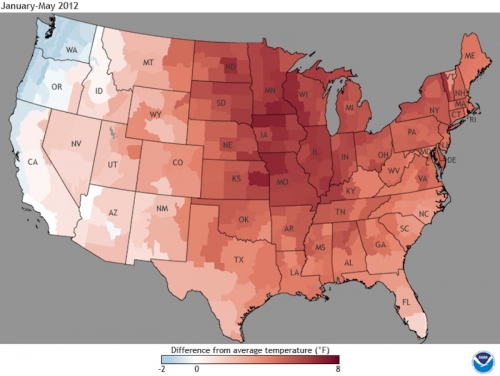
Year-to-Date divisional temperature rankings from NOAA.
More about that tomorrow!
OK, only a short rant! Which is immediately followed by an apology! Because you will have to wait 24 hours before reading my next Post about fracking, about how some ‘leaders’ expect the CO2 emissions in the earth’s atmosphere to stabilise at 650 ppm and how very close we are to losing control!
A revealing article in The Atlantic by Professor Adler.
Yesterday, I published a Post called Denialists standing up for insanity. Then within hours of writing that, up popped in my email ‘in-box’ the latest ‘What’s New’ from the Yale Forum on Climate Change and the Media. One article that jumped off the page at me was this one,
How A Conservative Sees, Wants to Address, Climate Change
June 6, 2012
Law professor Jonathan Adler, no flaming liberal, accepts much of the science and outlines conservative property rights principles for addressing climate change challenges.
What is surprising about these quotations?
“… there is reason to believe many of the effects [of climate change] will be quite negative.
“Excesses” of climate campaigners and “bad behavior” by some scientists “do not, and should not, discredit the underlying science.”
Despite some “substantial uncertainty … this is not sufficient justification for ignoring global warming or pretending that climate change is not a serious problem.”
“… effects will be most severe in those nations that are both least able to adapt and least responsible for” the greenhouse problem.
“Even non-catastrophic warming should be a serious concern.”
What’s actually surprising about these points is not so much the messages, but the messenger.
Then a couple of paragraphs later, the Yale Forum article links to The Atlantic piece as in, “Adler expresses his views on the seriousness of climate change in “A Conservative’s Approach to Combating Climate Change.”
Let me just give you a taste of that Atlantic piece.
It opens thus,
A Conservative’s Approach to Combating Climate Change
No environmental issue is more polarizing than global climate change. Many on the left fear increases in atmospheric concentrations of greenhouse gases threaten an environmental apocalypse while many on the right believe anthropogenic global warming is much ado about nothing and, at worst, a hoax. Both sides pretend as if the climate policy debate is, first and foremost, about science, rather than policy. This is not so. There is substantial uncertainty about the scope, scale, and consequences of anthropogenic warming, and will be for some time, but this is not sufficient justification for ignoring global warming or pretending that climate change is not a serious problem.
The fifth and sixth paragraphs present a powerful ‘constitutional’ perspective,
Accepting, for the sake of argument, that the skeptics’ assessment of the science is correct, global warming will produce effects that should be of concern. Among other things, even a modest increase in global temperature can be expected to produce some degree of sea-level rise, with consequent negative effects on low-lying regions. Michaels and Balling, for instance, have posited a “best guess” that sea levels will rise 5 to 11 inches over the next century. Such an increase in sea levels is likely manageable in wealthy, developed nations, such as the United States. Poorer nations in the developing world, however, will not be so able to adapt to such changes. This is of particular concern because these effects will be most severe in those nations that are both least able to adapt and least responsible for contributing to the concentration of greenhouse gases in the atmosphere.
It is a well established principle in the Anglo-American legal tradition that one does not have the right to use one’s own property in a manner that causes harm to one’s neighbor. There are common law cases gong back 400 years establishing this principle and international law has long embraced a similar norm. As I argued at length in this paper, if we accept this principle, even non-catastrophic warming should be a serious concern, as even non-catastrophic warming will produce the sorts of consequences that have long been recognized as property rights violations, such as the flooding of the land of others.
Professor Adler closes the article, as follows,
Fourth and finally, it is important to recognize that some degree of warming is already hard-wired into the system. This means that some degree of adaptation will be necessary. Yet as above, recognizing the reality of global warming need not justify increased federal control over the private economy. There are many market-oriented steps that can, and should, be taken to increase the country’s ability to adapt to climate change including, as I’ve argued here and here, increased reliance upon water markets, particularly in the western United States where the effects of climate change on water supplies are likely to be most severe.
I recognize that a relatively brief post like this is unlikely to convince many people who have set positions on climate change. I can already anticipate a comment thread filled with charges and counter-charges over the science. But I hope this post has helped illustrate that the embrace of limited government principles need not entail the denial of environmental claims and that a concern for environmental protection need not lead to an ever increasing mound of prescriptive regulation. And for those who wish to explore these arguments in further detail, there’s lots more in the links I’ve provided throughout this post.
The links provided by Professor Adler, as he refers to above, are well-worth pursuing, so for that reason alone, I do recommend reading the whole Atlantic piece in full.
It’s amazing to think that anyone lived here, that this valley was once green. Now it is sun-blasted, scorching hot, and the only life is the circling vultures and the rainbow-colored iguanas, like something out of a desert hallucination, skittering across the rocks.
The reminders of past life rise up around me, however, eroded to look more like drip castles than the pyramids they once were. I am in Túcume, the once-grand capital of the Sican culture, Peru’s mythical Valley of the Pyramids.
I am not far from Chiclayo, and even closer to the city of Lambayeque, where the Royal Tombs of Sipán Museum serves as one of the major tourist attractions on the north coast. Here at Túcume however, there are few visitors.
It is not hard to get to the site. Combis leave regularly from Chiclayo and Lambayeque, dropping passengers in the modern village of Túcume, from which an quick mototaxi ride leads to the ruins. By car or taxi, it is about a 30 minute ride from Chiclayo.
There are two main trails marked out across the desert plain in Túcume. One leads to Cerro Purgatorio, a craggy hill overlooking the 26 pyramids that comprise the site. The trail winds across the scorched valley, between several of the pyramids, before arriving at a staircase leading to different scenic overlooks on the face of Purgatorio.
Then there’s a long and revealing article on the InkaNatura Travel Site, which I recommend you go to.
So what happened at Túcume to cause the civilisation to fail? Maybe this 10-minute film gives the answers, but just a note to say that there are some potentially upsetting scenes for the younger or more sensitive among us.
So anyone sufficiently brave to say that history won’t repeat itself.
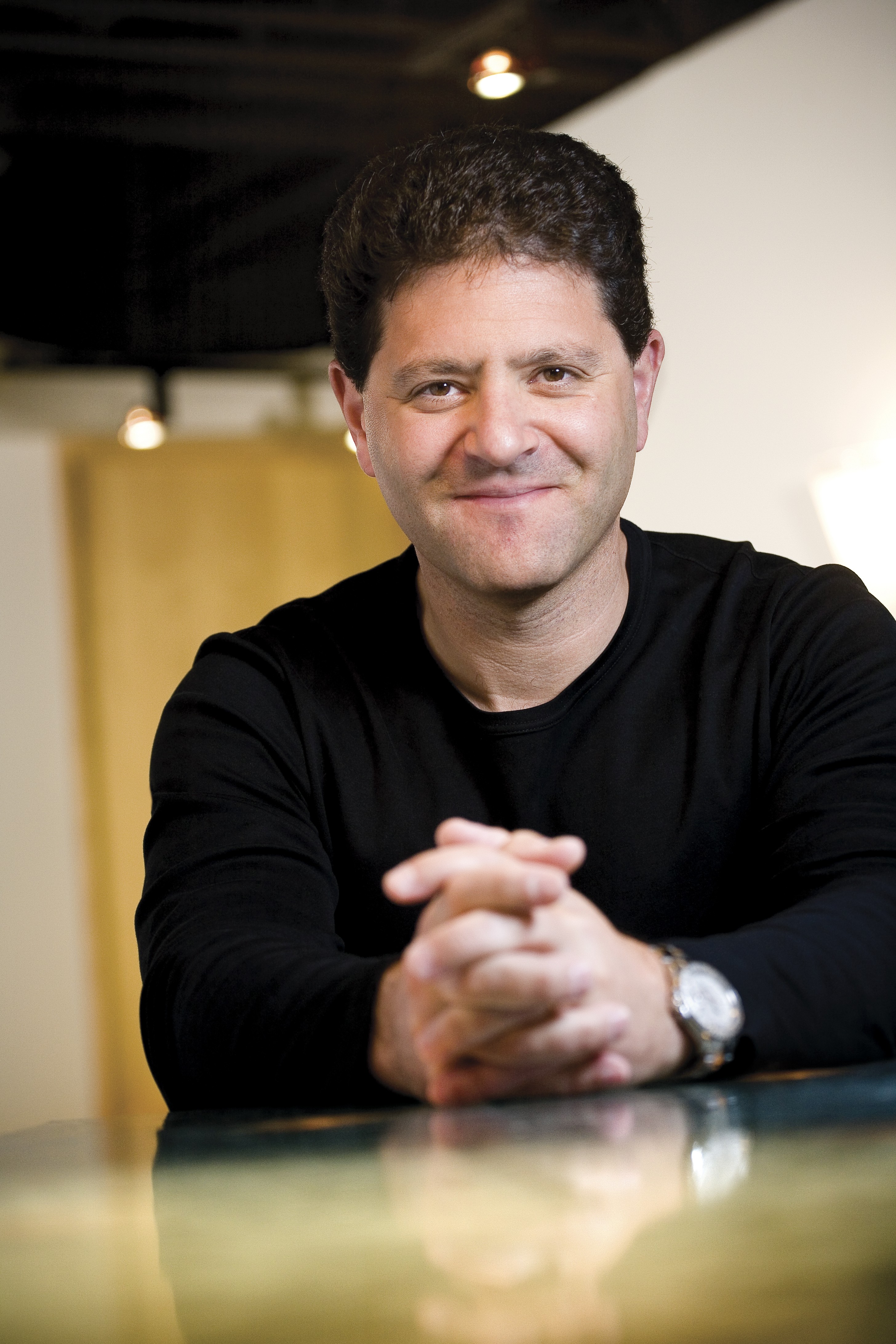
I hadn’t come across Mr. Hanauer before but thanks to some Facebook comments by Patrice Ayme found this YouTube video that is well-worth watching. That’s an understatement!
The fundamental message that is contained in this short video seems critical, well to me it does, to society (that’s all of us, by the way) understanding why so many things seem to be going so very wrong for so many people. But let me stop there before it becomes another of my rants!
Who is Nick Hanauer? Here is a small extract from Nick Hanauer’s website,
Nicolas J Hanauer is a partner with Second Avenue Partners, a Seattle venture capital partnership specializing in early state startups and emerging technology. He has had a hand in such companies as Amazon.com and aQuantive among others.
Hanauer’s career began with a position as executive VP of Sales and Marketing at Pacific Coast Feather Company, a family owned manufacturer of basic bedding. In his time in that role, he helped grow Pacific Coast from several million dollars to more than $300 million in sales. Hanauer subsequently served as the company’s Co-Chairman and Chief Strategy Officer and remains Chief Executive Officer.
In 1988, Hanauer co-founded Museum Quality Framing Company, a company that has emerged the largest of its kind on the west coast with 60 locations. Hanauer was also one of the first investors in Amazon.com in 1995, where he served as a Board Advisor until January of 2000.
In 1996, he founded and served as CEO of internet media company Avenue A Media (later re-named aQuantive, Inc.) and became Chairman of the Board upon the first public offering in 2000. aQuantive was purchased by Microsoft in August of 2007 for 6.4 billion dollars; the largest acquisition in Microsoft history.
Now the video; less than 6 minutes long – do watch it!
As a one-time entrepreneur back in the 80’s I can vouch for much of what Mr. Hanauer proclaims in his video. The essence of successful marketing for any business, large and small, is understanding your market. Seeing the customer’s world through the customer’s eyes would be another way of putting that.
In plain language that means carefully and closely understanding what your customers, both actual and prospective, require, objectively and subjectively, and providing it to them profitably. As the middle-classes (don’t like the term but it will have to do) are often the largest market opportunity, then it does follow that a healthy and vibrant middle-class is going to be best overall for the health and vibrancy of a country. Indeed, in this very inter-connected world, that really equates to the health and vibrancy of our planet.
Which so easily leads on to a core truth. This one. If all the Governments democratically elected on this planet truly acknowledged the democratic foundation, as Lincoln so ably put it, “government of the people, by the people, for the people” then those governments would be united in the one most important task facing the people – creating a sustainable way for us to live on the only planet we have!
Yesterday, I republished the recent Post from Martin Lack under my title of Playing with fire! In that Post there was a reference to just one example of the very different climatic world that we all live in. That reference was to the recent huge devastation of the apple and soft-fruit crops in Northern USA and Canada.
A catastrophic freeze has wiped out about 80 per cent of Ontario’s apple crop and has the fruit industry looking at losses already estimated at more than $100 million.
“This is the worst disaster fruit growers have ever, ever experienced,” Harrow-area orchard owner Keith Wright said Friday. “We’ve been here for generations and I’ve never heard of this happening before.
“This is unheard of … all fruit growing areas in the Great Lakes area, in Michigan, Pennsylvania, New York State, Ontario, are all basically wiped out.”
Wright lost hundreds of thousands of dollars worth of apples and peaches Sunday morning when freezing temperatures killed the blossoms.
Warm temperatures caused fruit trees to bloom early and when temperatures plummeted Sunday morning it damaged or wiped out much of the $60-million apple crop and 20 to 30 per cent of Ontario’s $48-million tender fruit crop which includes peaches, cherries, pears, plums and nectarines.
Brian Gilroy, a Georgian Bay-area apple grower who is chairman of the Ontario Apple Growers, said the loss to fruit growers and the economy will easily be more than $100 million. On top of the lost yield or no crop at all, orchard workers and spinoff industries such as juice, packing, storage and farm supplies will be affected.
Gilroy said consumers will find locally grown apples pricey and difficult to find this fall. Some varieties of apples, such as Empire, will be very difficult to find.
Washington State has a good crop but consumers should expect apple prices to jump because all of northeastern North America was affected, he said.
The article goes on to report from the Globe and Mail and the Toronto Star. It does not make for pretty reading!
April 2012: Earth’s 5th Warmest On Record And La Niña Officially Ends, So The Heat Is On.
By Climate Guest Blogger on May 19, 2012 at 3:09 pm
JR: It’s remarkable how warm it was globally in April considering that we were only just coming out of a double dip La Niña. If we don’t triple dip, we’ll set more temperature records soon. Indeed, NOAA models predict a good chance of an El Niño forming in the late summer, which would make it quite likely next year would be the hottest on record. As for April, you’ll note it was hot in the ‘wrong’ places again — over much of the tundra, which is a carbon time bomb
The Think Progress article then draws heavily on an extensive comment from Dr.Jeff Master’s WunderBlog that I am going republish, hopefully in the interests of helping to spread the truth about this planet of ours.
April 2012 was the globe’s 5th warmest April on record, according to the National Oceanic and Atmospheric Administration’s National Climatic Data Center (NCDC). NASA rated April 2012 as the 4th warmest April on record. April 2012 global land temperatures were the 2nd warmest on record, and the Northern Hemisphere land surface temperature was 1.74°C (3.13°F) above the 20th century average, marking the warmest April since records began in 1880. Global ocean temperatures were the 11th warmest on record, and April 2012 was the 427th consecutive month with ocean temperatures warmer than the 20th century average. The last time the ocean temperatures were below average was September 1976. The increase in global temperatures relative to average compared to March 2012 (16th warmest March on record) was due, in part, to warming waters in the Eastern Pacific, due to the La Niña event that ended in April. Global satellite-measured temperatures for the lowest 8 km of the atmosphere were 6th or 4th warmest in the 34-year record, according to Remote Sensing Systems and the University of Alabama Huntsville (UAH). April temperatures in the stratosphere were the 1st to 4th coldest on record. We expect cold temperatures there due to the greenhouse effect and to destruction of ozone due to CFC pollution. Northern Hemisphere snow cover during April was 4th smallest in the 46-year record. Wunderground’s weather historian, Christopher C. Burt, has a comprehensive post on the notable weather events of April in his April 2012 Global Weather Extremes Summary. Notably, national heat records (for warmest April temperature on record) occurred in the United States (a tie), Germany, Austria, Poland, Belarus, Lithuania, Moldova, Hungry, Croatia, Ukraine, and Slovakia as well as the cities of Moscow and Munich.
Figure 1. Departure of temperature from average for April 2012. The most notable extremes were the warmth observed across Russia, the United States, Alaska, and parts of the Middle East and eastern Europe. There were no land areas with large-scale cold conditions of note. Image credit: National Climatic Data Center (NCDC) .
La Niña officially ends
According to NOAA’s Climate Prediction Center (CPC), La Niña conditions are no longer present in the equatorial Pacific, where sea surface temperatures were approximately average as of May 13. The threshold for a La Niña is for these temperatures to be 0.5°C below average or cooler. CPC forecasts that neutral conditions will persist though the summer, with a 41% chance of an El Niño event developing in time for the August – September – October peak of hurricane season. El Niño conditions tend to decrease Atlantic hurricane activity, by increasing wind shear over the tropical Atlantic.
Figure 2. Arctic sea ice extent in 2012 (blue line) compared to the average (thick grey line.) The record low year of 2007 (dashed green line) is also shown. Arctic sea ice was near average during April, but has fallen well below average during the first half of May. Image credit: National Snow and Ice Data Center (NSIDC).
April Arctic sea ice extent near average
Arctic sea ice extent was near average in April 2012, the 17th lowest (18th greatest) extent in the 35-year satellite record, according to the National Snow and Ice Data Center (NSIDC). This was the largest April Arctic sea ice extent since 2001. However, ice in the Arctic is increasingly young, thin ice, which will make it easy for this year’s ice to melt away to near-record low levels this summer, if warmer than average weather occurs in the Arctic.
So to those that still think the jury is out on climate change, let me just repeat the title, “What part of the word change are you having trouble with?”
A republication of a powerful essay from Martin Lack.
Martin and I haven’t seen eye-to-eye on everything, as each of us would readily admit. But there’s no taking away the power contained in many of Martin’s essays over on his Blog Lack of Environment. Unlike me, Martin has strong academic credentials that he uses well to support his position.
Martin recently published a strong Post called It doesn’t have to be like this and has kindly given written permission for it to be republished on Learning from Dogs.
Tomorrow, I plan to expand on the fruit crop disaster that Martin refers to below. So here is the essay,
—————
Planet Earth is not just another business!
It doesn’t have to be like this
In 1974, the former World Bank economist Herman E Daly published an article on ‘The Economics of the Steady State’, beginning with a quote from the famous scientist Sir Arthur Eddington: “But if your theory is found to be against the Second Law of Thermodynamics, I can give you no hope; there is nothing for it but to collapse in deepest humiliation.” Daly is also on record as having quoted Aleksandr Solzhenitsyn (from Letter to the Soviet Leaders [i.e. published in 1974]), who said: “Society must cease to look upon ‘progress’ as something desirable. Eternal ‘progress’ is a nonsensical myth. What must be implemented is a not a steadily expanding economy but a zero growth economy; a stable economy.”
The essential point of Thomas Malthus’ (1798) ‘Essay on the Principle of Population’ was that populations increase faster than the supply of food can be made available to meet their needs. With this in mind, in 1972, Meadows et al predicted that the biophysical limits to growth would be exceeded at some point within 100 years: “If the present growth trends in world population, industrialization, pollution, food production, and resource depletion continue unchanged, the limits to growth on this planet will be reached sometime within the next one hundred years. The most probable result will be a rather sudden and uncontrollable decline in both population and industrial capacity.”
Recent strange weather in the USA – specifically a very warm March followed by unseasonal frosts in May – has all but wiped out all kinds of fruit crops. This may not have been the industrial collapse envisaged by Meadows et al (that is yet to come), but it is evidence of the way in which anthropogenic climate disruption (ACD) – or what some would have us be more precise and call human induced rapid global overheating (HIRGO) – threatens our ability to feed ourselves.
In 1992, the Meadows et al team summarised their revised conclusions as follows:
— 1. Human use of many essential resources and generation of many pollutants have already surpassed rates that are physically sustainable. Without significant reductions in material and energy flows, there will be in the coming decades an uncontrolled decline in per capita food output, energy use and industrial production.
— 2. This decline is not inevitable. To avoid it two changes are necessary. The first is a comprehensive revision of policies and practices that perpetuate growth in material consumption and in population. A second is a rapid, drastic increase in the efficiency with which materials are used.
— 3. A sustainable society is still technically and economically possible. It could be much more desirable than a society that tries to solve its problems by constant expansion. The transition to a sustainable society requires a careful balance between long-term and short term goals, and an emphasis on sufficiency, equity, and quality of life rather than on quantity of output. It requires more than productivity and more than technology; it also requires maturity, compassion, and wisdom.
In general, Meadows et al have been consistently ignored. In 1993, frustrated by the absence of discussion on population growth in international politics, Garrett Hardin pointed out that: “Two centuries of intermittent wrestling with population problems have produced useful insights about the reality and nature of limits… Four centuries of sedation by the delusion of limitlessness have left humanity floundering in a wilderness of rhetoric… From this it must be inferred that someday political conservatism will once again be defined as contented living within limits. The limitless world view will have to be abandoned.”
In this context, the words growth and development should not be confused. As Daly has pointed out: “the Earth may be developing but it is not growing.”!
In their 30-year update of Limits to Growth, in a section entitled ‘Why Technology and Markets Alone Can’t Avoid Overshoot’, the Meadows et al team pointed out that if we put off dealing with limits to growth we are more likely to come up against several of them simultaneously. With regard to the computer modelling undertaken, they observed that in most cases the simulations ran out of the ‘ability to cope’ when too much industrial output has to be diverted to solving problems; and concluded: “Growth, and especially exponential growth, is so insidious because it shortens the time for effective action. It loads stress on a system faster and faster, until coping mechanisms that have been adequate with slower rates of change finally begin to fail.”
Just because Meadows et al have not yet been proven right does not mean that they were wrong.
In Small is Beautiful (1973), E. F. Schumacher wrote: “The illusion of [mankind’s] unlimited powers, nourished by astonishing scientific and technological achievements, has produced the concurrent illusion of having solved the problem of production… based on the failure to distinguish between income and capital where this distinction matters most… A businessman would not consider a firm to have solved its problems of production and to have achieved viability if he saw that it was rapidly consuming its capital…”
What he meant was:
There is something fundamentally wrong in treating the Earth as if it were a business in liquidation. ― (Herman E. Daly)
Center for American Progress Action Fund plea to all Americans
Friends,
For the first time in history, the Environmental Protection Agency has proposed to limit industrial carbon pollution from new power plants. This important action will slow the growth of the major pollutant responsible for global climate change. These new limits will have far-reaching public health impacts.
Power plants dump more than two billion tons of carbon and other toxic pollutants into the air each year—nearly 13,000 pounds for every man, woman, and child in the United States. With the proposed standard, though, a typical new coal-fired power plant would have to reduce its carbon pollution by 40 percent to 60 percent. Natural gas power plants should be able to comply with this standard without additional controls.
President Barack Obama has endorsed limits on carbon pollution from motor vehicles, which will ultimately reduce tailpipe emissions by six billion metric tons over the life of the program.
I proudly served as the administrator of the Environmental Protection Agency for eight years, and I know from experience how vitally important it is that citizens who support proposed public health standards that reduce pollution make their voices heard. Certainly, many of the companies emitting the pollution and other interests that oppose clean air standards will do so.
During the first month available for public comments, more than one million Americans took action to express their support for cleaner air, but we need your voice today!
Carol M. Browner
Distinguished Senior Fellow, Center for American Progress Action Fund
Just in case you want a reinforcing viewpoint, please do read this article from the Key Correspondents (KC) team website.
Coal-fired power damages health and the environment
Coal-fired power generation damages people’s health and contributes to climate change, according to a new study by academics at the University of Pretoria.
The study shows how coal-fired power stations run up large costs as a result of coincidental but often unavoidable side-effects electricity generation.
These ‘externalities’ include the creation of carbon dioxide, carbon monoxide, methane, oxides of nitrogen, sulphur oxide, mercury and a wide range of carcinogenic radio-nuclides and heavy metals during the combustion process.
The Business Enterprises department of the University of Pretoria conducted the study for Greenpeace Africa and Greenpeace International at Kusile power station in Emalahleni in September 2011.
According to the report: “In the generation of coal-fire power, the objective is electricity production, yet, as a side effect, emissions are also produced.
“Various epidemiological studies found that the mentioned pollutants contribute to the incidence of mortality.”
The study also measures the cost to the environment by determining the amount of potentially damaging emissions from a power station.
According to the report, Kusile power station emits 30m tons of carbon dioxide per year, on an annual consumption of 17m tons of coal.
The analysis provides strong evidence of the need for Eskom, the largest energy provider in Africa, to invest in alternative renewable energy sources and for the government to support such investment initiatives.
But Eskom is building more coal-fired power stations to add to new power stations in Kusile and Medupi in Lephalale, Limpopo, with the support of the Department of Energy.
Building new power plants also requires the construction of new coal mines and the expansion of existing coal mines.
There are fears that coal fired power plants like Kusile in South could severely contribute to climate change.
Just re-read that sentence above that spoke of Kusile power station, “Kusile power station emits 30m tons of carbon dioxide per year, on an annual consumption of 17m tons of coal.”
So, please, if you are an American who cares for the future of your children and grandchildren, take action.
Whatever the outcome of the US elections, a real change is desperately needed.
I stay neutral in terms of American party politics. As a ‘alien resident’, otherwise known as a Green Card holder, I am not eligible to vote anyway plus I readily admit to neither following nor understanding American politics.
But the focus on the late Ernest Callenbach’s words the last two days on Learning from Dogs has left me feeling pretty uncertain about the future for the USA. In reading those words, despite the many elements of hope and optimism that Callenbach engenders, it is difficult not to feel the scale of the challenges facing this great nation. Take these words toward the end of Callenbach’s essay,
Since I wrote Ecotopia, I have become less confident of humans’ political ability to act on commonsense, shared values. Our era has become one of spectacular polarization, with folly multiplying on every hand. That is the way empires crumble: they are taken over by looter elites, who sooner or later cause collapse. But then new games become possible, and with luck Ecotopia might be among them.
Humans tend to try to manage things: land, structures, even rivers. We spend enormous amounts of time, energy, and treasure in imposing our will on nature, on preexisting or inherited structures, dreaming of permanent solutions, monuments to our ambitions and dreams. But in periods of slack, decline, or collapse, our abilities no longer suffice for all this management. We have to let things go.
I have subscribed to the print version of The Economist for many years. Indeed, it is the only broad-reaching newspaper that I read on a regular basis. So in the last edition (May 12th), I couldn’t ignore the interesting position taken by Lexington under the title of Declinism resurgent. [NB. Not sure if you will be able to access that link without a subscription, Ed.]
The sub-heading sets the theme – The election campaign encourages America to feel worse about itself than it needs to
The third paragraph reads thus,
America is prone to bouts of “declinism”. In the 1980s the country was in a funk about the rise of Japan and its own vanishing competitiveness. Another bout was bound to follow China’s rise, two grinding wars and the deep recession of 2008. The gloom is nourished by a fountain of declinist literature. In “Time to Start Thinking” Ed Luce of the Financial Times ponders an America “in descent”. Norm Ornstein of the American Enterprise Institute and Thomas Mann of Brookings claim in a book on America’s politics (reviewed here two weeks ago) that “It’s Even Worse Than It Looks”.
Immediately followed by,
Yet anyone who prefers their glass half-full can find grounds for optimism. The first Boeing 787 Dreamliner has just landed in Washington, DC. It will be decades before China can make such a machine. The IMF is predicting average growth of over 2% for 2012 and 2013, not meteoric but not bad for a mature economy. America has a young workforce, with plenty of skilled people knocking at the door to come in. It still has more of the world’s best universities than any other country. It is the world’s largest producer of natural gas and its biggest food exporter. Amid the gloom, the economy is getting “Better, Stronger, Faster”, argues Daniel Gross, in a book of that name published this week.
Lexington then concludes,
The binary illusion
People tend to think in black and white. America is either in decline or it is ordained to be for ever the world’s greatest nation. Government is either paralysed or it is running amok, stifling liberty and enterprise and snuffing out the American dream. The election campaign accentuates the negative and sharpens this binary illusion. The Republicans say that Mr Obama is leading America into socialised serfdom; the Democrats retort that Mr Romney would restore the conditions that caused the recession. Little wonder that, according to polls, most voters do not believe that either man has a clear plan for fixing the economy.
Charles Dickens said of the United States that if its citizens were to be believed America “always is depressed, and always is stagnated, and always is at an alarming crisis, and never was otherwise.” On a variety of objective measures, it is in an awful mess right now. And yet America of all countries still has plenty of grounds to hope for a better future, despite its underperforming politics, and no matter who triumphs in November.
So a different perspective than the one articulated by Ernest Callenbach. But whatever the political result later in this year’s US presidential elections, if that new government doesn’t address the need for urgent attention to what mankind is doing to Planet Earth then the rest of the political agenda will become increasingly irrelevant.
I’ll close with that old saying, “Will the last person to leave Planet Earth, please turn the lights off!“








 Learning from Dogs