Category: Capitalism

The Southern Ring Nebula

Just had to share this incredible vista with you!

The James Webb Space Telescope is amazing. Wikipedia have a long article on the telescope from which one reads (in part):

The James Webb Space Telescope (JWST) is a space telescope specifically designed to conduct infrared astronomy. Its high-resolution and high-sensitivity instruments allow it to view objects too old, distant, or faint for the Hubble Space Telescope. This enables investigations across many fields of astronomy and cosmology, such as observation of the first stars and the formation of the first galaxies, and detailed atmospheric characterization of potentially habitable exoplanets.

But I want to share with you this video, please watch it now it is just a minute long:

Time to forget about our earthly challenges for just a short time.

And for those that want more here is the home page of the Webb Telescope.

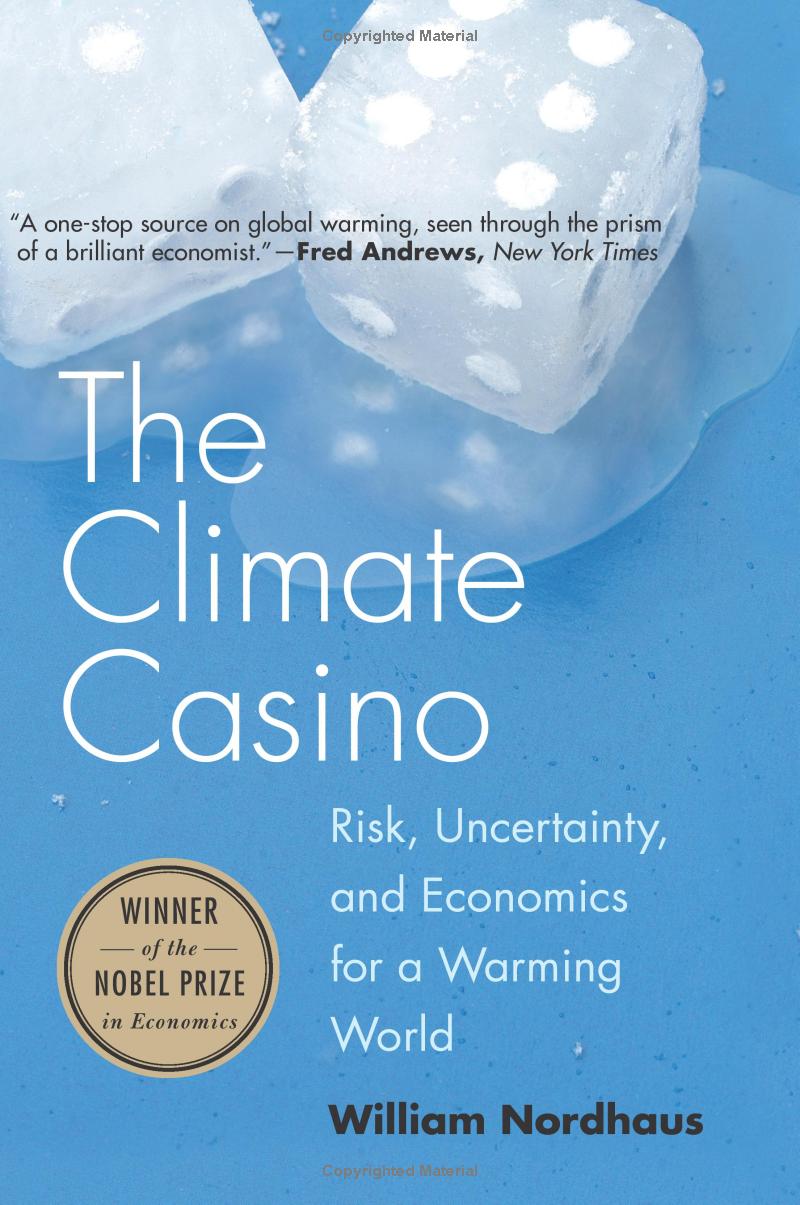
The Book – “The Climate Casino”

Three hundred plus pages of vital information.

I bought this book from Thriftbooks and was so fired up that I sat down and started reading it almost immediately. For as the back cover explains:

Climate change is profoundly altering our world in ways that pose major risks to human societies and natural systems. We have entered the Climate Casino and are rolling the global-warming dice, warns William Nordhaus. But there is still time to turn around and walk back out of the casino, and in this book the author explains how.

William Nordhaus

William Nordhaus is a brilliant economist as Fred Andrews describes above. Indeed he is the Sterling Professor of Economics at Yale University and he has his website here.

Now I am going straight to two videos.

The first is William Nordhaus receiving the Nobel Prize in 2018.

And the second is that lecture given at the same venue in 2018.

Hopefully you got to watch them both!

Journalism.

A start to a fascinating programme on BBC Radio 4.

Yesterday morning (Oregon time) had me listening to a new series on BBC Sounds. It was Frontlines of Journalism. Here is what the Beeb had to say about it:

Released On: 27 Feb 2023

Available for over a year

In the spring of 2023, twenty years after the Americans, the British and their allies invaded to overthrow Saddam Hussein, BBC International Editor Jeremy Bowen was reporting from Iraq for the BBC. He described the invasion as ‘a catastrophe’. Taking you to some of the most difficult stories Jeremy and other journalists have covered; in this episode – why impartiality is not about trying to get perfect balance, the truth lying somewhere in the middle.  Often it does not.   Jeremy speaks with: journalist Rana Rahimpour who was born in Iran but left when she was 25 to work for the BBC; former BBC bureau chief Milton Nkosi, who grew up under apartheid in Soweto, South Africa; journalist and environmentalist George Monbiot, and CNN’s Chief International Anchor Christiane Amanpour.

Presenter: Jeremy Bowen Producer: Georgia Catt Assistant Producer: Sam Peach Additional research: Rob Byrne Series mixing: Jackie Margerum Series Editor: Philip Sellars.

But in wanting to present a little more to you readers, I did some research on the topic and came across this article published by the Reuters Institute at the University of Oxford. I cannot see a warning about not sharing this with you.

ooOOoo

Impartiality is still key for news audiences. Here’s how to rethink it for the digital age

Our research shows people still value the ideal of impartial news. A new report offer suggestions to adapt it to a challenging environment.

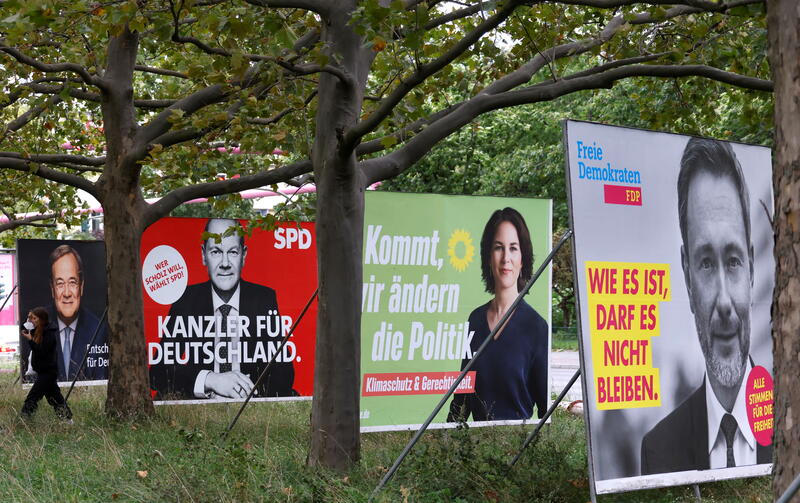
Election posters of Germany’s top candidates for chancellor.
September 16, 2021. REUTERS/Fabrizio Bensch

Nic Newman

Tuesday 19 October 2021

Most people agree that news organisations and journalists should reflect all sides of an issue and not push a particular agenda – at least when asked about it in surveys. Our 2021 Digital News Report finds this to be true across countries and age groups

However, many people feel that the media often fail to live up to this ideal. Our surveys consistently show that committed partisans believe that traditional media coverage is unfair, especially in countries where debates about politics or social justice have become deeply polarised. In recent years we’ve also seen an increase in opinion-led television formats such as Fox News/MSNBC in the United States, GB News in the UK and CNews in France, while many traditional print publications have focussed on distinctive and robust opinion as a way of standing out online.

Together with the growth of partisan websites, YouTubers and podcasters, audiences now have access to a wider range of views than ever before. Against this background, some have questioned traditional approaches to impartiality that try to represent all points of view within a single broadcast or publication. Other critics go further – arguing that impartiality has given extreme or unrepresentative views undue prominence, through its focus on balance, helping to legitimise climate change deniers and anti-vaxxers amongst others.

This all raises the question: how relevant is impartial and objective journalism to audiences today? The Reuters Institute commissioned market research company JV Consulting to carry out qualitative research in four countries – Brazil, Germany, the UK, and the US – with different news markets, traditions of public broadcasting, and systems of media regulation. They conducted a series of focus groups and in-depth interviews on our behalf in February and March 2021 with politically and ethnically diverse groups of older and younger people interested in and engaged with news (52 people in total).

These are some of the key findings of the report:

  • Engaged audiences in the four countries researched still care about impartiality and say it helps define news, even if some consider it an impossible ideal. They want journalists to focus on facts, objectivity and fairness, and to steer clear of opinions and bias in reporting, leaving them to decide for themselves how they feel about the news. Alongside accuracy, impartiality is a foundational value of news that underpins audiences’ trust.
  • People recognise the risk of giving exposure to extreme views or one side in the name of balance. However, evidence from this group of engaged users is that they are even more concerned about the suppression and silencing of viewpoints. There are particular misgivings about this in Brazil and Germany, where twentieth century history frames some people’s views.
  • Most participants recognise that there were some topics (e.g., science stories, natural disasters, and questions of social justice) where there were not always two or more sides to represent. Here, many felt there should be more latitude for journalists to present just one perspective or an established point of view. There are also expectations that journalists will show greater empathy and connection in their reporting than perhaps traditional interpretations of impartiality have allowed in the past.
  • Across countries, newer digital formats such as social media are perceived as carrying more risk of bias along with the growth of more informal and entertaining broadcast formats such as chat shows and podcasts. Impartiality is more vulnerable in these contexts, as well as when the news is emotive or controversial, because journalists’ personal views risk slipping out in the impulse to engage, although the subject and intention have a bearing on how audiences feel about this.
  • Younger people, who have grown up using more informal and digital sources, tend to have different expectations of impartiality, often looking for journalism that aligns with their values. But overall, their underlying attitudes and desires are remarkably similar to older people’s.
  • Different countries’ news traditions shape people’s experiences and expectations. Audiences in the US cannot envisage a world without partisan news outlets, but in the UK and Germany, with their public service traditions, most audiences still laud the upholding of impartiality.
  • Respondents also delineate between news reporting (where impartiality is expected) and opinion/commentary (where people expect that views are argued for). Importantly, many told us that they often find it difficult to distinguish between the two, especially online. Interviewees like news and they like opinion, but want them very clearly separated. 

It is important to recognise that not all news organisations are committed to impartiality: indeed, some make a virtue of creating news and opinion with a clear point of view. But most will want to take note of audience desires for a range of views to be represented and to see clearer labelling of news and opinion. For news organisations that are committed to impartiality, the report highlights the increased dangers in areas where journalism is more informal or accessed in distributed environments. Public media like the BBC have already embarked on updated training and issued new guidelines on these issues. Audiences have also sent a clear signal in this report that they would like much greater transparency over why certain perspectives are included or excluded, however difficult this may be in practice.

Finally, the report notes that given the importance of social media, search and other access points, technology platforms such as Facebook, Google and Apple, will also need to develop clearer guidelines on impartiality – as their own trust levels will depend on fair implementation of policies around inclusion and exclusion, whether by algorithm or human intervention.

Download the full report

ooOOoo

Now this isn’t everyone’s cup of tea but when one thinks of the enormous amount of news and information one gathers from the television, the radio, the press and a wide variety of online sources then thinking a little more about the truth of what we are being told is crucial to us making wise decisions. including voting where appropriate.

People still value the ideal of impartial news; there is no question about that!

Plastics in the ocean

A fascinating insight into recovered plastic.

Like so many others we do our little bit regarding plastic but do not properly think about the issue. I have to admit that I am not even sure if all plastics are harmful or just some.

But I comprehend art!

That is why I am republishing, with permission, this article from The Conversation.

ooOOoo

My art uses plastic recovered from beaches around the world to understand how our consumer society is transforming the ocean

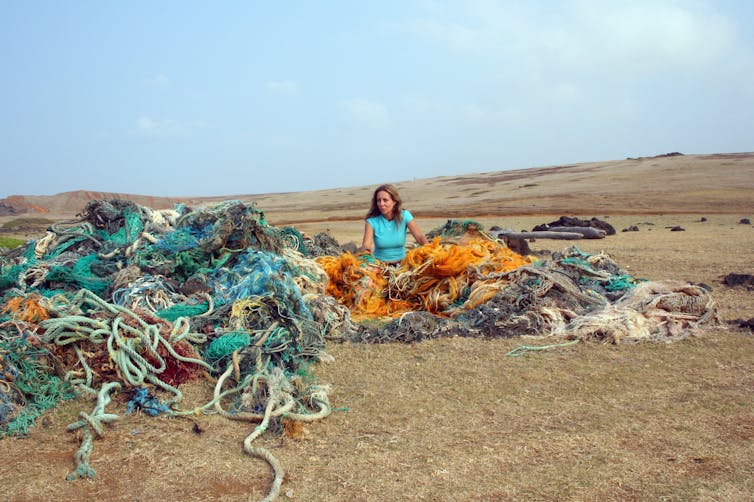
Pam Longobardi amid a giant heap of fishing gear that she and volunteers from the Hawaii Wildlife Fund collected in 2008. David Rothstein, CC BY-ND

Pam Longobardi, Georgia State University

I am obsessed with plastic objects. I harvest them from the ocean for the stories they hold and to mitigate their ability to harm. Each object has the potential to be a message from the sea – a poem, a cipher, a metaphor, a warning.

My work collecting and photographing ocean plastic and turning it into art began with an epiphany in 2005, on a far-flung beach at the southern tip of the Big Island of Hawaii. At the edge of a black lava beach pounded by surf, I encountered multitudes upon multitudes of plastic objects that the angry ocean was vomiting onto the rocky shore.

I could see that somehow, impossibly, humans had permeated the ocean with plastic waste. Its alien presence was so enormous that it had reached this most isolated point of land in the immense Pacific Ocean. I felt I was witness to an unspeakable crime against nature, and needed to document it and bring back evidence.

I began cleaning the beach, hauling away weathered and misshapen plastic debris – known and unknown objects, hidden parts of a world of things I had never seen before, and enormous whalelike colored entanglements of nets and ropes.

Three large plastic art installations, the central one a cornucopia spilling plastic objects onto the floor.
‘Bounty Pilfered’ (center), ‘Newer Laocoön’ (left) and ‘Threnody’ (right). All made of ocean plastic from the Atlantic, Pacific and Gulf of Mexico, installed at the Baker Museum in Naples, Fla., 2022. Pam Longobardi, CC BY-ND

I returned to that site again and again, gathering material evidence to study its volume and how it had been deposited, trying to understand the immensity it represented. In 2006, I formed the Drifters Project, a collaborative global entity to highlight these vagrant, translocational plastics and recruit others to investigate and mitigate ocean plastics’ impact.

My new book, “Ocean Gleaning,” tracks 17 years of my art and research around the world through the Drifters Project. It reveals specimens of striking artifacts harvested from the sea – objects that once were utilitarian, but have been changed by their oceanic voyages and come back as messages from the ocean.

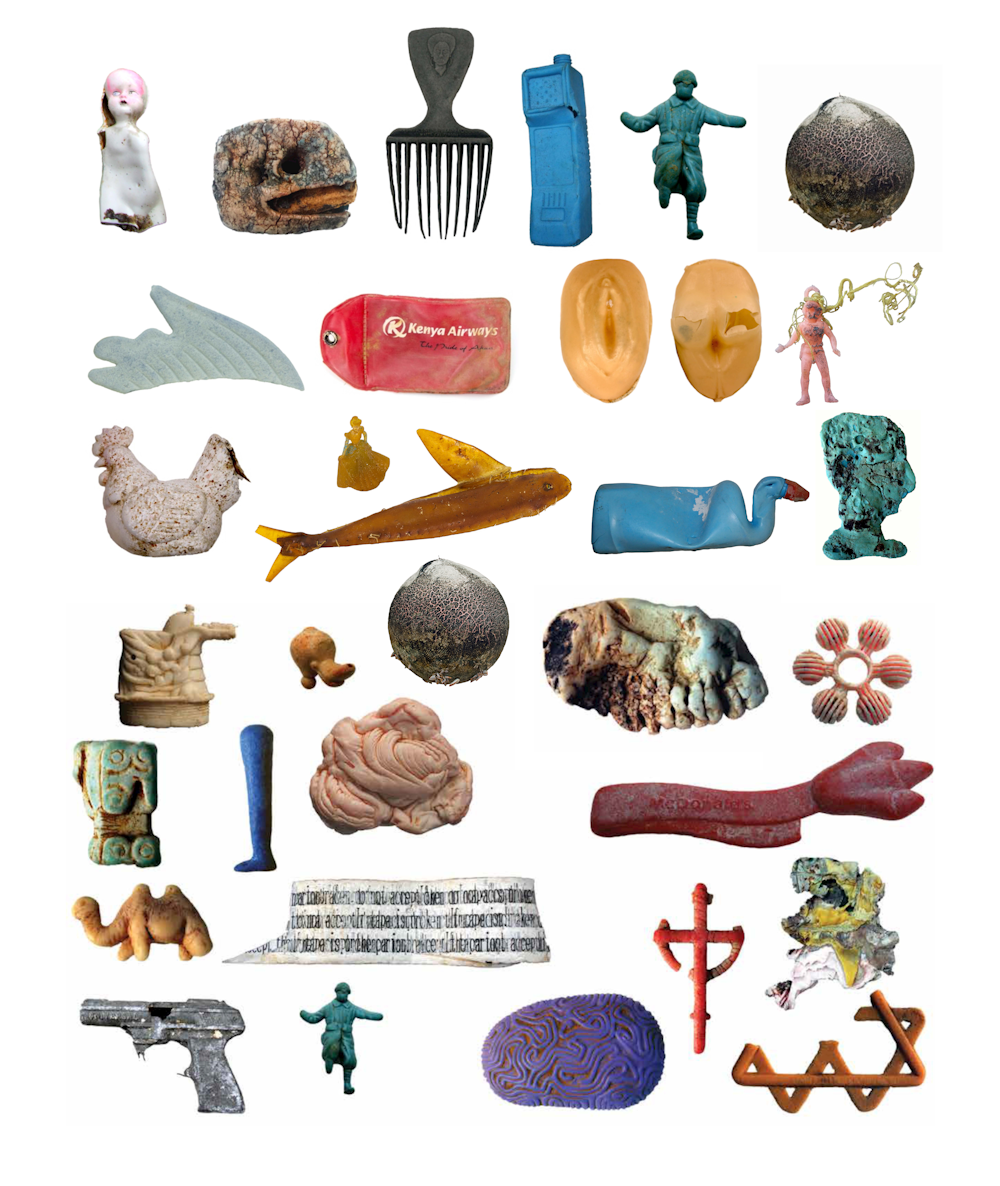
Array of plastic objects, including toys, action figures and fragments of larger objects.
‘Drifters Objects,’ a tiny sample of the plastic artifacts Pam Longobardi has collected from beaches worldwide. Pam Longobardi, CC BY-ND

Living in a plastic age

I grew up in what some now deem the age of plastic. Though it’s not the only modern material invention, plastic has had the most unforeseen consequences.

My father was a biochemist at the chemical company Union Carbide when I was a child in New Jersey. He played golf with an actor who portrayed “The Man from Glad,” a Get Smart-styled agent who rescued flustered housewives in TV commercials from inferior brands of plastic wrap that snarled and tangled. My father brought home souvenir pins of Union Carbide’s hexagonal logo, based on the carbon molecule, and figurine pencil holders of “TERGIE,” the company’s blobby turquoise mascot.

On the 2013 Gyre Expedition, Pam Longobardi traveled with a team of scientists, artists and policymakers to investigate and remove tons of oceanic plastic washing out of great gyres, or currents, in the Pacific Ocean, and make art from it.

Today I see plastic as a zombie material that haunts the ocean. It is made from petroleum, the decayed and transformed life forms of the past. Drifting at sea, it “lives” again as it gathers a biological slime of algae and protozoans, which become attachment sites for larger organisms.

When seabirds, fish and sea turtles mistake this living encrustation for food and eat it, plastic and all, the chemical load lives on in their digestive tracts. Their body tissues absorb chemicals from the plastic, which remain undigested in their stomachs, often ultimately killing them.

Two piles of tiny particles of virtually identical sizes.
Plastic ‘nurdles,’ (left), tiny pellets that serve as raw materials for manufacturing plastic products, and herring roe, or eggs (right). These visually analogous forms exemplify how fish can mistake plastic for food. Pam Longobardi, CC BY-ND

The forensics of plastic

I see plastic objects as the cultural archaeology of our time – relics of global late-capitalist consumer society that mirror our desires, wishes, hubris and ingenuity. They become transformed as they leave the quotidian world and collide with nature. By regurgitating them ashore or jamming them into sea caves, the ocean is communicating with us through materials of our own making. Some seem eerily familiar; others are totally alien.

Two views of a degraded arm from a plastic doll, found on Playa Jaco in Costa Rica.
A degraded plastic doll arm, from the series ‘Evidence of Crimes.’ Pam Longobardi, CC BY-ND

A person engaging in ocean gleaning acts as a detective and a beacon, hunting for the forensics of this crime against the natural world and shining the light of interrogation on it. By searching for ocean plastic in a state of open receptiveness, a gleaner like me can find symbols of pop culture, religion, war, humor, irony and sorrow.

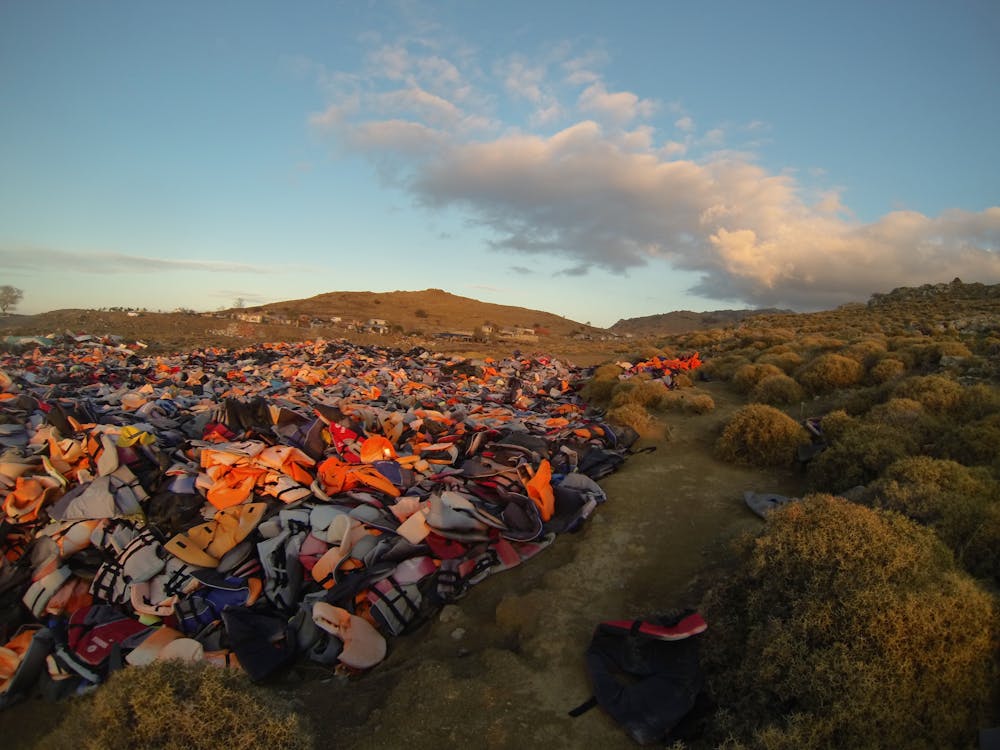
A rolling landscape covered with thousands of life vests.
‘Division Line,’ 2016. This photograph shows the ‘life-jacket cemetary’ in Lesvos, Greece. Traumatized asylum-seekers and migrants arriving by boat from Türkiye leave the life vests on shore as they stagger inland. Most of the waste is plastic. © Pam Longobardi, CC BY-ND

In keeping with the drifting journeys of these material artifacts, I prefer using them in a transitive form as installations. All of these works can be dismantled and reconfigured, although plastic materials are nearly impossible to recycle. I display some objects as specimens on steel pins, and wire others together to form large-scale sculptures.

A plastic bottle cap inscribed 'Endless' and a photograph of a beach littered with plastic objects.
From the series ‘Prophetic Objects,’ a plastic cap from a Greek manufacturer of cleaning products, found on the Greek island of Kefalonia. Pam Longobardi, CC BY-ND

I am interested in ocean plastic in particular because of what it reveals about us as humans in a global culture, and about the ocean as a cultural space and a giant dynamic engine of life and change. Because ocean plastic visibly shows nature’s attempts to reabsorb and regurgitate it, it has profound stories to tell.

A large sculpted anchor in the center of an art gallery, with ties to life preservers mounted on the ceiling.
‘Albatross’ and ‘Hope Floats,’ 2017. Recovered ocean plastic, survival rescue blankets, life vest straps and steel. Pam Longobardi, CC BY-ND

I believe humankind is at a crossroads with regards to the future. The ocean is asking us to pay attention. Paying attention is an act of giving, and in the case of plastic pollution, it is also an act of taking: Taking plastic out of your daily life. Taking plastic out of the environment. And taking, and spreading, the message that the ocean is laying out before our eyes.

Pam Longobardi, Regents’ Professor of Art and Design, Georgia State University

This article is republished from The Conversation under a Creative Commons license. Read the original article.

ooOOoo

Pam at one point describes the ocean plastic”… because of what it reveals about us as humans in a global culture, and about the ocean as a cultural space and a giant dynamic engine of life and change …”. It raises questions that I can only ponder the answer. Ultimately, are there too many inhabitants on this planet? What does the next generation think? Is there an answer?

A very small step.

But an important one!

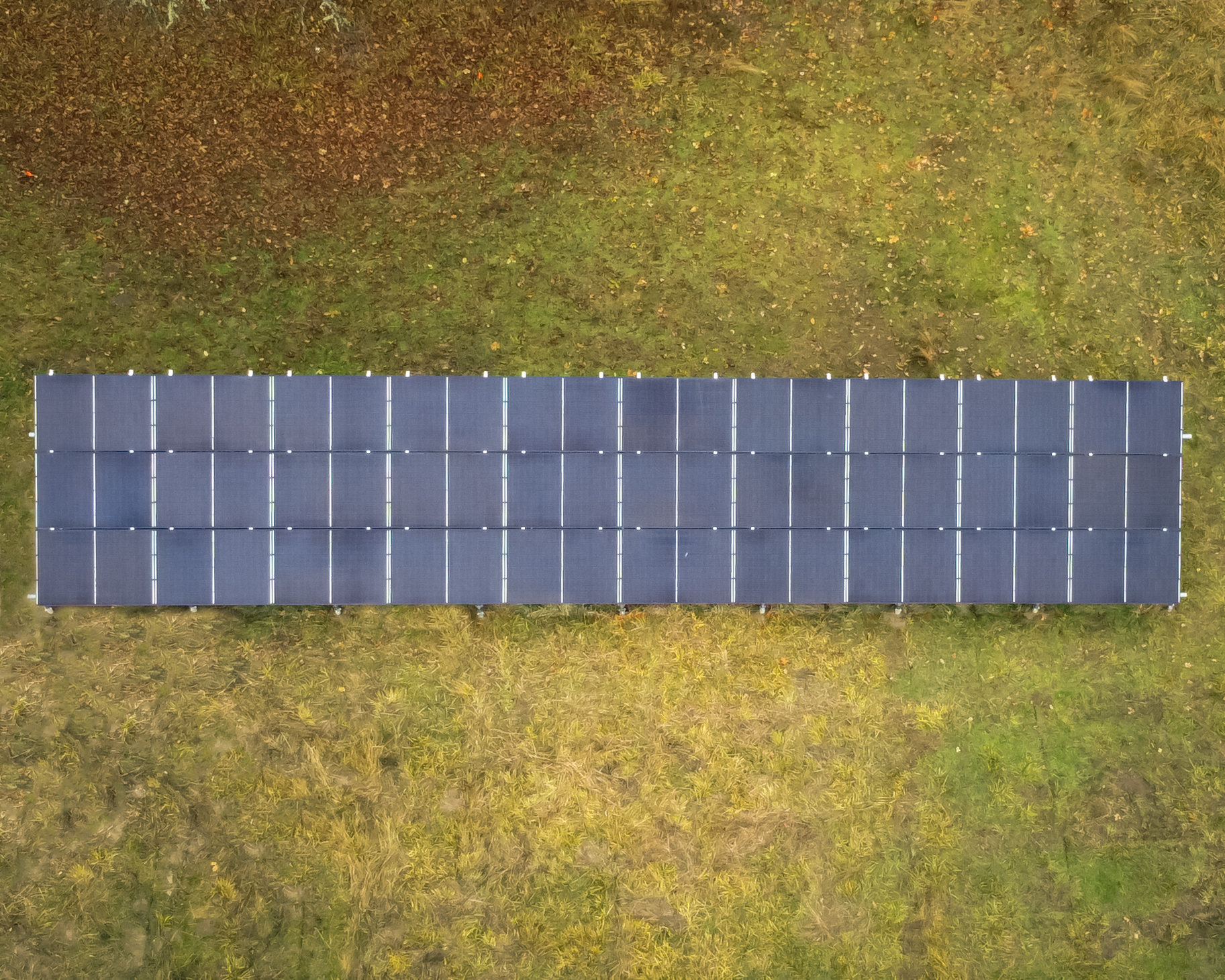
From the 21st November until the 23rd Sunshine Solar installed a solar panel system. But we were then told to wait until Pacific Power had come to the house to put in a new electricity meter. Last Thursday, 1st December, Brent from Pacific Power called by and replaced our electricity meter. He replaced it with a bi-directional meter that when we were producing more power than we are consuming then the surplus would be ‘banked’ to be used at times when we required the surplus.

This was the result of us investing in a ground-mounted solar system.

We purchased the system from Solar Sunshine after doing a great deal of research. Indeed Brent said that they were a great company.

The other thing that we had no choice over was to install a ground-mounted system some 120 feet from the house. Because neither the house nor the roof face East and therefore are no use for solar. But as Brent pointed out last Thursday the ground-mounted system, despite being more expensive, was a good alternative to the roof system because new roof tiles were irrelevant.

The system consists of 30 individual panels capable of producing a maximum output of 65 amps at 240 volts; in other words 15,600 watts!

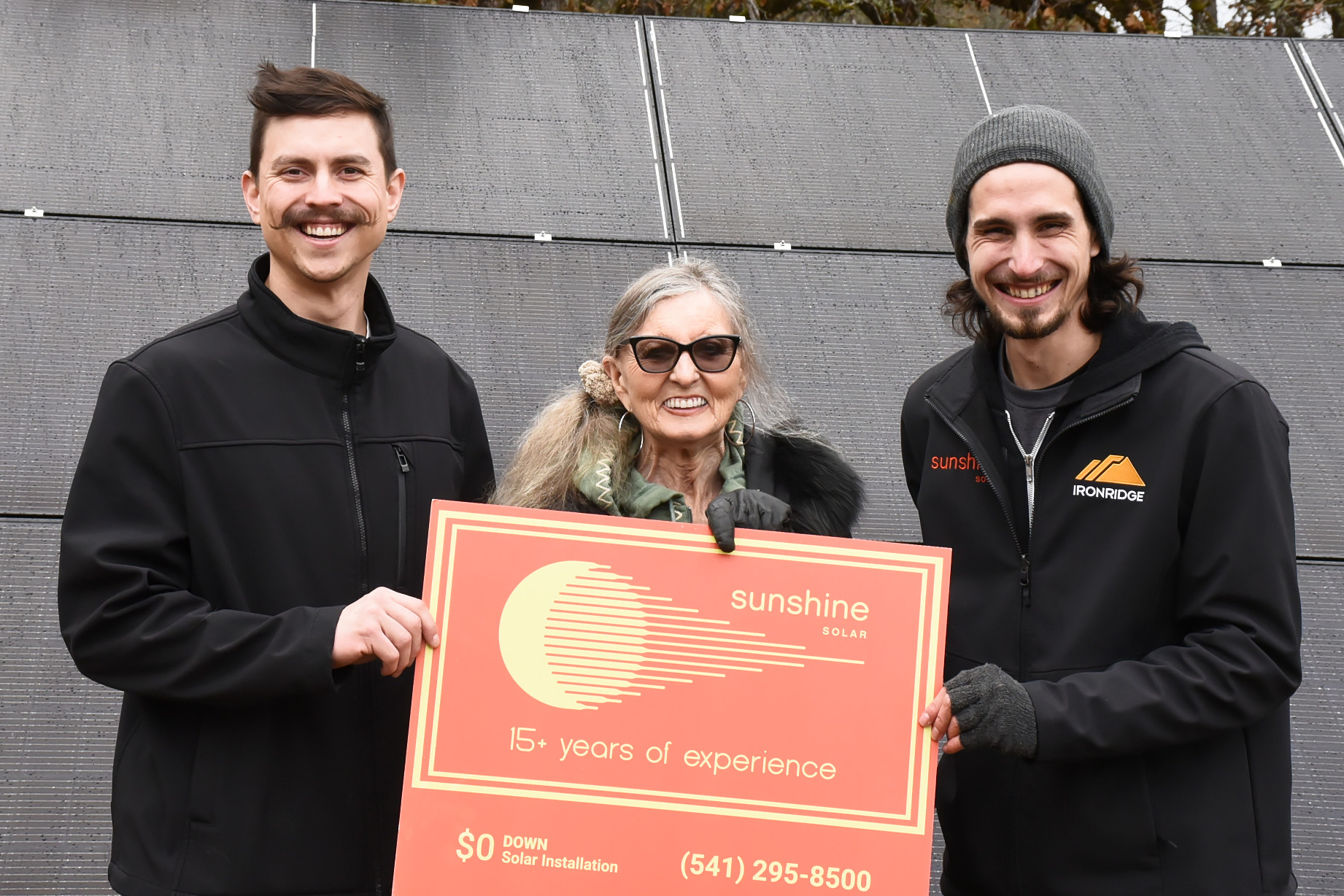
Yesterday, Cory and Brandon (sp?) came out to the system and checked that it was alright. Plus they gave us an digital application so we could see how much power we were generating, plus more, and they also took some photographs, that I offer you now.

oooo

oooo

oooo

This last photograph was one taken by yours truly with Cory on the left and Brandon on the right with Jeannie in the middle.

Finally, the ‘app’ is going to be very useful.

Already it shows that last Saturday the array produced 29 kilowatts and then yesterday, the 4th December, the array produced 22.9 kilowatts and these were by no means sunlit days all the time. That brings the total for all 5 days in December, in other words since the system went live, to 91.1 kilowatts as of 15:27 PT on the 5th.

We are most pleased with the company and the installation.

Why is intelligent life so rare?

Maybe it is because of a ‘Great Filter‘.

Like so many others I read many items online. One of the websites that I follow is the EarthSky site because for a long time I have been interested in space.

So when I saw an article on why intelligent life is so rare in our Milky Way I read it fully. And hoped it would be of interest to others.

Here it is:

ooOOoo

What is the Great Filter, and can we survive it?

Posted by

Kelly Kizer Whitt and Deborah Byrd

November 17, 2022

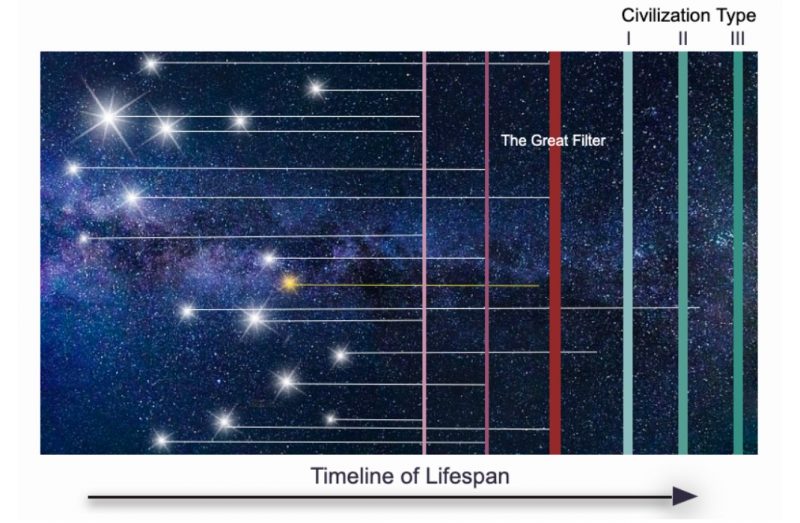
This graphic depicts intelligent civilizations as stars. The vertical lines represent Great Filters that civilizations do or don’t survive. This graphic depicts Earth’s human population (the yellow “star”) approaching its own Great Filter. How would we surpass it, and keep going? Image via NASA/ arXiv.

What is the Great Filter?

Is intelligent life common, or rare in our Milky Way galaxy? If it’s common, why haven’t we encountered it? While discussing UFOs on a walk to lunch in the year 1950, the physicist Enrico Fermi is famously said to have asked, “But where is everybody?” Scientists today call that riddle Fermi’s Paradox. Now a new paper by NASA scientists explores one possible answer to the paradox. The answer may be what’s called the Great Filter.

Economist Robin Hanson first proposed the Great Filter, in the late 1990s. It’s the idea of that – even if life forms abundantly in our Milky Way galaxy – each extraterrestrial civilization ultimately faces some barrier to its own survival. The barrier might come from without (for example, an asteroid striking a planet, and wiping out all life forms). Or it might come from within (for example, all-out nuclear war).

Hanson proposed that a Great Filter might be at work within our Milky Way galaxy. He argued – from what we can see here on Earth – life expands to fill every niche. And so, he argued, we should see signs of intelligent life beyond Earth in nearby star systems, perhaps even in our solar system. But we don’t see this.

Is humanity facing a Great Filter?

The authors of the new paper take Hanson’s idea further. They explore the idea that humanity may now be facing a Great Filter. The authors wrote:

We postulate that an existential disaster may lay in wait as our society advances exponentially towards space exploration, acting as the Great Filter: a phenomenon that wipes out civilizations before they can encounter each other … In this article, we propose several possible scenarios, including anthropogenic and natural hazards, both of which can be prevented with reforms in individual, institutional and intrinsic behaviors. We also take into account multiple calamity candidates: nuclear warfare, pathogens and pandemics, artificial intelligence, meteorite impacts, and climate change. 

And they offer solutions, beginning with, as they say:

… a necessary period of introspection, followed by appropriate refinements to properly approach our predicament, and addressing the challenges and methods in which we may be able to mitigate risk to mankind and the nearly 9 million other species on Earth.

In a sense, the authors of the new paper – including lead author Jonathan H. Jiang of NASA’s Jet Propulsion Laboratory in Pasadena, California – are engaging in a “necessary period of introspection” by the act of writing their paper.

And, with their paper, they’re laying out the challenges we’re facing and methods of addressing them.

We’ve already survived some ‘filters’

The scientists point to life’s resilience. Life on Earth has already survived a number of filters in the form of mass extinction events. The Permian-Triassic extinction – aka the Great Dying – occurred 250 million years ago and nearly ended all life on the planet. This extinction event wiped out about 96% of marine life and 70% of land species. The exact cause of the Great Dying is still a matter of study, but some scientists have said it was a combination of warming temperatures and decreasing oxygen.

But these previous filters, or extinction events, have been natural, arising from the evolution of our planet and solar system, including volcanic eruptions and asteroid impacts

A Great Filter of our own making

But now, clearly, humanity may be facing a Great Filter of our own making, and one that other intelligent civilizations in the galaxy have faced … and failed to withstand. Perhaps it’s no surprise that the technological advancements humans have achieved might ultimately lead to our undoing. Perhaps that’s nature’s way. As the new paper said:

It seems as though nearly every great discovery or invention, while pushing back the borders of our technological ignorance, is all too quickly and easily turned to destructive ends. Examples such as splitting the atom, biomedical innovations and resource extraction and consumption come to mind with disconcerting swiftness. Still, some have suggested artificial intelligence (AI) as yet another factor, which, pending substantial technical hurdles, may yet have its chance to prove friend or foe.

Here’s a look at some of the issues that might compose Earth’s Great Filter.

Unchecked population growth

One of the factors Earth faces, according to the paper, is unchecked population growth. Earth just passed a milestone on November 15, 2022, when it reached 8 billion human inhabitants. The paper said with our current population figures, Earth has experienced:

… an exponential rise from about 1.6 billion [people] at the start of the 20th century.

Technological advancements in farming, energy production and distribution have made such a large population possible on Earth. But, as the paper said, these advancements cannot:

… indefinitely offset the multifaceted stresses imposed by an ever-escalating population.

When will Earth’s human population reach its peak size? Some projections report that education in developing nations might allow Earth’s population to peak at 10 billion in the 2060s. But, of course, no one really knows.

Nuclear war

While warfare has long been a factor of life on Earth, only in the past century has humanity had a weapon that could destroy all nations, not just those participating in a nuclear war. The scientists said the greater the number of democracies in the world, the better our chances for avoiding nuclear war. The scientist also saw other encouraging signs, including:

Peace agreements in the historically troubled Middle East, a vast reduction in nuclear warheads since the height of the Cold War and a wide coalition of nations rallying their support for the besieged in Eastern Europe.

Pathogens and pandemics

The threat of illness and pandemics continues to grow simply because our world is so interconnected. Spreading diseases have a much easier time in our global society. But on the positive side, advancements in medicine have also given us an edge. The scientists said that having current and reliable data is crucial:

… in predicting how future pandemics will spread, how deadly they will be and how quickly and effectively we will be able to leverage our knowledge of the life sciences to counter this manifestation of the Great Filter.

Artificial intelligence

While true artificial intelligence as a separate sentient being is not yet reality, the authors of the paper urge a proactive plan to peacefully share Earth. They project that computer sophistication will one day rival that of the human mind. The scientists said:

As for whether AI would be benign or otherwise, self-imposing a Great Filter of our own invention, that will depend on the evolving nature and disposition of Earth’s first high-tech species.

Asteroid and comet impacts

Here’s an extinction event from the past that could still spell our doom in the future. While large impacts are exceedingly rare, there is, as the scientists said:

… a non-zero percentage [of asteroids or comets] which are large enough to survive passage through the atmosphere and, impacting the surface, cause catastrophic destruction to our sensitive biosphere.

The odds of a mass extinction level event in the coming years is vanishingly small. But, over time periods extending into the very distant future, the odds increase toward 100%. Meanwhile, with projects such as the DART mission, and given enough lead time, humanity has a way of defending itself.

Climate change

Climate change has become one of the most studied threats to life on Earth. Because the threats from climate change happen on a slower time scale than, say, the time it takes to launch a nuclear weapon, the efforts to curb these effects have not been as rapid as they could have been. The scientists said:

The major impediment to taking more decisive actions, however, are the challenges imposed by transitioning to non-carbon-based energy sources such as solar, wind, nuclear power. Here again, rapidly advancing technologies in areas such as modularized nuclear power plants and carbon capture and sequestration (CCS) are among the best hopes for avoiding slow-motion ensnarement by this lulling but lethal Great Filter.

Avoiding the Great Filter

So you see there’s not just one possible Great Filter for Earth, but many. Any one of them could be our downfall. These scientists are suggesting something that sounds simple on its face, but is (apparently) hard to do. That is, in order to avoid the Great Filter, humans must work together and recognize the big picture. As the paper said:

History has shown that intraspecies competition and, more importantly, collaboration, has led us toward the highest peaks of invention. And yet, we prolong notions that seem to be the antithesis of long-term sustainable growth. Racism, genocide, inequity, sabotage … the list sprawls.

Meanwhile, we continue to look outward, peering at the dark depths between the stars, hoping for a sign that we aren’t alone in the universe. Ultimately, our quest to find life beyond Earth is part of trying to understand life on our planet and where we fit in. As Carl Sagan said:

In the deepest sense, the search for extraterrestrial intelligence is a search for ourselves.

Bottom line: Scientists say the reason we haven’t found intelligent civilizations in the galaxy is that they may not have survived the Great Filter. And they say we may be facing down our own Great Filter.

Source: https://arxiv.org/ftp/arxiv/papers/2210/2210.10582.pdf

ooOOoo

We are a funny bunch! As was said just a couple of paragraphs ago we humans must work together and recognise the big picture. But we do not!

Why do we not do that?

I wish I knew the answer to that conundrum! Nevertheless, I hope you enjoyed the article.
Herman Daly.

A recent article in The Conversation

I was short of time yesterday when I turned my mind to Tuesday’s post. So I hope you won’t mind if I leave you with this very interesting article.

ooOOoo

The inconvenient truth of Herman Daly: There is no economy without environment

The economy depends on the environment. Economics can seem to forget that point. Ines Lee Photos/Moment via Getty Images

Jon D. Erickson, University of Vermont

Herman Daly had a flair for stating the obvious. When an economy creates more costs than benefits, he called it “uneconomic growth.” But you won’t find that conclusion in economics textbooks. Even suggesting that economic growth could cost more than it’s worth can be seen as economic heresy.

The renegade economist, known as the father of ecological economics and a leading architect of sustainable development, died on Oct. 28, 2022, at the age of 84. He spent his career questioning an economics disconnected from an environmental footing and moral compass.


In an age of climate chaos and economic crisis, his ideas that inspired a movement to live within our means are increasingly essential.

The seeds of an ecological economist

Herman Daly grew up in Beaumont, Texas, ground zero of the early 20th century oil boom. He witnessed the unprecedented growth and prosperity of the “gusher age” set against the poverty and deprivation that lingered after the Great Depression.

To Daly, as many young men then and since believed, economic growth was the solution to the world’s problems, especially in developing countries. To study economics in college and export the northern model to the global south was seen as a righteous path.

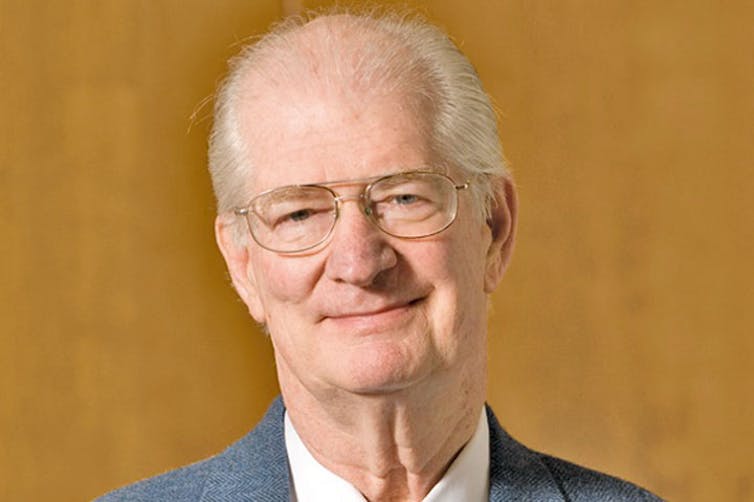
Headshot photo of Daly as an older man, with glasses and thinning hair,
Economist Herman Daly (1938-2022) Courtesy of Island Press

But Daly was a voracious reader, a side effect of having polio as a boy and missing out on the Texas football craze. Outside the confines of assigned textbooks, he found a history of economic thought steeped in rich philosophical debates on the function and purpose of the economy.

Unlike the precision of a market equilibrium sketched on the classroom blackboard, the real-world economy was messy and political, designed by those in power to choose winners and losers. He believed that economists should at least ask: Growth for whom, for what purpose and for how long?

Daly’s biggest realization came through reading marine biologist Rachel Carson’s 1962 book “Silent Spring,” and seeing her call to “come to terms with nature … to prove our maturity and our mastery, not of nature but of ourselves.” By then, he was working on a Ph.D. in Latin American development at Vanderbilt University and was already quite skeptical of the hyperindividualism baked into economic models. In Carson’s writing, the conflict between a growing economy and a fragile environment was blindingly clear.

After a fateful class with Nicholas Georgescu-Roegen, Daly’s conversion was complete. Georgescu-Roegen, a Romanian-born economist, dismissed the free market fairy tale of a pendulum swinging back and forth, effortlessly seeking a natural state of equilibrium. He argued that the economy was more like an hourglass, a one-way process converting valuable resources into useless waste.

Daly became convinced that economics should no longer prioritize the efficiency of this one-way process but instead focus on the “optimal” scale of an economy that the Earth can sustain. Just shy of his 30th birthday in 1968, while working as a visiting professor in the poverty-stricken Ceará region of northeastern Brazil, Daly published “On Economics as a Life Science.”

His sketches and tables of the economy as a metabolic process, entirely dependent on the biosphere as source for sustenance and sink for waste, were the road map for a revolution in economics.

Economics of a full world

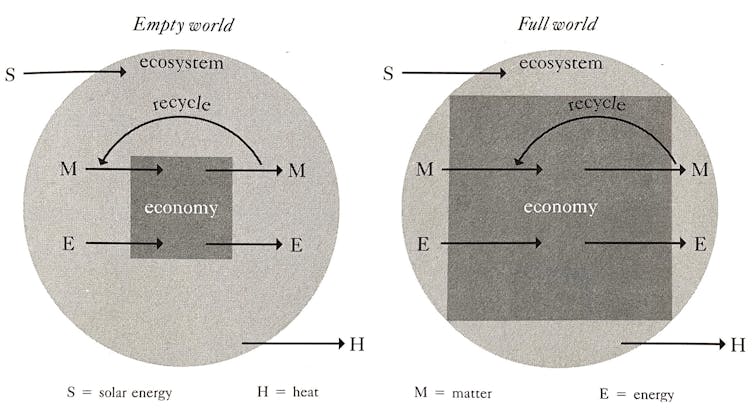
Daly spent the rest of his career drawing boxes in circles. In what he called the “pre-analytical vision,” the economy – the box – was viewed as the “wholly owned subsidiary” of the environment, the circle.

When the economy is small relative to the containing environment, a focus on the efficiency of a growing system has merit. But Daly argued that in a “full world,” with an economy that outgrows its sustaining environment, the system is in danger of collapse.

Illustrations of a square (economy) inside a circle (ecosystem). Energy and matter go into and out of the economy square, and some is recycled. Meanwhile solar energy enters the ecosystem circle and some heat escapes. In one, the square is too large.
Herman Daly’s conception of the economy as a subsystem of the environment. In a ‘full world,’ more growth can become uneconomic. Adapted from ‘Beyond Growth.’ Used with permission from Beacon Press.

While a professor at Louisiana State University in the 1970s, at the height of the U.S. environmental movement, Daly brought the box-in-circle framing to its logical conclusion in “Steady-State Economics.” Daly reasoned that growth and exploitation are prioritized in the competitive, pioneer stage of a young ecosystem. But with age comes a new focus on durability and cooperation. His steady-state model shifted the goal away from blind expansion of the economy and toward purposeful improvement of the human condition.

The international development community took notice. Following the United Nations’ 1987 publication of “Our Common Future,” which framed the goals of a “sustainable” development, Daly saw a window for development policy reform. He left the safety of tenure at LSU to join a rogue group of environmental scientists at the World Bank.

For the better part of six years, they worked to upend the reigning economic logic that treated “the Earth as if it were a business in liquidation.” He often butted heads with senior leadership, most famously with Larry Summers, the bank’s chief economist at the time, who publicly waved off Daly’s question of whether the size of a growing economy relative to a fixed ecosystem was of any importance. The future U.S. treasury secretary’s reply was short and dismissive: “That’s not the right way to look at it.”

But by the end of his tenure there, Daly and colleagues had successfully incorporated new environmental impact standards into all development loans and projects. And the international sustainability agenda they helped shape is now baked into the U.N. Sustainable Development Goals of 193 countries, “a plan of action for people, planet and prosperity.” In 1994, Daly returned to academia at the University of Maryland, and his life’s work was recognized the world over in the years to follow, including by Sweden’s Right Livelihood Award, the Netherlands’ Heineken Prize for Environmental Science, Norway’s Sophie Prize, Italy’s Medal of the Presidency, Japan’s Blue Planet Prize and even Adbuster’s person of the year.

Today, the imprint of his career can be found far and wide, including measures of the Genuine Progress Indicator of an economy, new Doughnut Economics framing of social floors within environmental ceilings, worldwide degree programs in ecological economics and a vibrant degrowth movement focused on a just transition to a right-sized economy.

I knew Herman Daly for two decades as a co-author, mentor and teacher. He always made time for me and my students, most recently writing the foreword to my upcoming book, “The Progress Illusion: Reclaiming Our Future from the Fairytale of Economics.” I will be forever grateful for his inspiration and courage to, as he put it, “ask the naive, honest questions” and then not be “satisfied until I get the answers.”

Jon D. Erickson, Professor of Sustainability Science and Policy, University of Vermont

This article is republished from The Conversation under a Creative Commons license. Read the original article.

ooOOoo

I found this to be absolutely fascinating and I am sure many besides me agree.

One of the puzzles of this age.

Why society doesn’t worry a whole lot more about the changing climate.

There was an article recently on Treehugger that I read in full.

It was predictable, in a way, and very disturbing. Have a read yourself.

ooOOoo

Why Don’t People Care About Climate Change?

They have other things on their mind, like being hit by a car.

By Lloyd Alter,

Published October 21, 2022

People fear this more than climate change. Halfpoint/ Getty Images

Treehugger was founded by Graham Hill as “a green lifestyle website dedicated to driving sustainability mainstream.” Sustainability is often defined as “meeting our own needs without compromising the ability of future generations to meet their own needs,” and doesn’t seem to be much more mainstream now than it was then. Here we are, 18 years later, and key sustainability issues like climate change are not top of mind for most people, and Treehugger is not the world’s biggest website.

One reason might be because of people’s perception of risk. The Lloyd’s Register Foundation is a charity that “helps to protect life and property at sea, on land, and in the air.” It hired Gallup to do a World Risk Poll in 2020, using 2019 data, and just published its latest 2022 poll with 2021 data, after polling 125,911 people in 121 countries, mostly by telephone. One poll was pre-pandemic, and the other during it.1Chief executive Dr. Ruth Boumphrey compares the two:

“Looking at this first report of the 2021 World Risk Poll, what strikes me most about the findings is what hasn’t changed, as much as what has. People globally still worry about perennial threats such as road crashes, crime, and violence more than any other risks, including Covid-19, and this has important implications for how policymakers work with communities to manage emerging public health challenges in the context of their everyday lives.”

Perhaps the most surprising statistic is that North Americans believe that their greatest daily source of risk is from road-related accidents and injuries at 29%, followed by crime and violence at 11%. Australia and New Zealand put road risk at 33%, weirdly followed by cooking and household accidents at 11%.1

At first, I thought this is terrible; we have been writing about road safety for years, and nothing gets fixed, and yet it is North Americans’ biggest worry! And what’s wrong with Australian kitchens? But when you look at the numbers, you realize that this is a result of rich countries not suffering as much from many of the things other countries worry about, such as Latin America with crime and violence at 43%, Africa worrying about not having money, and North Africa worried about disease.1

Covid-19 was considered a major risk in some parts of the world, but “its impact was moderate overall, and day-to-day risks such as road-related injuries, crime and violence, and economic concerns remained top-of-mind for most people.”

This has been the perennial sustainability story; day-to-day issues and worries have higher priority. Climate change gets its own special section of the risk report and it comes to much the same conclusion. The authors start by noting that “the global risk posed by climate change is widely recognised, and warnings about its effects are increasingly dire. A recent joint statement by more than 200 medical journals called the rapidly warming climate the ‘greatest threat to global public health.'”

But then they dig into the data and find that, while 67% of respondents consider climate change a threat, only 41% deem it serious.1 It varies by education:

“The likelihood of people viewing climate change as a very serious threat to their country was much lower among those with primary education or less (32%) than among those with secondary (47%) or post-secondary (50%) education. More than a quarter of people in the lowest education group (28%) said they ‘don’t know,’ compared to 13% among those with secondary education and 7% with at least some post-secondary education.”

Logically, people who had experienced severe weather events were more likely to consider climate change to be a serious threat, although even then, there is a correlation with education. So university grads in Fort Myers are probably pretty convinced that climate change is a problem right now. The conclusion:

“As in 2019, the 2021 World Risk Poll findings demonstrate the powerful influence of education on global perceptions of climate change. The data highlight the challenge of reaching people who may be vulnerable to risk from extreme weather but have low average education levels, such as agricultural communities in low- and middle-income countries and territories… Spreading awareness of how climate change may directly impact people’s lives may be crucial in broadening local efforts to reduce carbon emissions and build resilience to the effects of rising temperatures.”

Education has always been a problem because, as climate journalist Amy Westervelt noted after the latest IPCC report, there are powerful forces interested in downplaying the importance of climate change. She wrote, “The report made one thing abundantly clear: the technologies and policies necessary to adequately address climate change exist, and the only real obstacles are politics and fossil fuel interests.” Education would have a lot to do with how susceptible people are to their stories.

In many ways, we have seen this movie before, in the Great Recession of 2008. When people are worrying about whether they can heat or they can eat, or apparently whether they will survive crossing the street, then climate change is something they can worry about later.

  1. 2021 Report: A Changed World? Perceptions and Experiences of Risk in the Covid Age.” Lloyd’s Register Foundation, 2022.

ooOOoo

This is the reason why we need leaders, as in country leaders, because only these people are sufficiently committed to plan and to legislate for the most important tasks facing that country. In the case of climate change it requires even more co-ordination across all the countries in the world; we do have a way to go before that is achieved.

Our climate: Welcome to the New Normal!

An article read on Sunday is the motivation for today’s post.

The article, published by The Conversation blog site, was made public last Wednesday week.

I make no apologies for banging the climate change gong again, it is in my opinion the most important subject going.

Enough from me; now to the article.
(And it had been planned for last Tuesday but because of Pedi it is now today.)

ooOOoo

By Professor Shuang-Ye Wu

This article was written by Professor Shuang-Ye Wu. It is very good.

Professor Wu is the Professor of Geology and Environmental Geosciences at the University of Dayton, USA.

Looking back on America’s summer of heat, floods and climate change: Welcome to the new abnormal!

Much of the South and Southern Plains faced a dangerous heat wave in July 2022, with highs well over 100 degrees for several days. Brandon Bell/Getty Images

The summer of 2022 started with a historic flood in Montana, brought on by heavy rain and melting snow, that tore up roads and caused large areas of Yellowstone National Park to be evacuated.

It ended with a record-breaking heat wave in California and much of the West that pushed the power grid to the breaking point, causing blackouts, followed by a tropical storm that set rainfall records in southern California. A typhoon flooded coastal Alaska, and a hurricane hit Puerto Rico with more than 30 inches of rain.

In between, wildfires raged through California, Arizona and New Mexico on the background of a megadrought in Southwestern U.S. that has been more severe than anything the region has experienced in at least 1,200 years. Near Albuquerque, New Mexico, a five-mile stretch of the Rio Grande ran dry for the first time in 40 years. Persistent heat waves lingered over many parts of the country, setting temperature records.

At the same time, during a period of five weeks between July and August, five 1,000-year rainfall events occurred in St. Louis, eastern Kentucky, southern Illinois, California’s Death Valley and in Dallas, causing devastating and sometimes deadly flash floods. Extreme rainfall also led to severe flooding in Mississippi, Virginia and West Virginia.

The United States is hardly alone in its share of climate disasters.

In Pakistan, record monsoon rains inundated more than one-third of the country, killing over 1,500 people. In India and China, prolonged heat waves and droughts dried up rivers, disrupted power grids and threatened food security for billions of people.

In Europe, heat waves set record temperatures in Britain and other places, leading to severe droughts and wildfires in many parts of the continent. In South Africa, torrential rains brought flooding and mudslides that killed more than 400 people. The summer may have come to an end on the calendar, but climate disasters will surely continue.

This isn’t just a freak summer: Over the years, such extreme events are occurring in increasing frequency and intensity.

Climate change is intensifying these disasters

The most recent international climate assessment from the United Nations’ Intergovernmental Panel on Climate Change found significant increases in both the frequency and intensity of extreme temperature and precipitation events, leading to more droughts and floods.

A recent study published in the scientific journal Nature found that extreme flooding and droughts are also getting deadlier and more expensive, despite an improving capacity to manage climate risks. This is because these extreme events, enhanced by climate change, often exceed the designed levels of such management strategies.

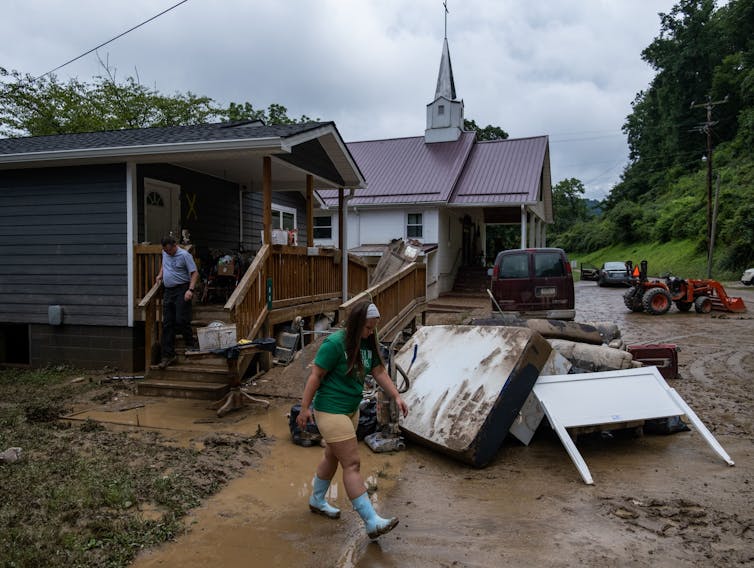
A girl in rain boots walks through a mud-filled yard. Damaged mattresses and other belongings from a flooded house are piled nearby.
Flash flooding swept through mountain valleys in eastern Kentucky in July 2022, killing more than three dozen people. It was one of several destructive flash floods. Seth Herald/AFP via Getty Images

Extreme events, by definition, occur rarely. A 100-year flood has a 1% chance of happening in any given year. So, when such events occur with increasing frequency and intensity, they are a clear indication of a changing climate state.

The term “global warming” can sometimes be misleading, as it seems to suggest that as humans put more heat-trapping greenhouse gases into the atmosphere, the world is going to get a bit warmer everywhere. What it fails to convey is that warming temperatures also lead to a more violent world with more extreme climate disasters, as we saw this past summer.

Climate models showed these risks were coming

Much of this is well-understood and consistently reproduced by climate models.

As the climate warms, a shift in temperature distribution leads to more extremes. The magnitudes of changes in extreme temperature are often larger than changes in the mean. For example, globally, a 1 degree Celsius increase in annual average temperature is associated with 1.2 C to 1.9 C (2.1 Fahrenheit to 3.4 F) of increase in the annual maximum temperature.

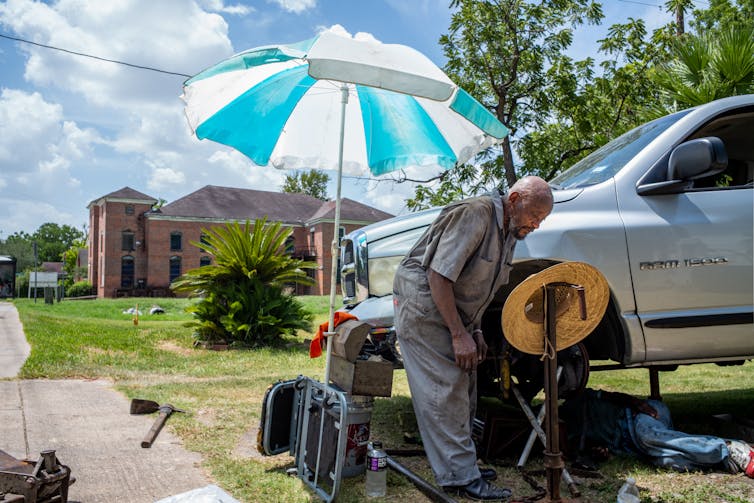
A man works on a car with an older mechanic in overalls standing next to him under the shade of a large beach umbrealla.
Heat waves, like the heat dome over the South in July 2022, can hit outdoor workers especially hard. Brandon Bell/Getty Images

In addition, global warming causes changes in the vertical profile of the atmosphere and equator-to-pole temperature gradients, leading to changes in how the atmosphere and ocean move. The temperature difference between equator and the poles is the driving force for global wind. As the polar regions warm at much higher rates then the equator, the reduced temperature difference causes a weakening of global winds and leads to a more meandering jet stream.

Some of these changes can create conditions such as persistent high-pressure systems and atmosphere blocking that favor more frequent and more intense heat waves. The heat domes over the Southern Plains and South in June and the West in September are examples.

The initial warming can be further amplified by positive feedbacks. For example, warming increases snow melt, exposing dark soil underneath, which absorbs more heat than snow, further enhancing the warming.

Warming of the atmosphere also increases its capacity to hold water vapor, which is a strong greenhouse gas. Therefore, more water vapor in the air leads to more warming. Higher temperatures tend to dry out the soil, and less soil moisture reduces the land’s heat capacity, making it easier to heat up.

These positive feedbacks further intensify the initial warming, leading to more heat extremes. More frequent and persistent heat waves lead to excessive evaporation, combined with decreased precipitation in some regions, causing more severe droughts and more frequent wildfires.

Higher temperatures increase the atmosphere’s capacity to hold moisture at a rate of about 7% per degree Celsius.

This increased humidity leads to heavier rainfall events. In addition, storm systems are fueled by latent heat, or the large amount of energy released when water vapor condenses to liquid water. Increased moisture content in the atmosphere also enhances latent heat in storm systems, increasing their intensity. Extreme heavy or persistent rainfall leads to increased flooding and landslides, with devastating social and economic consequences.

Even though it’s difficult to link specific extreme events directly to climate change, when these supposedly rare events occur with increasing frequency in a warming world, it is hard to ignore the changing state of our climate.

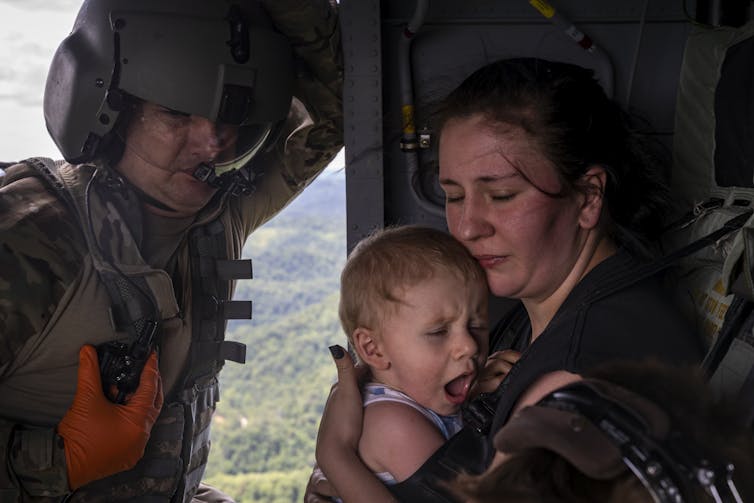
A woman with her eyes closed holds a screaming 1-year-old boy in a National Guard helicopter, with a guardsman standing in the open helicopter door.
A family had to be airlifted from their home in eastern Kentucky after it was surrounded by floodwater in July 2022. Michael Swensen/Getty Images

The new abnormal

So this past summer might just provide a glimpse of our near future, as these extreme climate events become more frequent.

To say this is the new “normal,” though, is misleading. It suggests that we have reached a new stable state, and that is far from the truth.

Without serious effort to curb greenhouse gas emissions, this trend toward more extreme events will continue. Things will keep getting worse, and this past summer will become the norm a few years or decades down the road – and eventually, it will seem mild, like one of those “nice summers” we look back on fondly with nostalgia.

This article is republished from The Conversation under a Creative Commons license. Read the original article.
ooOOoo

There is growing evidence that things are really changing globally. I used to say that I would be dead before the impacts of climate change really hit home. As in, it would be a good twenty years before things really took a hold. But it is now much more likely that the next five years are going to see a continuation of the changes and that there isn’t time to hang around.

I may not be as sharp as I used to be but the changing climate will affect me and Jean and all those in our area. Will our leaders grasp this nettle now? I wish I knew.

Climate Change

Paul Handover’s talk to the Grants Pass Humanists and Freethinkers group, Saturday, 17th September, 2022

oooo

Martin Lack, a good friend of Paul’s from England, wrote a book called The Denial of Science. The first words in the preface were from Sir Fred Hoyle, Fellow of the Royal Society (1915-2001).

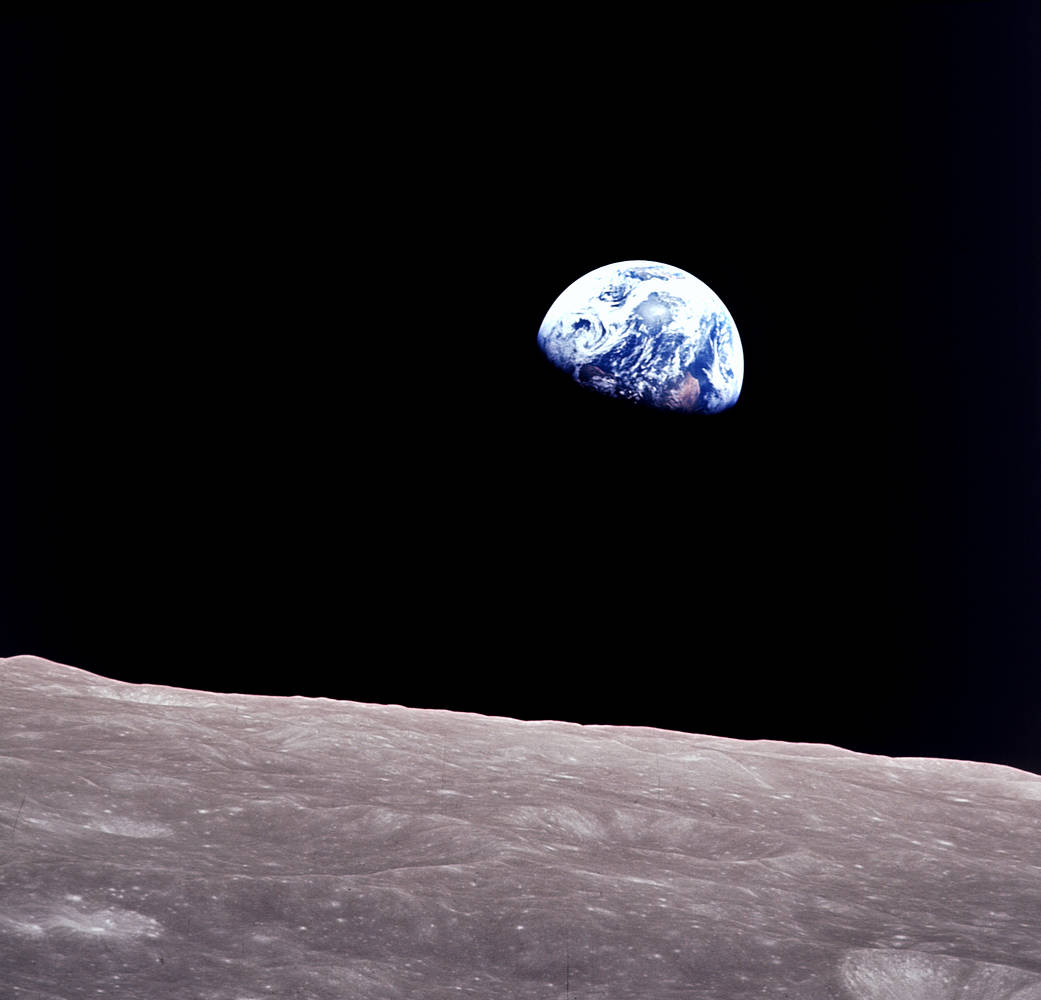
Once a photograph of the Earth taken from the outside is available, once the sheer isolation of the Earth becomes plain, a new idea as powerful as any in history will be let loose.

Here, in Paul’s opinion, is that photograph:

Taken aboard Apollo 8 by Bill Anders, this iconic picture shows Earth peeking out from beyond the lunar surface as the first crewed spacecraft circumnavigated the Moon, with astronauts Anders, Frank Borman, and Jim Lovell aboard.
Image Credit: NASA Last Updated: Dec 23, 2020
Editor: Yvette Smith

The 2021 United Nations Climate Change Conference was held in Glasgow, Scotland, UK, from 31st October to 13th November 2021. It was called COP26 because it was the 26th UN Climate Change Conference to be held. It was opened by the Prince of Wales, now King Charles III.

The Prince warned: “Time has quite literally run out.”

It is us!

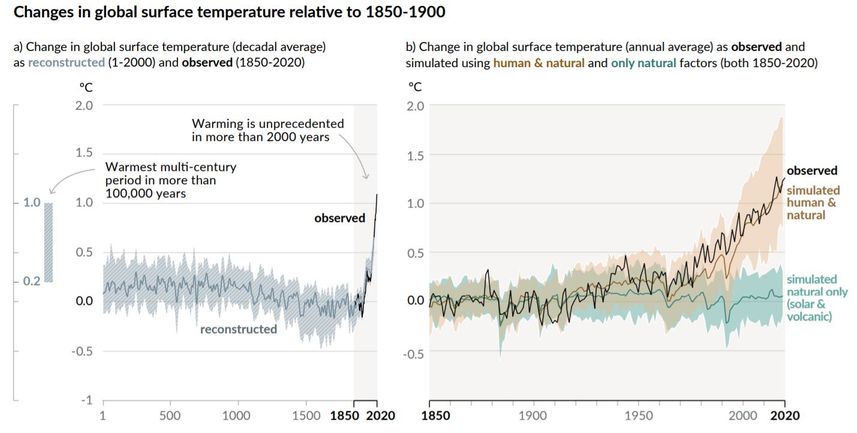
The UN’s Intergovernmental Panel on Climate Change (IPCC) kicked off its 2021 report with the following statement: “It is unequivocal that human influence has warmed the atmosphere, ocean and land.

The article also says: It took a while, but climate modelling is now refined enough to predict how things would go without human influence, within a margin of error. What we are observing today, however, is beyond that margin of error, therefore proving that we have driven the change.

It is getting hot

The last decade was the hottest in 125,000 years.

The oceans

We live on a water world. The facts are that 71% of the Earth’s surface is water-covered and the oceans hold about 96.5% of all Earth’s water. A 2019 study found that oceans had sucked up 90% of the heat gained by the planet between 1971 and 2010. Another found that it absorbed 20 sextillion joules of heat in 2020  – equivalent to two Hiroshima bombs per second. A (chiefly British) definition of a sextillion: It is the cardinal number equal to 1036. Sextillion is a number equal to a 1 followed by 21 zeros. 1,000,000,000,000,000,000,000 is an example of a sextillion.

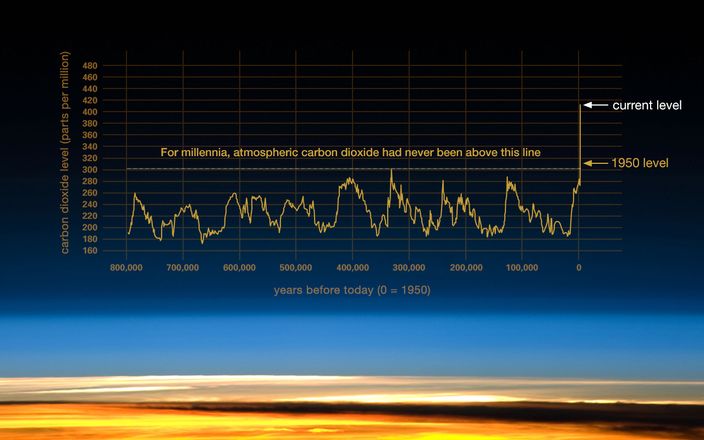
Carbon-dioxide

In fact CO2 levels are now the highest that they have been in 2 million years. Today, they stand at close to 420 parts per million (ppm). To put that into context pre-industrial levels, say before 1750, had CO2 levels around 280 parts per million.

We are losing ice big time

Paul can do no better than to quote from Earth.org“Since the mid-1990s, we’ve lost around 28 trillion tons of ice, with today’s melt rate standing at 1.2 trillion tons a year. To help put that into perspective, the combined weight of all human-made things is 1.1 trillion tons. That’s about the same weight as all living things on earth.”

To repeat that: Every single year we are losing 1.2 trillion tons of ice! (1,200,000,000,000).

Extreme weather

We can now attribute natural disasters to human-driven climate change with certainty. We can now say with precision how much likelier we made things like the North American summer 2021 heatwave, which the World Weather Attribution says was “virtually impossible” without climate change. Then there is the Indian heatwave that experts believe was made 30 times more likely because of climate change.

Climate change mitigation

There is a long and comprehensive article on the above subject on WikiPedia. I will quote from the paragraph Needed emissions cuts.

If emissions remain on the current level of 42 GtCO2, the carbon budget for 1.5°C (2.7°F) will be exhausted in 2028. (That’s 42 gigatons, as in 1 gigaton is a unit of explosive force equal to one billion (109) tons of trinitrotoluene (TNT).

In 2022, the Intergovernmental Panel on Climate Change (IPCC) released its Sixth Assessment Report on climate change, warning that greenhouse gas emissions must peak before 2025 at the latest and decline 43% by 2030, in order to likely limit global warming to 1.5°C (2.7°F).

Secretary-general of the United Nations António Guterres clarified that for this to happen “Main emitters must drastically cut emissions starting this year”.

WikiPedia also reports that: The United Nations Framework Convention on Climate Change, the UNFCCC, aims to stabilise greenhouse gas (GHG) concentrations in the atmosphere at a level where ecosystems can adapt naturally to climate change, food production is not threatened, and economic development can proceed in a sustainable fashion. Currently human activities are adding CO2 to the atmosphere faster than natural processes can remove it.

We need to act now, otherwise…

… it will be too late for billions of us.

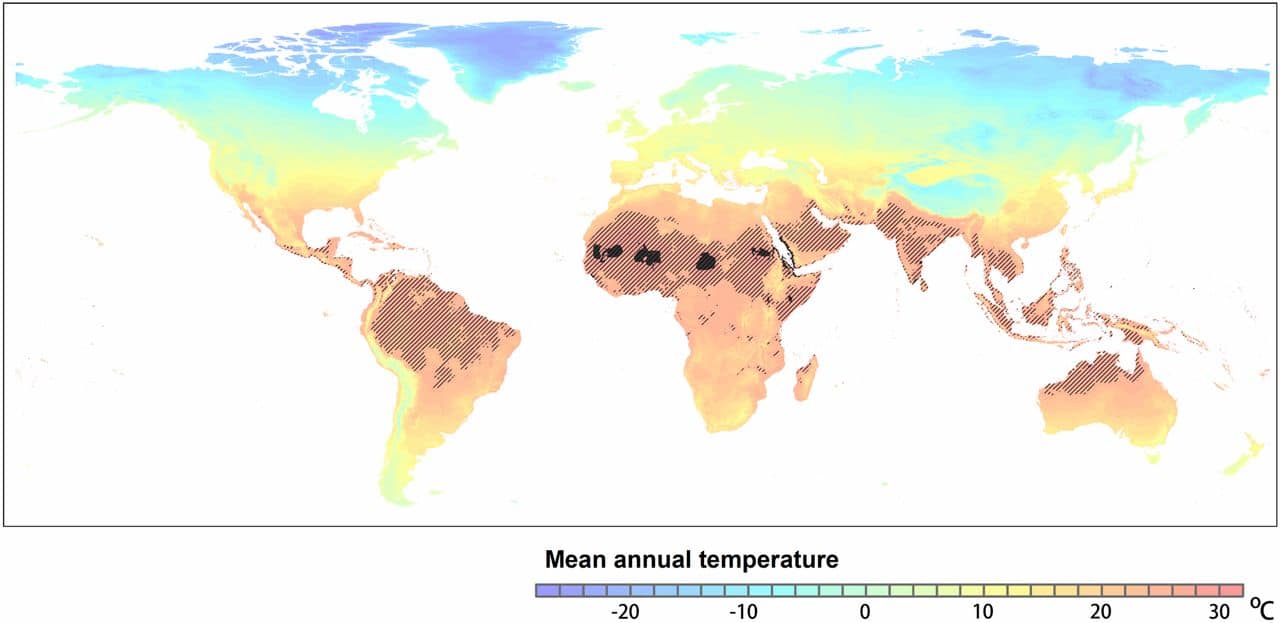
This may be the most catastrophic of our climate change facts. As of now, only 0.8% of the planet’s land surface has mean annual temperatures above 29°C (84.2°F) mostly in the Sahara desert and Saudi Arabia (solid black in the map).

study by Xu et al. (2020) called “Future of the Human Niche” found that by 2070, under a high emissions scenario, these unbearable temperatures could expand to affect up to 3 billion people (dark brown areas in the map).

Doing nothing is much worse than doing something

On the current path, climate change could end up costing us 11 to 14% of the global GDP by mid-century. Regression into a high emissions scenario would mean an 18% loss, while staying below 2°C would reduce the damage to only 4%. 

It has been proposed that ending climate change would take between $300 billion and $50 trillion over the next two decades. Even if $50 trillion is the price tag, that comes down to $2.5 trillion a year, or just over 3% of the global GDP. 

These are the facts. There is no disputing them. Paul and Jean, Paul’s wife, are relatively immune from the effects, because of their ages, but not entirely so. The last few weeks of summer (2022) with the imminent risk of their property being damaged by wildfires is one example. The last three winters being below average rainfall is another (and the prediction that next year will continue with below average rainfall). But it is the youngsters Paul fears most for. On a personal note, his daughter and husband have a son, Morten, and he is presently 12. What sort of world is Morten growing up in?

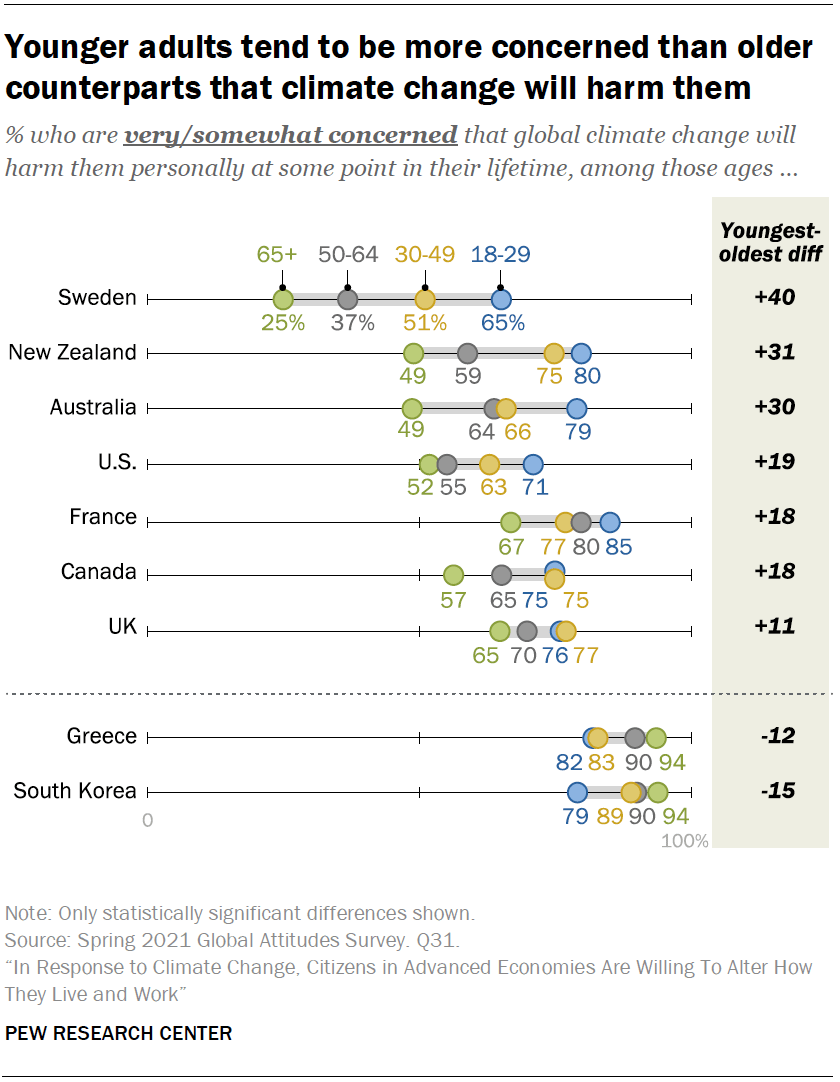
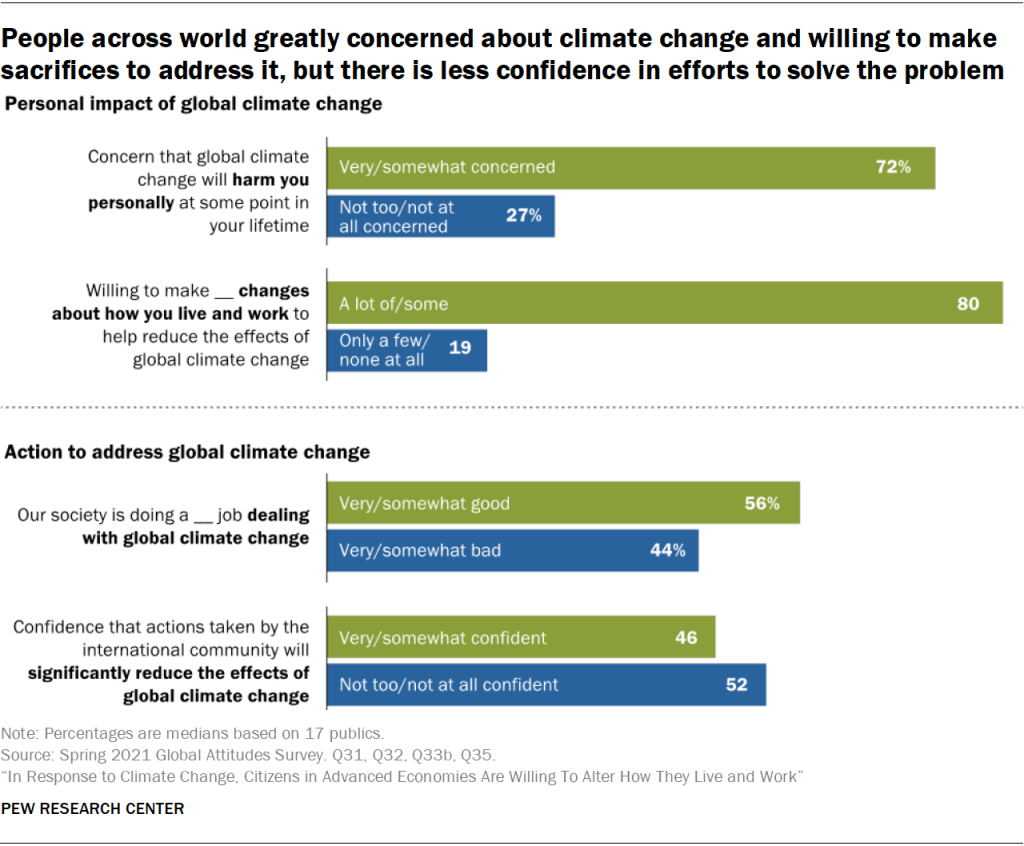
What about global attitudes to climate change?

Here is another chart setting out those concerns.

Paul is not a political animal. However he recognises that it is our leaders, globally, but especially in the top 10 countries in the world, who have to be leaders!

Here are the top 10 countries with areas of their country in square kilometres:

Russia. 17,098,242,

Canada. 9,984,670,

United States. 9,826,675,

China. 9,596,961,

Brazil. 8,514,877,

Australia. 7,741,220,

India. 3,287,263,

Argentina. 2,780,400,

Kazakhstan. 2,724,400, and

Algeria, 2,381,741.

But these are the top ten countries based on land size. That is not helpful. We have to examine the top countries in terms of CO2 emissions. Here are the top five countries, as in the top five worst, (readings from 2020):

  1. USA, 416,738 metric tons,
  2. China, 235,527 tons,
  3. Russia, 115,335 tons,
  4. Germany, 92,636 tons, and,
  5. UK, 78,161 metric tons.

This puts the USA as the top worst country, some 77% ahead of China.

So focussing on the USA, again in 2020, the split of greenhouse gas emissions, was:

  1. Transportation, 27%,
  2. Electric Power, 25%,
  3. Industry, 24%,
  4. Commercial and Residential, 13%,
  5. Agriculture, 11%.

So back again to all five countries we say, please, dear leader, make this the number one priority for your country, and for the world.

The end.