Category: Business

The coming new year!

Be warned, one of my more reflective muses!

Tomorrow is the last day of the year 2011.

For reasons that I am not clear about, there is a mood of pessimism about my person.  Whether it is the scale of global issues that I see ahead that drags me down, whether the year of an American Presidential election will remind me of the loss of reason that afflicts so many modern democracies, whether the messages in Kunstler’s book The Long Emergency still resonate in my mind well, who knows?

But when one does look at the broader picture of modern society, there is much that troubles.

So forgive me if I provide a couple of examples of these troubles.  I do so on the grounds of communication – the more that understand the risks ahead of us, the more likely we, as in the peoples of this planet, will say to our leaders, “Enough of this!  For the sake of my children, my grandchildren and all of humanity we have to change our priorities, and soon!”

Here’s my first example.

The US National Resources Defense Council recently published an item about severe weather including an interactive Extreme Weather Map, introduced thus,

Climate change increases the risk of record-breaking extreme weather events that threaten communities across the country. In 2011, there were at least 2,941 monthly weather records broken by extreme events that struck communities in the US.

That was backed up by an article on the Onearth website that opened,

By many measures, 2011 was the most extreme weather year for the United States since reliable record-keeping began in the 19th century — and the costs have been enormous. According to the National Oceanic and Atmospheric Administration, 2011 set a record for the most billion-dollar disasters in a single year. There were 12, breaking the old record of nine set in 2009. The aggregate damage from these 12 events totals at least $52 billion, NOAA found.

And that just for the USA.  But will climate change be the Number One political issue in 2012?  And if not in 2012, when will it be?

Let me move on to my second example, very different from the one above but, in a sense, just as scary.  This is an interview that was in a recent article on the Food Freedom website ( brilliant website, by the way).  Dr. Joseph Mercola, the leading natural health practitioner, interviews Dr. Don M. Huber, one of the senior scientists in the U.S about the area of science that relates to genetically modified organisms (GMO). Here’s an extract from the article on Food Freedom,

Toxic botulism in animals linked to RoundUp

Dr Mercola recently interviewed Dr Don Huber, whose letter to the USDA warning that Monsanto’s RoundUp, a broad-spectrum “herbicide” that has been linked with spontaneous abortion in animals, continues to be ignored by food and environmental safety authorities. In this important hour-long discussion, Huber, a plant pathologist for over 50 years, explains how RoundUp is destroying our healthy soils by killing needed microorganisms.

Not only did his team discover a new soil pathogen, but he reports that animals are coming down with over 40 new diseases, like toxic botulism. Huber explains that before the widespread use of herbicides, pesticides and genetically modified food and feed, natural probiota would have kept Clostridium botulinum in check

The video, below, of the interview is included in the article.  Please don’t be put off by the length, the material covered is riveting and critical to our general knowledge about the threats to our society.

So that’s enough from me for one day!  On Monday, I shall include another video relating to the RoundUp issue that reveals, both directly and metaphorically, how the only solution to pessimism is to embrace the need to make change happen.  Be inspired by this poem by Sam Keen, included in the latest Sabbath Moment from Terry Hershey,

I Want to Surrender

God, I want to surrender
to the rhythm of music and sea,
to the seasons of ebb and flow,
to the tidal surge of love.

I am tired of being hard,
tight, controlled,
tensed against tenderness,
afraid of softness.
I am tired of directing my world,
making, doing, shaping.

Tension is ecstasy in chains.
The muscles are tightened to prevent trembling.
Nerves strain to prevent trust,
hope, relaxation….

Surrender is a risk no sane man may take.
Sanity never surrendered
is a burden no man may carry.

God give me madness
that does not destroy
wisdom,
responsibility,
love.

Sam Keen

The only way to fly!

London Airport this isn’t!

(For my regular readers, indeed, for all of you, just a reminder that I’m giving the Blog a small rest until later this week – just filling in with silly things!)

Dear friend, senior airline Captain, Bob D., sent me this video to demonstrate that not all flying is from one enormous hub to another.

Background information on the aircraft is here.

The Long Emergency, part two.

The concluding extract from James Kunstler’s powerful book.

Last Friday, I published the first part of the extract that so powerfully articulated the madness of present global policies (especially US policies) with regard to oil.  Let me continue.

The first part finished thus, “Yet, I was not soothed by these thoughts, nor by the free eats, and even the liquor failed to lift me up because I couldn’t shake the recognition that in the short term we are in pretty serious trouble, too.”

There is near unanimity among the scientific community that global warming is happening.  There is also a definite consensus emerging that the term “climate change” may be more accurate than “global warming” to describe what we are in for.  The mean temperature of the planet is going up.  The trend is unmistakable.  Average global land temperature was 46.90 degrees Fahrenheit [Ed. 8.278 °C.] when modern measurements began and had reached 49.20 degrees F [Ed. 9.556 °C.] in 2003.  The rate of change has also increased steadily.  The total increase of 2.30 degrees might seem trivial, but has tremendous implications.  And the rise in temperature happens to correlate exactly with the upward scale of fossil fuel use since the mid-nineteenth century.

It may not matter anymore whether global warming is or is not a by-product of human activity, or if it just represents the dynamic disequilibrium of what we call “nature.”  But it happens to coincide with our imminent descent down the slippery slope of oil and gas depletion, so that all the potential discontinuities of that epochal circumstance will be amplified, ramified, reinforced, and torqued by climate change.  If global warming is a result of human activity, fossil fuel-based industrialism in particular, then it seems to me the prospects are poor that the human race will be able to do anything about it, because the journey down the oil depletion arc will be much more disorderly than the journey up was.  The disruptions and hardships of decelerating industrialism will destabilize governments and societies to the degree that concerted international action – such as the Kyoto protocols or anything like it – will never be carried out.  In the chaotic world of diminishing and contested energy resources, there will simply be a mad scramble to use up whatever fossil fuels people can manage to lay their hands on.  The very idea idea that we possess any control over the process seems to me further evidence of the delusion gripping our late-industrial culture – the fatuous certainty that technology will save us from the diminishing returns of technology.

So for the purposes of this book, the relevant question concerning global warming and climate change is not whether human beings caused  it or whether we will come up with some snazzy means to arrest it, but simply what the effects are likely to be and what they signify about the way we will live later on this century.

This extract from the book was published in 2005, although there is an Afterword included that was published in 2009.  So to bring things more up to date, here’s a video of James Kunstler speaking about peak oil just about a year ago.

In this fourth video in the series “Peak Oil and a Changing Climate” from The Nation magazine and On The Earth Productions, James Howard Kunstler discusses how finance and energy are running neck and neck to fuel the end of advanced industrial civilization.

For more videos in the series, visit The Nation.

Plus for those that are interested in the data of global land-surface temperatures, here’s a two-minute video showing the temperature change over the last 200 years.

For more information about this study visit http://berkeleyearth.org. Berkeley Earth video representation of the land surface temperature anomaly, 1800 to the present. The map of the world shows the temperature anomaly by location over time. The chart at the bottom, shows the global land-surface temperature anomaly. The Berkeley Earth analysis shows 0.911 degrees Centigrade of land warming (+/- 0.042 C) since the 1950s.

The Long Emergency, part one

A reflection on the huge changes facing our global society.

I am reading James Howard Kunstler’s book The Long Emergency.  On the front cover there is a quote from a review in The Independent newspaper, “If you give a damn, you should read this book.”  On the back cover, the quote, “Stark and frightening.  Read it soon.” – Daily Camera.  The quotes are spot on!

Rather than give my own opinion at this stage (I should finish the book first!), let me quote from the opening of Chapter Five, Nature Bites Back.

I was a at a four-day conference called Pop Tech in the seaside village of Camden, Maine, at the peak of the fall foliage season in October 2003, having a pretty good time at the talks, and enjoyiong a series of extravagant dinners – one featuring a free oyster raw bar and gratis Grey Goose vodka – not to mention all the lobsters, steaks, and other products of our bountiful cheap-oil economy.  Then, on Saturday afternoon, a scientist from the University of Washington, Peter D. Ward, got up in the old-time opera house where the conference was held and did a presentation about the life and death of the planet Earth,  Using a series of vivid artist’s renderings delivered on PowerPoint, Ward showed us how, hundreds of millions of years hence, all land animals would become extinct, the green forests and grasslands would broil away, the oceans would evaporate, and eventually our beloved planet would be reduced to a pathetic ball of inert lifeless lint – prefatory to being subsumed in the expanded red giant heat cloud of our baking sun.  Few members of the audience had any appetite for the spread of cookies and munchables laid out for the break that followed.  Personally, I was so depressed that I felt like gargling with razor blades.

The human spirit is remarkably resilient, though.  A few hours later, the horror of it all was forgotten and the conference-goers reported to the next supper buffet with the appetites recharged, happy to scarf more lobster and beef medallions and guzzle more liquor, while chatting up new friends about their various hopes and dreams for the continuing story of civilized life here on good old planet Earth, which, it was assumed, had quite a ways to go before any of us needed to worry about its fate, if ever.

Wasn’t it John Maynard Keynes who famously remarked to a group of fellow economists dithering about the long-term this and the long-term that: “Gentlemen, in the long term we’re all dead.”  Our brains are really not equipped to process events on a geological scale – at least in reference to how we choose to live, or what we choose to do in the here-and-now.  Five hundred millions years is a long time, but how about the mad rush of events in just the past 2,000 years starring the human race?  Rather action-packed, wouldn’t you say?  Everything from the Roman Empire to the Twin Towers, with a cast of billions – emperors, slaves, saviors, popes, kings, queens, navies, rabbles, conquest , murder, famine, art, science, revolution, comedy, tragedy, genocide, and Michael Jackson.  Enough going on in a mere 2,000 years to divert anyone’s attention from the ultimate fate of the earth, you would think.  Just reflecting on the events of the twentieth century alone could take your breath away, so why get bent out of shape about the ultimate fate of the earth?  Yet, I was not soothed by these thoughts, nor by the free eats, and even the liquor failed to lift me up because I couldn’t shake the recognition that in the short term we are in pretty serious trouble, too.

OK, that’s enough for today – I’ll continue this important extract on Monday.  Let me close by inviting you to watch James Kunstler in interview.

Final message in a bottle

The concluding part of what we might care to leave for the next generation

Mankind over the next few years is facing the start of an interval of economic chaos and social stress between the end of the fossil fuel age and whatever follows.  That interval could well last a lifetime or more.  Some might argue that the economic challenges that have been the mark of 2011 are, indeed, the first signs of this economic chaos.

How well we cope, adapt and survive is not going to be down to those of my age (born 1944) but to the bright youngsters who have been born in the 21st century.

That was the motivation behind publishing, on December 1st, the speech given by Steve Jobs, the 2005 Stanford Commencement Speech, and on December 6th, the famous and fabulous speech given by Sir Ken Robinson at the 2005 TED Talks conference.

The third and concluding message is a subsequent speech given by Sir Ken, this time in May 2010.  It isn’t as stirring as his speech in 2005 but still a wonderful focus on what is our, as in homo sapiens, only chance of surviving – the innovation and creativity of the next  generations.

In this poignant, funny follow-up to his fabled 2006 talk, Sir Ken Robinson makes the case for a radical shift from standardized schools to personalized learning — creating conditions where kids’ natural talents can flourish.

Second message in a bottle

Continuing the advice you might offer to the next generation?

On the 1st December I published the first message.  It had been inspired by a conversation with Peter McCarthy, who lives and works in Bristol, England.  Here’s a little of what I wrote,

Anyway, Peter and I were talking about the sorts of qualities that enable some young people to take a risk-based entrepreneurial approach to life.  Peter gave me the links to three videos that he thought were especially relevant to the notion of achieving success in life.  So over the next few days I want to share those videos with you, dear reader.  To me, these videos are, indeed, the essence of the messages that any person, especially those the wrong side of 60, would wish to leave in a bottle floating down the river of life.

So to the second message which is a recording of the talk that Sir Ken Robinson gave to the TED Talks conference in Monterey in February, 2006.  It has been widely seen for all the right reasons; Sir Ken offers some powerful common-sense and a wonderful message for all the young people out there.  As Sir Ken’s website says,

Sir Ken Robinson, PhD is an internationally recognized leader in the development of education, creativity and innovation.  He is also one of the world’s leading speakers with a profound impact on audiences everywhere.  The videos of his famous 2006 and 2010 talks to the prestigious TED Conference have been seen by an estimated 200 million people in over 150 countries.

Read the rest of Sir Ken’s background here.

So with no more ado, here’s the film, watched by nearly 3 million people!


First message in a bottle

So what advice would you offer to the next generation?

One of the biggest differences between Homo sapiens and Canis lupus familiaris is that the latter is such a master of living in the present that, one assumes, the issue of worrying about the next generation is largely irrelevant.  Definitely not so with us humans.

A few weeks back I was chatting to a good friend of mine, Peter McCarthy, whom I first met when I undertook a sales and marketing project for one his companies.  That was many years ago but Peter and I have stayed in touch.  One of the many attributes about Peter that I have admired over the years is his instinctive and thoughtful approach to entrepreneurism.  Peter is still an active entrepreneur.

Anyway, Peter and I were talking about the sorts of qualities that enable some young people to take a risk-based entrepreneurial approach to life.  Peter gave me the links to three videos that he thought were especially relevant to the notion of achieving success in life.  So over the next few days I want to share those videos with you, dear reader.  To me, these videos are, indeed, the essence of the messages that any person, especially those the wrong side of 60, would wish to leave in a bottle floating down the river of life.

So to the first.  The address by Steve Jobs to the University of Stanford’s 114th Commencement on June 12, 2005.  Already watched at the time of writing this by 12,690,731 persons!

The Greatest Crash – footnote

The story that could run for an awfully long time!

I rather revealed my newness as a US resident by posting my review of David Kauders’ book The Greatest Crash over 2 days last week,  one of them being Thanksgiving Day.  Despite that 1,895 people viewed my review which was entitled The end of an era.

A week has now passed since that review.  I was curious to see what sorts of headlines had been making the news in the last 7 days.  It’s just a random trawl through those items that have captured my attention.

Let’s start with the Financial Times, November 27th,

The eurozone really has only days to avoid collapse

By Wolfgang Münchau

In virtually all the debates about the eurozone I have been engaged in, someone usually makes the point that it is only when things get bad enough, the politicians finally act – eurobond, debt monetisation, quantitative easing, whatever. I am not so sure. The argument ignores the problem of acute collective action.

Last week, the crisis reached a new qualitative stage. With the spectacular flop of the German bond auction and the alarming rise in short-term rates in Spain and Italy, the government bond market across the eurozone has ceased to function.

Wolfgang concludes his article thus,

Italy’s disastrous bond auction on Friday tells us time is running out. The eurozone has 10 days at most.

Then my print copy of The Economist that arrived on the 26th had this lurid cover page,

Unless Germany and the ECB move quickly, the single currency’s collapse is looming
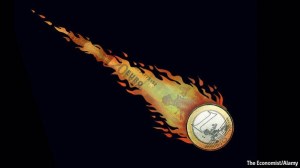
The leader article contains this paragraph,

Past financial crises show that this downward spiral can be arrested only by bold policies to regain market confidence. But Europe’s policymakers seem unable or unwilling to be bold enough. The much-ballyhooed leveraging of the euro-zone rescue fund agreed on in October is going nowhere. Euro-zone leaders have become adept at talking up grand long-term plans to safeguard their currency—more intrusive fiscal supervision, new treaties to advance political integration. But they offer almost no ideas for containing today’s conflagration.

and a few paragraphs later, this,

This cannot go on for much longer. Without a dramatic change of heart by the ECB and by European leaders, the single currency could break up within weeks. Any number of events, from the failure of a big bank to the collapse of a government to more dud bond auctions, could cause its demise. In the last week of January, Italy must refinance more than €30 billion ($40 billion) of bonds. If the markets balk, and the ECB refuses to blink, the world’s third-biggest sovereign borrower could be pushed into default.

Then on Sunday, 27th, MISH’s Trend Analysis blogsite reveals,

ICAP Plc, the world’s largest inter-dealer broker (one that carries out transactions for financial institutions rather than private individuals), is now Testing Trades In Greek Drachma Against Dollar, Euro

ICAP Plc is preparing its electronic trading platforms for Greece’s potential exit from the euro and a return to the drachma, senior executives at the inter-dealer broker said Sunday.

ICAP is the latest firm to disclose such preparations, joining the growing ranks of banks, governments and other key players in the global financial system whose officials are worried enough about the stability of the common currency to be making contingency plans for a possible break-up.

Then Bloomberg published an article by Peter Boone and Simon Johnson, the latter of Baseline Scenario fame, that opened as follows,

Investors sent Europe’s politicians a painful message last week whenGermany had a seriously disappointing government bond auction. It was unable to sell more than a third of the benchmark 10-year bonds it had sought to auction off on Nov. 23, and interest rates on 30-year German debt rose from 2.61 percent to 2.83 percent. The message? Germany is no longer a safe haven.

and concluded,

Ultimately, an integrated currency area may remain in Europe, albeit with fewer countries and more fiscal centralization. The Germans will force the weaker countries out of the euro area or, more likely, Germany and some others will leave the euro to form their own currency. The euro zone could be expanded again later, but only after much deeper political, economic and fiscal integration.

Tragedy awaits. European politicians are likely to stall until markets force a chaotic end upon them. Let’s hope they are planning quietly to keep disorder from turning into chaos.

Finally, on the 29th the BBC News website carried details of the Autumn Statement made by British Chancellor, George Osborne, to Parliament.

Osborne confirms pay and jobs pain as growth slows

Chancellor George Osborne has said public sector pay rises will be capped at 1% for two years, as he lowered growth forecasts for the UK economy.

The number of public sector jobs set to be lost by 2017 has also been revised up from 400,000 to 710,000.

Borrowing and unemployment are set to be higher than forecast and spending cuts to carry on to 2017, he admitted.

Just look at that figure of public sector job losses – 710,000!

Well that’s more than enough from me but it does surely endorse the opening views that David Kauders expounded in his book, as carried in my review, and reproduced here,

Starting with the first sentence, David sets out the core problem;

This book argues that it is impossible to expand the financial system much further.

expanding this a few paragraphs later,

This is the financial system limit: lack of new borrowing plus excessive weight of debt obligations from past borrowing combine to slow economies down. This is the barrier whichever way policy makers turn. It is like the lid on a boiling kettle. Enough steam can lift it for a while but it always snaps back into place. The financial system limit is a roadblock preventing growth.

A few pages later in this opening chapter ‘The roadblock preventing growth‘ this limit is explained thus,

Policy contradictions also show us that the financial system has reached a roadblock. The glaring conflict between bailout and austerity is at the core. Each bailout or stimulus requires creation of more credit, leading to false financial speculation, and for a short while markets recover their poise. The threat of inflation returns. Later, bad debts rise, the markets tumble again and a new crisis emerges. Austerity, the alternative policy, cuts spending thereby cutting the immediate level of economic activity and bringing economic decline more quickly than the stimulus alternative. Whichever way they turn, the authorities are damned.

You can understand why I called this Post a ‘footnote’ not an endnote.

Your call is so, so important to us!

A delightful trawl by Neil Kelly through the call centre industry.

Picture by Neil Kelly

Are there any more annoying phrases in the English language than “your call is important to us“, or “we are experiencing particularly high call volumes“?

In 2007 companies worldwide spent some $280 billion on outsourced call-centre services, according to NASSCOM, a call-centre trade group in Delhi. Much of India’s call-centre industry, which employs roughly 300,000 agents, is located outside the ring road that encircles Bangalore, in a string of smart new business parks with tidy lawns and private security. Were it not for the stray dogs, a visitor could be forgiven for mistaking the area for Silicon Valley.

Meanwhile in Australia …

Meanwhile …… back in Wales in the United Kingdom … listen to this call centre handling a complaint from an ASDA customer – listen right to the end!

Thanks to David from neatorama.com I was able to put together a medley of hold music and without resorting to The Four Seasons!  Hope to have The Top Twenty Hold Music Songs out in time for Christmas.

Click on this link hold music medley to listen to that medley.

Finally, you may be interested in reading Your Call Is Important to Us: The Truth about Bullshit by Laura Penny which is available as a free eBook here.

The end of an era, part two.

A review of David Kauder’s recently published book, The Greatest Crash.

Details of the availability of the book are included at the end of the review.

Extracts from the book included are with grateful thanks to Sparkling Books.

Part One of this review was published yesterday which needs to be read before Part Two.

——————-

Chapter 5 continues by examining the over-bearing consequences of excessive public spending, excessive Government regulations, substitute taxation, weakness of Treasury forecasts, and so on. While these are UK issues, there is no doubt that similar restraints of free enterprise exist in many other western nations.

In Chapter 6, ‘Group Think‘, David looks at the strange ways in which we form opinions.  It’s a topic that has been discussed and written about widely but the point behind this chapter is that people have in great part lost the ability to discern truth from fiction, with terrible implications when it comes to understanding how individuals are affected by government and bureaucratic institutions.

The chapter closes;

One of the remarkable points that I have found in writing this book is that many of the detailed errors, incorrect policies et al, have already been amply documented by others. But we never learn. The delegated society, the strength of lobby groups and vulnerability of our political system to pressure, the sheer volume of noise in the media and on the Internet, the immediacy of the demands of daily life, all combine to make our collective memory rather short.

Amen to that!

Chapter 7, ‘Academic differences of opinion‘, was surprisingly short at just 6 1/2 pages. One would have thought the subject worthy of a much longer review especially as David was exploring the fundamental differences between Keynesian and Ricardian economic theories and opportunities for alternative theories. Must say that that I laughed out loud (David’s book is a little short on humour!) at the sentence on p.127 that ran, “One correspondent writing to the Financial Times proposed that economics should be declared a failing discipline, economists as not fit for purpose, and a physicist put in charge of sorting their theories out.

Chapter 8, ‘The dark side of capital markets‘, is the penultimate chapter and quite a technical one at that. But David manages to trip through esoteric aspects, well esoteric to the lay reader, in a manner that keeps one involved.   Here’s an example from early on in the chapter.

Capital markets follow a long cycle beyond the experience of most practitioners, detectable only by understanding history and then applying this understanding to contemporary conditions.

It didn’t mean much to me. Then the next sentence;

The principles are identical for any market where prices depend on the supply of credit: equities, bonds, property and commodities are all markets where the prices must relate to the availability of credit.

That, at least, was understood but still the penny hadn’t dropped. Then came;

Bond prices prosper when credit is lacking while the other three prosper when credit is abundant.

That then made sense to me but still only at some academic level. David then followed those sentences with these two paragraphs;

The whole market cycle consists of bull market followed by bear market, as surely as night follows day. The bull market in assets is driven by an increasing supply of credit and economic expansion, since more credit leads to higher prices. The bear market in assets is driven by less credit and economic contraction; there is no purchasing power to keep asset prices high. Only fixed interest bonds are contra-cyclical, declining in price as credit expands and rising in price as credit sinks.

There are two useful theories for analysing the whole market cycle: conversion flow and Dow theory.

So in half-a-page of text, the book effectively educated me and then showed the relevance of that learning to the world I was living in. Cleverly done!

Chapter 9, ‘The attitude change‘, is, without doubt, a clincher of a close to this fascinating book. The sentiments conveyed in this chapter are so unexpected that, forgive me, it would be wrong to explicitly refer to them.  Buy the book!

Let me just say that the last chapter fully endorsed me calling this review The End of an Era.

Overall conclusions

This is an important book from a writer who has both the academic and professional experience to enable him to form the views that he expresses. Only time will tell if the whole scenario that is envisaged by Mr. Kauders will play out as he expects. My personal view is that it will.

For individuals and business alike, reading The Greatest Crash will inform you in a manner that I would argue is critical when one notes the precarious and potentially unstable period we are living through. The decisions readers make after reading the book are beyond the remit of this review and, of course, David Kauders, but, at least, read the book!

Prof. Myddelton in the book’s introduction wrote, “But one of the things we need now is new thinking on the fundamentals.” Perhaps not new thinking on fundamentals, as the Prof. puts it, but a reinstatement of core fundamental values.

I am not alone from sensing that the world, especially the western world, is transitioning from an era of greed and materialism, seeing a world of unlimited resources, to a different societal relationship with planet Earth, the only planet we have. A transition across all layers of society towards the values of truth, integrity and compassion; values whose day has come.

The Greatest Crash reinforces immensely my notion that this truly is the end of an era.

——————

Want to buy The Greatest Crash?  The ebook was published in October worldwide, the  paperback published in the UK on the 1st November UK, the hardcover being released any day now in the UK.  For North America both the paperback and hardcover versions are being published on 1st February, 2012.

Full details from the Sparkling Books webpage here.

Copyright © 2011 Paul Handover