Category: Animal rescue

What is love?

How the relationship that we have with domesticated animals taught us the meaning of love.

This exploration into the most fundamental emotion of all, love, was stimulated by me just finishing Pat Shipman’s book The Animal Connection.  Sturdy followers of Learning from Dogs (what a hardy lot you are!) will recall that about 5 weeks ago I wrote a post entitled The Woof at the Door which included an essay from Pat, republished with her permission, that set out how “Dogs may have been man’s best friend for thousands of years longer than we realized“.

The following day, I wrote a further piece introducing the book and then commenced reading it myself.  Please go there and read about the praise that the book has received.

What I want to do is to take a personal journey through love.  I should add immediately that I have no specialist or professional background with regard to ‘love’ just, like millions of others, a collection of experiences that have tapped me on the shoulder these last 67 years.

I would imagine that there are almost as many ideas about the meaning of love as there are people on this planet.  Dictionary.com produces this in answer to the search on the word ‘love’.

love

[luhv]  noun, verb, loved, lov·ing.
noun

  1. a profoundly tender, passionate affection for another person.
  2. a feeling of warm personal attachment or deep affection, as for a parent, child, or friend.
  3. sexual passion or desire.
  4. a person toward whom love is felt; beloved person;sweetheart.
  5. (used in direct address as a term of endearment, affection,or the like): Would you like to see a movie, love?

But, I don’t know about you, those definitions leave something missing for me.  Here’s my take on what love is, and it’s only by having so many dogs in my life that I have found this clarity of thought.

Love is trust, love is pure openness, love is knowing that you offer yourself without any barriers.  Think how you dream of giving yourself outwardly in the total surrender of love.  Reflect on that surrender that you experience when deeply connecting, nay loving, with your dog.

Here’s how Pat Shipman expressed it in her book:

Clearly, part of the basis of our intimacy with tame or domesticated animals involves physical contact.  People who work with animals touch them.  It doesn’t matter if you are a horse breeder, a farmer raising pigs, a pet owner, a zoo keeper, or a veterinarian, we touch them, stroke them, hug them.  Many of us kiss our animals and many allow them to sleep with us.  We touch animals because this is a crucial aspect of the nonverbal communication that we have evolved over millennia.  We touch animals because it raises our oxytocin levels – and the animal’s oxytocin levels.  We touch animals because we and they enjoy it. (p.274)

Pat soon after writes,

From the first stone tool to the origin of language and the most recent living tools, our involvement with animals has directed our course.

Thus it is not beyond reason to presume that tens of thousands of years of physical and emotional closeness between humans and their animals have developed the emotion of love in us humans, so eloquently expressed in art and life.

There’s another aspect of what we may have learned from dogs.  In Alexandra Horowitz’s book Inside of a Dog, she writes of the way that dogs look at us,

Having been folded into the world of humans, dogs no longer needed some of the skills that they would to survive on their own.  As we’ll see, what dogs lack in physical skills, they make up for in people skills.

AND THEN OUR EYES MET ….

There is one final, seemingly minor difference between the two species.  This one small behavioral variation between wolves and dogs has remarkable consequences.  The difference is this: dogs look at our eyes.

Dogs make eye contact and look to us for information – about the location of food, about our emotions, about what is happening.  Wolves avoid eye contact.  In both species, eye contact can be a threat: to stare is to assert authority.  So too is it with humans.  In one of my undergraduate psychology classes, I have my students do a simple field experiment wherein they try to make and hold eye contact with everyone they pass on campus.  Both they and those on the receiving end of their stares behave remarkably consistently: everyone can’t wait to break eye contact.  It’s stressful for the students, a great number of whom suddenly claim to be shy: they report their hearts begin to race and they start sweating when simply holding someone’s gaze for a few seconds.  They concoct elaborate stories on the spot to explain why someone looked away, or held their gaze for a half second longer.  For the most part, their staring is met with deflected gazes from those they eyeball.

Then a few sentences later, Alexandra continues to write,

Dogs look, too.  Though they have inherited some aversion to staring too long at eyes, dogs seem to be predisposed to inspect our faces for information, for reassurance, for guidance.  Not only is this pleasing to us – there is a certain satisfaction in gazing deep into a dog’s eyes gazing back at you – it is also perfectly suited to getting along with humans. (pps 45-46)

No apologies for now inserting the photograph of Pharaoh that adorns the Welcome page of Learning from Dogs.  Underlines what Alexandra wrote above in spades.
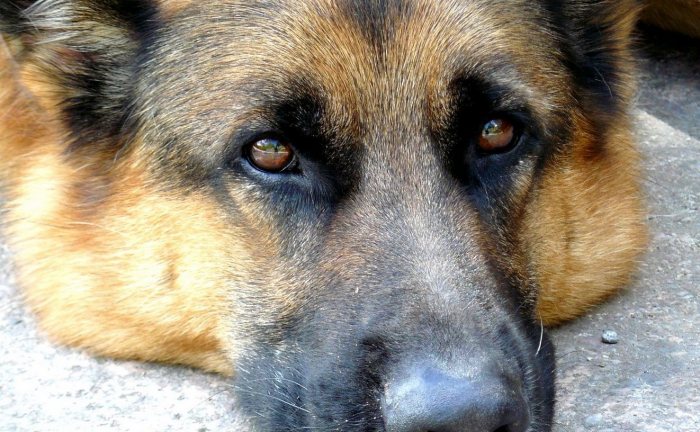
Now that is a gaze!

OK, time to start bringing this to a close.

The Toronto Star ran a great review of Pat Shipman’s book from which I will just take this snippet,

“But understanding animals and empathizing with them also triggered other changes in humanity’s evolution, Shipman said.

All those things allow people to live with people. Once people have domesticated animals, they start to live in stable groups. They have fields, crops and more permanent dwellings.”

In other words, we can see that living with animals took us from nomadic hunter-gatherers to living with other people in stable groups; the birth of farming.  It is my contention that the evolution of communities and the resulting more stable relationships elevated love leading to love becoming a higher order emotion than just associated with the ‘grunt’ of reproduction.

I started by saying that it was Pat Shipman’s book that stimulated me to wander through my own consciousness and realise that when I bury my face in the side of one of the dogs, say on the bed, it resonates with the most ancient memories in my human consciousness.  Indeed, I am of no doubt that my openness and emotional surrender to that dog enables me to be a better, as in more loving, person for Jean.

So let me close this essay by asking you to return here and read the guest post tomorrow from author Eleanore MacDonald, where Eleanore writes of the loss of their dog Djuna.  You will read the most precious and heart-rending words about love.  Thank you.

Feeling depressed? Join your pals in the pool!

A wonderful video sent in by Dan Gomez.

Regular followers of Learning from Dogs will know that Dan and I go back a long way; far too long!  In fact the occasion of me becoming aware of Mr. Daniel Gomez was at a Commodore Computer users conference in Boston, Mass.

I was giving a talk promoting a word-processing program that I was marketing for the Commodore.  That software was called Wordcraft and I think the year was 1979, possibly 1980.  Anyway, I used the word ‘fortnight’, which back in England is a common word meaning two weeks.  Immediately, a voice called out from the audience, “Hey Handover, what’s a fortnight?

The session deteriorated rapidly thereafter!  Dan and I became very good friends and his LA company Cimarron became my West Coast USA distributor for Wordcraft.  And it was Dan’s sister, Suzann, who invited me down to Mexico for Christmas 2007 which led to me meeting my beloved Jeannie!  Funny old world!

On to the video

The male golden dog on the left-hand side of pool is Willis, a two-year-old Golden Retriever who has cataracts and is practically blind.  Then there is Gwendy who seems to have been with Dan for an absolute lifetime.

Then the black dog is Bella, a flat-coated retriever, that belongs to a neighbour.

When I spoke with Dan over the phone about Willis, Dan said that he is not in any way a disabled dog.  In the pool, he listens to where the ball lands, swims towards it and then lets his nose locate it precisely.  Out walking, when Dan throws the ball, Willis is just able to see Dan’s arm move through the air.  Willis then computes where the ball is heading, runs in that direction and, again, uses his power of smell to pin down the ball exactly.

What fabulous animals they are

The power of touch

Nature, once again, shows the value of loving contact during those crucial early years.

I’m writing this at 7.45am on the 30th.  Coincidentally, Jean and I were chatting in bed about an hour ago about this ‘touchy – feely’ stuff.  This was a bed having four dogs on it!  One of those, Hazel, was laying alongside my left leg just sucking up me stroking her head and tummy.  Jean and I were musing that for animals and humans, how we are touched by our parents, especially our mother, during those first few years of growing up has profound implications for how we as adults respond to being touched and hugged.

So then I opened up my mail box and there was this sent by Cynthia Gomez serving as a wonderful reminder of the power of touch.  Thanks Cynthia, great timing!

oooOOOooo

Some pictures just don’t need captions.
There is nothing like Mom’s lap no matter who you are. This is precious !!!!
This is a newborn offspring of Taskin, a Gypsy Stallion owned by
Villa Vanners of Oregon ..
These pictures were taken immediately after his birth on April 6.
The mare laid down, and then he trotted around and
crawled right up into her lap.
—————–
——–
——–
——–
——–
So give someone a hug today!

Dogs and life

A lovely guest Post from author Dianne Gray.

Introduction

Dianne was unaware when she contacted me that her timing was exquisite!  Why?  Because it had recently crossed my mind that many readers must wonder why a blog with the name of Learning from Dogs so infrequently had articles about dogs!  Hopefully both the Welcome page and my piece on Dogs and integrity make it clear that it is the qualities of dogs, the examples they set to mankind, that inspire these writings.  As I say in Dogs and integrity,

Dogs:

  • are integrous ( a score of 210) according to Dr David Hawkins
  • don’t cheat or lie
  • don’t have hidden agendas
  • are loyal and faithful
  • forgive
  • love unconditionally
  • value and cherish the ‘present’ in a way that humans can only dream of achieving
  • are, by eons of time, a more successful species than man.

So it is a double pleasure to offer Dianne’s guest post today because it reminds us, so clearly, that the qualities of dogs are something very real for mankind.

Dianne Gray

Dianne is a writer.  As she explains on her blog site,

I live in Australia, have a sensitive-new-age Rottweiler called Kitty and a German Shepherd (in desperate need for The Dog Whisperer) called Sabre.

I’ve had interesting jobs, including working in a crocodile farm in Far North Queensland.

My web page can be found at http://www.diannegray.au.com/

The story

Sabre enjoying some Winter sun.

Sabre came into our lives in November 2004. He was seven weeks old. We were lucky enough to get Sabre from Bob Knight, a German shepherd breeder in Canberra, Australia. For those of you who don’t live in Australia you wouldn’t know that Bob was tragically shot and killed in 2010 while driving his truck through Sydney – the innocent victim of a gang war taking place several blocks away, he was hit by a stray bullet.

Bob was very passionate about his dogs and would interview those who were interested in buying one of the litter. If he didn’t think you were capable of managing a German shepherd he would not sell you one. He also ensured that each and every one of his puppies were brought back to him weekly (if possible) for free puppy training. So for over twelve months we (and the others who had bought one of the litter) met at the lake to take our dogs for a walk and training.

We live in the inner city and have an enormous yard so Sabre loved playing catch and patrolling the borders of our property. We live adjacent to a laneway and had some trouble with junkies shooting up near our fence and threatening to kill him if he barked at them. When he was two years old he became very ill very suddenly (it was Good Friday and near impossible to find a vet). We took him to the out-of-hours vet in the city who just looked at him and ($A800 later) told us not to feed him for the rest of the weekend.

By Saturday morning he could hardly move. We called Bob who told us about a woman called Jan who would be available to see him who lived in a nearby town. She was a country vet and looked after horses and cattle – so we loaded him in the car. This was the best move we ever made because, as it turned out, Jan would save his life a couple of times. When Jan saw him she couldn’t believe another vet would tell us not to feed him. “You don’t feed animals, they die,” she said. She gave us some horse paste (I still don’t know to this day what it was) and told us to put some in his mouth every hour. She said to try and give him his favourite food as often as possible and to call her every hour and tell her if he had eaten anything. She said he had the classic symptoms of having ingested a common bait (I’m not revealing what it was publically) and if we couldn’t get him to eat within four hours we had to bring him straight back to her. Basically he was starving to death.

We put the paste in his mouth as often as possible and tried to tempt him with cheese (his favourite) for three hours. Finally, he took a small mouthful of cheese and we celebrated like it was Christmas! We took him back to Jan for the next three days and he got stronger and stronger and within a week was back to his old playful self.

Twelve months later he began to walk with his head to one side and then he’d shake it and basically seemed very uncomfortable. We took him back to Jan who looked in his ear to find he had a chronic ear infection. She gave him antibiotics and cleaned his ear, but weeks passed and it just didn’t want to budge. We took him back to Jan every weekend and she would clean his ear (he wouldn’t let us touch it) and give him a penicillin injection. I surfed the net trying to find out what I could do to get rid of this damn infection – we were trying everything possible and it still wouldn’t budge. Then I read somewhere that yoghurt in a dog’s diet can be good for this kind of thing. I added yoghurt to his diet and within a week he was looking better. We still had him back to Jan’s every weekend for a few months and I still put yoghurt in his diet!

Six months later he started to change and became obnoxious and aggressive with us. We thought it may have had something to do with the ear infection so we took him back to Jan. She laid him on his back and felt his testies. He was kind of shocked and so were we, but she had definitely done the right thing because at this stage he had testicular cancer in both testies. She operated and found that the cancer was at the advanced stage. She was pretty sure she had got it all, but told us the signs to watch for over the next few months. She put him on ‘girly hormones’ as she called them and he was on those for about twelve months – and what a pleasure he became. He was behaving himself and not cranky or aggressive like before the operation. He was a different boy! If you have a male dog that is not de-sexed and he becomes even the slightest bit aggressive, I strongly suggest you have him checked for testicular cancer!

Because we’d had so much trouble with the junkies I decided to get cameras around the outside of the house. It was such a novelty at first – I’d come home from work and check the cameras to see what had happened during the day, but then I noticed something really sad.  Sabre would say goodbye to me at the gate every morning and then just sit there ALL DAY waiting for me to come home. It was heartbreaking, I’d never realised until this time how lonely he was. I’d watch the tape on X30 and it reminded me of one of those television advertisements where someone stands still while everything around them speeds past. So hubby and I decided it was time for another dog. This is where Kitty comes into the picture. From the moment Sabre saw her he absolutely loved her and she loved him. She is obsessed with his tail and when we go anywhere she grips onto his tail and follows him.

First meeting Sabre and Kitty.

Sometimes when they’re playing in the yard she grabs his tail and runs past him so fast he ends up running sideways! Kitty has had her fair share of problems as well. She was spade (by a vet other than Jan because she doesn’t have the capacity or equipment to spade female pups) and three months later she went on heat! I took her back to the other vet and he had only removed one ovary. So she had to be spade again, the poor darling. Meanwhile, Sabre must have had enough male hormones left in him to want to mount her every five minutes. So what I did was rub eucalyptus oil on Kitty’s back and this was enough to keep him away (the smell made him sneeze). Now we find Kitty has arthritis (she’s only fifteen months old) so we’re back to see Jan every other weekend for treatment. We’re kind of like a family now!

Sabre and Kitty today.

Kitty and Sabre are a wonderful pair and now when I watch the cameras when I get home from work all I can see is the two of them playing all day long. It’s a wonderful life!

oooOOOooo

So back to me!  Couple of items to close this lovely story from Dianne.

Firstly, a photograph of these caring owners:

John and Dianne Gray.

Secondly, Dianne’s Blog ‘Dianne Gray – Writing and loving life! is full of reflective pieces, as one might imagine.  This one caught my eye and seemed perfect to close today’s Post.

The Last Unicorn

So true –

“Writing has nothing to do with publishing. Nothing. People get totally confused about that. You write because you have to – you write because you can’t not write. The rest is show-business. I can’t state that too strongly. Just write – worry about the rest of it later, if you worry at all. What matters is what happens to you while you’re writing the story, the poem, the play. The rest is show-business.” — Peter S. Beagle

Love thy neighbour the crocodile.

Not quite how you would expect a crocodile to behave!

With thanks to Christine over at 350 or bust who published on Saturday, 30th June.

Then a web search found a more extensive video.

Pocho, the “domesticated” Costa Rican crocodile that gained international attention for a weekly show he performed with owner Gilberto Sheedan, died Tuesday at Finca Las Tilapias in the Caribbean-slope town of Siquirres. Olga Valle, Sheedan’s wife, said the nearly 1,000-pound croc died a natural death at age 50. A funeral will be held for Pocho on Sunday at 1 p.m.

“All of the people in the village have offered their condolences and assistance,” Valle said.

On past Sundays, Pocho and “Chito,” as Sheedan was better known, performed a show for visitors in a 100-square-meter artificial lake at Finca Las Tilapias. Chito, 54, declared the one-eyed crocodile “domesticated.” He could command Pocho to do tricks such as winking its one good eye, lifting its head and tail out of the water, rolling over and permitting Chito to stick his head inside the massive reptile’s maw.

Chito found the 5-meter-long crocodile near death on the shore of the Parismina River, in the Limón province, 17 years ago. The crocodile had been shot in the left eye. Chito and several friends loaded the animal into a boat and took him to Siquirres, where Pocho was nursed back to health. Chito even slept with the crocodile during its recovery.

After an employee saw Chito swimming with Pocho one day, word of the duo’s friendship spread. In July 2000, Costa Rica’s Channel 7 filmed the unusual pair. Chito and Pocho became stars, receiving attention as far as the United States, Chile and the United Kingdom.

The Environment, Energy and Telecommunications Ministry allowed Chito to keep the crocodile as long as they could monitor it. Chito worked with a veterinarian and a biologist and fed Pocho 30 kilograms of fish and chicken a week.

Chito never imagined the fame that would come from the unique friendship. All he wanted was an animal companion. A sign on his ranch emphasized that relationship: “Chito and Pocho are best friends.”

“I just wanted him to feel that someone loved him, that not all humans are bad,” Chito told The Tico Times in 2007. “I love all animals, especially ones that have suffered.”

Love is really the solution to practically every problem in the world!

We are what we eat!

So why do we insist of manipulating the genetics of food!

I read somewhere recently, and of course now can’t find the reference, that the genetic modification of our food represents as big a danger to the long-term survival  of man as does the damage to our biosphere.

So a recent item on the blog Food Freedom News jumped out at me.  This was an item that was introduced as, “The author of Seeds of Destruction (about Monsanto) has a new piece out on pesticides and mass animal deaths… very sobering.

Clicking on the ‘new piece’ link takes one to here, from which I quote the opening paragraphs,

Death of the Birds and the Bees Across America

By F. William Engdahl
Global Research

“A recent study showed that every human tested had the world’s best-selling pesticide, Roundup, detectable in their urine at concentrations between five and twenty times the level considered safe for drinking water.”

Birds and bees are something most of us take for granted as part of nature. The expression “teaching about the birds and the bees” to explain the process of human reproduction to young people is not an accidental expression. Bees and birds contribute to the essence of life on our planet. A study by the US Department of Agriculture estimated that “…perhaps one-third of our total diet is dependent, directly or indirectly, upon insect-pollinated plants.”

The honey bee, Apis mellifera, is the most important pollinator of agricultural crops. Honey bees pollinate over 70 out of 100 crops that in turn provide 90% of the world’s food. They pollinate most fruits and vegetables–including apples, oranges, strawberries, onions and carrots.  But while managed honey bee populations have increased over the last 50 years, bee colony populations have decreased significantly in many European and North American nations. Simultaneously, crops that are dependent on insects for pollination have increased. The phenomenon has received the curious designation of Colony Collapse Disorder (CCD), implying it could be caused by any number of factors. Serious recent scientific studies however point to a major cause: use of new highly toxic systemic pesticides in agriculture since about 2004.

That first paragraph alone made me sit up, “A recent study showed that every human tested had the world’s best-selling pesticide, Roundup, detectable in their urine at concentrations between five and twenty times the level considered safe for drinking water.”  What a strange race we are!

Wlliam F. Engdahl

Then it was easy to find out more information about the author of the book Seeds of Destruction, William F. Engdahl, including his website.  Mr. Engdahl is clearly no stranger to controversy as this YouTube video illustrates,

Back to that Food Freedom article.  Further on, there is evidence of the size of the problem in the UK,

Alarming UK results

A private UK research organization, Buglife and the Soil Association, undertook tests to try to determine cause of the bee death. They found that the decline was caused in part by a group of pesticides called neonicotinoids. Neonicotinoids are “systemic” chemicals that kill insects by getting into the cell of the plant. In Britain it’s widely used for crops like oilseed rape and for production of potted plants.

The neonicotinoids are found in the UK in products including Chinook, used on oilseed rape and Bayer UK 720, used in the production of potted plants which then ends up in gardens and homes around the country. The new study examined in detail the most comprehensive array of peer-reviewed research into possible long-term effects of neonicotinoid use. Their conclusion was that neonicotinoid pesticides damage the health and life cycle of bees over the long term by affecting the nervous system. The report noted, “Neonicotinoids may be a significant factor contributing to current bee declines and could also contribute to declines in other non-target invertebrate species.” The organization called for a total ban on pesticides containing any neonicotinoids.

The president of the UK Soil Association, Peter Melchett, told the press that pesticides were causing a continued decline in pollinating insects, risking a multimillion pound farming industry. “The UK is notorious for taking the most relaxed approach to pesticide safety in the EU; Buglife’s report shows that this puts at risk pollination services vital for UK agriculture,” he said.

Indeed in March 2012 Sir Robert Watson, Chief Scientist at the British Government’s Department of Environment announced that his government was reconsidering its allowance of neonicotinoid use in the UK. Watson told a British newspaper, “We will absolutely look at the University of Stirling work, the French work, and the American work that came out a couple of months ago. We must look at this in real detail to see whether or not the current British position is correct or is incorrect. I want this all reassessed, very, very carefully.”  To date no policy change has ensued however. Given the seriousness of the scientific studies and of the claims of danger, a prudent policy would have been to provisionally suspend further uise of neonicotinoids pending further research. No such luck.

And if the harm to bees wasn’t serious enough, try this extract,

Effect on Human Brain?

But most alarming of all is the evidence that exposure to neonicotinides has horrific possible effects on humans as well as on birds and bees.

Professor Henk Tennekes describes the effects:

“Today the major illnesses confronting children in the United States include a number of psychosocial and behavioral conditions. Neurodevelopmental disorders, including learning disabilities, dyslexia, mental retardation, attention deficit disorder, and autism – occurrence is more prevalent than previously thought, affecting 5 percent to 10 percent of the 4 million children born in the United States annually. Beyond childhood, incidence rates of chronic neurodegenerative diseases of adult life such as Parkinson’s disease and dementia have increased markedly. These trends raise the possibility that exposures in early life act as triggers of later illness, perhaps by reducing the numbers of cells in essential regions of the brain to below the level needed to maintain function in the face of advancing age. Prenatal and childhood exposures to pesticides have emerged as a significant risk factor explaining impacts on brain structure and health that can increase the risk of neurological disease later in life.”

There is also growing evidence suggesting persistent exposure to plants sprayed with neonicotinoids could be responsible for damage to the human brain, including the recent sharp rise in incidents of autism in children.

This really is an article that you should read in full, which also includes a full bibliography and notes section.  Plus you can leave your responses as a comment – go for it!

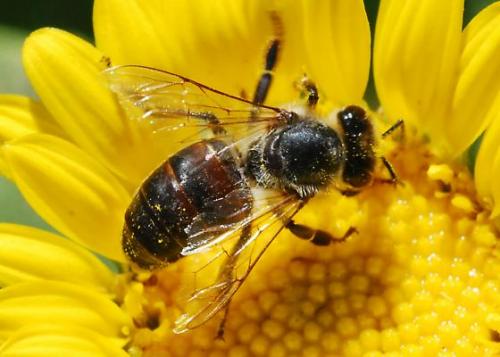
Apis mellifera – the honey bee (family Apidae)

The bond between dogs and humans

Such a beautiful and mutually-important relationship.

I didn’t plan to write more about this subject thinking that my last two posts, Woof at the Door and Prof. Pat Shipman, more than covered the theme; indeed much more.

But then a flurry of other articles conspired to pass my desk.

In no particular order there was an article on the Big Think website, Do Dogs Speak Human?  As the article opened,

What’s the Big Idea?

Perhaps the better question is, do humans speak dog? Either way, the debate over whether language is unique to humans, or a faculty also possessed by wild and domestic animals from dogs to apes to dolphins, is an interesting one. The answer depends on exactly how we define “language,” and who’s doing the talking, says David Bellos, the Booker prize-winning translator.

The article includes this three-minute video,

and concludes,

Broadly, a language is a mode of expression. “The argument that only human language is language and that animal communication systems, however sophisticated they are — and some of them are quite sophisticated — are not languages because they consist of discrete signals is a circular argument,” he argues. “It’s a self-fulfilling thing. And I think we should be a little bit more interested in the complexity and the variability of animal communication systems and less rigid about this distinction between what is a language and what is not a language.”

For now, we’re happy with this:

The June 30th edition of The Economist had an article entitled, Can dogs really show empathy towards humans? (You may have to register (free) to view this.)  That report ends, as follows,

As they report in Animal Cognition, “person-oriented behaviour” did sometimes take place when either the stranger or the owner hummed, but it was more than twice as likely to occur if someone was crying. This indicated that dogs were differentiating between odd behaviour and crying. And of the 15 dogs in the experiment that showed person-oriented responses when the stranger cried, all of them directed their attention towards the stranger rather than their owner.

These discoveries suggest that dogs do have the ability to express empathetic concern. But although the results are clear enough, Dr Custance argues that more work needs to be done to be sure that such behaviour is true empathy. It is possible, she points out, that the dogs were drawing on previous experiences in which they were rewarded for approaching distressed human companions. Dog-owners, however, are unlikely to need any more convincing.

It was then an easy follow-up to that Animal Cognition article which is available online here; here’s the abstract,

Empathy covers a range of phenomena from cognitive empathy involving metarepresentation to emotional contagion stemming from automatically triggered reflexes.

An experimental protocol first used with human infants was adapted to investigate empathy in domestic dogs. Dogs oriented toward their owner or a stranger more often when the person was pretending to cry than when they were talking or humming. Observers, unaware of experimental hypotheses and the condition under which dogs were responding, more often categorized dogs’ approaches as submissive as opposed to alert, playful or calm during the crying condition. When the stranger pretended to cry, rather than approaching their usual source of comfort, their owner, dogs sniffed, nuzzled and licked the stranger instead.

The dogs’ pattern of response was behaviorally consistent with an expression of empathic concern, but is most parsimoniously interpreted as emotional contagion coupled with a previous learning history in which they have been rewarded for approaching distressed human companions.

It doesn’t get closer than this.

Prof. Pat Shipman

Pat Shipman showing how animals were intimately involved in the development of early humans.

Yesterday’s fascinating post was predominately taken up by a long and deeply interesting essay by Prof. Pat Shipman, The Woof at the Door.

Today, I want to report further on Pat Shipman primarily by looking at her book The Animal Connection.

What makes us human?

Let me do no more than quote from page 259,

Domesticating animals provided a new sort of benefit.  They were living tools first and meat sources later, only when their useful lives were over or circumstances required.  The crucial importance of animal domestication in modern life shows that our relationship with animals selected for a set of communication skills and abilities to observe, draw conclusions and make connections among different observations that had been increasingly important since at least 2.6 million years ago.  The relationship between such skills and modern behaviors that characterize humanity is clear.

Prof. Shipman also confirms that the first domestication was of the dog at 32,000 years ago and goes on to say,

Other types of domestic animals provide enhanced protection for people, dwellings, stored crops, and other livestock.  Dogs and cats are the obvious examples, but herders have recently started touting llamas as guardians for flocks of sheep.

The domesticated carnivores also provide important assistance in hunting.  Dogs are better trackers than humans; they are faster runners, take larger prey, and will hunt with humans.  Cats hunt solitarily and are far superior to humans at catching rodents that can decimate crops or carry disease.  Dogs hunt with you; cats hunt for you; but both offer an advantage. (p.254)

As I said, it’s a fascinating book and one that is already reshaping my knowledge about the early evolution of man.  And in terms of reshaping knowledge about early man, do go across to Pat Shipman’s Blog, The Animal Connection.

You can read a full review with links to a number of book sellers here.  Let me close by using this praise for the book by Jeffrey Moussaieff Masson.  (Masson’s book Dogs Never Lie About Love is just a few feet from me as I write this, a deeply moving book for all dog lovers.)

This is what Jeffrey Masson wrote about The Animal Connection,

Pat Shipman has written one of the most important books on the human-animal connection ever.  One might even say it is the single most important book, possibly the only one, to look at our deep connection to animals over the entire evolutionary history of our species.

The oldest bond in the world!

Letting go; a dog lesson.

Some of us think holding on makes us strong; but sometimes it is letting go. Hermann Hesse

Nuneaton in Warwickshire is a town about 100 miles North-West of London.  It’s firmly in that part of England known as the Midlands, encircled by such places as Birmingham, Coventry, Rugby and Leicester.  It is also the home of the Nuneaton & Warwickshire Wildlife Sanctuary  So what, you might ask?

Watch this!

On the Wildlife Sanctuary’s website, there is the story of Jasmine,

Jasmine was a rescue dog who lived at the sanctuary until her passing in 2011. She was no ordinary rescue dog, she was the most amazing greyhound in the world!

She was only a young pup when she was locked in a shed and abandoned. When she was discovered by the police many days later she was emaciated, mange ridden and terrified. She was taken to the RSPCA quarters in Coventry where Geoff just happened to be visiting several weeks later. They were introduced and as they say ‘the rest is history’. She came to live with Geoff at the sanctuary. Each day her confidence grew and her personality flourished. But the most amazing thing was yet to come….

It turned out Jasmine was a natural ‘Mother hen’. One day a young fox cub was brought in to the sanctuary. She had been tied to railings and left to die. She was very small and weak and the outlook wasn’t bright. That was until Jasmine sauntered over to the fox cub’s basket and started to lick her. Geoff was immediately concerned, followed by bemusement, followed by amazement as he saw before his eyes the fox responding to Jasmine’s touch. He quickly realised that Jasmine was acting in the same way the fox cub’s mother would have done in the wild!

Over the next few days Jasmine continued to ‘mother’ the fox cub who Geoff had named Roxy. Roxy grew strong and grew up. She lives at the sanctuary with Jasmine who is mum and best friend all rolled into one.

Jasmine was truly one of a kind. She mothered many of the sanctuary’s residents back to health including Bramble the roe deer, Humbug the badger and two of the other sanctuary dogs, just to mention a few.

Sadly Jasmine passed away in 2011. She is greatly missed by all at the sanctuary.

So what’s Geoff’s story?  That is beautifully explained here,

In February 2001, an injured swan was taken to a veterinary clinic in Warwickshire. The swan was injured, but needed only a week of rest before it was able to be released back into the wild. However, there was nowhere in the area for the swan to rest and receive care, so it was put to sleep. This was when Geoff decided to set up the sanctuary.

Geoff had worked as a security guard for many years but was injured at work and forced to retire. He used his savings to transform his garden into a haven for wildlife and has never looked back.

Geoff, all the caring people in the world salute you!

As of 2011, the Sanctuary has been open for ten years, and has had 6,500 birds and 4,250 animals.

The Sanctuary relies on the work of our dedicated team of volunteers; who accompany us on fundraising events, talks, and shows to help raise money for the Sanctuary.

So let me close by thanking Suzann for sending me the video link to this beautiful story.  And do make a note to look in on Learning from Dogs next Saturday to marvel at yet another example of the way dogs (and Geoff!) throw off their pasts and rejoice in the present.

In the end these things matter most:

How well did you love?

How fully did you love?

How deeply did you learn to let go?

The Buddha

Dear George!

The sad story of the death of Lonesome George, a giant tortoise.

When you’re gone, you’re gone, it is said.  But in the case of this example of the beauty of Mother Nature, the idea of being gone is as final as it comes; George was the last of his species.

Here’s how the BBC reported the story,

Last Pinta giant tortoise Lonesome George dies

Staff at the Galapagos National Park in Ecuador say Lonesome George, a giant tortoise believed to be the last of its subspecies, has died.

Scientists estimate he was about 100 years old.

Park officials said they would carry out a post-mortem to determine the cause of his death.

With no offspring and no known individuals from his subspecies left, Lonesome George became known as the rarest creature in the world.

For decades, environmentalists unsuccessfully tried to get the Pinta Island tortoise to reproduce with females from a similar subspecies on the Galapagos Islands.

Park officials said the tortoise was found dead in his corral by his keeper of 40 years, Fausto Llerena.

While his exact age was not known, Lonesome George was estimated to be about 100, which made him a young adult as the subspecies can live up to an age of 200.

Lonesome George was first seen by a Hungarian scientist on the Galapagos island of Pinta in 1972.

Environmentalists had believed his subspecies(Chelonoidis nigra abingdoni) had become extinct.

Lonesome George became part of the Galapagos National Park breeding programme.

After 15 years of living with a female tortoise from the nearby Wolf volcano, Lonesome George did mate, but the eggs were infertile.

He also shared his corral with female tortoises from Espanola island, which are genetically closer to him than those from Wolf volcano, but Lonesome George failed to mate with them.

He became a symbol of the Galapagos Islands, which attract some 180,000 visitors a year.

Galapagos National Park officials said that with George’s death, the Pinta tortoise subspecies has become extinct.

They said his body would probably be embalmed to conserve him for future generations.

Tortoises were plentiful on the Galapagos islands until the late 19th century, but were later hunted for their meat by sailors and fishermen to the point of extinction.

Their habitat furthermore suffered when goats were introduced from the mainland.

The differences in appearance between tortoises from different Galapagos islands were among the features which helped the British naturalist Charles Darwin formulate his theory of evolution.

Some 20,000 giant tortoises of other subspecies still live on the Galapagos.

Continuing the tribute, Chris Mazzarella had some stunning photographs on his wonderful photographic blogsite Fast Forward. (Do take a look!) I held my breath and asked Chris for permission to republish his article and was delighted to be given his approval.  Thanks Chris, thanks very much.

oooOOOooo

An Ode To George

To pay tribute to our late friend Lonesome George, I thought it would be appropriate to write a post in celebration of turtles. George was the last tortoise of the subspecies Chelonoidis nigra abingdoni from Pinta Island in the Galapagos. Sadly George passed yesterday at the tender age of 100 years. This could be considered middle aged for the tortoise who’s counterparts can live beyond 200 years.

This is easily the smallest one I’ve seen all year. To give you some perspective, this lily pad is about eight inches across.

In Vermont, we have seven species of turtles, and I run into many of them while kayaking around the state. The one I see most often is the painted turtle. I spot these guys by the dozen basking in the sun while I’m paddling throughout the northeast. They are very cooperative subjects, but will head for a swim if you get too close. I don’t like spoiling anyone’s sunbath so I do my best to keep a respectable distance out on the water.

You can check out the biggest turtle I’ve seen all year in an April post entitled Snappers.

I’ve read that snapping turtles are the most common turtle in Vermont, yet I do not see quite as many in my travels. When I do see them, they are usually trolling underwater, covered in algae.

I have encountered a few snappers above the surface this year. I found this old guy lounging on a log in Bradford, Vermont a few days ago.

One of the rarer species of turtle I encountered this spring was a wood turtle in Magalloway Brook. I didn’t have much time to prepare for this shot before he launched off the log and into the water. It was a brief meeting, but certainly a memorable one as this is the only wood turtle I’ve ever photographed.

While turtles are not known for their speed they do offer unique challenges for photographers, particularly when shooting in the sun. Their reflective carapace makes them easy to spot, but difficult to expose for. A polarizing filter is sometimes necessary to reduce the glare on their wet shells. While this will help, the ideal situation is to shoot them under overcast skies.

Another thing to keep in mind is the angle of your shot. The kayak makes a great vehicle for wildlife photography because it keeps you low on the water. I often try to shoot wildlife at eye level. This gives you the same perspective from which the animal views the world. It’s much more interesting than a bird’s eye view, for example, and embodies the subject with the sense of pride that it deserves.

George’s passing marks the end of an important legacy, as the Galapagos turtles played a very important role in the foundation of Darwin’s theory of Natural Selection.

To learn more and see photos of George check out this great article by Jess Zimmerman at Grist.org.

We salute you George!

oooOOOooo

What stunningly beautiful photographs.  Once again, Chris, thanks for your permission to republish your Ode.

Finally, going back to 2009 there’s a BBC video of Simon Reeve visiting Lonesome George while visiting the Galapagos islands.