The British General Election is really hotting up, with mud flying in all directions.
Mr Pott. Your proposal to keep NI (National Insurance contributions for employers and employed) as it is rather than putting it up as we propose (as usual) will leave a black hole in the country’s finances.
Mr Kettle: a Black hole? YOU are worried about a black hole??? Ha, Ha, Ha ……
Your quiz question: Who are the real Mr Pott and Mr Kettle?
“Son, your ego’s writing checks your body can’t cash.”
Well, this may be old hat for specialists but it surprised me. Is the same true for Britain? In either case, as Friedman says, it suggests we should explore more forcefully the ways we could aid business startups.
I always find Thomas Friedman excellent value for the time invested in reading him! See here:
“Here’s my fun fact for the day, provided courtesy of Robert Litan, who directs research at the Kauffman Foundation, which specializes in promoting innovation in America: “Between 1980 and 2005, virtually all net new jobs created in the U.S. were created by firms that were 5 years old or less,” said Litan. ‘That is about 40 million jobs. That means the established firms created no new net jobs during that period.’”
And if you want to know where the opening quote comes from, read the Friedman article!
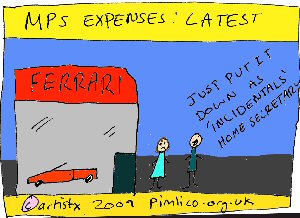
Nonsense, Sir? Then why are the police involved again?
Again?
Yes, Sir. They’re also investigating the mysterious unthinking think-tank remember?
Oh yes, I’d forgotten that.
There’s a rumour going round the canteen that the police are going to set up an incident room on the terrace of the House of Commons, Sir.
On the terrace?
Yes Sir. The idea is to save time going to and fro’ the house; deal with the criminals, sorry MPs, in batches – benefit from economies of scale sort of thing ….
Perkins! That’s the kind of silly rumour started by malicious gossips. I’m surprised you even listen to such tittle-tattle.
But you must admit it’s a rum do, Sir – using public money to finance his son’s university education!
But Perkins, it was only his expenses that he used!
That money is supposed to be used – if I may say so – for expenses, Sir.
But those WERE expenses, Perkins! Goodness, you are being obtuse, today. When your son goes to university you certainly have expenses, I can tell you!
I meant his parliamentary expenses, Sir.
Oh really, Perkins. If we’re going to start nit-picking over every pound in every expense account in the House of Commons then where will we be?
I don’t know where we’ll be, Sir, but I know where the police will be and where half of our illustrious MPs will end up ……..
But Perkins, we’re talking about money already earmarked for expenses. Once it’s allocated then it doesn’t really exist any more; it’s virtually spent!
Well, it seems this money was actually spent, Sir – and after all, it was public money, Sir!
Public money? What on earth are you talking about, Perkins! It was the government’s money!
But it came from the public, Sir!
Aha! Got you there, Perkins. Granted it WAS the public’s money originally but once it left their bank accounts it became Government money! Surely you can see the distinction?
The expression “mind-boggling” seems most appropriate here.
After reading my book, “The Ascent of Science“, referred to yesterday, I gathered together just a few of the randomly-miscellaneous statistics which most struck me. No doubt there are plenty more! PLEASE SEND ME YOUR MOST AMAZING NATURAL STATISTICS!
We are carbon-based creatures. EVERY SINGLE CARBON ATOM in our bodies
was created in a supernova explosion of a giant star. We are truly “Children of the Stars”.
The “Nature” of our world and existence is indeed almost unbelievable.
MOLECULES: They are extremely small: a teaspoonful of water contains about 200,000,000,000,000,000,000,000 molecules. If everyone on the planet set out to count these molecules one per second it would take over ONE MILLION YEARS.
A molecule of hydrogen in a steel cylinder travels at about 3,800 mph.
Molecules NEVER stop moving. A molecule in the air makes 6,000 MILLION collisions with other molecules PER SECOND.
The above two facts explain why the progress of molecules through space is extremely slow unless assisted by an external force (e.g. the wind)
Every second, your skin is subject to bombardment by 2*10 to the power 24 (200,000,000,000,000,000,000,000,000) blows from molecules in the air.
ELECTRONS: When you switch on a light bulb, approximately 3*10 to the power 19 (30 million million million) electrons flow through your lamp EVERY SECOND
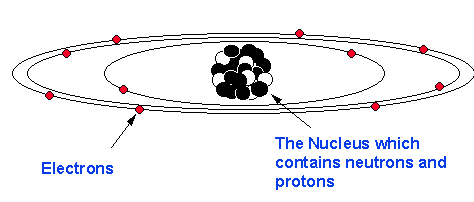
THE ATOM
NOT drawn in "real" proportions
A man is about 10 BILLION times larger than an oxygen atom. If an atom were the size of a golf ball then a man would stretch from earth to the moon.
A teaspoonful of solid nuclei of atoms would weigh about 500 million tons.
The nucleus of a typical atom contains about 99.8% of the total mass of the atom.
The diameter of an atom is about 100,000 times the diameter of the central nucleus.
Most of an atom is empty space. Imagine a sphere of FIVE MILES to represent an atom. The nucleus on the same scale would be the size of a tennis ball.
Most of your body is empty space …..
A black hole is supposed to consist entirely of material from the nucleus; all the “empty space” has been stripped away. A black hole of the mass of the earth would be ONE CENTIMETER in diameter.
COLLAPSED STARS
There is believed to be a black hole at the centre of our galaxy with the mass of ONE MILLION times that of our Sun.
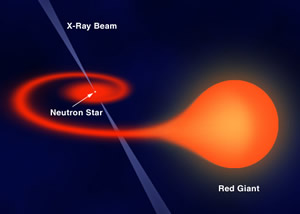
A pulsar or neutron star is a collapsed star that spins on its axis up to three or four thousand times per second.
A pulsar is ONE HUNDRED TIMES DENSER than a white dwarf, which is what our Sun will become once its nuclear fuel has been used up.
Pulsars sometimes send out gigantic amounts of visible light, equivalent to many times the total light emitted by the Milky Way.
A tablespoon of material from a neutron star would weigh about 3 BILLION TONS.
THE HUMAN EAR
can distinguish around 400,000 different sounds.
can detect sounds so quiet that the vibratory movement induced in the eardrum is not much more than the width of a calcium atom.
a science class at Woolverstone Hall School, late 50s - click to see more
Apart from hearing and knowing that many people are suffering terrible hardships in this world, I find few things more depressing than to hear young people say “I’m not interested in science”.
We are part of Nature. Science is the study of Nature.
How can it possibly NOT be the most interesting and endlessly-fascinating of subjects? There is a shortage of well-trained science teachers in Britain. There are too many students doing courses on “Football Management”, “Media Studies” or even “sociology”.
Why is this? I can’t explain it. Can anyone else?
I am not a scientist, having had to abandon the study of physics and biology – two subjects I loved – because I was better at languages. Too many youngsters have to drop science at the age of 16. What an absolute folly in the technological age, even 50 years ago.
My point is not just that science is important but that it is so interesting. Is the problem that some kids find it “too hard”? That must be poor teaching, surely? You gear your lessons to your students.
One positive point about British schools – at least in my distant experience – was the great use made of practical work. I so looked forward to that in physics: boiling up water in calorimeters, mucking about with levers and pulleys, passing electrical currents through each other …. I looked on physics lessons as a game, not a boring school subject.
Yes, science CAN be hard, especially for those not that good at maths. Some of the most brilliant minds on the planet do science; we cannot hope to understand all they do. But this doesn’t matter, does it?
ISBN: 0-19-511699-2
As for maths, I have recently been reading a most stupendous book, one that I cannot recommend too highly to any layman interested in science. Shown right, this was written by Brian Silver, former Professor of Physical Chemistry at the Technicon Institute of Technology in Israel.
I read and re-read this book every night, each time hoping – somewhat in vain – that I will eventually understand what quantum mechanics and relativity really are. But I read it, too, with a tinge of sadness, for Brian Silver died in 1997, just prior to the publication of his book, which I personally feel is a masterpiece of its kind.
In this book Professor Silver takes us through the history of science from Antiquity and before right up to the end of the 20th century. As well as chapters on all the major fields and discoveries of science from Pythagoras to Hawking we have fascinating snippets of biographical information about the science greats: Galileo, Copernicus, Newton, Herschel, Boyle, Hooke, Faraday, Lavoisier, Maxwell, Mendel, Darwin, Planck, Bohr, Heisenberg, Schrödinger, Einstein, Rutherford, Crick and so many more.
Their biographies themselves make fascinating reading, let alone their discoveries.
I read a book some years ago about Joseph Salk and the development of the polio vaccine. This was a hundred times more exciting than the most classy whodunnit, recounting the story of one of the greatest triumphs of medicine. Do you know anyone with polio? Nor do I, though I did when I was a kid in the 50s and of course there are many in “developing” nations still today, as we spend billions on CERN and not enough on medicine for the deprived of this world. Interwoven with the factual accounts of science and scientists considerable attention is given to philosophy and the placing of scientists and their discoveries in their historical context. A dry, purely factual book this isn’t, with the final chapters on cosmology, the origin of the universe and the meaning of life. (But don’t expect any answers to the last two!!)
Maths? Well, Professor Silver puts Michael Faraday right up there among the immortals. An astounding practical scientist/technologist, he made major discoveries in the field of electricity that affect the lives of everyone on the planet today. But his maths wasn’t too good! So much so that he pleaded with James Clerk Maxwell to write his equations in a more understandable way!
So you don’t have to be a great mathematician to do good things in science. If only I’d realized that before, I could have been another Faraday!
This book should be a standard textbook for all 6th formers, not just those doing science. I salute the brilliant and too-soon departed author.
I’ve been trying to think of the right word, and I think I’ve finally managed it – “stupefying”. This is in connection with Fr Cantalamessa’s remarks comparing the current criticism of the Roman Catholic church hierarcy with anti-semitism, this in relation to the on-going child-abuse scandals that are rocking the Roman Empire.
I don’t like to kick a man when he is down, and Fr Cantalamessa is clearly challenged on a wide number of fronts, including cerebrally.
The Catholic Church is in a totally indefensible position on the abuse front; the Pope himself is accused of failing to take action (always the easy course) in his earlier career when presented with clear evidence of wrong-doing.
No, the only possible reaction was to assume great humility and sorrow and issue grovelling apologies. No doubt the usual politicians’ standby soundbite would not have gone amiss: “Lessons have been learned.”
I give Fr Cantalamessa some credit for saying what he thinks instead of passing his comments through a gruesome PR spin merchant, but unfortunately he has got it completely wrong. And it’s no good the Vatican claiming that these remarks “did not represent its official view”. They were after all printed in full on the front page of the Vatican’s own newspaper “L’Osservatore Romano.”
As Peter Isely of SNAP (survivors Network of those Abused by Priests) put it much better than I could:
“They’re sitting in the papal palace, they’re experiencing a little discomfort, and they’re going to compare themselves to being rounded up … and sent in cattle cars to Auschwitz? You cannot be serious.”
Porr old Fr Cantalamessa should get out and about into the real world a bit more. Someone should send him a copy of Mother Theresa’s biography or “Five Chimneys”
Has he seen “Schindler’s List”, even though what was shown there was extremely mild compared to the horror of the reality?
Sorry Fr Cantalamessa, you score nul points on this one ….
A dream that, perhaps, one day politicians will be truthful.
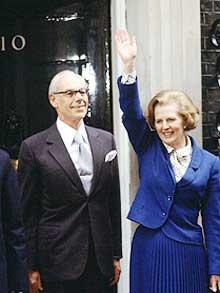
British General Elections are always fascinating occasions. On the one hand they are deadly serious. Mrs Thatcher’s win in 1979 set up the country for 18 years of Tory rule with massive changes and frequent social conflict whose effects are still felt today.
It was either a total social and economic disaster or a great leap forward into modernity depending on your point of view. Her victory of course also consigned Labour to 18 years of impotent pfaffing about in the political wilderness.
But on the other hand they always cause a great deal of hilarity to the student of human behaviour, as day after day nonsensical, fatuous, spinladen pronouncements are made by those desperate to get their hands on power.
And these pronouncements of future intentions (often delivered with the word “pledge” attached – as if that were somehow more weighty than “promise”) are often based not on reason or good planning but on how they will go down with the public!
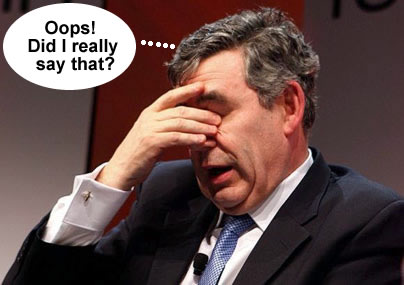
And amazingly, they often seem to be made without any great thought about the consequences. Brown has got some stick only today because he promised (or if you like “pledged”) that there would be no VAT imposed on the Simon Cowell charity record for Haiti, yet EU rules prohibit such gestures and so the Treasury is having after all to charge VAT and is now promising to pay this back with increased aid as a workaround.
Foot in mouth - again!
The increased aid could have been given in the first place without his headline-grabbing “pledge” to make it VAT-free.
As ex Chancellor, Brown should have KNOWN that removing VAT from individual items on a whim is not allowed, but he clearly spoke without thinking, the headline-potential of declaring the record VAT-free being irresistible.
Gordon Brown has also got himself into “another fine mess” by trying out a variation of his trick of the 1994 election.
During the pre-election campaign then he solemnly pledged NOT to raise income tax. No, not he. He was not the man to steal the public’s hard-earned cash by raising income tax; that would be most unsporting.
Meanwhile the poor old honest and hopelessly-naive spinfree Lib-Dems promised to put one measly pence onto income tax to pay for more education. Naturally, in the election they got slaughtered as wild spenders. You couldn’t make it up!
As for Gordon Brown, he kept his word. Income Tax remained as untouched as the virgin snow. But he had a cunning plan; as soon as he got his hands on our money, he vastly raised National Insurance (NI) instead. It actually comes down to the same thing, but of course the SPIN was different. That was how Brown’s management of our finances began, and so it has gone ever since.
Well, it’s hard not to repeat a winning formula, as many crooks have found out to their cost. Putting up National Insurance of course (even if this time you TELL the people you’re going to do it) can be sold as much more socially responsible than simply putting up income tax. The former can be spun as essential to pay for hospitals, pensions and the like whereas the latter seems more often like Robin Hood in reverse. The silly thing is that it’s ALL MONEY TAKEN FROM OUR PAYPACKETS, so what difference does it make?
Well, to the wage-earner, none at all, but to the employer quite a lot, and this is where Brown is batting on a sticky wicket. Increasing National Insurance certainly IS a “tax on jobs”. Let’s look across the English Channel ……
They have a VERY high level of NI (French = “charges”) in France. The result is that:
Employers bend over backwards NOT to employ anyone; it is so expensive.
Productivity in France is very high (higher than in the US – fewer workers than in many other countries do the same amount of work).
Unemployment is also consistently very high.
In Denmark it is much cheaper and easier to hire and fire people than in France. Oh Dear! Horrible, nasty, capitalist, Denmark and wonderful, caring, socialist France!!
Errmmm … No, actually; unemployment in Denmark is usually around 4% (I just checked; it is TODAY despite all the economic chaos just 4.1%) and in France endemically nearer 10%.
Rocket science it ain’t. Sad for the otherwise-could-be-employed it certainly is.
Well, even the plebs are not quite as gullible as 25 years ago. The negative effects on employment are blindingly-obvious to employers but as it is such an easy thing to understand (though not apparently for the entire French government or for Mr Brown) ordinary people are beginning to understand it, too. Brown’s statement that he will raise NI isn’t doing his election campaign any good at all.
However, as it is currently business leaders in particular who are bleating about this, perhaps it will be spun as: “Don’t worry chaps – it’s just those capitalist business-chief bastards whinging again”. That’s one thing you can rely on in an election; there will be endless spinning, quoting of statistics and rubbishing of the enemy ….
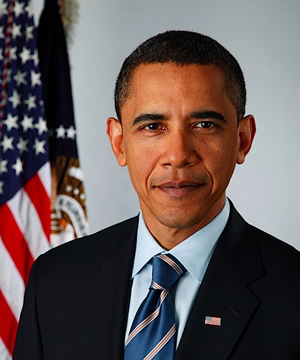
Dr Sherry Jarrell commented recently on her disappointment with President Obama, with two specific criticisms:
A) the way he speaks to the people, or perhaps to some of the people
B) his handling of the economy
With this in mind and given that the President has now been in office for long enough for a judgement to be made, here is a view from this side of the water.
HOME
How he speaks to the people. I can’t judge this; I don’t currently have a television, let alone one with access to all the US media; And “yes”, I know this is a bit bizarre, but there you go …
What does surprise me is that during the election he showed himself to be an orator of considerable talent. Indeed, without this talent to inspire people it seems unlikely that he could have got elected in the first place. So what has gone wrong? Do the people he is speaking badly to perhaps deserve it?
The economy? Dr Jarrell is the expert. However, I just caught sight of a headline about US growth, which seems to be picking up surprisingly well.
Surely it is not all gloom, even if unemployment is high at nearly 10%. However, if you think this is bad you should visit Spain.
Health? As a European, one struggles to understand why he has been criticized by some on this issue. The US can’t afford it? Well, perhaps the bankers should be giving up some of their vast salaries and bonuses to help pay for it.
Priorities? How can the USA possibly NOT have a universal health system, when poor little Cuba has one? As I understand it, health consumes about 17% of US GDP, which is WAY above other comparable nations.
Something is wrong here. Have the medical profession and pharmaceutical companies got Americans by the short and curlies? And even this 17% didn’t until now include tens of millions of people. I would really like to have someone’s take on this.
The Republicans? Well, are we seeing a great party beginning to implode? The hysteria over the health reforms is astonishing. The “Tea Party” group has issued all kinds of threats and complaints that even senior members of the Republican party have not criticized. What is going on here?
Do they have no understanding of how modern, civilised societies work? As a friend of mine put it (as it happens a strong supporter of the Cuban regime, which I certainly am NOT) “You judge a society by the way it treats its poorest and weakest members.” On this score, the Republicans are living on another planet.
I read a fascinating take on this the other day in the New York Times. In essence, Frank Rich claims that the Tea Party hysteria is nothing to do with the health system, but concerns the fact that WASPs feel threatened as they will soon be in a minority in the USA.
Yup – hard to believe for a British kid brought up on John Wayne, the Pilgrim Fathers, New England and all that … but true. Even so, if the Republicans are not to become a laughing-stock they need to find some more statesmanlike leaders. Sarah Palin just doesn’t cut the mustard I’m afraid.
Oil & Energy? Well, he is cracking down on gas-guzzlers. He has to have points there, surely? It is both essential and long overdue. On the other hand, he has sanctioned oil exploration in hitherto off-limits areas, the idea being to reduce dependency on imported oil. Very commendable, but the aim of all nations is to reduce consumption, isn’t it?
AWAY
As a European, whatever impression one has of the USA has to be tempered by remembering that one does not live there. One simply cannot pick up the real mood of the country unless one has feet on the ground, and so all the above comments are impressions, possibly misplaced.
But on INTERNATIONAL affairs one is on slightly firmer ground, and of course what the US does internationally also concerns us more directly. When he took office, I decided I would judge him on one thing in particular ……
Palestine: There has been precious little movement since 9/11. Lots of “talks”, “negotiations” and proposals of course, but underlying it all the feeling that the Israelis are not going to give up anything at all.
The present government in particular seems like an immovable object on many key issues that must – frankly – be resolved by compromise on all sides. This is where an irresistible force comes in, and this can only be Obama.
Well, there have been positive signs, but I have yet to see evidence that pressure on Israel will be both real and sustained. Sometimes “negotiations” and “frank-talking” are just NOT enough, and this is one of them. The jury has retired with some recent positive feelings, but it is still out, and very sceptical.
Iran/China?: Obama has tried to be nice to these people, but – as with Israel – being nice sometimes doesn’t do it. There is I feel serious trouble ahead with China, one way or the other. Will Obama be tough enough to deal with it? The jury is still out on that one, too.
SUMMARY: Humans tend to be optimistic folk: we believe there is a solution out there somewhere. We believed Obama might be it.
We were as ever hopelessly-idealistic. Nevertheless, I am mindful that this is an extremely inexperienced President, chosen by Americans for his youth, optimism and charisma more than his long experience as a statesman.
He will need time. Unlike some Americans – who already think he is the anti-Christ (those strange Republicans again) – I am prepared to wait a bit longer to make a final judgement.
Now come on Perkins. You know that these things happen down there in the underclass.
But this is more than the usual knocking-about of wives and kids that goes on Sir.
But it doesn’t do to over-sentimentalize things, Perkins.
I’m sorry, Sir, but do you actually know the details?
Details? Good God, man! I’m far too preoccupied with the broad sweep of politics to worry about details!
But it seems this tyrannical father actually starved several of his kids to death …
Goodness me, and there were we thinking New Labour had abolished poverty.
And there were apparently three other kids locked up in perpetuity; one of them subjected to horrendous torture ….
Locked up? What had they done?
They apparently answered back, Sir?
Answered back?
Yes, Sir …. and there’s more ….
There usually is with you Perkins.
Those who weren’t starved to death or locked up were subjected to a life of deprivation, misinformation and misery, Sir.
You mean they were British voters? (just a joke, Perkins …)
It’s not a laughing matter Sir. They had no access to proper food or health provision.
Sounds pretty normal for the mob to me, Perkins …
And then they were brainwashed; they could only see and hear what their father wanted them to see … they have no idea what is going on in the outside world, Sir ….
But the mob have always lived like that, Perkins – they do read “The Daily Mail” after all …
But you haven’t heard the worst, Sir!
Oh dear …
Last week two of the kids ran away. They managed to climb across the fence into the grounds of a major company on a neighbouring industrial estate. But a guardcaught them and took them back to the tyrannical father, even though they were crying, emaciated and showed signs of malnutrition and harsh punishment ….
Goodness Perkins …. this does sound bad.
I’ve been investigating, Sir, and it seems that it is this has happened before and it is company’s policy to hand the kids back instead of trying to help them.
Well, one can’t interfere in private family matters, Perkins …. come on, let’s have a cup of tea and get on with the preparations for the election …
But I found out more, Sir …
Oh Dear, Perkins …. all right, tell me the worst!
Well Sir, it was all very well concealed, but I discovered that this large company that handed back the cruelly-treated children is the government’s largest supplier of cheap, rubbishy goods ……
Perkins! For goodness sake! They are NOT cheap and rubbishy … cheap perhaps …
So you KNOW about this company, Sir?
Of course Perkins …. as you said, they are our main supplier.
But they connive with child abuse, Sir …
Look Perkins, if we were to have a crisis of conscience over every single case of abuse we’d hardly be able to import anything, except from Canada, Switzerland, Germany and Sweden, and have you seen their prices?
But it’s not moral, Sir …
We try to avoid using this word in politics, Perkins. We would be on a sticky wicket on thin ice if we didn’t ….
But back in 1994 Robin Cook said that the new Labour Government would have an ethical policy on abuse …
Perkins, let me explain the difference between heady, overblown, post-election rhetoric and the real world of pragmatism … besides, Robin Cook died …..
So our pragmatism outweighs our morality?
Well, doing it the other way would only mean shooting ourselves in the wallet, Perkins ….
But it’s very sad, Sir!
Indeed, Perkins, but not for us, and that’s the main thing after all …. come on – put the kettle on ….
[For Gulagova family read North Korea; for large trading company read China, Ed.]
Our doughty mole has unearthed more secret transcriptions from the Ministry ….
The Ministry
Hello Perkins! Let’s get to it!
Get to what, Sir?
Perkins – there’s a mini-crisis …..
There usually is, Sir …..
We have a stark, difficult choice ahead of us.
Oh, Dear, Sir – not again.
Yes, Perkins. I know that choice is not something we prefer to face, but there it is.
But why has it come to this, Sir?
Cuts, Perkins – The IMF are about to be called in so the PM – I mean the Chancellor – has been forced to make some cuts.
Oh Dear, Sir. But how does this affect us?
Well, you know those consultants that were called in?
You mean those on £100,000 a day plus bonus, Sir?
Yes, that’s them! By Jove don’t you admire this dynamic synergy between public and private, Perkins!!
Well ….
Anyway, after weeks of in-depth research they’ve narrowed it down for us to a clear choice, which certainly saves us some head-banging, I must say.
And this choice is ……?
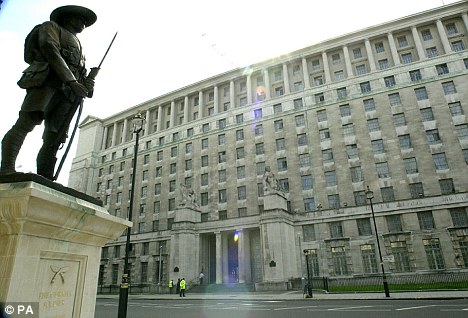
Well, we either buy more flak jackets for the men on front-line duty in Iraq or we pay the MOD mandarins a bonus.





 Learning from Dogs