Just enjoy watching these dogs – as good as it can ever be!
(With thanks to Charlie and Tracy for this heads up.)

Dogs are animals of integrity. We have much to learn from them.
Author: Paul Handover
Just enjoy watching these dogs – as good as it can ever be!
(With thanks to Charlie and Tracy for this heads up.)
The Loop in North Wales and a neat gag!

The British Royal Air Force frequently train their air crews in and around the valleys of North Wales. Much of that area is designated a Tactical Training Area. One such route is known as The Loop. Here’s a description of that from the website Warplane.co.uk:
Machynlleth Loop
The most appropriate place to start with is the Machynlleth Loop which is usually referred to by aircrews as ‘The Loop’ although the USAF crews refer to it as ‘The Roundabout’. It is literally a roundabout of flowed valleys running counter-clockwise following the A470 north eastwards from Machynlleth in the south to Dinas Mawddwy then heading north west to join the A487 at the Cross Foxes Inn. From here it follows the A487 southwards through Corris to end back at Machynlleth. Ordnance Survey Explorer Map OL23 is recommended for anyone planning a visit.
It is arguably the busiest part of the UK low fly system and although the cold war days of up to 80 plus movements in a day are long gone it is still sometimes possible to see 30 plus aircraft in one day. The usual daily total is usually between 10 and 20 aircraft mainly made up of Hawks with the odd Tornado, Harrier or Hercules thrown in. It is certainly the place to go to practice your panning technique.
It takes about 3 minutes for a jet aircraft to do a circuit of the Loop and multiple passes by aircraft is not an uncommon sight, especially by Hawks. So whenever you see an aircraft it is worth checking to see if it looks like doing a circuit as you may be lucky enough to see it again in 3 minutes.
Do click on the link if only to view some of the fantastic flying photographs.
Anyway, a couple of British newspapers recently published a piece about an RAF Navigator holding up a sign inside the cockpit for the many amateur photographers who frequent this part of the country.
Here’s an extract from the Daily Mail:
A RAF navigator gave plane-spotters a chuckle as he held up a sign reading ‘I’m with stupid’ with an arrow pointing to the pilot.
The pair were on a training mission in a £13million Tornado GR4 aircraft, capable of reaching 1,400mph, when the navigator pulled the prank as they jetted through a valley in Wales.
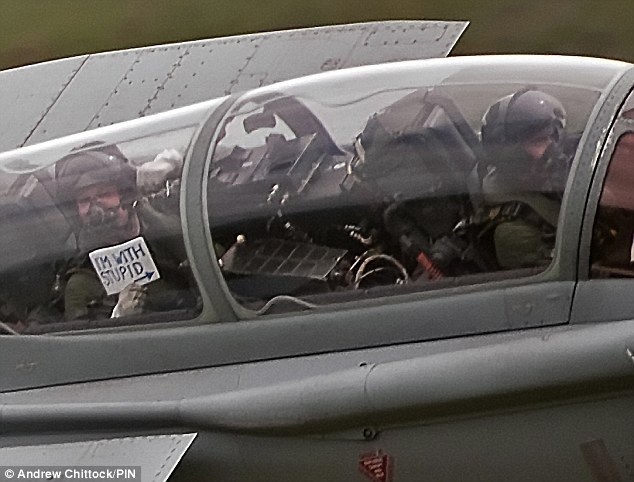
Wonderful prank, and wonderful picture taken by Andy Chittock who clearly is rather used to taking a mean photograph!
By Paul Handover
Incredible outcomes from the dig in 2008
Stonehenge is one of Britain’s most famous historical sites, deservedly so because Stonehenge was one of the most important places in ancient Europe.


But evidence from a dig that was authorised in 2008 has shown that not only is Stonehenge a much older site of human habitation but that it’s purpose is altogether different to what has been assumed. It was, indeed, a healing place, possibly the most important in Europe.
Those living in the UK can watch the Timewatch programme on the BBC iPlayer. But for those living outside the UK then the following web site has reams of wonderfully fascinating information. That site is here.
By Paul Handover
Visualisation of data
I can’t recall how but I came across a web site that focuses on ‘translating’ data into pictures. As they say, a picture is worth a thousand words. The web site is called Information is Beautiful.
Anyhow, they have attempted to graphically portray the scale of the BP oil spill. (A thumbnail is below but please click on the link, or here, to see this as it was meant to be shown.)

But this image is an update of an earlier one here that is really powerful. Because it attempts to put the scale of the oil spill into context with global oil consumption.
If the Purdue University estimate of the oil spill is correct at 48,500 barrels a day (a barrel is approximately the equivalent of two car tankfuls of gas/petrol) and the spill is contained in 90 days then the total oil spilled will be:
That is an enormous quantity.
But have a guess as to how much that would represent in terms of hourly global oil consumption?
Any idea?
Well global oil consumption is 3,500,000 barrels an hour.
So 90 days at 48,500 barrels a day represents just 1 hour 15 minutes worth of global consumption!
If there was ever an argument for the world to wean itself off oil then this would appear to be it.
What has happened so far is tragic – tragic beyond measure. But if it turns out to be a ‘tipping point’ for nations to reconsider how we find and use energy then, perhaps, it will have been a horrible lesson that we all had to take.
And if the USA puts all it’s collective back into leading the world out of our addiction to oil then the damage and hardship will not have been in vain.
By Paul Handover
What do you think of it so far?
The above is a popular catchphrase. It suggests that how we view something now is the product of all our experiences to date. It might apply to a book, play, TV programme or life itself.
But the truth may be very different, how we view the present moment may be more to do with shutting off all those previous experiences and just accepting the present as if we have been blind, dumb and deaf until this perfect moment of now.
That’s why what we have to learn from dogs is so important even though that ‘lesson’ may be just this single, very, very important aspect. Living in the now!
Here’s what is written on our Home Page post:
Dogs have so much to teach us. To an extent that’s difficult for humans to contemplate, they live in the present. Dogs just are!
They make the best of each moment uncluttered by the sorts of complex fears and feelings that we humans have.
Living in the present is not easy. Trust me, I’m only starting to practice this myself and maintaining a few seconds is a challenge!
But try it. Just let everything in your mind be replaced, just for a few moments, by NOW. That’s the sound of your breath woven into the sound of everything going on around you. Let all of those sounds just be a part of your awareness.
Be aware of touch. Feel what you are sitting on standing on. Feel the messages your fingers and hands are sending to your nervous system. Feel the bench, chair, ground or whatever is connecting your body in a physical sense to the world around you.
Hold a rock, a plant, a branch, anything real and be totally aware of the texture and feel of that object.
Smell the aromas entering your nose – just be aware of them.
And see with your eyes. Really see. See through your eyes with the innocence of eyes first opened.
Just hold this place of divine grace for a few moments.
You have just experienced true peace and your world will never be quite the same again.

Oh, how I envy dogs!
By Paul Handover
That pre-frontal cortex is at it again.

There’s a fascinating video on the http://www.TED.com website given by Prof Dan Gilbert. Prof Dan is Professor of Psychology at Havard and there’s a good resume on WikiPedia.
Here’s how John Brockman describes Dan Gilbert.
Dan Gilbert doesn’t have an instruction manual that tells you how to be happy in four easy steps and one hard one. Nor is he the kind of thinker who needs Freud, Marx, and Modernism to explain the human condition.
Gilbert, the Director of Harvard’s Hedonic Psychology Laboratory, is a scientist who explores what philosophy, psychology, neuroscience, and behavioral economics have to teach us about how, and how well the human brain can imagine its own future, and about how, and how well it can predict which of those futures it will most enjoy.
There can’t be a human that hasn’t pondered on what makes them happy. Gilbert sets out some fascinating and possibly counter-intuitive ideas. Here’s the video
By Paul Handover
A foreigner but not a foreigner!
Despite the fact that we have now been living in Payson, Arizona, since the end of February and, therefore, a degree of familiarity exists in both directions, the local Saturday Farmers Market prompted this thought.
Why do I not feel a foreigner here?
There is no question that America, in general, and Arizona, in particular, is very different to England. In many ways the differences are far greater than, say, England and Australia, or England and New Zealand (I’m picking other English speaking countries to avoid to obvious difference between countries of different languages).

I love Farmers Markets. They seem to encapsulate the wholeness of locals growing meat and produce for other locals. They seem to serve as a reminder of the integrity that is needed just as much in food as in all other areas of life.
Of course, I am not so naive to think that we could wind the food revolution back to before the days of supermarket chains – food is wonderful value nowadays especially for those families on tight incomes.
But I can’t be the only one that ponders what the long term effect of all those

E-numbers and other strange ingredients that one reads on most packets of most items, and whether or not fruit is sprayed with anything that we should know about, and so on and so forth.
That’s why that place in my psyche is ‘stroked’ so well by wandering around the Farmers Market.
One would expect if there was going to be any place where yours truly, dressed and sounding like the Englishman that he is, is going to feel foreign, it would be at the Payson Farmers Market. I don’t even try to hide my origins, responding to a “Howdy folks” from the stall-holder with a quintessentially English “Good Morning!”
Inevitably there are reasons why I am made to feel welcome here in Payson, my hunch is that it is much to do with this being a pioneering town for most of the last 100 years, and therefore co-operation, collaboration and a welcoming attitude were key elements of sustaining a way of life, but, in the end, analysis is pointless.
What matters is how we are made to feel, and we are made to feel very welcome.
Indeed, Payson with it’s predominance of right-wing, independent thinking, tough ‘cow-boy’ inhabitants echoing a recent past, may have an important lesson for all of us, across the globe, as the forces of disconcerting change build and build: be local, think local, preserve local.
I’m very proud to be slowly but surely turning into a Payson local.
By Paul Handover

I can’t possibly add anything of substance to the hours and millions of words spoken about this tragic event.
All I felt as I watched the Congressional Hearing live on CNN was both embarrassment and sadness as a fellow Englishman demonstrated how the lawyers have won.
Hayward, from the couple of hours that I saw, said nothing of substance, nothing of real value and nothing that recognised how the American people, and the world in general, deserved openness and in-depth answers.
Very poorly advised, in my opinion.
Tragic.
By Paul Handover
In the laboratory of the hermits, no one noticed that the monkeys could talk.

When a book ends with the above line, you know it’s going to be interesting.
When the inside front page carries a short review from Prof Alan Dershowitz of Havard Law School that reads, “One simply can’t finish this book and see the world in the same way”, you know the book is important.
Yes to both.
On Page 2, Ellen writes,
Unlike the exotic “altered states of conciousness” that we read so much about, mindfulness and mindlessness are so common that few of us appreciate their importance or make use of their power to change our lives.
This is a book for so many different aspects of life. From fields like aviation where mindlessness can, literally, kill to mindful new perspectives for people looking to explore new horizons for the soul.
Langer demonstrates a rare capacity both to see what is extraordinary about human events and to envision even more enlivening human possibilities. – Lee Ross, Stanford University.
By Paul Handover
‘Among the calamities of war may be jointly numbered the diminution of the love of truth, by the falsehoods which interest dictates and credulity encourages.‘ (Samuel Johnson, from The Idler, 1758)
I have used this quotation simply because we need to remind ourselves that the media, politicians, journalists and many ordinary folk find it easier to be extreme, opinionated, outlandish and provocative (ergo, ignorant) than to be thoughtful and reflective about an incredibly complex situation. Rant and blame, while making for great reading or viewing, is not helpful.
This all came to mind from reading a recent article in The Financial Times (you may need to register to view it) which was titled:
By Clive Crook
That article starts like this:
A week ago I criticised the US media for childishly demanding that President Barack Obama “just do something” about the oil spill in the Gulf of Mexico, observing there was much to be said for a leader who stayed calm in a crisis. Next day, no doubt as a result, Mr Obama became pointedly less calm. He called for some “ass to kick”, a very Bushian sentiment, and dialled up the invective against BP – which he likes to call by its old name, British Petroleum, to underline the company’s alien perfidy.
The US outcry against the company is still building, and the administration, intent on deflecting its critics, has put itself in the vanguard. Criminal investigations and efforts to remove a statutory cap on the company’s liability are under way. It is ominous that lawyers are working hard, with the administration’s blessing, to enlarge the very concept of civil liability.
And concludes thus:
The question of whether even this company’s mighty resources are adequate to meet these demands cannot be dismissed. In such circumstances, I cannot see why BP has hesitated to suspend its dividend. The idea that it can take this calamity in its stride and proceed on the basis of business as usual is absurd, and politically foolish too, since it is a provocation to critics intent on vengeance.
The Gulf disaster will have far-reaching economic and energy-policy implications. The right liability and mandatory insurance regimes for deepwater drilling are high on the list. No doubt the White House should worry less about kicking ass and more about thinking these questions through. But British complaints that BP is being “scapegoated” will not help reason to prevail. Let us not add insult to injury.
Frankly, I don’t have either the knowledge or the competence to judge the validity of Mr Crook’s article and, as so often in cases like this, took to reading the comments as they can frequently shed more light on a particular issue.
And that is how I came across the following comment from RiskManager. Whoever you are, well done on taking the time to put what feels like some badly needed balance into this issue. This in no way lessens the terrible harm being metered out on innocents, just as in any ‘war’, but this is not about winning – it is about learning.
From RiskManager
Unlike ANY U.S. company EVER in a similar situation (Exxon, Union Carbide, Accidental Petroleum, etc. etc. – its ALL of them), BP has indeed done the right thing since the blowout by immediately admitting its liability/responsibilities. It has mobilised the largest containment and clean up operation ever and immediately issued compensation to those affected. The effort to stem the well, something never done before at this depth, has seen the assembly of the best experts in the world and the greatest concentration of sub-sea equipment perhaps ever seen. That efforts have failed so far to stem the leak is a fact that testifies to the challenge of the task, a challenge that cannot be understood until the failed Blowout Preventer (BOP) is recovered and we find out why the accident happened and why the top-kill did not work. What is going on inside the BOP?
And there it is. Today we just do not know. The failsafe in place, a modern BOP, failed. We don’t yet know why. BP may well. Transocean and Cameron the same. When we do recover the failed BOP which is under subpoena already all the questions will be answered. Until then it is fatuous and unhelpful to go round looking for bottoms to boot.
Why the gas kick happened down the well seems to me to be secondary. Things happen. That’s why we have a failsafe, that’s why there was BOP installed and paid for by BP, the failsafe device.
An editorial in The Daily Telegraph of yesterday said….
“It should not be difficult to rewrite the rules to make sure that no deep-water drilling is permitted without a fail-safe arrangement in place from the start,…..”
No, these are the current rules. The fail-safe arrangement was the blowout preventer, the one that failed. Note how BP always refer to it as the “failed blowout preventer”. Always.
The BOP has multiple (five I think) valves, of varying types with at least one that is meant to shear the casing, the drill pipe and anything else.
One valve was operated from the surface by the tool pusher who testified as such, indeed he operated it before the Offshore Installation Manager gave permission as mud circulation had been lost. That failsafe BOP valve failed.
The next I believe is a failsafe that shuts when contact is lost with the rig, like a dead mans handle on a train. As the Deepwater Horizon rig sank and contact was physically broken (or before), it also failed.
The others (three ?? ) are I believe all meant to be operable by sub sea vehicles (ROV’s). The first days after the blowout were spent trying to shut these valves as per the design of the failsafe device, the blowout preventer. All these valves failed.
That’s a lot of failure. Why??
Now, if BP should have known about whatever is found to have happened in the failsafe BOP then it is their fault. If sub-contractors installing and operating the BOP or is manufacturers lied or were negligent it is there fault.
If the blowout preventer had worked as intended, as the failsafe final defence device, there would have been no loss of life and no oil spilled.
Given the sums of money involved I suggest the UK immediately prepares to seize US assets of potentially liable companies or associates in the event that BP is found to be the victim of its supplier’s negligence. Unlike BP these companies have already sought protection of US law, are paying dividends and are saying nothing at all as BP gets a kicking
At the end of the day, we (you and I) need the deepwater oil as the worlds easy and cheap to produce oil reserves are controlled by the OPEC cartel and restricted to about a 40% of global production from 80% of reserves. But however many failsafes, however many regulations, human activities entail risk. The deep water drilling was thought to be safe with a modern BOP. It wasn’t. Now we need a BOP and inspection/testing regime that really is failsafe and expertise in responding if that fails. I would have thought the facility to install a new shear ram at the well head below the BOP after a blowout would do the job, or a fitting at the top of the LMRP that a ready built new valve could be installed on top of post blowout would do the job..
Ironically BP will certainly be the world experts in these matters after this accident and response.
P.S. Shortly after completing this Post, I read the following from the BBC. (Extract provided only – see link for full BBC article.)

US President Barack Obama has called on his Democratic Party and other supporters to back a government campaign for clean energy.
In a statement aimed both at paid-up Democratic Party members and at millions of individuals who backed his 2008 presidential bid online, the president asked his network to lend their name to a campaign to change the way America produces and consumes its energy.
“We are working to hold BP accountable for the damage to the lands and the livelihoods of the Gulf Coast, and we are taking strong precautions to make certain a spill like this never happens again,” Mr Obama said.
“Beyond the risks inherent in drilling four miles beneath the surface of the Earth, our dependence on oil means that we will continue to send billions of dollars of our hard-earned wealth to other countries every month – including many in dangerous and unstable regions,” he said.
“In other words, our continued dependence on fossil fuels will jeopardise our national security. It will smother our planet. And it will continue to put our economy and our environment at risk.
“We cannot delay any longer, and that is why I am asking for your help.”
Let me close as I started, by using an old saying:
“It’s an ill wind that blows no good.” (John Heywood (c.1497-1580))
By Paul Handover
 Learning from Dogs