Author: Paul Handover

Cosmic Modesty Required

THE UNIVERSE TEACHES AWE AND HUMILITY

This is a guest post from an old friend of Learning from Dogs, Patrice Ayme.  Patrice writes his own Blog here and this article is published with gratitude and with awe! If you can, because the article more than deserves this, find somewhere quiet for half-an-hour to read this – it may well change the way you think about everything.

Theme: Is there extraterrestrial life? Extraterrestrial intelligence? A related question: how big is the universe? On all these subjects considerable and very surprising progress is in the making. I describe some of the new ideas and facts in plain language, from Plate Tectonics to Cosmic Inflation.

Facing the enormity of it all, honest minds will find honor and pleasure in telling the truth, and nothing but the truth (carefully distinguishing it from hope we can believe in). Some physicists, searching for the limelight, have presented some science fiction, or some science fantasy, or let’s say scientific working hypotheses, philosophically grounded, as real, established science. This is misleading and dangerous: science is truth, and that is why the public supports it. Let’s keep it that way.

Sometimes all that science does, but that is fundamental, is to find new uncertainties we did not previously suspect. A basic humility that needs to be taught to people and politicians is that knowledge is not just about learning what we know, but also about learning that there are new dimensions to what we don’t know.

One certainty: our Earth is rare and fragile. Earth was a primordial deity of the Greeks, Gaia, viewed as female, nourishing humankind. Gaia is an on-going miracle, of self regulation, with extremely complicated biology and physics entangled. The more we observe the cosmos, the more we see that’s hell out there. Gaia is a rare deity, Pluto is the rule. Here are some inklings.

***

ALIEN SOLAR SYSTEMS EVERYWHERE:

Many planets have been discovered around many stars. Solar systems (= several planets orbiting the same star) have also been discovered. In one of these systems three planets around a dwarf red star are all in the inhabitable zone (= neither too cold nor too hot, so that liquid water exists on a planet there). One of them is smack in the middle of the balmy zone. It seems clear that most stars will be found to have planets (we are above 30%, and our present detection methods are very crude).

Still there does not seem to be many civilizations out there. As Enrico Fermi put it:”Where is everybody?”

Far enough from the dangerous galactic center, with its zooming stars, high radiation, and gigantic black hole, but not far enough to miss the full wealth of the periodic table, with its many elements, there is a narrow band all around the galaxy, the inhabitable zone, with at least 50 billion suns (within the trillion suns of the Milky Way).

Everything indicates that there are billions of colonizable planets in the inhabitable zone of our galaxy: colonialism has a great future (once we find how to get there). Life could have started on many of these planets. But on most of these, it was quickly annihilated: hellish, incandescent “super-earths” (= rocky planet with masses up to 10 times Earth) ready to fall into their star, abound.

***

INGREDIENTS FOR LIFE: MAGNETOSPHERE, TECTONICS, MOON…

The obvious candidate for the start of life is next door. It is Mars (Venus may have qualified too, the early Sun being 25% weaker; but Venus has long turned into hell, destroying all biological remnants). Everything indicates that life started on Mars. It would be very surprising that it did not.

Probably even OUR life started there. Impacts of asteroids and comets would have thrown living material from Mars to Earth. Mars meteorites have been found in Antarctica, lying on the ice. It has been observed that the temperatures within a Mars meteorite could stay very low: no more than around 40 Celsius, during the entire Mars-Earth transfer.

The Earth stayed too hot for life much longer than Mars, due to its much greater thermal inertia, large, intense radioactive core, greater number of impacts, and having thoroughly melted after the giant impact which created our life fostering Moon.

But then, after an auspicious start, Mars lost most of most of its atmosphere (probably within a billion years or so). Why? Mars is a bit small, its gravitational attraction is weaker than Earth (it’s only 40%). But, mostly, Mars has not enough a magnetic field. During Coronal Mass Ejections, CMEs, the Sun can throw out billions of tons of material at speeds up to and above 3200 kilometers per seconds. It’s mostly electrons and protons, but helium, oxygen and even iron can be in the mix.

The worst CME known happened during the Nineteenth Century, before the rise of the electromagnetic civilization we presently enjoy. Should one such ejection reoccur now, the electromagnetic aspect of our civilization would be wiped out.It goes without saying that we are totally unprepared, and would be very surprised. Among other things, all transformers would blow up, and they take months to rebuild. we would be left with old books in paper, the old fashion way. A CME can rush to Earth in just one day. (Fortunately the Sun seems to be quieting down presently, a bit as it did during the Little Ice Age.)

When a CME strikes a planet, the upper atmosphere is hit by a giant shotgun blast. Except a shotgun blast goes around 300 meters per second, 10,000 times slower than a CME. So, per unit of mass, the kinetic energy of a powerful CME is at least ten billion times more powerful than a shotgun blast. Since the liberation speed is going to be around ten kilometers per second, on an average life supporting planet, to be hit by projectiles going at 3,000 kilometers per second is going to knock all too much of the upper air atoms into space. That’s how Mars lost most of its atmosphere. And thus its ocean and much of its greenhouse. So now Mars is desperately airless, dry, and cold.

A cluster of new stars forming in the Serpens South cloud

(More on the Serpens constellation here. Ed.)

***

Both Mars and Venus are at the limit of the inhabitable zone. But Venus does not have a magnetic field worth this name. Thus Venus lost a lot of its hydrogen (hence water; the rest is tied up in sulfuric acid, H2SO4).

It is known that the Earth’s strong magnetic field originates from the motion of huge masses of liquid metal within.

So a solar wind shield, a magnetosphere, is tied to the plate tectonic of a very dynamical planet with a powerful nuclear reactor deep inside. Whereas Venus and Mars are tectonically inert, at least, most of the time; maybe they wake up every half a billion years or so, for a big eruption. If Mars and Venus had been very tectonically active planets, may be they would be teeming with life (but that depends upon the distribution of heavy radioactive nuclei in a gathering solar system, an unknown subject, obviously non trivial, since Earth got them, and not the other two).

In any case the Earth’s magnetic shield protects life from the worst abuse of the Sun, as it deflects most of the CMEs out and around (they sneak back meekly as Aurora Borealis).

Another factor in the stable environment Earth provides for life is the Moon. The Earth-Moon system divides its angular momentum, between each other and the orbital motion of the Moon. This prevents the Earth to lay its rotation axis on its side: such a wobbling could not be compensated by the rest of the system. So it does not happen.

Mars, though, not being so impaired, wobbles between 15 and 35 degrees (causing weird, pronounced super-seasonal variations).

In any case, everything indicates that extremely primitive life appears quickly. But complex life needs time, lots of time, to evolve. Animal life and intelligence needs even more time. However, what strikes me in the new solar systems discovered so far, is how alien and unstable they are (this is partly a bias of the present detection methods).

Many of these systems have huge Jupiter styles planets in low orbit around their stars. It’s pretty clear that they fell down there, destroying the entire inner system in their path.

Other notions threaten life; gamma ray explosions, supernovas, and simply passing next to another star, throwing a solar system into chaos, and some Jupiters down into a fatal spiral. Our Sun, though, is pretty much cruising far from any star, in a cosmic void right now, perhaps left by a supernova explosion. Maybe we have been lucky for 4 billion years.

***

COSMIC GRANDEUR VERSUS MONKEY BUSINESS:

Many a physicist, or cosmologist, talks about the beginning of time, and other various notions pertaining to the grandest imagined machinery of the universe, as if they had found God, and it was themselves they were looking for (as Obama would put it). They claim to know their garden, the universe, pretty well (having apparently being there, at the moment of creation).

Verily, what we know for sure is what we see in pictures, and that’s plenty:
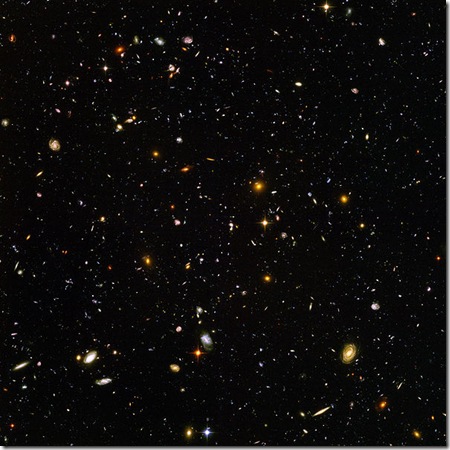
Hubble Ultra Deep Field: 10,000 galaxies. How many men?

Notions such as the “edge of the universe” are much less scientifically robust than some scientists claim. When some talk about the “First Three Minutes”, one can only laugh, even if countless Nobel Prizes in physics subscribe to the notion. Physics is relative, the search for glory, absolute. At least so do monkeys behave.

The concept of time in Quantum Mechanics and Relativity are in complete contradiction. One is absolute, the other relative. So nobody knows for sure what time is, and what is truly its relation to space (nor do we know what space is, much beyond the pretty pictures given by the telescopes). Speaking of the history of time is completely meaningless, except as poetry. Or scientific sounding poetry. Too many holes in the logic.

Even using standard science to buttress one’s reflection, the size of the universe could well be at least a 1,000 bigger than the 14 billion light year piece that we presently observe. In truth, we have literally no idea. Even when sticking to conventional theory, which predicts only one thing in that respect, namely that the universe is bigger than what we see (it predicts it by requiring it actually, see below).

Another thing is sure: it’s incredibly immense out there, and not just in physical size, but also in conceptual size. We know lower bounds for the universe in size and complexity, but have no idea whatsoever about the upper bounds. Dark Energy is a perfect example. Fifteen years ago, Dark Energy was unknown. Now it makes up 74% of the mass of the universe.

***

PRESENTING SCIENTIFIC PHILOSOPHY AS SCIENCE IS NOT WISE:

It is not a good thing when highly uncertain science is presented as certain, just as much as really true parts of science. It is not just immodest. It undermines, and threatens, science deeply.

Because presenting as certain what is not so is just a lie. But science is truth, and that is why society supports it.

To present as true what is not so ridiculizes the notion of certainty. When, ultimately, the ineluctable collapse of immodest pseudo-certainty occurs, all of science gets slashed with doubt. American witches can run as republican candidates for the US Senate on completely crazed platforms, mumbling about mice with human brains (this happened in the last USA election). Scientists ought not to make craziness respectable by leveraging it themselves. Crazy is crazy, especially when a scientist does it. It’s craziness squared.

Make no mistake: speculation is central to science and even more to philosophy. Just speculation ought to be labeled as such. When I talk about my own TOW theory, I do not present it as fact and certitude.

Most of recent (last 120 years) physics was totally unexpected. A lot of it is true, no doubt, in some sense. Some of it is completely false, too, most probably, in the most fundamental sense. The more fundamental science gets, the more it gets subjected to representations which can be misleading. Thus when some physiology or solid state physics gets established, it will not be shattered. Not so for Quantum Field Theory (most of which being an extrapolation over an energy domain where it has not been tested).

Science, like philosophy, is not just a body of knowledge, but also a method. Both have to use common sense as much as possible. Philosophy uses the external edge of knowledge, the first inklings, the first warnings, the smallest indices, the irreproducible experiments. Thus any scientist searching for really shattering new science will pass through the philosophical method, as a mandatory passage to greater certainty.

When science is proclaimed, it has to be certain. Science is truth in which one can have faith. A lot of the most glitzy cosmology comes short of that. (Thus the adventures of the alleged Big Bang should not be used as an argument to fund expensive accelerators: there are enough good reasons to fund them, not to use the bad ones!) The surest part of cosmology is actually its pretty pictures.

***

INFLATE OUR CLAIMS, IF THE OLD ONES DID NOT WORK OUT:

All of recent conventional cosmology’s biggest and noisiest concepts rest on something called the Inflaton Field. One could say that it is just as much a rabbit out of a hat as in the best circus acts. There is no justification for it, except to explain what we see: something very big, very homogeneous, apparently contradicting relativity. The universe in its entirity.

The mystery that Cosmic Inflation tries to explain was this: as new regions of the universe come into view (at the speed of light!), it is observed that the new regions are exactly as the region we already know; same aspect, same background temperature, etc. How did they know how to look the same? They could not have talked to each other! Light did not have time to go from one to the other!

According to standard Einsteinian relativity, our region, and those regions, some on the opposite side of the universe from each other, have no common history! (Those new regions which appear are NOT within our past light cone… To use relativity lingo.)

In the USSR, Einstein’s work was criticized in minutia, for ideological reasons (Note1). So the great astrophysicist Zeldovitch came up in 1965 with the idea of inflation (the discovery is attributed to Guth, 1980, in the USA, because the USA buried the USSR, and America is a super power blessed by God, as the resident of the White House reminds his flock every day).

Einstein’s Relativity speaks of the speed of light within space, but not of the speed of space (so to speak). Speed of light is limited within space, speed of space is not limited. So it was breezingly supposed space had inflated at a gigantic speed, before slowing down. So the new regions coming into view had a sort of common history, after all.

From a philosophical perspective, to invent an explanation to explain a specific effect is called an ad hoc hypothesis. It can be a correct way to advance science, if it has predictive power (But differently from the neutrino, or the W, or the Higgs, how do you check for it? Finding the Inflaton particle? The Inflaton is supposed to have given birth to most other particles). In the meantime, it provides some hand waving to explain away an otherwise obvious contradiction with Relativity.

But it is not enough that some of the best theories in physics are weird, with the logical consistency of gruyere.

The apparent discovery of Dark Matter and especially Dark Energy, have brought a new twist. Dark Energy is completely unexplainable.

Dark Energy attracted attention to the fact that Quantum field theory is both the most precise and the most false theory ever contemplated (QFT is off in its prediction of vacuum energy by a factor of ten to the power 120, or so, the greatest mistake in theory, in the entire history of hominids… it would make even baboons scream in dismay.)

NASA-ESA Hubble

Billions of galaxies can be seen when we look as far as we can see. Here is a tiny detail, as far as we can see, without using a gravitational lens. [NASA-ESA Hubble]. Baffling. We are going to need a bigger imagination.

It’s hard for me to escape the feeling that the universe is much older than what standard cosmology believes, as I look at these very ancient, but very diverse galaxies in a piece of sky (Note 2).

Dark energy was discovered when it was realized, in super novae studies, that the universe’s expansion was accelerating (so energy is injected).

A natural question, though is this: ”If, as it turned out, the expansion is accelerating now, maybe it was at standstill much earlier?” Then the universe, even the small piece we can see, would be older and bigger than we have imagined so far. Don’t be afraid of the simple questions. Einstein asked himself at 16 what would happen if he looked at a mirror when going at the speed of light (Note 1).

Time will tell, as long as astronomy gets massively funded. Astronomy (astrophysics, cosmology, etc.) is one of the fields of science where fabulous progress is certain if it gets funded enough (the breakthroughs it made and will make in basic technology, to design the new instruments are very useful to the rest of society too).

In any case, the national debt is secure: it has a long way to go, before it can fill up the entire universe…

***

Patrice Ayme

***

Note 1.

Einstein’s views on space and time came under the label “Theory of Relativity”. That incorporated Lorentz’s work on the correct space-time transformation group compatible with Maxwell equations.

That is why looking at a mirror will not work, at the speed of light, if the conventional addition of speed used by Galileo was really true, because light could not catch up: light could not be seen at the speed of light (just as sound cannot be heard if one goes away from it at the speed of sound). So Galilean Relativity did not work (the first scientists who pointed that out were not Einstein, but Lorentz, Fitzgerald, and Poincare’, among others; Lorentz got the Nobel Prize for it).

Soviet scientists were irritated by the exaggeratedly sounding “Relativity” (since only Marx was absolute). They pointed out that the “Theory of General Relativity” should be called the “Theory of Gravitation”, and then they made more pointed critiques.

Ideology is important in science. The “multiverse” theory, a support of string theory, is a case in point. The multiverse ideology exists, because string theory has nothing to say about the measurement process, so it sweeps that inconvenient truth below an infinity of rugs. The multiverse cannot be fought scientifically, because it is not science. But it is philosophically grotesque, since it consists in claiming that all lies are true, somewhere else.

***

Note 2

The oldest galaxy was detected by Europeans at the Very Large Telescope in the high Chilean desert, in 2004, using a galactic super cluster as a lens (giving the VLT an aperture between 40 and 80 meters), had a redshift of 10, with an apparent age of more than 13 billion years.

***

Note on the notes: What did Einstein do in Relativity? He used an axiomatic method, with two axioms only (Principle of modern Relativity and Constancy of Light Speed).

Both axioms had been proclaimed by Poincare’, as Einstein knew, but Poincare’ had not realized that, with these two axioms only, all the known formulas could be derived in a few pages, as Einstein did (after doing away with the “Ether”, the substance in which waves were supposed to be waving). Einstein said he was influenced by empiricist philosophy from Hume and Mach.

The final story has not been written yet: and if the waves made the space? (TOW.)

Welcome to America

A meaningful Thanksgiving at so many levels.

In September 1620, a small ship, the Mayflower, left Plymouth, England carrying a 102 passengers.  After a difficult crossing lasting 66 days, the Mayflower anchored near the tip of Cape Cod. One month later, the Mayflower crossed Massachusetts, where the Pilgrims, as they are now commonly known, began the work of establishing a village at a new Plymouth.

In November 1621, having produced a successful corn harvest, the settlers organised a celebratory feast.

The First Thanksgiving at Plymouth" By Jennie A. Brownscombe.

In December 2007 a Virgin flight pushed back from the stand at Gatwick Airport in England en route to Los Angeles airport.  On board was yours truly. Two days later, a Aeromexico flight, again with me on board, pushed back from the stand at LAX for the short flight down to Hermosillo Airport in the State of Sonora, Mexico.

That same afternoon, around 2pm, I was met by Sue at Hermosillo airport ready for the relatively short drive down to San Carlos.  I was there for a Christmas holiday courtesy of Sue and Don, her husband.

With Sue to meet me at the airport was Jean, a good friend of many years standing.  Jean was originally a Londoner, having been born just a few miles from where I was born.  Now she was settled in San Carlos after her American husband died in 2005.

Sue and Jean

We all headed off in Sue’s car for the journey to San Carlos.

Little did I know that just a few days later at a local dinner and dance spot in San Carlos when I got up and asked Jean for a dance something magical would happen when I put my arm around Jean’s waist.  That evening was a 20th.

Fast forward 35 months, not only to the day but practically to the hour and that magic in our lives is still there in abundance.

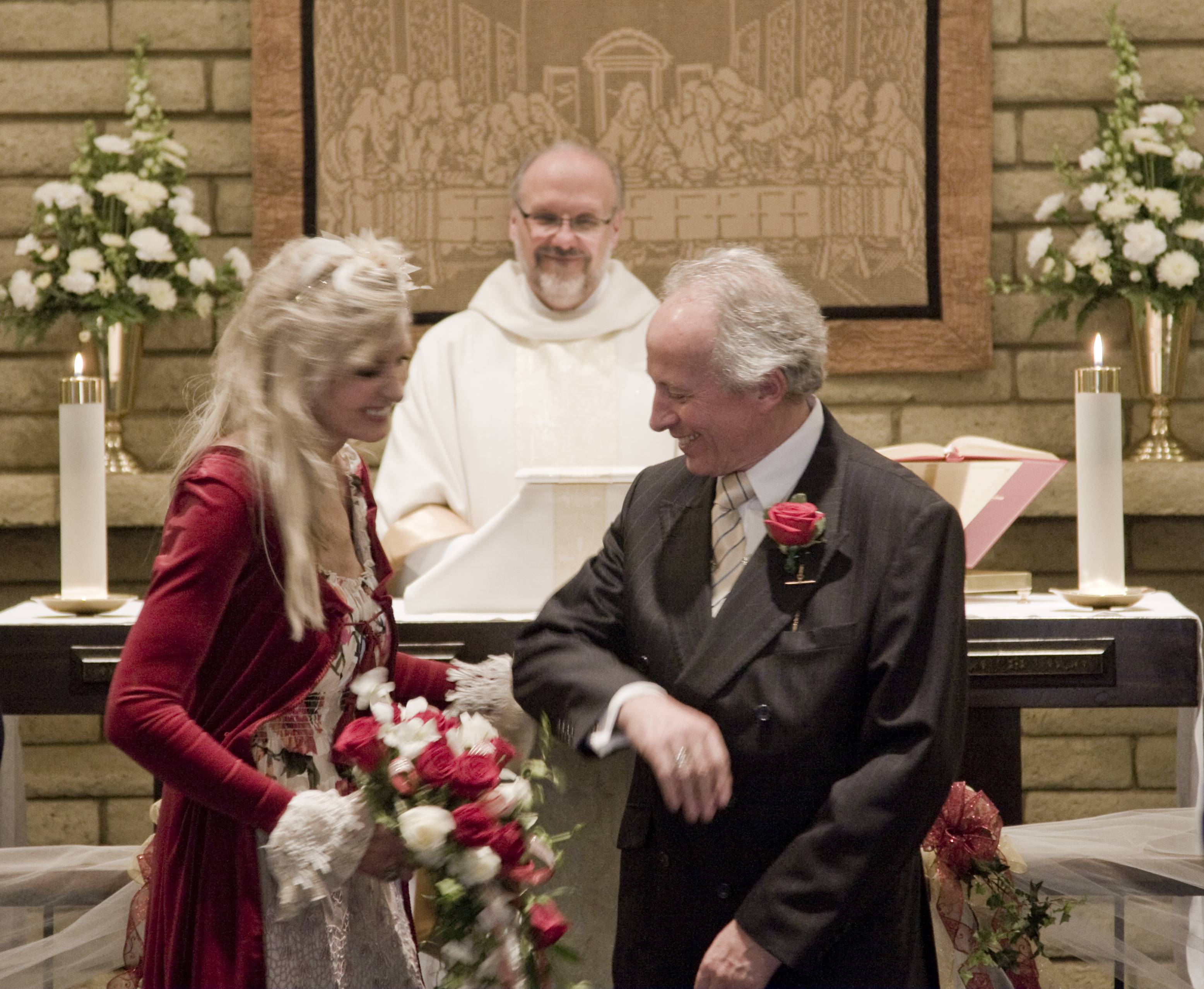
For Jean and I were married in St Paul’s Episcopal Church, Payson, Arizona on the 20th November in front of the Reverend Dan Tantimonaco.

Mr and Mrs Handover

That marriage gives me the right to apply to the US Government for Resident status and so, today, Thanksgiving Day 2010, Jean and I will also have our first celebratory feast in gratitude to starting our married lives as new Americans.

By Paul Handover

Whoops, just on the phone!

The unacceptable side of mobile (cell) phones.

Recently, I saw something come in to my in-box that just held my attention for sufficiently long to get me to move from scan reading to actually thinking about what I was reading and how it made me feel.

The US government may require cars to include scrambling tech that would disable mobile-phone use by drivers, and perhaps passengers.

“I think it will be done,” US Secretary of Transportation Ray LaHood said on Wednesday morning, according to The Daily Caller. “I think the technology is there and I think you’re going to see the technology become adaptable in automobiles to disable these cell phones.

No, this is not some other form of Government interference in areas of our lives that are irrelevant to the real world.  This is serious stuff:

Believe it or not, I wasn’t always so outspoken about the dangers of distracted driving. Like a lot of folks, I just didn’t give a lot of thought to it.

But that all changed as I met people from coast to coast who told me about the loved ones they lost in senseless crashes caused by texting and cell phone use behind the wheel. And it was their stories–of dreams shattered and lives cut short–that turned the fight to end distracted driving into my personal crusade.

These people have had a profound effect on me. And I think their stories will have a profound effect on you.

SNIP

Just last year, nearly 5,500 people were killed and 500,000 more were injured in distracted driving-related crashes.  But, these aren’t statistics. They’re children and parents, neighbors and friends.

So this really does deserve thinking about.  As The Register article puts it:

The problem is that the average driver doesn’t think that he or she is an average driver: nearly two-thirds of drivers think of themselves as safer and more skillful than a driver of median safety or skills — a statistical impossibility, of course.

When faced with the prospect of automotive mobile phones being disabled, we’d be willing to bet that most drivers, suffused with confidence in their own skills, will think in terms of personal inconvenience and a restriction on personal freedom.

Perhaps it might be better to think of the guy texting in the lane to your left, or the gal yelling at her ex on her iPhone in the lane to your right, and think not of your own inconvenience, but of some distracted dolt killing you.

Remember one unassailable statistic, as explained by the late, great George Carlin: “Just think of how stupid the average person is, and then realize half of them are even stupider!”

LaHood may be right. Disabling mobile phones in cars should not be looked at as a way of protecting you from yourself, but instead as a way of protecting you from the stupid.

Quite so!

By Paul Handover

You all be careful out there!

International security alerts – in case you are traveling over the holidays.

(Sent in by a good friend! Warning, the following is very politically incorrect!)

The English are feeling the pinch in relation to recent terrorist threats, and have therefore raised their security level from  “Miffed” to “Peeved”.

Soon, though, security levels may be raised yet again to “Irritated” or even “A Bit Cross”.

The English have not been “A Bit Cross” since the blitz in 1940, when tea supplies nearly ran out.  Terrorists have been re-categorized from “Tiresome” to “A Bloody Nuisance”.  The last time the British issued a “Bloody Nuisance” warning level was in 1588, when threatened by the Spanish Armada.

The Scots have raised their threat level from “Pissed Off” to “Let’s get the Bastards”.  They don’t have any other levels. This is the reason they have been used on the front line of the British army for the last 300 years.

The French government announced yesterday that it has raised its terror alert level from “Run” to “Hide”.  The only two higher levels in France are “Collaborate” and “Surrender”.  The rise is precipitated by a recent fire that destroyed France’s white flag factory, effectively paralyzing the country’s military capability.

Italy has increased the alert level from “Shout Loudly and Excitedly” to “Elaborate Military Posturing”.  Two more levels remain: “Ineffective Combat Operations” and “Change Sides”.

The Germans have increased their alert state from “Disdainful Arrogance” to “Dress in Uniform and Sing Marching Songs”.  They also have two higher levels: “Invade a neighbor” and “Lose”.

Belgians, on the other hand, are all on holiday as usual; the only threat they are worried about is NATO pulling out of Brussels.

The Spanish are all excited to see their new submarines ready to deploy.  These beautifully designed subs have glass bottoms so the new Spanish navy can get a really good look at the old Spanish navy.

The Americans meanwhile, and as usual, are carrying out pre-emptive strikes on all of their allies “just in case”.

Canada doesn’t have any alert levels.

New Zealand has raised its security levels – from “baaa” to “BAAAA”.  Because of continuing defense cutbacks, New Zealand has only one more level of escalation, which is “I hope Australia  will come and rescue us”.

Australia, meanwhile, has raised its security level from “No worries” to “She’ll be all right, mate”.

Three more escalation levels remain: “Crikey!”, “I think we’ll need to cancel the barbie this weekend” and “The barbie is cancelled”.  So far no situation has ever warranted use of the final escalation level.

Happy holidays and safe travels!

Future for Societies

The glass is filled half-way.  Is it half-full or half-empty?

This is a rhetorical question, of course.  It is what comes to mind as I write this simply because of a small half-full/half-empty experience in the last 10 minutes.  Let me explain.

I had started watching a video on TED.com.  This one was entitled Jared Diamond on why societies collapse.  Within a few minutes I started drifting to the comments, and read:

Jared Diamond talks of how societies choose (unwittingly) to collapse. William McDonough with his Cradle to Cradle concept also talks about choices and provides ‘Love of all children of all species for all time’ as a positive conscious choice.

With goals or missions in place (for example profit for businesses) humans have achieved amazing things.

So what would happen if all groups, families and individuals followed a mission of ‘Love of all children of all species for all time’?

I rather liked that.  We always have choices. A positive conscious choice is always better.

So I stopped the Jared Diamond lecture and found the William McDonough one, also on TED.com, and conveniently shared on YouTube.  It’s just 20 minutes long, so settle down somewhere, perhaps with a glass filled half-way with something!

By Paul Handover

Days of Hope

Today, like every day, is a beautiful day of hope!

At 3.30pm US Mountain Time – 10.30pm UK time – the marriage service between me and Jean Susan will commence at the Episcopal Church in Payson, Arizona.  It represents a wonderful day of hope.

But hope is something much bigger than a couple getting married.  See it from this perspective. From the eyes of Shimon Schocken.

There’s that word ‘love’ again.

By Paul Handover

On a Clear Day

An inspirational film with an incredibly relevant message to us all.

I’m not going to yield to the temptation to take a personal view, real life is too complicated.

Just, if you can, watch the film.

Here’s the summary from Wikipedia.  More background to the film is on the IMDB website including this review:

I saw this movie at Sundance, and it was brilliant. Beautiful shots, wonderful acting and such a moving story! It made me cry, it made me laugh (with Billy Boyd as much of the comic relief!), it made me want to see it again! Gaby Dellal’s direction was spot on, and the emotions from each of the characters was so true, that I wanted to cheer Frank (Peter Mullan)) on while swimming the English Channel and console him when he felt like he couldn’t do anything.

The only thing that I had an “issue” with, was that at a few moments, the Scottish accent was so thick that I missed what was said.

Some scenes from the film follow:

Finally, more on Peter Mullan, a very powerful actor.

By Paul Handover

Veritas Publishing

Note: the next 10 days are pretty challenging, in the most positive and beautiful way, as Jean and I are to be married at Payson Episcopal Church on Saturday afternoon and we have guests until the 29th.  There will always be a daily post from either me or Jon but do forgive us if they are not of the usual longer reflective style.

Dr. David R. Hawkins, M.D., Ph.D.

Both Jon and I have written about Dr Hawkins many times in Learning from Dogs.  But there is also a plethora of valuable material available from the organisation, Veritas Publishing, that is the wrapper, so to speak, around David Hawkins work.

His monthly newsletter is free and often very interesting.  For example, in the one that arrived today, there are a couple of extracts from his October lecture that resonate very closely with what Jon published about Eckhart Tolle the previous two days.

“The Self knows.  The mind thinks.  The thinking is just added as a thrill.  Thinking is a thrill and an entertainment.  Can you get along without thinking?  There is a chair.  I don’t think about the chair but I know it’s there.  Most of real knowingness goes on without thinking.  The animal knows without thinking.  It just knows right off the bat who is a friend and who is a burglar.”

“Make choices instead of craving and desire and clutching.  Choose to be happy instead of craving what you don’t have.  Give up all cravingness.  ‘I cannot be happy unless I get to do this or that.’  You are putting happiness as outside of yourself.  The source of happiness is within.  Winning $1 million does not make a big change in your life.  Surrender all cravings to God.”

And do watch this:

Finally, I have repeated a publication today of a post written about Truth published earlier on Learning from Dogs in September.  It has come out at the same time as this Post.

By Paul Handover

Thinking about Truth

(A copy of the original post published earlier in September on this Blog)

Dr David Hawkins writing about truth

One of the many strange consequences of leaving the United Kingdom in 2008 leading, eventually, to settling in Arizona is that we are within a half-day’s car ride of Sedona. Sedona is where Dr. David R Hawkins is based.

Dr. David R Hawkins

Dr. David Hawkins is a life member of the American Psychiatric Association but is best known for his research into “the hidden determinants of human behavior”. That quote is taken from the front cover of Hawkins’ seminal book, Power vs. Force.

Dr. Hawkins was Knighted by the Danish Crown for this work in 1996, a worthy recognition, it seems to me.

I have been reading Power vs. Force for some weeks now. Normally I devour a book, fiction or non-fiction, if it holds my interest. But this book is different! Power vs. Force contains so many profound teachings that frequently there is more than enough to take in from a single page, or even just a couple of paragraphs. To read on before a particular proposition has had time to invade and penetrate one’s deeper senses is almost painful.

The challenge in wanting to share some of these teachings is having the patience to finish the book before putting pen to paper, so to speak. I failed!

In one of the early chapters, Hawkins writes about “the intrinsic source of power and how it operates.” There are a couple of paragraphs that just punched out from the page. Here they are, interwoven with my thoughts:

In looking for the source of power we have noted that it is associated with meaning, and this meaning has to do with the significance of life itself. Force is concrete, literal and arguable. It requires proof and support. The sources of power, however, are inarguable and are not subject to proof. The self-evident is not arguable.

Just at this point, one might have forgiven me for being slightly skeptical. How can the ‘self-evident’ or anything be above argument? Especially if one reflects on the notion that all we perceive with our senses is an illusion, a product of our minds. I clearly recall having this fleeting thought at this point in the paragraph. But the eyes continued to the next sentence and, figuratively, I was gasping for breath. Remember I had just read, “The self-evident is not arguable.” This was what came next:

That health is more important than disease, that life is more important than death, that honor is preferable to dishonor, that faith and trust are preferable to doubt and cynicism, that the constructive is preferable to the destructive – all are self-evident statements not subject to proof. Ultimately, the only thing we can say about a source of power is that it just “is”.

Wow! Those few sentences stopped me in my tracks. Think about what Hawkins is saying. He is saying that we intuitively know, without the need of intellectual argument or ‘proof’, the rightness, the beauty, the perfection of some deeply fundamental concepts.

It’s as if from the earliest moments of human awareness, gravity, sunlight, night and day, for example, were obvious despite eons of time needing to pass before science could ’explain’ these aspects of life.

In other words, there are understandings that are deeply embedded in human consciousness. Hawkins continues:

Every civilization is characterized by native principles. If the principles of a civilization are noble, it succeeds; if they are selfish, it falls. As a term, “principles” may sound abstract, but the consequences of principles are quite concrete. If we examine principles we will see that they reside in an invisible realm within consciousness itself. Although we can point out examples of honesty in the world, honesty itself as an organizing principle central to civilization is nowhere independently existent in the external world. True power, then, emanates from consciousness itself; what we see is a visible manifestation of the invisible.

Phew! True power emanates from consciousness itself!

It’s now 2 days since I read that. It still reverberates within my mind. I was compelled to share it with you. And it reverberates for me in an even clearer form – truth emanates from consciousness itself! Stay with me just a while longer.

A very well-known magical attribute of the human brain is what goes on in the sub-conscious, our ‘back-office’. Give our brain some space to process a dilemma such as deciding what to do for the best and it does come up with what is best for us. Often the best space we can provide for our brain is a good night’s sleep. It’s common folklore to ‘sleep’ on a problem.

My co-founder of Learning from Dogs, Jon Lavin, says that often in sleep we find the truth. I think the same could be said for prayer, as in a spiritual sense more than in a religious sense.

Just reflect again on the power of what comes out from those two paragraphs. Truth is not something external to us; it is within us, all the time. Our level of consciousness is the key to this truth. Our self-awareness is the tool by which we understand our level of consciousness – our mirror to our soul.

This is truly life-changing!

By Paul Handover

Everything revolves around love.

This is not corny, this is at the heart of everything in life.

Nearly a month ago, I wrote a piece called The Power of Love.  It was offered as a logical argument in favour of love – read it if you want to see what was written.

In line with the general Blog theme on here that we have much to learn from dogs and unconditional love is the BIG lesson we should take from these noble animals, here’s a lovely story that was sent to me by a dear friend.

WHOEVER DID THIS IS A VERY BEAUTIFUL PERSON

The ‘whoever’ being someone at a dead letter office within the US Postal System.

Here’s how it goes.

Our 14 year old dog, Abbey, died last month. The day after she died, my 4 year old daughter Meredith was crying and talking about how much she missed Abbey.. She asked if we could write a letter to God so that when Abbey got to heaven, God would recognize her. I told her that I thought we could so she dictated these words:

Abbey and Meredith

Dear God,
Will you please take care of my dog? She died yesterday and is with you in heaven. I miss her very much. I am happy that you let me have her as my dog even though she got sick.
I hope you will play with her.. She likes to play with balls and to swim. I am sending a picture of her so when you see her You will know that she is my dog. I really miss her.
Love, Meredith

We put the letter in an envelope with a picture of Abbey and Meredith and addressed it to God/Heaven. We put our return address on it.. Then Meredith pasted several stamps on the front of the envelope because she said it would take lots of stamps to get the letter all the way to heaven. That afternoon she dropped it into the letter box at the post office. A few days later, she asked if God had gotten the letter yet. I told her that I thought He had.

Yesterday, there was a package wrapped in gold paper on our front porch addressed, ‘To Meredith’ in an unfamiliar hand.. Meredith opened it. Inside was a book by Mr. Rogers called, ‘When a Pet Dies..’ Taped to the inside front cover was the letter we had written to God in its opened envelope. On the opposite page was the picture of Abbey &Meredith and this note:

Dear Meredith,
Abbey arrived safely in heaven.
Having the picture was a big help. I recognized Abbey right away.
Abbey isn’t sick anymore. Her spirit is here with me just like it stays in your heart. Abbey loved being your dog. Since we don’t need our bodies in heaven, I don’t have any pockets to keep your picture in, so I am sending it back to you in this little book for you to keep and have something to remember Abbey by..

Thank you for the beautiful letter and thank your mother for helping you write it and sending it to me. What a wonderful mother you have. I picked her especially for you.
I send my blessings every day and remember that I love you very much.
By the way, I’m easy to find, I am wherever there is love.

Love,
God

[The book is available on Amazon here. I have no financial interest in providing you with the link. Ed.]

Thanks Julie for sending that in – it’s a very moving example of unconditional love and generosity.

By Paul Handover