Please forgive me but this week-end I am taking things easy. Jean and I want to savour the beautiful weather here in Payson and just enjoy the special life up here at 5,000 feet in Arizona.
Here’s something to reflect upon; another one tomorrow. Normal service returns on Monday 😉
“A Native American Elder once described his own inner struggles in this manner: Inside of me there are two dogs. One of the dogs is mean and evil. The other dog is good. The mean dog fights the good dog all the time. When asked which dog wins, he reflected for a moment and replied, ‘the one I feed the most.'” – — George Bernard Shaw
On April 12th, I introduced to you, dear reader, the philosopher, Alain de Botton. I promised that I would soon give you more.
On Top Documentary Films, there are links to all six parts of a series on philosophy presented by this popular British philosopher featuring six thinkers who have influenced history, and their ideas about the pursuit of the happy life.
The first part is about Socrates; Socrates and self-confidence. But before linking to that specific programme, a little about this enigmatic man, Socrates, who lived about 2,500 years ago (469–399 B.C.E). Here’s an extract from the Stanford Encyclopaedia of Philosophy.
The philosopher Socrates remains, as he was in his lifetime (469–399 B.C.E.),an enigma, an inscrutable individual who, despite having written nothing, is considered one of the handful of philosophers who forever changed how philosophy itself was to be conceived. All our information about him is second-hand and most of it vigorously disputed, but his trial and death at the hands of the Athenian democracy is nevertheless the founding myth of the academic discipline of philosophy, and his influence has been felt far beyond philosophy itself, and in every age. Because his life is widely considered paradigmatic for the philosophic life and, more generally, for how anyone ought to live, Socrates has been encumbered with the admiration and emulation normally reserved for founders of religious sects—Jesus or Buddha—strange for someone who tried so hard to make others do their own thinking, and for someone convicted and executed on the charge of irreverence toward the gods. Certainly he was impressive, so impressive that many others were moved to write about him, all of whom found him strange by the conventions of fifth-century Athens: in his appearance, personality, and behavior, as well as in his views and methods.
Full entry may be read here, and very interesting it is, by the way.
Anyway, back to the programme from Alain de Botton. The part on Socrates is introduced thus,
Why do so many people go along with the crowd and fail to stand up for what they truly believe? Partly because they are too easily swayed by other people’s opinions and partly because they don’t know when to have confidence in their own.
You can either watch the video by clicking here, or view it as three sections from YouTube, as follows.
Things do not change; we change.Henry David Thoreau
To a great extent, my thoughts in this article will make less sense if one hasn’t watched the Rupert Sheldrake video included in the Post on the 10th January, 2011. It’s 1 hour 20 minutes long but every minute will captivate you, trust me.
But if, for whatever reason, you don’t watch that video then the following YouTube videos are offered where Sheldrake speaks of the evidence supporting telepathy between cats and dogs and humans. The demonstration of a dog knowing when their owner is coming home is enthralling.
The science behind this link between, for example, the dog and its owner, is what Dr. Sheldrake calls an example of Morphic Fields.
I must confess that if someone had said to me, say 10 or even 5 years ago, that some form of energy field links the brains of dogs and their owners, or of cats and their owners, I would have been at least confused, at best very skeptical. Then comes the evidence, statistically valid, that being rung on the ‘phone by someone close to you can be anticipated frequently before the phone is picked up creates even more uncertainty.
Settle down and listen to these videos (they are sound recordings only but nonetheless fascinating),
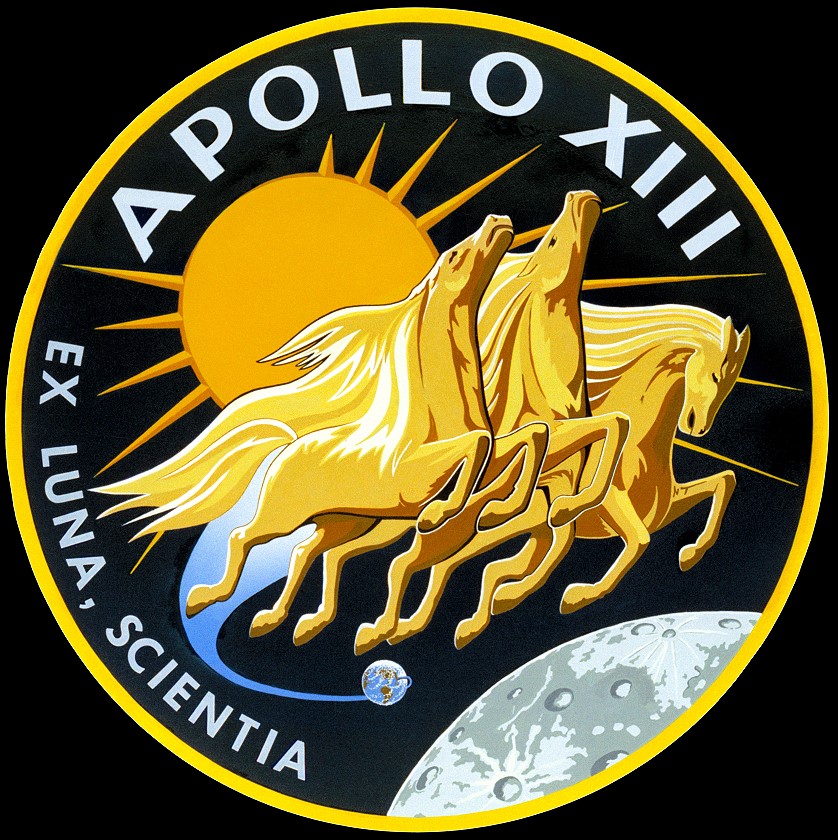
55:55:20 – Swigert: “Okay, Houston, we’ve had a problem here.”
Apollo 13
Probably one of the most famous phrases from the whole Apollo program, these immortal words were uttered shortly before 10.10 PM EST on April 13th, 1970.
There is so much material around that it would be pointless covering too much ground in this Post. So why the Post today?
Because today, too, is the 13th April. So on this day, 41 years ago, the world came together held its collective breath and prayed for a successful outcome to this scary disaster.
There are some wonderful archives around from NASA. Here’s one that covers the chronology of events of that famous accident.
The following includes events from 2.5 minutes before the accident to about 5 minutes after. Times given are in Ground Elapsed Time (G.E.T.), that is, the time elapsed since liftoff of Apollo 13 on April 11, 1970, at 2:13 PM Eastern Standard Time (EST). 55:52:00 G.E.T. is equal to 10:05 PM EST on April 13, 1970.
Also, those who want more information, may wish to go here, here and here
And 41 years ago, this coming Sunday, i.e. April 17th 1970, with the whole world praying for their safe return, Apollo 13 splashed down near Samoa.
Four hours before landing, the crew shed the service module; Mission Control had insisted on retaining it until then because everyone feared what the cold of space might do to the unsheltered CM heat shield. Photos of the Service Module showed one whole panel missing, and wreckage hanging out, it was a sorry mess as it drifted away. Three hours later the crew left the Lunar Module Aquarius and then splashed down gently in the Pacific Ocean near Samoa. From here.
In a very real sense, Apollo 13, like a number of the other historic Apollo flights, is a wonderful reminder of something that this Planet needs right now. A coming together of all the peoples of this beautiful planet, a unity of mankind, to remind us in these fragile and difficult times of the saying, ‘United we stand, divided we fall.’
Finally, this Post is published, not only on the 41st anniversary of that memorable Apollo Flight but the day after the 50th anniversary of Yuri Gagarin’s first flight of a human into space, the 12th April, 1961.
I had not heard of Alain de Botton before coming across a series of his TV programmes via Top Documentary Films. But, clearly, that has been my loss because he appears to have quite a following. So over the next 10 days or so, I’m going to include some of his material in upcoming articles in the hope that you enjoy them as much as we have.
But first, an introduction to Alain de Botton from a TED Talks video from July 2009. Enjoy.
Can we really make sense of the science of climate change?
Those that come to this Blog on a regular basis, and many thanks to you, by the way, will know that, overall, I take the stance that climate change, global warming, etc., etc. is real. At the very least to me it is reasonably described by the saying that most pilots are familiar with, “If there’s any doubt, there’s no doubt.” In other words, if something is worrying you don’t hesitate to get your ‘arse’ on the ground.
The planet’s climate systems are incredibly complex and like processes and systems much less complex than the earth’s atmosphere getting to real hard evidence is challenging. Please accept that my personal position is unchanged; for me there are sufficient signs to suggest that climatic changes may be more likely, than less likely, to substantially harm humankind’s existence on Planet Earth within the next generation.
However, Dan Gomez, my very good Californian friend of 40-plus years, is much more sceptical. I respect his intellect greatly and, therefore, respect his opinions. Dan recently sent me a number of documents that raise valid questions. Over time I want to share these with you and invite anyone who wishes to comment on Learning for Dogs to do so, or even better submit a guest post.
But before going to the first of Dan’s documents, let me share something that was reported by BBC News recently. It’s this.
New York is a major loser and Reykjavik a winner from new forecasts of sea level rise in different regions.
The Intergovernmental Panel on Climate Change (IPCC) said in 2007 that sea levels would rise at least 28cm (1ft) by the year 2100.
But this is a global average; and now a Dutch team has made what appears to be the first attempt to model all the factors leading to regional variations.
Other researchers say the IPCC’s figure is likely to be a huge under-estimate.
Whatever the global figure turns out to be, there will be regional differences.
That IPCC report may be accessed here and the main website of the IPCC is here. But even the BBC’s report shows that scientists are still learning more, as time goes on.
Ocean currents and differences in the temperature and salinity of seawater are among the factors that mean sea level currently varies by up a metre across the oceans – this does not include short-term changes due to tides or winds.
So if currents change with global warming, which is expected – and if regions such as the Arctic Ocean become less saline as ice sheets discharge their contents into the sea – the regional patterns of peaks and troughs will also change.
“Everybody will still have the impact, and in many places they will get the average rise,” said Roderik van der Wal from the University of Utrecht, one of the team presenting their regional projections at the European Geosciences Union (EGU) meeting in Vienna.
“But places like New York are going to have a larger contribution than the average – 20% more in this case – and Reykjavik will be better off.”
The news item also contains some fascinating evidence of the influence of gravity from the mass of the polar ice caps. Read the full article here.
Gondola's for hire in a few year's time?
Now on to one of Dan’s documents. It is from the website detailing the history of plant fossils of West Virginia. The document refers to the climate of the carboniferous period. Here’s how it starts.
West Virginia today is mostly an erosional plateau carved up into steep ridges and narrow valleys, but 300 million years ago, during the Carboniferous Period, it was part of a vast equatorial coastal swamp extending many hundreds of miles and barely rising above sea level. This steamy, tropical quagmire served as the nursery for Earth’s first primitive forests, comprised of giant lycopods, ferns, and seed ferns.
North America was located along Earth’s equator then, courtesy of the forces of continental drift. The hot and humid climate of the Middle Carboniferous Period was accompanied by an explosion of terrestrial plant life. However by the Late Carboniferous Period Earth’s climate had become increasingly cooler and drier. By the beginning of the Permian Period average global temperatures declined by about 10° C.
Interestingly, the last half of the Carboniferous Period witnessed periods of significant ice cap formation over polar landmasses– particularly in the southern hemisphere. Alternating cool and warm periods during the ensuing Carboniferous Ice Age coincided with cycles of glacier expansion and retreat. Coastlines fluctuated, caused by a combination of both local basin subsidence and worldwide sea level changes. In West Virginia a complex system of meandering river deltas supported vast coal swamps that left repeating stratigraphic levels of peat bogs that later became coal, separated by layers of fluvial rocks like sandstone and shale when the deltas were building, and marine rocks like black shales and limestones when rising seas drowned coastlands. Accumulations of several thousand feet of these sediments over millions of years caused heat and pressure which transformed the soft sediments into rock and the peat layers into the 100 or so coal seams which today comprise the Great Bituminous Coalfields of the Eastern U.S. and Western Europe.
One needs to read the full article to properly understand this period of history of the planet. But it includes revealing diagrams like this one.
Global Temperature and Atmospheric CO2 over Geologic Time
Here’s how it concludes.
What will our climate be like in the future? That is the question scientists are asking and seeking answers to currently. The causes of “global warming” and climate change are today being popularly described in terms of human activities. However, climate change is something that happens constantly on its own. If humans are in fact altering Earth’s climate with our cars, electrical powerplants, and factories these changes must be larger than the natural climate variability in order to be measurable. So far the signal of a discernible human contribution to global climate change has not emerged from this natural variability or background noise.
Understanding Earth’s geologic and climate past is important for understanding why our present Earth is the way it is, and what Earth may look like in the future. The geologic information locked up in the rocks and coal seams of the Carboniferous Period are like a history book waiting to be opened. What we know so far, is merely an introduction. It falls on the next generation of geologists, climatologists, biologists, and curious others to continue the exploration and discovery of Earth’s dynamic history– a fascinating and surprising tale, written in stone.
Sad to read the loss of a giant of the UK’s hauliers.
I have no personal knowledge or experience of Eddie Stobart’s haulage firm. But as someone who for many years operated as a salesman in the UK, with the associated high annual car mileages, seeing Eddie Stobart trucks on the road was a familiar experience.
This week’s copy of The Economist carried an obituary telling of the death, at the young age of 56, of Edward Stobart.
A Stobart truck, always spotlessly clean.
The UK Independent newspaper carried a report of Eddie’s death on the 31st March, as well as the BBC. Here’s a flavour of the Independent’s report.
Edward Stobart, the trucking legend who brought the phenomenon of “Stobart spotting” to Britain’s motorways, has died from heart problems at the age of 56.
Mr Stobart turned his father Eddie’s agricultural seeds business into a multimillion-pound haulage empire and quirk of British culture.
“Edward built Eddie Stobart into the iconic brand and business we know today,” his brother William Stobart, who now runs the business, told staff yesterday with “great sadness and regret”.
Edward Stobart took over the business in the late 1960s and within a decade spotting the green-and-red livery of Eddie Stobart lorries had become a favourite way to while away long journeys.
As a sign of the company’s cult appeal, Twitter was flooded with condolences and messages of appreciation within minutes of the announcement of Mr Stobart’s death in hospital in Coventry
The son of one of our neighbours called us round last Thursday to show us the skeletal remains he recently found in their front garden together with a most beautiful pot. Here are a few pictures.
Discovery siteMogollon culture pot?Ancient and modern!
On the website Desert USA there is a section dealing with the culture of the Prehistoric Desert Peoples including the peoples of The Mogollon. Here’s an extract.
In addition to wild edible and utilitarian plants, the mountain flanks and desert basins harbored a thriving community of game, including bighorn sheep, elk, mule deer, white-tail deer, antelope, beaver, badger, blacktail jackrabbits, desert cottontails, turkeys and various other species. Rock exposures served as quarries for the raw materials for making projectile points and tools. Clay exposures provided the raw material for making ceramic vessels and figurines.
Even as the Mogollon people gradually adopted village life and farming, they would continue to count on the ranges and basins to supplement their larder and provide essential material resources. They would never be able to rely on corn, beans, squash and other crops to the exclusion of wild plant foods because the Mogollon region held relatively few areas suitable for agriculture. Most of them occurred along lower mountain river valleys, along the few desert river basins and near a few desert playas. Even those areas which were suitable experienced erratic rainfall year in and year out.
The article includes the following photograph which shows how close the resemblance of the pot found next door to the one in the article.
All very fascinating. Indeed, when one reflects that European descendants have only been in the area for about 500 years and Payson considers it’s founding year as recent as 1882 it really isn’t that long ago, in historical terms, that the land around here will have borne the footprints of peoples very different to us today.
Maybe on still, dark nights, their memories are very close to us.
Europe’s fishing quotas turning a seemingly good idea into apparent madness.
The European Union formally came into being in 1993 although co-operation in the form of the European Coal and Steel Community and then the European Economic Community went well back before then, back to the 1950’s.
As far back as 1957 when the Treaty of Rome was established, an Article stated that there should be a common policy for fisheries. That became known as the Common Fisheries Policy. Fish catches in many European waters were reducing stocks of many species to the point of extinction, so something had to be done.
Now watch this.
If you feel sufficiently perplexed to want to learn more, then Hugh Fearnley-Whittingstall, a food and cookery writer and broadcaster, as well as a campaigner for real food, has a Campaign Website here. There is a Facebook page here.
How on earth would one explain such actions to, say, these two kids?
This documentary may, probably WILL, enlighten you.
On the 30th March I wrote about the film Inside Job. Then a few days ago James Kwak of Baseline Scenario, a blog that I have been reading for some time now, also wrote a piece about the film, opening his Post thus,
I finally saw Inside Job at a friend’s house tonight. I don’t have anything original to say about it. I thought it was a very, very good movie. There were lots of little things that weren’t quite right (many of which were probably conscious decisions to simplify details for the sake of comprehension), but I don’t think any of them were substantively misleading.
As always with Baseline Scenario, the comments are as interesting and educational as the article, and that was just as valid in this case. One of the comments was from Carla who wrote,
I think Inside Job is no longer available to view for free now that the DVD is for sale at Amazon (well worth the purchase, BTW).
Anyway, we watched the film on Tuesday evening and, boy oh boy, was it an eye-opener.
I promise you, the full film is so well worth watching. (And do read to the end of this Post!)
The film also makes reference to the website The Money Fix which has a great number of resources for those that wish to explore further this fascinating subject. Thanks Carla.







 Learning from Dogs