A fascinating and beautiful insight into wild turkeys!
Yesterday, I published a couple of stories that demonstrated that close, loving bonds can form between different species, including an orang-utan and a dog, and a duck and a man.
By chance, Jean and I came across another example of cross-species bonding. This time between Joe Hutto, an American living in Florida, and a brood (is that the right description?) of newly-born wild turkeys. The first thing these tiny birds saw when they opened their eyes after breaking clear of their egg was Joe, and they immediately imprinted him as their ‘mother’.
Joe spent a complete year and more being ‘mother’ to these birds right up to the point where they naturally flew the nest, so to speak. Joe’s experiences led to a book, Illumination in the Flatwoods, and from that to a BBC Natural World special My Life as a Turkey, regrettably not available to viewers outside the UK.
But speaking to someone who did watch the BBC film, it was clear that it was a most beautiful and touching account of how young wild turkeys can bond to a human. Here’s part of the programme review in the British Guardian newspaper,
Joe Hutto’s life changed when a local farmer in the Florida flatlands where he lives left a stainless steel dog bowl full of wild turkey eggs on the porch of his cabin. Joe put them in an incubator, and waited. Some weeks later, cracks began to appear. This is the crucial time: “imprinting” only occurs in the first few moments after hatching. So Joe put his face down to the level of the opening eggs and the first poult emerged, wet and confused. Joe made a chirping, clucky noise, the poult looked him square in the eye, “and something very unambiguous happened in that moment”.
The little turkey stumbled and crawled across to Joe, and huddled up against his face. It recognised Joe as its mother. In the next few hours, Joe became mother to 15 more baby turkeys and remained so for the next 18 months. My Life as a Turkey: Natural World Special (BBC2) tells that story.
Across to the programme details from the BBC2 website (may not be available 26 days after the date of this article),
Biologist Joe Hutto was mother to the strangest family in the world, thirteen endangered wild turkeys that he raised from egg to the day they left home.
For a whole year his turkey children were his only companions as he walked them deep through the Florida Everglades. Suffering all the heartache and joy of any other parent as he tried to bring up his new family, he even learnt to speak their language and began to see the world through turkey eyes. Told as a drama documentary with an actor recreating the remarkable scenes of Joe’s life as a turkey mum.
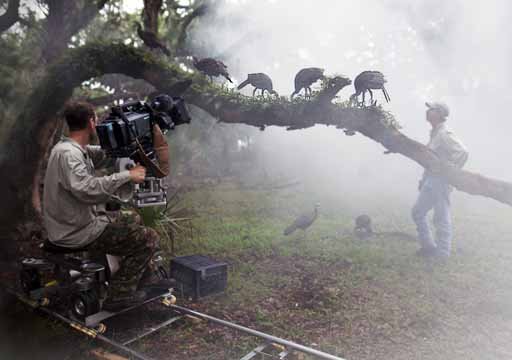
Behind the scenes image of turkeys and Jeff Palmer (actor) in misty forest in Florida. Cameraman (Mark Smith) on track & dolly shows how some of the beautiful sweeping shots were filmed.
Sam Wollaston of the Guardian continues,
It’s not hard to see how the little birds were taken in. Joe’s moustache does look a bit like feathers, he has a long scraggy neck, an understanding of the forest, and a tentative, birdlike walk. He takes them out, to catch their first grasshoppers; he teaches them how to roost. For Joe, as for any mother, parenthood is an emotional rollercoaster ride. There is the joy of seeing his babies grow, but almost constant worry. Grief too, when one is taken by a rat snake, and another by a hawk, and two more get sick (bird flu?) and die.
Adolescence arrives with all its associated problems. The males start fighting; only the toughest will get to mate. “I had no way of knowing how I was going to be part of this rite of passage,” says Joe. Steady now, Joe, let’s not take this too far, you’re not supposed to mate with any of them. For one, they’re your children. They’re also turkeys. That would be doubly wrong. Sometimes I think Joe spends too much time alone in the forest.
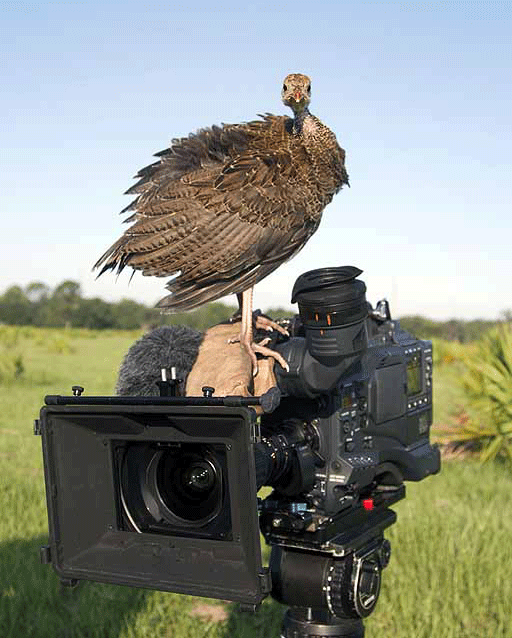
Quite so! However, the film was so beautifully shot that it was very, very easy to forget that this was a re-enactment of Joe’s original experience. That love is all about how you make someone, or in these cases, some other creature, feel. Another couple of pictures from the BBC website,
Lights, camera, action!Jeff Palmer (actor) sat on large felled tree on his cell phone with a dozen wild turkeys.
One final extract from the Sam Wollaston article in The Guardian newspaper,
My Life as a Turkey isn’t simply a wildlife film though. It’s not just about wild animals, it’s about one man’s relationship with wild animals, and that’s what makes it so fabulous. Serious animal behaviourists may not agree, but if you throw a human being in there, it all suddenly becomes a lot more interesting. I’m thinking Ring of Bright Water, Gorillas in the Mist, I’m definitely thinking Werner Herzog’s brilliant Grizzly Man about a man named Tim whose friendship with bears went wrong and he ended up inside one. My Life as a Turkey has something of Grizzly Man about it – a man obsessed, alone in a beautiful place, living with wild animals. But, although Joe was attacked, he didn’t end up inside one of his turkeys thankfully. There would have been a certain irony to that, especially if it had happened at Thanksgiving.
Anyway, it’s a lovely film – beautiful, charming, funny, sad, thought-provoking even. What thoughts did it provoke in me? That I need to go and see my mum.
Unfortunately, as mentioned above if you are outside the UK you are not able to watch the film via the BBC iPlayer system. But you can buy the book.
Joe Hutto's book of his life with wild turkeys.
Available from Amazon, here’s just one of the reviews,
My review is not unbiased because Joe Hutto, author of “Illumination in the Flatwoods,” and I have been friends for almost 25 years.
Joe is the most humble man I’ve ever known. I am honored that he brought me the original manuscript to read. It was so beautiful I could have cried.
With the same graceful writing skills used by conservationists Aldo Leopold (“Sand County Almanac”) and Herbert Stoddard (“Memoirs of a Naturalist”), Joe gives a masterful mix of documentary-style nature reporting and heartfelt thoughts on the meaning of life. As dramatic as that sounds, I think most readers will agree that “Illumination in the Flatwoods” is a life-changing book.
You will never regret the dollars you spend to buy this book nor the time it takes you to read it. . .
A chance email from Dan G. opens up a whole treasure trove.
Here’s what Dan sent to me,
True Friends
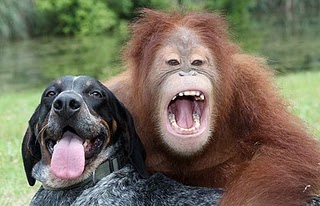
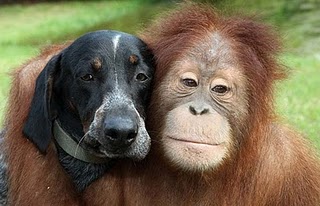
After losing his parents, this 3 year old orangutan was so depressed he wouldn’t eat and didn’t respond to any medical treatments. The veterinarians thought he would surely die from sadness. The zoo keepers found an old sick dog on the grounds in the park at the zoo where the orangutan lived and took the dog to the animal treatment center. The dog arrived at the same time the orangutan was there being treated. The 2 lost souls met and have been inseparable ever since.
The orangutan found a new reason to live and each always tries his best to be a good companion to his new found friend. They are together 24 hours a day in all their activities.
Roscoe and Surya
They live in Northern California where swimming is their favorite past time, although Roscoe (the orangutan) is a little afraid of the water and needs his friend’s help to swim.
Roscoe and SuryaRoscoe and Surya
Together they have discovered the joy and laughter in life and the value of friendship.
Roscoe and SuryaRoscoe and Surya
They have found more than a friendly shoulder to lean on.
Roscoe and SuryaLove across the species boundary
Long Live Friendship!!!!!!!
I don’t know……some say life is too short, others say it is too long, but I know that nothing that we do makes sense if we don’t touch the hearts of others…….while it lasts!
So after I had seen the pictures above, it was pretty easy to find this YouTube video.
Then if that wasn’t amazing and wonderful, try this,
Well that’s enough for today. But tomorrow, I will continue with Part Two which recounts the amazing year that Joe Hutto spent in the Florida wildlands with ….. (you’ll have to wait for tomorrow!)
One thousand, nine hundred and thirty-two years ago, today, there was a loud bang in Italy!
On the 24th August, in the year 79 A.D. the residents of Pompeii would undoubtedly had very little time to ponder on the consequences of a volcanic eruption just five miles away.
Try to imagine huge, billowing, gray-black clouds like those at Mount St. Helens rushing toward you at a hundred miles an hour. That is probably what the ancient Romans saw just before they were entombed by hot ash.
There is much material available for those that wish to read more about the devastating effects of that volcanic eruption, so superfluous to add much more here. The Classroom of the Future link is as good a place to start as any. What I would like to comment on is this – but first a picture,
Vesuvius and nearby cities
What is worth noting that in 2009 the CIA Factbook records that the population of Naples was 2,270,000 people. Naples is very close to Vesuvius. As WikiPedia puts it,
Mount Vesuvius (Italian: Monte Vesuvio, Latin: Mons Vesuvius) is a stratovolcano on the Bay of Naples, Italy, about 9 kilometres (5.6 mi) east ofNaples and a short distance from the shore. It is the only volcano on the European mainland to have erupted within the last hundred years, although it is not currently erupting.
There is a saying in Italy that goes ‘vedi Napoli e poi muori’. Translated, this means ‘see Naples and die’. The actual meaning of this refers to being overwhelmed by what a beautiful and an incredible city Naples is. (although some may argue that what it really means that Naples is such a dangerous and chaotic city that it will kill you!)
H’mmm. Get the timing wrong and that saying could have a literal meaning way beyond the ancient author’s intent! I quote from the website Geology.com,
Starting in 1631, Vesuvius entered a period of steady volcanic activity, including lava flows and eruptions of ash and mud. Violent eruptions in the late 1700s, 1800s and early 1900s created more fissures, lava flows, and ash-and-gas explosions. These damaged or destroyed many towns around the volcano, and sometimes killed people; the eruption of 1906 had more than 100 casualties. The most recent eruption was in 1944 during World War II. It caused major problems for the newly-arrived Allied forces in Italy when ash and rocks from the eruption destroyed planes and forced evacuations at a nearby airbase.
But for all it’s power, the Vesuvius eruption of the 24th August, 79 was a squib compared to the Toba eruption some 73,000 years ago. More on that one in a few days perhaps.
Yesterday, I wrote about the fabulous success of the British otter having gone from the crumbling edge of extinction to now being found in every English county.
For something completely different, and I do mean completely, have a read of this item that appeared in the British Guardian newspaper of the 18th August.
Aliens may destroy humanity to protect other civilisations, say scientists
Rising greenhouse emissions could tip off aliens that we are a rapidly expanding threat, warns a report
It may not rank as the most compelling reason to curb greenhouse gases, but reducing our emissions might just save humanity from a pre-emptive alien attack, scientists claim.
Watching from afar, extraterrestrial beings might view changes in Earth’s atmosphere as symptomatic of a civilisation growing out of control – and take drastic action to keep us from becoming a more serious threat, the researchers explain.
This highly speculative scenario is one of several described by a Nasa-affiliated scientist and colleagues at Pennsylvania State University that, while considered unlikely, they say could play out were humans and alien life to make contact at some point in the future.
Shawn Domagal-Goldman of Nasa’s Planetary Science Division and his colleagues compiled a list of plausible outcomes that could unfold in the aftermath of a close encounter, to help humanity “prepare for actual contact”.
Beneficial encounters ranged from the mere detection of extraterrestrial intelligence (ETI), for example through the interception of alien broadcasts, to contact with cooperative organisms that help us advance our knowledge and solve global problems such as hunger, poverty and disease.
Another beneficial outcome the authors entertain sees humanity triumph over a more powerful alien aggressor, or even being saved by a second group of ETs. “In these scenarios, humanity benefits not only from the major moral victory of having defeated a daunting rival, but also from the opportunity to reverse-engineer ETI technology,” the authors write.
Other kinds of close encounter may be less rewarding and leave much of human society feeling indifferent towards alien life. The extraterrestrials may be too different from us to communicate with usefully. They might invite humanity to join the “Galactic Club” only for the entry requirements to be too bureaucratic and tedious for humans to bother with. They could even become a nuisance, like the stranded, prawn-like creatures that are kept in a refugee camp in the 2009 South African movie, District 9, the report explains.
The most unappealing outcomes would arise if extraterrestrials caused harm to humanity, even if by accident. While aliens may arrive to eat, enslave or attack us, the report adds that people might also suffer from being physically crushed or by contracting diseases carried by the visitors. In especially unfortunate incidents, humanity could be wiped out when a more advanced civilisation accidentally unleashes an unfriendly artificial intelligence, or performs a catastrophic physics experiment that renders a portion of the galaxy uninhabitable.
To bolster humanity’s chances of survival, the researchers call for caution in sending signals into space, and in particular warn against broadcasting information about our biological make-up, which could be used to manufacture weapons that target humans. Instead, any contact with ETs should be limited to mathematical discourse “until we have a better idea of the type of ETI we are dealing with.”
The authors warn that extraterrestrials may be wary of civilisations that expand very rapidly, as these may be prone to destroy other life as they grow, just as humans have pushed species to extinction on Earth. In the most extreme scenario, aliens might choose to destroy humanity to protect other civilisations.
“A preemptive strike would be particularly likely in the early phases of our expansion because a civilisation may become increasingly difficult to destroy as it continues to expand. Humanity may just now be entering the period in which its rapid civilisational expansion could be detected by an ETI because our expansion is changing the composition of the Earth’s atmosphere, via greenhouse gas emissions,” the report states.
“Green” aliens might object to the environmental damage humans have caused on Earth and wipe us out to save the planet. “These scenarios give us reason to limit our growth and reduce our impact on global ecosystems. It would be particularly important for us to limit our emissions of greenhouse gases, since atmospheric composition can be observed from other planets,” the authors write.
Even if we never make contact with extraterrestrials, the report argues that considering the potential scenarios may help to plot the future path of human civilisation, avoid collapse and achieve long-term survival.
I am bound to say that if Mr Domagal-Goldman and his colleagues believe that spending time and money on the possible outcomes of contact with extraterrestrials is a good idea in these present times then I am minded about those other visitors from outer space who passed Planet Earth by because there were no signs of intelligent life!
Just a few days ago, the British news media carried a wonderful story about the resurgence of the otter in every county of England. For many years, the otter was losing the battle for survival owing to hunting and trapping and the far South-West of England became it’s last refuge.
Then a combination of sensible legislation and public commitment to saving the otter became the turning point.
Watch this clip from ITN News from the 18th August.
Here’s a typical media report from The Independent newspaper of Thursday, 18th August,
Otters return to every county in England
Once the rivers were cleaned up, fish returned to once-polluted waters and otters began to spread back eastwards from their strongholds in Devon and Wales
By Michael McCarthy, Environment Editor
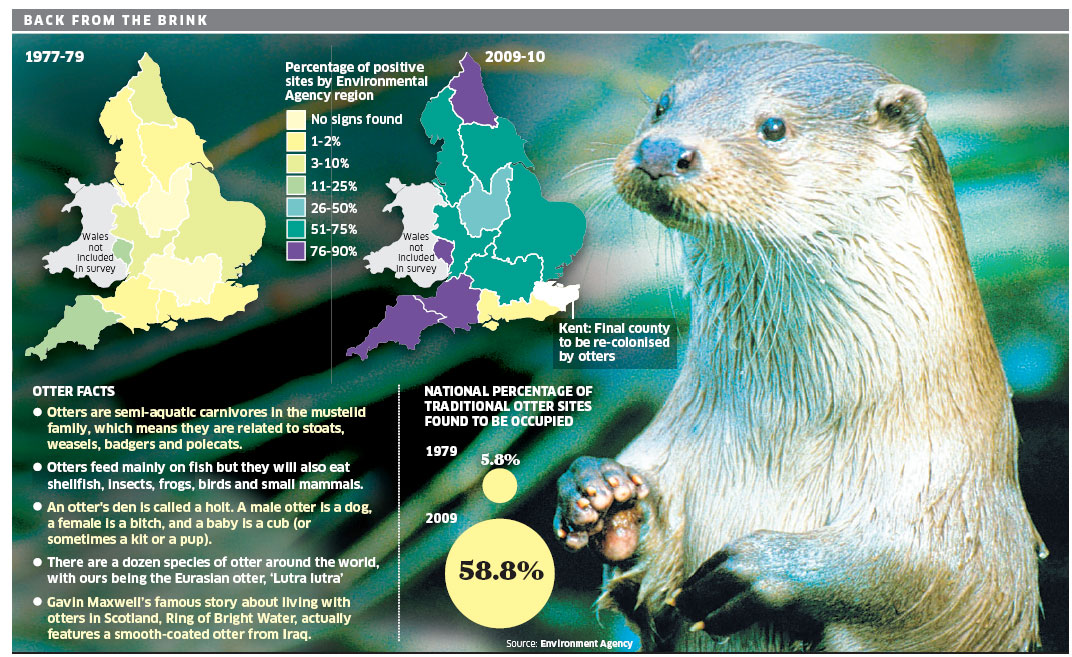
It has taken 30 years, but the otter’s comeback is now complete. After becoming extinct across most of England in the Fifties and Sixties, one of Britain’s best-loved animals has now returned to every English county, the Environment Agency announced yesterday.
The slow but steady recolonisation of its former haunts has been rounded off with the reappearance of otters in Kent, the last county to have been without them, the agency said.
The otter’s return represents a happy ending to one of the worst episodes in modern British wildlife history: the sudden disappearance of one of our most widespread and charismatic mammals.
The process began around 1956 and was almost certainly caused by the introduction of powerful organochlorine pesticides such as aldrin and dieldrin. Residues of these chemicals were washed into the rivers where otters lived, poisoning them.
As wild otters are hard to spot – their presence is usually detected by their spraints, or droppings – it was several years before the scale of their disappearance began to dawn on people, but by then they had been wiped out over vast areas of lowland England.
Despite the banning of organochlorine pesticides in the mid-Sixties, otters continued to decline, and their population reached a low point by the end of the 1970s, when they had effectively vanished from everywhere except the West Country and parts of Northern England (although good numbers remained in Wales and Scotland).
The first national otter survey, carried out between 1977 and 1979, detected the presence of otters in just over 5 per cent of the 2,940 sites surveyed; all the sites were known to have held the animals previously.
But then a comeback gradually began. Helped by a substantial clean-up of England’s rivers, which brought back fish to many once-polluted watercourses, and by legal protection, otters began to spread back eastwards into England from their strongholds in Devon and in areas of the Welsh borders, such as the Wye Valley.
By the time of the fourth otter survey, carried out between 2000 and 2002, more than 36 per cent of the sites examined showed otter traces; and when the fifth survey was carried out, between 2009 and 2010, the figure had risen to nearly 60 per cent, with otters back in every English county except Kent. Now wildlife experts at the Environment Agency have confirmed that there are at least two otters in Kent, which have built their holts on the River Medway and the River Eden.
“The recovery of otters from near-extinction shows how far we’ve come in controlling pollution and improving water quality,” said Alastair Driver, the Environment Agency’s National Conservation Manager. “Rivers in England are the healthiest for over 20 years, and otters, salmon and other wildlife are returning to many rivers for the first time since the industrial revolution.
“The fact that otters are now returning to Kent is the final piece in the jigsaw for otter recovery in England and is a symbol of great success for everybody involved in otter conservation.”
Otters are at the top of the food chain, and are therefore an important indicator of river health. The clean-up means that they are now inhabiting once-polluted rivers running through cities – something which would have been unthinkable before the population crash – and they have been detected in places such as Stoke-on-Trent, Reading, Exeter and Leeds, as well as in more likely urban centres, such as Winchester.
But although they are now widespread once more, otters’ nocturnal habits and riverine habitat make them difficult to glimpse, let alone observe, in England. The best place to see otters in Britain is Western Scotland, where the animals have become semi-marine and live along the coast. They can regularly be seen foraging along the shoreline in the daytime, especially on some of the larger islands, such as Mull and Skye.
A lovely story with a powerful message – mankind can change things for the better, and frequently has done.
More on how dogs adapt to challenges in their lives.
(As readers picked up from my closing comment in yesterday’s part of this story, technology has rather interfered with events. ‘Touch wood’ things appear to be back to normal!)
Yesterday’s article (thanks to Paul Gilding for the link) was about the stray dogs in Moscow. Before musing on the more general nature of how dogs survive as strays, there is a video on YouTube about these Muscovite dogs. Just over 7 minutes long, it further underlines the amazing adaptability of the domesticated dog when thrust into self-survival.
As regular readers of Learning from Dogs will know, before Jean and I met, Jean had spent a large part of her life rescuing dogs in the San Carlos area of Mexico, much of that with Suzann (who was instrumental in Jean and me meeting!). Indeed, when Jean and I moved up to Payson in February, 2010 we had with us, much to the amusement of the American border staff at the Nogales crossing, 12 dogs and 6 cats, all rescues except my German Shepherd dog, Pharaoh.
So Jean has lots of stories about how the far-too-many stray dogs in San Carlos developed strategies for staying alive. Dhalia, see story below, shows her feral habits when we go out for a walk in the forest by constantly looking for food, despite the fact that she is a well-fed, happy and contented dog. Jean recounts finding Dhalia,
It was in 2005, about three months after Ben died (Jean’s husband). I was driving out to the small Mexican fishing port of La Manga where there were many stray dogs. The aim was to feed them on a regular basis and hope that they would become sufficiently comfortable with my presence so that they could be caught, so that they may be spayed or neutered and then offered for adoption.
On the way there, I drove past a couple of dogs running alongside the highway. Dogs frequently did this looking for ‘road-kill’ that they could feed on. I stopped the car wanting to put out some food and water.
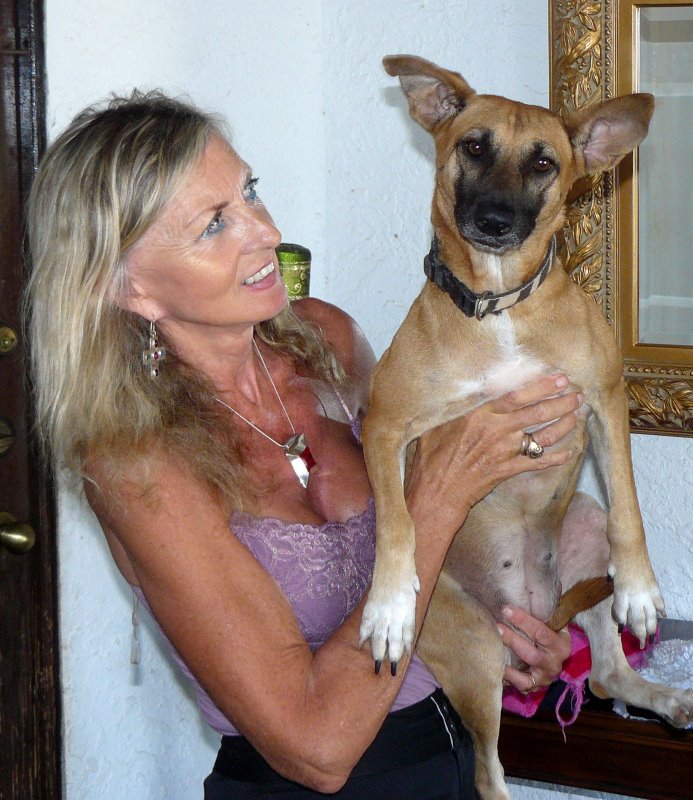
One of the dogs was so feral that it immediately took off into the bush. I turned around and the other dog was standing about ten feet away. It was cadaverous and obviously suffering from mange but cautiously came up to the food, sniffed carefully and then started to eat. That dog allowed me to pick it up and then sat quietly with me on the front seat of the car while I continued to La Manga. It sense immediately that it was safe and from that day has remained with me. I named her Dhalia.
Dhalia in Jean's arms, November 2008
Fast forward to today. Dhalia is one of Pharaoh’s group of dogs and is a sweet and loving animal.
Finally, a couple of other stories to give you a feeling about these rescue dogs. One from August 2009 about a dog called Lucky Lucy. The other about Corrie, both stories from Suzann.
Stray dogs demonstrate remarkable skills at staying alive.
Before I start, a big word of thanks to Paul Gilding who passed this story to me. Apart from reading Paul’s powerful book, The Great Disruption, and exchanging a couple of emails, he doesn’t know me from Adam. But the fact that this undoubtedly busy man (his book has been a great success) not only responded to an earlier email from me and then dropped me a note to say that I might enjoy the following article, says a great deal about the integrity of the person.
The article, from the website The Dog Files, is about Moscow’s stray dogs. I’m taking the liberty of reproducing it in full.
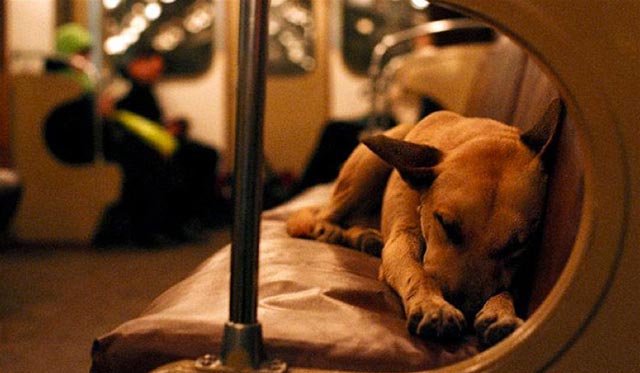
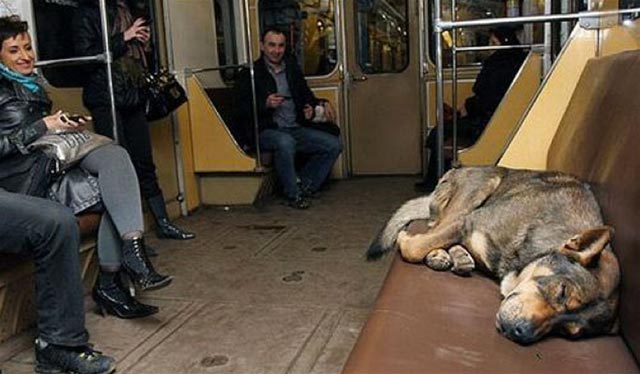
Each morning, like clockwork, they board the subway, off to begin their daily routine amidst the hustle and bustle of the city.
But these aren’t just any daily commuters. These are stray dogs who live in the outskirts of Moscow Russia and commute on the underground trains to and from the city centre in search of food scraps.
Then after a hard day scavenging and begging on the streets, they hop back on the train and return to the suburbs where they spend the night.
Experts studying the dogs, who usually choose the quietest carriages at the front and back of the train, say they even work together to make sure they get off at the right stop – after learning to judge the length of time they need to spend on the train.
Scientists believe this phenomenon began after the Soviet Union collapsed in the 1990s, and Russia’s new capitalists moved industrial complexes from the city centre to the suburbs.
Dr Andrei Poiarkov, of the Moscow Ecology and Evolution Institute, said: “These complexes were used by homeless dogs as shelters, so the dogs had to move together with their houses. Because the best scavenging for food is in the city centre, the dogs had to learn how to travel on the subway – to get to the centre in the morning, then back home in the evening, just like people.”
Dr Poiarkov told how the dogs like to play during their daily commute. He said: “They jump on the train seconds before the doors shut, risking their tails getting jammed. They do it for fun. And sometimes they fall asleep and get off at the wrong stop.”
The dogs have also amazingly learned to use traffic lights to cross the road safely, said Dr Poiarkov. And they use cunning tactics to obtain tasty morsels of shawarma, a kebab-like snack popular in Moscow.
With children the dogs “play cute” by putting their heads on youngsters’ knees and staring pleadingly into their eyes to win sympathy – and scraps.
Dr Poiarkov added: “Dogs are surprisingly good psychologists.”
Now had this been a normal day then I would have had the time to complete this story about the tenacity of dogs. But a failed wireless modem earlier today (Thursday) meant the loss of too many hours fighting technology. It was all sorted just a little before 5pm. It is now 6.15 pm and dinner is ready and, frankly, my brain is too tired to continue.
So stay with this fascinating story about stray dogs as I continue it tomorrow (Saturday, 20th.).
Being in the present is the key message that we can learn from dogs. Why is this so important?
‘Drink your tea slowly and reverently, as if it is the axis
on which the world earth revolves – slowly, evenly, without
rushing toward the future. Live the actual moment. Only this moment is life.’ ~Thich Nhat Hanh
[my blue emboldening]
Unlike Jon, I muse as an ‘amateur’ when I sense that the human psyche is attracted to fear. I use that word ‘attracted’ simply because some stimuli that touch our consciousness seem to have more force than others. Ergo, the response to the simple question of asking someone how they are, is likely to me more engaging if they come up with some form of crisis reply than by saying, “Everything’s fine, thanks!” Look at how the news media use the power of fear to capture our attention.
There is a strong biological explanation for this. From the Science daily website,
The amygdala (Latin, corpus amygdaloideum) is an almond-shape set of neurons located deep in the brain’s medial temporal lobe. Shown to play a key role in the processing of emotions, the amygdala forms part of the limbic system.
In humans and other animals, this subcortical brain structure is linked to both fear responses and pleasure. Its size is positively correlated with aggressive behaviour across species. In humans, it is the most sexually-dimorphic brain structure, and shrinks by more than 30% in males upon castration.
Conditions such as anxiety, autism, depression, post-traumatic stress disorder, and phobias are suspected of being linked to abnormal functioning of the amygdala, owing to damage, developmental problems, or neurotransmitter imbalance.
For more information about the topic Amygdala, read the full article at Wikipedia.org
I am going to get to the point of this article but stay with me a little longer. Let’s look some more at the ‘fight or flight’ aspect of our brains. From the website, How Stuff Works,
It’s dark out, and you’re home alone. The house is quiet other than the sound of the show you’re watching on TV. You see it and hear it at the same time: The front door is suddenly thrown against the door frame. Your breathing speeds up. Your heart races. Your muscles tighten.
An instant later, you know it’s the wind. No one is trying to get into your home.
For a split second, you were so afraid that you reacted as if your life were in danger, your body initiating the fight-or-flight response that is critical to any animal’s survival. But really, there was no danger at all. What happened to cause such an intense reaction? What exactly is fear? In this article, we’ll examine the psychological and physical properties of fear, find out what causes a fear response and look at some ways you can defeat it.
What is Fear?
Fear is a chain reaction in the brain that starts with a stressful stimulus and ends with the release of chemicals that cause a racing heart, fast breathing and energized muscles, among other things, also known as the fight-or-flight response. The stimulus could be a spider, a knife at your throat, an auditorium full of people waiting for you to speak or the sudden thud of your front door against the door frame.
The brain is a profoundly complex organ. More than 100 billion nerve cells comprise an intricate network of communications that is the starting point of everything we sense, think and do. Some of these communications lead to conscious thought and action, while others produce autonomic responses. The fear response is almost entirely autonomic: We don’t consciously trigger it or even know what’s going on until it has run its course.
Because cells in the brain are constantly transferring information and triggering responses, there are dozens of areas of the brain at least peripherally involved in fear. But research has discovered that certain parts of the brain play central roles in the process:
Thalamus – decides where to send incoming sensory data (from eyes, ears, mouth, skin)
Sensory cortex – interprets sensory data
Hippocampus – stores and retrieves conscious memories; processes sets of stimuli to establish context
Amygdala – decodes emotions; determines possible threat; stores fear memories
Hypothalamus – activates “fight or flight” response
Now I originally called this article Present Perfect but WordPress quickly indicated that the title had already been used. Once again, the old memory cells are failing me! In fact the post of the name Present Perfect was published on the 8th June, just a couple of months ago. Glad that I was reminded because from that article in June,
Did you see Mr. Holland’s Opus? About Glenn Holland’s lifetime of teaching music to a high school band. In one scene he is giving a private lesson to Gertrude. She is playing clarinet, making noises that can only be described as other-worldly. He is clearly frustrated. As is she. Finally Mr. Holland says, “Let me ask you a question. When you look in the mirror what do you like best about yourself?”
“My hair,” says Gertrude.
“Why?”
“Well, my father always says that it reminds him of the sunset.”
After a pause, Mr. Holland says, “Okay. Close your eyes this time. And play the sunset.”
And from her clarinet? Music. Sweet music.
Sometime today, I invite you to set aside the manual, or the list, or the prescription.
Take a Sabbath moment. . . close your eyes and play the sunset.
Mary Oliver describes such a moment this way, “. . .a seizure of happiness. Time seemed to vanish. Urgency vanished.”
Because, in such a moment, we are in, quite literally, a State of Grace. In other words, what we experience here is not as a means to anything else.
If I am to focused on evaluating, I cannot bask in the moment.
If I am measuring and weighing, I cannot marvel at little miracles.
If I am anticipating a payoff, I cannot give thanks for simple pleasures.
If I am feeling guilty about not hearing or living the music, I cannot luxuriate in the wonders of the day.
Beautiful thoughts all woven around the power of focusing on the moment (if you want to catch up on the full article it is here).
Jon’s article last Monday was all about the way forward in a positive, well-being sense. In that article Jon showed the Maslow Hierarchy of Needs pyramid. It’s reproduced again below; spend a few moments absorbing the nature and sense of each level in that hierarchy.
Now ponder on that fear – ‘fight or flight’ – response. Most likely it’s going to be initiated in the ‘Safety’ level but flick straight down one level to the ‘Physiological’ layer. All very primitive stuff and utterly out of our control! Remember from the extract above, “The fear response is almost entirely autonomic.”
Even modest amounts of these fear responses is very wearying, very unsettling. Remember Jon touched on that when he wrote,
The point I’m trying to make is that the same panic I notice in many of the companies I work in, and in me, is based on fear of the unknown and on a lack of trust in all its forms. I’ve deliberately underlined that last phrase because it is so incredibly important. The truth is that we get more of what we focus on. So we can choose to focus on the constant news of more difficulties, hardship and redundancies, or we can focus on what is working.
So because our fear response is entirely autonomic and because there is so much out there, all around us, pulling those autonomic strings we have to actively, quite deliberately, do what dogs (and many other animals) do quite naturally. We deliberately have to focus on spending time being in the present!
There was a recent piece from Leo Babauta about being in the present. While he doesn’t touch on the underlying biology of why we humans are so ‘attracted’ to fear, he does offer some excellent advice about being in the present.
No matter how out-of-control your day is, no matter how stressful your job or life becomes, the act of being present can become an oasis. It can change your life, and it’s incredibly simple.
Look at Lorraine’s website (a recent visitor to Learning from Dogs). In particular this piece, from which I quote,
3. The Serenity Prayer – all about accepting the things I cannot change and changing the things I can.
4. People are always more important than things. Things can mostly be replaced but people cannot.
5. Do it now – if there is something to be done, then what is stopping me from doing it straight away?
6. If I appreciate and look after what I have now, there will be a positive flow back to me in the future. If I am neglectful and ungrateful with what I have now, I cannot expect to be rewarded with more in the future.
7. Be quiet and keep breathing – no one will know how crazy I feel inside
8. Don’t hold on to people or things too tightly. Be open to letting go and letting be.
9. It is really important to let others know that I love them. They need to know now and often. Love isn’t just a beautiful feeling – show it by how I act and speak with those I love.
10. I can’t make anyone love me and I can’t fix anyone by loving them. I may have a script for how life should be but I have no control over other people, places or things. Go with the flow and accept what is.
(The blue emboldening is mine – highlighting the power of now.)
Grandson Morten - peace in the present
“Live the actual moment. Only this moment is life.”









 Learning from Dogs