Regular readers will have seen that Cynthia S. has contributed some lovely items to Learning from Dogs. To be honest, if it wasn’t for the support of so many readers and the contributions that regularly come to my in-box, I would have long ago stopped writing. Anyway, a couple of weeks back Cynthia forwarded an email to me that had a series of the most beautiful nature photographs. So I’m going to reserve showing these over a number of week-end days to serve as a very restful and peace-inspiring alternative to the crazy world that most of us ‘enjoy’ during the working week.
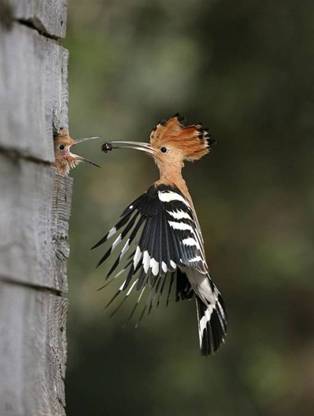
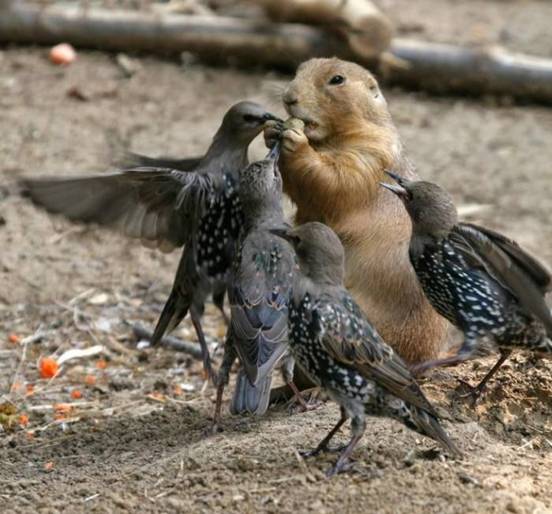
Here’s the first four pictures of those fabulous pictures,
“Be who you are and say what you feel….
Because those that matter…
don’t mind…
And those that mind… don’t
matter.”
Possibly the start of the end of traditional means of generating electricity
A recent item by David Roberts on the Grist website/Blog caught my eye,
Solar is getting cheap fast—pay attention, Very Serious People
That was the headline to the opening, thus,
I hope everyone has read Kees Van Der Leun’s post about the rapidly falling cost of solar PV. I want to draw out one quick point that Kees leaves implicit.
He argues that PV will be the cheapest source of electricity for most of the world some time around 2018, and for the rest of the world soon after. That could be off by a few years in either direction. It depends on whether the cost curve for silicon solar cells continues as it has the past and, as Alan says in his comment, whether the cost curve for “balance of system” costs (steel, glass, installation, etc.) declines as well. Let’s say it could be off by five years either way. Let’s just assume it’s 2023 before solar PV crosses grid parity and becomes cheaper than coal.
The Kees Van Der Leun post, referred to, points out that,
For a long time, the holy grail of solar photovoltaics (PV) has been “grid parity,” the point at which it would be as cheap to generate one’s own solar electricity as it is to buy electricity from the grid. And that is indeed an important market milestone, being achieved now in many places around the world. But recently it has become clear that PV is set to go beyond grid parity and become the cheapest way to generate electricity.
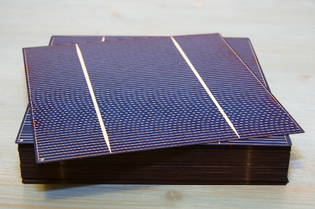
A hundred solar cells, good for 380 watts of solar PV power. Photo: Ariane van Dijk
Whenever I say this I encounter incredulity, even vehement opposition, from friends and foes of renewable energy alike. Apparently, knowledge of the rapid developments of the last few years has not been widely disseminated. But it’s happening, right under our noses! It is essential to understand this so that we can leverage it to rapidly switch to a global energy system fully based on renewable energy.
Working on solar PV energy at Ecofys since 1986, I have seen steady progression: efficiency goes up, cost goes down. But it was only on a 2004 visit to Q-Cells‘ solar cell factory in Thalheim, Germany, that it dawned on me that PV could become very cheap indeed. They gave me a stack of 100 silicon solar cells, each capable of producing 3.8 watts of power in full sunshine. I still have it in the office; it’s only an inch high!
That’s when I realized how little silicon was needed to supply the annual electricity consumption of an average European family (4,000 kWh). Under European solar radiation, it would take 1,400 cells, totaling less than 30 pounds of silicon.
Of course, you need to cover the cells with some glass and add a frame, a support structure, some cables, and an inverter. But the fact that 30 pounds of silicon, an amount that costs $700 to produce, is enough to generate a lifetime of household electricity baffled me. Over 25 years, the family would pay at least $25,000 for the same 100,000 kilowatt-hours (kWh) of electricity from fossil fuels — and its generation cost alone would total over $6,000!
He argues that PV will be the cheapest source of electricity for most of the world some time around 2018, and for the rest of the world soon after. That could be off by a few years in either direction. It depends on whether the cost curve for silicon solar cells continues as it has the past and, as Alan says in his comment, whether the cost curve for “balance of system” costs (steel, glass, installation, etc.) declines as well. Let’s say it could be off by five years either way. Let’s just assume it’s 2023 before solar PV crosses grid parity and becomes cheaper than coal.
Here’s the thing: 2023 isn’t that far off. It feels distant to us in a lot of ways. My kids will be out of college. Fifty versions of the iPhone will have come and gone. We might finally have the jetpacks we were promised.
But in terms of energy infrastructure, 12 years is nothing. It can take half that long or longer to permit and build big coal and nuclear plants, and they are meant to last a long-ass time. The Perry K Steam Plant, which serves downtown Indianapolis, was built in 1938. They didn’t have color TV then. Thirty-six coal plants in the U.S. were built before 1950. If a coal plant built today lasts that long, it will still be belching all over the atmosphere in 2072. My kids will be in their 60s.
This is also true of nuclear plants (the oldest is 42 years) and to a lesser extent natural-gas plants. It’s even true of transmission lines. These are large, long-term investments.
So if solar PV is going to be cheaper than coal in the next decade or so, that seems like the kind of thing utilities, regulators, investors, and political leaders would want to, I don’t know, talk over. Grapple with. Mull. It certainly seems relevant to the investment thesis for large, centralized power infrastructure. Yet it’s all but invisible in the elite U.S. energy conversation, outside of a few voices like FERC Chair Jon Wellinghoff. Very Serious People still see solar PV as an affectation, a kind of charity project.
Hope you are still with me, because this is really an incredibly positive message. By the time children born today are becoming teenagers, the means of harnessing the sun to deliver clean energy cheaper than carbon-based and nuclear generation will be a reality. In a little over a decade from now!
It is so easy to see doom and gloom wherever we look. For good reasons; these are very difficult times as societies pull back from the greed and materialism of recent times to a better, sustainable relationship with our planet, the only one we have. But technology and innovation are quietly creating the opportunities for a new future for humanity.
Let me finish with an email received recently from good friend, John H., up here in Payson, Arizona.
Greetings from a Mountain Top,
It has been another bright and peaceful day of Indian summer in the Ponderosa pine forests of the Arizona Rocky Mountains. Our annual state-wide church convention last weekend was a metaphorical breath of fresh air. It was an opportunity to realize where we’ve been and consider how far we have to go.
From the early evening vantage point of an upper porch with a vista of forest, mountains and sky, it appears that we’re facing spiritual, environmental, human and economic bankruptcy caused by top down idolatry, arrogance and ignorance.
It’s deeply disturbing to watch our human heritage destroyed by a corporate-government-military-industrial-intelligence complex with a clear plan to control the world through oppression. This systemic machine continues to increase the drain on the earth’s severely depleted resources.
Our present energy sources can no longer sustain exponential human population growth. The industrial use of fossil fuels is destroying the earth which sustains us. It’s time for us to wake up and read the book of life. It’s time to lighten the human footprint upon the earth while we still have a choice. Nature doesn’t care about human ambition.
Reflections on the Irish poet and author, John O’Donohue.
John O'Donohue
While many will have heard the name of this wonderfully inspirational man, John O’Donohue is not a name known to the masses. Yet his writings are, without fail, beautifully moving. Indeed, this Post was prompted by me coming across a piece from his first book, Anam Cara, meaning ‘soul friend’ in Gaelic, and, as any dog owner will attest, dogs are the animal example of a soul friend to a human.
John tragically died well before his time, in January 2008, just three days after his 56th birthday. As the John O’Donohue website reveals,
John O’Donohue vanished from among us on January 4, 2008 as physical presence, but it is impossible to write about John as someone who “was”; he so thoroughly “is”. In the context of the immense presence of his absence, the following biographical facts and dates can serve only as time-bound points of orientation for those who wish to try and locate history.
John was born in January 1956, the first of four children to Patrick and Josie O’Donohue. At the age of 18, John entered the novitiate at Maynooth where he completed his BA in English and Philosophy in 1977 and his degree in Theology, in 1980. He was ordained to the priesthood in 1982, received his MA in 1982 and, in 1986 began work on a doctorate at the University of Tubingen in Germany. John was awarded his Ph.D in Philosophical Theology in 1990. In his dissertation, Person als Vermittlung, (published in Germany in 1993), John developed a new concept of Person through a re-interpretation of the philosophy of Hegel. The prestigious Review of Metaphysics commended him for “breaking new ground in our thinking about consciousness . . . [with] a richer and deeper notion of Personhood.” In John’s words: “Hegel struck me as someone who put his eye to the earth at a most unusual angle and managed to glimpse the circle toward which all things aspire.”
There is so much more to say and write about this lovely man, but for another time. Let me close by publishing this extract from Anam Cara. But a plea! Before you plunge ahead and read these words, just slow yourself down. The thoughts behind the words below are profound, romantic and applicable to all, yes, every one of us. They offer peace and calmness – embrace them with a peaceful and calm mind.
The eye celebrates Motion
The human eye adores movement and is alert to the slightest flicker. It enjoys great moments of celebration when it beholds the ocean as the tide comes in, and tide upon tide repeats its dance against the shore. The eye also loves the way light moves; summer light behind a cloud crawling over a meadow. The eye follows the way the wind shovels leaves and sways trees. The human person is always attracted to motion. As a little baby you wanted to crawl, then to walk, and as an adult you feel the continuous desire to walk into independence and freedom.
Everything alive is in movement. This movement we call growth. The most exciting form of growth is not mere physical growth, but the inner growth of one’s soul and life. It is here that the holy longing within the heart brings one’s life to motion. The deepest wish of the heart is that this motion does not remain broken or jagged, but develops sufficient fluency to become the rhythm of one’s life.
The secret heart of time is change and growth. Each new experience which awakens in you adds to your soul and deepens your memory. The person is always a nomad, journeying from threshold to threshold, into ever different experiences. In each new experience, another dimension of the soul unfolds. It is no wonder that from ancient times the human person has been understood as a wanderer. Traditionally, these wanderers traversed foreign territories and unknown places. Yet, Stanislavsky, the Russian dramatist and thinker, wrote: “The longest and most exciting journey is the journey inwards.”
There is a beautiful complexity of growth within the human soul. In order to glimpse this, it is helpful to visualise the mind as a tower of windows. Sadly, many people remain trapped at one window, looking out every day at the same scene in the same way. Real growth is experienced when you draw back from one window, turn and walk around the inner tower of the soul and see all the different windows that await your gaze. Through these different windows, you can see new vistas of possibility, presence and creativity. Complacency, habit and blindness often prevent you from feeling your life. So much depends on the frame of vision – the window through which we look.
Think about the times we live in, challenging times for so many. Then realise that what we see (and feel) is so dependent on how we look. Let me repeat those last few lines, “Through these different windows, you can see new vistas of possibility, presence and creativity. Complacency, habit and blindness often prevent you from feeling your life. So much depends on the frame of vision – the window through which we look.”
It’s coming up to noon on the 18th, i.e. yesterday. The morning has been busy and this afternoon a number of items on the ‘to do’ list are making it difficult for me to put together a Post for today. I was minded to simply write a small piece saying this and apologising for leaving you, dear reader, in the lurch for a day.
Thought I might call the Post, ‘Events, dear boy, events’, the famous quotation from the Rt. Hon. Harold Macmillian, Prime Minister of the UK between January 1957 and October 1963. Did a quick Google search to check the quote and came across a delightful piece from The Telegraph British newspaper published in June 2002. So I’m cheating by selectively republishing the article in that paper written by Robert Harris.
As Macmillan never said: that’s enough quotations
Reading through the Guardian over breakfast the other day, I came across a column headlined “Events, ol’ buddy, events”. It was all I could do not to hurl it across the kitchen.
This was not because the column was bad, or because the Guardian’s leader pages were any more irritating than usual, but simply because I knew what was coming.
And, yes, of course, there it was, down towards the bottom of the page: “All politicians know – and often quote – the response from Harold Macmillan when asked what a prime minister most feared: ‘Events, dear boy, events’.”
Later Robert Harris writes,
It’s not as if it’s even been reliably authenticated. Some say Macmillan made it to President Kennedy, others to a journalist after dinner. Denis Healey claims it referred to foreign policy.
Alistair Horne, Macmillan’s official biographer (who tells me he can’t put his finger on it, either) thinks it may have been a response to the Profumo affair.
It didn’t appear in the Oxford Dictionary of Quotations until 1999 (where it is carefully described as “attributed”) which may explain why hardly anybody used it until three years ago. Now it’s as unavoidable as “a week is a long time in politics” or “it’s the economy, stupid”.
I’m not trying to be snooty about this. I can’t remember whether I’ve ever actually used it myself, but I’ve certainly used plenty of quotations like it – aphorisms that fall into a particular category: just above the out-and-out cliché and just below the level of something genuinely apt and unfamiliar.
Then Robert writes in a way that slightly touches a nerve of this poor writer, having lent on the use of a quotation from time to time!
Every writer and reader will no doubt have their own particular favourites that they’d be grateful never to hear again, but these are mine:
“All political lives, unless they are cut off in midstream at a happy juncture, end in failure, because that is the nature of politics and of human affairs” – Enoch Powell on Joseph Chamberlain.
“There are three bodies no sensible man directly challenges: the Roman Catholic Church, the Brigade of Guards and the National Union of Mineworkers” – Harold Macmillan (also attributed to Stanley Baldwin).
“In the long run we are all dead” – John Maynard Keynes.
“I’d rather take advice from my valet than from the Conservative Party Conference” – Arthur Balfour.
“Socialism is what a Labour Government does” – Herbert Morrison.
“Not while I’m alive ‘e ain’t” – Ernest Bevin, on being told that Morrison was “his own worst enemy”.
“How can you govern a country which has 246 varieties of cheese?” – de Gaulle.
“Is it better to be loved than feared, or the reverse? The answer is that it is desirable to be both, but because it is difficult to join them together, it is much safer for a prince to be feared than loved” – Niccolo Machiavelli.
“Treason is a question of dates” – Talleyrand.
“It is worse than a crime, it is a blunder” – Anotine Boulay de la Meurthe, on hearing of the execution of the Duc d’Enghien by Napoleon.
These are all, in their different ways, excellent quotations – epigrammatic or wise or cynical. They are certainly not as clichéd as “I don’t know what effect these men have upon the enemy, but, by God, they frighten me”, as Wellington is usually misquoted, or Lady Thatcher’s “there is no such thing as Society”.
And yet, for all that, they are clichés, made slightly worse by the fact that using them is designed to convey a thin patina of learning. They are at once familiar, yet just unfamiliar enough to have a certain snob value.
Interesting list, don’t you think!
Is Mr. Harris immune? Of course not! Here’s how the article closes,
And while we’re about it, can we also lose those other phrases and images that have no specific author, but that regularly surface in columns (including mine)?
Let no more deckchairs be rearranged on the Titanic, or Fuhrers in their bunkers order around phantom divisions, or turkeys vote for Christmas, or horses be promoted by Caligula. Let there be no more strange deaths of Liberal/Tory/ Labour England.
“You have used every cliché except ‘God is love’ and ‘Please adjust your dress before leaving’,” Churchill (famously) said. In that spirit, I curse “events, dear boy, events”. As Cromwell (equally famously) declared: “Depart, I say, and let us have done with you. In the name of God, go.”
With no more ado, (there’s another cliché!), I will sign off.
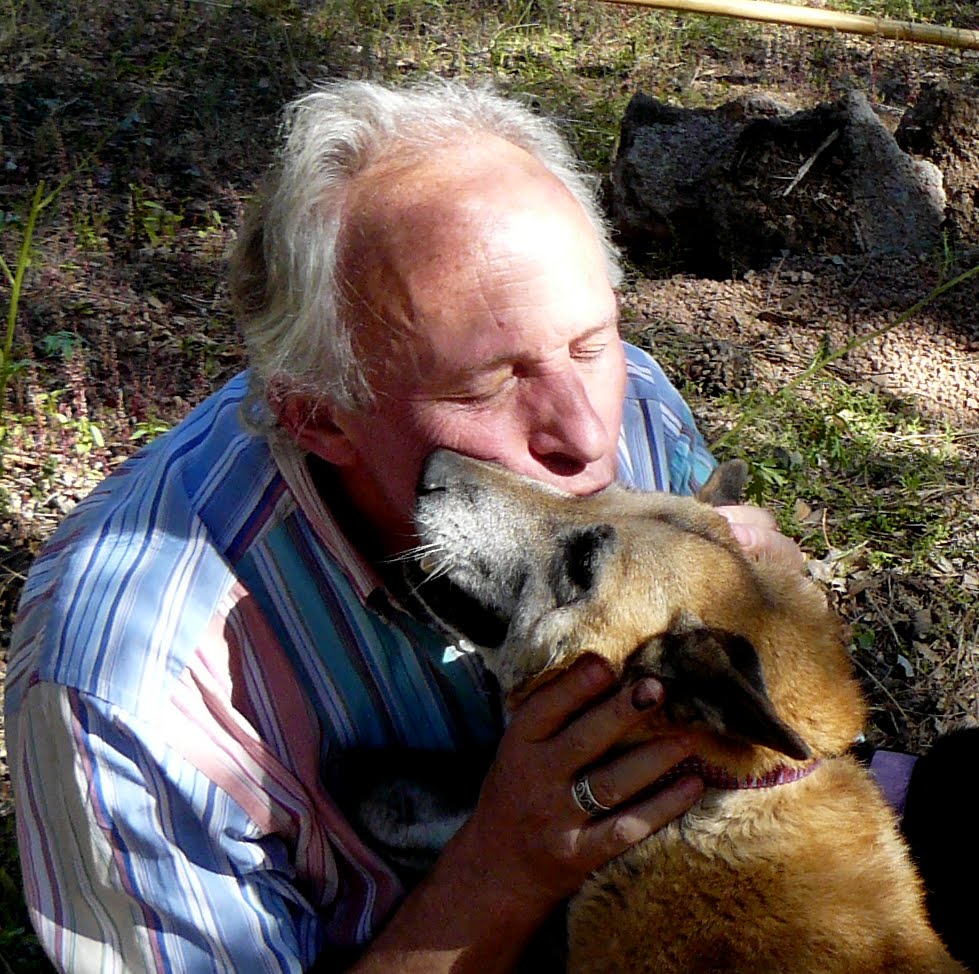
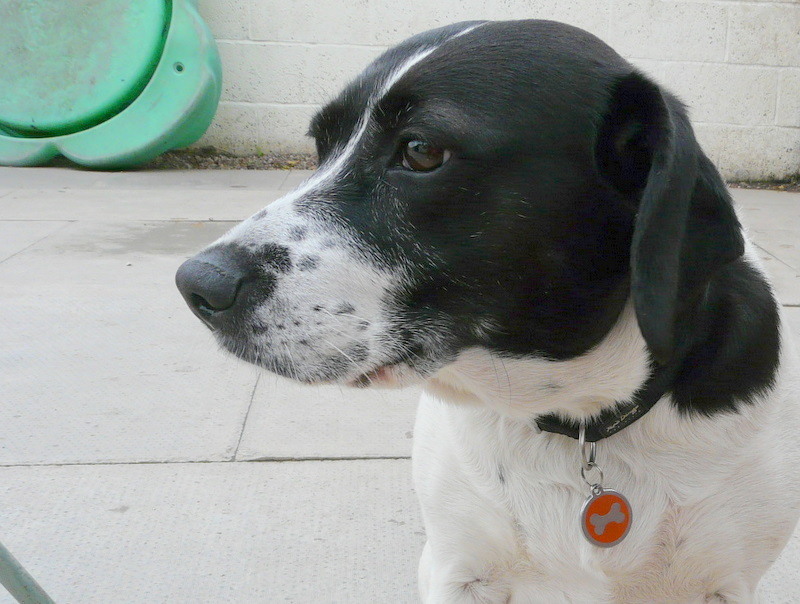
The brown dog with her head nestled against my chest is Loopy. Like Phoebe, the black dog looking at the camera, they are dogs that Jean originally had rescued in Mexico.
Here’s Loopy’s story.
Loopy and Phoebe
When I first met Jean in December 2007 in San Carlos, Mexico, it was immediately clear that she was an animal lover extraordinaire! There were 13 dogs and 6 cats in her home and many other dogs in a fenced off compound not so far away from the house.
Abandoned and stray dogs in that part of Mexico were numerous, there was no humane society and no real care or interest from the Mexicans for these dogs. So many years ago, Jean decided to run her own unofficial dog rescue society, supported by more than a few Americans who had winter homes in San Carlos. Over the years, Jeannie and her team must have rescued and found homes for well over 50 dogs.
In my introduction to the post last Tuesday, Please Help a George, I wrote about how long it had taken for Loopy to bond with me, but Jean’s experience of Loopy goes way back before I entered their lives.
I mentioned above that Jean had a piece of land in San Carlos that she used as a rescue compound for her dogs. One morning, back in 2003, as usual she had gone to the compound to attend to her dogs. Jeannie noticed immediately, cowering in one corner, this young female, brown-haired dog, the dog had been tossed over the fence of the compound. Jean estimated that she was about a year old, hadn’t yet had any pups. The dog had very cold eyes, growled aggressively as soon as Jean approached her; clearly deeply traumatised.
Jean set out food and water before the dog, hoping that whatever had traumatised the dog would soon abate. The dog was named: Loopy!
Despite the fact that Loopy wouldn’t mix with the other dogs in the compound, she was not mean. But the days turned into weeks, the weeks into months, and still Loopy would not allow Jean to get close to her. One could only imagine the degree of cruelty that must have been metered out to Loopy – or, rather, one couldn’t imagine it!
Then, one day, when Jean went to the compound, Loopy was amongst the other dogs. Loopy cautiously came up to Jean, sniffed her feet and legs and then, miraculously, allowed Jean to gently stroke her head and back. Loopy’s cold, angry eyes were now soft and brown; Loopy had melted. For obvious reasons, Loopy would never be available for adoption and soon moved into the main house.
When I became a permanent part of the Mexican household in 2008, Loopy was deeply suspicious of me. I was given the cold, hard-eyed stare from Loopy and any attempt by me to touch her was returned with growling, fanged teeth. There were a number of instances where I collected teeth rips across my hands from Loopy.
The aggression towards me lasted a long time, about a year. But then one day, quite unexpectedly, Loopy decided that I was friend, not some reminder of a demon foe from her past. She trusted me, first with strokes and cuddles and then with the most passionate and trusting embraces. I love her so much.
One could wax lyrical about love, patience and trust, but I won’t. The photograph below says it all. We really do have so much to learn from dogs!
This is such a beautiful dog, and so many ways to help her.
Milly
On the 11th October, I published a story, a story with a very happy ending, about George, a lovely dog who was rescued from the Dog Pound the day before he was due to be killed. The underlying request was to help, in any way that you could, raise funds in conjunction with the Dog Pound Ball being held in Yorkshire.
As I wrote, and as we all know full too well, there are many other dogs that require our help. This is the story of Milly, 9 years old and sadly has spent almost 3 years in rescue.
Little Milly
Milly was handed in from a local home when her owners felt they could no longer keep her. She is an affectionate dog once she learns to trusts, but does growl at strangers and doesn’t present well in kennels. As a result of these issues Milly has been at the rescue kennels for almost three years now, which is a long time for any dog to have to tolerate.
As time goes on it becomes increasingly unlikely that we will succeed in finding her a home. Barnsley Animal Rescue Centre (BARC) does not give up on its rescue animals and has been working with this lovely dog to overcome her problems. Sadly we feel we have done all we can here.
It would be heartbreaking to think she would live out the rest of her life here with us instead of being loved and surrounded by her own family. So we have decided on a way of helping Milly, but it comes at a cost.
Specialist rehabilitation has been arranged but it is going to cost BARC about £50 per week. It’s unclear how long the treatment will take and how effective it will be, but we feel Milly deserves this chance, and know that you will agree with us.
So let’s all do something to help these special creatures, the Georges and the Millys of this world, who offer us humans such unconditionally love and loyalty.
Friday 4th November, 7.30pm – Come to the Hellaby Hall Hotel, Old Hellaby, Maltby, Yorkshire, S66 8SN
Call for tickets now to the Pound Dog Ball telephone number (UK) 07772 538513 or email pogpublications@yahoo.com Full details here.
Please help by supporting this Charity Fundraising Event: Black Tie, Dinner/Dance at Hellaby Hall, Rotherham, 7.30pm, on Friday 4th November. It’s a don’t miss night…..3 course meal, live entertainment all night and dancing ’til late!!!! It’s going to be a great night.
If you can’t make the Ball but would like to send in a donation then please post a cheque, made out to Pound Dog Ball, to the following address:
c/o Jennifer Smith
Clumber Lodge,
50 Hemingfield Road
Wombwell, S73 0LY.
Or if you prefer an electronic donation, further details are:
Pound Dog Ball
A/C 31542265
Sort 40-45-29 (HSBC)
The account is a charity account, set up only for this event. Once the money has been paid to the charities the account will be closed.
When I was living back in South-West England, in the Totnes area, I had plenty of time to get to know Neil K. Neil has the most wonderful sense of humour and an ability to look at the world rather differently than the rest of us. I offer this tribute in acknowledgement of the great items that Neil passes to me for inclusion in Learning from Dogs. This one is no exception.
——————–
The Story of Adam & Eve’s Pets
Adam and Eve said, ‘Lord, when we were in the garden, you walked with us every day. Now we do not see you any more. We are lonesome here, and it is difficult for us to remember how much you love us.’
And God said, I will create a companion for you that will be with you and who will be a reflection of my love for you, so that you will love me even when you cannot see me.
Regardless of how selfish or childish or unlovable you may be, this new companion will accept you as you are and will love you as I do, in spite of yourselves.’
And God created a new animal to be a companion for Adam and Eve.
And it was a good animal and God was pleased.
And the new animal was pleased to be with Adam and Eve and he wagged his tail.
And Adam said, ‘Lord, I have already named all the animals in the Kingdom and I cannot think of a name for this new animal.’
And God said, ‘I have created this new animal to be a reflection of my love for you, his name will be a reflection of my own name, and you will call him DOG.’
And Dog lived with Adam and Eve and was a companion to them and loved them.
And they were comforted.
And God was pleased.
And Dog was content and wagged his tail.
After a while, it came to pass that an angel came to the Lord and said, ‘Lord, Adam and Eve have become filled with pride. They strut and preen like peacocks and they believe they are worthy of adoration. Dog has indeed taught them that they are loved, but perhaps too well.’
And God said, I will create for them a companion who will be with them and who will see them as they are. The companion will remind them of their limitations, so they will know that they are not always worthy of adoration.’
And God created CAT to be a companion to Adam and Eve.
And Cat would not obey them. And when Adam and Eve gazed into Cat’s eyes, they were reminded that they were not the supreme beings.
A chance dip into the BBC News website a few days ago allowed me to come across an article about the vanishing glaciers in the Himalayas. It just about broke my heart. Here’s what it said,
Rivers of ice: Vanishing glaciers
Stunning images from high in the Himalayas – showing the extent by which many glaciers have shrunk in the past 80 years or so – have gone on display at the Royal Geographical Society in central London.
Between 2007 and 2010, David Breashears retraced the steps of early photographic pioneers such as Major E O Wheeler, George Mallory and Vittorio Sella – to try to re-take their views of breathtaking glacial vistas.
The mountaineer and photographer is the founder of GlacierWorks – a non-profit organisation that uses art, science and adventure to raise public awareness about the consequences of climate change in the Himalayas.
Rivers of Ice: Vanishing Glaciers of the Greater Himalaya can be seen at the RGS in London until 11 November 2011. Admission free.
All photos courtesy GlacierWorks and Royal Geographical Society. Map copyright Jay Hart. All images subject to copyright.
Music courtesy KPM Music. Audio slideshow production by Paul Kerley. Publication date 11 October 2011.
Then follows a 3:59 film made by David Breashears that is so beautiful as well as so upsetting. I don’t have a way of linking to the film directly but it’s easy to watch, just click here and be very moved.
David Breashears has his own website, from where one can learn that,
David Breashears is an accomplished filmmaker, adventurer, author, mountaineer, and professional speaker. Since 1978, he has combined his skills in climbing and filmmaking to complete more than forty film projects.
In 1983, Breashears transmitted the first live television pictures from the summit of Mount Everest, and in 1985 became the first American to reach the summit of Mount Everest twice.
In the spring of 1996, Breashears co-directed and co-produced the first IMAX film shot on Mount Everest. When the now infamous blizzard of May 10, 1996 hit Mount Everest, killing eight climbers, Expedition Leader Breashears and his team were in the midst of making this historic film. In the tragedy that soon followed, Breashears and his team stopped filming to provide assistance to the stricken climbers. After returning to Base Camp, Breashears and his team then regrouped and reached the summit of the mountain on May 23, 1996, achieving their goal of becoming the first to record IMAX film images at Earth’s highest point. Breashears has said that if there is a lesson to be learned from the May 1996 tragedy, it is that for him, success that year was not to be found in reaching the summit, it was that everyone on his team returned safely. The film, titled EVEREST, premiered in March 1998.
As was written in that BBC item, David is the founder of GlacierWorks which is full of beautiful, albeit tinged with sadness, images of the glaciers featured in that BBC item. As the GlacierWorks website explains on the home page,
The Mighty Himalayan Glaciers are Vanishing.
The rate of recession is unprecedented, accelerating and, without some remedy to the problem of climate change, unstoppable. GlacierWorks is a non-profit organization that uses art, science, and adventure to raise awareness about the consequences of climate change in the Greater Himalaya.
Read that first sentence again, “The rate of recession is unprecedented, accelerating and, without some remedy to the problem of climate change, unstoppable.” [my emphasis]
There are a number of videos on YouTube if you search for David Breashears, none up to the beauty of the slide show in the BBC item so don’t miss that at all. However, the following is also worth watching,
OK, a change of topic but one that connects with the underlying message about the disappearing glaciers. This was an article in the American The Nation newspaper written by Naomi Klein, following her speech to the demonstrators at Occupy Wall Street. The article really should be read in full but I wanted to highlight just the following words from Naomi,
The point is, today everyone can see that the system is deeply unjust and careening out of control. Unfettered greed has trashed the global economy. And it is trashing the natural world as well. We are overfishing our oceans, polluting our water with fracking and deepwater drilling, turning to the dirtiest forms of energy on the planet, like the Alberta tar sands. And the atmosphere cannot absorb the amount of carbon we are putting into it, creating dangerous warming. The new normal is serial disasters: economic and ecological.
We all know, or at least sense, that the world is upside down: we act as if there is no end to what is actually finite—fossil fuels and the atmospheric space to absorb their emissions. And we act as if there are strict and immovable limits to what is actually bountiful—the financial resources to build the kind of society we need.
The task of our time is to turn this around: to challenge this false scarcity. To insist that we can afford to build a decent, inclusive society—while at the same time, respect the real limits to what the earth can take.
Thanks to Bill Mitchell of Billy Blog for linking me to the Naomi Klein speech.
We can afford to build a decent, inclusive society and we must – not tomorrow but now. Start with your local community, think about transition. Some of our grandchildren will be mountaineers – let them see the beautiful rivers of ice.
The ways of our carbon-consuming past & present cannot be continued into the future.
In many ways that sub-heading above is not controversial for millions of citizens of Planet Earth. The challenge is in changing behaviours, ending old habits of energy use, and working towards a truly sustainable relationship with the only planetary home we have!
Like many others, Jean and I are of the view that the Keystone XL Pipeline is not required. Last week there was an update from EPI about this subject illustrating how the pipeline is not required. That update is published in full, as follows,
Plan B Updates
OCTOBER 06, 2011
U.S. Gasoline Use Declining: Keystone XL Pipeline Not Needed
Lester R. Brown
As the debate unfolds about whether to build a 1,711-mile pipeline to carry crude oil from the tar sands in Canada to refineries in Texas, the focus is on the oil spills and carbon emissions that inevitably come with it. But we need to ask a more fundamental question. Do we really need that oil?
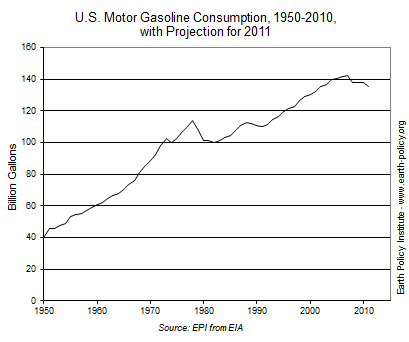
The United States currently consumes more gasoline than the next 16 countries combined. Yes, you read that right. Among them are China, Japan, Russia, Germany, and Brazil. (See data.)
But now this is changing. Not only is the affluence that sustained this extravagant gasoline consumption eroding, but the automobile-centered lifestyle that was considered part of the American birthright is fading as well. U.S. gasoline use has dropped 5 percent in four years.
Four key developments are set to further reduce U.S. gasoline use: a shrinking car fleet, a decline in the miles driven per car, dramatic mandated future gains in new car fuel efficiency, and the shift from gasoline to electricity to power our cars.
The U.S. fleet appears to have peaked at 250 million vehicles in 2008. From 1994 through 2007, new-car sales were in the range of 15–17 million per year. Since then they have totaled 10–13 million per year, and they are unlikely to top 14 million again. Retirees likely will exceed sales of new cars throughout this decade.
The contraction that began when the fleet dropped from 250 million in 2008 to 248 million in 2010 is likely to continue. Sales of new cars are not matching those of earlier years in part because the economic prospect has dimmed and in part because we are still urbanizing. Today 82 percent of us live in urban areas where cars are becoming less essential.
On top of urbanization, we also have a change in the manner in which young people socialize. For teenagers in rural communities a half century ago, getting a driver’s license and something to drive—a car, a pickup, or even a farm truck—was a rite of passage. That’s what everyone did.
This too is changing. Today’s teenagers, most of whom grew up in an urban setting, socialize through smartphones and the Internet. For many of them, a car is of little interest. The number of licensed teenage drivers in this country—the car owners of the future—has dropped from a peak of 12 million in 1978 to 10 million today.
Cities are also being redesigned for people. Among other things, this means cities are becoming pedestrian- and bicycle-friendly, with ready access to public transit.
Many cities are building a cycling infrastructure of bicycle trails, dedicated bike lanes, and bike racks for parking. Bike-sharing programs are showing up, too. In Washington, D.C., the Capital Bikeshare program that began in 2010 has expanded to 116 stations with 1,100 bicycles. Within the first year, some 16,000 riders signed up for annual membership in the program. Denver and Chicago have similar bike share programs. And New York City is about to launch a huge program of its own.
The second reason that gasoline use is falling is the decline in miles driven per car. This is partly in response to economic uncertainty and the high price of gasoline. When gas costs nearly $4 a gallon, people think twice before jumping in a car and using a gallon of gasoline to pick up a half-gallon of milk.
A third trend that is reducing gasoline use is the rising fuel efficiency of the U.S. automobile fleet. New cars sold in 2008 averaged 27 miles per gallon. But in early 2009, President Obama raised the average fuel efficiency standard so that those sold in 2016 will get 36 miles per gallon. Additional standards announced in 2011 mean that new cars sold in 2025 will use less than half as much gasoline as the 2008 models.
The game changer in reducing gasoline use is going to come as drivers shift from gasoline to electrically powered vehicles, including plug-in hybrids and all-electric cars. General Motors recently introduced the Chevrolet Volt, designed to run largely on electricity, and Nissan unveiled the Leaf, an all-electric vehicle. Beyond these, Toyota is accepting orders for the plug-in version of its Prius hybrid, the pacesetter in fuel efficiency. It will be followed by a steady flow of new plug-in hybrid and all-electric car models coming to market.
Although these electrically powered vehicles are typically more costly to buy, the day-to-day cost of operating them is extraordinarily low. An analysis by Professor Michael McElroy at Harvard indicates that running a car on wind-generated electricity could cost less than the equivalent of 80-cent-a-gallon gasoline.
With the auto fleet shrinking, with the average car being driven less, with the fuel use of new cars to be cut in half by 2025, and with electricity starting to replace gasoline as a fuel, why do we need to build a pipeline to bring crude oil from Canada’s tar sands to oil refineries in Texas? The answer is we don’t.
Lester R. Brown is president of the Earth Policy Institute and author of World on the Edge.
There’s a footnote that I would like to add from the Center for Biological Diversity (great website!) that came out in a recent newsletter.
Here it is,
Lawsuit Seeks to Halt Work on Controversial Keystone XL Pipeline
Keystone Pipeline
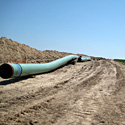
The hotly contested Keystone XL pipeline hasn’t been approved for construction, but federal officials don’t seem to care; they’ve allowed the pipeline company to mow down 100 miles of native prairie grasslands in Nebraska to clear the way — before any public hearings were held on whether Keystone XL should move forward at all.
The Center for Biological Diversity and Friends of the Earth filed a lawsuit in federal court in Omaha Wednesday to halt that work. Specifically, we’re challenging decisions by the State Department and U.S. Fish and Wildlife Service to allow work to begin before a decision’s been made on the pipeline or the public hearings, which look like little more than a sham at this point.
If approved, TransCanada’s 1,700-mile pipeline would carry up to 35 million gallons of oil a day from tar sands in Canada to refineries in Texas. Not only will this project add fuel to the global climate crisis, but the pipeline will cut across Nebraska’s legendary Sandhills, hundreds of rivers and streams, and the Ogallala Aquifer, which provides drinking water for millions of people. TransCanada’s existing pipeline, called Keystone 1, has reportedly leaked 14 times since it started operating in June 2010.






 Learning from Dogs