Yesterday, I wrote a post I cry for the wolves. A comment from Jeremy Nathan Marks included this:
I have learned slowly that being an adult means learning to face and acknowledge the many horrors of our world. It also means -for me, anyway- recognizing that love is the one saving grace, the one remaining hope, the one promise that might be kept. And I mean love in the hear and now and not in any afterlife. Love is what animates beauty for me -a beauty that is about more than aesthetics.
Some people would perhaps think I am ridiculous for saying that I feel that wolves are my kin. But they are. To be kin doesn’t mean we have to think the same thoughts, speak the same spoken language, or even move through the world in precisely the same way. Being kin to me means that we recognize the life lived in one another. I see that life and its light and love in wolves, just as you have beautifully described. And I know people who have lived and worked with wolves have seen that mutuality in their encounters and interactions with wolves and their packs.
That is such a profound reflection.
Unwittingly, before I read that comment from Jeremy, I had added this comment:
Around 7am I went down to our pond just to enjoy the world Jean and I live in and there was a young deer grazing the field grass near the water. Slowly, I moved towards a bench seat by the edge of the pond and sat down. The deer strolled away, perhaps some 30 feet, and continued to graze. Thanks to Dordie and Bill this young, beautiful creature was perfectly comfortable with my presence.
I sat there and my mind wander back to some far-off time when a curious young wolf might have let curiousity compell it to come a little closer to a human, perhaps nibble at the bone that the human threw in its direction.
There’s a theme here. “Love in the here and now ..” from Jeremy and me being lost watching that deer; the love of that moment.
A couple of evenings ago, Jean and I watched a truly wonderful and inspiring film. The film was called What about me? 1 Giant Leap The embedded link takes you to the website for the film.
Here’s the trailer.
Following the success of their first double Grammy nominated film & album, What About Me? is the latest offering from 1 Giant Leap. This visionary project took Jamie Catto and Duncan Bridgeman to over 50 locations as they explore through music, the complexities of human nature on a global scale, and aims to reveal how we are all connected through our creativity and beliefs, but most of all through our madness.
Through music and film, “1 Giant Leap” explores the universal complexities of human nature. Jamie Catto (Faithless co-founder) and Duncan Bridgeman set out on their journey recording musical jewels and words of wisdom with the cream of the world’s thinkers, writers and entertainers along the way. The duo traveled to the farthest corners of the planet, to ensure immense cultural diversity in this time capsule of humanity at its most inspirational.
Covering universal topics such as God, Sex, Death and Money, What About Me? features an incredibly diverse collection of collaborators from Noam Chomsky to Will Young, Maxi Jazz to Tim Robbins, Billy Connolly to Michael Stipe, Eckhart Tolle to Baaba Mal, among many others.
Encompassing a TV series, film and album, this is a poignant, emotional and entertaining time capsule of humanity at its most inspirational.
I can’t recommend too strongly that you watch the full-length film – I doubt that you will watch it and remain unchanged.
Like thousands of others I have been supporting the efforts to ensure that the US Government did not proceed with the proposal to remove wolves from endangered species protection.
Wolves are the animals that enabled early man to ‘progress’ from hunter-gatherer to the life of farming, and thence to our modern world. As I write elsewhere on Learning from Dogs,
There is no hard evidence about when dogs and man came together but dogs were certainly around when man developed speech and set out from Africa, about 50,000 years ago.
So it utterly breaks my heart to republish a recent post on The Sand County, Jeremy Nathan Marks wonderful and evocative blog. Here it is, republished with Jeremy’s kind permission.
oooOOOooo
I used to believe
As some of you may have heard, late last week the Obama Administration officially delisted gray wolves from endangered species protection. This means that 40 years of wolf recovery efforts have come to an end. Wolves only occupy a tiny fraction of their former habitat and with anti-wolf governments occupying the state houses in the few places that still have wolf populations, states like Montana, Wyoming, Idaho and Wisconsin, it is hard to imagine that wolves have a bright future in the lower 48 states.
I am deeply, profoundly saddened by this decision. I have learned over time how wolves -like so many other species- just don’t register on the list of national concerns and priorities. A great many people oppose the delisting, in fact one gets the impression that the effort to remove these protections has consistently been guided by political pressures and a political agenda and not by a true commitment to a sustainable and enduring wolf recovery. I know that I am hardly alone in registering my disappointment and voice of protest.
I cannot let this sad milestone pass without acknowledging it here on this blog. If you do not like wolves -if you feel hatred or resentment towards them or are pleased at what has recently transpired, I respectfully request that you refrain from sharing your feelings here. I seldom offer any “directives” like this, but if you are a reader of this blog then you know how strongly I feel about this issue. I am sharing these thoughts because I want to not only draw attention to what has happened, but also because I feel the need to mourn it. I tremble at the thought of a United States -or a North America- without wolves. Defenders of the administration and the Department of Interior’s position will say that the United States Government is committed to protecting wolves and ensuring their future but I am afraid I see things quite differently. This is not a partisan political issue: Democratic and Republican administrations alike are behind this stance towards wolves.
I would like to share a poem which I feel is very incomplete and does not begin to adequately draw upon the well of feelings, concerns and thoughts I have on this subject. But I would be remiss I think if I did not mark what has just happened.
I used to believe
I used to believe that one day
I might live carefully, cooperatively
beside the wolves
I would go to them but respect their
space; wait for their return and tend
my garden with local mind, open my windows
When they moved off I would wait
and make a space; I would lock my guns
in bolted cabinets to honor and not to intrude
I used to believe that there was a chance
of this because there were others who saw
in wolves the same uncertainties and histories
And we, a new community, would redraw
the map, eradicate “the frontier” and perhaps
expunge that word altogether from our plans
It is ironic really how a word, a concept,
one invisible line can have more tendrils
and seeds than a weed, more pups than a pack.
–Jeremy Nathan Marks
oooOOOooo
The Center for Biological Diversity has been incredibly active in fighting for the continued protection of the wolf. The Press Release about the loss of protection is here. Do read it and do everything you can to help. PLEASE!
Let me share some of my special feelings about wolves.
Luna, the wild wolf, with Tim and Tim’s dog; taken in 2006.
Then in February this year, I wrote about Oregon and the wolf. The following picture was in that Post.
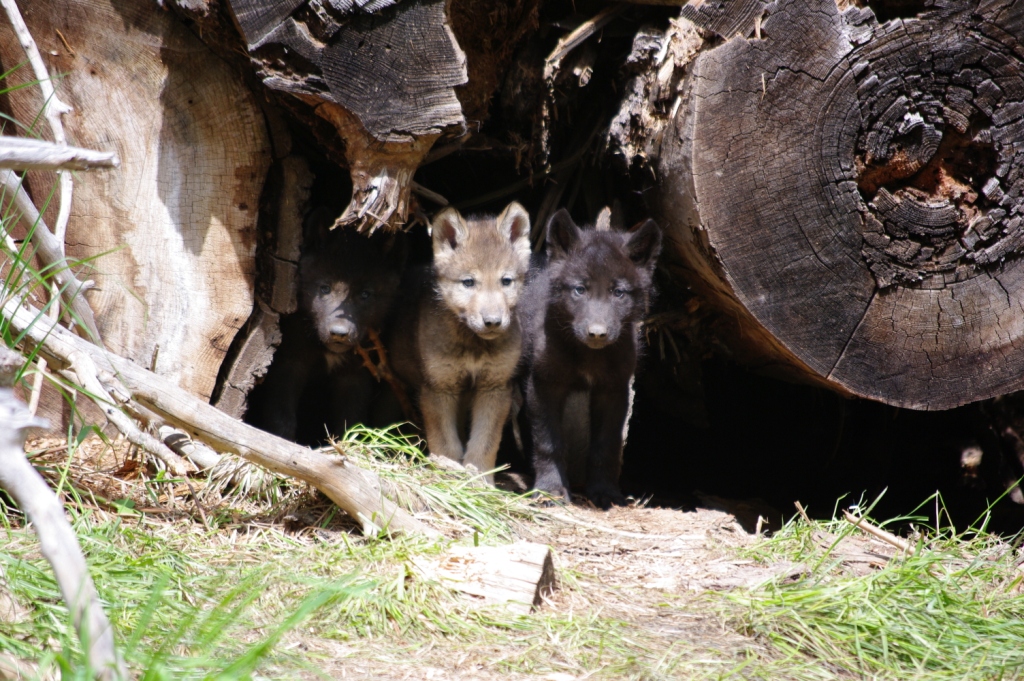
These wolf pups born to the Wenaha Pack in 2012 helped get recovery back on track. But their future remains tenuous (photo courtesy ODFW)
Please now listen to this:
So you can see that I have written frequently about wolves; indeed just a few days ago did so and included this photograph.
Wolf greets man.
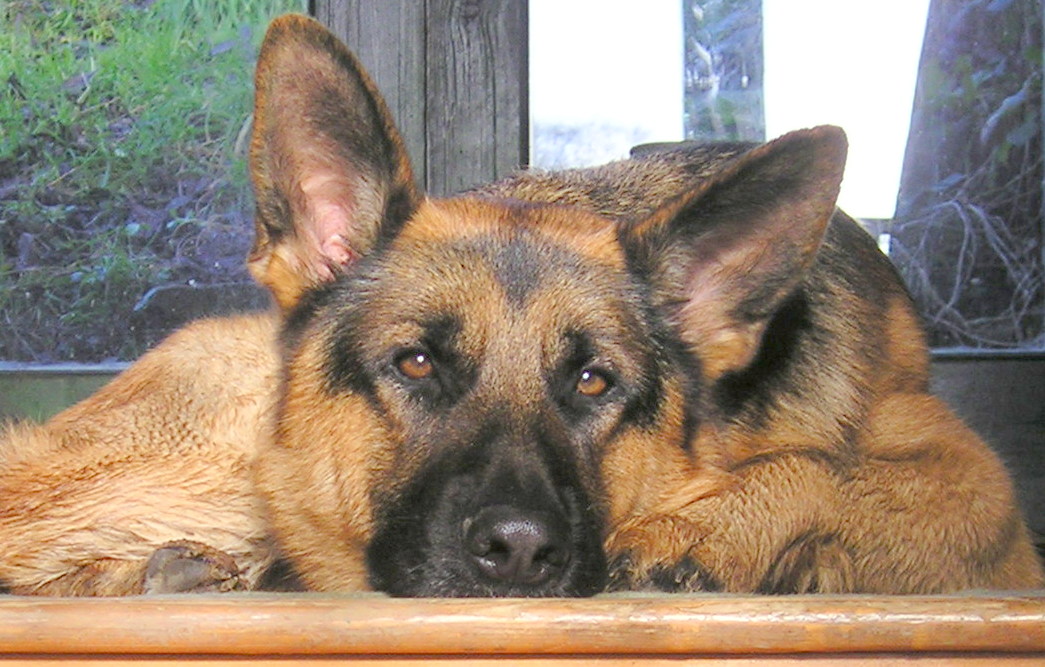
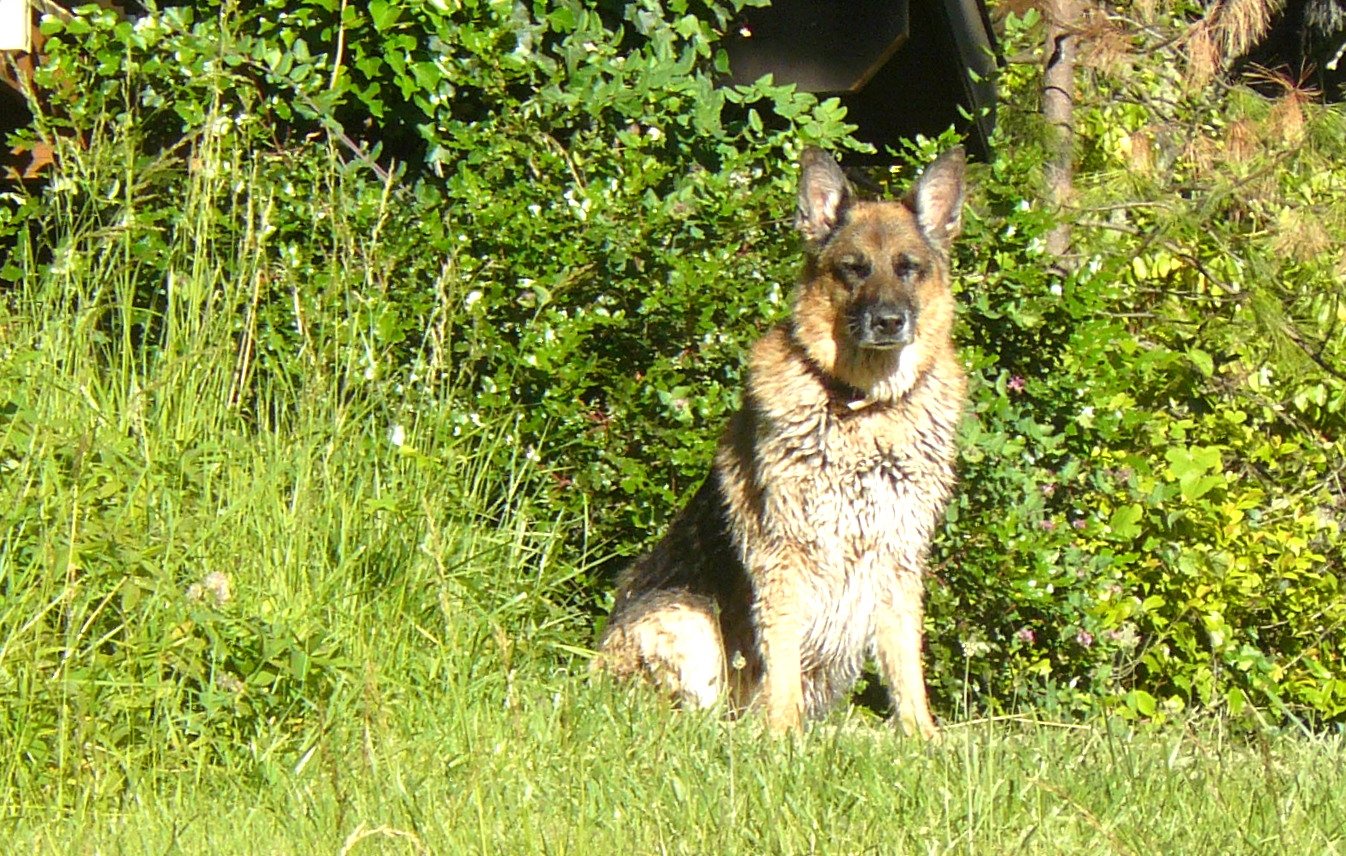
Now just look at those eyes of the Grey Wolf above and compare them to the eyes of the German Shepherd dog below and tell me that wolves aren’t as close to man as dogs.
Finally, feel free to share this post as far and wide as you can. Learning from Dogs is published under a Creative Commons License. This link covers how to share my material.
Please do something to help these ancient animals who, more than any other creature, helped put mankind ‘on the map’.
That post celebrated the arrival into the Handover household of three Koi.
However, since that day the three Koi have not been seen; not even a tremor on the surface of the water. We doubt that they have survived.
Jean found a rather fancy bird cage in a secondhand store the other day and a couple of days ago the cage became home to Mr. Blu and Mr. Green, a pair of Parakeets, or Budgerigars in English speak. I know many feel uncomfortable about having birds in cages but as the store assistant pointed out, these birds had been breed in captivity and wouldn’t survive a moment if released.
Mr. Green and Mr. Blu!
I have not a single jot of doubt that Jeannie will love them as she loves all our animals – with total devotion.
This second offering from Dan is very different to yesterday’s deep space theme.
Yesterday, I published an item sent in by Dan that included a video of an area of deep space photographed by the Hubble Space Telescope. Do take a look if you missed it yesterday – it is truly astounding.
Today, something from Dan that is altogether much more pragmatic, albeit very funny. Enjoy!
Dan sent me an email with a link to a most astounding video. But before we get to that, just take a look at these images. Here are the first three from the set of eight.
Eight breathtaking images of baby stars
1. Beautiful newborns
In a universe of fantastic images, a newborn star is a mystical masterpiece. Cradled within the dusty arms of a nebula, a baby star seems to blink its way to a new life. The lifespan of a star is a series of sequences. A star may spend most of its life in a “main sequence phase” where nuclear fusion of hydrogen into helium is happening in its core. But before this happens, it lives as a protostar, or baby star.
Thanks to NASA’s advanced infrared space telescopes such as Hubble and Spitzer, we are able to view these star births as never before. Pictured here are newborn stars peeking out “from beneath their natal blanket of dust” in the Rho Ophiuchi dark cloud as seen by the Spitzer Space Telescope. (Text: Katherine Butler)
2. Young stars in Serpens
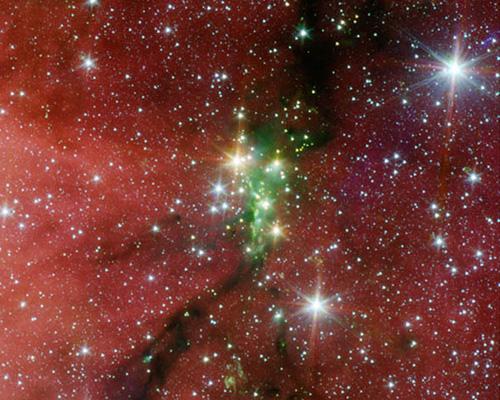
Here the Spitzer Space Telescope reveals the Serpens South star cluster, in which 50 or so young stars exist. They are seen as the “green, yellow, and orange-tinted specks sitting atop the black dust lane.” A supernova or galaxy collision can cause a star to form when huge clouds of hydrogen and helium collapse under mutual gravity. As the cloud collapses, it heats up and starts to spin. Since protostars are covered in dust, they can be seen only through infrared telescopes like Hubble and Spitzer. As Universe Today writes, “After about 100,000 years or so, the protostar stops growing and the disk of material surrounding it is destroyed by radiation.” Then this star, now called a T Tauri or pre-main sequence star, is visible from Earth.
3. Bubbly little star
We are used to images of babies blowing bubbles, and it looks like the infants of the cosmos do the same. This image, taken by the Spitzer Space Telescope, shows the HH 46/47 baby star blowing bubbles into space via powerful jets of gas. Located about 1,140 light-years from Earth, HH 46/47 is the bright white star at the middle of the image. Two bubbles reach out in opposite directions and are formed when the jets collide with the dust and gas surrounding the star. As Universe Today reports, “Astronomers think that young stars accumulate material by gravitationally pulling in gas and dust. This process ends when the star gets large enough to create these jets. Any further material is just blown away into space.”
Go and view the remaining five stunning images here.
Now to what was sent by Dan.
Check out this mind-bending video that talks about the “Hubble Ultra Deep Field” image captured by NASA astronomers nearly a decade ago — a photograph that some call “the most important image ever taken.”
It all started back in 1996 when a group of astronomers pointed the Hubble Space Telescope at an empty patch in the sky close to the Big Dipper in hopes of seeing something, anything. At the time, it was considered to be a risky move, given that demand for use of the telescope was so high. What if the experiment yielded no results? What if nothing but an empty image was the final result?
After ten full days of exposing the telescope’s CCD camera sensor to this seemingly vacuous patch of sky, a breathtaking image was produced. Over three thousand galaxies appeared in one image — some as dots, others as spirals. It was a visual reminder of just how big our universe really is. The photo is called the “Hubble Deep Field“:
In 2004, astronomers pointed Hubble near constellation Orion and opened the shutter for a whopping 11 days. Using sensitive detectors and specialized filters, the telescope was able to capture an image with over 10,000 galaxies. This image became known as the “Hubble Ultra Deep Field.”
Scientists later used redshift calculations of the galaxies to turn the photograph into a “fly-thru” view of the photo:
It didn’t end there. Last year, NASA scientists created the Hubble Extreme Deep Field, which has an equivalent exposure time to 23 days and features. It’s the “deepest image of the sky ever obtained” that reveals “the faintest and most distant galaxies ever seen”:
And just think: scientists created these photos by pointing their mega-camera at a tiny speck of the night sky that appears to be completely devoid of visible stars!
oooOOOooo
“… a tiny speck of the night sky that appears to be completely devoid of visible stars!”
Dan said in his email, “Are we really here? What are the chances?”
You really have to wonder! Incredibly long odds. Both to us being here and to us being the only conscious, intelligent species in the universe.
Reflections on the launch of George Monbiot’s new book Feral.
In my recent post, Dealing with Madness, where I referred to the launch of this new book there were comments from Jules that included him saying:
George is appearing at the Hay Festival to sell his book and do a talk this Saturday and it is only a few miles away so may be I will pop in and buy the book.
all the best
Jules
Jules, who has his own blog Bollocks2012, did go across to the Hay Festival and most generously agreed to write up his visit as a guest post.
So I am delighted to offer you Jules’ report today.
oooOOOooo
George at Hay
by Jules Bywater-Lees, 1st June, 2013
The small Welsh border town of Hay-on-Wye in Powys is just a few miles from where I live. It went from a little backwater with a failing rural economy to become, in the words of Bill Clinton, ‘the Woodstock of the mind’. All through the vision of eccentrics!
Hay-on-Wye
The town of Hay-on-Wye is pretty. It is set in the most beautiful Welsh countryside and even has its own tumble-down castle. However, back in the 70’s, like so many other small market centres, the town was in decline. That was until an eccentric bibliophile moved into the castle. The name of that eccentric was Richard Booth.
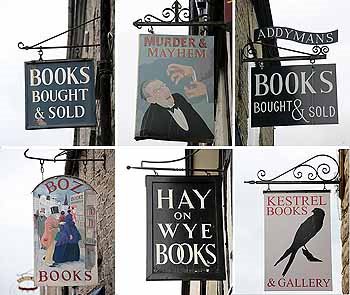
Richard Booth established a second-hand bookshop in town and, as a publicity stunt, on 1st April 1977 proclaimed himself King of Hay and Head of this new Independent Kingdom! Hay-on-Wye subsequently became a magnet for the second-hand book lover and trader, and now every other shop is a bookshop giving the town a healthy economy serving the many visitors.
Books, books and more books!
The Hay Literary Festival was devised by Norman and Peter Florence in 1988 and had become sufficiently established internationally for the highlight of Bill Clinton being a speaking guest in 2001. It is rather a corporate festival now attracting big names but the town has developed fringe events, that are both cheaper and more fun.
The reason this back story is relevant is that Hay-on-Wye has always been a gateway town between the urban English and rural Welsh. It is only a few hours drive from London and the nearest ‘wilderness’ for day trippers and holiday makers. A few miles further west and the uplands, or mountains as we call them (few are higher than 1000 feet), are considered by most people to be wild.
George Monbiot lives another 60 miles away to the West on the coast in what is considered deepest Wales where the hills have a barren beauty and the locals speak Britain’s ancient first language. But it is not all that it seems; the moors and hilltops are not natural they are a product of over-grazing. They are the degraded shells of a natural ecosystem. A shadowland; a ghostly memory of a former landscape.
View from Hay Bluff, just a few miles from Hay-on-Wye, and a powerful example of a bald hill.
Back to this year’s Festival. I coughed up the £8 ticket price and went with friends to have a day of culture. Those friends who came to hear George Monbiot speak were sceptical; for them the hills are beautiful and it is the denuded ‘wildness’ and prancing Spring lambs that gives the landscape so much value.
George makes frequent appearances on television and is very much a leading commentator on the environment and climate change, and his Guardian articles, see postscript, cover his views well so I wasn’t expecting any surprises. If anything I felt sceptical! You see while in principle I agreed with Monbiot’s message of rewilding and supportive of his views on the wide range of subjects he covers, the concept of rewilding appeared to be woolly and vague and lacking the practicalities of how this vision would be achieved. I even prepared a question for the session after his presentation.
Britain is a little country and our national parks are not the same as those elsewhere in the world, a better description would be regulated areas of private ownership. There are a few parks in Wales notable Snowdonia, which amounts to 2,200 square Kilometres (850 square miles), Brecon Beacons, 1,300 Km2 (502 SqM) and larger ones in Scotland such as the Cairngorms of 4,500 Km2 (1,737 SqM). But all of these are tiny compared to Yellowstone National Park with its 9,000 km2 (3,475 SqM and about 100 wolves!). Is it possible to have viable populations of wild animals in such a small area?
My concern is that Britain actually does have a wild landscape of both international importance and scale, with mega fauna, diversity and rare ecosystems that put it on par with the rainforest. It is truly huge with a conservative estimate of 50 to 100 thousand Km2 in area (19,305 to 38,610 square miles) but it is hidden: It is the 31,000 Km (19,260 miles) of coastline and the waters that extend from it. Surely we should be concentrating on its protection rather than allowing the hill tops to grow pretty common native woodland that could support a few hundred wolves, Lynx and beavers at best?
George live, as it were, was a lot more engaging than his appearance on telly and his spoken words a lot more passionate than his written words. I was surprised, and interested. Like all good story tellers he started off with a mystery. Why do British native trees appear to thrive when they are hacked about into hedges, why do blackthorn trees have thorns so tough and sharp they spike industrial leather gloves and why does the yew and holly have roots so extensive they could hold up a tree twice as big? The answer: Elephants!
Much of what he spoke about is found in his last three Guardian articles so I will spare you the detail but what struck me was his passion. Initially the cynic within wondered if George was just another celebrity seeking a cause. But such thoughts were dispelled as soon as George started to speak. What was communicated resonated strongly with this idealistic former self who was sufficiently passionate about nature enough to have studied zoology and yearned a human desire for wilderness and, indeed, danger but whose life has otherwise been engaged in more civilised necessities.
Such was the passion expressed by Mr. Monbiot that even I could overlook the practicalities and details; they can be sorted out when they need to be. My friends were impressed and even they were able to see that letting the hills go wild or a least a few of them would enhance their appreciation of our countryside.
But I didn’t buy a signed copy of the book! At £20 for the hardback version I thought it best to order one from my local library or at least wait for the paperback edition on Amazon.
Until modern humans arrived, every continent except Antarctica possessed a megafauna. In the Americas, alongside mastodons, mammoths, four-tusked and spiral-tusked elephants, there was a beaver the size of a black bear: eight feet from nose to tail. There were giant bison weighing two tonnes, which carried horns seven feet across.
Even before you start reading the devastating State of Nature report, published today, you get an inkling of where the problem lies. It’s illustrated in the opening pages with two dramatic photographs of upland Britain (p6). They are supposed to represent the natural glories we’re losing. In neither of them (with the exception of some distant specks of scrub and leylandii in the second) is there a tree to be seen. The many square miles they cover contain nothing but grass and dead bracken. They could scarcely provide a better illustration of our uncanny ability to miss the big picture.
The dam is beginning to crack, faster than I would have believed possible. Britain, one of the world’s most zoophobic nations, is at last considering the return of some of its extinct and charismatic mammal species.
While wolves, lynx, bears, bison, moose, boar and beavers have been spreading across the continent for decades, into countries as developed and populous as ours, and while they have been widely welcomed in those places, here we have responded to this prospect with unjustified horror.
As Edinburgh Zoo’s panda freakshow continues to captivate the witless and the infantile, a real Scottish animal has been allowed to die. Under the noses of Scottish Natural Heritage, which likes to be known as the nation’s leading conservation body, the Scottish wildcat has all but been extinguished from the Highlands. The importance of this news may be deemed worthy of a mere footnote on the schedule of important issues with which Scotland is grappling but it ought to rank much higher. For the wildcat’s demise seems to be part of the neutering and emasculating of our wildest places. That which was previously held to be a quintessential part of what Scotland was originally meant to look like and smell like and sound like is now, it seems, unimportant.
I never imagined being 52. As I grew up catching lizards and newts, rummaging through hedges to find birds’ nests, or prodding flattened hedgehogs with my scuffed Clarks lace-ups, the world was ripe with natural riches. Every scrap of wasteland revealed yet more gems: tadpoles, fox cubs and a confetti of butterflies. And when at the weekends the family Ford Anglia trundled off to the countryside, I strode in shorts into a wildlife nirvana, a utopia, and I explored what I imagined would be a never-ending world of beautiful and exotic creatures.
oooOOOooo
Finally, back to me and all I want to add is that the blogsite for more information on the book Feralis here.
So how to close? Well having given this post the title of a well-known saying, let me close with one perhaps less familiar but, boy oh boy, so relevant.
“When the oak is felled the whole forest echoes with it fall, but a hundred acorns
What an expanse of learning is out there in this modern interconnected world!
I try to limit my following to those organisations and writers who offer me the opportunity of learning. Whether something I was previously unaware of or a sight of the world from an unfamiliar perspective, it’s a rare day when something doesn’t ‘pass my screen’ that offers an ‘Ah, ha’ moment.
Such as the following essay by Dave Nussbaum that recently appeared on the Big Think website. Cheekily, I asked permission to republish and promptly and generously both Dave and Daniel Honan, managing editor of Big Think, said yes. Thank you, gentlemen.
A quick web search finds that Dave Nussbaum is Adjunct Assistant Professor of Behavioral Science, University of Chicago Booth School of Business. (I couldn’t avoid wondering if the learned Professor requires extra-large business cards! Sorry for that!) To fill in a little more about the Professor, one can easily read that:
I am currently an Adjunct Assistant Professor of Behavioral Science at the University of Chicago Booth School of Business. I received my PhD in Social Psychology from Stanford in 2008, working primarily with Claude Steele and Carol Dweck. I recently completed a SSHRC Post-Doctoral Fellowship at the University of Waterloo with Steve Spencer. My research is primarily focused on how people manage and defend their self-image in the face of threats, and how this affects their beliefs and behavior. I also explore how social contexts and psychological processes can either exacerbate threats to self-image or attenuate them. I have found that defensively managing self-image threats can often lead to negative consequences, including academic disidentification, missed learning opportunities, the avoidance of important medical tests, and persistence in failing investments. I believe that by identifying contexts and processes that attenuate threat, individuals and organizations can employ strategies to prevent these maladaptive outcomes.
So moving on past my quip about the length of Professor Nussbaum’s title, the summary above shows that this is one smart cookie! Just go back and reread “My research is primarily focused on how people manage and defend their self-image in the face of threats, and how this affects their beliefs and behavior.” Then reflect on the range and scale of ‘threats’ facing millions of us across the world. So research into “how social contexts and psychological processes can either exacerbate threats to self-image or attenuate them“, seems particularly appropriate for these times.
OK, without further ramblings from yours truly, here is that essay.
oooOOOooo
Odysseus Nudged: How Limiting Our Choices Can Give Us More Freedom
According to legend, the Sirens were beautiful women whose voices were so alluring that when sailors heard their song they could not resist approaching and were drowned on the rocky shores of the island where the Sirens sang. No sailor had heard their song and lived until Odysseus, who, on the counsel of the goddess Circe, had his crew tie him to the mast of his ship. When he heard the Sirens’ song he begged to be released, but his crew, their ears plugged with beeswax, would not unbind him and saved him from his own desires. Odysseus was lucky – he knew that he would be unable to resist the Sirens and had himself bound – but people often have difficulty foreseeing their weakness from a distance. Sometimes they need help.
I love watching my not-quite-two-year-old son learn about the world from his mistakes. I look on with sympathy at his falls and bumps and spills and I try to restrain myself from interceding. But when he’s about to tumble down a flight of stairs I step in. It is difficult to balance preserving his freedom to explore and make his own mistakes with the desire to keep him safe. There’s a lot to be said for giving kids autonomy and letting them learn from experience, but sometimes you have to behave paternalistically and tie them to the mast (or at least install safety gates).
When you start treating grown men and women like you’re their father, though, the charge of paternalism becomes a more serious one. There may be cases in which a heavy-handed approach is necessary (particularly when people’s actions harm others), but we should be careful about using it. A more circumspect approach is libertarian paternalism, described by Richard Thaler and Cass Sunstein in Nudge (and re-articulated more recently by Sunstein in his Simpler) as a way of influencing people to make decisions that they themselves would consider beneficial, without restricting their freedom.
Here, we are not tying Odysseus to the mast – the more appropriate analogy would be to the beeswax that Odysseus had his sailors put in their ears. The wax prevented the sailors from hearing the Sirens’ song and saved them from being lured to their deaths, but it also left them free to remove the wax if that is what they wanted to do. This sort of intervention is an acknowledgment that the sailors’ freedom is important, but also that people are not always perfectly rational. As Carnegie Mellon economist (and psychologist) George Loewenstein recently explained to me, “When people have problems exercising self-control, restricting their choices can, in some cases, leave them more freedom to choose.”
On its face, Loewenstein’s claim may seem paradoxical – isn’t a person most free when presented with all her options and allowed to choose among them? But as the mythical Sirens make clear, there are some options that we are not truly free to resist. Without beeswax in their ears Odysseus’ crew would have been doomed; the wax gave them the freedom to choose.
Take the recent attempt by New York City Mayor, Michael Bloomberg, to forbid stores from displaying cigarettes to their customers. Just like the beeswax did not prevent the sailors’ from choosing to hear the Sirens’ song, hiding cigarettes from view doesn’t prevent people from buying them. But, as Loewenstein explains, it makes it easier for those who may be trying to quit to avoid being lured back in.
When we pass laws that forbid the sale of cigarettes to minors we are being paternalistic. We are tying Odysseus to the mast, whether he likes it or not. But when we ban cigarette advertising that targets children – as the FTC did when it banned Joe Camel ads – we’re not tying anyone down. We are merely acknowledging that children are vulnerable to influences that may lead them to act contrary to their own interests and that they may not be in a position to resist these influences. Banning the display of cigarettes in stores is merely acknowledging that children aren’t the only ones who are vulnerable. The cigarettes, like the sirens, draw us in against our will. Putting them out of sight is like putting wax in our ears – we can easily still give in to temptation if we choose to, but we’re less at its mercy.
‘Twas brillig, and the slithy toves
Did gyre and gimble in the wabe;
All mimsy were the borogoves,
And the mome raths outgrabe. — Lewis Carroll, Jabberwocky.
To begin to understand nonsense it may help first if one has a good grasp of sense, for comparison between the two.
General education is obviously useful in this regard; after which perhaps the most important trait is critical thinking. One suggestion for a book that gives a good grounding in critical thinking is ‘What’s the Worst That Could Happen’, by Greg Craven.
Craving Understanding
Nonsense can be interpreted as communication that lacks any coherent meaning; it can be considered synonymous with absurdity and the ridiculous. Artists in many realms have long employed nonsense (though ironically, tragically, many suffer unemployment while doing so). Poets, novelists, lyricists and copywriters often seek refuge in it; and there are entire works that depend upon it as a foundation.
Swans Reflecting Elephants — Salvador Dali
When contemplating the antithesis of sense, one promising candidate for non-sense can be found lurking within surrealism.
And then there’s ‘common sense’, which is a thing to which people often appeal, and yet its use all too often can turn out to be oxymoronic. One example of ‘common sense’ that results in reality inversion is the persistent case of King Cnut.
In the philosophies of language and science, nonsense is distinguished from sense or meaningfulness. An understanding of nonsense is a necessary field of study in cryptography, as it is essential in separating a signal from noise. But attempts to come up with a coherent and consistent method of distinguishing sense from nonsense are troublesome at best; such may be a slippery chimaera, one that can even perhaps be spied on occasion chewing upon its own tail.
When all else is said and done, phlyarology can be a subject of crucial importance — especially when it comes to considering peak everything (to name but a few paltry aspects that, it would seem, appear to be irrelevant to ‘normal’ life).
Which is, of course, why we’re all here. Assuming, of course, that we are…
“Death is not an event in life: we do not live to experience death. If we take eternity to mean not infinite temporal duration but timelessness, then eternal life belongs to those who live in the present. Our life has no end in the way in which our visual field has no limits.” — Ludwig Wittgenstein, Tractatus, 6.431
I do not believe it is possible to ever fully grok nonsense; and so phlyarology is a never-ending pursuit. But I do believe that this doom can be a thoroughly rewarding and worthwhile one.
Or, to put it another way, stupid nonsense is a serious matter!
Any questions to be directed to Pendantry!
oooOOOooo
So how to close off a post about nonsense?
Well being a Brit sufficiently old to remember The Two Ronnies, a YouTube find that so perfectly shows the skill and professionalism of Ronnie Barker now follows.
Years ago if I was ever to own a dog, it had to be one breed and one breed only: a German Shepherd Dog.
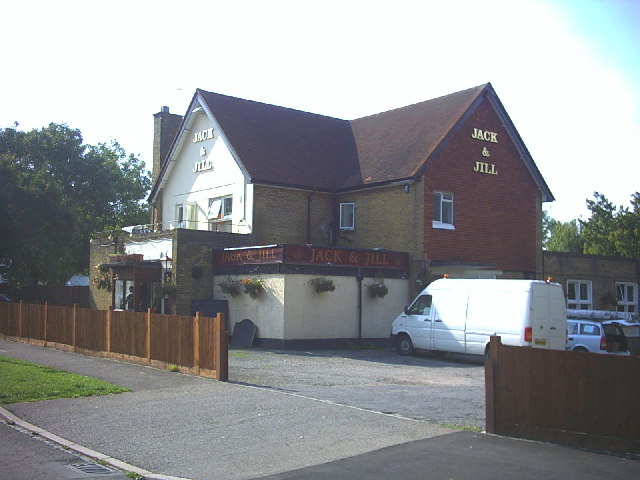
The reason for this was that back in 1955 my father and mother looked after a German Shepherd dog called Boy. Boy belonged to a lovely couple, Maurice and Marie Davies. They were in the process of taking over a new Public House (Pub); the Jack & Jill in Coulsdon, Surrey. My father had been the architect of the Jack & Jill.
Jack & Jill, Longlands Avenue, Coulsdon, Surrey
As publicans have a tough time taking holidays, it was agreed that the move from their old pub to the Jack & Jill represented a brilliant opportunity to have that vacation. My parents offered to look after Boy for the 6 weeks that Maurice and Marie were going to be away.
Boy was the most gentle loveable dog one could imagine and I quickly became devoted to him; I was 11 years old at the time. So when years later it seemed the right time to have a dog, there was no question about the breed. Boy’s memory lived on all those years, and, as this post reveals, still does!
Pharaoh was born June 3rd, 2003 at Jutone Kennels up at Bovey Tracy, Devon, on the edge of Dartmoor. As the home page of the Jutone website pronounces,
The Kennel was established in 1964 and it has always been the aim to breed the best German Shepherd Dogs for type and temperament. To this end the very finest German bloodlines are used to continue a modern breeding programme.
and elsewhere on that website one learns:
Jutone was established by Tony Trant who was joined by Sandra Tucker in 1976. Sandra continues to run Jutone since Tony passed away in 2004. Both Tony and Sandra qualified as Championship Show judges and Sandra continues to judge regularly. Sandra is the Secretary and a Life Member of the German Shepherd Dog Club of Devon.
Tony Trant
Turning to Pharaoh, here are a few more pictures over the years.
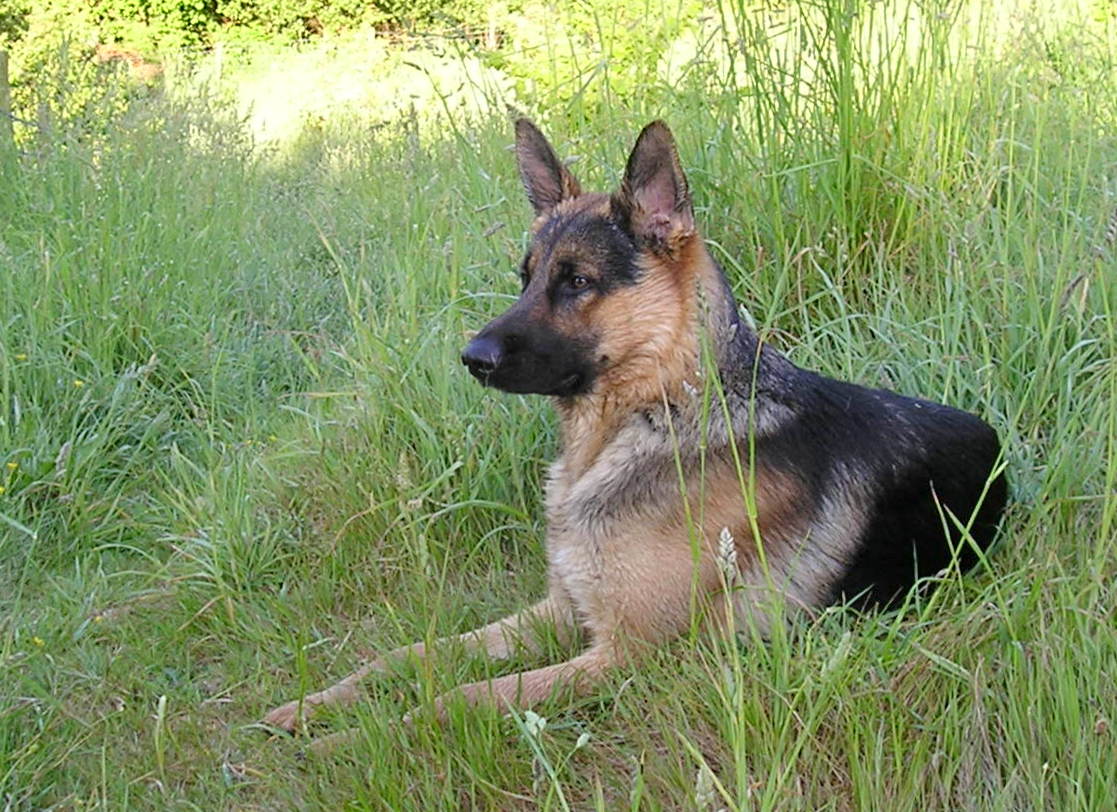
Pharaoh, nine months old.
oooOOOooo
One year old: June 3rd 2004.
The next picture of Pharaoh requires a little background information.
For many years I was a private pilot and in later days had the pleasure, the huge pleasure, of flying a Piper Super Cub, a group-owned aircraft based at Watchford Farm in South Devon. The aircraft, a Piper PA-18-135 Super Cub, was originally supplied to the Dutch Air Force in 1954 and was permitted by the British CAA to carry her original military markings including her Dutch military registration, R-151, although there was a British registration, G-BIYR, ‘underneath’ the Dutch R-151. (I wrote more fully about the history of the aircraft on Learning from Dogsback in August 2009.)
Piper Cub R151
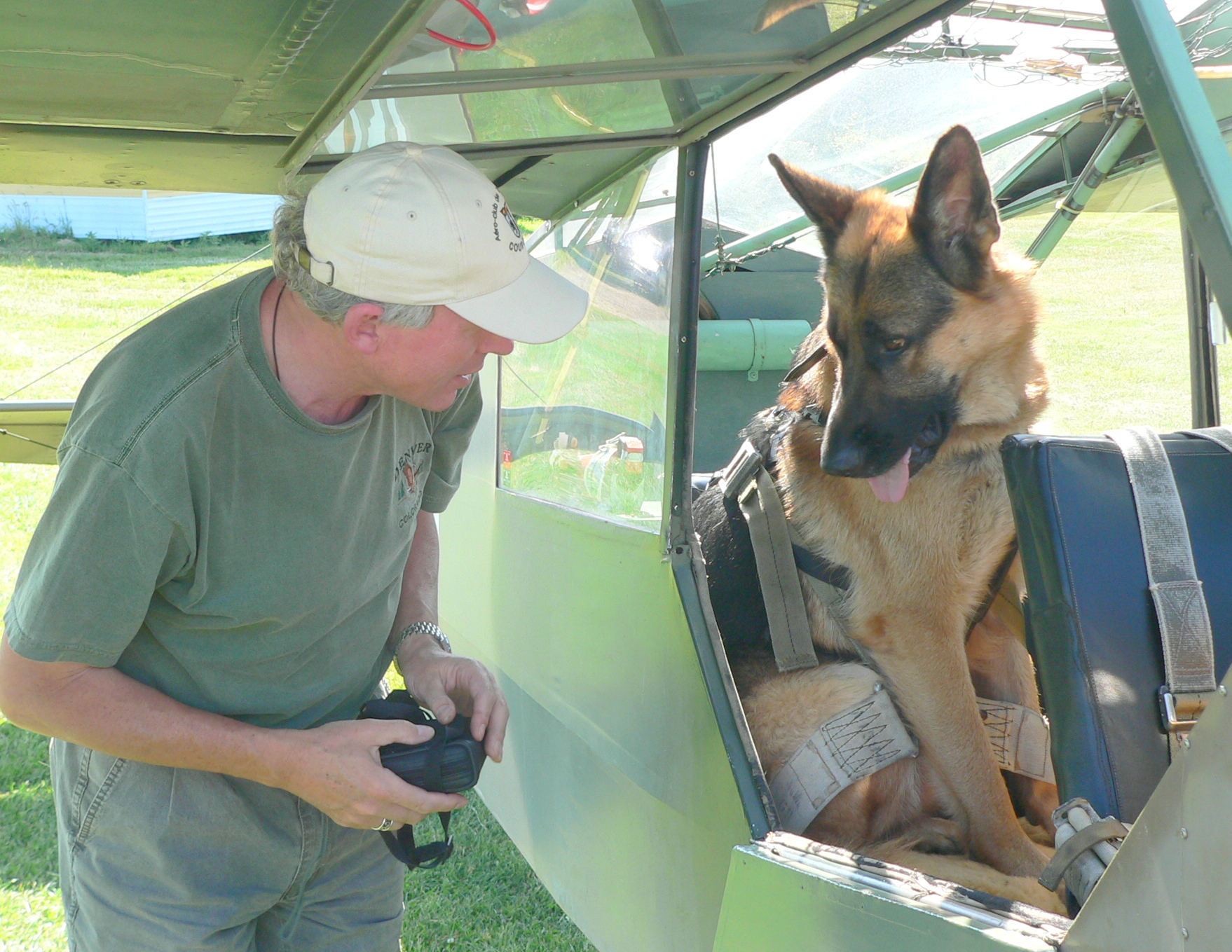
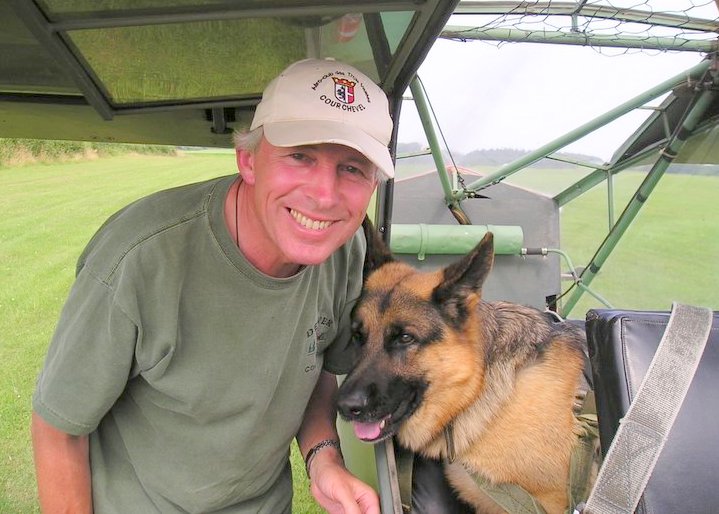
Anyway, every time I went to the airfield with Pharaoh he always tried to climb into the cockpit. So one day, I decided to see if he would sit in the rear seat and be strapped in. Absolutely no problem with that!
Come on Dad, let’s get this thing off the ground!
My idea had been to fly a gentle circuit in the aircraft. First I did some taxying around the large grass airfield that is Watchford to see how Pharaoh reacted. He was perfectly behaved.
Then I thought long and hard about taking Pharaoh for a flight. In the Cub there is no autopilot so if Pharaoh struggled or worse it would have been almost impossible to fly the aircraft and cope with Pharaoh. So, in the end, I abandoned taking him for a flight. The chances are that it would have been fine. But if something had gone wrong, the outcome just didn’t bear thinking about.
So we ended up motoring for 30 minutes all around the airfield which, as the next picture shows, met with doggie approval. The date was July 2006.
That was fun!
What a dear dog he has been over all the years and, thankfully, still is!
As if to reinforce the fabulous dog he still is, yesterday it was almost as though he knew he had to show how youthful he still was.
Because, when I took his group of dogs out around 7.30am armed with my camera, Pharaoh was brimming over with energy.
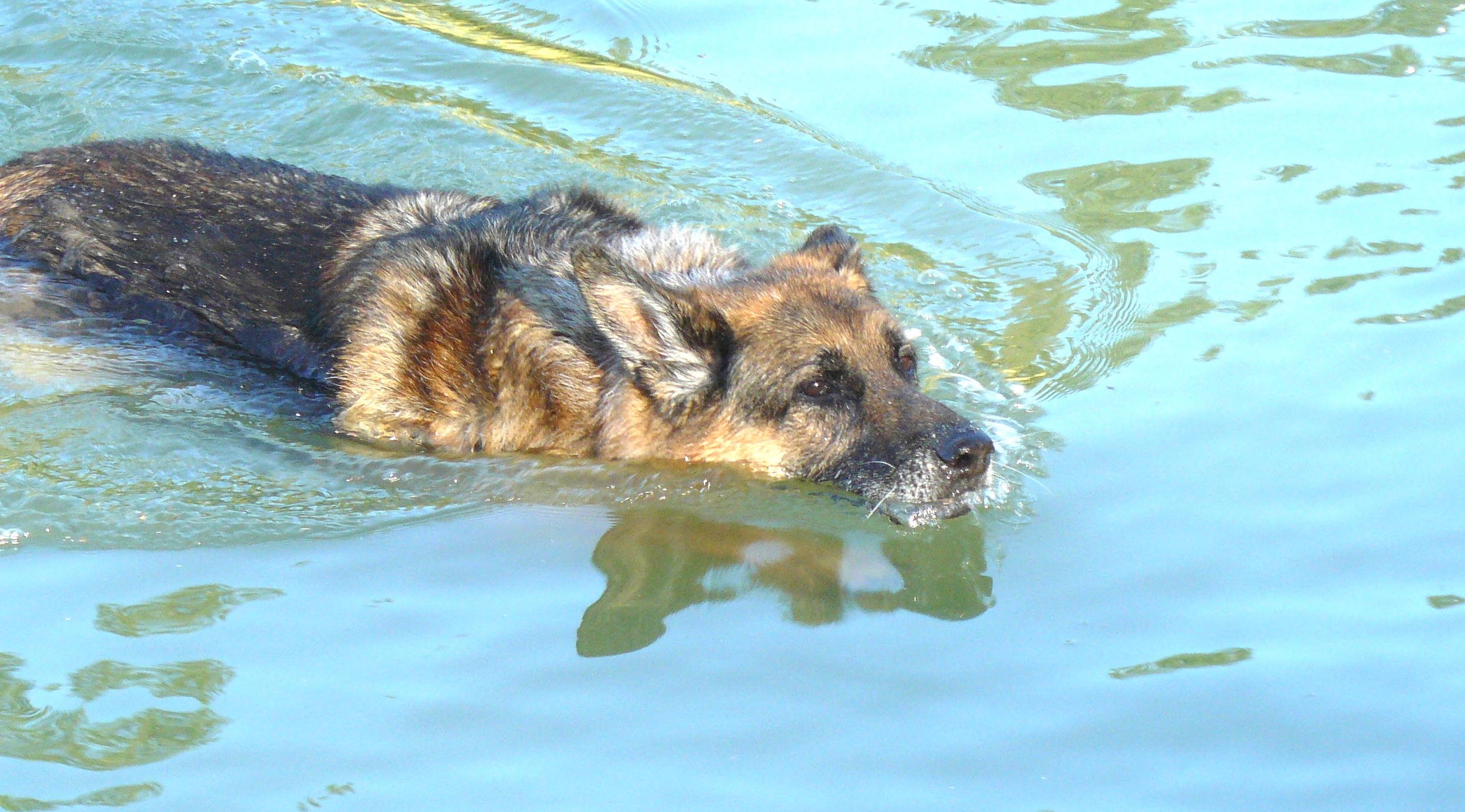
First up was a swim in the pond.
Ah, an early birthday dip! Bliss!
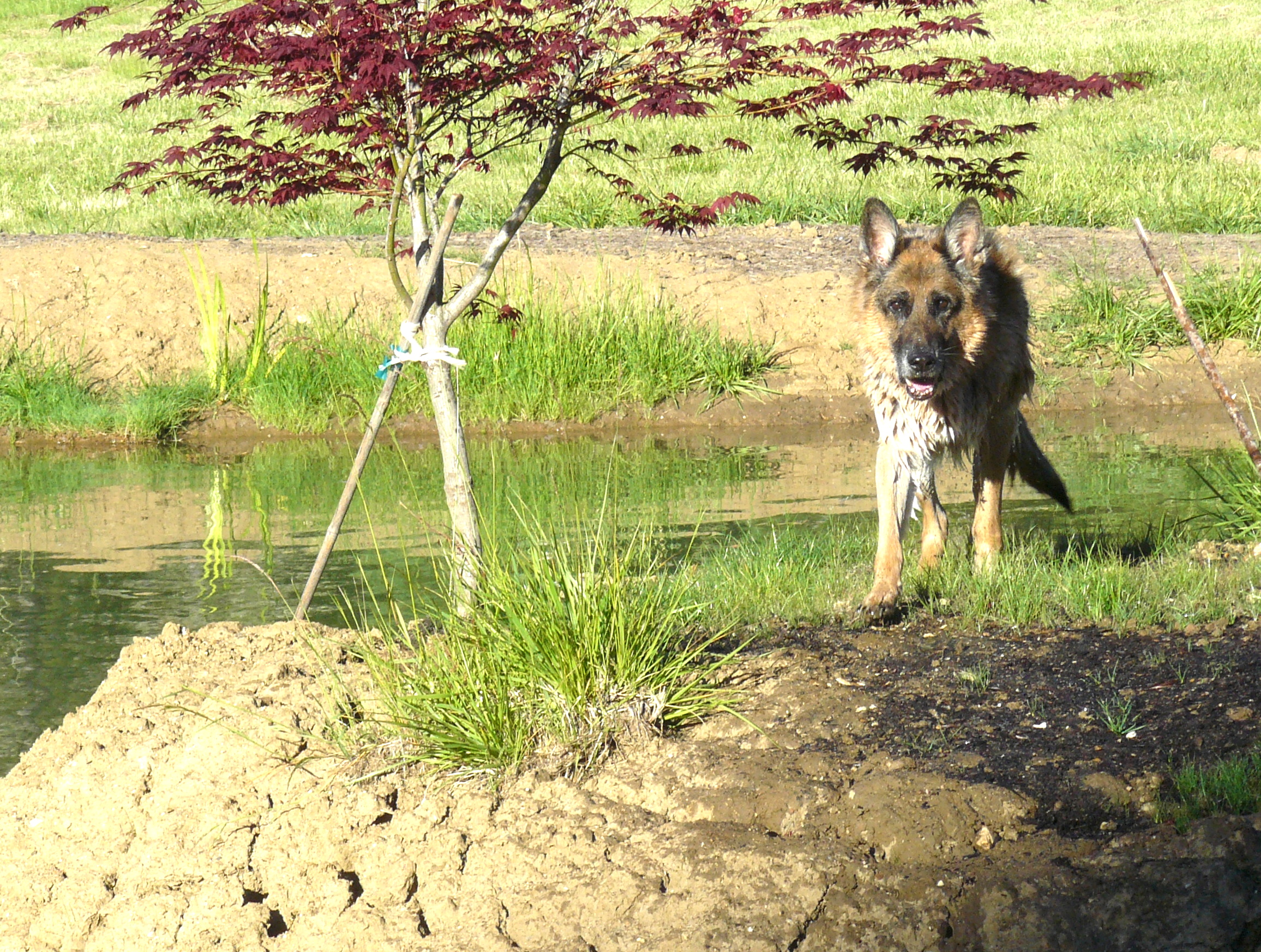
Then in a way he has not done before, Pharaoh wanted to play ‘King of my Island’, which is in the middle of the pond.
Halt! Who goes there!
ooo
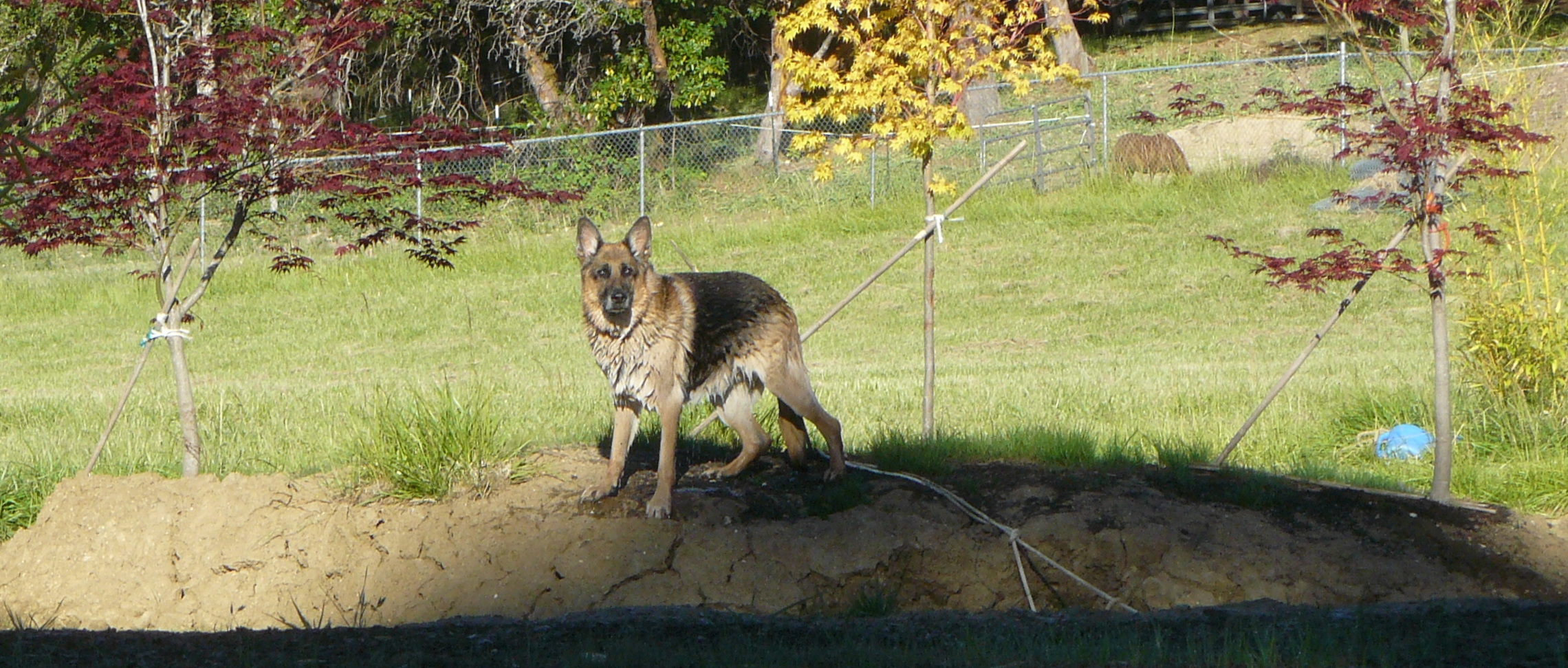
This is my island! So there!
Then a while later, when back on dry land, so to speak, it was time to dry off in the morning sunshine.
Actually, this isn’t a bad life!
Long may he have an enjoyable and comfortable life.
Yes, Pharaoh was born back on June 3rd 2003. So today, in human years he is 10. In the old traditional ‘dog years is seven times times human years‘ he would be 70. But according to a recent item on BBC News there is a more accurate way of calculating dog years.
Longevity secrets of readers’ pets who lived past 100 ‘dog years’
Thanks to our dog age calculator, people have been reassessing the age of their furry friends.
It put a new spin on the old saying that the age of dogs could be better understood by multiplying the number of years since their birth by seven.
You can read more here. That dog age calculator is here.
Dog years: The calculator
Working out your dog’s true age used to be a case of simply multiplying it by seven. But it’s more complicated than that, and here’s a handy calculator to do it for you.
Dogs age at varying speeds at different stages of their lives
With that in mind, we’ve built a calculator for you to work out your dog’s true age – its age in “dog years”.
Alternatively, you can find out how old you would be if you were a dog. You can choose to be a labrador, a spaniel, a whippet, or any one of 20 breeds.
The calculator uses these multipliers for the first two years of a dog’s life:
12.5 for small dogs
10.5 for medium-sized dogs
9 for large dogs
Then, for the third and subsequent years of the dog’s life, each human year has to be multiplied by between 4.3 and 13.4 years, depending on the breed:
Small: Dachshund (Miniature) 4.32, Border Terrier 4.47, Lhasa Apso 4.49, Shih Tzu 4.78, Whippet Medium 5.30, Chihuahua 4.87, West Highland White Terrier 4.96, Beagle 5.20, Miniature Schnauzer 5.46, Spaniel (Cocker) 5.55, Cavalier King Charles 5.77, Pug 5.95, French Bulldog 7.65
The calculator does not work for cross breeds, sadly, but on average these live 1.22 years longer than pure breeds, according to Dan O’Neill (from Petts Wood in London…) who is researching the subject for a PhD at the Royal Veterinary College.
Nor does the calculator work for cats. What we can say is that the average life expectancy of a cat is 12.1 years, which equates to 64 human years.
Guidelines issued by the American Association of Feline Practitioners say that cats reach 10 human years in their first six months and are approximately 24 at the age of two years. After this their age increases by four “cat years” every year.
So dear Pharaoh is the equivalent of an 80-year-old human! The breed has an average life expectancy of 9.73 years. (Source: BBC calculations on data from UK Kennel Club and US Veterinary Medical Database.)
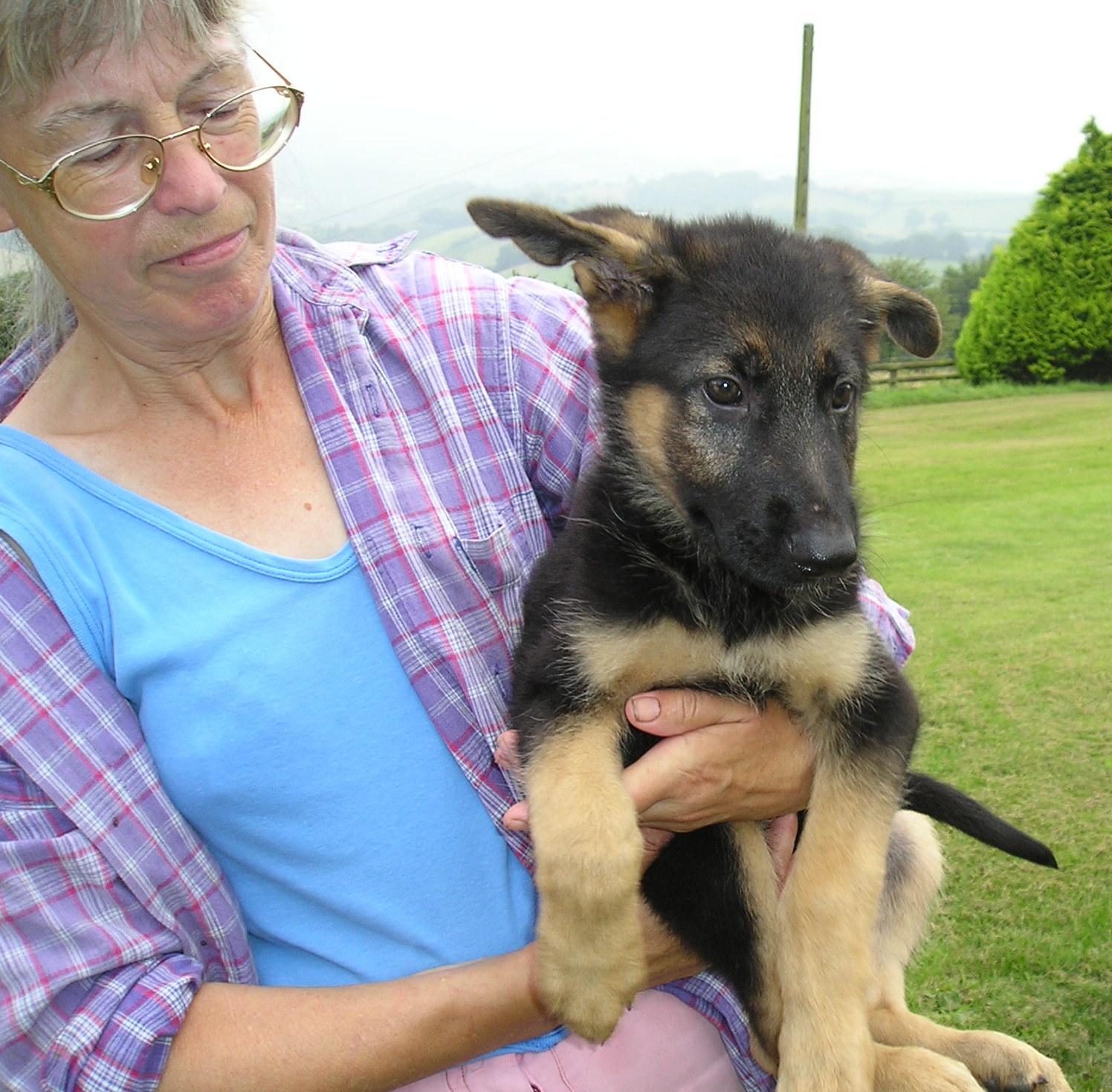
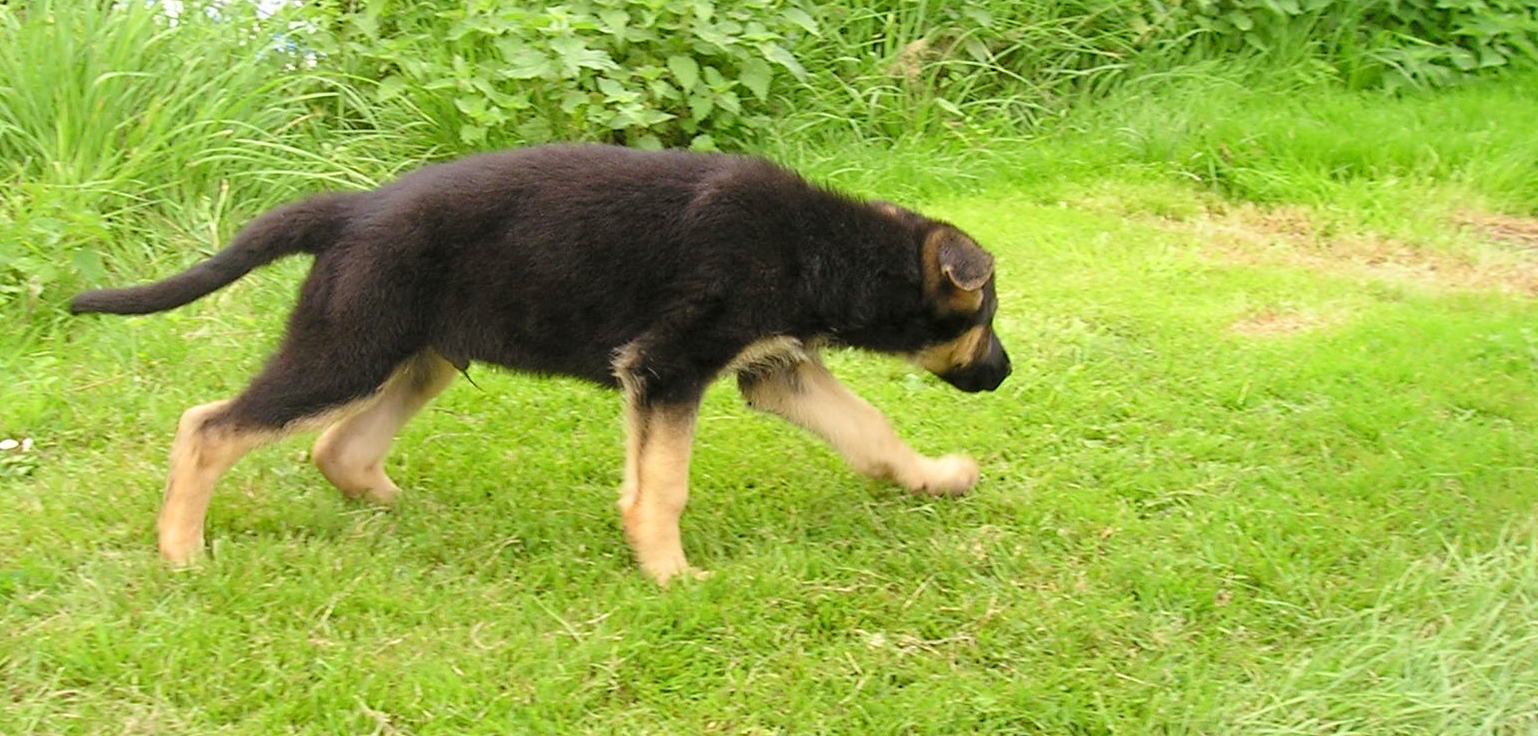
Going to leave you for today with three photographs of Pharaoh taken the day I first saw Pharaoh as a puppy, back on the 12th August 2003. The woman holding Pharaoh is Sandra Tucker who runs Jutone Kennels in Devon, England., where Pharaoh was born 10 years ago this day!












 Learning from Dogs