Staying with the theme of the relationship with humanity’s oldest friend.
Yesterday, I offered the first of two articles forwarded to me by local friend Jim, a vet, about the domestication of the wolf.
Here is the second.
Study narrows origin of dogs
By Krishna Ramanujan/ January 16th, 2014
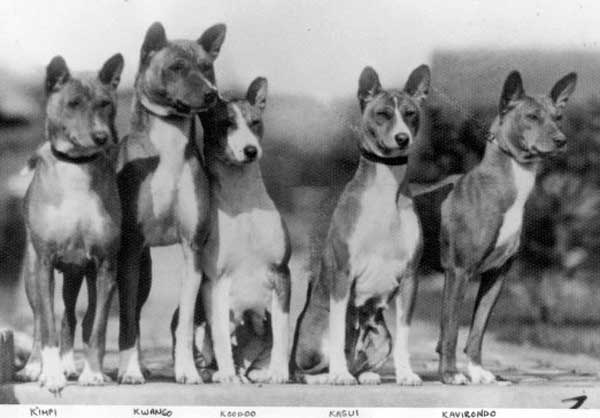
Genomic sequencing of genetically divergent dogs, such as this basenji from the Congo, together with wolves and other wild canids, provides rich information about the history of domestic dogs.
Dogs were domesticated between 9,000 and 34,000 years ago, suggesting the earliest dogs most likely arose when humans were still hunting and gathering – before the advent of agriculture around 10,000 years ago, according to an analysis of individual genomes of modern dogs and gray wolves.
An international team of researchers, who published their report in PLoS Genetics Jan. 16, studied genomes of three gray wolves, one each from China, Croatia and Israel – all areas thought to be possible geographic centers of dog domestication. They also studied dog genomes from an African basenji and an Australian dingo; both breeds come from places with no history of wolves, where recent mixing with wolves could not have occurred.
Their findings revealed the three wolves were more closely related to each other than to any of the dogs. Likewise, the two dog genomes and a third boxer genome resembled each other more closely than the wolves. This suggests that modern dogs and gray wolves represent sister branches on an evolutionary tree descending from an older, common ancestor. The results contrast with previous theories that speculated dogs evolved from one of the sampled populations of gray wolves.
“This is an incredibly rich new dataset, and it has allowed us to carry out the most detailed analysis yet of the genetic history of dogs and wolves,” said Adam Siepel, associate professor of biological statistics and computational biology at Cornell and a co-author of the paper. “There are still many open questions, but this study moves the ball forward,” Siepel added.
Computer methods for analyzing complete genome sequences developed by Ilan Gronau, the paper’s second author and a postdoctoral associate in Siepel’s lab, played a key role in the collaboration. Gronau’s computer program, called G-PhoCS (Generalized Phylogenetic Coalescent Sampler), was previously applied with success in a 2011 Nature Genetics study of early human history and demographics.
In this case, G-PhoCS provided a detailed picture of the demographic changes that occurred during the divergence of dogs from wolves. The analysis revealed there was a sizable pruning in population of early dogs and wolves around the time of domestication. Dogs suffered a sixteenfold cut in population size as they diverged from an early wolf ancestor. Gray wolves also experienced sharp drops in population, suggesting that the genetic diversity among both species’ common ancestors was larger than represented by dogs and modern wolves. In addition, there was considerable gene flow between dogs and wolves after domestication. Accounting for gene flow was a major challenge in the analysis, and Gronau’s research on this topic proved valuable in obtaining an accurate model of canid demography.
The picture emerging from this study will allow researchers to better interpret genetic differences observed between dogs and wolves and to identify differences driven by natural selection. “This paper sets the stage for the next step in the study of dog domestication that tries to determine the genetic changes that enabled this amazing transformation,” said Gronau.
The study’s senior authors included geneticists John Novembre at the University of Chicago and Robert Wayne at the University of California, Los Angeles (UCLA). Adam Freeman, a postdoctoral fellow at UCLA, was the paper’s first author. Adam Boyko, a Cornell assistant professor of biomedical sciences, also co-authored the paper.
The study was funded by various sources, including the National Science Foundation, National Institutes of Health and Life Technologies.
Staying with the theme of our early companions, back on the 28th February, 2015 there was an article in the UK’s Guardian newspaper about the way wolves helped early modern man. Now I don’t have permission to republish the full article but here’s a taste:
How hunting with wolves helped humans outsmart the Neanderthals
Forty thousand years ago in Europe our ancestors formed a crucial and lasting alliance that enabled us to finish off our evolutionary cousins, the Neanderthals.
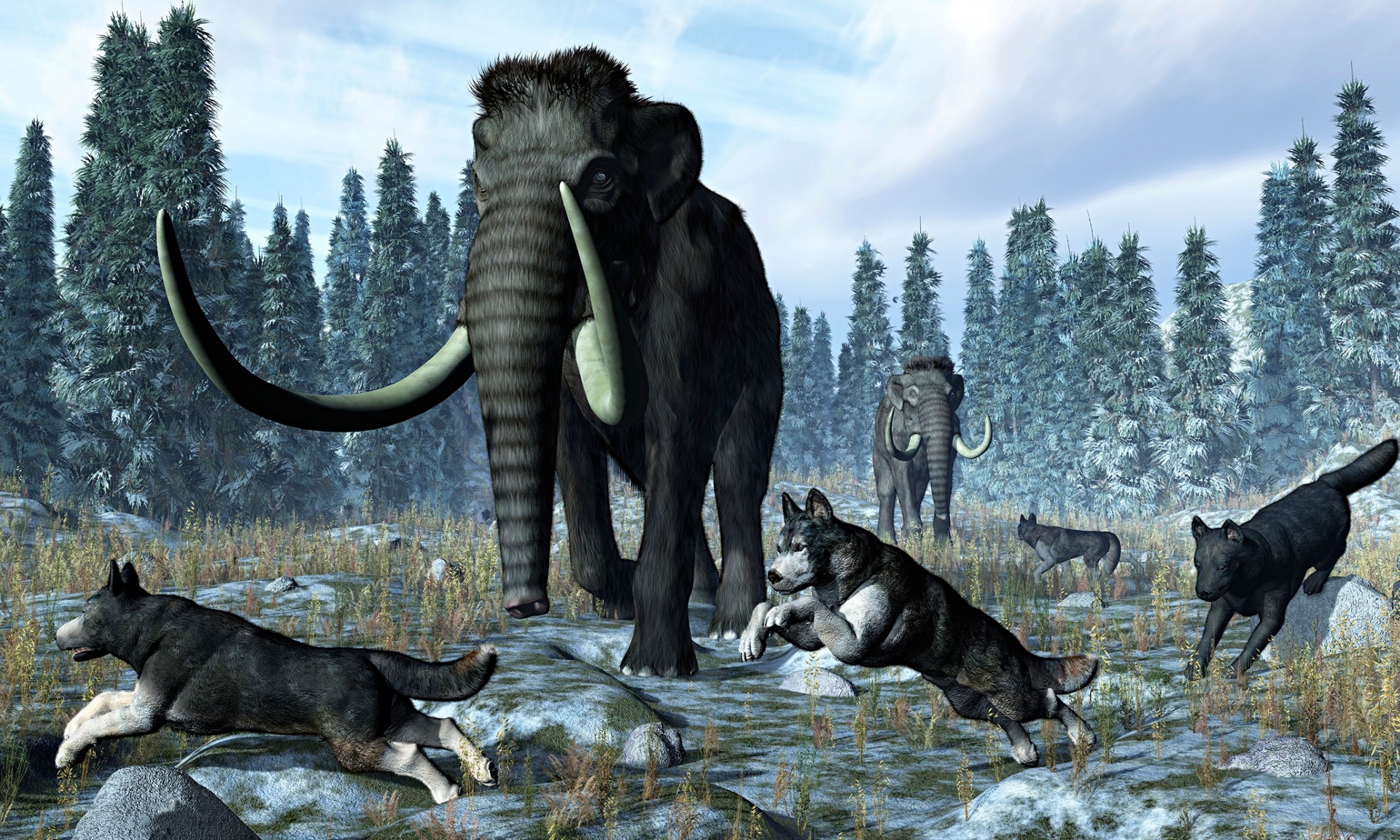
A pack of dire wolves crosses paths with two mammoths during the Upper Pleistocene Epoch. Photograph: Alamy
Dogs are humanity’s oldest friends, renowned for their loyalty and abilities to guard, hunt and chase. But modern humans may owe even more to them than we previously realised. We may have to thank them for helping us eradicate our caveman rivals, the Neanderthals.
According to a leading US anthropologist, early dogs, bred from wolves, played a critical role in the modern human’s takeover of Europe 40,000 years ago when we vanquished the Neanderthal locals.
The Guardian article finishes, thus:
Thus we began to change the wolf’s appearance and over the millennia turned them into all the breeds of dog we have today, from corgis to great Danes. Intriguingly, they may have changed our appearances as well, says [Professor Pat] Shipman, whose book, The Invaders: How Humans and Their Dogs Drove Neanderthals to Extinction, will be published this month. Consider the whites of our eyes, she states. The wolf possesses white sclera as does Homo sapiens though, crucially, it is the only primate that has them.
“The main advantage of having white sclera is that it is very easy to work out what another person is gazing at,” added Shipman. “It provides a very useful form of non-verbal communication and would have been of immense help to early hunters. They would been able to communicate silently but very effectively.”
Thus the mutation conferring white sclera could have become increasingly common among modern humans 40,000 years ago and would have conferred an advantage on those who were hunting with dogs.
By contrast, there is no evidence of any kind that Neanderthals had any relationship with dogs and instead they appear to have continued to hunt mammoths and elks on their own, a punishing method for acquiring food. Already stressed by the arrival of modern humans in Europe, our alliance with wolves would have been the final straw for Neanderthals.
Nor does the story stop in Europe, added Shipman. “I would see this as the beginning of the humans’ long invasion of the world. We took dogs with us wherever we went after our alliance formed in the palaeolithic. We took them to America and to the Pacific Islands. They made hunting easy and helped guard our food. It has been a very powerful alliance.”
RISE AND FALL OF NEANDERTHALS
250,000 years ago The first Neanderthals appear in Europe.
200,000 years The first modern humans appear in Africa.
70,000 years The first modern humans leave Africa.
50-60,000 years Modern humans and Neanderthals share territory in Middle East.
45,000 years Modern humans enter Europe.
40,000 years Neanderthals disappear.
I don’t know about you but I find the history of our, as in man’s, relationship with wolves and thence with dogs to be not just romantic but spiritually significant. To know, as I hug one of our many huggable dogs here at home, that I am bonding my mind and emotions with an animal that has been my partner for tens of thousands of years is beautiful beyond words.
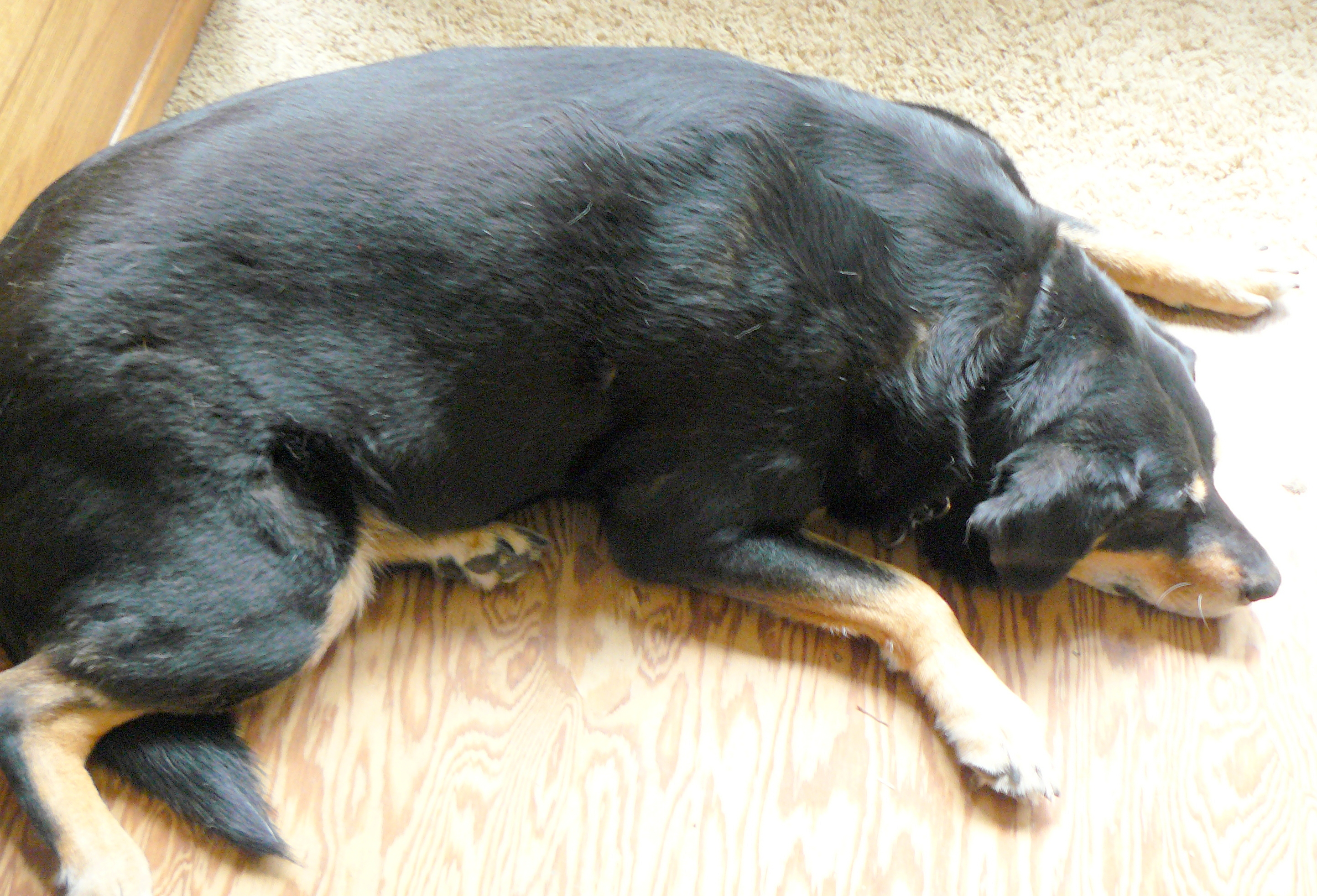
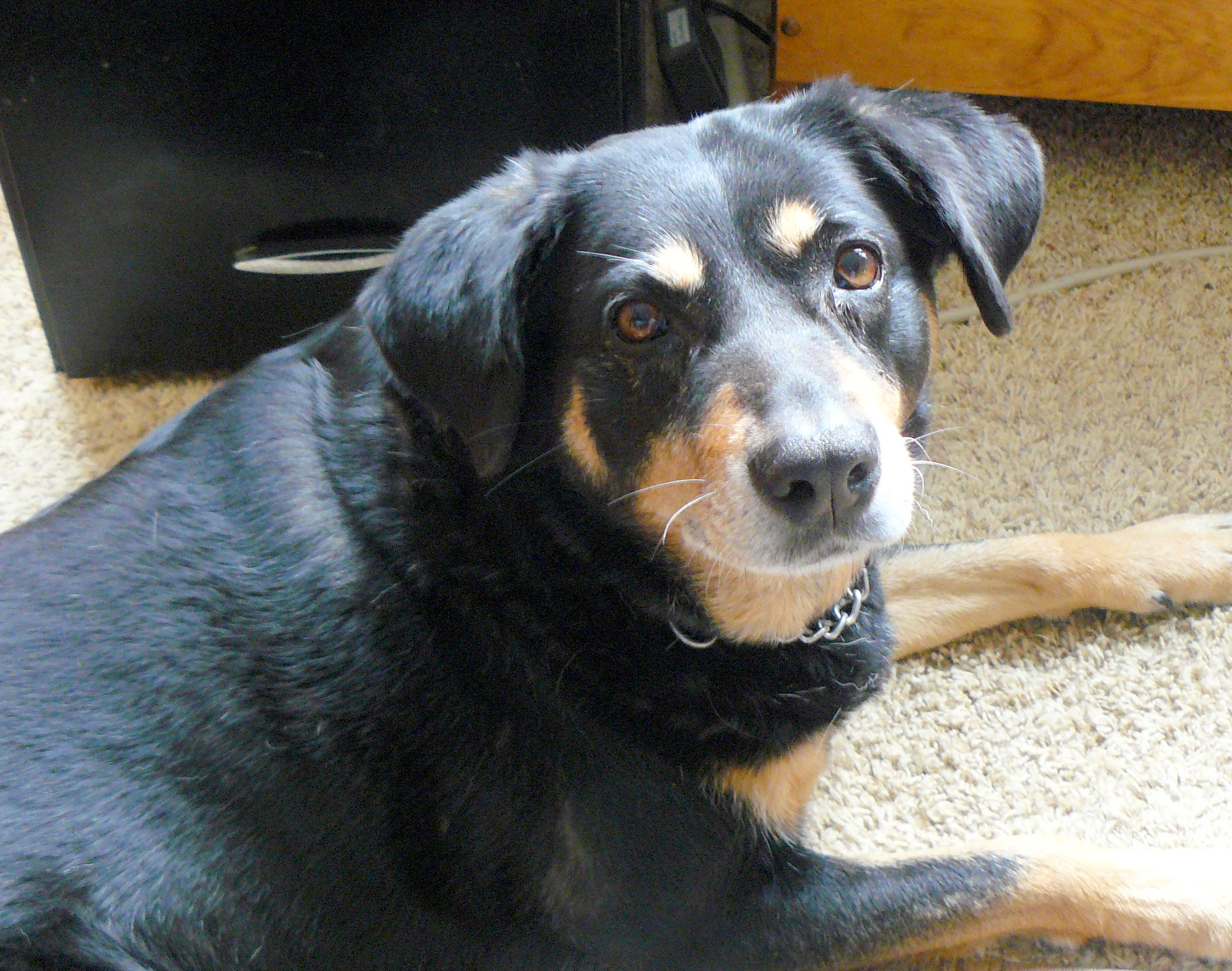
(I took a break of a couple of minutes at this point to grab my camera and take a photograph of Hazel sleeping next to my chair, as she so often does when I am writing. Then one of her when she looked up at me. Here they are:)
oooo
That second photograph reminds me that somewhere I read that dogs are the only animal that can look to where a human is directing a gaze or pointing a finger.
The revised understanding of humanity’s oldest friend.
I mentioned in yesterday’s post how on Sunday afternoon, Jean and I, together with little Sweeny, went for a forest walk with friends, Janet and Jim and their dog Louie, who all live a few hundred yards from us along Hugo Road.
As Jim, a vet, and I were walking and chatting the subject, inevitably, turned to dogs! Or more precisely the history of the domestication of dogs. Jim then promised to send me a couple of papers highlighting a new study that has turned the clock back, so to speak, on when domestic dogs evolved from European wolves.
Here’s the first of those reports.
Origin of Domestic Dogs
New analysis suggests that domestic dogs evolved from European wolves that interacted with human hunter-gatherers.
By Ed Yong | November 14, 2013
Domestic dogs evolved from a group of wolves that came into contact with European hunter-gatherers between 18,800 and 32,100 years ago and may have since died out.
This origin story comes from a new study that compares DNA from dozens of dogs and wolves, including 18 ancient fossils. The results, published today (November 14) in Science, provide the clearest picture yet of where, when, and how wild predators came to be man’s best friend.
“It really is a sea change from the little bits of fragmentary DNA that have been reported in the past,” said Gregor Larson from Durham University in the U.K., who was not involved in the study. “It includes really old material from a wide range of sites.”
The new paper follows two earlier studies that looked at the genetic signatures of domestication in dogs, and came to differing conclusions about canine origins. One group suggested that dogs were domesticated around 10,000 years ago during the Agricultural Revolution, when wolves started scavenging human scrap heaps. Another concluded that wolves and dogs split 32,000 years ago, somewhere in East Asia.
Both studies compared the genes of a wide variety of living dogs and wolves, but modern samples can be deceptive. Dogs and wolves diverged so recently that many of their genes have not had time to separate into distinct lineages. They have also repeatedly hybridized with each other, further confusing their genealogies.
To deal with these problems, a team led by Olaf Thalmann from the University of Turku in Finland analyzed mitochondrial DNA from 18 fossil canids. They compared these ancient sequences to those from 49 modern wolves and 77 modern dogs, and built a family tree that charts their relationships.
The tree conclusively pinpointed Europe as the major nexus of dog domestication. It identified four clades of modern dogs, which are all most closely related to ancient European canids rather than wolves from China or the Middle East. “We didn’t expect the ancestry to be so clearly defined,” Thalmann told The Scientist.
“This suggests that the population of wolves in Europe that gave rise to modern dogs may have gone extinct, which is plausible given how humans have wiped out wolves over the centuries,” he added.
According to this new tree, the largest clade of domestic dogs last shared a common ancestor 18,800 years ago, and collectively, they last shared a common ancestor with a wolf around 32,100 years ago. They must have been domesticated at some point during this window.
These molecular dates fit with fossil evidence. The oldest dog fossils come from Western Europe and Siberia, and are thought to be at least 15,000 years old. By contrast, those from the Middle East and East Asia are believed to be 13,000 years old, at most. “The archaeologists would be happy,” said Larson.
The dates also make it unlikely that dogs were domesticated during the Agricultural Revolution, which took place millennia later. Instead, they must have first associated with European hunter-gatherers. They may have assisted humans in bringing down large prey, or could simply have scavenged leftover carcasses. Either way, their association with humans grew stronger and stronger, until they eventually evolved into domestic dogs.
However, Thalmann acknowledged that his team’s analysis does not include any ancient DNA from the Middle East or China, nor nuclear DNA from any of the fossils. In other ancient DNA studies, nuclear DNA sequences have revised the evolutionary stories told by mitochondrial ones.
“Who knows what we would find if we had ancient canid samples from East Asia or elsewhere, or were successful in amplifying nuclear DNA from ancient canids,” said Adam Boyko from Cornell University, who was not involved in the study, via email. “But that shouldn’t detract from the great work they were able to do here,” he added.
Larson cautioned that the paper is not the final word on canine origins. “It would be a mistake to jump and say that dogs were domesticated in Europe and not anywhere else,” he said. “We know pigs were domesticated independently in China and Turkey, so there’s no thinking that dog domestication had to happen in just one place.”
Indeed, Thalmann’s team showed that the famous Goyet dog—a 36,000 year old Belgian skull, supposedly belonging to the oldest known dog — is not directly ancestral to modern dogs. Instead, it represents an ancient sister lineage that died out. The same is true for other old specimens from Belgium and Russia’s Altai Mountains. “Maybe they were trial domestications that were not successful,” said Thalmann.
O. Thalmann et al., “Complete mitochondrial genomes of ancient canids suggest a European origin of domestic dogs,” Science, doi:10.1126/science.1243650, 2013.
Clearly, a blog that is entitled Learning from Dogs needs to take notice of this new evidence!
So I will return tomorrow with the second of the reports.
Remains for the older prehistoric dog, which were excavated at Goyet Cave in Belgium, suggest to the researchers that the Aurignacian people of Europe from the Upper Paleolithic period first domesticated dogs.
Yesterday afternoon Jean and I were invited to join Jim and Janet on a forest walk joined by their dog, Louie, and our Sweeny.
Jim is a vet working locally here in Oregon and, as you might expect, much of the conversation was about animals, nature and ‘the meaning of life’.
By the time we were back home and dogs fed and horses brought in for the night, my creative juices were severely lacking. I browsed through what had been published in March, 2014 and came across a post called My wish for the world that came out on the 28th of that month.
It seemed such an appropriate item to republish for today, with the kind permission of the author, Jeremy Nathan Marks.
ooOOoo
The Sand County
“In wildness is the preservation of the world.” -Henry David Thoreau
My Wish for the World
If I could leave behind but one lasting accomplishment from my life it would be to have changed the hearts and minds of all those people who accept or practice cruelty towards animals.
Now there are a great many worthy causes in this world which fully deserve the attention of all those who believe in justice, in fairness, and in mercy. But I also know that each of us -perhaps- has a cause that stands above and beyond all of the other noble concerns that we know exist. For me this cause is the humane treatment of animals. And when I say animals I mean ALL animals. Permit me to explain.
My wife and I have two dogs. Both are mutts and both were adopted through the Animal Rescue Foundation of Ontario (ARF). I have blogged about ARF before and can only offer the highest praise for the organization. Courtesy of ARF, we have been provided with free dog training classes which have proved to be an invaluable resource in learning about dog behaviour. Better yet, the dog trainer we have worked with has made herself available for our questions outside of class.
Whenever we have encountered a behavioural challenge that we have not understood or have been unsure of a proper method of approach, this trainer has been very obliging. Importantly, she believes in positive reinforcement and does not believe in the use of pain, dominance, or stress as a means of conditioning dogs. For my wife and me, this fits in with our moral beliefs and our ethics.
Our eldest dog, who just turned one year old, is a 60 lbs. shepherd mix who has a “leash anxiety,” if I may call it that. When we are out on a walk and she sees another dog she becomes quite agitated and will bark loudly and lunge at the other dog. This has puzzled us because our dog loves to play with others and is frequently socialized. We grew increasingly concerned because our use of treats and positive reinforcement was not working. And because our dog is a large shepherd, we both have worried that she might develop a reputation and become a source of fear or suspicion by other people in our neighbourhood.
In due course, we contacted our trainer for advice. She suggested that rather than putting our dog in a stressful situation by repeatedly walking her past other dogs (and trying to control her behaviour when she becomes agitated) we should take her out of the situation instead. So, when we see another dog approaching we turn around and walk in a different direction, all the while rewarding our dog with treats and telling her she is a good girl. We have recently started doing so and the improvements are showing. So, let us fast forward to today. . .
This afternoon we took both of our dogs on a 20 km hike along the Thames River. The trail is like so many other trails; it forms a narrow path through the woods which makes passing other trail goers challenging at points. If another dog were to come toward us this narrowness would pose something of a challenge because we cannot turn around (and head home). Also, because the trail runs through the woods, there aren’t often places to step aside and let other dogs pass by without our oldest detecting them.
Inevitably we encountered another dog. We were approached by a small dog that was off leash (which is posted as unlawful, actually). We heard the dog before we saw it and prepared ourselves for some nervousness on the part of our oldest. When the dog approach some barking ensued and I tried to move our dog, as best I could, off the trail to let the family that was approaching us pass by with their dog. When we informed the family that our dog is uncomfortable around other dogs when she is leashed they did not seem to understand that we wanted them to pass by us quickly. When our eldest became excited one of the women turned to us and said that we should “knee our dog in her side to show her who is dominant.”
I was appalled. Some woman, whom I have never met, who knows nothing about our dog or our relationship with our dog, was suggesting we use violence against her to show her who is boss. . . And this is a woman with a dog of her own!
My wife later remarked to me, as we were driving home, that she would not feel entitled to the love and affection our dogs offer us if we used violence on them in any way. I thought what she said was beautiful and captured the principle of the matter perfectly. We want our dogs to love us and to trust us. How would we have any right to their love and affection if we were to lead them to believe that at any moment and for no apparent reason we might use painful force on them?
Dogs do not understand why you use violence against them. They do not reason or understand cause-and-effect the same way that humans do. This is not a fault. It does not mean they are stupid or of lesser value than human beings. It does not mean they deserve to be treated with cruelty or brutality. Dogs experience violence as pain and suffering that is inflicted out of the blue. They are not only unprepared for it, but are often completely defenceless against it. How could we ever defend such an inhumane practice?
It troubles me immensely that someone, whom I do not know, could so nonchalantly counsel me to violence against my dog. Her arrogant presumption aside, this was a monstrous act. It was barbaric. Nowhere in polite society would someone get away with counseling violence against a child. . . or against someone who is weaker. Yet violence against animals, even against dogs who supposedly occupy a place closer to human hearts than most other animals, is countenanced and even endorsed. (I won’t even begin to explain why the Dog Whisperer horrifies and saddens me.) If a young child was caught torturing animals we would all raise the alarm. The torture of animals, by a young child, is seen as an early warning sign of severe mental disturbance and has been linked to homicidal tendencies and highly violent behaviour.
One of the great villains of American literature, the character Popeye from William Faulkner’s novel Sanctuary is depicted as a torturer of animals in his youth. Now I know that increasingly there are laws on the books in many nations that are designed to prevent cruelty to animals and to prosecute perpetrators. This is a positive development that I certainly applaud. But I would argue that there is something broader, more troubling in our relationship with animals that goes beyond the bounds of this current posting. It is a topic I will return to time and again at this blog. What troubles me is how animals are frequently seen as objects if they are even seen or thought of at all.
The damage that our destruction of the forests, deserts, plains, and oceans of this world does to countless species is something that has been well documented. We do this because we are interested in acquiring the resources we feel are vital to ensuring our survival. . . but often it is our comfort or our “way of life” that really is the central reason for our pursuit of these things. There is a deep seated human arrogance which treats animals as inferior forms of life. We see them as less sophisticated because they cannot compete with us for power on this planet.
We suffer from what Aldo Leopold called an “Abrahamic view” toward the land. Somewhere biblical “dominion” over nature became domination.
This is tragic. And it is not necessary. I was deeply troubled by what I experienced today and it reminded me that if I could leave behind but one lasting accomplishment it would be to somehow awaken a sense of love, of mercy, and a thirst for justice where the animal life on this planet is concerned.
Just imagine what realizing that love would really mean. By achieving a love that transcends the will to power, the will to control, and the will to domination our embrace of animals really is, after all, the achievement of that revelatory love that is at the heart of the great religions and the religious spirit. Love for animals is love for justice and mercy. It is reverence for life. And it is peace.
I think Henry Beston captures these sentiments beautifully: “Remote from universal nature, and living by complicated artifice, man in civilization surveys the creature through the glass of his knowledge and sees thereby a feather magnified and the whole image in distortion. We patronize them for their incompleteness, for their tragic fate in having taken form so far below ourselves. And therein we err, and greatly err. For the animal shall not be measured by man. In a world older and more complete than ours they move finished and complete, gifted with extensions of the senses we have lost or never attained, living by voices we shall never hear. They are not brethren; they are not underlings; they are other nations, caught with ourselves in the net of life and time, fellow prisoners of the splendour and travail of the earth.” -from The Outermost House, by Henry Beston (quoted from Farley Mowat’s A Whale For The Killing)
ooOOoo
A year ago, I closed the post with these words, “I’m sure you will join me in thanking Jeremy for writing such a beautiful and heart-felt essay.” They more than stand as closing words today. Do please drop in to Jeremy’s blog The Sand County.
She gets into the cab, and notices that the handsome cab driver won’t stop staring at her.
She asks him why he is staring.
He replies: “I have a question to ask you but I don’t want to offend you.”
She answers, “My son, you cannot offend me. When you’re as old as I am and have been a nun as long as I have, you get a chance to see and hear just about everything. I’m sure that there’s nothing you could say or ask that I would find offensive.”
“Well, I’ve always had a fantasy to have a nun kiss me.”
She responds, “Well, let’s see what we can do about that: First, you have to be single, and second, you must be Catholic.”
The cab driver is very excited and says, “Yes, I’m single and Catholic!”
“OK,” the nun says. “Pull into the next alley.”
The nun fulfils his fantasy, with a kiss that would make a hooker blush.
But when they get back on the road, the cab driver starts crying.
“My dear child,” says the nun, “why are you crying?”
“Forgive me but I’ve sinned. I lied and I must confess, I’m married and I’m Jewish.”
The nun says, “That’s OK. My name is Kevin and I’m going to a Halloween party.”
(Apologies if some of you old hands have heard this before!)
The moment of the equinox is Friday, March 20, 2015 at 22:45 UTC.
I want to share something with you that was sent in the mail to Jean and me two days ago.
Interstellar News
The essence of a shadow is the energy of the leading edge of Creation.
The dominant species on a remote, possibly unique, planet called Earth has as yet to learn that life is the essence of a shadow.
As a result, the self-centred dominant species on this possibly unique planet appear to self-destruct. The shame and the pity are that a majority of life on the beautiful and evolving planet will accompany the selfish human species into the void of biological extinction.
The good news is that although extinctions have not been previously caused by dominant life forms on planet Earth, multiple mass extinctions have taken place. Life has regenerated every time. The planet will create new life and consciousness as it heals.
The Nature of Creation always wins. Stay tuned to learn if humans wake up in time.
AOL Universal Communications
Picking up on that last sentence, humans will wake up in time if we learn to care for each other and the environment as Nature’s animals have done for ever.
Just watch this short video of a mother wolf and her four one-week-old pups as evidence of the power of caring.
Fitting in very neatly with yesterday’s post And human wisdom?, on Tuesday evening Jean and I sat down after dinner and watched a documentary film that was available on the website Top Documentary Films. It was called Our Rising Oceans and was introduced, thus:
In the opening moments of Our Rising Oceans we learn that global catastrophe lies beneath the awe-inspiring pale blue skies and ghostly white icescapes of West Antarctica. The scientific data regarding the effects of climate change on the ongoing process of glacial melting is overwhelming. Yet according to the many subjects featured in the film, a staggering percentage of the public remains doubtful, and our politicians and other policy influencers remain hesitant to act due to ill-informed skepticism and corporate interests.
In response to those naysayers, VICE founder and host Shane Smith ventures to the epicenter of the crisis to discover firsthand the science by which these changes are being observed, and the dire consequences of inaction.
“Antarctica is starting to melt,” warns expert glaciologist Dr. Eric Rignot. Over the past twenty years, Dr. Rignot has analyzed reams of carefully procured data, and his discoveries indicate a rapidly deteriorating environment which could forever alter the fate of mankind. Here, in the midst of the Antarctic plains, wind is circulating at an unprecedented rate and pushing warm waters underneath the massive sheets of ice. This dynamic effectively melts these sheets from the bottom up, and has a profoundly distressing impact on rising sea levels.
Over the course of the film, Dr. Rignot is joined by a host of additional scientists who dedicate their lives to bearing witness to these calamitous changes, and pursuing solutions against the opposition of politicized stagnation. But even in the absence of this opposition, the disastrous effects of climate change may be too far gone to rectify. Dr. Rignot contends that even the strictest emission regulations cannot reverse the tides of a redefining global landscape. Others testify that additional environmental protection policies may slow the process, but will by no means guarantee the sustainability of future generations.
But even the slivers of hope which do exist seem impossible to realize given the gridlock of governmental leadership within the United States, as its representatives remain sharply divided on the mere existence of climate change. “I think it’s almost like denying gravity now,” says Vice President Joe Biden in an interview which closes the film. Our Rising Oceans paints a powerful portrait of a planet on the brink of ruin, and the political dysfunction which continues to push it over the edge.
Now in that opening paragraph I deliberately used the expression “was available” because when I came to check that the video, a YouTube video, was available, I received a “This video is private.” message.
So all I can do is to offer you the link to the Top Documentary Film page for Our Rising Oceans and hope that you are able to freely watch the full documentary. The link is here.
The documentary was scary and only confirmed the truth of what Jean and I instinctively felt – that unless those who lead and comprise all the governments of the free world react to the truth of where this planet is heading, and react soon, then the next great extinction is guaranteed. The first great extinction that is man-made!
If for whatever reason the video is unavailable to you then, at least, do watch the trailer.
For if we, as in humanity, turn a blind eye to this then reality will have a way of reminding us of what science already knows: significant sea-level rises are guaranteed.
A hundred years from now, humans may remember 2014 as the year that we first learned that we may have irreversibly destabilized the great ice sheet of West Antarctica, and thus set in motion more than 10 feet of sea level rise.
Meanwhile, 2015 could be the year of the double whammy — when we learned the same about one gigantic glacier of East Antarctica, which could set in motion roughly the same amount all over again. Northern Hemisphere residents and Americans in particular should take note — when the bottom of the world loses vast amounts of ice, those of us living closer to its top get more sea level rise than the rest of the planet, thanks to the law of gravity.
The findings about East Antarctica emerge from a new paper just out in Nature Geoscience by an international team of scientists representing the United States, Britain, France and Australia. They flew a number of research flights over the Totten Glacier of East Antarctica — the fastest-thinning sector of the world’s largest ice sheet — and took a variety of measurements to try to figure out the reasons behind its retreat. And the news wasn’t good: It appears that Totten, too, is losing ice because warm ocean water is getting underneath it.
The title of today’s post picks up the theme of yesterday’s post Dog Wisdom, that incorporated a wonderful essay from Mark Rostenko about the wisdom of dogs.
The words in the sub-heading came to me because, unlike wild dog packs, we do not have the luxury of our ‘alpha female’ deciding her pack’s territory is no longer viable and they needed to move on.
All of which serves as an introduction to a recent essay from Martin Lack over on the blog Lack of Environment. Martin is well qualified to write on such matters as climate as he has been a Fellow of the Geological Society (FGS) since 1992 and a Chartered Geologist (CGeol) since 1998. His essay was published on the 15th March and is called Merchants of Doubt need to do the math.
ooOOoo
A feature-length documentary, based on the content of the Merchants of Doubt book by Naomi Oreskes and Erik Conway, went on general release at movie theatres in the USA this weekend.
As Desmogbog.com points out, it has already attracted the attention of an odd mixture of ideologically-motivated deniers of the reality of anthropogenic climate disruption.
I say “odd” because, as per the above link, those who prefer to see climate science as a conspiracy to raise taxes (and install worldwide Communist government via the United Nations, etc.) include both longstanding disputers of inconvenient science like Fred Singer (who questions whether the movie is defamatory) and self-confessed non-experts like James Delingpole.
Both of the above would have done well to watch a recent BBC Four (television) programme – Climate Change by Numbers. In contrast to just about every other programme about climate change that you might have seen, this one is presented by three mathematicians. A 30-second trailer is inserted below but, if you have not seen the full 74-minute programme (opens in a new window), I really would recommend it.
The programme focuses on three numbers:
— 0.85 Celsius – the rise in average global surface temperatures since the 1880s.
— 95% – the certainty of the scientific community that this is primarily human-caused.
— 1 trillion tonnes – humanity’s carbon budget to avoid 0.85 increasing to 2 Celsius.
Along the way, the programme highlights the early work of Svante Arrhenius – who determined that a halving of atmospheric CO2 could cause a 4 Celsius drop in temperature (and therefore that a doubling of CO2 will cause a 4 Celsius rise).
With regard to the accuracy of computer models, the programme highlights the way in which this has been proven by their ability to predict the cooling effects of large volcanic eruptions.
With regard to our carbon budget, the programme highlights the fact that humanity has already burnt 0.5 trillion tonnes and, unless radical changes are made to global trends, will burn the remaining 0.5 trillion tonnes within 30 years. It also points out that, as ongoing events might well suggest, even 2 Celsius could have severe and pervasive impacts (as the IPCC described them last year).
All very inconvenient for libertarians everywhere, I guess.
NB: The link that Martin offers to the full programme is a version on YouTube that is chock-full of adverts; seemingly inserted every ten minutes or so. Unfortunately, other YouTube videos of the same BBC programme also seem to have too many adverts.
Please don’t let that put you off watching a critically important message. Plus, as you watch the video, do stick under your hat the following note from Martin.
Thanks, Paul. There is one thing you might care to add (which I forgot to mention), which is this:
The final third of the programme includes a discussion of ‘extreme value analysis’ (EVA), which Wikipedia helpfully describes as “a branch of statistics… [that] seeks to assess… the probability of events that are more extreme than any previously observed“. Flood defences like the Woolwich Barrier on the Thames estuary were designed using EVA. However, crucially, EVA assumes that average parameter values do not change over time. Therefore, given that climate change invalidates this assumption, it is now accepted that London will need greater protection from flooding in the future. Athough not explicit in my original post, this was why I included a link to the ‘Climate Departure’ reseach of Mora et al., which estimates the regional variation in the date by which future climates will have departed from what has hitherto been considered normal.
It is becoming an oft-repeated theme by me; the power of the connections that exist between the thousands of bloggers. Again, regular readers (thank you!) will not be surprised to hear me say that this power of connectivity may be the ultimate force that stops humanity from going past a point of no return in terms of the viability of our planet to sustain us and all of life. (And to reinforce that in spades, tomorrow I am republishing a recent item from Martin Lack; he of Lack of Environment.)
Let me just play a little more with this idea of the connectivity between us bloggers. Theoretically, if one had five bloggers all following each other then the number of permutations between those five bloggers would be factorial 5, or 120 connections. If there were ten bloggers all following each other, then the number of connections would be 3,628,800! (Background maths here.) I’m certain that there are more than ten bloggers whom I follow and who in turn follow me.
All of which is a preamble to a recent post from fellow blogger Mark M. Rostenko over on his wonderful blog Call Of The Wilderness. He recently published an item with the title of Dog Wisdom and I have the very great pleasure in reposting it here, with Mark’s kind permission.
ooOOoo
Dog Wisdom
We don’t have to live deep in the wilds at the end of a long dirt road to learn from Nature. She’s everywhere; in our hearts, our minds, our bodies… our pets. Frankly, I’ve learned more about living authentically from my dogs than from any authority, parent, classroom, job, book or so-called expert.
Sami’s old. Around ninety in people-years. She mounts the stairs one careful step at a time these days, however she must to curl up by her dad as she has almost every night since I rescued her from the shelter just yesterday… or was it thirteen years ago? It’s said that dogs sleep facing outward from the pack, positioned to notice and respond immediately to threats. Sami doesn’t anymore. Recently she’s taken to lying towards me, as if to say “I can’t protect you anymore… I’m old and weak and vulnerable… and I need you to watch out for me from now on.” But a glimmer of pride sparkles in her eyes as she leaps onto the bed unassisted; it’s been there a few months, ever since the night after her legs gave out and she crashed to the floor in her attempt. I think she felt my heart break, and bless her velvety, floppy Lab ears, she vowed to stay strong for her worried dad.
We don’t hike anymore; this terrain’s hard on her withering hinds. We just saunter casually down the dirt road a couple times a day, as far as makes her happy… not so far. But I still see remnants of her bouncy puppy-gait, that “stretch-and-stand-tall-so-I-can-see-as-much-of-this-deliciously-exciting-world-as-I-possibly-can” spring in her step unleashed only after time had carried away the neglect of her former life. And once in a while after a hardy dose of love she’ll still crouch down in the “let’s play!” chin-to-the-ground puppy posture before tearing off into a spastic circle of rambunctious frenzy like the young’uns do.
I like to watch her when we walk, the soft ripples of footfalls reverberating through her age-slackened flesh, how the slight bottom-curl of her ears unfurls with every bob of her moist snout. I take in as much of her as I can because any day now omens of finality will alight to the shadows and perch among the pines waiting to guide her back to the oneness from whence she came. And I see in her gait that no matter how old, no matter how tired, no matter how many tumors and aches, Sami’s as thrilled to walk as ever, her enthusiasm fading not one smidge.
Will I thrill so at ninety? Probably not. Likely I’ll dwell on aches and pains and look back at all I’ve lost, at what I no longer can, as we humans tend. But not Sami. Sami doesn’t think about what she’s lost; Sami just enjoys what’s still hers… fully and without reservation. Sami worries not of what she can’t, delighting only in what she still can.
Her joie de vivre is the effervescence of perpetual gratitude. Not submissive lip-service borne upon fears of eternal damnation but a physical affirmation of genuine grace and gratitude: living life fully, sans complaint, thoroughly consumed with blessings of the moment. Sami, I suspect, is the pride and joy of her creator who smiles fondly upon her antics, reveling in the satisfaction that at least this one critter got the point of it all: that life is to be lived.
Sami has little choice in the matter; she’s built to live here and now, to take what comes and make the best of it. We, however, have been gifted choice… a very clear choice, if you ask me…
ooOOoo
Thanks Mark. That’s a beautiful account of the wisdom and compassion of our dogs. They offer so many examples of grace and unconditional love to us humans!
Lack of sleep can have a role in obesity and diabetes.
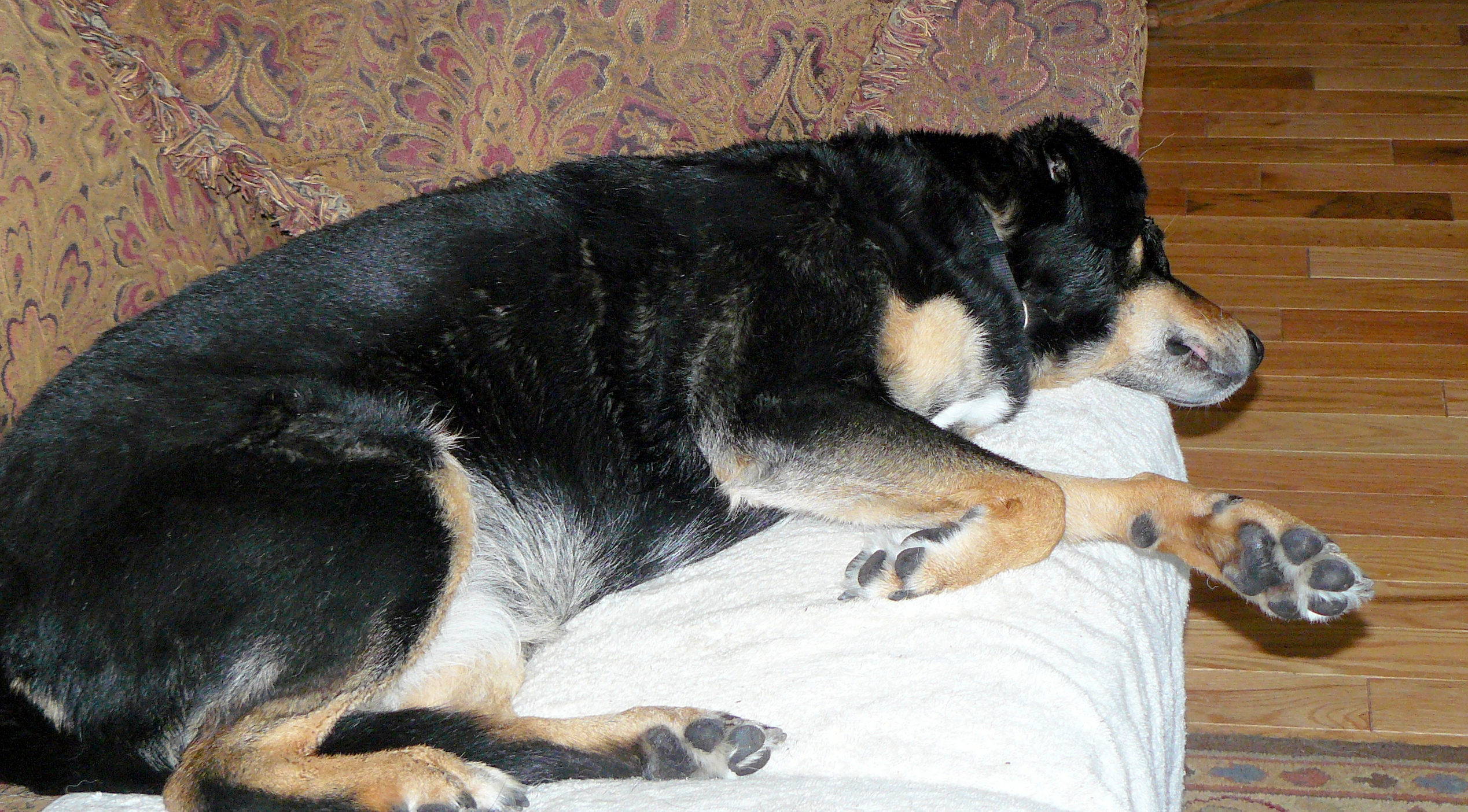
Hazel asleep on the living-room couch at 2pm yesterday.
The sub-heading is taken from an item on the BBC News website that I read yesterday morning. (I’m republishing it in full so that readers are fully informed.)
Lack of sleep can have role in obesity and diabetes, study says
By James Gallagher, Health editor, BBC News website, San Diego
If you need a lie-in at weekends to make up for lack of sleep in the week, you may be at risk of obesity and type 2 diabetes, a study suggests.
The sleeping habits of 522 people found those losing sleep on weekdays were more likely to develop the conditions.
The findings, shown at the Endocrine Society‘s annual meeting, suggested increasing sleep could help patients.
Experts said the findings were interesting and called for the idea to be tested in large trials.
Studies have already shown that shift work can rapidly put healthy people into a pre-diabetic state.
The action of throwing the body clock out of sync is thought to disrupt the natural rhythm of hormones in the body, leading to a host of health problems.
But the pressures of work and social lives mean many people cut their sleep during the week and catch up at the weekend. Researchers are investigating whether there is a health impact.
Widespread
The study, by a team at the University of Bristol in the UK and Weill Cornell Medical College in Qatar, assessed “sleep debt” – a measure of the difference in the nightly hours asleep on weekdays and at the weekend.
“We found that as little as 30 minutes a day sleep debt can have significant effects on obesity and insulin resistance,” said Prof Shahrad Taheri from Weill Cornell.
He added: “Sleep loss is widespread in modern society, but only in the last decade have we realised its metabolic consequences.
“Our findings suggest that avoiding sleep debt could have positive benefits for waistlines and metabolism and that incorporating sleep into lifestyle interventions for weight loss and diabetes might improve their success.”
The study was funded by the UK’s Department of Health, where 10% of healthcare budgets are already spent on treating diabetes.
The disease can lead to blindness, increase the risk of heart attacks and strokes, as well as damaging nerves and blood vessels – dramatically increasing the risk of a foot needing to be amputated.
What the researchers do not know is the impact of improving people’s sleep so they get more on a weeknight and do not need a weekend lie-in.
Dr Denise Robertson, a senior lecturer from the University of Surrey, commented: “This work is interesting and consistent with prospective data found in healthy individuals without type 2 diabetes.
“However, before this association between sleep length, obesity and metabolic status can be used in terms of public health we need the next tier of evidence.
“To date there have been no randomised controlled trials where sleep debt is addressed and a metabolic benefit is observed. However, the potential for such interventions to impact on health is great.”
So while it might be regarded as a little ‘tongue-in-cheek’ to say that we need to learn to sleep more effectively from dogs, the BBC item suggests that it’s not as silly as one might think.
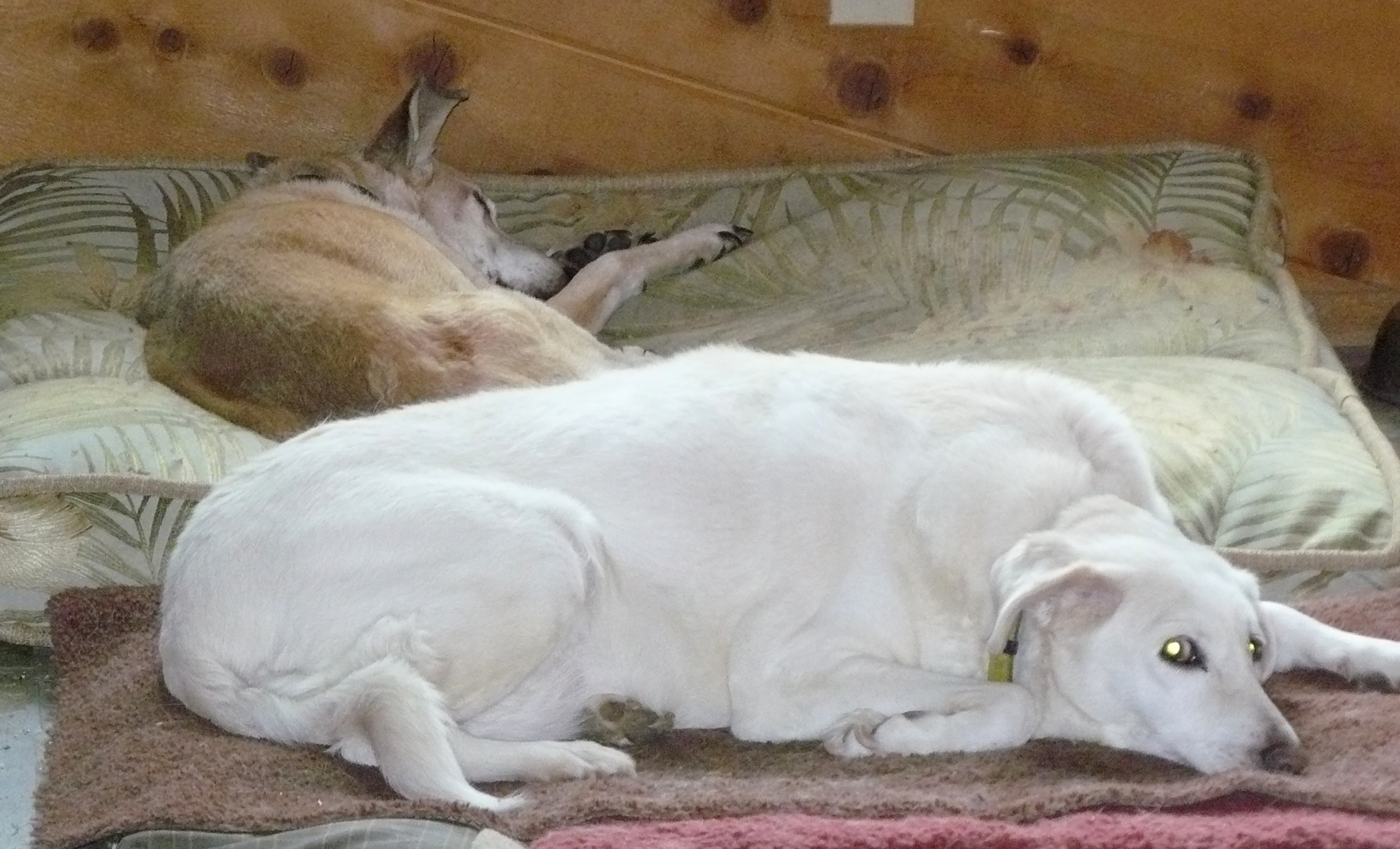
Lilly, to the rear of Paloma, sleeping soundly yesterday afternoon.
In the photograph above of Lilly and Paloma, both Mexican feral dogs rescued by Jean many years ago, sleep and a gentle life have allowed Lilly to achieve the grand old age of 17! In human terms that would be the equivalent of 136-years-old!





 Learning from Dogs