We must constantly remind ourselves that we are the servants of Nature, not the other way around!
There is only one species of creature on this planet that has the power to destroy its own species, and much else: Homo sapiens!
It’s such an obvious reflection, yet it is also such an incredibly difficult commitment to make. I am speaking of the commitment to do more than “tut, tut” but to make a real difference in how each of us live, ensuring that we are making real changes year by year.
I am being little more than a “smart arse” in saying we should learn from dogs to live in harmony with our planet because, in truth, this is the one key area where we can’t learn from our dogs: we each have to learn for ourselves and influence others to do the same.
All of which is my way of introducing a very recent essay from Tom Dispatch. It now follows, but be aware that there were simply too many links to recreate in my republished version. It is republished with the very kind permission of Tom Engelhardt.
ooOOoo
Tomgram: Michael Klare, Tipping Points and the Question of Civilizational Survival
Posted by Michael Klare at 8:00am, October 8, 2015.
In mid-August, TomDispatch’s Michael Klare wrote presciently of the oncoming global oil glut, the way it was driving the price of petroleum into the “energy subbasement,” and how such a financial “rout,” if extended over the next couple of years, might lead toward a new (and better) world of energy. As it happens, the first good news of the sort Klare was imagining has since come in. In a country where the price of gas at the pump now averages $2.29 a gallon (and in some places has dropped under $1.90), Big Oil has begun cutting back on its devastating plans to extract every imaginable drop of fossil fuel from the planet and burn it. Oil companies have also been laying off employees by the tens of thousands and deep-sixing, at least for now, plans to search for and exploit tar sands and other “tough oil” deposits worldwide.
In that context, as September ended, after a disappointing six weeks of drilling, Royal Dutch Shell cancelled “for the foreseeable future” its search for oil and natural gas in the tempestuous but melting waters of the Alaskan Arctic. This was no small thing and a great victory for an environmental movement that had long fought to put obstacles in the way of Shell’s exploration plans. Green-lighted by the Obama administration to drill in the Chukchi Sea this summer, Shell has over the last nine years sunk more than $7 billion into its Arctic drilling project, so the decision to close up shop was no small thing and offers a tiny ray of hope for what activism can do when reality offers a modest helping hand.
As Klare makes clear today, when it comes to the burning of fossil fuels, reality — if only we bother to notice it — is threatening to offer something more like the back of its hand to us on this embattled planet of ours. He offers a look at a future in which humanity, like various increasingly endangered ecosystems including the Arctic, may be approaching a “tipping point.” Tom
Welcome to a New Planet
Climate Change “Tipping Points” and the Fate of the Earth
By Michael T. Klare
Not so long ago, it was science fiction. Now, it’s hard science — and that should frighten us all. The latest reports from the prestigious and sober Intergovernmental Panel on Climate Change (IPCC) make increasingly hair-raising reading, suggesting that the planet is approaching possible moments of irreversible damage in a fashion and at a speed that had not been anticipated.
Scientists have long worried that climate change will not continue to advance in a “linear” fashion, with the planet getting a little bit hotter most years. Instead, they fear, humanity could someday experience “non-linear” climate shifts (also known as “singularities” or “tipping points”) after which there would be sudden and irreversible change of a catastrophic nature. This was the premise of the 2004 climate-disaster film The Day After Tomorrow. In that movie — most notable for its vivid scenes of a frozen-over New York City — melting polar ice causes a disruption in the North Atlantic Current, which in turn triggers a series of catastrophic storms and disasters. At the time of its release, many knowledgeable scientists derided the film’s premise, insisting that the confluence of events it portrayed was unlikely or simply impossible.
Fast forward 11 years and the prospect of such calamitous tipping points in the North Atlantic or elsewhere no longer looks improbable. In fact, climate scientists have begun to note early indicators of possible catastrophes.
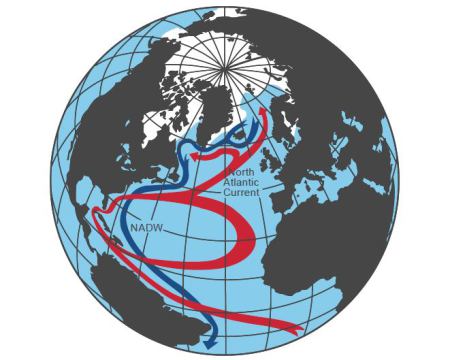
Take the disruption of the North Atlantic Current, the pivotal event in The Day After Tomorrow. Essentially an extension of the Gulf Stream, that deep-sea current carries relatively warm salty water from the South Atlantic and the Caribbean to the northern reaches of the Atlantic. In the process, it helps keep Europe warmer than it would otherwise be. Once its salty water flows into sub-Arctic areas carried by this prolific stream, it gets colder and heavier, sinks to lower depths, and starts a return trip to warmer climes in the south where the whole process begins again.
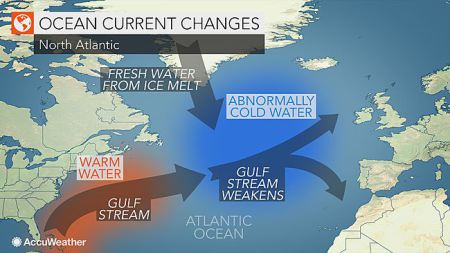
So long as this “global conveyor belt” — known to scientists as the Atlantic Meridional Overturning Circulation, or AMOC — keeps functioning, the Gulf Stream will also continue to bring warmer waters to the eastern United States and Europe. Should it be disrupted, however, the whole system might break down, in which case the Euro-Atlantic climate could turn colder and more storm-prone. Such a disruption might occur if the vast Greenland ice sheet melts in a significant way, as indeed is already beginning to happen today, pouring large quantities of salt-free fresh water into the Atlantic Ocean. Because of its lighter weight, this newly introduced water will remain close to the surface, preventing the submergence of salty water from the south and so effectively shutting down the conveyor belt. Indeed, exactly this process now seems to be underway.
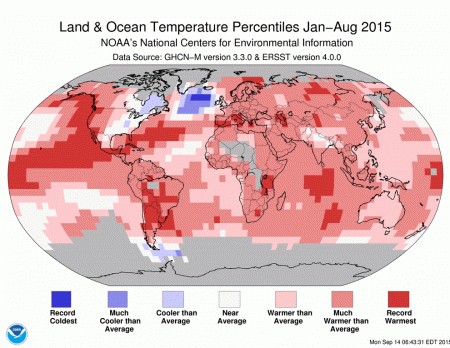
By all accounts, 2015 is likely to wind up as the hottest year on record, with large parts of the world suffering from severe heat waves and wildfires. Despite all this, however, a stretch of the North Atlantic below Iceland and Greenland is experiencing all-time cold temperatures, according to the National Oceanic and Atmospheric Administration. What explains this anomaly? According to scientists from the Potsdam Institute for Climate Impact Research and Pennsylvania State University, among other institutions, the most likely explanation is the arrival in the area of cold water from the Greenland ice sheet that is melting ever more rapidly thanks to climate change. Because this meltwater starts out salt-free, it has remained near the surface and so, as predicted, is slowing the northern advance of warmer water from the North Atlantic Current.
So far, the AMOC has not suffered a dramatic shutdown, but it is slowing, and scientists worry that a rapid increase in Greenland ice melt as the Arctic continues to warm will pour ever more meltwater into the North Atlantic, severely disrupting the conveyor system. That would, indeed, constitute a major tipping point, with severe consequences for Europe and eastern North America. Not only would Europe experience colder temperatures on an otherwise warmer planet, but coastal North America could witness higher sea levels than those predicted from climate change alone because the Gulf Stream tends to pull sea water away from the eastern U.S. and push it toward Europe. If it were to fail, rising sea levels could endanger cities like New York and Boston. Indeed, scientists discovered that just such a slowing of the AMOC helped produce a sea-level rise of four inches from New York to Newfoundland in 2009 and 2010.

In its 2014 report on the status of global warming, the IPCC indicated that the likelihood of the AMOC collapsing before the end of this century remains relatively low. But some studies suggest that the conveyor system is already 15%-20% below normal with Greenland’s melting still in an early stage. Once that process switches into high gear, the potential for the sort of breakdown that was once science fiction starts to look all too real.
Tipping Points on the Horizon
In a 2014 report, “Impacts, Adaptation, and Vulnerability,” Working Group II of the IPCC identified three other natural systems already showing early-warning signs of catastrophic tipping points: the Arctic, coral reefs, and the Amazonian forest. All three, the report suggested, could experience massive and irreversible changes with profound implications for human societies.
The Arctic comes in for particular scrutiny because it has experienced more warming than any other region on the planet and because the impact of climate change there is already so obvious. As the report put it, “For the Arctic region, new evidence indicates a biophysical regime shift is taking place, with cascading impacts on physical systems, ecosystems, and human livelihoods.”
This has begun with a massive melt of sea ice in the region and a resulting threat to native marine species. “For Arctic marine biota,” the report notes, “the rapid reduction of summer ice covers causes a tipping element that is now severely affecting pelagic [sub-surface] ecosystems as well as ice-dependent mammals such as seals and polar bears.” Other flora and fauna of the Arctic biome are also demonstrating stress related to climate change. For example, vast areas of tundra are being invaded by shrubs and small trees, decimating the habitats of some animal species and increasing the risk of fires.
This Arctic “regime shift” affects many other aspects of the ecosystem as well. Higher temperatures, for instance, have meant widespread thawing and melting of permafrost, the frozen soil and water that undergirds much of the Arctic landmass. In this lies another possible tipping-point danger, since frozen soils contain more than twice the carbon now present in the atmosphere. As the permafrost melts, some of this carbon is released in the form of methane, a potent greenhouse gas with many times the warming potential of carbon dioxide and other such gases. In other words, as the IPCC noted, any significant melting of Arctic permafrost will “create a potentially strong positive feedback to accelerate Arctic (and global) warming.” This, in fact, could prove to be more than a tipping point. It could be a planetary catastrophe.
Along with these biophysical effects, the warming of the Arctic is threatening the livelihoods and lifestyles of the indigenous peoples of the region. The loss of summer sea ice, for example, has endangered the marine species on which many such communities depend for food and the preservation of their cultural traditions. Meanwhile, melting permafrost and coastal erosion due to sea-level rise have threatened the very existence of their coastal villages. In September, President Obama visited Kotzebue, a village in Alaska some 30 miles above the Arctic Circle that could disappear as a result of melting permafrost, rising sea levels, and ever bigger storm surges.
Coral Reefs at Risk
Another crucial ecosystem that’s showing signs of heading toward an irreversible tipping point is the world’s constellation of coral reefs. Remarkably enough, although such reefs make up less than 1% of the Earth’s surface area, they house up to 25% of all marine life. They are, that is, essential for both the health of the oceans and of fishing communities, as well as of those who depend on fish for a significant part of their diet. According to one estimate, some 850 million people rely on coral reefs for their food security.
Corals, which are colonies of tiny animals related to sea anemones, have proven highly sensitive to changes in the acidity and temperature of their surrounding waters, both of which are rising due to the absorption of excess carbon dioxide from the atmosphere. As a result, in a visually dramatic process called “bleaching,” coral populations have been dying out globally. According to a recent study by the Worldwide Fund for Nature, coral reef extent has declined by 50% in the last 30 years and all reefs could disappear as early as 2050 if current rates of ocean warming and acidification continue.
“This irreversible loss of biodiversity,” reports the IPCC, will have “significant consequences for regional marine ecosystems as well as the human livelihoods that depend on them.” Indeed, the growing evidence of such losses “strengthens the conclusion that increased mass bleaching of corals constitutes a strong warning signal for the singular event that would constitute the irreversible loss of an entire biome.”
Amazonian Dry-Out
The Amazon has long been viewed as the epitome of a tropical rainforest, with extraordinary plant and animal diversity. The Amazonian tree cover also plays a vital role in reducing the pace of global warming by absorbing vast amounts of carbon dioxide from the atmosphere during the process of photosynthesis. For years, however, the Amazon has been increasingly devastated by a process of deforestation, as settlers from Brazil’s coastal regions clear land for farming and ranching, and loggers (many operating illegally) harvest timber for wood products. Now, as if to add insult to injury, the region faces a new threat from climate change: tree mortality due to a rise in severe drought and the increased forest fire risk that accompanies it.
Although it can rain year-round in the Amazon region, there is a distinct wet season with heavy rainfall and a dry season with much less of it. An extended dry season with little rain can endanger the survival of many trees and increase the risk of wildfires. Research conducted by scientists at the University of Texas has found that the dry season in the southern Amazonian region has grown by a week every decade since 1980 while the annual fire season has lengthened. “The dry season over the southern Amazon is already marginal for maintaining rainforest,” says Rong Fu, the leader of the research team. “At some point, if it becomes too long, the rainforest will reach a tipping point” and disappear.
Because the Amazon harbors perhaps the largest array of distinctive flora and fauna on the planet, its loss would represent an irreversible blow to global biodiversity. In addition, the region hosts some of the largest assemblages of indigenous peoples still practicing their traditional ways of life. Even if their lives were saved (through relocation to urban slums or government encampments), the loss of their cultures, representing thousands of years of adaptation to a demanding environment, would be a blow for all humankind.
As in the case of the Arctic and coral reefs, the collapse of the Amazon will have what the IPCC terms “cascading impacts,” devastating ecosystems, diminishing biodiversity, and destroying the ways of life of indigenous peoples. Worse yet, as with the melting of the Arctic, so the drying-out of Amazonia is likely to feed into climate change, heightening its intensity and so sparking yet more tipping points on a planet increasingly close to the brink.
In its report, the IPCC, whose analysis tends, if anything, to be on the conservative side of climate science, indicated that the Amazon faced a relatively low risk of dying out by 2100. However, a 2009 study conducted by Britain’s famed Meteorological (Met) Office suggests that the risk is far greater than previously assumed. Even if global temperatures were to be held to an increase of 2 degrees Celsius, the study notes, as much as 40% of the Amazon would perish within a century; with 3 degrees of warming, up to 75% would vanish; and with 4 degrees, 85% would die. “The forest as we know it would effectively be gone,” said Met researcher Vicky Pope.
Of Tipping Points and Singularities
These four natural systems are by no means the only ones that could face devastating tipping points in the years to come. The IPCC report and other scientific studies hint at further biomes that show early signs of potential catastrophe. But these four are sufficiently advanced to tell us that we need to look at climate change in a new way: not as a slow, linear process to which we can adapt over time, but as a non-linear set of events involving dramatic and irreversible changes to the global ecosphere.
The difference is critical: linear change gives us the luxury of time to devise and implement curbs on greenhouse gas emissions, and to construct protective measures such as sea walls. Non-linear change puts a crimp on time and confronts us with the possibility of relatively sudden, devastating climate shifts against which no defensive measures can protect us.
Were the Atlantic Meridional Overturning Circulation to fail, for example, there would be nothing we could do to turn it back on, nor would we be able to recreate coral reefs or resurrect the Amazon. Add in one other factor: when natural systems of this magnitude fail, should we not expect human systems to fail as well? No one can answer this question with certainty, but we do know that earlier human societies collapsed when faced with other kinds of profound changes in climate.
All of this should be on the minds of delegates to the upcoming climate summit in Paris, a meeting focused on adopting an international set of restrictions on greenhouse gas emissions. Each participating nation is obliged to submit a set of measures it is ready to take, known as “intended nationally determined contributions,” or INDCs, aimed at achieving the overall goal of preventing planetary warming from exceeding 2 degrees Celsius. However, the INDCs submitted to date, including those from the United States and China, suggest a distinctly incremental approach to the problem. Unfortunately, if planetary tipping points are in our future, this mindset will not measure up. It’s time to start thinking instead in terms of civilizational survival.
Michael T. Klare, a TomDispatch regular, is a professor of peace and world security studies at Hampshire College and the author, most recently, of The Race for What’s Left. A documentary movie version of his book Blood and Oil is available from the Media Education Foundation. Follow him on Twitter at @mklare1.
Follow TomDispatch on Twitter and join us on Facebook. Check out the newest Dispatch Book, Nick Turse’s Tomorrow’s Battlefield: U.S. Proxy Wars and Secret Ops in Africa, and Tom Engelhardt’s latest book, Shadow Government: Surveillance, Secret Wars, and a Global Security State in a Single-Superpower World.
Copyright 2015 Michael T. Klare
ooOOoo
Just to repeat myself in that if you find this essay from Michael Klare one that you want to refer to again, then go across to the version published on TomDispatch so you can follow up the many links in that essay.





















 Learning from Dogs