It goes back much further than the Christian church.
Jean and I are atheists and have been all our lives. Therefore we tend to take more notice of the Winter solstice (that is today as the day that I am preparing this post) rather than Christmas Day and our sense that it is a product of Jesus Christ being born on the 25th; or so I thought!
But the tradition of a Christmas tree in particular goes much further back, as this article from The Conversation sets out.
ooOOoo
The Christmas tree is a tradition older than Christmas
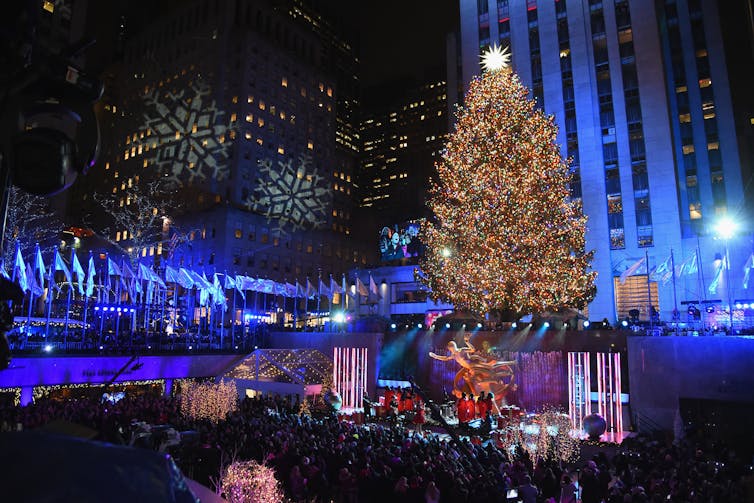
Public Christmas trees, like Rockefeller Center’s famous tree, didn’t start appearing in the U.S. until the 20th century. Nicholas Hunt/WireImage via Getty Images
Why, every Christmas, do so many people endure the mess of dried pine needles, the risk of a fire hazard and impossibly tangled strings of lights?
Strapping a fir tree to the hood of my car and worrying about the strength of the twine, I sometimes wonder if I should just buy an artificial tree and do away with all the hassle. Then my inner historian scolds me – I have to remind myself that I’m taking part in one of the world’s oldest religious traditions. To give up the tree would be to give up a ritual that predates Christmas itself.
The solstices, when the Sun is at its highest and lowest points in the sky, were major events. The winter solstice, when the sky is its darkest, has been a notable day of celebration in agrarian societies throughout human history. The Persian Shab-e Yalda, Dongzhi in China and the North American Hopi Soyal all independently mark the occasion.
The favored décor for ancient winter solstices? Evergreen plants.
Whether as palm branches gathered in Egypt in the celebration of Ra or wreaths for the Roman feast of Saturnalia, evergreens have long served as symbols of the perseverance of life during the bleakness of winter, and the promise of the Sun’s return.
Christmas slowly emerges
Christmas came much later. The date was not fixed on liturgical calendars until centuries after Jesus’ birth, and the English word Christmas – an abbreviation of “Christ’s Mass” – would not appear until over 1,000 years after the original event.
While Dec. 25 was ostensibly a Christian holiday, many Europeans simply carried over traditions from winter solstice celebrations, which were notoriously raucous affairs. For example, the 12 days of Christmas commemorated in the popular carol actually originated in ancient Germanic Yule celebrations.
The continued use of evergreens, most notably the Christmas tree, is the most visible remnant of those ancient solstice celebrations. Although Ernst Anschütz’s well-known 1824 carol dedicated to the tree is translated into English as “O Christmas Tree,” the title of the original German tune is simply “Tannenbaum,” meaning fir tree. There is no reference to Christmas in the carol, which Anschütz based on a much older Silesian folk love song. In keeping with old solstice celebrations, the song praises the tree’s faithful hardiness during the dark and cold winter.
Bacchanal backlash
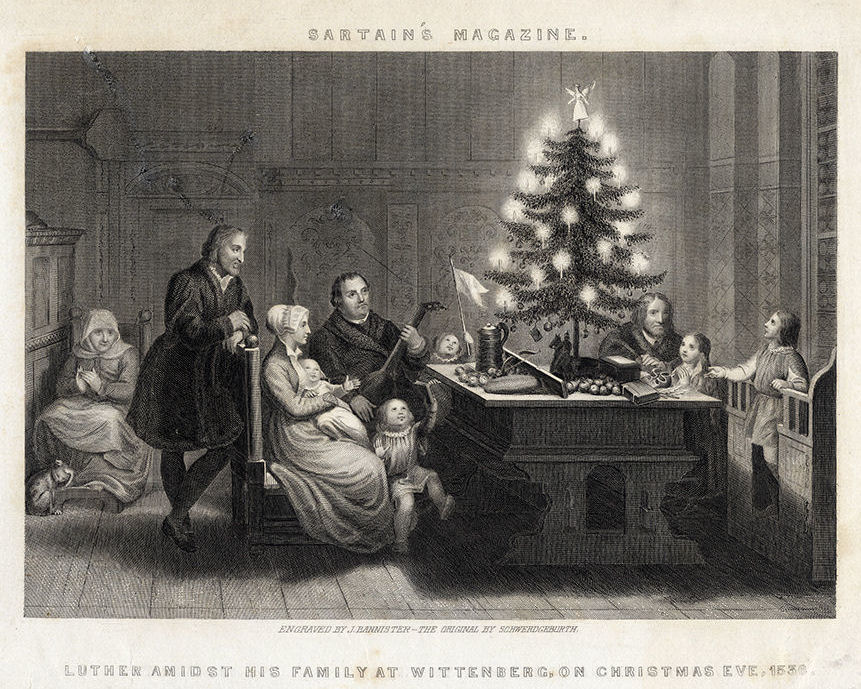
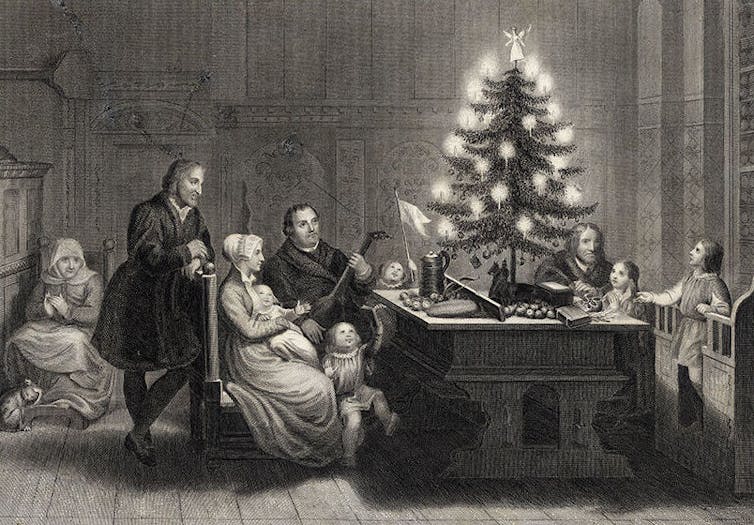
Sixteenth-century German Protestants, eager to remove the iconography and relics of the Roman Catholic Church, gave the Christmas tree a huge boost when they used it to replace Nativity scenes. The religious reformer Martin Luther supposedly adopted the practice and added candles.
German Protestants sought to replace ornate Nativity scenes with the simpler tree. Wikimedia Commons
But a century later, the English Puritans frowned upon the disorderly holiday for lacking biblical legitimacy. They banned it in the 1650s, with soldiers patrolling London’s streets looking for anyone daring to celebrate the day. Puritan colonists in Massachusetts did the same, fining “whosoever shall be found observing Christmas or the like, either by forbearing of labor, feasting, or any other way.”
German immigration to the American colonies ensured that the practice of trees would take root in the New World. Benjamin Franklin estimated that at least one-third of Pennsylvania’s white population was German before the American Revolution.
Yet, the German tradition of the Christmas tree blossomed in the United States largely due to Britain’s German royal lineage.
Victoria’s style of rule both reflected and shaped the outwardly stern, family-centered morality that dominated middle-class life during the era. In the 1840s, Christmas became the target of reformers like novelist Charles Dickens, who sought to transform the raucous celebrations of the largely sidelined holiday into a family day in which the people of the rapidly industrialized nation could relax, rejoice and give thanks.
His 1843 novella, “A Christmas Carol,” in which the miserly Ebenezer Scrooge found redemption by embracing Dickens’ prescriptions for the holiday, was a hit with the public. While the evergreen décor is evident in the hand-colored illustrations Dickens specially commissioned for the book, there are no Christmas trees in those pictures.
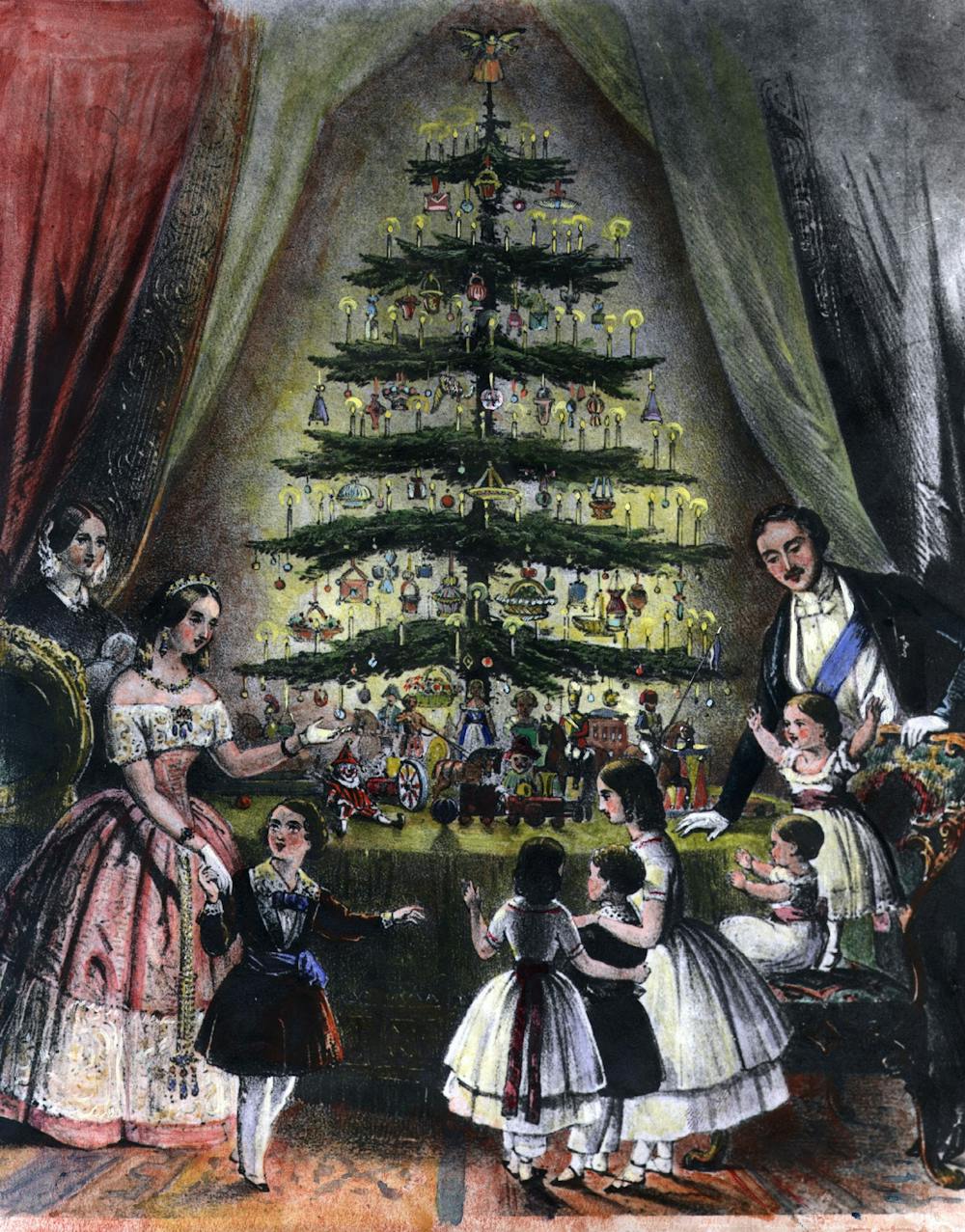
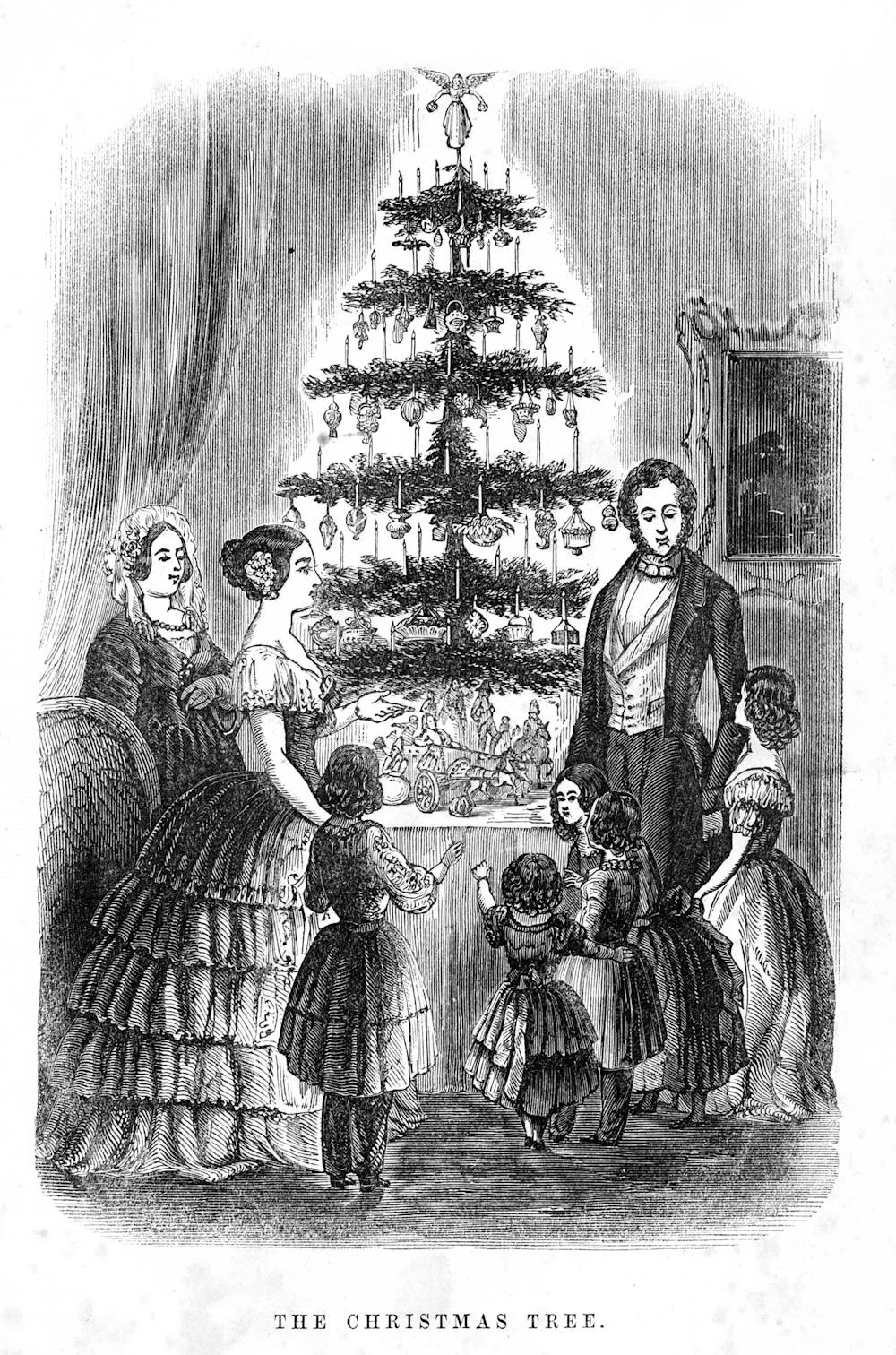
After the London Illustrated News published an image of Queen Victoria’s tree, the public eagerly sought to mimic the tradition. Wikimedia Commons
Victoria added the fir tree to family celebrations five years later. Although Christmas trees had been part of private royal celebrations for decades, an 1848 issue of the London Illustrated News depicted Victoria with her German husband and children decorating one as a family at Windsor Castle.
The cultural impact was almost instantaneous. Christmas trees started appearing in homes throughout England, its colonies and the rest of the English-speaking world. Dickens followed with his short story “A Christmas Tree” two years later.
Adopting the tradition in America
During this period, America’s middle classes generally embraced all things Victorian, from architecture to moral reform societies.
Sarah Hale, the author most famous for her children’s poem “Mary had a Little Lamb,” used her position as editor of the best-selling magazine Godey’s Ladies Book to advance a reformist agenda that included the abolition of slavery and the creation of holidays that promoted pious family values. The adoption of Thanksgiving as a national holiday in 1863 was perhaps her most lasting achievement.
An engraving of Queen Victoria’s tree in Godey’s Ladies Book popularized Christmas trees in the U.S. Godey’s Lady’s Book
It is closely followed by the Christmas tree.
While trees sporadically adorned the homes of German immigrants in the U.S., it became a mainstream middle-class practice when, in 1850, Godey’s published an engraving of Victoria and her Christmas tree. A supporter of Dickens and the movement to reinvent Christmas, Hale helped to popularize the family Christmas tree across the pond.
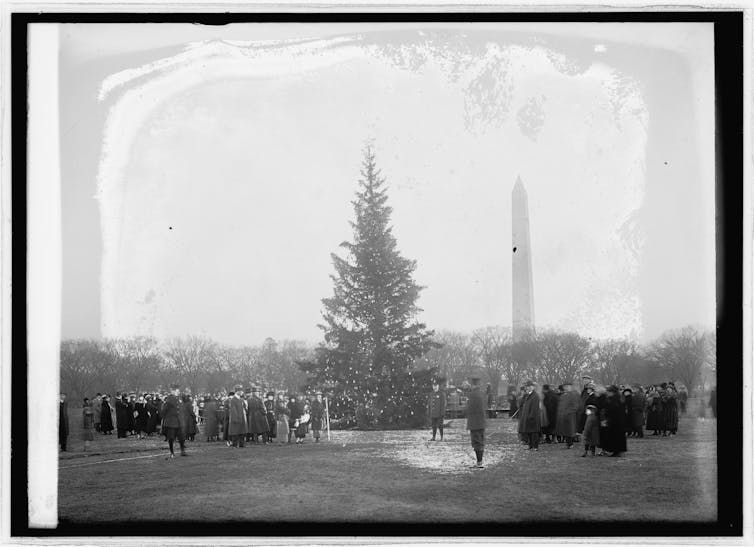
A Christmas tree was erected on the White House South Lawn for the first time in 1923. Library of Congress
Christmas trees go global
As both American and British cultures extended their influence around the world, Christmas trees started to appear in communal spaces even in countries that are not predominately Christian. Shopping districts in Dubai, United Arab Emirates, Hong Kong and Tokyo now regularly erect trees.
The modern Christmas tree is a universal symbol that carries meanings both religious and secular. Adorned with lights, they promote hope and offer brightness in literally the darkest time of year for half of the world.
In that sense, the modern Christmas tree has come full circle.
During the holidays, it’s typical for people to indulge in special foods. Being a pet owner myself, I know that many pet parents want to give their fur babies special treats as well.
Here are some of the most common food-related crises we veterinarians encounter in the animal ER during the holidays, and what to do if they happen.
Fatty food risks
Turkey with gravy is probably among the most popular holiday meals. And most dogs or cats would certainly agree with their humans that roast turkey is delicious.
However, the fat contained in turkey skin – and the excess of fatty, greasy foods that can accompany it, such as gravy, butter and bacon – don’t go down well with cats and dogs. Pets that ingest an overload of fats may develop pancreatitis, an inflammation of the pancreas, the organ that helps break down fat, protein and carbs.
Pancreatitis causes the pancreas to leak digestive enzymes and ultimately “digest” itself. If untreated, pancreatitis can affect other organ systems such as the kidneys and the liver and even cause blood clotting.
The most common symptoms of pancreatitis include vomiting and diarrhea. Pets that may have pancreatitis should be rushed to the closest veterinary hospital or ER. The vet will perform diagnostic blood tests, including a specific test for pancreatic enzymes called pancreatic lipase immunoreactivity or cPLI/fPLI.
Treatment for pancreatitis mostly involves dealing with its symptoms. The pet receives IV fluids to help establish electrolytes balance, with added anti-nausea and pain medications to stop the vomiting. Antibiotics may be necessary, as well as liver protectants and probiotics, and a special diet.
Onion offenses and bread badness
If only turkey were the sole problem! Many other common holiday ingredients can also harm pets.
Several allium species common to holiday cooking, such as leeks, garlic, onions, chives and shallots, can be healthy for people. For dogs and cats, though, alliums are toxic. If ingested, they can cause hemolytic anemia – a decreased number of red blood cells.
The signs of hemolytic anemia, which normally appear a few days after ingestion, include vomiting, diarrhea, lethargy and jaundice.
To treat hemolytic anemia in pets, veterinarians do blood tests to determine whether a transfusion is necessary. They address the symptoms of allium intoxication with IV fluids, antioxidants and anti-nausea drugs.
Yeast-risen foods like rolls and breads are also holiday dinner staples that people should keep away from their pets. The yeast in these foods can ferment in a pet’s warm stomach and produce toxic levels of ethanol. In pets, ethanol toxicity may lead to metabolic acidosis, which can cause sudden drop in blood glucose, respiratory depression, seizures and cardiac arrest.
Normally, pet owners do not suspect metabolic acidosis until it is almost too late, because it has few outward symptoms. So if there’s a possibility that a pet has swallowed any type of cooked or raw yeast dough, get it to a veterinary ER right away.
By the way, pets can also experience ethanol toxicity by lapping up cocktails or beer, so keep alcoholic drinks out of their reach as well.
No chocolate for pets
Now, what about a favorite holiday treat – chocolate?
Substances that may actually attract humans to chocolate – methylxanthines like theobromine and caffeine – are toxic to both dogs and cats. When vets provide emergency treatment for chocolate ingestion, we typically hear that children shared their candy with their beloved pet.
Pets that ingest chocolate can develop “chocolate intoxication,” a condition in which methylxanthines accumulate in the body and make them sick. Signs of chocolate intoxication in pets include tremors, increased heart rate, vomiting, diarrhea, restlessness and even seizures.
Chocolate intoxication in pets is a medical emergency. The pet needs to have its stomach emptied and receive support therapy with IV fluids and activated charcoal. The vet will probably want to know the type and how much chocolate the pet ate, because some kinds of chocolate, such as baking chocolate, can have worse toxic effects.
Chocolate also has a lot of fat, so the cat or dog’s pancreas will not enjoy it either.
Grapes and dogs don’t mix
How about fruits? Well, there is a fruit very toxic to dogs that often shows up at holiday gatherings: grapes, both fresh and dehydrated into raisins.
If eaten, the tartaric acid in grapes or raisins may cause acute kidney disease. Common signs of acute kidney disease in dogs are vomiting, intermittent diarrhea and increased intake of water.
Acute kidney disease in dogs is a medical emergency. If it is suspected, the pet should be rushed to a veterinary hospital or ER right away. Treatment is typically limited to stabilizing the pet with IV fluids.
Sweet for people, poison to pets
While xylitol toxicity is one of the more common emergencies we veterinarians see these days, it’s still largely unknown among pet owners.
Xylitol is an artificial sweetener often used in sugar-free products. While safe for humans, for cats and dogs it’s a fast-acting and potentially deadly poison.
Ingesting even the smallest amount of xylitol can cause a pet’s liver to rapidly release insulin, causing hypoglycemia – unusually low blood glucose levels. Within 30 minutes, the pet will experience symptoms such as vomiting, lethargy and seizures and lose coordination of its limbs – called ataxia.
Emergency treatment for a pet with xylitol toxicity involves giving the animal IV fluids containing dextrose to raise its blood glucose level and carefully monitoring its progress.
The bottom line? Several delicious foods that are safe for humans can be very dangerous for pets in general – not just cats and dogs, but also birds, reptiles and pocket pets like mice, hamsters and gerbils. So make the holidays special for furry or feathery babies by giving them treats from the pet food store or veterinarian’s office, and keep them away from the kitchen counter and trash can.
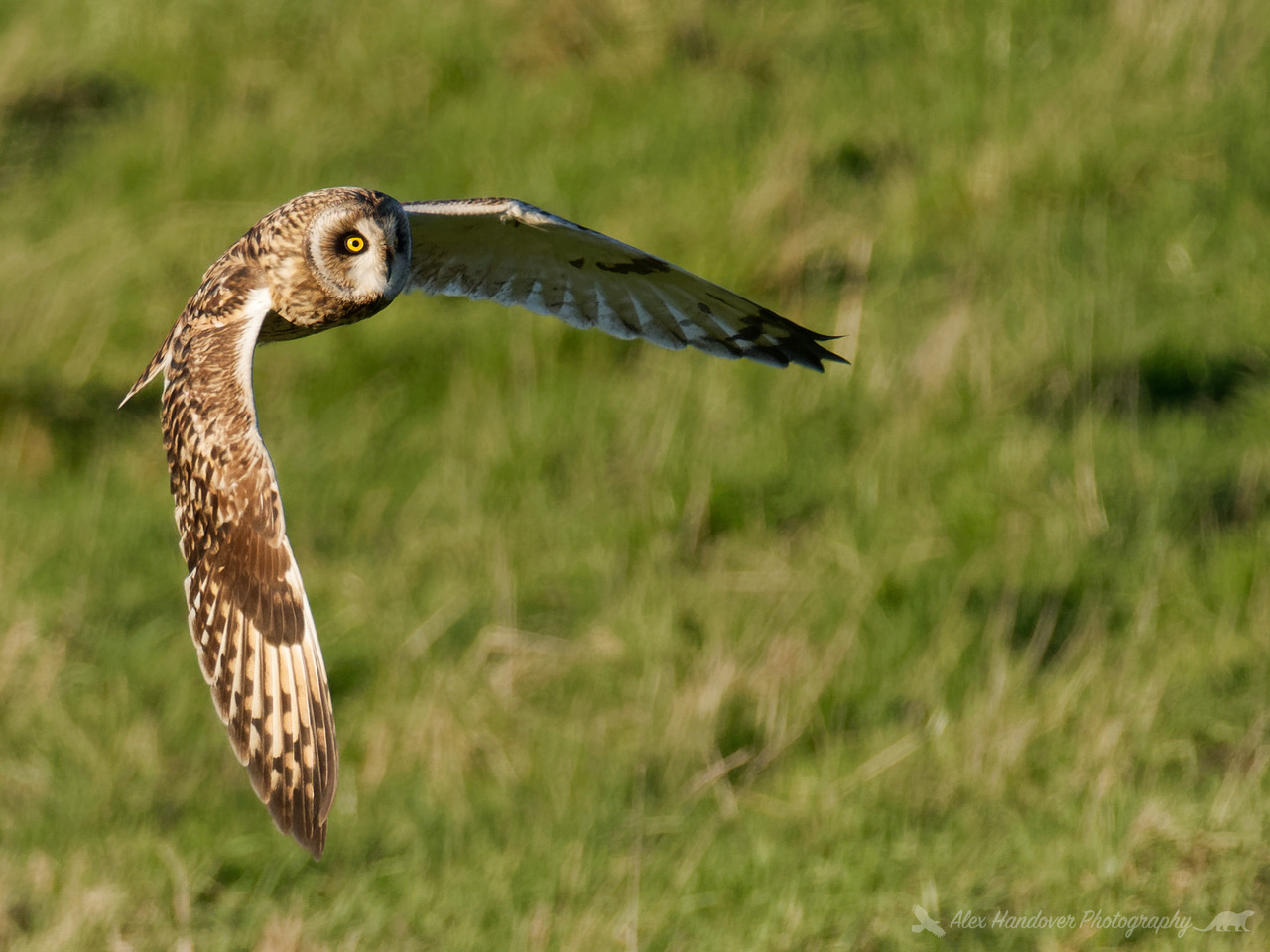
Last Friday I received an email from my son in which he said: “… bit chilly here -9C (16F) overnight but we heard that some short-eared owls had turned up in a nature reserve near Minehead so have been down there the last few days, here are the pictures.”
He included the many photographs separately as well. If you want to see more then please go here plus I want to credit Alex Handover as the photographer.
Here they are:
oooo
oooo
oooo
oooo
oooo
oooo
oooo
oooo
I have no doubt that many of you will find these very exciting!
People who have never had dogs in their lives don’t understand the closeness and intensity of the relationship between dogs and humans. Just recently I posted an article that mentioned how dogs can understand our speech in many ways.
Now comes an article in The Dodo that reinforces the amazing bond between dog and human. Here it is:
ooOOoo
Dog Can’t Believe Her Eyes When She Sees Who’s Standing Outside The Door
Since the time when this sweet German shepherd named Sofie was just a puppy, her and her dad, Austin, have been inseparable.
“She loves him so much,” Ally Ross, Sofie’s mom, told The Dodo.
This year, however, due to life circumstances, Sofie and Austin were forced to spend more than a little time apart.
Ally Ross took all the photographs.
Austin is a member of the U.S. Armed Forces and, earlier in the year, was called up for a six-month deployment. Sadly, that meant his daily routine of love and fun with Sofie had to be put on hold.
It was something Sofie couldn’t quite comprehend.
“After he left, she would still go into our bedroom and look for him,” Ross said.
Fortunately, Austin wouldn’t be gone forever.
Last month, having completed his deployment, Austin could finally return home. Ross decided to record the moment he arrived at the door to surprise Sofie.
The dog’s heart was about to be whole once again.
When the door opened, Sofie could hardly believe her eyes.
(Unfortunately, this link does not play automatically in WordPress but I will leave it there in case anyone else can play it.)
Sofie’s disbelief quickly turned into an explosion of love and excitement. It was an outward expression of what Sofie’s spirit longed to feel each and every day Austin was away.
“Oh, I definitely cried!” Ross said.
Her dad is back. Their family is complete anew.
With Austin’s return, it’s been business as usual again for him and Sofie — and how sweet it is.
“Now that he’s home, they go on runs and adventures together,” Ross said. “Best buds for sure.”
My Garmin GPS required updating and I had no idea of how long it would take. It was a Garmin for the car and hardly ever used; but an appointment coming up required its use!
So there’s no post for today (apart from this apology).
Recently, after this sweet dog named Rosie somehow ended up getting lost near her home in England, she picked the perfect place to go for help.
She simply strolled into a local police station to report (in her own way) her own disappearance.
“[You] can see her approaching the doors before walking in and taking a seat in the corner,” the Leicestershire Police wrote. “Good dog!”
Here’s footage of Rosie in action:
It’s unclear how long Rosie had been lost, but after making her presence known to authorities, it was only a matter of time before things were set right.
“Our staff fetched some water for Rosie, and made fast friends with plenty of fuss,” police wrote. “Thankfully she was wearing a collar, so a lead was available to contact Rosie’s owner, who was delighted she had been found safe and well.”
Rosie’s own cleverness had made their job easy — though she was pretty tuckered out after the little drama finished unfolding.
Rosie’s problem-solving skills have earned her plenty of praise from people online — all well deserved, of course. But the police themselves perhaps put it best.
“What a lovely, clever dog,” they wrote.
ooOOoo
It is not just Rosie that is a “lovely, clever dog” but all dogs. But, of course, we are biased!
From the 21st November until the 23rd Sunshine Solar installed a solar panel system. But we were then told to wait until Pacific Power had come to the house to put in a new electricity meter. Last Thursday, 1st December, Brent from Pacific Power called by and replaced our electricity meter. He replaced it with a bi-directional meter that when we were producing more power than we are consuming then the surplus would be ‘banked’ to be used at times when we required the surplus.
This was the result of us investing in a ground-mounted solar system.
We purchased the system from Solar Sunshine after doing a great deal of research. Indeed Brent said that they were a great company.
The other thing that we had no choice over was to install a ground-mounted system some 120 feet from the house. Because neither the house nor the roof face East and therefore are no use for solar. But as Brent pointed out last Thursday the ground-mounted system, despite being more expensive, was a good alternative to the roof system because new roof tiles were irrelevant.
The system consists of 30 individual panels capable of producing a maximum output of 65 amps at 240 volts; in other words 15,600 watts!
Yesterday, Cory and Brandon (sp?) came out to the system and checked that it was alright. Plus they gave us an digital application so we could see how much power we were generating, plus more, and they also took some photographs, that I offer you now.
oooo
oooo
oooo
This last photograph was one taken by yours truly with Cory on the left and Brandon on the right with Jeannie in the middle.
Finally, the ‘app’ is going to be very useful.
Already it shows that last Saturday the array produced 29 kilowatts and then yesterday, the 4th December, the array produced 22.9 kilowatts and these were by no means sunlit days all the time. That brings the total for all 5 days in December, in other words since the system went live, to 91.1 kilowatts as of 15:27 PT on the 5th.
We are most pleased with the company and the installation.



























 Learning from Dogs