Guess what! More pictures from Kristýna Kvapilová

oooo

oooo

oooo

oooo
oooo

oooo

oooo

Once again, taken from here.
More of these gorgeous photographs in a week’s time.
Dogs are animals of integrity. We have much to learn from them.
Year: 2019
Guess what! More pictures from Kristýna Kvapilová
oooo
oooo
oooo
oooo
oooo
oooo
oooo
Once again, taken from here.
More of these gorgeous photographs in a week’s time.
And what a great story!
This article really demonstrates the power of love, good training and inspiration.
ooOOoo
November 6th, 2018.

What happens to those dogs that are just too much dog for people to handle? “You know them — you go to your friend’s barbecue, their dog is so happy to see you that she pees on your feet, and she drops a slobbery ball in your lap,” says Megan Parker (TEDxJacksonHole talk: Dogs for Conservation), a wildlife biologist and dog expert based in Bozeman, Montana. “You throw it to get as much distance between you and the dog as possible, but she keeps coming back with the ball. By the 950th throw, you’re thinking, Why don’t they get rid of this dog?” All too often, their owners reach the same conclusion and leave their pet at a shelter.
Thanks to Parker and the team at Working Dogs for Conservation (WD4C), some of these dogs have found a new leash lease on life. They’re using their olfactory abilities and unstoppable drive in a wide variety of earth-friendly ways, working with human handlers to sniff out illegal poachers and smugglers, track endangered species, and spot destructive invasive plants and animals.

Parker first considered using dogs in conservation when she worked on the reintroduction of wolves to Yellowstone Park and was asked how researchers could track wolves through their scat, or droppings. “I started thinking how best to detect their scat off a large landscape, and the idea came up for dogs,” she says. In 2000, she cofounded WD4C to train and use canines in conservation work. Most of their dogs are adopted from shelters or from organizations or work settings where they didn’t quite fit in.
While it’s fair to say almost all dogs love toys, wildlife-detection dogs are obsessed with them. “They’ll do anything to chase a ball or a tug toy,” says Parker. If their preferred plaything is thrown far into the brush or buried in a massive pile of leaves, no worries — they won’t stop looking until they find it. No food, obstacle or distractions can deter them, and WD4C staff have turned this single-minded focus into a powerful incentive. Their canine friends are rewarded with their favorite toy every time they locate a desired wildlife-related scent, anything from elephant ivory and poachers’ guns in Zambia and trafficked snow leopards in Tajikistan to predatory Rosy wolf snails in Hawaii and invasive Argentine ants on California’s Santa Cruz Islands. The dogs are careful not to disturb or touch any specimens they pinpoint; it’s all about the toy.
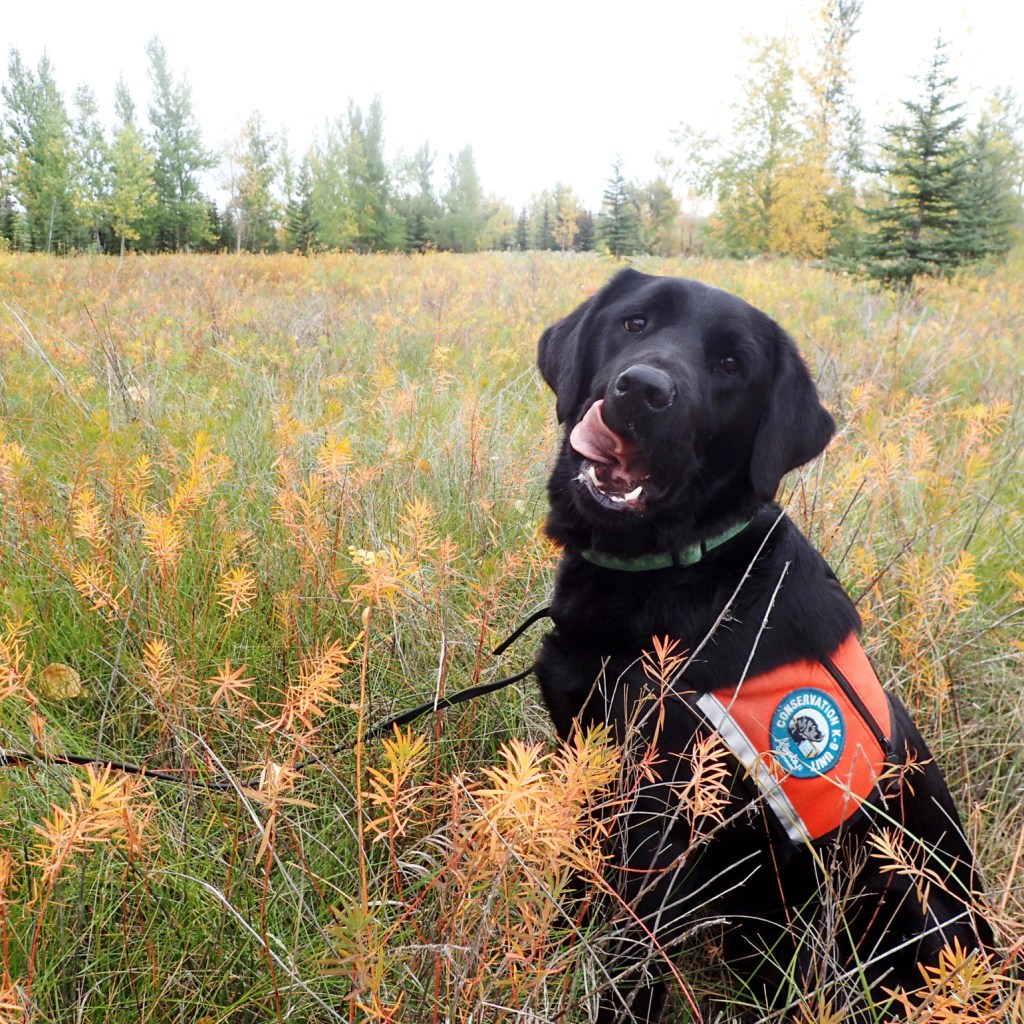
Lily, a yellow Lab, is one of the group’s many sad-start-happy-ending stories. When the then-three-year-old came to the attention of WD4C trainers, she’d already bounced her way in and out of five different homes. She couldn’t sit still and she never, ever wanted to stop playing. Oh, and she was a bit of a whiner. Since joining WD4C in 2011, she has been trained to recognize a dozen different conservation-related scents and been deployed to track grizzly bears and sniff out the eggs, beetles and larvae of emerald ash borers, an insect that has killed millions of trees in the US and Canada.
The three-dozen-strong WD4C pack also includes purebred working dogs who weren’t right for their intended occupations. Orbee, a border collie, had the enthusiasm and live-wire energy required of ranch dogs, but there was one problem: he had zero interest in herding sheep. He also barked a lot. Since joining WD4C in 2009, Orbee has had a globe-trotting career — he has spotted invasive quagga and zebra mussels on boats in Alberta and Montana, monitored the habitats of the endangered San Joaquin kit fox in California, and assisted scientists in northern Africa in counting up Cross River gorillas, the world’s rarest gorilla.
Jax is a Belgian malinois, a sturdy breed frequently used by the police and military. He was in training to serve with the US Army’s special unit, the Green Berets, until his handlers realized Jax doesn’t like to bite people — just toys. And, boy, does he loves toys; he’s even tried to climb trees to reach prized objects. Since 2017, Jax’s athleticism and high spirits have been used by the WD4C to perform tasks such as mapping the movements of bobcats in the western US.
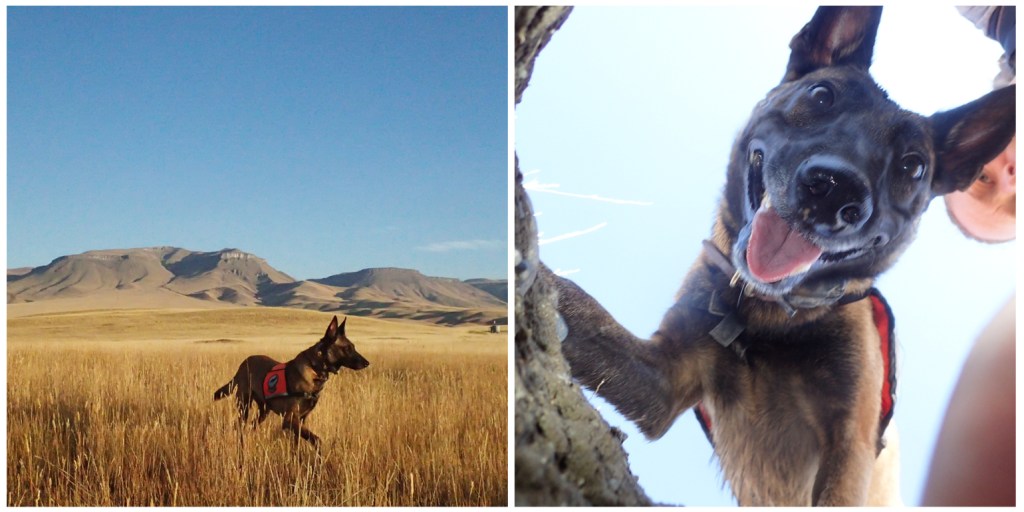
“Different dogs have different strong suits,” says Parker. She and the WD4C team try to place their charges in environments that match their skillset, likes and dislikes. Unlike many dogs, Tule (above), a Belgian malinois who flunked out of a job with US Customs and Border Patrol, has absolutely no desire to chase small animals such as cats, squirrels and rabbits. This made her the perfect fit to help researchers monitor black-footed ferrets, which live in the same territory as a large, scampering prairie-dog population. The ferrets, once thought extinct in the US, were reintroduced in Wyoming in recent years. Tule alerts her handlers to the scent of live ferrets or their scat, information that allows state wildlife officials to map their distribution and see if the population is recovering. Without Tule and her pack, researchers would be forced to study the elusive creatures with cameras or live traps, undependable methods at best.
The dogs’ efforts have resulted in positive, substantial changes. The organization teamed up with the nonprofit Wildlife Conservation Society so their dogs could track the scat of four keystone carnivores (grizzly bears, black bears, mountain lions and wolves) through the Centennial Mountains in Idaho and Montana. Five years of doggie data showed that all four species depended on the mountains to move between the Greater Yellowstone ecosystem and central Idaho wilderness areas. Thanks to this information, activists were able to stop construction of a housing development that would have interrupted their migratory pathway.
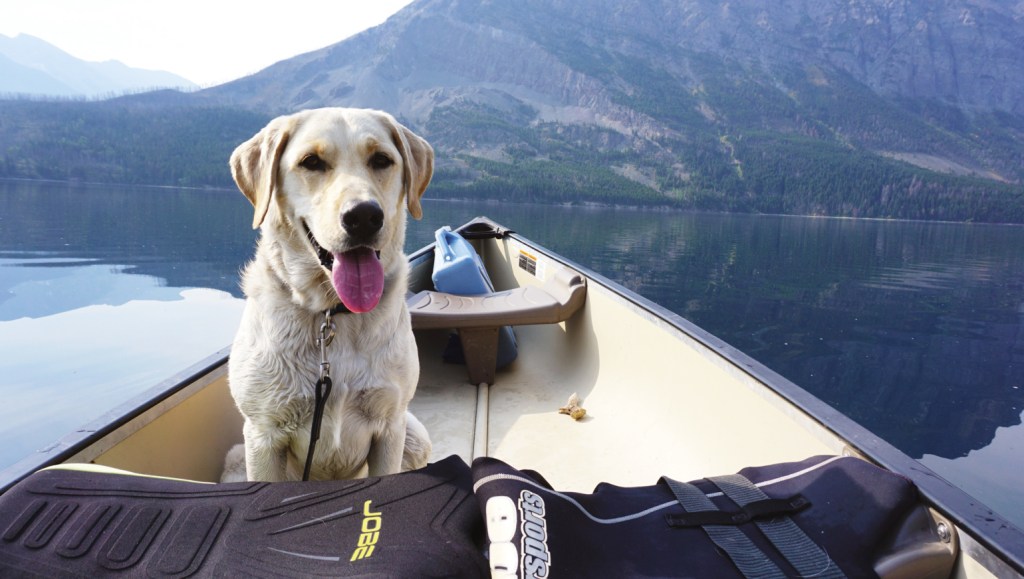
Some dogs are searching for animals and plants that are most wanted for the opposite reason: they’re invasive species proliferating where they don’t belong and driving out native flora and fauna. There’s the previously mentioned zebra and quagga mussels, which spread by clinging to boats and watercraft, and which clog water and sewage pipes, foul up power plants, and destroy good algae. Tobias (above) is a specialist in finding them. In one test, WD4C dogs identified 100 percent of the boats with mussels aboard (human screeners spotted 75 percent). The dogs did the job more quickly, and they could also detect the mussels’ microscopic larvae.
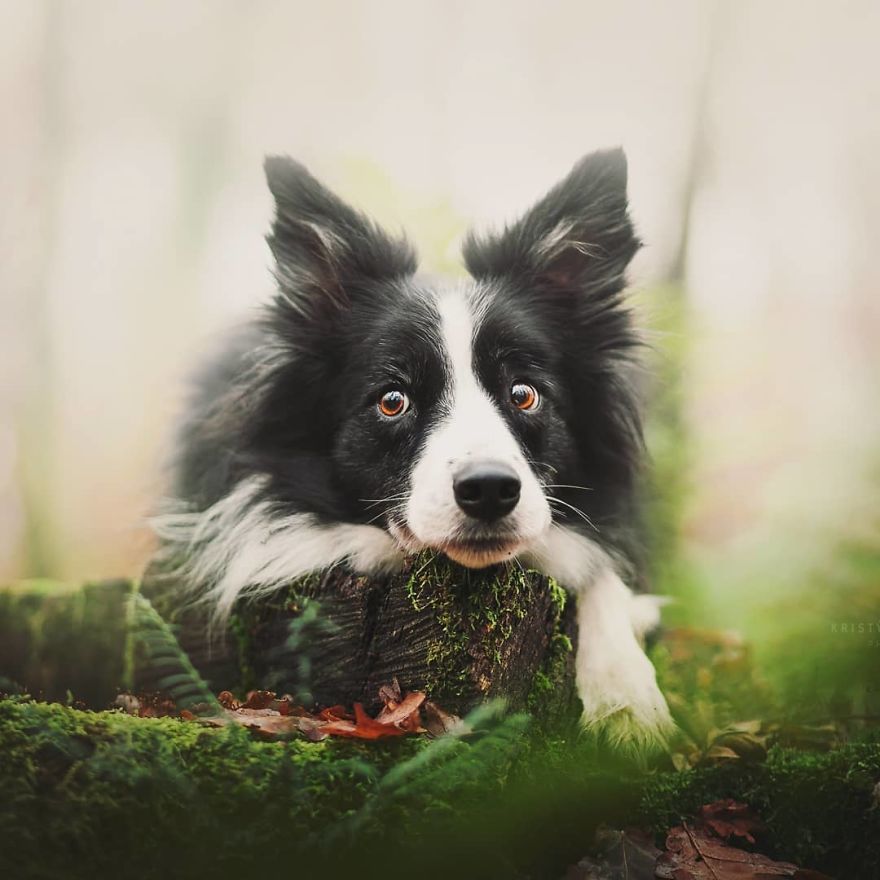
Former shelter dog Seamus (shown at the top of the post), a border collie, is an expert in searching out dyer’s woad on Mount Sentinel in Montana. Humans have tried to eradicate the invasive weed by spotting its flowers and pulling out plants by hand, but these attempts barely made a dent. By the time it’s found, it’s often already seeded (and a single plant can produce up to 10,000 seeds). Seamus’s keen nose, along with those of three canine colleagues, learned to sniff out woad before it flowered, a time when it’s extremely hard for human eyes to see. They also found root remnants left in the ground. At a recent checkup, just 19 of the invasive plants were found on the mountain. “It will be a complete extermination,” says Parker. “It’s just going to take a long time because we don’t know how long their seeds last in the soil.”
The dogs’ hunting grounds even extend into the water. Although prized in their native habitat, brook trout are an invasive species elsewhere; in some places in the Western US, they are pushing out the native cutthroat trout. WD4C was brought to Montana by the US Fish and Wildlife Service, the US Geological Survey and the Turner Endangered Species Fund to see whether their animals could learn to sniff out live fish in moving water. Reports Parker, “This project confirmed what we long suspected: that dogs can detect and discriminate scents in water.”

Pepin (above), who worked on the brook trout project, is part of an ambitious charge to train the dogs to detect infectious diseases in animals.“He’s done the first of a lot of things for us, because he’s so game,” says Parker. Some wildlife carry brucellosis, a bacterial disease that is particularly harmful to cattle. It’s difficult to tell when animals are first infected because they typically don’t display symptoms, so in areas where the disease is prevalent, ranchers tend to keep livestock and wildlife as far away from each other as possible — severely limiting the territory and movement of both kinds of animals. The hope is that dogs could provide a fast, reliable way to identify infected herds. So far, Pepin has shown he can discriminate infected elk scat with higher and lower concentrations of the bacteria, and WD4C is eager to explore this use of dog power. “We have proof of concept,” says Parker. “I’d like to move that work forward.”
There are so many other unexplored capacities and environments where dogs could help, Parker believes. To that end, WD4C started a program in 2015 called Rescues 2the Rescue, which aims to help shelters around the world identify would-be detection dogs and place them with wildlife and conservation organizations. What kind of dogs are they looking for? Ones that are, uh, crazy.
To clarify that adjective, we’ll close by telling you about Wicket, a black Lab mix who retired from WD4C in 2017 at the top of her game, having detected 32 different wildlife scents in 18 states and seven countries. Wicket languished in a Montana shelter for six months, barking up a storm and scaring away potential owners, until WD4C cofounder Aimee Hurt found her there in 2005. When she went to adopt her, the shelter director said, “You don’t want that dog — that dog’s crazy!” To which Hurt replied, “I think she might be the right kind of crazy.”
All photos courtesy of Working Dogs for Conservation.
Watch Megan Parker’s TEDxJacksonHole talk here:
Rebekah Barnett is the community speaker coordinator at TED, and knows a good flag when she sees one.
ooOOoo
Dogs give us so much. They are inspiring, loving and happy creatures.
Musings about truth, faith and reason.
One of the Christmas cards that we received said this:
So glad we are friends and neighbors. And I will pray you will have a year full of the peace, love and hope that Jesus promises.
With Love, Hugs and Prayers.
Now I understand to a degree why the sender, a neighbour of ours, would write that. But at the same time I do not. We are clearly atheists. Indeed, back in 2012 on first meeting I happened to say that I was not a believer and it produced a shock; a reaction that how could anyone not be a believer.
And I think yesterday’s post supports the view that the reality of the existence of our solar system, all 2.6 billion years of it, shows that religious beliefs of all forms come from an age where the world beyond one’s doorstep was unknown and scary. Things are different now.
But to go back to the age of things.
That existence of our solar system came about some 9.2 billion years, give or take some 60 million years, after the Big Bang.
In other words, the Big Bang, that started the whole thing off, came about three and a half times earlier than the creation of the solar system.
So read the following by Prof. Jerry Coyne. It makes perfect sense.
ooOOoo
Professor Emeritus of Ecology and Evolution, University of Chicago
As the West becomes more and more secular, and the discoveries of evolutionary biology and cosmology shrink the boundaries of faith, the claims that science and religion are compatible grow louder. If you’re a believer who doesn’t want to seem anti-science, what can you do? You must argue that your faith – or any faith – is perfectly compatible with science.
And so one sees claim after claim from believers, religious scientists, prestigious science organizations and even atheists asserting not only that science and religion are compatible, but also that they can actually help each other. This claim is called “accommodationism.”
But I argue that this is misguided: that science and religion are not only in conflict – even at “war” – but also represent incompatible ways of viewing the world.
Opposing methods for discerning truth
My argument runs like this. I’ll construe “science” as the set of tools we use to find truth about the

universe, with the understanding that these truths are provisional rather than absolute. These tools include observing nature, framing and testing hypotheses, trying your hardest to prove that your hypothesis is wrong to test your confidence that it’s right, doing experiments and above all replicating your and others’ results to increase confidence in your inference.
And I’ll define religion as does philosopher Daniel Dennett: “Social systems whose participants avow belief in a supernatural agent or agents whose approval is to be sought.” Of course many religions don’t fit that definition, but the ones whose compatibility with science is touted most often – the Abrahamic faiths of Judaism, Christianity and Islam – fill the bill.
Next, realize that both religion and science rest on “truth statements” about the universe – claims about reality. The edifice of religion differs from science by additionally dealing with morality, purpose and meaning, but even those areas rest on a foundation of empirical claims. You can hardly call yourself a Christian if you don’t believe in the Resurrection of Christ, a Muslim if you don’t believe the angel Gabriel dictated the Qur’an to Muhammad, or a Mormon if you don’t believe that the angel Moroni showed Joseph Smith the golden plates that became the Book of Mormon. After all, why accept a faith’s authoritative teachings if you reject its truth claims?
Indeed, even the Bible notes this: “But if there be no resurrection of the dead, then is Christ not risen: And if Christ be not risen, then is our preaching vain, and your faith is also vain.”
Many theologians emphasize religion’s empirical foundations, agreeing with the physicist and Anglican priest John Polkinghorne:
“The question of truth is as central to [religion’s] concern as it is in science. Religious belief can guide one in life or strengthen one at the approach of death, but unless it is actually true it can do neither of these things and so would amount to no more than an illusory exercise in comforting fantasy.”
The conflict between science and faith, then, rests on the methods they use to decide what is true, and what truths result: These are conflicts of both methodology and outcome.
In contrast to the methods of science, religion adjudicates truth not empirically, but via dogma, scripture and authority – in other words, through faith, defined in Hebrews 11 as “the substance of things hoped for, the evidence of things not seen.” In science, faith without evidence is a vice, while in religion it’s a virtue. Recall what Jesus said to “doubting Thomas,” who insisted in poking his fingers into the resurrected Savior’s wounds: “Thomas, because thou hast seen me, thou hast believed: blessed are they that have not seen, and yet have believed.”

And yet, without supporting evidence, Americans believe a number of religious claims: 74 percent of us believe in God, 68 percent in the divinity of Jesus, 68 percent in Heaven, 57 percent in the virgin birth, and 58 percent in the Devil and Hell. Why do they think these are true? Faith.
But different religions make different – and often conflicting – claims, and there’s no way to judge which claims are right. There are over 4,000 religions on this planet, and their “truths” are quite different. (Muslims and Jews, for instance, absolutely reject the Christian belief that Jesus was the son of God.) Indeed, new sects often arise when some believers reject what others see as true. Lutherans split over the truth of evolution, while Unitarians rejected other Protestants’ belief that Jesus was part of God.
And while science has had success after success in understanding the universe, the “method” of using faith has led to no proof of the divine. How many gods are there? What are their natures and moral creeds? Is there an afterlife? Why is there moral and physical evil? There is no one answer to any of these questions. All is mystery, for all rests on faith.
The “war” between science and religion, then, is a conflict about whether you have good reasons for believing what you do: whether you see faith as a vice or a virtue.
Compartmentalizing realms is irrational
So how do the faithful reconcile science and religion? Often they point to the existence of religious scientists, like NIH Director Francis Collins, or to the many religious people who accept science. But I’d argue that this is compartmentalization, not compatibility, for how can you reject the divine in your laboratory but accept that the wine you sip on Sunday is the blood of Jesus?

Others argue that in the past religion promoted science and inspired questions about the universe. But in the past every Westerner was religious, and it’s debatable whether, in the long run, the progress of science has been promoted by religion. Certainly evolutionary biology, my own field, has been held back strongly by creationism, which arises solely from religion.
What is not disputable is that today science is practiced as an atheistic discipline – and largely by atheists. There’s a huge disparity in religiosity between American scientists and Americans as a whole: 64 percent of our elite scientists are atheists or agnostics, compared to only 6 percent of the general population – more than a tenfold difference. Whether this reflects differential attraction of nonbelievers to science or science eroding belief – I suspect both factors operate – the figures are prima facie evidence for a science-religion conflict.
The most common accommodationist argument is Stephen Jay Gould’s thesis of “non-overlapping magisteria.” Religion and science, he argued, don’t conflict because: “Science tries to document the factual character of the natural world, and to develop theories that coordinate and explain these facts. Religion, on the other hand, operates in the equally important, but utterly different, realm of human purposes, meanings and values – subjects that the factual domain of science might illuminate, but can never resolve.”
This fails on both ends. First, religion certainly makes claims about “the factual character of the universe.” In fact, the biggest opponents of non-overlapping magisteria are believers and theologians, many of whom reject the idea that Abrahamic religions are “empty of any claims to historical or scientific facts.”
Nor is religion the sole bailiwick of “purposes, meanings and values,” which of course differ among faiths. There’s a long and distinguished history of philosophy and ethics – extending from Plato, Hume and Kant up to Peter Singer, Derek Parfit and John Rawls in our day – that relies on reason rather than faith as a fount of morality. All serious ethical philosophy is secular ethical philosophy.
In the end, it’s irrational to decide what’s true in your daily life using empirical evidence, but then rely on wishful-thinking and ancient superstitions to judge the “truths” undergirding your faith. This leads to a mind (no matter how scientifically renowned) at war with itself, producing the cognitive dissonance that prompts accommodationism. If you decide to have good reasons for holding any beliefs, then you must choose between faith and reason. And as facts become increasingly important for the welfare of our species and our planet, people should see faith for what it is: not a virtue but a defect.
ooOOoo
I would love to have your views.
This is incredible!
I will do no more than to post the description of the film that was provided on Top Documentary Films.
STORYLINE
The long-awaited second part of the unauthorized documentary series based on Carl Sagan’s groundbreaking 1994 book has arrived. The insightful Pale Blue Dot: Humility examines how our perspective on the vastness of the cosmos has shaped our shifting sense of self through the ages.
Pieced together as a mosaic of pop culture clips, historical stills and footage, appealing animations, and Sagan’s own audio commentary, the film is a rebuke against the plague of bloated self-importance, and the need to claim superiority over others for control of insignificant specks of territory. Even the field of science has not immune to these selfish pursuits.
From that foundation, Sagan’s probing commentary provides a brief recap of our understanding of the heavens and the Earth throughout history. This evolution of discovery represents an epic and ongoing battle between our quest for supremacy and the reality of our insignificance. For many generations, the deeply held belief that the Earth was the center of the universe was impervious to reason or to revelations obtained through further investigation. Mainstream thinking was slow to evolve when it came to the correlation between the Earth and the Sun, for example, or the age of our planet in comparison to the universe at large. The widespread and steadfast acceptance of various theologies further clouded our capacity for reasoned judgment.
But the ceaseless canvas of the universe – adorned with hundreds of billions of galaxies, distant planets and brilliant stars – provides the ultimate lesson in humility. Our modern understanding of the universe demands a more nuanced and less conceited perspective. Yet our yearning to give special meaning to our existence is a barrier to these scientific discoveries. After all, we have to be here for a reason. As Sagan states during the course of the film, it is a battle between our quest for “deep knowledge and shallow reassurance”.
It is obvious that great care went in to assembling the film, and the flow of complex information is cleanly and artfully presented. Pale Blue Dot: Humility is an affectionate representation and tribute to Sagan’s trailblazing intellect.
But as well as wanting to share this with you it also serves as an introduction to tomorrow’s post.
Won’t say any more just now.
Watch the film.
This was too good to ignore.
ooOOoo
A puppy was saved from a frozen lake by a police diver in Turkey. The rescuer feared the worst but said it was miracle that she survived.
(Now try as I may I can’t embed the video but, please, follow the link to the page.)
https://www.bbc.com/news/av/world-europe-46709311/police-diver-adopts-dog-rescued-from-icy-lake
ooOOoo
It’s inspiring and beautiful what a human will do for a dog!
Last but not least Happy New Year to you.
 Learning from Dogs