Round two of taking it easy!
oooo
 oooo
oooo
 oooo
oooo
 oooo
oooo
 Stay warm, stay safe and don’t read too much news! 😉
Dogs are animals of integrity. We have much to learn from them.
Year: 2016
Round two of taking it easy!
oooo
oooo
oooo
oooo
Stay warm, stay safe and don’t read too much news! 😉
Concerning Blue Ridge Beef
Repeat of what came in yesterday:
Dear Fellow Dog Lover,
Because you signed up on our website and asked to be notified, I’m sending you this special recall alert. If you no longer wish to receive these emails, please click to unsubscribe.Blue Ridge Beef of Eatonton, Georgia, has announced it is voluntarily recalling 2 of its raw frozen products due to their potential to be contaminated with Salmonella and Listeria bacteria.
To learn which products are affected, please visit the following link:
Blue Ridge Beef Pet Food Recall of December 2016
Please be sure to share the news of this alert with other pet owners.
Mike Sagman, Editor
The Dog Food AdvisorP.S. Not already on our dog food recall notification list yet? Sign up to get critical dog food recall alerts sent to you by email. There’s no cost for this service.
If you visit that Blue Ridge link you will read the following:
ooOOoo
December 8, 2016 — Blue Ridge Beef of Eatonton, Georgia has announced it is voluntarily recalling two of its frozen products due to their potential to be contaminated with Salmonella and/or Listeria monocytogenes.
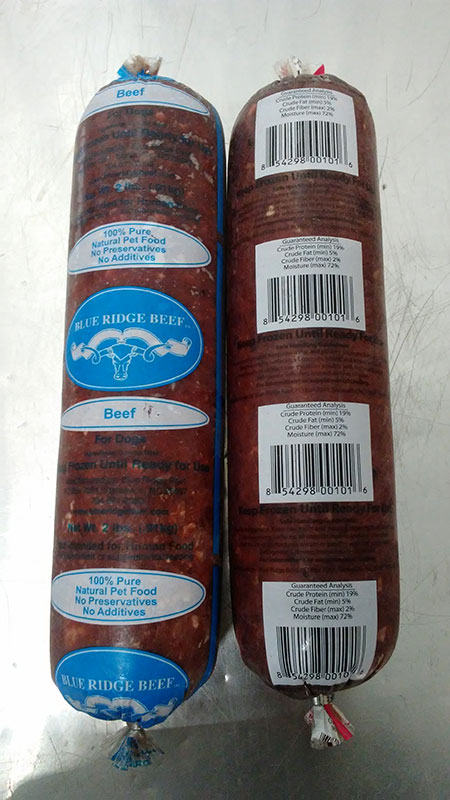
 The affected products are sold in 2 pound chubs and can be identified with the following manufacturing codes:
The affected products were distributed to retail stores in the following states:
Salmonella and Listeria can affect animals eating the product.
There is a risk to humans from handling contaminated pet products, especially if they have not thoroughly washed their hands after having contact with the products or any surface exposed to these products.
Healthy people infected with Salmonella and/or Listeria should monitor themselves for some or all of the following symptoms:
Consumers exhibiting these signs after having contact with this product should contact their healthcare provider. Consumers should also follow the simple handling tips on the package.
This recall was initiated after the FDA received two complaints associated with these products, including one complaint of two kitten illnesses and one complaint of a puppy death.
Subsequent testing by the FDA of a 2 pound chub of beef for dogs and kitten grind collected at a veterinary office revealed the presence of Salmonella and Listeria monocytogenes.
There is no direct evidence linking these unfortunate instances to contaminated product.
This recall is being made with the knowledge of the U.S. Food and Drug Administration.
Consumers who have purchased the above lots of beef for dogs or kitten grind are urged to stop feeding them and return products to the place of purchase for a full refund.
Or dispose of them immediately. Those with questions can email the company at blueridgebeefga@yahoo.com
U.S. citizens can report complaints about FDA-regulated pet food products by calling the consumer complaint coordinator in your area.
Or go to http://www.fda.gov/petfoodcomplaints.
Canadians can report any health or safety incidents related to the use of this product by filling out the Consumer Product Incident Report Form.
ooOOoo
We must keep our dogs and cats as healthy and safe as possible.
Feel free to share this howsoever you wish.
Have a gorgeous Saturday smile!
This is one very smart dog!
P.S. first published in this place back in December 20th, 2014.
Four household products that could be making you sick.
In yesterday’s post I republished an email sent by fellow author Judi Holdeman warning about some brands of peanut butter in terms of potential harm to our gorgeous dogs. Or to be more precise about the dangers of xylitol that is an ingredient in those named brands.
Today, I am delighted to publish a guest post from Charlotte Meier. Charlotte explained to me that she “Operates Home Safety Hub, a site which provides resources on preventing injury and property loss. Her mission is the same as Home Safety Hub’s, which is to help people keep their homes safe. ” Yes, keeping our homes safe includes keeping our dogs safe.
Here is that guest post.
ooOOoo
 We tend to believe that household products such as cleaners or kitchen utensils are good for us. Keeping your house bacteria-free surely can’t have a negative effect on your well-being, right? Unfortunately, as the world becomes more eco-friendly, studies are now showing that your favorite household products could be damaging both you and the planet.
It is critical that you do the research necessary to identify healthy and eco-friendly products. However, that may be easier said than done. Here are a few common household products that could be harmful to your health or the environment.
Nonstick Cookware
Nonstick cookware (such as pots, pans, and baking dishes) was initially celebrated and sought-after, seeming to make cooking simpler and cleanup easy. However, we now know that the nonstick surface is created using Teflon which releases toxic gasses. When you use this cookware at a high temperature, you are essentially poisoning yourself and placing yourself at risk for organ failure, cancer, and other health concerns.
A few healthy alternatives are cast iron, stainless steel, and ceramic coated cookware. Just be certain you do your research on the proper way to care for each type of cookware. For example, cast iron cannot be washed with soap and should be dried immediately after rinsing to avoid rust.
Air Fresheners
Keeping your home smelling fresh with wall plug-ins or sprays is very common. However, many of these products can have a detrimental impact on your health. Furthermore, aerosols are very bad for the environment.
If you want your home to smell wonderful, there are a number of ways you can do so in an eco-friendly and beneficial way. Scented soy candles can be highly effective as can boiling aromatic spices. Recipes for seasonal home scent blends can be found for essential oil diffusers as well.
Garden Insecticides
If you are using insecticides in your garden or on your landscaping, lawn, or potted plants, you are endangering your health and the well-being of the planet. Insecticides are extraordinarily harmful, affecting the nervous system and respiratory system in humans while carrying toxins to water supplies and culling bee populations.
If you have a pest problem, you need to either seek out a home remedy such as vinegar or purchase a genuinely eco-friendly insect control.
Anti-Bacterial Cleaners
Exposure to bacteria is how our immune systems learn and grow. In order do that, you must embrace bacteria in your home. Anti-bacterial products keep your home sterile, leaving your immune system to drop its guard and increase the likelihood of getting sick. When you clean your home, you certainly want to keep it clean, but you do not want it entirely sterile. Anti-bacterial products may do more harm than good.
If you want an eco-friendly cleaner, try utilizing the app ThinkDirty, which rates the safety of household products in terms of their impact on people and the planet. Seventh Generation is one of the best lines of household goods for those seeking eco-friendly options.
Knowing how to best keep yourself and the planet well can be very difficult. False or misleading advertising can trick you into using unhealthy products and knowing what is truthful is no easy feat. However, with a little time, effort, and research, you can make the right decisions with your household products.
Image via Pixabay by Taken
ooOOoo
There you are good people; another Friday come and gone.
But I do hope that you found value in what Charlotte wrote about. Indeed, I have no doubt that many of you did.
Let me close by sharing the email that Charlotte sent me a couple of weeks ago.
Hi!
Our homes are our safe havens. In fact, the term “homesick” refers to a longing for the comfort and love that we associate with home when we’re away from it.
But many Americans, today, are homesick in a different way. They (and often their pets as well) are suffering from respiratory illnesses, skin irritations, allergies, and in some cases, even cancer, due to factors found in their homes.As part of my research for my new site, HomeSafetyHub.org, I’ve been studying ways our homes make us sick and what we can do about them. I’d love to share what I’ve learned with your readers in the form of a guest article.
The article will offer tips and advice on what factors to test for, suggestions for easy, environmentally-friendly DIY repairs to eliminate problems, what products or building materials to avoid, and more.
If you’re interested in receiving a guest article, please let me know. No payment necessary, of course, I’d just love the opportunity to share my original content on a great site.
Hope to hear from you soon!
All the best,
Charlotte
Because it could kill your beloved companion.
Fellow author Judi Holdeman sent me an email that contained a warning that had been in a recent health newsletter from Jeff Reagan. Here’s the essence of that warning (and my emphasis in parts):
If your dog is anything like my dog, they probably love a good scoop of peanut butter.
As I’m writing this, my pup Ellie is actually snuggled up next to my leg and going to town on her peanut butter filled Kong. She’s in heaven…
But I want to warn you about a NEW problem with dogs and peanut butter.
There’s been a number of reports lately of dogs who are winding up dead because of their beloved peanut butter.
How is this happening?
It has to do with a new ingredient being used in certain peanut butters.
That ingredient is xylitol.
Xylitol is an artificial sweetener that you’ll recognize from things like gum and candy.
And while it’s generally “safe” for humans to eat, it can be deadly for dogs. Just a small amount of it can cause severe liver damage and can even kill your dog.
From my research, I’ve found 5 brands of peanut butter that have recently added xylitol to their ingredients. I’m listing these brands below…
– Go Nuts Co
– Hank’s Protein Plus Peanut Butter
– Krush Nutrition
– Nuts N More
– P28
Now luckily most of these are NOT the most popular brands.
These brands are usually sold at specialty shops or health food stores.
But I still wanted to alert you to this…
Because if your dog is anything like mine, they probably love peanut butter.
So make sure you’re staying away from the brands I listed above.
And double-check the label on your peanut butter to make sure it doesn’t have xylitol in it.
Feel free to forward this email on to your friends or family that have dogs so they are aware of this…
– Jeff Reagan. Editor, Patriot Health Alliance
Please, good people, do share this as far and wide as possible.
Reflections on what we leave behind.
I included in yesterday’s post the interview with Bill Kotke and his concern that humanity’s greed, and that’s the correct term in my view, focusing on each generation having more, howsoever one defines ‘more’, was utterly at odds with a sustainable future on the only home we have: Planet Earth. A finite planet in a finite solar system.
On Monday I was chatting with Roger D. back in the old country. It was Roger who introduced me to gliding back in the late 70s. Later we were in business together in Colchester, Essex and we still keep in touch.
Anyway, Roger was bemoaning the current state of affairs in the UK regarding Brexit and went on to say that every economic strategy offered by this or that UK Government was about growth. Whether we are talking economic growth, improvement in living standards or population growth why are there no leading figures in any leading government standing up and saying this can’t go on! Because it can’t!
 We are presently a global population of 7.5 billion. This year alone, as of today, there have been 56,000,000 deaths. But also, as of today, there have been 133,000,000 births. (I rounded the figures but what difference does it make!) That’s a growth of 77 million persons in this one year. It cannot go on!
Bill Kotke also spoke of soil loss. Just last Sunday there was a Care2 item about soil loss. From which I extract:
Could soil ever actually run out?
Yes. If we continue to harm and degrade topsoil at the current rate, it’s estimated that the world could lose all its topsoil within 60 years.
Topsoil is the uppermost layer of soil on the surface of the earth. It’s the most fertile type of soil that typically contains lots of nutrient-rich organic matter from broken down plants and other organisms. Topsoil is also alive with beneficial microbes, fungi and critters like earth worms, which feed on the organic matter.
The deeper layers of soil beneath the topsoil are not nearly as rich. They are primarily made up of decomposing rock that provides the raw material for future topsoil as well as a substrate for deeply rooted plants to anchor in.
If the delicate ecosystem within topsoil is disrupted, it will essentially die. Plants can’t grow in topsoil that doesn’t have abundant organic matter and thriving populations of microbes.
Yes, there are street protests about this political action or that political action but why aren’t we seeing tens of thousands on the streets protesting about the loss of our topsoil!!
Moving on.
There was a recent essay from Patrice Ayme in which he wrote about the Australian Asthma Thunderstorm. Just read this long extract from that essay:
(November 29th, 2016 Italics are from the story as presented in the New York Times)
Mr. McGann was one of thousands of people in Melbourne having an attack of thunderstorm asthma. About 8,500 people went to hospitals. Eight have died, and one remains in intensive care more than a week after a thunderstorm surged across Melbourne, carrying pollen that strong winds and rain broke into tiny fragments.
Perennial ryegrass seeds were swept up in whorls of wind and carried from four million hectares of pasturelands (about 9.9 million acres) that lie to Melbourne’s north and west. If broken into fragments, they are so fine that they can be inhaled.”
Actually what also lie north and west of Melbourne are giant fields of canola. Consider the following propaganda picture:
Mr. McGann did not end up in the hospital. “Every breath I took made the next breath harder,” he said, adding that he had no family history of asthma. “I just didn’t realize it could have the effect it had.”
Grass pollen is the primary source of allergies in southern Australia, and tracking the data allowed scientists to forecast high levels of grass seeds in the atmosphere on Nov. 21. Still, Ms. Hennessy said, the government was taken by surprise.”
Surprise, indeed, this did not happen before, by two orders of magnitude. How come so much more severity?
My lawyer’s theory is different. It evolved from my own observations and theories of why asthma and allergies, let alone weird cancers, have been augmenting spectacularly. There are around 150,000 artificial, man-made chemical products in use. By medical drug standards, they are untested (in earlier essays, I mentioned 80,000, which is the number brandished in the USA; however, French specialists talk about 150,000 untested chemicals.).
Canola (or rapeseed), Brassica napus, is an oilseed crop which is cultivated for its high quality edible oil used in many foods (eg. margarines and cooking oil) and seed meal (the fibrous material left after the oil pressing process), which has a high protein content. That makes it highly desirable as a stock feed.
In 2010-11, the Australian state of Victoria, where Melbourne is located, produced 476 thousand tonnes of canola with a gross value of $293 million.
Control of weeds, particularly weeds from the Brassicaceae family (broadleaf), through herbicide application during the canola-growing season, significantly improves the quantity of the grain produced. Weeds compete for space, nutrients and sunlight. (African countries have dismissed that the quality of GMO seed is higher, in contradistinction with US propaganda; quite the opposite, they say)
Two genetically modified (GM) canola varieties have been developed in Australia, Roundup Ready® (by Monsanto Australia Ltd) and InVigor® (by Bayer CropSciences Pty Ltd). For maximum effect, each GM variety has been developed to be tolerant to and hence used with, a specific herbicide. The result is the mass poisoning of the planet, horizon to horizon.
The same poisoning trick is used for insecticides. To boot, the poison resistance spreads, demanding even higher doses of poison to be used in the grand outdoors..
In other words, massive quantities of poisons are put in the soil, and from there, are kicked up, in the air.
Exposed to this life destroying poisons, the body reacts by shutting down all pores. Asthma.
It cannot go on!
It is time for you and me and millions of others to be the change we want to see. Whether it’s the little things like recycling, or car sharing, or the bigger things like moving to an eco village we have to make a difference.
We have to learn from those communities that for thousands of years lived harmonious and sustainable lives on the planet. Doing so many thousands of years before farming man came on to the scene
In 1969 I spent a year in the outback of Australia as a correspondent for KotiPosti; a Finnish magazine. While I was out in the wilderness looking for Finns to write about it was impossible not to be drawn into the history of the aboriginal Australian.
ABORIGINAL AUSTRALIANS ARE descendents of the first people to leave Africa up to 75,000 years ago, a genetic study has found, confirming they may have the oldest continuous culture on the planet.
Professor Eske Willerslev of the University of Copenhagen, who led the study, says Aboriginal Australians were the first modern humans to traverse unknown territory in Asia and Australia. “It was a truly amazing journey that must have demanded exceptional survival skills and bravery,” he says.
A century-old lock of hair, given by a West Australian indigenous man to an anthropologist, has led to the discovery that ancestors of Aboriginal Australians reached Asia at least 24,000 years before another wave of migration that populated Europe and Asia.
It was back then that I truly understood the relationship that those early Australians had with the earth; with their planet. Forget religions and churches, the Aborigines had a spiritual relationship with the planet that sustained them.
I will never forget exploring quietly, just me and my wife of those days, the caves and darker recesses around the base of Ayers Rock, better called Uluru, the most amazing monolith right out there in the middle of the desert. The unmistakable signs of so many of those quiet recesses being spiritual places for those ancient people.
 Uluru, or Ayers Rock, is a massive sandstone monolith in the heart of the Northern Territory’s arid “Red Centre”. The nearest large town is Alice Springs, 450km away. Uluru is sacred to indigenous Australians and is thought to have started forming around 550 million years ago. It’s within Uluru-Kata Tjuta National Park, which also includes the 36 red-rock domes of the Kata Tjuta (colloquially “The Olgas”) formation.
It is just he same for the North American Indians. They have a spiritual relationship with the land.
Back to Bill Kotke’s talk. He spoke of how when each of us was the product of the fertilisation of the egg by the sperm in utero we grow first as a fish, then as a mammal and, finally, emerge as a human: “We are connected to the earth!”
As you all know I am a secular humanist. But that doesn’t mean that I don’t have deep, as in spiritual, feelings for the lands and the oceans and for the wildlife of this planet
So let me close by repeating what I said at that meeting where Bill was presenting. For Bill spoke of being connected, in a heartfelt manner, with the planet. For if one is so connected then it is natural for one to want to love and protect the planet.
This is what I said:
Bill,
In 1991 I departed Gibraltar Harbour solo on my yacht Songbird of Kent heading West out across the Atlantic.
After I had settled in to the routine of being at sea, better described as settling in to being connected to the ocean, I loved watching the dolphins come up to the boat, give it the once over, raise their heads and offer me a brief eye contact and then slip away.
Then I became aware that when I was laying down on my bunk in the cabin I could sense when the dolphins were close to my hull. Each time I had that sense I would come up to the deck, briefly pausing to clip on my safety harness lest I truly joined the dolphins, and one or two of those dolphins were always by my boat.
I called this post What To Say To The Kids. Not just my son and daughter, now both mature adults, but my grandson Morten son to my daughter and her husband.
Because I feel so strongly that waiting for our leaders and politicians to lead humanity in protecting our planet is pointless. They are driven by other values.
It cannot go on!
I want to be measured by my son and my daughter, and by my grandson in due time, as a person who made a difference; even just a small one.
For I truly believe that showing love for our planet will make a difference and that is what I want to say to my kids.
We have to return to community living; a twenty-first century version of such living. Even in the giant populations of big cities we have to reach out and form local communities. Groups of people who are driven by the imperative to curtail population growth, eager to share in as many ways as possible and totally committed to taking no more from the planet than they put in.
Because It cannot go on!
This is what I want to say to my kids.
We, as in humanity, could be very close to the end!
Now my sub-title could be argued as being a tad provocative and, perhaps, it is. But I wanted to catch your attention and then hope that you stay with me for today’s post.
Jean and I belong to the Humanists & Freethinkers Group of Grants Pass. At last Saturday’s meeting the main item was a talk given by William Kötke: His website is here. Bill, as he was happy to be called, is the author of the books The Final Empire and Garden Planet (the links take you to the respective Amazon pages). Bill also has more details of his first book here.
The essence of Bill’s talk was that when we ‘evolved’ from a life of hunting and gathering to developing the land for agricultural purposes we lost our connection to the planet. For the simple reason that as foragers we depended on always being able to find edible wild plants and fruit, and therefore lived in balance with the land, but when we started to farm we became protective, materialistic and greedy. For having more land, even if one took it by force from another, equated to making more; making more food, using the surplus to buy favours, sell, etc.
Some of the facts that Bill presented in his talk were truly frightening such as soil loss; a topic I highlight in tomorrow’s post.
But for now just settle down and watch this interview of Bill filmed by Woodburn Community Access Television.
Published on Jan 10, 2016Author and Futurist William H. Kotke shares with Woodburn his years of knowledge and understandings of the Human History and The Current Dilemma all of us face as a species.
Is there a way forward?
Yes, I think so and it’s all to do with communities; more on that in a later post.
Is this anything to do with dogs?
Here’s what the Welcome page of this blog says (in part):
As man’s companion, protector and helper, history suggests that dogs were critically important in man achieving success as a hunter-gatherer. Dogs ‘teaching’ man to be so successful a hunter enabled evolution, some 20,000 years later, to farming, thence the long journey to modern man. But in the last, say 100 years, that farming spirit has become corrupted to the point where we see the planet’s plant and mineral resources as infinite. Mankind is close to the edge of extinction, literally and spiritually.
Dogs know better, much better! Time again for man to learn from dogs!
I rest my case.
except the things I forget!
Taken in the round I don’t think I’m ageing too badly. But there is one aspect of my world that does drive me bonkers from time to time. That is a decline (and that’s putting it politely) in my short-term memory. Everything from forgetting what it was I wanted to say to Jeannie to still being unsure of finding regularly visited places in Grants Pass, our local city. To put that last point into context we moved here to Merlin, some 12 miles from Grants Pass, back in September, 2012.
Turning to the cognitive skills of our wonderful dogs it is clear to me that we can only go so far in understanding how our dogs think and how much of their world is dealing with the present supported by their memories of previous events. (Frankly, in writing the last sentence I realised how even that premise was more of a guess than a known fact.)
A recent study at Eotvos Lorand University in Budapest about the memories of dogs has been widely referred to across many news outlets. So when it appeared on the Care2 site it was a natural to republish it for all you good people.
ooOOoo
 By: Laura Goldman December 2, 2016
My doorbell has been broken for a few years, but every time my 9-year-old dog, Leroy, hears one chiming on a TV show, he looks at the front door.
Many pet owners have similar tales to tell about their dogs being able to remember long-ago experiences and events. And now we have proof that this really is possible. A new study found that dogs may have a more complex form of memory than most other nonhuman animals (sorry, elephants).
“Every move you make, every step you take, I’ll be watching you,” Sting once sang, and these lyrics could apply to our dogs, too. They’re not only watching us, but they’re remembering what they’re observing, no matter how trivial it may seem to us.
In the study at Eotvos Lorand University in Budapest, published Nov. 23 in Current Biology, 17 dogs were taught a training method called “Do As I Do.” The dogs would watch their owners perform an action. When the dogs were told, “Do it” and imitated their owners’ action, they were rewarded with a treat.
Next, the owners performed various actions but told the dogs to lie down instead of “Do it.” After a while, the dogs began lying down without being told to do so. The study’s authors noted that this showed the dogs had lost the expectation that they would be given the “Do it” command to imitate their owners.
Finally, the owners performed various actions, and when their dogs would lie down, the owners would wait either a minute or an hour and then give them the “Do it” command.
Some of the actions were unfamiliar to the dogs, such as their owners tapping on an open umbrella. The dogs would be led behind a partition, and a minute to an hour later would be led back to the umbrella and given the “Do it” command.
The dogs were able to remember what their owners had done, and tapped the umbrella with their paws.
“We cannot directly investigate what is in the dog’s mind,” psychologist Claudia Fugazza, an author of the study and owner of a Czechoslovakian Wolfdog who participated, told the Washington Post. “So we have to find behavioral evidence of what they expect or not.”
Remembering events in our lives is known as episodic memory. Until recently, only humans were thought to have this ability, but studies have found evidence that rats, monkeys and birds also have it, and so do dogs.
However, the researchers said the dogs don’t have full-fledged episodic memory, which would give them self awareness. Fugazza told NPR she didn’t think there was a method available to test whether dogs are self aware.
Victoria Templer, a behavioral neuroscientist at Providence College who wasn’t involved in the study, told NPR the results could be useful in helping scientists understand how episodic memory developed in humans and how it’s helped us to survive.
One interesting possibility Templer suggested is that “we evolved the ability to relive the past in order to imagine the future.”
ooOOoo
Of course what would be a marvelous aspect of a dog’s memory is being able to take note and remember where his male human companion left items around the house!
 Learning from Dogs