With seventeen pets here at home Jean and I should live forever!
Another Saturday and another gentle post about the power of our wonderful pets. (Oh, and who, as I did, missed the fact that yesterday was not only a Friday the Thirteenth but the third one this year!)
Anyway, back to the plot!
Last Monday, Mother Nature Network published an item about how good pets are for our health. It seemed the perfect item to share with all of you this Saturday.
ooOOoo
11 studies that prove pets are good for your health
Check out the ways your 4-legged friends enhance your physical and emotional health.
By: Sidney Stevens, November 9, 2015.
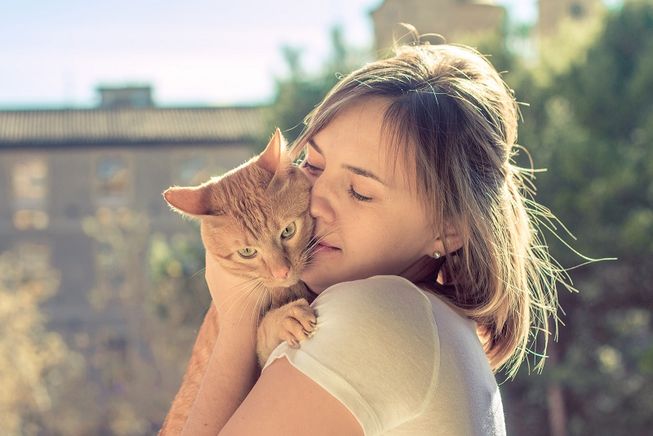
Pets strengthen our hearts, calm our nerves and a whole lot more. (Photo: Juanedc.com /flickr)
If you have pets you already know the joy and love they bring to your life. Now science is confirming just how good they really are for you — both mentally and physically.
How do they help? One theory is that pets boost our oxytocin levels. Also known as the “bonding hormone” or “cuddle chemical,” oxytocin enhances social skills, decreases blood pressure and heart rate, boosts immune function and raises tolerance for pain. It also lowers stress, anger and depression.
No surprise then that keeping regular company with a dog or cat (or another beloved beast) appears to offer all these same benefits and more. Read on to discover the many impressive ways a pet can make you healthier, happier and more resilient.
1. Pets alleviate allergies and boost immune function
One of your immune system’s jobs is to identify potentially harmful substances and unleash antibodies to ward off the threat. But sometimes it overreacts and misidentifies harmless stuff as dangerous, causing an allergic reaction. Think red eyes, itchy skin, runny nose and wheezing. You’d think that having pets might trigger allergies by kicking up sneeze-and-wheeze-inducing dander and fur. But it turns out that living with a dog or cat during the first year of life not only cuts your chances of having pet allergies in childhood and later on but also revs up your immune system and lowers your risk of eczema and asthma. In fact, just a brief pet encounter can invigorate your disease-defense system. In one study, petting a dog for only 18 minutes raised immunoglobulin A (IgA) levels in college students’ saliva, a sign of robust immune function.
2. Pets up your fitness quotient
This one applies more to dog owners. If you like walking with your favorite canine, chances are you’re fitter and trimmer than your non-dog-walking counterparts and come closer to meeting recommended physical activity levels. One study of more than 2,000 adults found that regular dog walkers got more exercise and were less likely to be obese than those who didn’t walk a dog. In another study, older dog walkers (ages 71-82) walked faster and longer than non-pooch-walkers, plus they were more mobile at home.
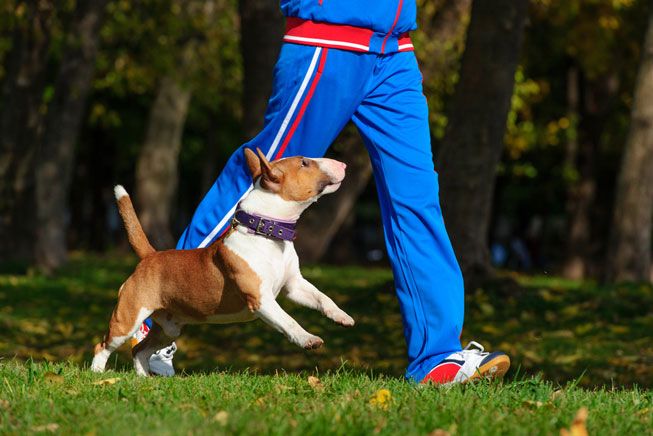
Dog owners who take their canine companions on walks tend to be trimmer and fitter than their fellow dog-less peers. (Photo: AMatveev/Shutterstock)
3. Pets dial down stress
When stress comes your way, your body goes into fight-or-flight mode, releasing hormones like cortisol to crank out more energy-boosting blood sugar and epinephrine to get your heart and blood pumping. All well and good for our ancestors who needed quick bursts of speed to dodge predatory saber-toothed tigers and stampeding mastodons. But when we live in a constant state of fight-or-flight from ongoing stress at work and the frenetic pace of modern life, these physical changes take their toll on our bodies, including raising our risk of heart disease and other dangerous conditions. Contact with pets seem to counteract this stress response by lowering stress hormones and heart rate. They also lower anxiety and fear levels (psychological responses to stress) and elevate feelings of calmness.
4. Pets boost heart health
Pets shower us with love so it’s not surprising they have a big impact on our love organ: the heart. Turns out time spent with a cherished critter is linked to better cardiovascular health, possibly due to the stress-busting effect mentioned above. Studies show that dog owners have a lower risk of heart disease, including lower blood pressure and cholesterol. Dogs also benefit patients who already have cardiovascular disease. They’re not only four time more likely to be alive after a year if they own a dog, but they’re also more likely to survive a heart attack. And don’t worry, cat owners — feline affection confers a similar effect. One 10-year study found that current and former cat owners were 40 percent less likely to suffer a heart attack and 30 percent less likely to die of other cardiovascular diseases.
5. Make you a social — and date — magnet
Four-legged companions (particularly the canine variety that pull us out of the house for daily walks) help us make more friends and appear more approachable, trustworthy and date-worthy. In one study, people in wheelchairs who had a dog received more smiles and had more conversations with passersby than those without a dog. In another study, college students who were asked to watch videos of two psychotherapists (depicted once with a dog and once without) said they felt more positively toward them when they had a dog and more likely to disclose personal information. And good news for guys: research shows that women are more willing to give out their number to men with a canine buddy.
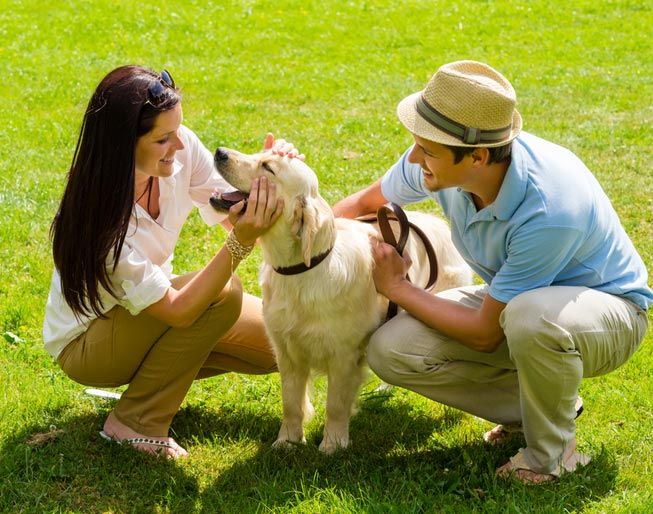
A dog can make you appear friendlier and more approachable to others. (Photo: CandyBox Images/Shutterstock)
6. Provides a social salve for Alzheimer’s patients
Just as non-human pals strengthen our social skills and connection, cats and dogs also offer furry, friendly comfort and social bonding to people suffering from Alzheimer’s and other forms of brain-destroying dementia. Several canine caregiver programs now exist to assist at-home dementia patients with day-to-day tasks, such as fetching medication, reminding them to eat and guiding them home if they’ve wandered off course. Many assisted-living facilities also keep resident pets or offer therapy animal visits to support and stimulate patients. Studies show creature companions can reduce behavioral issues among dementia patients by boosting their moods and raising their nutritional intake.
7. Enhances social skills in kids with autism
One in nearly 70 American kids has autism (also known as autism spectrum disorder, or ASD), a developmental disability that makes it tough to communicate and interact socially. Not surprisingly, animals can also help these kids connect better to others. One study found that youngsters with ASD talked and laughed more, whined and cried less and were more social with peers when guinea pigs were present. A multitude of ASD animal-assisted therapy programs have sprung up in recent years, featuring everything from dogs and dolphins to alpacas, horses and even chickens.
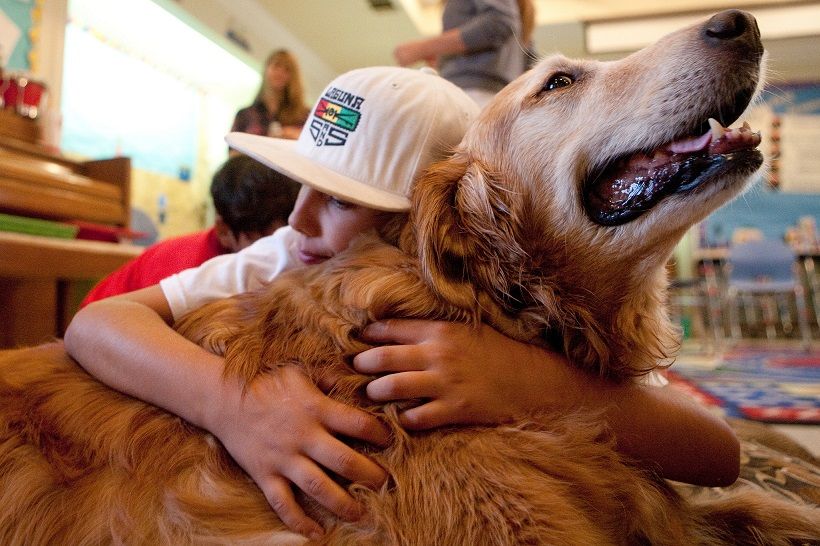
Animal-assisted therapy helps kids with autism and other developmental disabilities learn social skills. (Photo: UCI UC Irvine/flickr)
8. Dampens depression and boosts mood
Pets keep loneliness and isolation at bay and make us smile. In other words, their creature camaraderie and ability to keep us engaged in daily life (via endearing demands for food, attention and walks) are good recipes for warding off the blues. Research is ongoing, but animal-assisted therapy is proving particularly potent in deterring depression and other mood disorders. Studies show that everyone from older men in a veterans hospital who were exposed to an aviary filled with songbirds to depressed college students who spent time with dogs reported feeling more positive.
9. Defeats PTSD
People haunted by trauma like combat, assault and natural disasters are particularly vulnerable to a mental health condition called post-traumatic stress disorder (PTSD). Sure enough, studies show that the unconditional love — and oxytocin boost — of a pet can help remedy the flashbacks, emotional numbness and angry outbursts linked to PTSD. Even better, there are now several programs that pair specially trained service dogs and cats with veterans suffering from PTSD.
10. Fights cancer
Animal-assisted therapy helps cancer patients heal emotionally and physically. Preliminary findings of an on-going clinical trial by the American Humane Association shows that therapy dogs not only erase loneliness, depression and stress in kids fighting cancer, but canines can also motivate them to eat and follow treatment recommendations better — in other words participate more actively in their own healing. Likewise, new research reveals a similar lift in emotional well-being for adults undergoing the physical rigors of cancer treatment. Even more astounding, dogs (with their stellar smelling skills) are now being trained to literally sniff out cancer.
11. Puts the kibosh on pain
Millions live with chronic pain, but animals can soothe some of it away. In one study, 34 percent of patients with the pain disorder fibromyalgia reported pain relief (and a better mood and less fatigue) after visiting for 10-15 minutes with a therapy dog compared to only 4 percent of patients who just sat in a waiting room. In another study, those who had undergone total joint replacement surgery needed 28 percent less pain medication after daily visits from a therapy dog than those who got no canine contact.
ooOOoo
When I was setting this post up and copying across all the many links I was aware that there was a mountain of information out there. You may want to take some time and explore those links. For example, the link to HABRI- Human-Animal Research Initiative looks incredibly interesting. Then there was the link to the work being undertaken by the American Humane Association, that link being to this video that I am presenting here to close off today’s post.
Wherever you are in the world look after yourself and care for all those lovely pets out there. Love them so dearly!
Nothing to do with dogs but, nonetheless, a neat way to finish the week.
I was looking at a recent George Monbiot essay and getting myself all wound up about it, thinking that it should be today’s post. Then I thought, “Come on, Paul, end the week on a gentle tone.”
So with that in mind, let me offer you an item on British history that Su sent me a week ago. I can’t authenticate the details but my instinct is that everything mentioned is correct.
ooOOoo
There is an old Pub in Marble Arch, London, which used to have a gallows adjacent to it. Prisoners were taken to the gallows (after a “fair” trial of course) to be hanged. The horse-drawn dray, carting the prisoner, was accompanied by an armed guard, who would stop the dray outside the pub and ask the prisoner if he would like ”ONE LAST DRINK.” If he said YES, it was referred to as ONE FOR THE ROAD. If he declined, that prisoner was ON THE WAGON.
So there you go … On with some more history.
They used to use urine to tan animal skins, so families used to all pee in a pot and then once a day the pot was taken and sold to the tannery. If you had to do this to survive you were “piss poor”, but worse than that were the really poor folk, who couldn’t even afford to buy a pot, they “didn’t have a pot to piss in” and were the lowest of the low. The next time you are washing your hands and complain because the water temperature isn’t just how you like it, think about how things used to be.
Here are some more facts about the 1500s:
Most people got married in June, because they took their yearly bath in May and they still smelled pretty good by June. However, since they were starting to smell, brides carried a bouquet of flowers to hide the body odor. Hence the custom today of carrying a bridal bouquet when getting married.
Baths consisted of a big tub filled with hot water. The man of the house had the privilege of the nice clean water, then all the other sons and men, then the women and finally the children. Last of all came the babies. By then the water was so dirty you could actually lose someone in it. Hence the saying, “Don’t throw the baby out with the bath water!”
Houses had thatched roofs, thick straw piled high on the rafters, with no wood underneath. It was the only place for animals to get warm, so all the cats and other small animals (mice, bugs) lived in the roof. When it rained it became slippery and sometimes the animals would slip and fall off the roof. Hence the saying “It’s raining cats and dogs.” There was nothing to stop things from falling into the house.
This posed a real problem in the bedroom, where bugs and other droppings could mess up your nice clean bed. Hence, a bed with four big posts and a sheet hung over the top afforded some protection. That’s how canopy beds came into existence.
The floor was dirt. Only the wealthy had something other than a dirt floor. Hence the saying, “dirt poor.” The wealthy had slate floors that would get slippery in winter when wet, so they spread thresh (straw) on floor to help keep their footing. As the winter wore on they added more thresh until, when you opened the door, it would all start slipping outside. A piece of wood was placed in the entrance. Hence: a threshold.
In those old days, they cooked in the kitchen with a big kettle that always hung over the fire. Every day they lit the fire and added things to the pot. They ate mostly vegetables and did not get much meat. They would eat the stew for dinner, leaving leftovers in the pot to get cold overnight, then start over the next day. Sometimes stew had food in it that had been there for quite a while. Hence the rhyme: ”Peas porridge hot, peas porridge cold, peas porridge in the pot, nine days old.” Sometimes they could get pork, which made them feel quite special. When visitors came over they would hang up their bacon, to show off.
It was a sign of wealth that a man could, “Bring home the bacon.” They would cut off a little to share with their guests and would all sit around talking and ”chew the fat.”
Those with money had plates made of pewter. Food with high acid content caused some of the lead to leach onto the food, causing lead poisoning and death. This happened most often with tomatoes, so for the next 400 years or so, tomatoes were considered poisonous.
Bread was divided according to status. Workers got the burnt bottom of the loaf, the family got the middle, and guests got the top, or ”The Upper Crust.”
Lead cups were used to drink ale or whisky. The combination would sometimes knock the imbibers out for a couple of days. Someone walking along the road would take them for dead and prepare them for burial. They were laid out on the kitchen table for a couple of days and the family would gather around and eat and drink and wait and see if they would wake up. Hence the custom of ”Holding a Wake.”
England is old and small and the local folks started running out of places to bury people, so they would dig up coffins and would take the bones to a bone-house and reuse the grave site. When reopening these coffins, 1 out of 25 coffins were found to have scratch marks on the inside and they realised they had been burying people alive. So they would tie a string on the wrist of the corpse, thread it out through the coffin and up through the ground and tie it to a bell. Someone would have to sit out in the graveyard all night (the graveyard shift) to listen for the a bell; thus someone could be, ”Saved by the Bell ”or was considered a ”Dead Ringer.” And that’s the truth.
Now, whoever said history was boring ! ! !
So ….. get out there and educate someone!
ooOOoo
Just out of curiosity, I did a web search on that Pub in Marble Arch. Quickly came across this, from which I quote, in part:
The site of the Tyburn Tree is said to be at what is now Marble Arch, at the north-east corner of Hyde Park. Some historians give a more precise location as slightly to the north-west at Connaught Square. In fact, many bodies were found there when the square was being built in the 1820s, so it’s possible that some Tyburn victims were buried right where they died.
Mass executions took place on Mondays, when prisoners were transported from Newgate Prison to Tyburn in an open wagon, often in their finest clothes. The procession, which was watched by a large and enthusiastic crowd, wound down Snow Hill, across Holborn Bridge into Holborn, down Broad St Giles into Oxford Street and on to Tyburn.
And it was but a moment to find a photograph of the place.
You all have a wonderful, relaxing week-end and don’t lose your head over anything!
Staying with the theme of our lives being “rebooted” by our dogs.
Again, as so often occurs, a thought or reply left by someone to a previous post kicked off a new post for me.
So it was yesterday when Hariod commented: “This is the organisation that brought dogs into the care home my father lived in: http://www.petsastherapy.org/”
That website is full of great information and any readers living in the UK who have not come across them before are highly recommended to have a good browse. One item that caught my eye was the Precious Memories link.
The loss of a pet is always a devastating and traumatic experience but even more so for the owner of a PAT dog or cat who has brought much love and companionship to many people, as well as to their owners.
This page contains lasting memorials to some PAT dogs and PAT cats who have given much to society by regularly visiting in Hospitals, Hospices, Residential homes or Day Care Centres.
Baggy was a Finnish Lapphund and a wonderful and loving companion. She enjoyed taking part in many canine events including passing the KCGC Bronze, Silver & Gold awards, agility, showing and heel work to music, Baggy loved to go on a camping trip in the caravan or a trip down the river in our boat.
Baggy had two litters of puppies and two sons one from each litter are PAT dogs and her grand daughter is also a PAT dog. Baggy was my first PAT dog and she loved to go visiting in our local Residential home bringing joy and love to many people.
We love and miss Baggy so much our special sweet little friend.
Sheila Hall
The last aspect of the Pets As Therapy site that I want to refer to is their blog: Dog Dog Dog. Do drop in there and read some of the wonderful stories of those caring dogs.
That very nicely leads on to two videos that I quickly came across.
The first is described, thus:
Published on Dec 19, 2013
Follow Fraser, a black lab-golden mix, who has been a part of HCA Virginia’s unique Pet Therapy program since 2007. For several years, Fraser has spread comfort, compassionate care and joy to the faces of countless patients and staff at Chippenham and Johnston-Willis Hospitals from Tucker Pavilion and the Thomas Johns Cancer Hospital to many other areas. Catch a glimpse of how pet therapy is a source of alternative care for those in need.
While the second is about the therapy dog test.
Published on Dec 16, 2012
Achilles, my German Shepherd Dog, taking the Therapy Dog International test for certification.
Having this certification will allow Achilles and I to visit people in the hospital and other health care facilities.
Achilles is an AKC Obedience trained competitor and was able to pass the TDI test using that training and experience rather than special training for the test.
If you are interested in making your dog a TDI Therapy Dog go to their web site for information on how to accomplish that.
This is no conundrum: a direct contrast to yesterday.
The benefits of having a dog or two (or nine) are boundless and have been documented for thousands of years. Indeed, a quick web search revealed that Alexander Pope, the 18th-century English poet, is the attributed author of the quote, “Histories are more full of examples of the fidelity of dogs than of friends.”
Nevertheless, it was still a joy to come across the documentary film Dogs On The Inside.
Filmed in a Massachusetts prison, DOGS ON THE INSIDE follows the birth of a relationship between abandoned rescue dogs and prison inmates as they work together toward a second chance at a better life. Giving a voice to a forgotten dog and a forgotten man, the film is a life-affirming testament to the power of second chances.
The film was released in February 2014, and here is the trailer.
In general, it seems to have gathered good reviews with this one from Amazon being typical of what I have seen.
I had tears in my eyes during several segments of this film. Such a lovely connection between the rescue workers and the dogs. Then, the inmates and the dogs. And, finally, the photos of their forever homes and families. Bravo to all at Don’t Throw Us Away. People like you, who work to save and rehab these animals, are amazing.
You are also recommended to read the review that is on the Ecorazzi website. Here’s a flavour of that review:
Two parties neglected and forgotten become the powerful emotional center of an uplifting new documentary, Dogs on the Inside.
We’re taken to Massachusetts, where there exists a unique, mutually-beneficial rehabilitation program that finds rescue dogs paired with prison inmates.
This documentary, from directors Brean Cunningham and Douglas Seirup, follows a handful of inmates at a correctional facility involved in Don’t Throw Us Away, a program that partners them with neglected dogs. For the animal, benefits include exercise, attention, and care while shelters remain crowded. For the prisoners, they have a chance to form connections and work towards parole.
It’s fascinating throughout watching both sides – scared dogs and (emotionally) guarded inmates – warm to one another, seemingly leaving their past behind.
That’s at the heart of this illuminating, heartwarming film: second chances. Early on, it’s easy to see the parallels between these two groups – with the comparisons handled tactfully throughout a film that never strays from its simple, honest goal. Dogs never preaches or calls for political or social change; it more so asks the viewer to be willing to forgive and welcome in those which have been cast aside. When an inmate says, ‘they come from a bad life, they haven’t seen love in while,’ he isn’t necessarily talking just about the dog.
Let me close with this heart-stirring photograph that was included in the above review.
So much to learn from our precious, gorgeous dogs!
Some of you may have noticed a reply left by Marg (aka MargfromTassie) to my post yesterday. In part, this is what Marg wrote:
By the way Paul, you’re 71 now. If you reverse it, and were 17 again – what is the major thing, if any, that you would do differently with your life – knowing what you know now? ( or is this just too difficult?)
In turn, I replied:
What would I do differently? What a fascinating question. Rather than dump the first thing that comes to mind, let me reflect on the question for a while. Who knows? Maybe make it tomorrow’s post?
At first it was very clear what I would have done differently. Namely, had I had the awareness at a much earlier age of the psychological and emotional impact of my father’s death back in December 1956, just six weeks after I had had my twelfth birthday, I would have been a much more emotionally settled person and, in time, a better father to my son and daughter.
Then almost immediately I recognised the conundrum in what I was thinking.
For that subconscious fear of rejection that I carried all the way through my life until 2007, when a local Devon psychotherapist exposed that fear (thank you, J), had both strong positive and negative consequences. The positive consequences far outweighed the negative ones, that were mainly to do with uncertainty over relationships with women.
Because if my previous wife hadn’t announced in December 2006, fifty years to the day after my father died, that she had been unfaithful, I wouldn’t have sought J’s help, wouldn’t have gained the self-awareness that is so vital for all of us, and wouldn’t have met Jean in December 2007. And that has been a positive consequence of unimaginably beautiful measure.
So dear Marg, thank you for your fascinating question but, in the end, if I had the chance I would repeat my life exactly the same way again.
With apologies to any readers who have regarded the above as excessive navel-gazing! But my justification for writing this is to underline the supreme importance of knowing oneself!
Consequently, writing a blog post for today wasn’t high on my list of things to do.
So this is to offer my thanks to everyone who sent me greetings; it was wonderful to hear from so many friends, old and new.
Thus my post today is to share three items that came from family back in England.
First, my mother, who is still teaching piano and oboe at the age of 95, sent me this:
Secondly, my son, Alex, and his long-term partner, Lisa, sent me this in an card chosen from the Friends of the Earth selection:
(All dog owners know, I’m sure, that dogs must never eat chocolate.)
Lastly, my grandson, Morten, who despite being just five-years-old, is already a dab hand with an iPhone and sent me the following picture of himself with Dad in the background:
Finally, my love and gratitude to Jeannie for making me feel special yesterday, as she has done every day since we first met.






 Learning from Dogs