Note: If readers find these food recall alerts a waste of time, then do let me know – I’m aware that for many there are already too many emails in the ‘in-box’.
Dear Fellow Dog Lover,
On September 30, 2015, Salix Animal Health of Deerfield, Florida announced the recall of one lot of its Good ‘n’ Fun Beefhide Chicken Sticks because the product has the potential to be contaminated with Salmonella.
Salmonella is a bacteria that can affect the health of both pets and humans.
It really is about good people refusing to let evil dominate our world.
The response to yesterday’s post was incredible and very gratifying.
For I was conscious that many would simply reject the proposition that I saw in John Zande’s book, namely that, “there was an evil origin to the universe and, more directly, that the deep, and growing, suffering of the pinnacle of evolution, us humans, can be traced back to that evil origin.”
The emotional challenge, of which I am acutely aware, is recognising that core proposition, that as we humans evolve so too does the capacity for human suffering, yet not wanting to give up on my personal core belief that better times ahead are possible, given sufficient people sharing that power of hope. Echoing what Sue wrote as a response to yesterday’s post that motivated me to reply, in part, thus:
If there was one sentence of yours that struck me as spot on, it was your declaration that what we think is what we create. Or as I often reflect, we are what we think.
Jean and I last night watched the latest BBC Panorama report about the migrant/refugee crisis in Europe. It was profoundly upsetting for reasons that many will understand.
George Monbiot’s essay that follows shortly is also profoundly upsetting.
But if hope is to be translated into a determination to make a difference, then it demands that we don’t ignore the pain but use our anger to fuel our passion to behave appropriately: We are what we think! Or in the much more eloquent words of Albert Einstein:
Learn from yesterday, live for today, hope for tomorrow. The important thing is not to stop questioning.
George Monbiot is to be saluted for his commitment to questioning and I am privileged to have his permission to republish the following.
There may be water on Mars. But is there intelligent life on Earth?
By George Monbiot, published in the Guardian 30th September 2015
Evidence for flowing water on Mars – this opens up the possibility of life; of wonders we cannot begin to imagine. Its discovery is an astonishing achievement. Meanwhile, Martian scientists continue their search for intelligent life on Earth.
We might be captivated by the thought of organisms on another planet, but we seem to have lost interest in our own. The Oxford Junior Dictionary has been excising the waymarks of the living world. Adders, blackberries, bluebells, conkers, holly, magpies, minnows, otters, primroses, thrushes, weasels and wrens are now surplus to requirements.
In the past four decades, the world has lost 50% of its vertebrate wildlife. But across the latter half of this period, there has been a steep decline in coverage. In 2014, according to a study at Cardiff University, there were as many news stories broadcast by the BBC and ITV about Madeline McCann (who went missing in 2007) as there were about the entire range of environmental issues.
Think of what would change if we valued terrestrial water as much as we value the possibility of water on Mars. Only three percent of the water on this planet is fresh, and of that two-thirds is frozen. Yet we lay waste to the accessible portion. Sixty percent of the water used in farming is needlessly piddled away by careless irrigation. Rivers, lakes and aquifers are sucked dry, while what remains is often so contaminated that it threatens the lives of those who drink it. In the UK, domestic demand is such that the upper reaches of many rivers disappear during the summer. Yet still we install clunky old toilets and showers that gush like waterfalls.
As for salty water of the kind that enthralls us when apparently detected on Mars, on Earth we express our appreciation with a frenzy of destruction. A new report suggests that fish numbers have halved since 1970. Pacific bluefin tuna, that once roamed the seas in untold millions, have been reduced to an estimated 40,000, yet still they are pursued. Coral reefs are under such pressure that most could be gone by 2050. And in our own deep space, our desire for exotic fish rips through a world scarcely better known to us than the red planet’s surface. Trawlers are now working at depths of 2000 metres. We can only guess at what they might be destroying.
A few hours before the Martian discovery was announced, Shell terminated its Arctic oil prospecting in the Chukchi Sea. For the company’s shareholders, it’s a minor disaster: the loss of $4 billion. For those who love the planet and the life it sustains, it is a stroke of great fortune: it happened only because the company failed to find sufficient reserves. Had Shell succeeded, it would have exposed one of the most vulnerable places on Earth to spills that are almost inevitable, where containment is almost impossible. Are we to leave such matters to chance?
At the beginning of September, two weeks after he granted Shell permission to drill in the Chukchi Sea, Barack Obama travelled to Alaska to warn Americans about the devastating effects that climate change, caused by the burning of fossil fuels, might catalyse in the Arctic. “It’s not enough just to talk the talk”, he told them. “We’ve got to walk the walk.” We should “embrace the human ingenuity that can do something about it.” Human ingenuity is on abundant display at Nasa, which released those astounding images. But when it comes to policy, the search for intelligent life goes on.
Let the market decide: this is the way in which governments seek to resolve planetary destruction. Leave it to the conscience of consumers, while that conscience is muted and confused by advertising and corporate lies. In a near-vacuum of information, we are each left to decide what we should take from other species and other people; what we should allocate to ourselves or leave to succeeding generations. Surely there are some resources and some places – such as the Arctic and the deep sea – whose exploitation should simply stop?
All this drilling and digging and trawling and dumping and poisoning – what is it for anyway? Does it enrich human experience, or stifle it? A couple of weeks ago, I launched the hashtag #extremecivilisation, and invited suggestions. They have flooded in. Here are just a few of the products my correspondents have found. All of them, as far as I can tell, are real.
An egg tray for your fridge, that syncs with your phone to let you know how many eggs are left. A gadget for scrambling them – inside the shell. Wigs for babies, to allow “baby girls with little or no hair at all the opportunity to have a beautifully realistic hair style”. The iPotty, that permits toddlers to keep playing on their iPads while toilet training. A £2000 spider-proof shed. A snow sauna, on sale in the United Arab Emirates, in which you can create a winter wonderland with the flick of a switch. A refrigerated watermelon case on wheels: indispensable for picnics. Or perhaps not, as it weighs more than the melon. Anal bleaching cream, for … to be honest, I don’t want to know. An “automatic watch rotator” that saves you the bother of winding your luxury wrist candy. A smart phone for dogs, with which they can take pictures of themselves. Pre-peeled bananas, in polystyrene trays covered in clingfilm. Just peel back the packaging …
Every year, clever new ways of wasting stuff are devised, and every year we become more inured to the pointless consumption of the world’s precious resources. With each subtle intensification, the baseline of normality shifts. It should not be surprising to discover that the richer a country becomes, the less its people care about their impacts on the living planet.
Our alienation from the world of wonders with which we evolved has only intensified since David Bowie described a girl stumbling through a “sunken dream”, on her way to be “hooked to the silver screen”, where a long series of distractions diverts her from life’s great questions. The song, of course, was Life on Mars.
a whole new way of looking at you and me, and the rest of humanity.
Back on September 16th, I published the post Of paradoxes, and headaches! It included the fact that I was about 20% of the way through John Zande’s book The Owner of All Infernal Names.
On Tuesday evening of this week, I finished the book and, without doubt, I shall be publishing a review on Amazon books by the end of the week. First, I wanted to share a longer reflection of Zande’s book with all of you dear readers.
ooOOoo
One of the many five-star reviews of this book that has been published on the relevant Amazon page opens simply: “This is a beautifully written, terribly uncomfortable book to read.” I couldn’t better that summary. This is, indeed, a beautifully written book. Yet it is also a book that will forever change the way you think about species: Homo sapiens.
Zande offers a powerful argument that, “Following then the Principle of Sufficient Reason, the observer concludes with a level of argued certainty that a Creator must exist.” Then sets out to demonstrate that this Creator, far from being an expression of universal love, is fundamentally an expression of universal suffering. Reminding the reader that, “This world was never good. It was never peaceful, and never without suffering.”
For the first time in my life, Zande’s words had cause for me to reflect on something that, hitherto, had never dawned on me. That if there is a God, why have I, and countless others, assumed that this God be necessarily benevolent. The evidence presented in Zande’s book is comprehensive: that there was an evil origin to the universe and, more directly, that the deep, and growing, suffering of the pinnacle of evolution, us humans, can be traced back to that evil origin. Better than that, frequently the book is almost scientific. And in the best of scientific traditions, Zande adopts the position of a neutral witness.
Whether or not you are relaxed about that previous paragraph, and I suspect many readers will not, it is impossible not to be in awe of the beauty, the power, and the eloquence of Zande’s words. Take this opening paragraph of Zande’s chapter titled A SIGHTLESS CREATION.
It is a basal vagary, a question that screams for attention and if left unresolved – if left problematic – could invalidate all practicalities of a functioning Creation lorded by a maximally wicked Creator: Would sentient, attentive, self-respecting life choose to live in a world underwritten by evil? Could self-aware life endure a thoroughly hopeless reality?
Whether one is a believer in a religious god or not, it will also be impossible not to have one’s deepest emotions and beliefs about the nature of humankind stirred very deeply around. No-one who reads this book will be left unchanged.
If you have ever pondered about the way the world is heading, or more accurately put, about the way that we humans are managing our existence on Planet Earth, then you need to read this book. Period!
ooOOoo
Reinforcing what I have just written is the latest essay from George Monbiot, that will be published on Learning from Dogs on Friday.
Because you signed up on our website and asked to be notified, I’m sending you this special recall alert.
On September 23, 2015, The U.S. Food and Drug Administration announced the recall of certain lots of Dingo brand dog chews because the product has the potential to contain amantadine.
Amantadine is a human antiviral drug not approved for use in animal food.
Forget about the big world out there, be loved by our dogs.
Monday’s post about the precariousness of man’s future on this planet if we don’t prevent the melting of the Antarctic ice sheet was a bit gloomy, however true it might be. The gloom continued with yesterday’s post about the VW scandal illustrating the “unethical culture endemic in business”.
So what a nice change to think about the way that our pets keep us bright, cheerful and healthy.
All of which is my way of introducing a guest post from Vee Cecil. Now I am fairly cautious about guest posts from those who want to promote their businesses, for obvious reasons. But Vee’s essay is so lovely that it truly deserves to be shared.
Firstly, here is the email that Vee sent me back in August,
Hi!
In the U.S., 91 percent of pet owners say they consider their pet to be a member of the family. And for good reason! Our pets are constant sources of comfort and companionship.
What many pet owners may not realize is how great their furry family members are for their physical and mental health. For example, studies have shown that pet owners have lower blood pressure than people who don’t have pets and that being around pets also makes us “less anxious and less stressed.” And that’s just the beginning. There are many other wonderful health benefits that result from owning a pet.
May I write an article for learningfromdogs.com on this topic? The article will be approximately 500 words, unique to your site, and complete with resources.
Please let me know – I am always looking to spread the word about how we can be healthier and happier and having a pet is a great way to achieve both!
Best,
Vee
Here then is that article.
ooOOoo
Feeling Under the Weather? Learn More About the Amazing Healing Powers of Pets
Ask any dog owner and you’ll find out just how remarkable a dog can be. They can turn a terrible day into an amazing one with one lick of the face or wag of the tail. But more and more studies are showing that our four-legged friends might be even more awesome than we previously thought.
As TheWashington Post explains, research is showing that being around dogs can help us feel better and less stressed, while also improving our physical health. For example, the article cites studies which found that our pets can lead to “lower blood pressure, lower resting heart rates and less risk of hypertension.”
And that’s not all. Here are four other health issues and how dogs help their human companions:
Cancer. As this CBSNews.com article explains, a recent study at Mount Sinai Beth Israel found that therapy dogs had a very positive impact on patients receiving chemo therapy. The patients showed improvements in “emotional well-being and quality of life.” The director of the program that provided the therapy dogs also noted that patients felt less stressed and anxious. The article notes that this was a ground-breaking study as the impact of therapy dogs on cancer patients hadn’t been examined before.
Alzheimer’s Disease. Therapy dogs are also proving to be extremely helpful for patients with Alzheimer’s. In this article, a man with early on-set Alzheimer’s explains how his therapy dog helps him with daily tasks. Through the help of his therapy dog, the man says his stress and anxiety levels have significantly reduced.
Surgery recovery. Chances are if you were recovering from a painful surgery you wouldn’t turn down a snuggle from a pet. But, as The Telegraph shows, researchers have found that pets can do more than just provide you with a little tender loving care. A study led by a researcher from Loyola University found that pet therapy can reduce the amount of pain patients experience after surgery. In fact, according to the article, the patients in the study, who had had joint replacement surgery, “needed 50 per cent less pain medication if they used pet therapy.”
Diabetes. And perhaps most remarkable of all is what therapy dogs can be trained to do for diabetics. In this case, dogs put their acute sense of smell to good use. As this article explains, dogs exhibiting a better-than-average sense of smell can be trained to help diabetics. Once trained these dogs use their sense of smell to detect signs of hypoglycemia and low blood sugar (based on their human companion’s breath). They’re also trained to get a sugary food for their diabetic, get help if the person goes into diabetic shock, and more.
As more research is conducted to see the benefits of not only service dogs, but pets too, it will be interesting to see how dogs are woven into more medical treatments. They are truly amazing creatures, who can help us mind, body, and soul.
***
Vee Cecil keeps busy by being a wellness coach, personal trainer and bootcamp instructor in Kentucky. She also recently launched a blog where she shares her passion for health by writing about her favorite tips, activities and recipes.
ooOOoo
Here’s a republication of a picture from a recent Picture Parade. It has health stamped all over it, for the young boy and the Shepherd Dog!
Why we have to learn integrity from our dogs, and soon!
After yesterday’s post about the ice dagger poised to fall on the heads of humanity, I was hoping to offer something more cheerful for today. Indeed, I had a guest post ready for publication but then ran into a small technical hitch that stopped it being scheduled for today.
So I turned to this recent article that appeared on The Conversation blogsite that is, unfortunately, another reminder of these mad times. It is republished within the terms of articles that appear on The Conversation.
ooOOoo
How could VW be so dumb? Blame the unethical culture endemic in business.
Author: Edward L Queen, Director of Ethics and Servant Leadership Program, Emory University.
How much can corporate culture explain VW’s deception? Jim Young/Reuters
That far too much of the world’s corporate leadership is driven by moral midgets who have been educated far beyond their capacities for good judgment should be obvious after observing the events of the past week.
The financial industry-led economic collapse of 2008 should have taught us this lesson, but the specificity and clarity of it was brought home by news of price-gouging in the pharmaceutical industry and, even more blatantly, by the announcement that Volkswagen intentionally programmed thousands of its diesel automobiles to cheat emissions testing.
We should be outraged by such behavior and demand appropriate punishments and sanctions as well as restitution and correction. But we should not be shocked. As an ethicist who has looked at the behavior of individuals in business and corporations, I can point to a number of troubling trends that help explain these transgressions.
Impaired moral imaginations
For the past five to six decades, epigones of Milton Friedman have been emphasizing that the only duty of a corporation is return on investment (regularly ignoring his caveat of doing so within the law and social norms).
This lesson, drilled into generations of business school graduates, now drives tsunamis of corporate malfeasance. Data regularly demonstrate that business school students are more likely to cheat on examinations and assignments than their peers, although – and this is of interest for the Volkswagen case – they are closely followed by engineering students.
Are business school teaching the right values? mleiboff/flickr, CC BY-NC-ND
Additionally, some evidencesuggests that not only are business students more impaired in their moral judgments in a broader sense than are those in other majors and professional schools, but that business schools themselves may be responsible.
More disturbing, observational and anecdotal evidence suggests that business students are not only impaired in their moral judgments but that significant percentages of them have severely impaired moral imaginations. By this I mean not only do they make bad ethical decisions, but they actually are incapable of identifying an ethical situation when they are presented with one.
Numerous interviews with business ethics faculty I have had over the past decade suggest that when business students are presented with an ethics case, that is a case where they have been told that there is an ethical problem, 20% to 30% of the students cannot find or identify the ethical issue. This has been borne out by my personal experience when teaching business students.
Unmistakable malfeasance
With regards to the Volkswagen scandal, let us be clear about the nature of the company’s activities. This was not a mistake, an error, an ethical lapse or poor judgment. This was an intentionally designed and executed violation of the law in both its letter and its spirit. It also was an ethical violation of the highest level.
Volkswagen intentionally deceived those to whom it owed a duty of honesty. It fraudulently misrepresented its automobiles to be other than what they were. Most significantly, it intentionally chose to do so and went out of its way to commit the wrong.
This last fact may make it far more difficult for VW to recover from the reputational hit than it perhaps has been for GM or Toyota. Even though the latter’s product defects cost people their lives, they did not intentionally produce such parts.
The sheer brazenness and conniving that went into Volkswagen’s actions are probably what shocked people the most. This was a highly technical and sophisticated operation that basically taught the emissions system how to distinguish between road travel, typical idling and idling while undergoing an emissions test.
No spin can mitigate that fact. There is and can be no claims of confusion or misunderstanding, no failures to communicate. This will erode people’s trust in Volkswagen as a company to a degree that the failures of other companies may not have experienced. In the Volkswagen scandal, just like the story about price gouging in pharmaceuticals that broke the same week, consumers are confronted with the stark reality of corporate malfeasance.
In both instances, the wrongdoing was exacerbated by the responses of the companies’ CEOs. The now former CEO of Volkswagen, Martin Winterkorn, basically acknowledged his incompetence and failure of leadership by claiming that he was unaware of the actions taken by his employees. Martin Shkreli, the CEO of Turing Pharmaceuticals, in a series of tweets responding to criticisms of its pricing of the drug Daraprim demonstrated a level of knowledge of moral and social norms that can only be described as clueless.
Redefining success
These events – and others – make clear that there is a need to look at the broader cultural realities that drive unethical decisions in business, particularly the perception that the only way of determining value and worth is money.
This situation is not new – as early as 1906 William James wrote in a letter to H G Wells, “The moral flabbiness born of the exclusive worship of the bitch-goddess SUCCESS. That – with the squalid cash interpretation put on the word success — is our national disease.”
When a person’s worth is determined only by money, only by success as it is and can be monetized, when one has no sense of being without the BMW, the Rolex, the Armani suits, the yacht, etc, the moral flabbiness emerges. Indeed, it engulfs entire organizations and perhaps even entire societies.
ooOOoo
Those last two sentences of that essay need repeating over and over again. This may just be a blog about learning from our beloved dog companions but as my home page spells out, this is not some silly romantic notion:
As man’s companion, protector and helper, history suggests that dogs were critically important in man achieving success as a hunter-gatherer. Dogs ‘teaching’ man to be so successful a hunter enabled evolution, some 20,000 years later, to farming, thence the long journey to modern man. But in the last, say 100 years, that farming spirit has become corrupted to the point where we see the planet’s plant and mineral resources as infinite. Mankind is close to the edge of extinction, literally and spiritually.
Dogs know better, much better! Time again for man to learn from dogs!
Republished for the wider promotion of this alert.
Dear Fellow Dog Lover,
Because you signed up on our website and asked to be notified, I’m sending you this special recall alert.
On September 25, OC Raw Dog of Rancho Santa Margarita, CA, announced it is recalling its OC Raw Chicken, Fish and Produce Raw Frozen Canine Formulation because it has the potential to be contaminated with Salmonella.
To learn which products are affected, please visit the following link:
This is the wake-up call that we humans simply can’t afford to sleep through.
This stunningly beautiful image is of an Antarctic iceberg, with a cavity. It belies the power of ice to destroy the world that we currently experience, and that “we” is not just humans but vast tracts of nature and, of course, our dogs.
So what has got “my knickers in a twist“? Answer: A reminder that the potential melting of the Antarctic ice sheet is a real and tangible threat; something that mankind has understand within the next few years.
First, let me share some of the material from the website of Antarctic Glaciers.
An ice shelf is a floating extension of land ice. The Antarctic continent is surrounded by ice shelves. They cover >1.561 million km2 (an area the size of Greenland)[1], fringing 75% of Antarctica’s coastline, covering 11% of its total area and receiving 20% of its snow.
The difference between sea ice and ice shelves is that sea ice is free-floating; the sea freezes and unfreezes each year, whereas ice shelves are firmly attached to the land. Sea ice contains icebergs, thin sea ice and thicker multi-year sea ice (frozen sea water that has survived several summer melt seasons, getting thicker as more ice is added each winter).
You can see this flat, floating ice shelf is almost featureless.
With this in mind, let me turn now to a recent post from Patrice Ayme in which he spells out very clearly the metaphorical dagger hanging above all our heads.
ooOOoo
Ice Sheets Melt: Academics Waking Up; New York Times In Denial
There has never been a more important moral, philosophical, military, civilizational, psychological, sociological and economic issue than the concerted holocaust of the biosphere by Homo Sapiens, presently passing one tipping point after another. Thus I will not present excuses for keeping abreast of any advance in understanding in the field. Even if it is just to confirm what I have long said.
The first scientific paper including computerized models of ice sheets melt predicts the obvious: if we burn all PROVEN fossil fuels reserves, ice will completely melt, all over Earth. Yet it is a big surprise to most scientists
“This is humanity as a geologic force,” said Ken Caldeira, a researcher at the Carnegie Institution for Science in Stanford, California, an author of the paper. “We’re not a subtle influence on the climate system – we are really hitting it with a hammer.”
Nice to read. Nietzsche was doing philosophy with a hammer, we went further: we are doing climate with a hammer. Hopefully, it will crack soon: nothing like a great catastrophe to bring further fascism. Nihilism is bad thing, naivety, even worse. To please the powers that be, and thus to be taken seriously, serious climate scientists have made unwarranted, profoundly unscientific, over-optimistic declarations about the ice sheets. Now their time is up. In truth the GreenHouse emissions are completely out of control, and still increasing… At a geological scale, every year:
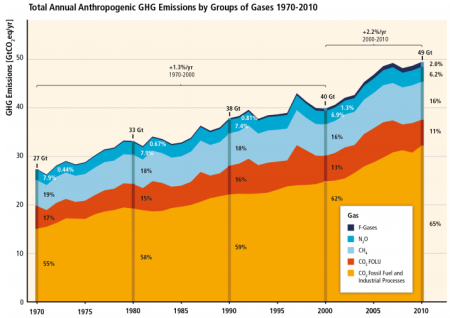
50 Gigatons Per Year: This GreenHouse Is Bigger Than CO2 Alone.
“I didn’t expect it would go so fast,” Dr. Caldeira said. “To melt all of Antarctica, I thought it would take something like 10,000 years.” Didn’t they all. Why? Because only then would one be invited at the White House. Thinking correctly means, first, to think in a way that pleases those with power.
“Combustion of available fossil fuel resources sufficient to eliminate the Antarctic Ice Sheet” [Ricarda Winkelmann, Anders Levermann, Andy Ridgwell,, Ken Caldeira]:
“The Antarctic Ice Sheet stores water equivalent to 58 meters in global sea-level rise. We show in simulations using the Parallel Ice Sheet Model that burning the currently attainable fossil fuel resources is sufficient to eliminate the ice sheet. With cumulative fossil fuel emissions of 10,000 gigatonnes of carbon (GtC), Antarctica is projected to become almost ice-free with an average contribution to sea-level rise exceeding 3 m per century during the first millennium. Consistent with recent observations and simulations, the West Antarctic Ice Sheet becomes unstable with 600 to 800 GtC of additional carbon emissions. Beyond this additional carbon release, the destabilization of ice basins in both West and East Antarctica results in a threshold increase in global sea level. Unabated carbon emissions thus threaten the Antarctic Ice Sheet in its entirety with associated sea-level rise that far exceeds that of all other possible sources.”
The famous Doctor Hansen and his collaborators upset the establishment two months ago by predicting a rise of three meters within 85 years (they use the reasoning I have used before, namely that paleontological data show sea level rise of 5 to 9 meters, with a rise of just one degree Celsius; actually the reasoning was obvious since 2009, when I pointed out that “2C Is Too Much“). The new paper potentially confirms Hansen’s findings. As I said, the new paper tries to NOT upset the powers that be (differently from yours truly, who view most individuals and institutions in power more than suspiciously, and it shows). Thus, one has to read between the lines to deduce that, from the paper itself, interpreting it optimistically is completely unwarranted.
The paper says: “Consistent with recent observations and simulations, the West Antarctic Ice Sheet becomes unstable with 600 to 800 GtC of additional carbon emissions.” Hmm… Let’s see, how long would that take, at the present increasing rate? Now emissions of CO2 itself are around 35 Gt, per year. That’s a number often brandished, but, left at that, it’s disinformation. With other GreenHouse Gases, we are at 50 Gigatons of CO2 equivalent emission, per year. Sorry for taxing the mathematical capabilities of our great leaders: 12 x 50 = 600. This fits perfectly my “Ten Years To Catastrophe” essay. Thus, the West and EAST Antarctic Ice Sheet becomes unstable in TWELVE YEARS (according to this paper; I obtained the same rough estimate with a paleoclimate approach).
The United Nations has said that the rise of the sea would not likely exceed three feet in this century. Some island nations will be wiped out (oops). Yet experts officially hope that major cities could be protected from it, in the richest countries that is (re-oops), though at a cost in the trillions of dollars (contemplate the enormous works to protect London or Venice).
The New York Times mentioned the paper above, which say the ice sheets will start melting irreversibly within a decade, to argue, in Politically Correct fashion, that ice sheets respond slowly enough to changes in the climate that it simply takes longer than a century for large-scale melting to begin. As if that notion was in the paper. It is not. Far from it. As I have argued before, that notion is ridiculous.
Subglacial Basins Are The Achilles’ Heel Of The Biosphere.
{WAIS = West Antarctica Ice Shelf; WB = Wilkes Basin; AB = Aurora Basin.]
Yet from that (tipping) point on, the paper found that thereafter, the sea would rise at the rate at a foot per decade, ten times faster than now, the New York Times admitted.
However the real text is much more alarming. Here is an extract:
“The Antarctic Ice Sheet is severely affected by high carbon emissions through both the marine ice-sheet instability and surface elevation feedbacks. On the time scale of millennia, large parts of the ice sheet melt or drain into the ocean, raising global sea level by several tens of meters. Most of the ice loss occurs within the first millennium, leading to high rates of sea-level rise during this period (Fig. 3; for more details, see also fig. S6). Our simulations show that cumulative emissions of 500 GtC commit us to long-term sea-level rise from Antarctica of 1.15 m within the next millenium, which is consistent with the sensitivity of 1.2 m/°C derived with a different ice-sheet model (33, 34). Paleo data suggest that similar rates of sea-level rise have occurred during past warm periods (35). If the 2°C target, corresponding to about 600 GtC of additional carbon release compared to year 2010, were attained, the millennial sea-level rise from Antarctica could likely be restricted to 2 m. In our simulations, this would keep the ice sheet below the threshold for the collapse of the Wilkes Basin. However, if that threshold is crossed, the Antarctic ice cover is significantly reduced in thickness and area (Fig. 4). If we were to release all currently attainable fossil fuel resources, Antarctica would become almost ice-free. It is unclear whether this dynamic discharge would be reversible and, if so, on which time scales.”
As I already said, since 2010, we have added another 230 Gigatons. So we are within eight year of the Wilkes ice sheet, the largest in the world, to become unstable. The paper admitted that about half the Antarctic ice sheet would melt or fall into the sea in the first thousand years.”
The New York Times’ interpretation that it will take nearly a century for dramatic melting to start was obviously tainted. It is just driven by political Machiavellianism: let’s admit there is climate “change” just as there is sea level “change”, and misinform about the unfolding catastrophe (although Main Stream Media had to recently admit the snow pack in California last April was the lowest in at least 500 years). How do I know this? The scientific paper used computerized models of the huge ice sheets covering Antarctica and Greenland. It is the first paper to do so. Yet, according to the biased New York Times, it would have found exactly what the UN found, during this century… Although the UN did not incorporate the ice sheet melt models.
Once the ice sheet melting is incorporated, faster melting ought to have been predicted, for THIS century. However that grim prediction would have upset the powers that be. We don’t want that to happen. Now that they have the drone habit, killing throngs of people they know nothing about, who knows what’s coming next if one disparages them? Beheading and crucifixion at the most esteemed Saudi plutocracy?
For plutocrats, the Saudis are a model of Human Rights: thus they elected them to head the UN panel on Human Rights. And ice sheet melting is perfect: all great catastrophes call onto what Obama calls “leaders” (our masters). If a bit of engineered inflation could bring Hitler, imagine what an inflating ocean can bring! A great future for the few who rule us, tax free.
Patrice Ayme’
ooOOoo
Let me close with two pictures:
That is a very great deal of water locked up in that ice!
and this one that shows how at least one would have a wonderful view of the sea from your room at the Boston Harbour Hotel!










 Learning from Dogs