Year: 2014

Picture parade thirty-three.

The concluding photographs on the theme of why we have pets.

The first set may be seen here; the second set are here.

AS17

oooo

AS18

oooo

AS19

oooo

AS20

oooo

AS21

oooo

AS22

oooo

AS23

oooo

AS24

oooo

AS25

oooo

As I mentioned in Picture parade thirty-one, all twenty-five photographs were sent to me by friend and follower in Australia, Amanda Smith.

Amanda will be delighted that her photographs have caused so much pleasure to so many, including Jean and me, of course.

Sunlight from grey skies!

Just stop whatever you are doing for fewer than four minutes …

… watch this in full screen mode.

You will not be disappointed,


Blast from the past: IBM

A powerful reminder of ethical business practices.

First the background to today’s post. (You may want to settle down with a glass of something; it’s a bit of a ramble!)

In 1968, I emigrated to Sydney, Australia.  In those days, one could get a sponsored one-way flight ticket to Australia for 10 GBP if one intended to make Australia your new home.  Once there, I obtained a sales clerking job with the Australian division of the famous British company, ICI (Imperial Chemical Industries).  I had previously been working for a UK part of ICI Plastics, British Visqueen Ltd, in Stevenage, Hertfordshire.

Going to Australia came about because in the UK, I had been dating a Finnish woman who, together with her parents and sisters, was living in Sydney.  So when Britta returned to Sydney I thought ‘what the hell’ for a ‘tenner’ I can follow her out there.  (We subsequently married and Britta is the mother of my son, Alex, and daughter, Maija.)

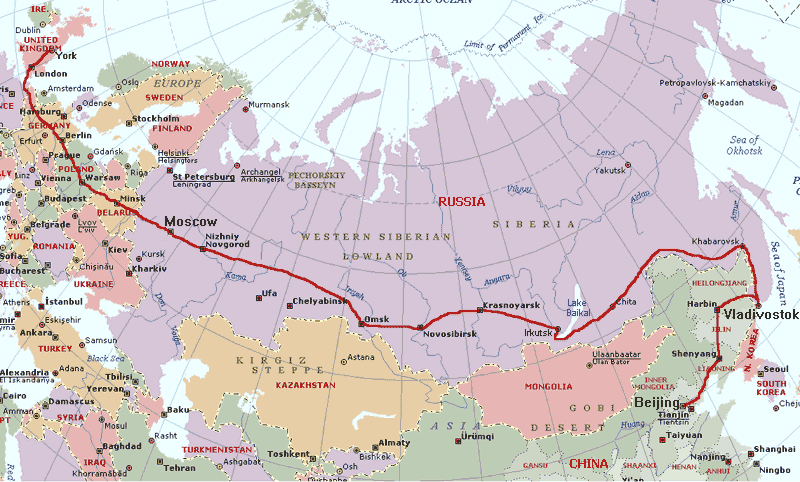
Via very circuitous circumstances, I ended up as a freelance journalist working for a Finnish magazine KotiPosti.  Britta and I spent many months in 1969-1970 driving 30,000 miles all around around Australia finding Finns in the most amazing places doing the most incredible things, and me writing about them.  Then I was invited to travel to Helsinki and in 1970, Britta and I decided to go to Finland via the Trans-Siberian Railway, all the way from Nakhodka in Eastern Russia, on the Sea of Japan, to Moscow, thence on to Helsinki. The route being via Vladivostok, Irkutsk (where we took 24 hours out to visit Lake Baikal), Novosibirsk, Moscow, St. Petersburg (Leningrad) and the short hop to Helsinki.

transib3

What on earth does this have to do with IBM?  Hang on in there! 😉

We initially travelled from Australia to Japan because in 1970, Expo 70 was being held in Japan, and KotiPosti had asked me to write about the event.  One of the most impressive stands at Expo 70 was the IBM stand.  Frankly, it blew me away.

So now fast-forward to Britta and me having completed our stuff in Helsinki and on our way home to Sydney, via London of course, because I still had family in England.  A couple of evenings after we had arrived at Preston Road, Wembley, where my mother’s house was, I read an advertisement in the daily evening newspaper, The London Evening Standard, (still going strong) that IBM UK Ltd, their office products division, were looking for salesmen.  I had been so impressed with IBM at Expo 70 that I seemed unable to resist applying for the job.  To my amazement, I won a place in IBM’s sales team and was with IBM for 8 years – we never returned to Australia.

Fast forward all the way to present times.

A while ago, I signed up to the Current and Ex-IBM Employee Group (Unofficial) on Linked-In.  Yesterday, a member of that group published, The Original IBM Basic Beliefs for those that have never seen them.  They really are worth sharing because how much better would our corporate world be if all businesses subscribed to these beliefs.  Here they are:

ooOOoo

The Original IBM Basic Beliefs for those that have never seen them.

Respect for the Individual
===================
Our basic belief is respect for the individual, for his rights and dignity. It follows from this principle that IBM should:
1. Help each employee to develop his potential and make the best use of his abilities
2. Pay and promote on merit
3. Maintain two-way communications between manager and employee, with opportunity for a fair hearing and equitable settlement of disagreements.

Service to the Customer
===================
We are dedicated to giving our customers the best possible service. Our products and services bring profits only to the degree that they serve the customer and satisfy his needs. This demands that we:
1. Know our customers’ needs, and help them anticipate future needs
2. Help customers use our products and services in the best possible way.
3. Provide superior equipment maintenance and supporting services

Excellence Must Be a Way of Life
==========================
We want IBM to be known for its excellence. Therefore, we believe that every task, in every part of the business, should be performed in a superior manner and to the best of our ability. Nothing should be left to chance in our pursuit of excellence. For example, we must:
1. Lead in new developments
2. Be aware of advanced made by others, better them where we can, or be willing to adopt them whenever they fit our needs.
3. Produce quality products of the most advanced design and at the lowest possible cost

Managers Must Lead Effectively
=========================
Our success depends on intelligent and aggressive management which is sensitive to the need for making an enthusiastic partner of every individual in the organization. This requires that managers:
1. Provide the kind of leadership that will motivate employees to do their jobs in a superior way.
2. Meet frequently with all their people.
3. Have the courage to question decisions and policies; have the vision to see the needs of the Company as well as the division and department
4. Plan for the future by keeping an open mind to new ideas, whatever the source

Obligations to stockholders
=====================
IBM has obligations to its stockholders whose capital has created our jobs. These require us to:
1. Take care of the property our stockholders have entrusted to us.
2. Provide an attractive return on invested capital
3. Exploit opportunities for continuing profitable growth

Fair Deal for the Supplier
====================
We want to deal fairly and impartially with suppliers of goods and services. We should:
Select suppliers and according to the quality of their products or services, their general reliability and competitiveness of price.
1. Recognize the legitimate interests of both supplier and IBM when negotiating a contract; administer such contracts in good faith
2. Avoid suppliers becoming unduly dependent on IBM

IBM should be a Good Corporate Citizen
================================
We accept our responsibilities as a corporate citizen in community, national and world affairs; we serve our interest best when we serve the public interest. We believe that the immediate and long-term public interest is best served by a system of competing enterprises. Therefore, we believe we should compete vigorously, but in a spirit of fair play, with respect for our competitors, and with respect for the law. In communities where IBM facilities are located, we do our utmost to help create an environment in which people want to work and live. We acknowledge our obligation as a business institution to help improve the quality of the society we are part of. We want to be in the forefront of those companies which are working to make our world a better place.

Thomas J. Watson, Jr.
April 1969

ooOOoo

1969! Coming up to 45-years ago.  Sometimes one wonders if society has learnt anything in the last five decades!

The history of everything – In just three minutes.

The history of life on Earth  – quicktime!

A whole clutch of things happened yesterday to conspire in me running out of creative time.  Indeed, it was after 4pm when I sat down in front of my computer wondering about today’s LfD blog post.

Luckily (well for me!), amongst the list of draft posts was this one from January 1st, 2014.  So I cheated by grabbing it and offering it for you today. I just hope you find it of interest.  It was originally presented on Big Think on the 1st January, 2014.

ooOOoo

The History of Life on Earth in Three Minutes

by BIG THINK EDITORS
JANUARY 1, 2014, 12:00 AM

earth_dna

Happy New Year, planet Earth!

According to the Anno Domini designation, the year is now 2014. But the Earth has been around a lot longer than that – about 4.567 billion years. The first evidence of life dates back to around 3.8 billion years ago. Homo sapiens first appeared on the planet around two hundred thousand years – or ten thousand generations – ago.

How’s that for perspective?

Kirk Johnson, director of the National Museum of Natural History, calls this perspective “deep time.” This is the story of our planet preserved in “the DNA of living things,” Johnson explains, as well as “in the fossils we find, in the geologic structures of our planet, in the meteorites we scavenge from the ice fields in Antarctica. Those things together give us an incredible manual for thinking about the planet.”

Why is this manual useful? We are facing a century that will be an incredibly challenging one for humanity. We now live on a planet with seven billion people, which is up from 1.7 billion people just three or four generations ago. So we have more people, and a greater need for resources.

Fortunately we have the bodies of extinct plants and animals that lived for the last three-and-a-half billion years. These fossils are not only a source of energy, but also a source of knowledge about how this planet works. Over its history the Earth has seen an incredible diversity of life – maybe as many as fifty million species. Johnson says we’re learning “as much about the evolution of life on Earth by looking at what happened in the past as we are at looking at the breakthroughs in genomics and DNA of living things.” Furthermore, Johnson sees the sequencing of the human genome as the vanguard for what will eventually be “the study of the genomics of all living things.”

We have the opportunity right now, Johnson says, to choose what our future will be. Our understanding of the diversity of life on this planet, he says, will be our guide. This story is being told at a current exhibition at the National Museum of Natural History called “Genome: Unlocking Life’s Code.”

In the video below, Johnson shares a unique perspective on deep time in the form of a timeline of life on this planet in just three minutes.

ooOOoo

Don’t know about you but I found the video fascinating.

A short story – The Kiss.

The power of the short story.

Funny how things run at times!

Back on the 20th, just six days ago, I published a post under the title of Oregon wolves, and book writing!  Frankly, it was a bit of a hotch-potch of a post but it did include a reference to Melinda Roth’s book Mestengo, that Jean adored and I was finding delightful before ‘circumstances’ caused me to put the book to one side.  For ‘circumstances’ read an email from the said Melinda.  That, in turn, was the result of a comment that Melinda left on that post, namely:

Just read and re-read your draft of Chapter 23. Extraordinary. I hope you’re not going to leave us hanging… (sending you a private email to further make my point).The draft of Chapter 23 is good, good stuff. I found myself totally caught up without even knowing what came before.

It would be wrong for me to share the whole of that email without Melinda’s prior permission but I am comfortable in revealing this:

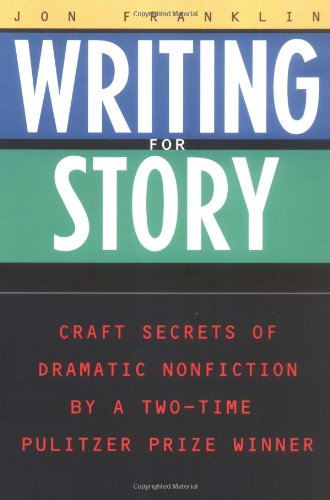
Another book you might consider (not that you have time if you’re going to get this book finished) is “Writing for Story” by Jon Franklin:

This a a very quick read, and I highly recommend it. There are a million books out there about writing, but this one gets straight to the point in a business-like manner and gives THE best advice about how to structure a non-fiction (or fiction) book. The author has won two Pulitzer prizes and uses his two winning pieces as examples – line by line – of how he structures a story.

This book is my bible.  One day I was a ho-hum journalist writing mediocre stories. Then I read this book and the first story I wrote afterwards – following his guidelines – became a finalist for the Penn/Faulkner award. I don’t credit myself for this: I credit Jon Franklin and his book.
41I1HXek2iL

Jon Franklin’s book arrived last Monday and I’m already half-way through reading it.  Wow, what a fantastic book.  Because it sets out the power of the art of the short story, or more accurately, the power of the narrative non-fiction story.  From page 23:

Then, in the ’60s, Truman Capote, a novelist, short-story writer, and playwright, performed a literary experiment that opened the way for a new kind of literature. Capote recognized and accepted the public’s growing interest in nonfiction but objected to the genre’s traditional dry style.  What would happen, he asked, if a true story were told in the form of a novel.

If you go to Jon’s website, there’s a link to one of his short stories, Mrs. Kelly’s Monster, that is in the book.  Do read it.  Trust me, you will be impressed, enthralled and inspired.

So the logic and power of Jon’s argument slammed me full in the face. And, if you will forgive me, offered some comfort to this tyro author struggling with his first book; a nonfictional book.  Because this approach of nonfiction drama resonated with me.  For way back in the late 60s I had worked as a freelance journalist for a Finnish magazine, KotiPosti, writing about Finns all across Australia (long story in itself!) and much more by luck than anything else, had written stories in the style of a ‘true story told in the form of a novel.’

Moving on over 40 years, to when Jean and I were living in Payson, Arizona, we both attended a creative writing class held at the local college.  One of my stories that came out of that class was published not so long ago on Learning from Dogs: Messages from the Night.

Which is all a long preamble to say that one of the many, many things that Jean and I share includes ‘putting pen to paper’ – story writing.

The following short story was also written by Jean when we were attending that writing course in Payson. Enjoy. I know you will.

ooOOoo

The Kiss

by

Jean Handover

She sat at the end of the bar.  Her misery was palpable.  An invisible shroud that hunched her shoulders and bent her head over the glass of wine.  She peered into the pale liquid like it were a pool to drown in.

She was pretty in a faded way.  Trying hard; skirt a little too short, blouse a little too low and blood red lipstick.  Dark for a pinched mouth.  A slim body the way I liked it!  All around were drunken revellers whilst she remained in a bubble.  I wanted to take her in my arms and crush her to my body and burst that bubble.

Hoisting my beer, I ambled to the stool beside her.  She didn’t stir.  Seemed unaware of my presence.  I looked at our reflections in the mirror opposite.  Then at Rose the barmaid.  Rose of the buzzcut and tattoos.  The tattoo on her neck.  Then a small voice, “Why would anyone have lips tattooed on their neck?”

“Guess that’s where Rose likes to be kissed,” I said, taking a gulp of my beer and casting a glance in her direction.

“Yeah, that is a nice place for a kiss.”

She turned and a small smile twitched her lips.  “I shouldn’t have come here.  I’m not used to this scene,” she said.

“How long have you been divorced?” I asked.

“How can you tell I’m divorced?” she replied.

“Your ring finger has a wide indent.”

She fanned her fingers and looked.  “Dead giveaway, isn’t it,” she wanely replied.

“What happened?” I asked.

“He came home one night and said he’d found someone else!”

“Younger woman?” I asked.

“No worse, a younger man!”

“Oops!” I said.

She swivelled in the stool and faced the crowd.  The shroud was slipping perceptively.  I finished my beer and beckoned for Rose to bring us another round.  The divorcee was prettier that I thought at first.  Her hand pushed a lock of hair behind an ear and trailed down her neck, then smoothing her skirt rested on a rounded knee.  A fluid sensuous motion.  I wanted to touch that hand.

“Oh God, no,” she gasped.  Eyes large and face suddenly flushed.  “It’s him with the boyfriend.  They’ve just come in.”

“Don’t worry, Babe.  Let’s just walk right past and get out of here.”

I took her hand and as we strolled past the two men I gently leaned over and kissed her on the neck.  On the same place as Rose’s tattoo.

My lips lingered and with my arm around her waist, we drifted out into the night.

“That felt so good, what’s your name?” I asked.

“Elizabeth.  What’s yours?” she asked.

“Melissa.”

Copyright © 2012, 2014 Jean Susan Handover

ooOOoo

Meet the dogs – Casey

On to dog number five.

If you are new to this series then Ruby’s story of last week will link you to all the dogs written about so far.  Today, here is Jean’s account of how Casey became part of the family.

ooOOoo

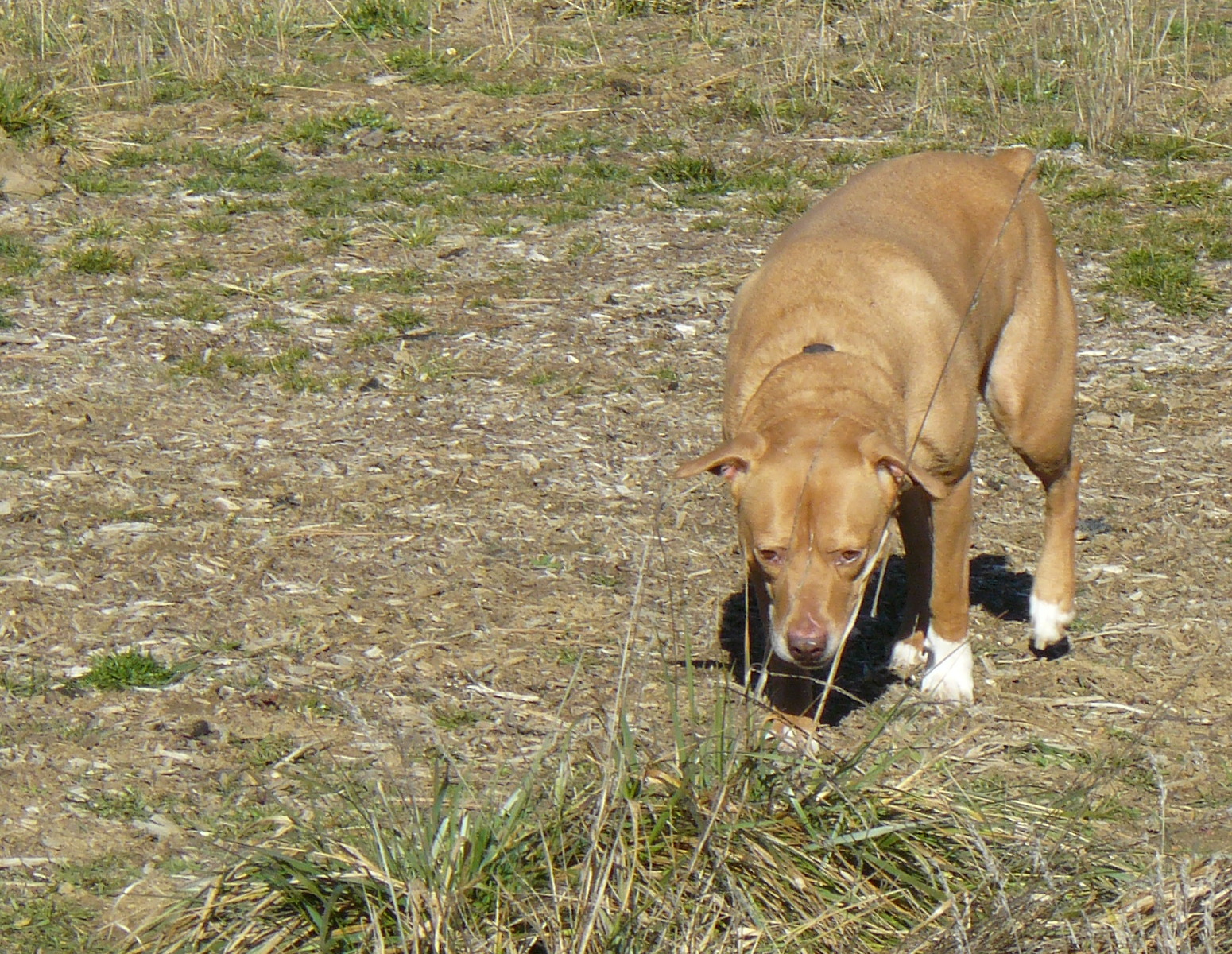
Casey

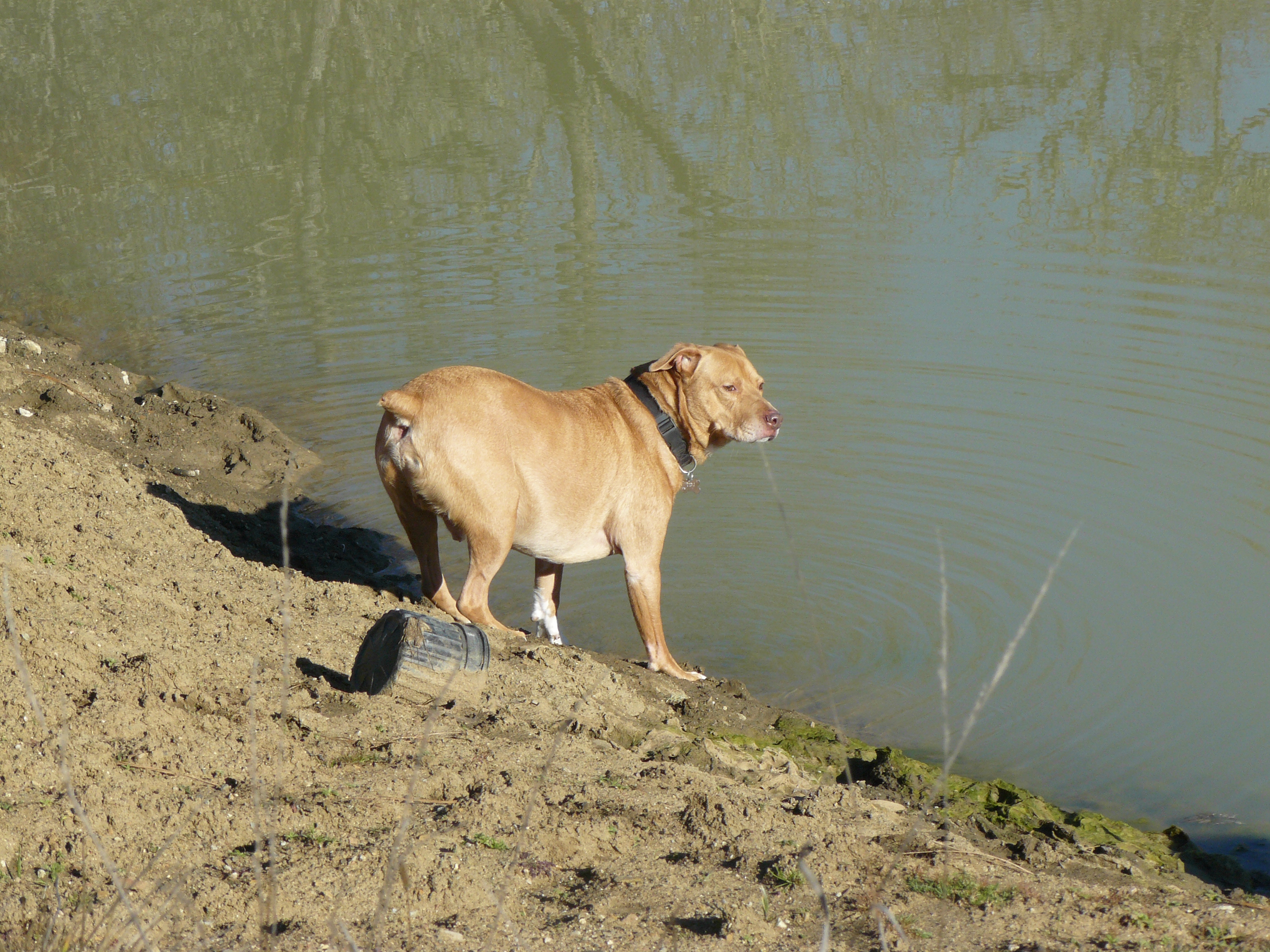
Casey, at home; picture taken a month ago.

Every Friday, the Payson Roundup newspaper would devote a full page to the Humane Society, displaying some of the cats and dogs they had for adoption. I would read about each animal and quietly wish I could bring them all home.

I was particularly taken with one dog that had appeared several times in this Friday page.  His name was Casey and he was a six-year-old Pit Bull mix.  Unfortunately, at home (we were then living in Payson, AZ) we were ‘maxed out’ with a total of 14 dogs in three different sections of our house.  We just couldn’t take Casey.

I had volunteered to be a dog-walker at the Humane Society dog shelter.  But after two sessions walking dogs, I just couldn’t look at these sad little faces without breaking down in tears. I switched my efforts to working at the Society’s Thrift Store.  That was great fun and, at least, it felt as though I was still helping the animals. Nonetheless, I was very impressed with the animal shelter.  They did their utmost to re-home the animals in their care.

Ruby’s ‘pack’ here at home included Phoebe and Tess, rescue dogs from Mexico.   Recently, Phoebe had died with leukaemia and Tess with bone cancer leaving Ruby on her own.  Ruby was a dog that didn’t mix at all well with the other dogs, as was explained in last week’s post.

The next Friday, the Payson Roundup showed the Society’s ‘lonely hearts club’, highlighting animals that had been in care for a long time.  The first dog shown was Casey.  I telephone Chandra, the lady responsible for adoptions, and asked if Paul and I could bring Ruby to the shelter to find a companion for her. When we were at the shelter, Chandra asked us if we had anything against Pit Bulls. Of course we didn’t.  Ruby was introduced to Casey and, as they say, the rest was history.  Casey and Ruby right from the start were just wonderful together.

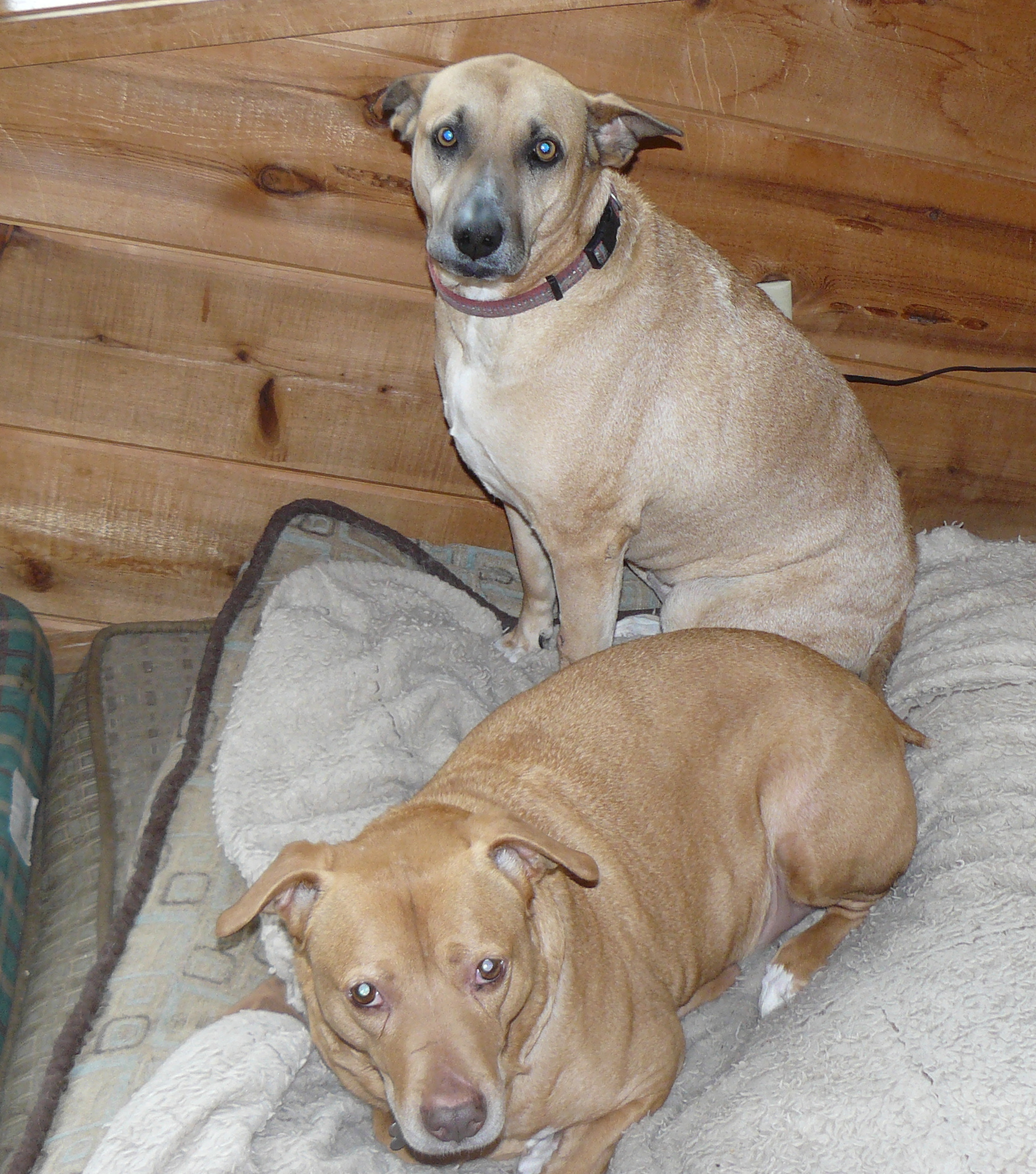
Ruby behind Casey.
Ruby behind Casey.

Subsequently, I learned from Chandra that Casey had been in care for over a year and, had we not taken him home, his days were numbered at the shelter.  There were many cheers and tears when I signed the adoption paper for Casey.

Casey now lives in the kitchen group here in Oregon: Paloma, Ruby, Lilly and Casey.  As with all our dogs, Casey is so happy to have our 14 acres to play in.  He is also the sweetest natured of dogs and will try to climb on to your lap at the first opportunity.  I have always been a great advocate of Pit Bulls and Pit Bull mixes and have never come across a mean one.

Thus, if you are in the position to adopt a dog, please consider Pit Bulls and Pit Bull mixes for the Pit Bull is a much-maligned breed.

Casey demonstrating a dog's focussing skills!
Casey demonstrating a dog’s focussing skills!

ooOOoo

Meet dog number six next week.

The critical value of predators in our wild lands.

The consequences of the reintroduction of wolves to Yellowstone National Park.

I have two people to offer my thanks to for today’s post: Suzann and Ginger.   Both of them within hours of each other sent me an email recommending the following video.  So, without further ado, here is that video.  (Oh, would you believe this.  The video was released on February 13th, 2014 and, at the time of me writing this post, has been viewed 1,453,345 times! Wow!)

Published on Feb 13, 2014

Visit http://sustainableman.org/ to explore the world of sustainability.

For more from George Monbiot, visit http://www.monbiot.com/ and for more on “rewilding” visit http://bit.ly/1hKGemK and/or check out George Monbiot’s book Feral: rewilding the land, the sea and human life: http://amzn.to/1dgdLi9

“When we try to pick out anything by itself, we find it hitched to everything else in the Universe.” – John Muir

When wolves were reintroduced to Yellowstone National Park in the United States after being absent nearly 70 years, the most remarkable “trophic cascade” occurred. What is a trophic cascade and how exactly do wolves change rivers? George Monbiot explains in this movie remix.

Narration from TED: “For more wonder, rewild the world” by George Monbiot. Watch the full talk, here: http://bit.ly/N3m62h

B-Roll Credits:
“Greater Yellowstone Coalition – Wolves” (http://bit.ly/1lK4LaT)
“Wolf Mountain” (http://bit.ly/1hgi6JE)
“Primodial – Yellowstone” (https://vimeo.com/77097538)
“Timelapse: Yellowstone National Park” (http://bit.ly/1kF5axc)
“Yellowstone” (http://bit.ly/1bPI6DM)
“Howling Wolves – Heulende Wölfe” (http://bit.ly/1c2Oidv)
“Fooled by Nature: Beaver Dams” (http://bit.ly/NGgQSU)

Music Credits:
“Unfoldment, Revealment, Evolution, Exposition, Integration, Arson” by Chris Zabriskie (http://bit.ly/1c2uckW)

FAIR USE NOTICE: This video may contain copyrighted material. Such material is made available for educational purposes only. This constitutes a ‘fair use’ of any such copyrighted material as provided for in Title 17 U.S.C. section 106A-117 of the US Copyright Law.

For any concerns or questions, you may contact us athttp://sustainableman.org/contact/

If you want to read more on a general level, then my post on the 11th January, 2014, An echo in the hills! may be worthwhile. It included this from William Ripple, of Oregon State University:

ooOOoo

Top dogs keep ecosystems in order

Many of these large carnivore species are endangered and some are at risk of extinction, either in specific regions or entirely. Ironically, they are vanishing just as we are learning about their important ecological effects, which is what led us to write a new paper in the journal Science to document their role.

From a review of published reports, we singled out seven species that have been studied for their important ecological role and widespread effects, known as trophic cascades. These are the African lion, leopard, Eurasian lynx, cougar, gray wolf, sea otter and dingo.

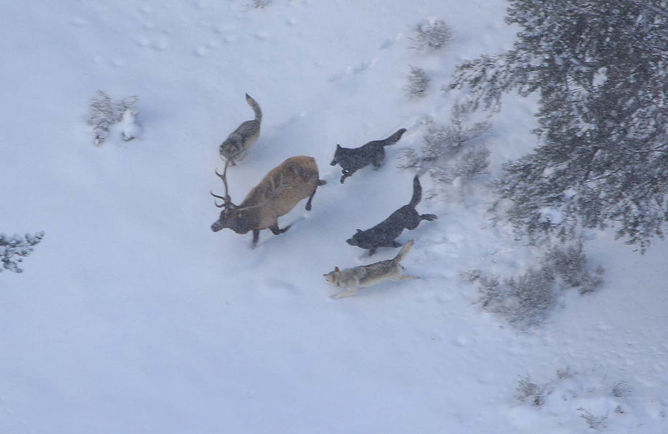
Based on field research, my Oregon State University co-author Robert Beschta and I documented the impact of cougars and wolves on the regeneration of forest tree stands and riverside vegetation in Yellowstone and other national parks in western North America. Fewer predators, we found, lead to an increase in browsing animals such as deer and elk. More browsing disrupts vegetation, reduces birds and some mammals and changes other parts of the ecosystem. From the actions of the top predator, widespread impacts cascade down the food chain.

Similar effects were found in studies of Eurasian lynx, dingoes, lions and sea otters. For example in Europe, absence of lynx has been closely tied to the abundance of roe deer, red fox and hare. In Australia, the construction of a 3,400-mile dingo-proof fence has enabled scientists to study ecosystems with and without dingoes which are closely related to gray wolves. They found that dingoes control populations of herbivores and exotic red foxes. The suppression of these species by dingoes reduces predation pressure, benefiting plants and smaller native prey.

In some parts of Africa, the decrease of lions and leopards has coincided with a dramatic increase in olive baboons, which threaten crops and livestock. In the waters off southeast Alaska, a decline in sea otters through killer whale predation has led to a rise in sea urchins and loss of kelp beds.

Predators are integral, not expendable

We are now obtaining a deeper appreciation of the impact of large carnivores on ecosystems, a view that can be traced back to the work of landmark ecologist Aldo Leopold. The perception that predators are harmful and deplete fish and wildlife is outdated. Many scientists and wildlife managers now recognise the growing evidence of carnivores’ complex role in ecosystems, and their social and economic benefits. Leopold recognised these relationships, but his observations were ignored for decades after his death in 1948.

op carnivores, at work keeping things in check. Doug Smith
Top carnivores, at work keeping things in check. Doug Smith

Human tolerance of these species is the major issue. Most would agree these animals have an intrinsic right to exist, but additionally they provide economic and ecological services that people value. Among the services documented in other studies are carbon sequestration, restoration of riverside ecosystems, biodiversity and disease control. For example, wolves may limit large herbivore populations, thus decreasing browsing on young trees that sequester carbon when they escape browsing and grow taller. Where large carnivore populations have been restored – such as wolves in Yellowstone or Eurasian lynx in Finland – ecosystems appear to be bouncing back.

I am impressed with how resilient the Yellowstone ecosystem is, and while ecosystem restoration isn’t happening quickly everywhere in this park, it has started. In some cases where vegetation loss has led to soil erosion, for example, full restoration may not be possible in the near term. What is certain is that ecosystems and the elements of them are highly interconnected. The work at Yellowstone and other places shows how species affect each another through different pathways. It’s humbling as a scientist to witness this interconnectedness of nature.

My co-authors and I have called for an international initiative to conserve large carnivores in co-existence with people. This effort could be modelled after a couple of other successful efforts including the Large Carnivore Initiative for Europe, a non-profit scientific group affiliated with the International Union for the Conservation of Nature, and the Global Tiger Initiative which involves all 13 of the tiger-range countries. With more tolerance by humans, we might be able to avoid extinctions. The world would be a scary place without these predators.

William Ripple does not work for, consult to, own shares in or receive funding from any company or organisation that would benefit from this article, and has no relevant affiliations.

ooOOoo

The ConversationMan! We are a strange species at times!