I was in TM the other day, pushing a cart around, when I collided with a young guy also pushing his cart.
I said to the young guy, “Sorry about that. I’m looking for my wife and I guess I wasn’t paying attention to where I was going..”
The young guy says, “That’s OK. It’s just a coincidence. I’m looking for my wife, too. I can’t find her and I’m getting a little desperate.”
So, I said, “Well, maybe we can help each other. What does your wife look like?”
The young guy says, “Well, she is 24 years old, tall, with blond hair, green eyes, long legs, big boobs and she’s wearing tight white shorts, a halter top and no bra. What does your wife look like?”
More on the way we are most likely treating Planet Earth.
At the start of the week the first of a shortish series of articles was published, reflecting my support of the book, World on the Edge. Here’s what I wrote then:
I have mentioned before the Earth Policy Institute and Lester Brown’s latest book, World on the Edge. Details of the book are here.
At the time of writing this Post (10am US Mountain Time on the 4th Feb.) I have read through to the end of Chapter 5 of the book and will have it completed soon. It’s opening my eyes hugely!
I have decided over the next week or so to summarise each chapter, hoping that this encourages many readers of Learning from Dogs to reflect, go to the EPI website, buy the book or think about making a difference in any way that you can.
So today, I move on to the next chapter.
Chapter two, Falling Water Tables and Shrinking Harvests.
The term ‘fossil aquifer’ demonstrated that not all aquifers are the same. Let me quote, “There are two sources of irrigation water: underground water and surface water. Most underground water comes from aquifers that are regularly replenished with rainfall; these can be pumped indefinitely as long as water extraction does not exceed recharge. But a distinct minority of aquifers are fossil aquifers – containing water put down eons ago. Since these do not recharge, irrigation ends whenever they are pumped dry.“
Saudi Arabia started drilling for water from their underground fossil aquifer when after the Arab oil-export in the 1970s, the Saudis realised that they were dependent on imported grain and set out to create self-sufficiency in grain by way of irrigation.
In January 2008 the Saudis announced that this huge aquifer was largely depleted!
From 2007 to 2010 the Saudi wheat harvest dropped from nearly 3 million tons to around 1 million tons.
The likelihood is that the last Saudi harvest will be around 2012.
One can’t imagine how the management of a fine and proud country such as Saudi Arabia could be so foolish! But slightly closer to home …..
In most of the leading U.S. irrigation states, the amount of irrigated area has peaked and begun to decline.
California, historically the irrigation leader, has seen irrigated areas fall from nearly 9 million acres in 1997 to an estimated 7.5 million acres in 2010, that’s a 16% drop! Why?
Aquifer depletion and diversion of water to fast-growing cities!
Then there’s Texas. Their irrigated area peaked in 1978 at 7 million acres, now down to 5 million acres, a loss of 29%, as the Ogallala fossil aquifer under the Texas panhandle becomes depleted.
Colorado has seen its irrigated are shrink by 15%
Arizona’s irrigated area is shrinking.
Florida’s irrigated area is shrinking.
Then there’s India. Then there’s Mexico. And on and on. I could quote so much more from this single chapter but – you get the message!
Here’s how the chapter ends.
Today more than half the world’s peoples live in countries with food bubbles. The question for each of these countries is not whether the bubble will burst, but when – and how the government will cope with it. [Read that last sentence again, folks. Ed]
Will governments be able to import grain to offset production losses? For some countries, the bursting of the bubble may well be catastrophic. For the world as a whole, the near-simultaneous bursting of several national food bubbles, as aquifers are depleted could create unmanageable food shortages.
This situation poses an imminent threat to food security and political stability. We have a choice to make. We can continue with over-pumping as usual and suffer the consequences. Or we can launch a worldwide effort to stabilise aquifers by raising water productivity – patterning the campaign on the highly successful effort to raise grainland productivity that was launched a half-century ago.
H’mmm. Tough reading.
Amazon Drought in 2005.
The above photograph was taken from this website; here’s an extract from the accompanying article.
Food inflation is here and it’s here to stay. We can see it getting worse every time we buy groceries. Basic food commodities like wheat, corn, soybeans, and rice have been skyrocketing since July, 2010 to record highs. These sustained price increases are only expected to continue as food production shortfalls really begin to take their toll this year and beyond.
This summer Russia banned exports of wheat to ensure their nation’s supply, which sparked complaints of protectionism. The U.S. agriculture community is already talking about rationing corn over ethanol mandates versus supply concerns. We’ve seen nothing yet in terms of food protectionism.
But as I wrote in the previous article, “Be worried, be concerned but don’t panic – you and I, all of us, have the collective power to sort this all out.” Lester Brown’s book sets out some strong advice on the way forward.
It started when someone we know in Payson, Peter N, posted an item on Facebook about dogs being able to smell out cancer. The Facebook item referred to an article in Natural News. That item here went as follows:
(NaturalNews) The mainstream media is suddenly reporting on the idea that dogs can sniff out cancer in human beings. This concept is no surprise to NaturalNews readers, of course, as we’ve talked about this before, but until now the idea that cancer patients could be detected by smelling them was considered pure quackery by conventional doctors.
Of course, conventional doctors are once again wrong:Cancer patients do have a particular smelldue to the metabolic off-gassing of cancer cell tumors. But here’s the real story the mainstream media isn’t telling you: It’s not just dogs that can smell cancer — manyhealth practitionerscan also smell cancer patients.
I’ve personally spoken to numerous natural health practitioners who say they can smell cancer in patients. It’s not really a difficult thing to do, it turns out. With a bit of training, I believe most doctors could even be trained to do it, much like this dog in Japan which correctly identified cancer from stool samples 37 out of 38 times.
It doesn’t mean doctors have to sniff patients’ poo, either: You can also smell cancer on someone’s breath, so just talking to a patient can give a doctor an opportunity to do that. (Historically, by the way, physicians use to taste patients’ urine, from which they could diagnose a number of diseases, especially diabetes.)
This particular research on dogs’ ability to sniff out cancer was conducted by researchers at the Kyushu University in Japan. Dr Hideto Sonoda, who conducted the research, told the BBC, “The specific cancer scent indeed exists, but the chemical compounds are not clear. Only the dog knows the true answer.”
An important point in all this is thatthe cancer-sniffing dogs were able to detect early-stage bowel cancer— something that is extremely difficult for modern medical technology to detect. And it only takes a dog a few seconds — at virtually zero cost — to make the assessment.
Now, of course, medical scientists are busy trying to build an electronic device to replace the dog, because conventional medicine can’t stand the fact that something built by nature (the dog’s nose) might be better than some million-dollar electronic gizmo they come up with that can be billed out at $500 a test. So rather than just using dogs who can already detect cancer right now, they’re going to wait around a few years and try to create some high-tech equipment that will probably be a poor replacement for the dog.
That’s how modern medicine works: It steals good ideas from nature and replicates them, but the results are almost always a poor imitation of what Mother Nature has provided for free. Here’s how the end results would likely stack up:
CANCER-SNIFFING DOG
Accuracy: 98%
Cost: One dog biscuit and a pat on the head
CANCER-SNIFFING HIGH-TECH MACHINE
Accuracy: 60%
Cost: $500 billed to Medicare [the US medical system for those unfamiliar with the term. Ed.]
Gee, which one do you think conventional medicine will end up using?
In fact, a quick web search finds much information on the topic including these YouTube videos.
Now how to get our dogs to tell us ……… we’re OK; assuming we are!
The British Medical Journal published a ground-breaking research reporting how dogs have been trained to detect bladder cancer by its smell in urine, bringing together dogs’ exceptional sense of smell, with the theory that cancer produces chemicals with distinctive odours. (on September 24th, 2004 )
Six dogs, none of which had any prior experience in scent discrimination, were trained over seven months to distinguish between urine samples from bladder cancer patients and those from healthy people and individuals with non-cancerous diseases. For the final tests, each dog was offered a set of seven urine samples, and their task was to determine which of them was from a patient with bladder cancer. All of the samples used in the tests were completely new and unfamiliar to the dogs.
The dogs, comprising three spaniels, one papillon, one Labrador and one mongrel, correctly selected the bladder cancer urine on 22 out of 54 occasions – an average success rate of 41% compared to the 14% which would have been expected if the dogs had randomly selected a sample each time. This was statistically significant.
The research was undertaken by a unique partnership of medical scientists, including a statistician, and dog trainers. An orthopaedic surgeon from Buckinghamshire, Mr John Church, brought together colleagues from the Department of Dermatology, Buckinghamshire Hospitals NHS Trust (funded by the Erasmus Wilson Dermatological Research Fund) to develop and supervise the scientific protocol for the research, and Hearing Dogs for Deaf People (based near Princes Risborough) for the purpose of training the dogs for the trial.
“We were flattered to be asked to assist in this study on the basis of our reputation in the field of training dogs,” Claire Guest, Operations Director at Hearing Dogs said, “although we have been very careful not to let this project affect our normal work which involves training dogs for deaf people. The four of us who trained these cancer detection dogs did so using our own pet dogs, in our own homes, in our own spare time.”
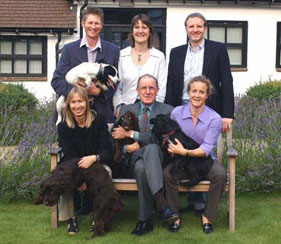
Back row: And Cook, Claire Guest, Martin Church. Front row: Carolyn Willis, John Church, Susannah Church
I rather loved the quote from John Church, “I am a passionate believer that animals have a huge amount to teach us, and I have heard many stories of people who have been alerted to the presence of cancer in their bodies by their pet dogs. I was delighted to find that the two charities were open-minded enough to participate in this study, so that we could really examine this phenomenon scientifically.”
As I keep going on about – we really can learn from dogs!
This opened my eyes; thought I would share it with you.
I know that many of the several hundred readers of Learning from Dogs are not in the USA. But many are. Hence me deciding, after mulling it over, to publish in full the contents of an email that came in a short while ago from the organisation Change.
Here’s that email.
Dear Paul,
Valentine’s Day, which accounts for 40% of fresh flower sales annually, is fast approaching.
Not always a sweet smell.
If you’re planning to order a bouquet from 1-800-Flowers — the world’s largest florist — you should know where most of those flowers really come from.
At flower farms in Ecuador and Colombia — the countries that export the most to the U.S. — two-thirds of the workers are women. These women are routinely subjected to harassment and even rape from their male supervisors. They suffer eye infections and miscarriages from consistent contact with dangerous pesticides.
In the weeks leading up to Valentine’s Day and Mother’s Day, they’re routinely forced to work 80-hour weeks with no overtime pay. Attempts to form a union are met with opposition by police and armed forces.
Many retailers — such as Whole Foods and Stop & Shop — have taken the important first step of offering Fair Trade flowers to consumers who want no part of these abuses. Fair Trade certified farms must adhere to strict standards for workers’ rights, which prevents the abuses described above.
1-800-Flowers is the largest florist in the world. Yet they offer no Fair Trade flowers at all.
1-800-Flowers uses a certifying agency called Florverde, which ensures that its flower farms measure up to certain environmental standards — this is a good thing. But Florverde has almost no labor standards: A farm can be certified even if it uses forced labor.Indeed, Florverde is owned by the Association of Colombian Flower Exporters, so it has a financial incentive to keep wages low and suppress workers’ rights.
This is the week before Valentine’s Day — more people will purchase flowers during the next seven days than any other week this year. This is our best opportunity to demand a promise from 1-800-Flowers to join its competitors in offering Fair Trade flowers. So after you sign the petition, please share this email widely and post on Facebook — do everything you can topressure 1-800-Flowers to show a little respect for the women who toil in unbearable circumstances. The women without whom they’d have no flowers to sell.
Click the link below to tell 1-800-Flowers to make a promise this Valentine’s Day to sell Fair Trade flowers:
Since this campaign began, the company has emailed to tell us that it will post more information on its website about the farms that supply their flowers. But this is a far cry from selling fair trade products — and we have much more to do to make sure workers are protected. This is the week to do it.
Thanks for taking action,
Patrick and the Change.org team
If you feel so minded to sign the petition, which can be done by people outside the USA, then that may be done here.
An interesting companion to the World on the Edge book
Regular readers of the Blog will know that yesterday an article was published, the first of a series, looking more closely at the book by Lester Brown of EPI called World on the Edge. That article followed on from this Post, Group Human Insanity, and yesterday’s Post, Total, Utter Madness, Pt 1.
Today, if you will forgive the emotional battering that the book and this film create, I want to draw your attention to a film that was produced in 2007, called What A Way To Go: Life at the End of Empire.
It was lent to us by John Hulburt, who lives in Payson, and holds many views that are close to the views of the founders of Learning from Dogs. John has offered to write the odd guest article for the Blog, which is fantastic.
Anyway, back to the film. Here are a couple of trailers.
A 2-minute trailer giving an overview of the film ..
and another one dipping into more detail.
And if you still want more, then here’s an interview of the two behind the film, Producer Sally Erickson and Writer/Director Tim Bennett. Twenty-seven minutes long but so what. Watch it!
We really do have so much to learn from dogs! (Before it’s too late!)
The way we are most likely treating Planet Earth is almost beyond comprehension.
I have mentioned before the Earth Policy Institute and Lester Brown’s latest book, World on the Edge. Details of the book are here.
At the time of writing this Post (10am US Mountain Time on the 4th Feb.) I have read through to the end of Chapter 5 of the book and will have it completed soon. It’s opening my eyes hugely!
I have decided over the next week or so to summarise each chapter, hoping that this encourages many readers of Learning from Dogs to reflect, go to the EPI website, buy the book or think about making a difference in any way that you can.
Chapter One, On the Edge, sets the background:
Summer of 2010 sees record-high temperates in Moscow, Russia’s grain harvest shrank by 40 million tons (40%) to 60 million tons.
Record high temperatures in south-central Pakistan were recorded. Snow and glaciers in the Himalayas melted fast, 20 million Pakistanis were affected by the resultant flooding, 2,000 died, 6 million acres of crops damaged.
A 2002 study by Mathis Wackernagel concluded that, “humanity’s collective demands first surpassed the earth’s regenerative capacity around 1980. By 1999, global demand’s on the earth’s natural systems exceeded sustainable yields by 20 percent. Ongoing calculations show it at 50 percent in 2007. Stated otherwise, it would take 1.5 Earths to sustain our current consumption.” [my emphasis]
“No previous civilisation has survived the ongoing destruction of its natural supports. Nor will ours.”
Let’s turn to NOAA. A few salient points from there State of the Climate – Global Review for 2010.
For 2010, the combined global land and ocean surface temperature tied with 2005 as the warmest such period on record, at 0.62°C (1.12°F) above the 20th century average of 13.9°C (57.0°F). 1998 is the third warmest year-to-date on record, at 0.60°C (1.08°F) above the 20th century average.
The 2010 Northern Hemisphere combined global land and ocean surface temperature was the warmest year on record, at 0.73°C (1.31°F) above the 20th century average. The 2010 Southern Hemisphere combined global land and ocean surface temperature was the sixth warmest year on record, at 0.51°C (0.92°F) above the 20th century average.
The global land surface temperature for 2010 tied with 2005 as the second warmest on record, at 0.96°C (1.73°F) above the 20th century average. The warmest such period on record occurred in 2007, at 0.99°C (1.78°F) above the 20th century average.
2010 is becoming the year of the heatwave, with record temperatures set in 17 countries.
Record highs have occurred in Russia, Belarus and Ukraine – the three nations at the centre of the eastern European heatwave which has lasted for more than three weeks – but also African, Middle Eastern and Latin American countries.
Temperatures in Moscow, which have been consistently 20C above normal, today fell to 31C (86F), and President Dmitry Medvedev cancelled a state of emergency in three out of seven Russian regions affected by forest fires.
Thousand of hectares of forest burned in the fires, killing 54 people and leaving thousands homeless. For days, Moscow was shrouded in smog, and environmentalists raised fears that the blaze could release radioactive particles from areas contaminated in the 1986 Chernobyl disaster.
Wildfires have also swept through northern Portugal, killing two firefighters and destroying 18,000 hectares (44,500 acres) of forests and bushland since late July. Some 600 firefighters were today struggling to contain 29 separate fires.
But the extreme heat experienced in Europe would barely have registered in Iraq, Saudi Arabia, Niger, Pakistan and Sudan, all of which have recorded temperatures of more than 47C (115F) since June. The number of record highs is itself a record – the previous record was for 14 new high temperatures in 2007.
The freak weather conditions, which have devastated crops and wildlife, are believed to have killed thousands of elderly people, especially in Russia and northern India. The 2003 European heatwave killed about 15,000 people.
Be worried, be concerned but don’t panic – you and I, all of us, have the collective power to sort this all out. More about this soon.



 Learning from Dogs