Except to thank Neil K. for passing it on.
Note: almost certainly this image is copyright protected, see here.
Dogs are animals of integrity. We have much to learn from them.
Year: 2011
Except to thank Neil K. for passing it on.

Note: almost certainly this image is copyright protected, see here.
The wonderful combination of paragliding and flying with hawks.
Thanks to Dan Gomez for passing me a short video about this amazing activity. It was a matter of moments to find out the background. But first a picture.

There’s a full description of the history of parahawking, as it is called, on WikiPedia.
Parahawking is a unique activity combining paragliding with elements of falconry. Birds of prey are trained to fly with paragliders, guiding them to thermals for in-flight rewards and performing aerobatic maneouvres.
Parahawking was developed by British falconer Scott Mason in 2001. Mason began a round-the-world trip in Pokhara, Nepal, where many birds of prey – such as the griffon vulture, steppe eagle andblack kite – can be found. While taking a tandem paragliding flight with British paraglider Adam Hill, he had the opportunity to see raptors in flight, and realized that combining the sport of paragliding with his skills as a falconer could offer others the same experience. He has been based in Pokhara ever since, training and flying birds during the dry season between September and March.
The team started by training two black kites, but have since added an Egyptian vulture and a Mountain hawk-eagle to the team. Only rescued birds are used – none of the birds has been taken from the wild.
There’s an interesting website for those that want to take a closer including more details about Scott Mason and his team here.
Now watch this!
Just some wonderful pictures of people and their pet dogs!
It’s 2pm Mountain Time on the 28th. I wanted to get a deeper post written for tomorrow (today as you are reading this!) but somehow too many things have been happening today.
So I’m ‘cheating’ and using a recent email sent to me by Cynthia Gomez, Dan’s lovely wife, that was called When your dog is your best friend. It contained some fabulous photographs of people and their pet dogs. A quick Google search showed that they came from a website devoted to finding homes for pets, Just One More Pet. Enjoy the pics.


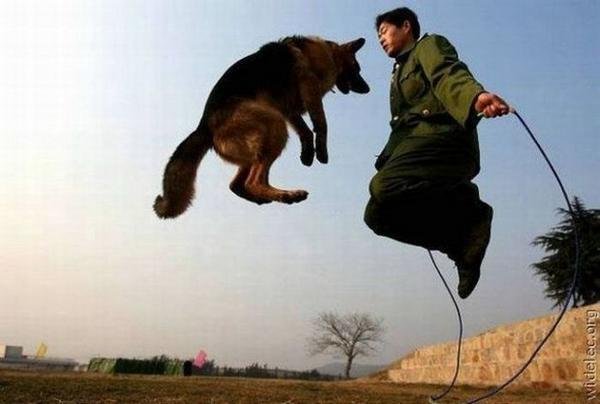

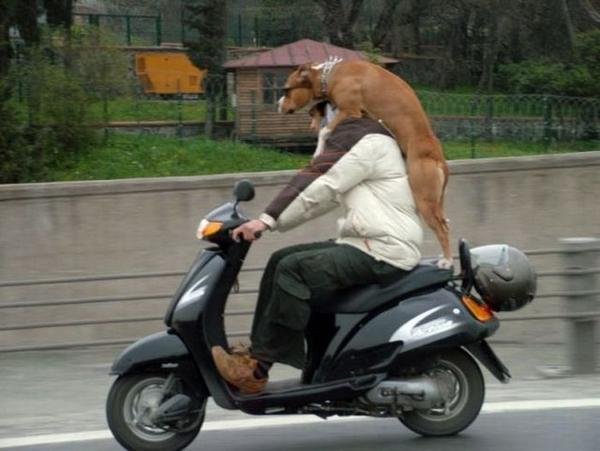
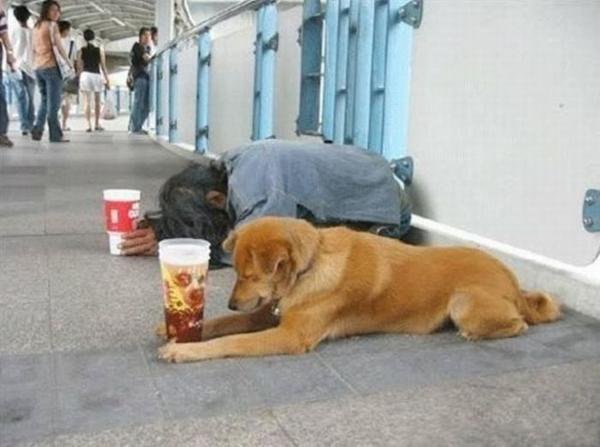

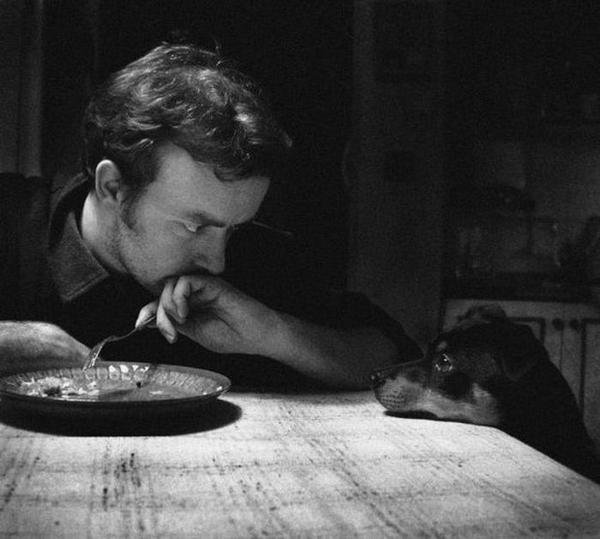
Thanks Cynthia for sharing those – heart-melting stuff!
Just a bit more science about that sixth sense.
Yesterday, I wrote about how science was coming up with some pretty strong evidence that humans do have the ability to communicate in a way that might be called ‘telepathic’.
If (and that’s a big ‘if’) I have any understanding of the science, I believe it has much to do with quantum physics. So I thought it fun to take a small diversion in today’s Post and give you some material on this very strange world of the very, very small.
From A Lazyman’s Guide to Quantum Physics,
What is Quantum Physics?
That’s an easy one: it’s the science of things so small that the quantum nature of reality has an effect. Quantum means ‘discrete amount’ or ‘portion’. Max Planck discovered in 1900 that you couldn’t get smaller than a certain minimum amount of anything. This minimum amount is now called the Planck unit.
Why is it weird?
Niels Bohr, the father of the orthodox ‘Copenhagen Interpretation’ of quantum physics once said, “Anyone who is not shocked by quantum theory has not understood it“.
To understand the weirdness completely, you just need to know about three experiments: Light Bulb, Two Slits, Schroedinger’s Cat.
Two Slits
The simplest experiment to demonstrate quantum weirdness involves shining a light through two parallel slits and looking at the screen. It can be shown that a single photon (particle of light) can interfere with itself, as if it travelled through both slits at once.
Light Bulb
Imagine a light bulb filament gives out a photon, seemingly in a random direction. Erwin Schroedinger came up with a nine-letter-long equation that correctly predicts the chances of finding that photon at any given point. He envisaged a kind of wave, like a ripple from a pebble dropped into a pond, spreading out from the filament. Once you look at the photon, this ‘wavefunction’ collapses into the single point at which the photon really is.
Schroedinger’s Cat
In this experiment, we take your pet cat and put it in a box with a bottle of cyanide. We rig it up so that a detector looks at an isolated electron and determines whether it is ‘spin up’ or ‘spin down’ (it can have either characteristic, seemingly at random). If it is ‘spin up’, then the bottle is opened and the cat gets it. Ten minutes later we open the box and see if the cat is alive or dead. The question is: what state is the cat in between the detector being activated and you opening the box. Nobody has actually done this experiment (to my knowledge) but it does show up a paradox that arises in certain interpretations.
To conclude I will offer this quotation reputed to be from the great master himself, Albert Einstein,
The more success the quantum theory has, the sillier it looks.
Science is catching up with dogs!
Those of you who have come across Rupert Sheldrake and, in particular his book Dogs That Know When Their Owners Are Coming Home will really not be surprised at what is coming, in terms of the rest of this Post. Because most dog owners know, from countless observations, that dogs have an uncanny ability to see the world around them in a more deeper and intuitive manner than we can explain.
I wrote of Sheldrake’s book on the 1st June including touching on a report of Mason, a small terrier mix …
On April 27th, Mason was hiding in his garage in North Smithfield when the storm picked him up and blew him away. His owners couldn’t find him and had about given up when they came back Monday to sift through the debris, and found Mason waiting for them on the porch.
A few evenings ago, we watched a documentary from the website Top Documentary Films from the series Through The Wormhole. This particular documentary was entitled Is There a Sixth Sense? Here’s how that film was introduced,
Sight, hearing, smell, taste and touch are the tools most of us depend on to perceive the world. But some people say they also can perceive things that are outside the range of the conventional senses, through some other channel for which there is no anatomical or neurological explanation. Scientific researchers who study such abilities call them extrasensory perception (ESP), but lay people often refer to them as the sixth sense.
Either term really is a catch-all for a variety of different purported abilities that vary from person to person. Some people claim the power of telepathy – that is, the ability to perceive others’ thoughts, without having them communicated verbally or in writing. Others claim to have the power of clairvoyance, which is the ability to perceive events and objects that are hidden from view because of barriers or distance. Still others claim to be gifted with precognition, which enables them to look into the future and glimpse what hasn’t yet occurred.
The belief in ESP or the sixth sense dates back thousands of years. The Greek historian Herodotus wrote that Croesus, who ruled a kingdom in what is now Turkey in the sixth century B.C., consulted oracles – that is, groups of priests claimed to be able to predict the future — before he went to war. In ancient India, Hindu holy men were believed to possess the power to see and hear at a distance, and to communicate through telepathy.
In the late 1700s, the Viennese physician Franz Mesmer claimed that he could give people ESP powers by hypnotizing them. Just before his assassination in 1865, President Abraham Lincoln told friends that he’d dreamed of his own body lying in state in the White House. In the 20th century, Edgar Cayce and Jean Dixon attracted wide followings by claiming that they could foresee future events. During the Cold War, U.S. military and intelligence agencies, spurred by reports that the Soviets had psychics at their disposal, even tried to utilize clairvoyants who claimed remote-viewing powers for espionage purposes.
As well as watching it directly from the Top Documentary Films website, it is also available from YouTube. Here are the four links. It is a most fascinating review of the scientific findings in this area. If you have a dog with you when you watch the videos, don’t be surprised if he or she fall asleep! Nothing new for dogs in all this!
A focus on Tim Bennett’s movie, What a Way To Go: Life at the end of Empire
We first came across this film, made by independent film-maker Tim Bennett, on the Top Documentary Films website, see here. The title to this article comes from that introduction, from which is quoted,
Tim Bennett, middle-class white guy, started waking up to the global environmental nightmare in the mid-1980s. But life was so busy with raising kids and pursuing the American dream that he never got around to acting on his concerns. Until now…
Bennett journeys from complacency to consciousness in his feature-length documentary, What a Way To Go: Life at the End of Empire. He reviews his Midwestern roots, ruthlessly examines the stories he was raised with, and then details the grim realities humans now face: escalating climate change, resource shortages, degraded ecosystems, an exploding global population and teetering global economies.
Now to be honest, this is a film that is both captivating and, in parts, pretty grim. A couple of trailers and other background material were posted on Learning from Dogs back in February.
The film also has an excellent web site What a Way To Go Movie which contains much background material including the opportunity to watch the film for free, click here. Or a quick YouTube search will bring you to here.
My own view is that this is a ‘must see’ film. Not because I want all of you to wallow in doom and gloom, far from it, but because, as Paul Gilding writes in his book, The Great Disruption, the quicker that mankind recognises the massive levels of denial presently in place, the quicker that mankind will commit to the scale of change that is required. That’s where Paul Gilding’s approach differs from the movie, The End of Empire. Gilding is optimistic that man will bring about change simply because fairly soon, in just a few years, it will be obvious at all levels in our societies that there simply is no choice!
A retrospective muse about the present global challenges.
A few days back I posted an article by Tom Engelhardt called The Great American Carbon Bomb. It attracted a number of comments including a couple from Learning from Dogs supporter, Patrice Ayme. Here is one of those comments,
Dear Paul: There is a gentleman leading the Tour de France, right now. He was not given a chance, especially in the mountains. However, he has been going day by day, and has now worn the Yellow Jersey for more than a week, supported by his inferior, but dedicated team. His philosophy: humility, and do the job day by day, trying his best, although he strongly doubts that he is up to the task.
We, as humankind, or, rather, our hubristic leaders are doing the exact opposite. We are not doing our best, and it’s precisely because those leaders are not humble and not honest, and so very sure we are going to pull out OK, because that’s what we do best, and have always done, and thus will always do.
Verily all indicators are that of an unfolding catastrophe. All signals are loud and clear that way. So it’s really not the moment to say:”Oh, BTW, we are very resilient and totally great, so it’s just a matter of time before we put it all together OK. So now let’s all pull together, and it’s fine.”
In truth we are on the verge of an irreversible situation, as the CO2 poisoning will turn, within a decade or so, into a political, and then military issue.
PA
Patrice is an angry man (not a criticism by the way – so many of us are angry!) and anger is a great reason to find someone, something, anything, to blame! I suspect, wearing my cloak of an amateur psychologist, that a core reason why we feel anger is that, so often, the causes of our anger are our own errors. Anger at one’s self is much more difficult to deal with!
Anyway, back to the plot.
Like Patrice I also feel badly let down by our ‘leaders’. Especially with regard to the nightmare of economic and ecological issues fast approaching.
Then I read this in Paul Gilding’s book, The Great Disruption, that has been featured on this Blog a couple of times.
Our addiction to growth is a complex phenomenon, one that can’t be blamed on a single economic model or philosophy. It is not the fault of capitalism or Western democracy, and it is not a conspiracy of the global corporate sector or of the rich. It is not a bad idea that emerged in economics, and it is not the result of free market fundamentalism that emerged in the 1980s with globalization. While each of those factors is involved, it is too simple and convenient to blame any of them as the main driver. Growth goes to the core of the society we have built because it is the result of who we are and what we have decided to value. [Chapter 5, Addicted to Growth, p66]
That last half of that last sentence – ‘it is the result of who we are and what we have decided to value.‘ That strikes me as the core truth. It is the reason why Patrice, and me, and countless thousands of others across the globe, are so angry. At heart we all know that the circumstances we find ourselves in are, in great part and before we ‘saw the light’, the result of earlier personal values which we now know were not compatible with a sustainable relationship with the planet we all live on.
It is very good news. That anger is fuelling change. As Malcolm Gladwell writes in his book The Tipping Point societies change when something of the order of 18% of individuals emotionally commit to change.
 Learning from Dogs