Having now been living in Arizona for 18 months, I can say with some degree of certainty that there are few British things that I miss. One of them is draft English beer, of course, but another one is the BBC. Luckily modern internet technology means that quite a few of the great BBC television programmes ‘leak’ outside the UK.
The BBC Horizon science series has been one such example of a really well-produced programme.
Recently, a BBC Horizon programme about genetically modified (GM) foods aired by the BBC found its way onto YouTube and thence to the website Top Documentary Films. Not only is it an interesting programme but it also reveals how the facts of new advances in science are often difficult to understand by us; the general public.
The link to the film on the TDF website is here but if you want to watch it directly from YouTube then here it is.
Is it me or does there seem to be a shift in overall awareness of our ‘new world’?
On the 30th May, I mentioned the concept of a new Anthropocene era for the second time, based on The Economist of the 28th May having it as a lead story. (The first mention was on the 16th May.)
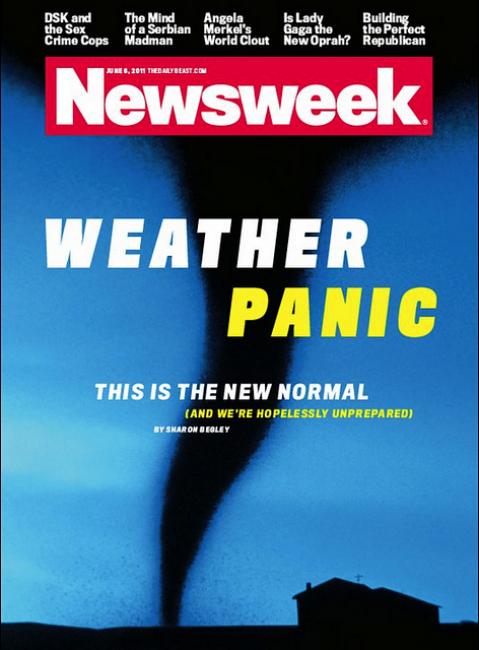
Then a couple of days later, friend John H. here in Payson, drops off his copy of Newsweek for June 6th. Here’s the cover page.
Newsweek, June 6, 2011
This is how the article runs, written by Sharon Begley,
Are You Ready for More?
In a world of climate change, freak storms are the new normal. Why we’re unprepared for the harrowing future.
Joplin, Mo., was prepared. The tornado warning system gave residents 24 minutes’ notice that a twister was bearing down on them. Doctors and nurses at St. John’s Regional Medical Center, who had practiced tornado drills for years, moved fast, getting patients away from windows, closing blinds, and activating emergency generators. And yet more than 130 people died in Joplin, including four people at St. John’s, where the tornado sucked up the roof and left the building in ruins, like much of the shattered city.
Then just a couple of paragraphs later, this pretty blunt summary,
From these and other extreme-weather events, one lesson is sinking in with terrifying certainty. The stable climate of the last 12,000 years is gone. Which means you haven’t seen anything yet. And we are not prepared.
Just read that again very carefully, “The stable climate of the last 12,000 years is gone.” Do take a few moments off and go here and read the full article. The last paragraph of which reads,
So what lies behind America’s resistance to action? Economist Sachs points to the lobbying power of industries that resist acknowledgment of climate change’s impact. “The country is two decades behind in taking action because both parties are in thrall to Big Oil and Big Coal,” says Sachs. “The airwaves are filled with corporate-financed climate misinformation.” But the vanguard of action isn’t waiting any longer. This week, representatives from an estimated 100 cities are meeting in Bonn, Germany, for the 2nd World Congress on Cities and Adaptation to Climate Change. The theme is “Resilient Cities.” As Joplin, Mo., learned in the most tragic way possible, against some impacts of climate change, man’s puny efforts are futile. But time is getting short, and the stakes are high. Says Daniel Sarewitz, a professor of science and society at Arizona State University: “Not to adapt is to consign millions of people to death and disruption.”
It’s a powerful article that can be read in full on the Newsweek website.
So, perhaps one might say at last, the notion that mankind’s impact on the Planet is real and capable of affecting practically all of us living on this beautiful Planet is becoming a ‘mainstream’ accepted idea.
What even a lovely boy, just one year old, can offer the world.
I’m writing this around 5pm UK time on the 8th June. A little over 4 hours ago, at 1230 give or take, I witnessed a tiny event, something that for many of us wouldn’t have been seen as anything but trivial, albeit lovely.
Here’s what happened.
I had been to an introductory meeting with Richard White of The Accidental Salesman fame. We met in Pall Mall, just by Trafalgar Square, at the offices of The Institute of Directors.
Shortly before 1230, after Richard and I had said our goodbyes, I jumped on a Bakerloo train at the London Underground station at Piccadilly Circus heading north for Baker Street.
Bakerloo line train at Piccadilly Circus station
I think it was one stop later that into my carriage entered parents with their small son. They sat down and the father, who had been carrying the young lad, was clearly beautifully bonded (not my favourite word, can’t think of a better one just now) with the small boy. The love and joy of the parents and their child just poured out into the ‘ether’ of the carriage. Result?
One man, middle-aged, sitting opposite to one side of the family beamed smiles in the direction of the young boy. You could sense that his emotional outlook had been transformed by the unencumbered joy flowing across the carriage. He really smiled more or less non-stop until I and this family got off at Baker Street station.
Another man, my guess upper middle-aged, was formally dressed in the business suit, tie and polished black shoes. He was reading a newspaper. But the boy’s joyful infectiousness touched him. He put the paper to one side and discretely looked across at the child bouncing on his father’s lap and a private smile crossed his face.
I was standing observing all of this and, of course, seeing the truth of something so core to the needs of humans. That is, the power of living beautifully in the present and how it demonstrates what my colleague Jon Lavin so often says, “The world reflects back what we think about most”.
Why do I write ‘of course’? Because what was so natural for this boy at the tender age of one is so natural for dogs throughout all their lives; wonderfully enjoying the present.
In a most un-English manner, I briefly caught up with the parents and established that the young boy’s name was Thomas.
Well done, Thomas, and may that joy in you be with you and all those around you for ever and ever.
Probably the best lesson dogs offer their human companions.
Having surfaced recently from being completely immersed in the writings of Dr. Rupert Sheldrake’s book, Dogs That Know When Their Owners Are Coming Home (start here and work backwards if you missed my musings on Sheldrake) I used the recent flight across to London to start into the book by Jeffrey Moussaieff MassonDogs Never Lie About Love.
Masson's book
While I might disagree with some minor aspects of the way that dogs relate to humans, the essential premise of the book is very powerful.
Indeed, the very last sentence of Chapter 2, Why We Cherish Dogs reads as follows:
Questers of the truth, that’s who dogs are; seekers after the invisible scent of another’s authentic core.
For me, any attempt to seek our own ‘authentic core’ can only come from understanding the power of remaining in the present. Dogs do this so naturally and instinctively. As Masson writes a little earlier in the above chapter,
A dog does not tremble at the thought of his own mortality; I doubt if a dog ever thinks about a time when he will no longer be alive. So when we are with a dog, we, too, enter a kind of timeless realm, where the future becomes irrelevant.
One could almost imagine this being the ancient wisdom of the teachings of Buddha!
Anyway, in a rather serendipitous manner, just before starting this essay, I read my weekly News and Notes from Terry Hershey. This is what he wrote about being in the present.
Did you see Mr. Holland’s Opus? About Glenn Holland’s lifetime of teaching music to a high school band. In one scene he is giving a private lesson to Gertrude. She is playing clarinet, making noises that can only be described as other-worldly. He is clearly frustrated. As is she. Finally Mr. Holland says, “Let me ask you a question. When you look in the mirror what do you like best about yourself?”
“My hair,” says Gertrude.
“Why?”
“Well, my father always says that it reminds him of the sunset.”
After a pause, Mr. Holland says, “Okay. Close your eyes this time. And play the sunset.”
And from her clarinet? Music. Sweet music.
Sometime today, I invite you to set aside the manual, or the list, or the prescription.
Take a Sabbath moment. . . close your eyes and play the sunset.
Mary Oliver describes such a moment this way, “. . .a seizure of happiness. Time seemed to vanish. Urgency vanished.”
Because, in such a moment, we are in, quite literally, a State of Grace. In other words, what we experience here is not as a means to anything else.
If I am to focused on evaluating, I cannot bask in the moment.
If I am measuring and weighing, I cannot marvel at little miracles.
If I am anticipating a payoff, I cannot give thanks for simple pleasures.
If I am feeling guilty about not hearing or living the music, I cannot luxuriate in the wonders of the day.
Living in the present is not specifically mentioned but how else could one interpret these beautiful concepts.
An amazing and powerfully positive story from here in Payson, AZ
Big thanks to friends John and Janet Z. here in Payson for passing me a copy of the Payson Roundup from Tuesday, May 24th. Because I want to include much of this news story I have left it a few days so as not seen too directly as a copyright infringement.
This is how the story unfolds,
Homeless teens triumph against odds
Graduation nears for students who persevered despite chaos and carnage
In the summer after fifth-grade, Payson Herring found himself on the streets, living behind dingy car washes and eating stale food out of dumpsters. With both of his parents in jail and no one to look after him, he barely survived.
When he did show up to school, he was dirty, smelly and his attitude stunk worse than his clothes. Herring didn’t worry about high school graduation, he just wanted to make it through another night.
Yes, young Mr. Herring’s first name is Payson, presumably named after the town. The article continues,
Meanwhile, for Emerald “Emi” Stacklie, after living through three of her mother’s failed suicide attempts and two of her own, life remains chaotic as a homeless student. She continues to bounce from one friend’s couch to another, and often spends the night in her truck.
The only stability she found in life came when she met her fiancé a year ago, but like her childhood, that was also ripped away. Five months ago, her fiancé died in a car crash that left Stacklie two weeks in the hospital for her own injuries.
Both Herring and Stacklie continue to face circumstances most teens will never dream of, but despite hardships — that include incarcerated or addicted parents, homelessness, medical conditions and tragedy — both have so far beaten the odds.
From the outside, both teens look normal, with designer-laced clothing and beautiful smiles, but what they have gone through is unbelievable.
Both teens agreed to an interview, hoping other homeless teens will come forward sooner for help. Payson High School has resources, including housing for homeless teens through the Payson Assisting Displaced Students (PADS) program launched last year.
Emi Stacklie and Payson Herring are ready to graduate, after having overcome daunting obstacles.
The rest of the story may be read here. I’m going to cut straight to the closing paragraphs.
With the support of friends and his teammates, Herring has developed a new perspective.
No longer angry with his past, Herring began focusing on the future. He worked hard at football, put more effort into schoolwork and stayed away from drugs and alcohol.
Herring used his past to help shape what he was becoming.
“I am not even mad at my parents,” he said. “There is nothing they can do now about the past. What matters now is what happens in the future and what I do. I am making my future brighter.”
Herring has plans to adopt “at least three kids.” Using his own experiences, Herring said he could handle just about any child. “I want kids to grow up realizing alcohol does bad things,” he said.
Recently, Herring even reconciled with his father.
While Herring and Stacklie still struggle, both are graduating May 26 along with 163 Payson High classmates. Both have plans for their futures — Herring to serve in the military and eventually become a police officer and Stacklie will start work at a hospital as an LPN.
“I am very, very proud,” Oakland said. “We will miss them.”
Herring and Stacklie defied the odds and “bottom-line beat the system,” she added.
These are very tough young people who will see in time that combating these sorts of major hurdles will give them a self-confidence and self-pride that is beyond measure. Well done to you, Payson and Stacklie.
Travelling the 5,200 miles, give or take, between Payson (AZ) and London (UK)
Apologies for a slightly reduced service over the next 10 days but Monday 6th June finds me travelling from Phoenix to Dallas, and then Dallas to London Heathrow. This as a result of the U.S. Citizenship and Immigration Service (USCIS) granting me permanent residence (the Green Card) in April and thus me being able to travel back to England to see my new grandson for the first time.
So just a few thoughts, courtesy of Terry Hershey. I subscribe to his weekly Sabbath Moment and they always contain some beautiful sayings and other gems. Take these for example, from his Sabbath Moment of the 30th May.
Anything I’ve ever done that ultimately was worthwhile. . .initially scared me to death. Betty Bender
Betty Bender
Or what about this?
To dare is to lose one’s footing momentarily. To not dare is to lose oneself. Soren Kierkegaard
Søren Aabye Kierkegaard (b. 1813, d. 1855) was a profound and prolific writer in the Danish “golden age” of intellectual and artistic activity. His work crosses the boundaries of philosophy, theology, psychology, literary criticism, devotional literature and fiction. Kierkegaard brought this potent mixture of discourses to bear as social critique and for the purpose of renewing Christian faith within Christendom. At the same time he made many original conceptual contributions to each of the disciplines he employed. He is known as the “father of existentialism”, but at least as important are his critiques of Hegel and of the German romantics, his contributions to the development of modernism, his literary experimentation, his vivid re-presentation of biblical figures to bring out their modern relevance, his invention of key concepts which have been explored and redeployed by thinkers ever since, his interventions in contemporary Danish church politics, and his fervent attempts to analyse and revitalise Christian faith.
OK, dear readers, from somewhere over who knows where!





 Learning from Dogs