Year: 2010

Attraction

The difference that makes the difference!

Nature's 'law' of attraction

As a follow-up to my last Post on Learning from Dogs “Managing in a mad world“, I got to thinking about the so called “Law of Attraction“.

I say that because I beginning to believe that this ‘Law’ is more about what we think about and focus our attention on than anything that has a tangible force of attraction.  But it is well known that the brain (to protect our sanity!) filters out on a huge scale so this ‘attraction’ may be our minds remaining receptive or, as it were, allowing us to ‘resonate’ with others sharing our ideas and emotions.

Again, I notice this common ground between my psychotherapy clients and my business clients. Successful people tend to focus on the positive and usually have a strong belief in themselves and their abilities, and unsuccessful people who have suffered any sort of difficulty for an extended time, tend to be preoccupied with focussing on the negative and tend to have a negative self-view.

Naturally, we become orientated around our belief systems. This, I believe is where good, consistent parenting comes in because many of our beliefs are taken on from our parents. Even if the parenting style has been ‘tough’ as long as there’s consistency, balance is maintained and there is a solid reference point for the youngster to come away from.

Management styles resemble parenting styles, and why shouldn’t they, as the higher qualities of facilitating structured learning in a safe environment is exactly what good management is all about. Delegating is about empowering and confidence building. Parenting styles that are loose or have little or no structure or that are overbearing and dictatorial tend to be damaging.

Of course, there are no hard and fast rules here, just tendencies but it’s interesting how these are played out everywhere, in every situation where we are in relationship with others. Even more interesting in a recession where companies are really struggling!

How fascinating to clock the number of companies struggling badly who have an autocratic management style, where staff are told what to do and there is little empowerment, and then compare them to ones where the opposite is true and people are free to interact, communicate, feel they’re reasonably empowered and work together in an environment of mutual trust.

The correlation in this part of the South West UK where I mainly work is significant. It’s as if  when we feel empowered and we’re working together with a group of like-minded people, all problems and challenges are solvable, because our self-belief is high and we visualise success. Also, adversity is seen as a challenge and one that can be mastered.

We certainly are living in interesting times!

By Jon Lavin

Assumptions can be fun!

An old aviation theme has a wider message

In flying, mistakes have the power to inflict harm way beyond the immediate significance of the mistake.  Thus the flying community have created a whole load of sayings that serve constantly to remind all those charged with the safe transport of aircraft.  For example we have ‘If there’s any doubt, there’s no doubt‘.  Or ‘There are old pilots and bold pilots, but no old, bold pilots‘.  However the saying that underlines this story is ‘Never assume, always ask!’

Who is that in the LH seat?

His request approved, the CNN News photographer quickly used a cell phone to call the local airport to charter a flight. He was told a twin-engine plane would be waiting for him at the airport.

Arriving at the airfield, he spotted a plane warming up outside a hanger. He jumped in with his bag, slammed the door shut, and shouted, ‘Let’s go‘.

The pilot taxied out, swung the plane into the wind and took off.

Once in the air, the photographer instructed the pilot, ‘Fly over the valley and make low passes so I can take pictures of the fires on the hillsides.

Why?‘ asked the pilot.

Because I’m a photographer for CNN‘ , he responded, ‘and I need to get some close up shots.’

The pilot was strangely silent for a moment, finally he stammered, ‘So, what you’re telling me, is . . . You’re NOT my flight instructor?

By Bob Derham

Kucinich’s Early Retirement Idea is Nuts!

Save a job – retire earlier! Duh!

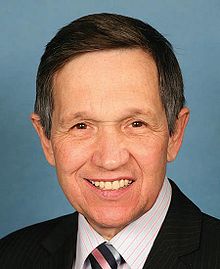
Democratic U.S. Senator Dennis Kucinich

Representative Dennis Kucinich (Democrat – Ohio) is on the media circuit promoting his rather novel idea on how to “create” jobs for younger people who are trying to enter the work force but can’t because of the recession.

The Congressman has proposed legislation that would allow people to take voluntary early retirement at age 60 instead of age 62, as the law now stands.

Kucinich, who ran for the Democratic nomination for President in both 2004 and 2008, estimates that about 25% of those eligible to retire at age 62, or about 1 million people, would choose to take early retirement under his plan. He claims that this is a conservative estimate, since about 70% of those who can retire at 62 do so now.

These early retirees would, of course, collect social security earlier, after having worked fewer years and contributed less to Social Security. And then we’d have to assume that these workers would be replaced by the younger people now looking.  And that they would generate the same tax revenues for the government that the early retirees did.

What a plan!  Lock in higher costs, with no guarantee of any benefits.  This is the kind of logic that put the U.S. into this pickle in the first place.

How does Mr.  Kucinich propose to pay for this plan?  Why, with government funds, of course!  Specifically, with the “extra” unspent stimulus and TARP funds.  This, despite the fact that he has spoken repeatedly about voting against the TARP funds because he opposes government interference in the private economy. But, hey, he goes on to say, “Since the money is lying around anyway, let’s use it!”  You’d think tax revenues fall out of the sky!

I do not know which is worse, the hypocrisy or the ignorance.  What folly! This man has absolutely no business talking about how to create jobs when he has no idea how the economy actually works.

Here’s an idea that is guaranteed to help the economy recover.  Why doesn’tMr. Kucinich take voluntary early retirement!

By Sherry Jarrell

Liking LikeMinds 2010

A global local conference

How often does a great conference on an emerging subject attract local, national and global participants to a quiet corner of the UK? Not often, I suspect.

Nevertheless last Friday, 2010 February 26, it happened again at LikeMinds 2010! The first time it happened was in 2009 on October 16th. Back in February 2009, two people met having got to know each other using Twitter, the popular social media tool/service. Scott Gould is a Devon-based web and experience designer. Trey Pennington is an American social media and business consultant. They met in Exeter and set the date for a half-day event which became LikeMinds 09. A local conference centre was the venue. People came from far and wide to became part of the inaugural gathering. Afterwards, they knew that they’d started something and felt the need to repeat it.

This time, just over four months later. More came to LikeMinds 2010, in the same relatively small venue. The same loyal bunch of social media specialists came back and brought more with them. There was more buzz and activity. This time, it lasted a full day and was followed by a business-oriented summit event at a prestigious location.

It was good to be there. It was good to meet new people. It was good to get a real sense of what is going on in human social communication. And all of this in my local city of Exeter, Devon, England.

There is more to come on this conference! But to give you a flavour, here is the talk by Chris Brogan … after I’d had lunch with him!

And, I am sure, more LikeMinds conferences to come.

By John Lewis

Latest US GDP Figures

Growth in final GDP hides disturbing weaknesses in economy

The U.S. GDP grew at an annual rate of 5.9% in the last quarter of 2009 which may look good at first glance, but when we dig a little deeper, we find some concerns about the implications for sustainable growth.  A large fraction of this reported growth came from businesses selling off accumulated inventories, which has more to say about past production than current. Exports were also a significant source of fourth quarter growth, driven in large part by a weak dollar.

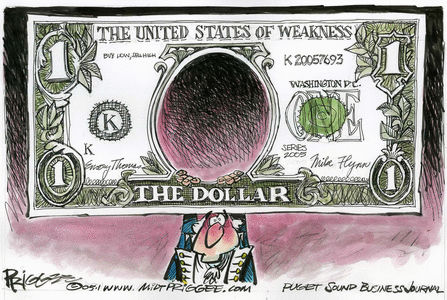
Weak dollar both helps and hurts the economy

Of course, a weak dollar is a very mixed blessing for the economy, and is hardly a sign of a strong or recovering economy.

Real residential fixed investment increased 5.0 percent, helped along by the extension of the home purchase tax credits from the federal government.

New housing helps spur growth in GDP

Real nonresidential fixed investment increased 6.5 percent. This figure nets out nonresidential structures, which decreased at a troubling rate of 13.9 percent, and equipment and software, which increased 18.2 percent. Investment in equipment and software consists of capital account purchases of new machinery, equipment, furniture, vehicles, and computer software; dealers’ margins on sales of used equipment; and net purchases of used equipment from government agencies, persons, and the rest of the world. Own-account production of computer software is also included, which is production performed by a businesses or government for its own use.

Again, the underlying figures show that those variables most associated with building a sustainable productive capital base for the economy – nonresidential fixed investment –are declining at an alarming rate. This, combined with a 9.7% unemployment rate and the specter of rising debt levels, energy prices, and taxes, paints a picture of a slow to non-existent recovery to a robust economy any time in the next year.

http://www.bea.gov/newsreleases/national/gdp/gdpnewsrelease.htm

by Sherry Jarrell

Greenwich Observatory

A rich and beautiful place in British History

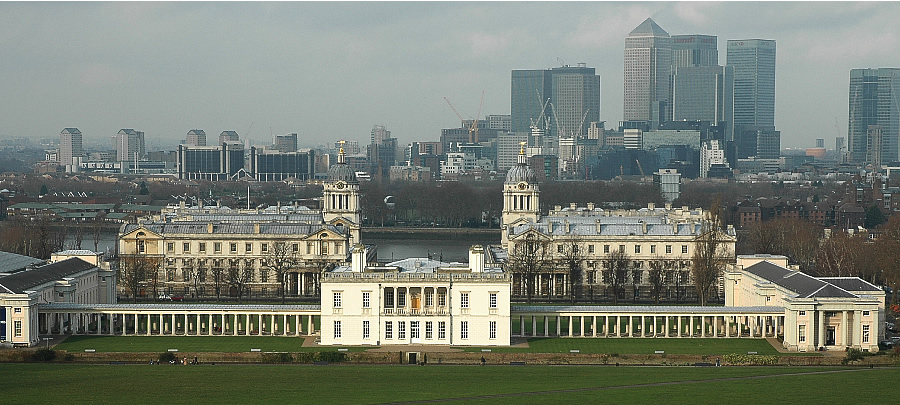
View from Observatory Hill of Queen Anne's Palace, the old naval buildings & across the river Canary Wharf

Paul Handover recently published an article about “Daylight Saving” and the Greenwich Meridian.  THIS SITE with its photos and links is of particular interest to those with little personal knowledge of London.

Greenwich Park – where stands the magnificent Royal Observatory – is one of the jewels of London. Steeped in history, it provides the perfect day-out for the family, including foreign tourists. Forget the jostling crowds in the frenzied den of useless consumption that is Oxford Street and take a train out to Greenwich. There you will find a magnificent park, wonderful views of London and the Thames, the Royal Observatory and the National Maritime Museum. Too much to mention in detail, but if for nothing else just go to see the clocks of John Harrison, horologer extraordinaire in a time when chronometry meant everything to men at sea. You don’t have to be British to take pleasure in the great skills and achievements of British sailors and explorers, backed up by men of science responsible for some of the most important advances in scientific history.

I can’t count how many times I’ve been to Greenwich Park, but every time I get back to London from my current home in Germany, I try to take my son there.  I want him to see this rich place in British history, but also to enjoy its enormous beauty.

The Magic Solution

A Magic Pill for Everything?

I am always struck by Man’s desperate groping for a Magic Solution to each and every problem. It is a bit pathetic but also of course rather funny, especially if one tries to see things from the perspective of a visiting alien from outer space.

Looking for a Magic Pill?

Let’s take “The Fat Pill”. What we really want is not to eat properly and cut down our vast consumption of just about everything but especially burgers, chips, popcorn swamped in sugar, honey or chocolate, giant steaks and pizzas, crisps, candy, and of course alcohol and simultaneously combine this with a healthy lifestyle involving regular exercise that makes us pant (to get the heart going – nothing to do with sex, though Tiger Woods is clearly pretty fit)!

No, what we prefer is to keep on stuffing ourselves and then take a FAT PILL! Whoever invents this is going to make Bill Gates look like a starving rickshaw- puller in India.

Then there is the ALCOPILL. Rather than drink in moderation to the benefit of all and sundry many of us prefer to binge ourselves to the point of death and then, just before hitting the sack (if we make it that far), grope for the magic pill. I believe pharmaceutical companies worldwide are working furiously on this in the hope of hitting the jackpot. Much more profitable than boring old stuff with malaria, which kills millions every year.

It may be cynical old age, but I’m currently off magic solutions. As a language teacher, I saw the desperate scrambling for nirvana when language laboratories came in. Every school had to have one; every timetable was hacked about; teachers would become redundant ….. Oh dear … most language labs are now broken-down, dusty and abandoned piles of junk at the bottom of some rubbish tip somewhere.  Are wind-turbines in the same category?

dot.com? This was the magic pill of the late 1990s! The new paradigm. Everything would be different; billions could be made without doing any real work. Oh, and does this remind us of the banker’s world? Of course, they are an exception because DESPITE everything they can STILL make billions for doing no real work.

As for government finance (a quite different animal), the current British magic pill is to print money and bung it into the economy in the hope of stimulating “growth”. None of this “living within our means”, taking “a bit of strong medicine” stuff. No, we’ll go for the magic pill so we can get back to normal levels of debt and spending. Patience, virtue, moderation and commonsense are much less fun than the magic pill of printing money.

And there is a VERY GOOD reason for this of course: the GENERAL ELECTION is around the corner and we don’t want any pain BEFORE then, do we? After, of course – if we get the right result – we will have a bit of commonsense back. Not that we want to, but it’ll be forced on us by the markets … but then we can blame it all on someone else. In Britain’s case, Mrs. Thatcher will probably still come in for considerable stick, even though she left power nearly twenty years ago.

Magic? Sadly, one can see the same desperate groping for the easy solution in religion. We are metaphysically, morally, spiritually and practically lost, so let’s look for some magic to provide a solution, even if there is not the slightest proof of the existence of God that would stand up in court.

Our epitaph may well be: Homo Sapiens – the Magic Species. Unfortunately, magic is best left to conjurors; it is not a recipe for managing society.

by Chris Snuggs

A “Rogue” Killer Whale?

Animals as Pets?  Do we ever really know what they are thinking?

Do we really ever know what is going on in an animal’s mind?  Some people believe that they do, but when they are wrong, disastrous consequences can result.  Sometimes. Many of these same people would tell you, before the fact, that the risks are worth it.

Unidentified trainer with Killer Whale

This subject has come up a number of times recently, both in my life and in the news from across the world.   Just recently, a seasoned trainer at Florida’s SeaWorld was killed by a killer whale that she had worked with for years.  She was very fond of the whale; there are many photos of her hugging the whale, playing, and working with the whale.  She obviously loved her job, and felt strongly about the whale conservation efforts that Seaworld claims to promote. Witnesses to the mauling have said that the whale seemed angry just before the attack, and concluded that the whale was stressed by being kept in a small tank with little to do.  Essentially, they theorized that the whale “lost it.”  Since then, however, I’ve heard statements made by whale trainers who theorize that the whale was simply playing; that the trainer has been in the water shortly before the incident, playing with the whale.  When she got out of the water, the whale might have wanted to continue to play, and grabbed her pony tail and thrashed her about without any understanding that he was causing her death.  This same whale has been involved in at least two previous deaths.

So can we tell what an animal is thinking?

Continue reading “A “Rogue” Killer Whale?”

In or out of recession?

A friend on another site just posed this question.

Why is it that a recession is described as two or more successive quarters of “negative growth”, but being out of recession is just one quarter of (estimated) growth?

I felt emboldened to pen an answer as follows ….

In Britain, the definition of recession-emergence is from the same school of economics as growth predictions for next year (any year), which are always about 5 zillion% more than actually turns out to  be the case.

Recession in Britain

The cunning  idea is that future growth will be vast enough to cover the even vaster existing debts and commitments. And, of course, by the time we KNOW what the growth actually turned out to be, most people will have forgotten the predictions on growth from the financial and economic wizards running the country. That’s also one of the great things about a new mess or crisis; it always takes the mind off previous crises, which are likely to be ongoing but less in the media and therefore not to be bothered about too much.

This is, of course, in addition to the fact that growth in itself is incompatible with reducing global warming, but here we are getting a bit too technical.

Well, that’s how we do it in Britain anyway. How do you manage it over there?

by Chris Snuggs

A reply from a U.S. economist.

Hello there Chris!

Recession in the U.S. is also defined as two successive quarters of negative GDP growth.  At least, that’s how its officially defined.  And to add my answer to your friend’s question — either the economy is either in a recession — i.e., two or more consecutive quarters of negative GDP growth — or it isn’t, which means that the string of negative GDP growth rates is broken.  And that only takes one quarter of positive growth.

Most of the economists I know personally tend to look at a bigger picture than the stated GDP figures, however.   I focus on capital and labor utilization rates as I believe that they are more important measures of a well-functioning economy.  The final GDP figures in both of our countries are national income accounting figures, and have all the weaknesses of any income statement variable.   They are flow variables, which ignore the stock of economic wealth.   For example, if you invest $100 this year in the stock market, and it grows in value by $20, only the $100 is counted. The increase in wealth is never captured in measures of GDP.

Another problem with current measures of GDP and GDP growth is that government spending is considered on par with private spending, which brings into question the sustainability of growth measures based on GDP, although President Obama and perhaps Prime Minister Brown are both fine with growth rates being fueled by large increases in government spending.  Finally, a significant fraction of economic activity, like the value of work in the home — is not measured.

So, yes, the official measurement of GDP is all wrapped up in technicalities.  But most economists I know pay little attention to it.  They are more concerned with how well the economy is functioning, whether the growth is sustainable, and whether people who want to work can find work.  If you are unemployed, the economy is in a recession, regardless of what the GDP figures say!

by Sherry Jarrell

Health Care Summit

Political leadership or grandstanding?

What has become very clear to me, after watching the U.S. Health Care Summit between Democrats and Republicans as objectively as possible, is that the President’s goal was not to craft a thoughtful approach to shoring up and improving the U.S. health care system.

Pres. Obama making one of many points at Healthcare Summit

No, the reason for the President and the Democratic leadership to convene the so-called summit was to grandstand; to make a show; to create a photo opportunity; and, most importantly, to try to garner enough support from the Democrats in Congress to ram through the Reconciliation option on the behemoth, disastrous 2000-plus page version of the bill, filled with incomprehensible, internally conflicting doublespeak.

A sad day for American politics.  A very sad day for American citizens.  We deserve better.