The promotion for this TED Talk appeared in my ‘in box’ last week and I was curious as to its contents. So I watched the talk on Sunday afternoon and was amazed. This is so much more significant to all of us than the title suggests.
First watch the talk.
Then some background to Jane, who is a ecosystem scientist:
Dr. Tamara Jane Zelikova works at the intersection of climate science and policy. Her work focuses on advancing the science of carbon removal and she has published in scientific journals like Nature and Proceedings of the National Academy of Sciences, written and contributed to climate policy reports and published articles in popular media outlets like Scientific American. She is currently the executive director of the Soil Carbon Solutions Center at Colorado State University, where she works with leading scientists to build the tools and approaches needed to accelerate the deployment of credible soil-based climate solutions, measure their impacts and bring them to scale.
That then led me to the Soil Carbon Solutions Center website and this is a site you should visit. A little piece from their About section:
Unlocking the potential of soil for a more sustainable planet
Soil is one of the largest natural carbon reservoirs and an important climate mitigation tool that is ready to deploy today. Accelerating the adoption of regenerative agricultural practices that build soil carbon on working lands offers the potential to substantially draw down atmospheric carbon while improving the environmental, economic and social sustainability of food, fiber and bioenergy production.
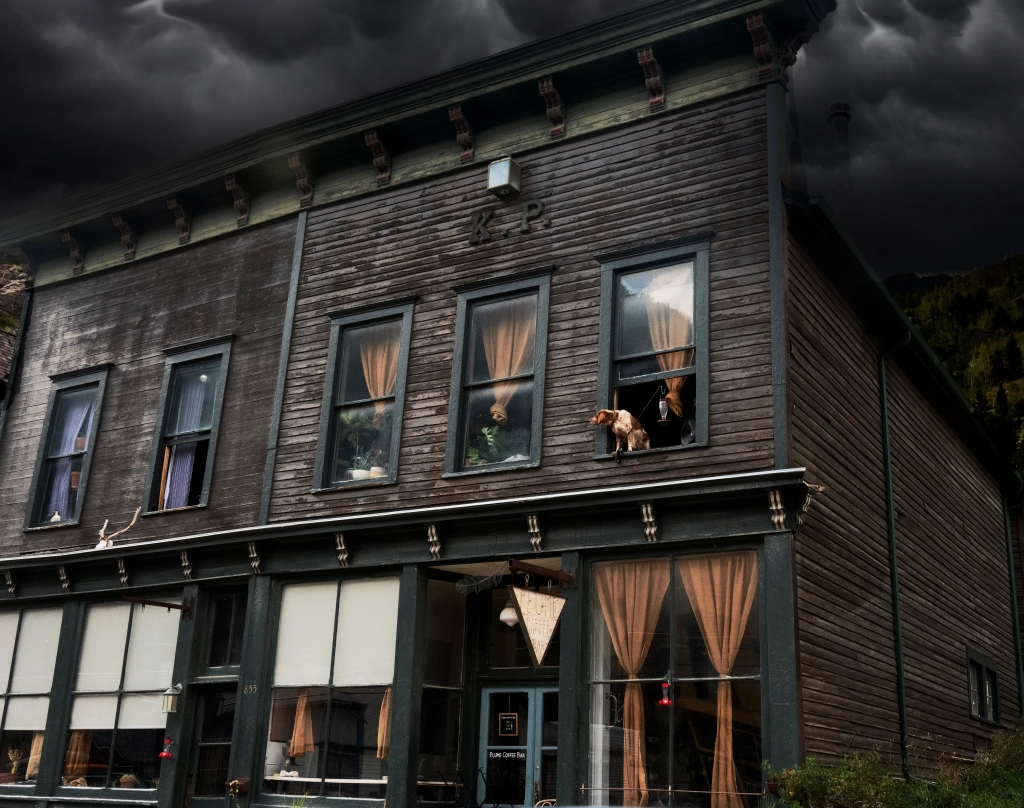
Just a beautiful photograph shared with you all from the Ugly Hedgehog photographic site.
Dog watching stormy evening in old inhabited “ghost” town.
I follow the website Ugly Hedgehog and within the last few days I saw this perfect photograph.
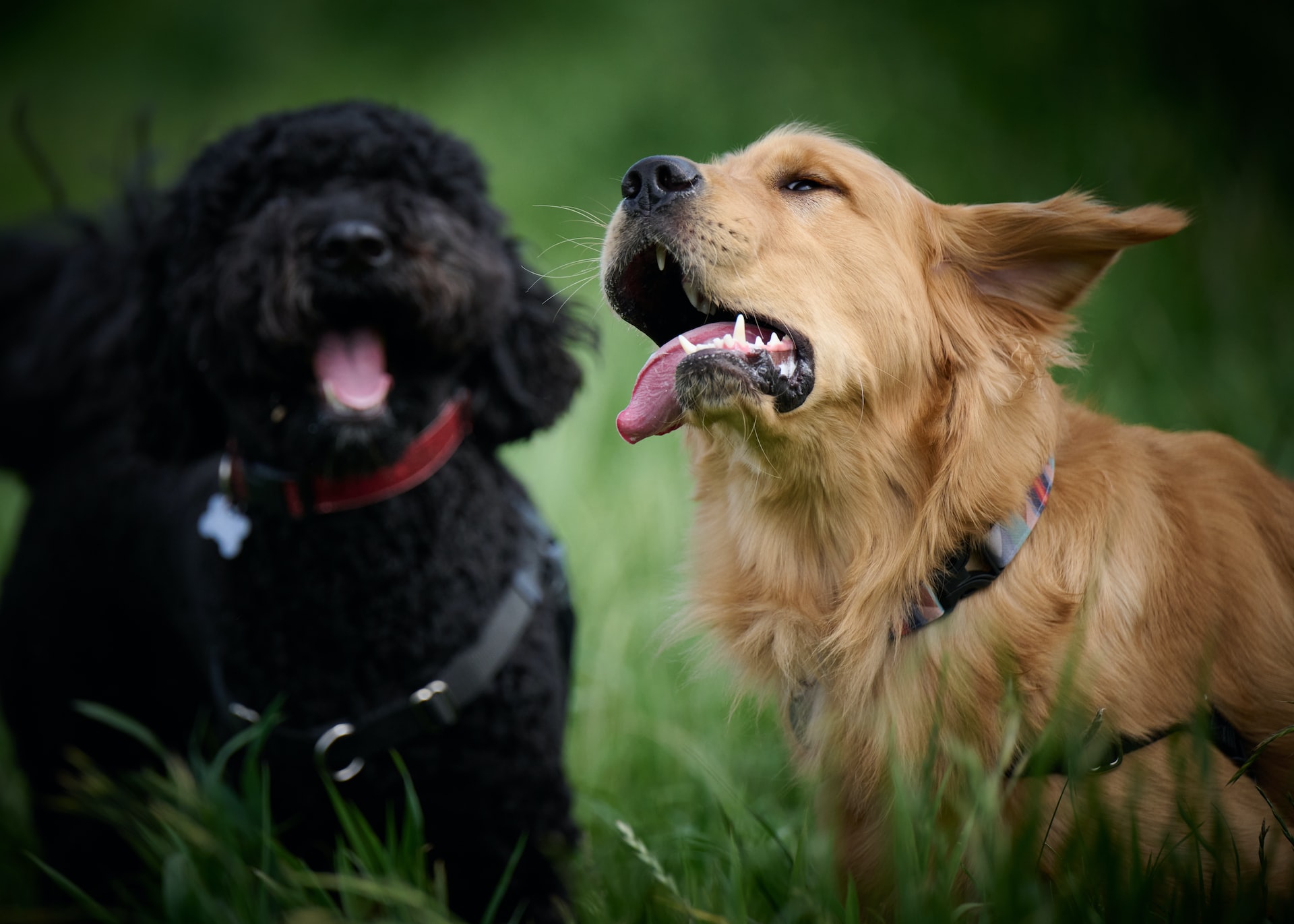
It was taken by ‘fantom’ and he says: “This was taken moments before a heavy rain storm. I think dog was responding to a lightning flash.“
It is a very different photograph to the normal Picture Parades but this was so attractive that it was the only way to go! And here’s a closeup of that photograph, or rather the dog!
This is another guest post from Indiana Lee. She writes with a compassionate and loving style and I am so pleased to be able to offer this post to you.
ooOOoo
How To Create a Healthy, Eco-Friendly Environment for Your Dog
As a dog owner, it’s perfectly normal to want an environment for your canine companion that is fun, happy, and healthy. That includes making sure they have a clean and secure place that’s comfortable and safe, as well as free from hazardous materials and harmful pests.
Creating a healthy environment for your dog is easier than you might think. By dedicating a specific space to your pooch and making some simple swaps, you can be an eco-friendly pet parent, doing something good for the planet and your pup all at once.
Create a Safe Space
First and foremost, try to create a safe space in your home for your dog. You can always consider a pet room, but even just an area in your living room or a comfy crate can do the trick.
Having a designated area for your dog in your home can make a big difference. Dogs are den animals and like having their own safe space to go to. While you don’t necessarily need to dedicate a whole room to your four-legged friend, your space should be pet-proofed to keep them safe.
That includes keeping things organized and clearing up clutter, so your dog doesn’t get into or chew on things they shouldn’t. You can also use baby gates to keep your dog in their space or to prevent them from going into areas of your home that haven’t been pet-proofed.
Use Eco-friendly Cleaning Products
Once you have set up that space, it’s important to keep it clean for your dog. Between rest and play and dinner time, it’s all too easy for your home to get dirty quickly. This means you have to keep your home clean, regularly pick up after your dog, and sanitize their space.
However, you must keep them away from potentially toxic substances — including the supplies you use to clean their area. Make sure your dog can’t get to any of the following:
Bleach
Aerosols
Ammonia
Phenol
Formaldehyde
You’ll quickly learn to become a “label reader” when it comes to the cleaning products you choose. Not only are the above ingredients bad for your pet, but they can also damage the environment.
When shopping for cleaning supplies, choose all-natural products as often as possible. Alternatively, consider making your own so you know exactly which ingredients are used. Vinegar, baking soda, and lemon juice are all common household items that you can use in cleaners — and they’re better for your pet and the planet.
Keep Pests Away
Creating a safe environment for your pet also means protecting your pooch from pests. You might not be able to control what comes into your house — especially since many pests can sneak in through tiny cracks — but you can discourage them from bothering your dog. You can do so while still making your yard a fun place for your dog.
You can reduce the risk of certain bugs and rodents entering your home by keeping your yard clean and trimmed. Don’t give wild animals a space to “hang out” and enjoy. The more time they spend in your yard, the more likely it is that they’ll get inside.
Additionally, the more wildlife you have in your yard, the more likely it is that your dog will bring in fleas or ticks that have “jumped” from raccoons, possums, or mice. Pests like fleas and ticks can be especially harmful to dogs, and they’re quick to get into rugs, carpets, and furniture, which can end up putting everyone’s health at risk. You can vacuum frequently if you’ve seen your dog with a tick or fleas and utilize some of the cleaning supplies listed earlier to deter them from sticking around.
If you see a bug on your dog, give them a thorough brushing and use natural shampooing solutions to get rid of the fleas quickly. Keep their fur trimmed back neatly and make sure they’re as clean as possible. Regular baths and grooming can also help keep pests away from your pet and ensure your dog doesn’t bring any extra visitors into your home.
Are you sensing a pattern?
A clean, healthy home typically means a happier, safer space for dogs. Whether you’re trying to live more sustainably or just focus on more natural ways of doing things, these suggestions will get you on the right track. Not only will your dog have a secure and pet-friendly environment to enjoy, but you can feel good knowing you’re doing something to improve the health of your entire family, as well as the future of the planet.
ooOOoo
This really hits the spot. For we live in the country in Southern Oregon and have more than our fair share of flies and fruit flies, and who knows what else!
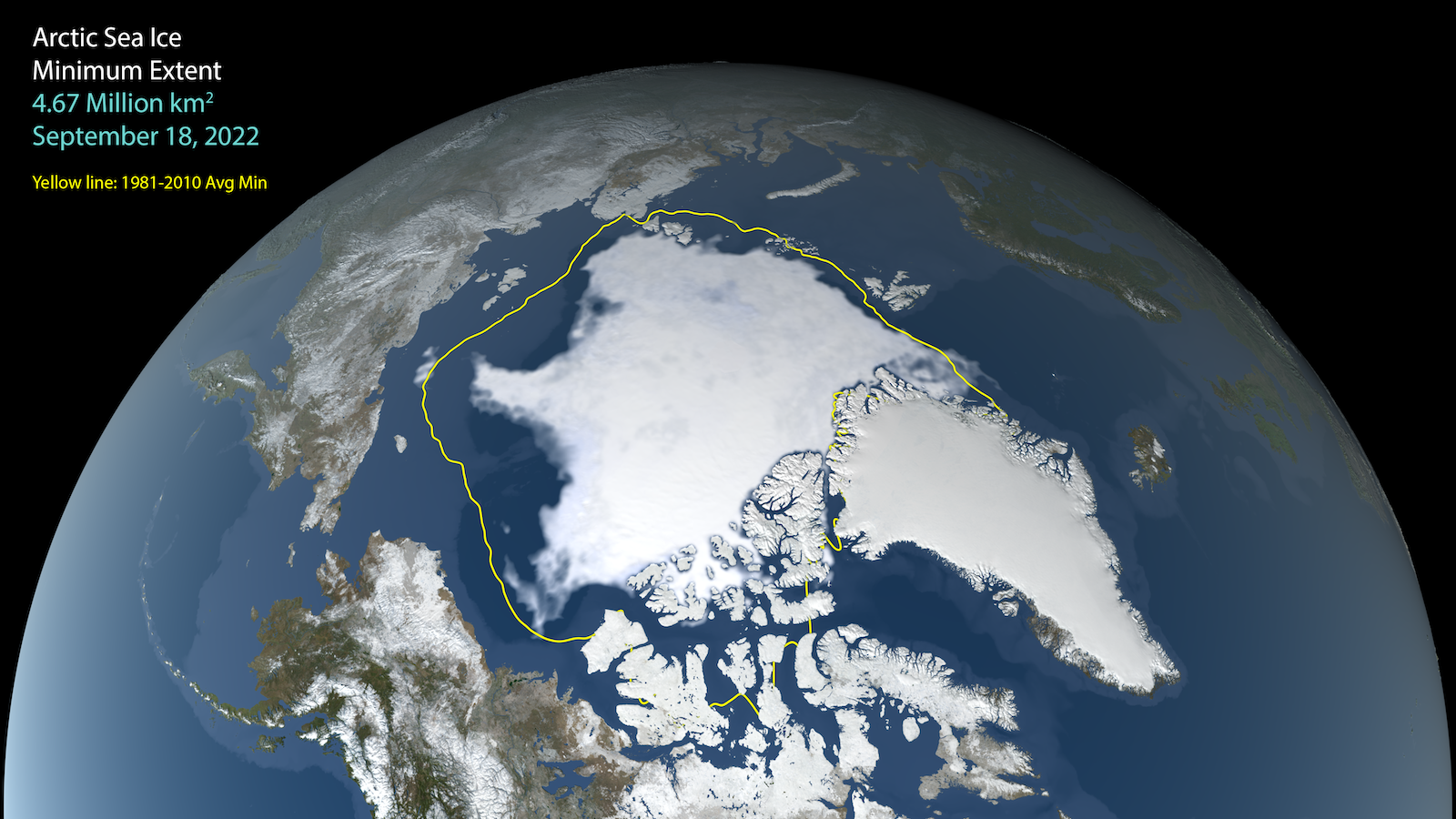
There’s no way to make this pleasant; the Arctic Summer Sea Ice tied for the tenth lowest on record.
ooOOoo
This image visualizes sea ice change in the Arctic using data provided by the Japan Aerospace Exploration Agency’s Global Change Observation Mission 1st-Water “SHIZUKU” satellite, which is part of a NASA-led partnership to operate several Earth-observing satellites. The visualization can be accessed at https://svs.gsfc.nasa.gov/5030. Credit: NASA’s Scientific Visualization Studio.
According to satellite observations, Arctic sea ice reached its annual minimum extent (lowest amount of ice for the year) on Sept. 18, 2022. The ice cover shrank to an area of 4.67 million square kilometers (1.80 million square miles) this year, roughly 1.55 million square kilometers (598,000 square miles) below the 1981-2010 average minimum of 6.22 million square kilometers (2.40 million square miles).
The average September minimum extent record shows significant declines since satellites began measuring consistently in 1978. The last 15 years (2007 to 2021) are the lowest 15 minimum extents in the 43-year satellite record.
This visualization, created at NASA’s Goddard Space Flight Center in Greenbelt, Maryland, shows data provided by the Japan Aerospace Exploration Agency (JAXA), acquired by the Advanced Microwave Scanning Radiometer 2 (AMSR2) instrument aboard JAXA’s Global Change Observation Mission 1st-Water “SHIZUKU” (GCOM-W1) satellite.
Music: “Celestial Vault” from Universal Production Music
Video credit: NASA’s Goddard Space Flight Center
Kathleen Gaeta (GSFC AIMMS): Lead Producer
Trent L. Schindler (USRA): Lead Animator
Roberto Molar (KBR): Lead Writer
ooOOoo
As I said, a sorry tale for which there is no good news. I wish there were!
Next, a few words from her website that explain a little more about Jill.
I started working in a photo studio in 1985 (yikes!). I’ve worked in studios in Maine and California, and started Lasting Image in 1997. I have photographed literally thousands of people of all ages.
I was a Grand Imaging Award finalist in 2019 (crazy hard to do!) and a PPA Silver Medalist in 2020. I regularly enter my work in Professional Photographers of America’s image competitions for judging and critique. It’s brutal. But it has made me a better photographer.
Here is Ziggy’s owner describing what it takes for Ziggy to become a service dog.
ooOOoo
Thank you to my friend Anne Marie Shumate from Lasting Image Photography for doing such a great job photographing Ziggy and me.
Ziggy is a SDIT or otherwise known as a Service Dog in Training. He has passed two of the three major test and four of the ten outings. Once he completes his other test he’ll get his final certificate from Soldiers Best Friend, a non-profit 501c3. Jamie Barilla is my trainer. She works with the two of us for two days a week. Sometimes Ziggy catches on quicker than I do, so I think Jamie is training me!
Jamie Barilla works with Soldiers Best Friend, a non-profit 501c3. Besides working on Photography with my own non-profit 501c3, I spend a great deal of time training Ziggy. Not counting the 2 1/2 hours of training Ziggy receives a day, I also have to write a daily report of what we do everyday.
I now can understand the complexities involved in training a service dog. He already knows over 64 commands, with a lot more coming down the road. A lot of the commands Ziggy first learned, even though they were OK at the beginning, had to be tweaked to make them even better.
So if you see a service dog now you know it takes a lot of work. Some 50 to 70 percent of dogs that enter a service dog program don’t make the grade; either because the dog doesn’t have the proper temperament or the person involved doesn’t have the time or energy to put into the dog.
ooOOoo
Well we hope that Ziggy gets the final certificate and I can see no reason why that doesn’t come about. And, finally, coming back to Jill to note that she is a great lover of dogs. Have a look at the page on her website that shows the awards that she has won. Please, take a peep and see the wonderful photos of dogs!
Showing that droughts have been in evidence for 1,000 years or more!
It is very easy, well it is for me, to think that the changes we are seeing in the climate are purely recent. There is no question that we are experiencing changes in the global climate. But it would be too easy to think that these changes are only the result of recent times.
1,000-year-old stalagmites from a cave in India show the monsoon isn’t so reliable – their rings reveal a history of long, deadly droughts.
Published on the 19th September, 2022 by:
Gayatri Kathayat Associate Professor of Global Environmental Change, Xi’an Jiaotong University
Ashish Sinha Professor of Earth and Climate Sciences, California State University, Dominguez Hills
In a remote cave in northeast India, rainwater has slowly dripped from the ceiling in the same spots for over 1,000 years. With each drop, minerals in the water accumulate on the floor below, slowly growing into calcium carbonate towers known as stalagmites.
These stalagmites are more than geological wonders – like tree rings, their layers record the region’s rainfall history. They also carry a warning about the potential for catastrophic multiyear droughts in the future.
By analyzing the geochemistry of these stalagmites in a new study published Sept. 19, 2022, in the Proceedings of the National Academy of Sciences, we were able to create the most precise chronology yet of the summer Indian monsoon over the past millennium. It documents how the Indian subcontinent frequently experienced long, severe droughts unlike any observed in the last 150 years of reliable monsoon rainfall measurements.
They show how the decline of the Mughal Empire and India’s textile industries in the 1780s and 1790s coincided with the most severe 30-year period of drought over the millennium. The depth and duration of the drought would have caused widespread crop failures and the level of famine discussed in written documentsat the time.
Another long drought encompasses the 1630-1632 Deccan famine, one of the most devastating droughts in India’s history. Millions of people died as crops failed. Around the same time, the elaborate Mughal capital of Fatehpur Sikri was abandoned and the Guge Kingdom collapsed in western Tibet.
Buland Darwaza (Door of Victory) at Fatehpur Sikri, India.
Our findings have important implications today for water planning in a warming world, particularly for India, which, with its vast monsoon-reliant agriculture industry, is on pace to soon be the most populous country on the planet.
Why the monsoon’s history matters
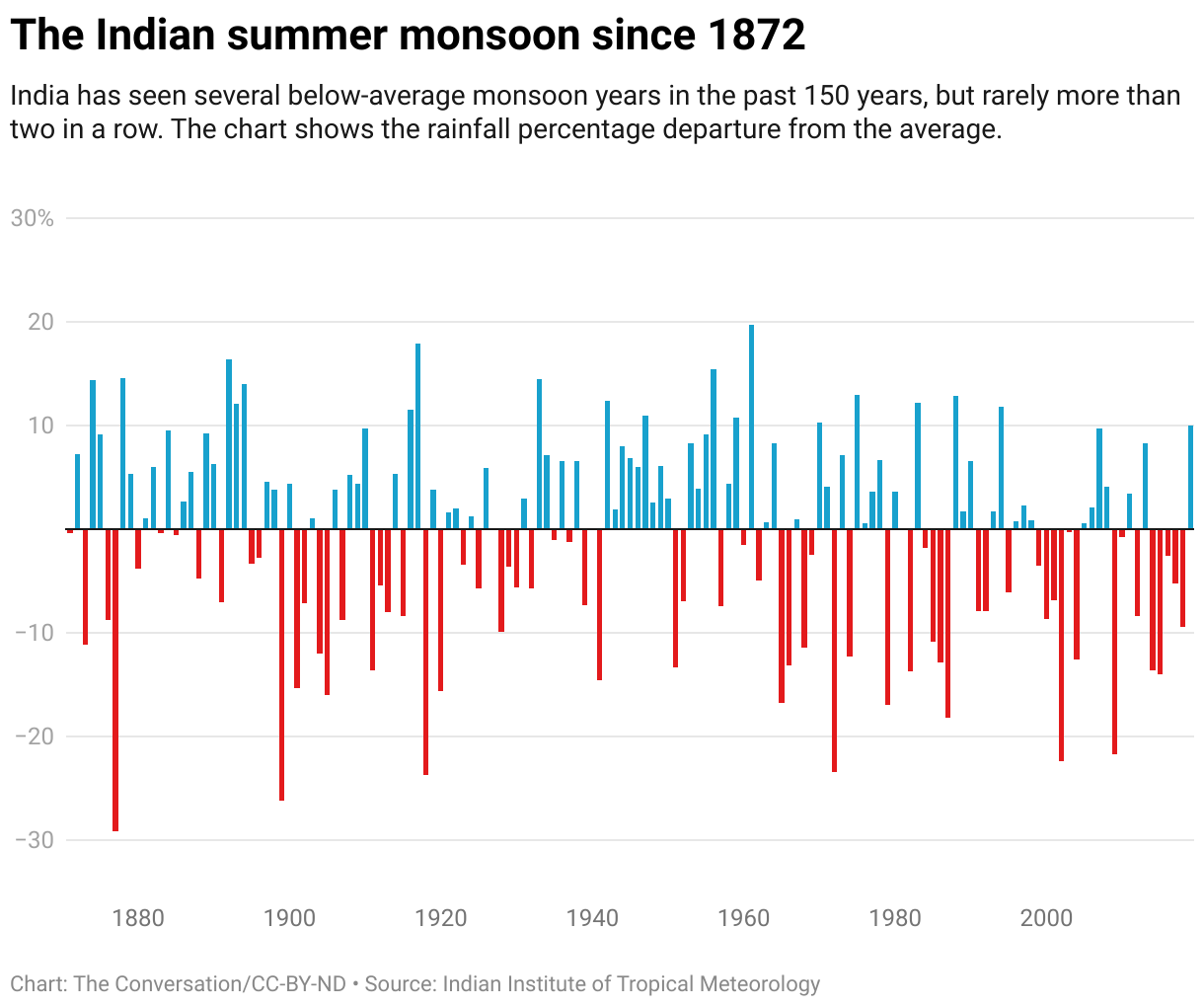
Scientists began systematically measuring India’s monsoon rainfall with instruments around the 1870s. Since then, India has experienced about 27 regionally widespread droughts. Among them, only one – 1985 to 1987 – was a three-year consecutive drought or worse.
The apparent stability of the Indian monsoon in that data might lead one to surmise that neither protracted droughts lasting multiple years nor frequent droughts are intrinsic aspects of its variability. This seemingly reassuring view currently informs the region’s present-day water resource infrastructure.
However, the stalagmite evidence of prolonged, severe droughts over the past 1,000 years paints a different picture.
It indicates that the short instrumental period does not capture the full range of Indian monsoon variability. It also raises questions about the region’s current water resources, sustainability and mitigation policies that discount the possibility of protracted droughts in the future.
Timeline of major societal and geopolitical changes in India and the oxygen isotope record from Mawmluh cave. Gayatri Kathayat
How do stalagmites capture a region’s monsoon history?
To reconstruct past variations in rainfall, we analyzed stalagmites from Mawmluh cave, near the town of Cherrapunji in the state of Meghalaya – one of the wettest locations in the world.
Stalagmites are conelike structures that grow slowly from the ground up, typically at a rate of about one millimeter every 10 years. Trapped within their growth layers are minute amounts of uranium and other elements that were acquired as rainwater infiltrated the rocks and soil above the cave. Over time, uranium trapped in stalagmites decays into thorium at a predictable pace, so we can figure out the age of each stalagmite growth layer by measuring the ratio of uranium to thorium.
The oxygen in rainwater molecules comes in two primary types of isotopes – heavy and light. As stalagmites grow, they lock into their structure the oxygen isotope ratios of the percolating rainwater that seeps into the cave. Subtle variations in this ratio can arise from a range of climatic conditions at the time the rainwater originally fell.
Stalagmite formation are marked inside Mawmluh Cave, where the new study was based. Gayatri Kathayat
A cross-section of a stalagmite shows differences in its ring formation as climate conditions changed. Gayatri Kathayat
Our previous research in this area showed that variations in oxygen isotope ratios in rainwater, and consequently, in stalagmites, track changes in the relative abundance of different moisture sources that contribute to summer monsoon rainfall.
During years when monsoon circulation is weak, rainfall here is primarily derived from the moisture that evaporated from the nearby Arabian Sea. During strong monsoon years, however, atmospheric circulation brings copious amounts of moisture to this area all the way from the southern Indian Ocean.
The two moisture sources have quite different oxygen isotope signatures, and this ratio is faithfully preserved in the stalagmites. We can use this clue to learn about the overall strength of the monsoon intensity at the time the stalagmite formed. We pieced together the monsoon rainfall history by extracting minute amounts of calcium carbonate from its growth rings and then measuring the oxygen isotope ratios. To anchor our climate record to precise calendar years, we measured the uranium and thorium ratio.
Stalagmites grow from the ground, and stalactites grow from above. These are in Mawmluh Cave, where the authors conducted their research. Gayatri Kathayat.
Next steps
The paleoclimate records can usually tell what, where and when something happened. But often, they alone cannot answer why or how something happened.
Our new study shows that protracted droughts frequently occurred during the past millennia, but we do not have a good understanding of why the monsoon failed in those years. Similar studies using Himalayan ice cores, tree rings and other caves have also detected protracted droughts but face the same challenge.
In the next phase of our study, we are teaming up with climate modelers to conduct coordinated proxy-modeling studies that we hope will offer more insight into the climate dynamics that triggered and sustained such extended periods of drought during the past millennium.
ooOOoo
So there we are. Droughts are a thing of the ancient past. But only a partial understanding for why the monsoons failed is known. Despite these modern times with so much general access to knowledge there are still things that we do not know!
Finally, one hopes that the next phase of their study will be along in reasonable time! I would love to report on it.
This article was written by Professor Shuang-Ye Wu. It is very good.
Professor Wu is the Professor of Geology and Environmental Geosciences at the University of Dayton, USA.
Looking back on America’s summer of heat, floods and climate change: Welcome to the new abnormal!
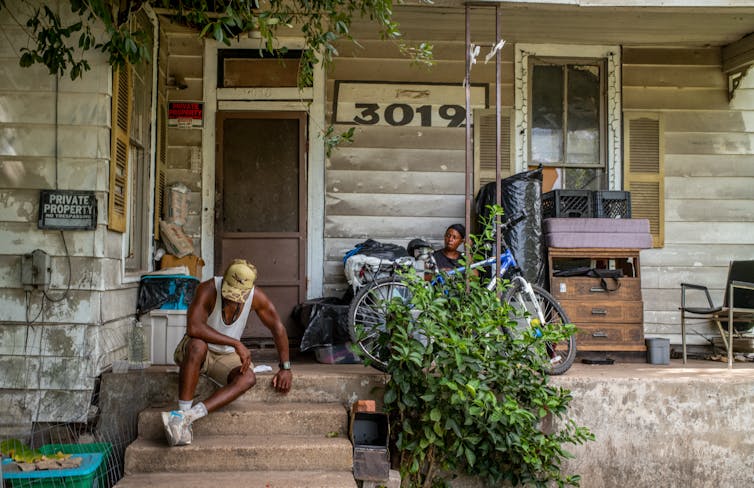
Much of the South and Southern Plains faced a dangerous heat wave in July 2022, with highs well over 100 degrees for several days. Brandon Bell/Getty Images
The summer of 2022 started with a historic flood in Montana, brought on by heavy rain and melting snow, that tore up roads and caused large areas of Yellowstone National Park to be evacuated.
In between, wildfires raged through California, Arizona and New Mexico on the background of a megadrought in Southwestern U.S. that has been more severe than anything the region has experienced in at least 1,200 years. Near Albuquerque, New Mexico, a five-mile stretch of the Rio Grande ran dry for the first time in 40 years. Persistent heat waves lingered over many parts of the country, setting temperature records.
The United States is hardly alone in its share of climate disasters.
In Pakistan, record monsoon rains inundated more than one-third of the country, killing over 1,500 people. In India and China, prolonged heat waves and droughts dried up rivers, disrupted power grids and threatened food security for billions of people.
In Europe, heat waves set record temperatures in Britain and other places, leading to severe droughts and wildfires in many parts of the continent. In South Africa, torrential rains brought flooding and mudslides that killed more than 400 people. The summer may have come to an end on the calendar, but climate disasters will surely continue.
This isn’t just a freak summer: Over the years, such extreme events are occurring in increasing frequency and intensity.
Climate change is intensifying these disasters
The most recent international climate assessment from the United Nations’ Intergovernmental Panel on Climate Change found significant increases in both the frequency and intensity of extreme temperature and precipitation events, leading to more droughts and floods.
A recent study published in the scientific journal Nature found that extreme flooding and droughts are also getting deadlier and more expensive, despite an improving capacity to manage climate risks. This is because these extreme events, enhanced by climate change, often exceed the designed levels of such management strategies.
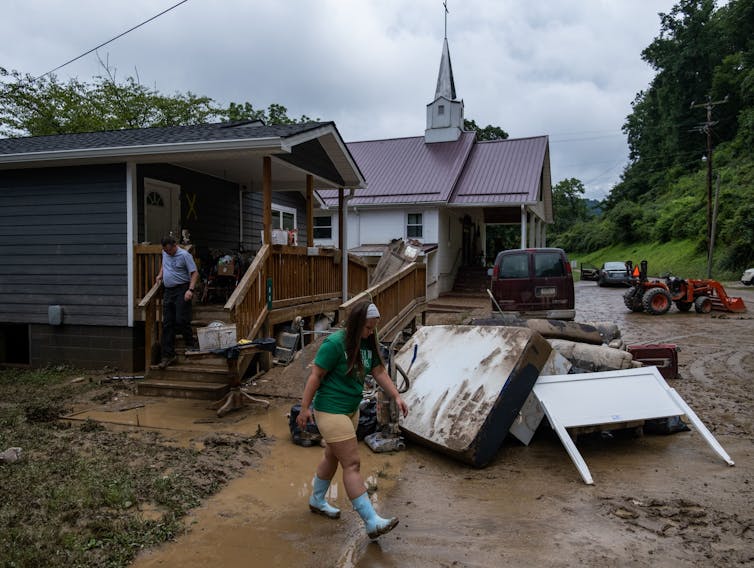
Flash flooding swept through mountain valleys in eastern Kentucky in July 2022, killing more than three dozen people. It was one of several destructive flash floods. Seth Herald/AFP via Getty Images
Extreme events, by definition, occur rarely. A 100-year flood has a 1% chance of happening in any given year. So, when such events occur with increasing frequency and intensity, they are a clear indication of a changing climate state.
The term “global warming” can sometimes be misleading, as it seems to suggest that as humans put more heat-trapping greenhouse gases into the atmosphere, the world is going to get a bit warmer everywhere. What it fails to convey is that warming temperatures also lead to a more violent world with more extreme climate disasters, as we saw this past summer.
Climate models showed these risks were coming
Much of this is well-understood and consistently reproduced by climate models.
As the climate warms, a shift in temperature distribution leads to more extremes. The magnitudes of changes in extreme temperature are often larger than changes in the mean. For example, globally, a 1 degree Celsius increase in annual average temperature is associated with 1.2 C to 1.9 C (2.1 Fahrenheit to 3.4 F) of increase in the annual maximum temperature.
Heat waves, like the heat dome over the South in July 2022, can hit outdoor workers especially hard. Brandon Bell/Getty Images
In addition, global warming causes changes in the vertical profile of the atmosphere and equator-to-pole temperature gradients, leading to changes in how the atmosphere and ocean move. The temperature difference between equator and the poles is the driving force for global wind. As the polar regions warm at much higher rates then the equator, the reduced temperature difference causes a weakening of global winds and leads to a more meandering jet stream.
Some of these changes can create conditions such as persistent high-pressure systems and atmosphere blocking that favor more frequent and more intense heat waves. The heat domes over the Southern Plains and South in June and the West in September are examples.
The initial warming can be further amplified by positive feedbacks. For example, warming increases snow melt, exposing dark soil underneath, which absorbs more heat than snow, further enhancing the warming.
Warming of the atmosphere also increases its capacity to hold water vapor, which is a strong greenhouse gas. Therefore, more water vapor in the air leads to more warming. Higher temperatures tend to dry out the soil, and less soil moisture reduces the land’s heat capacity, making it easier to heat up.
These positive feedbacks further intensify the initial warming, leading to more heat extremes. More frequent and persistent heat waves lead to excessive evaporation, combined with decreased precipitation in some regions, causing more severe droughts and more frequent wildfires.
This increased humidity leads to heavier rainfall events. In addition, storm systems are fueled by latent heat, or the large amount of energy released when water vapor condenses to liquid water. Increased moisture content in the atmosphere also enhances latent heat in storm systems, increasing their intensity. Extreme heavy or persistent rainfall leads to increased flooding and landslides, with devastating social and economic consequences.
Even though it’s difficult to link specific extreme events directly to climate change, when these supposedly rare events occur with increasing frequency in a warming world, it is hard to ignore the changing state of our climate.
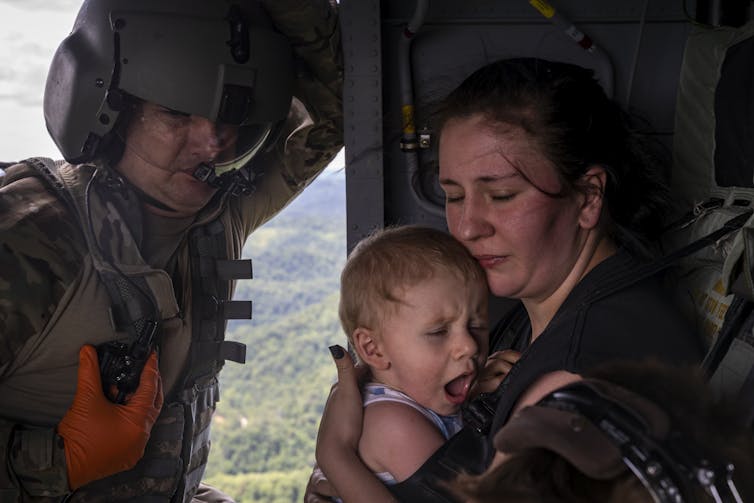
A family had to be airlifted from their home in eastern Kentucky after it was surrounded by floodwater in July 2022. Michael Swensen/Getty Images
The new abnormal
So this past summer might just provide a glimpse of our near future, as these extreme climate events become more frequent.
To say this is the new “normal,” though, is misleading. It suggests that we have reached a new stable state, and that is far from the truth.
Without serious effort to curb greenhouse gas emissions, this trend toward more extreme events will continue. Things will keep getting worse, and this past summer will become the norm a few years or decades down the road – and eventually, it will seem mild, like one of those “nice summers” we look back on fondly with nostalgia.
There is growing evidence that things are really changing globally. I used to say that I would be dead before the impacts of climate change really hit home. As in, it would be a good twenty years before things really took a hold. But it is now much more likely that the next five years are going to see a continuation of the changes and that there isn’t time to hang around.
I may not be as sharp as I used to be but the changing climate will affect me and Jean and all those in our area. Will our leaders grasp this nettle now? I wish I knew.
On this occasion it was the loss of our Pedi that had hearts ‘speaking’.
When it comes to dogs millions of people open their hearts to the love that exists between a dog and a dog’s close human. And I am not sure that I have cracked it yet; I know what is felt but putting it into words is more difficult.
So I shall turn to Jess and the guest post she sent to me. But just before sending me the story of Scruffy Jess sent me this email: “Sorry for the loss. Dogs have always been an important part of my life. I’ve cried like a baby every time I lost one. Truly man’s best friend. “
ooOOoo
Scruffy is getting up there in years and it breaks my heart to even think of losing him. He’s been my best friend for the past twelve years. He does everything that I do.
I never paint in my studio that he isn’t there beside me.
He will be 13 in February. I only hope that I can get a couple more years out of him. He is one of those special dogs. If someone said, “If there was one thing you would change about Scruffy, what would it be?” The only thing in this world I would change about him is to give him a longer life.
He minds me better than my kids ever minded and I’ve never laid an angry hand on him. I talk to him like I would a human, and he seems to understand everything that I say. I just bought another Schnauzer puppy, only four months old, hoping that some of Scruffy will rub off on him as he grows up. So far Scruffy is not too happy about sharing me with another dog, but hopefully time will change that.
So this is Scruffy at age 12. He still is full of life.
oooo
And this is Tux below, because of the Tuxedo that he always wears. He’s also a Miniature Schnauzer, but in an exotic color, and he has one blue eye that I love!
Yes, you should get another puppy to fill the hole in your heart. It seems, you are never sorry about it! You guys have a wonderful day! JESS


















 Learning from Dogs