There were a number of photographs of Comet 46P/Wirtanen on this site.
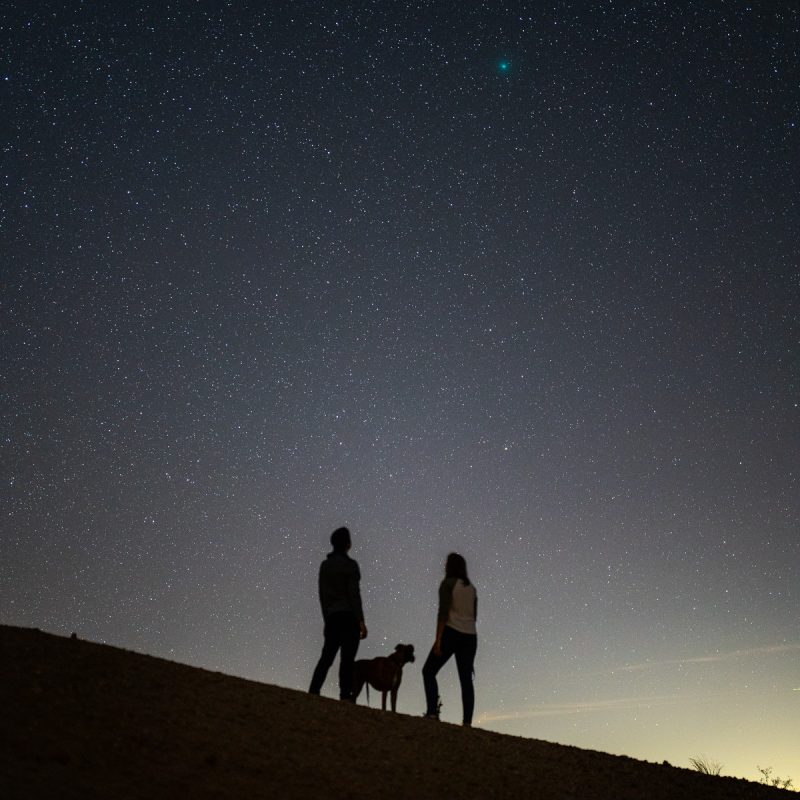
But the one that really leapt off the page, so to speak, was this one:
Jack Fusco Photography in California wrote: “Hi EarthSky! I’m so excited to share my 1st photo of comet 46P/Wirtanen! We took our boxer, Kona, out to the Anza Borrego Desert with us and came home with a new family photo. : ) I shared some behind-the-scenes and outtakes over on my blog as well.” Awesome photo, and thanks for the how-to-photograph info on your blog, Jack!
OK, not in the sense of weather because the worse is yet to come I’m sure. But in terms of the movement of the Planet Earth in its orbit around the Sun. And that’s what matters!
This is a really ancient moment as the following article published in The Conversation explains in much more detail.
ooOOoo
What winter solstice rituals tell us about indigenous people
By Rosalyn R. LaPier Associate Professor of Environmental Studies, The University of Montana
December 13th, 2018.
On the day of winter solstice, many Native American communities will hold religious ceremonies or community events.
The winter solstice is the day of the year when the Northern Hemisphere has the fewest hours of sunlight and the Southern Hemisphere has the most. For indigenous peoples, it has been a time to honor their ancient sun deity. They passed their knowledge down to successive generations through complex stories and ritual practices.
As a scholar of the environmental and Native American religion, I believe, there is much to learn from ancient religious practices.
Ancient architecture
For decades, scholarshave studied the astronomical observations that ancient indigenous people made and sought to understand their meaning.
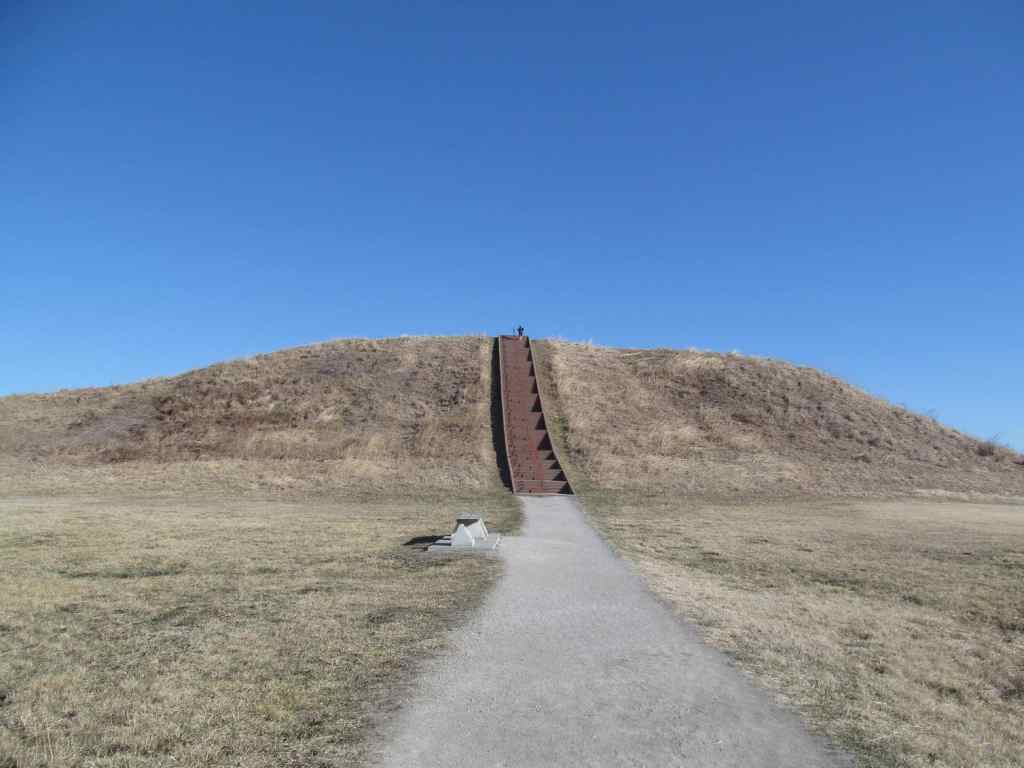
One such place was at Cahokia, near the Mississippi River in what is now Illinois across from St. Louis.
The Cahokia mounds. Doug Kerr, CC BY-SA
In Cahokia, indigenous people built numerous temple pyramids or mounds, similar to the structures built by the Aztecs in Mexico, over a thousand years ago. Among their constructions, what most stands out is an intriguing structure made up of wooden posts arranged in a circle, known today as “Woodhenge.”
To understand the purpose of Woodhenge, scientists watched the sun rise from this structure on winter solstice. What they found was telling: The sun aligned with both Woodhenge and the top of a temple mound – a temple built on top of a pyramid with a flat top – in the distance. They also found that the sun aligns with a different temple mound on summer solstice.
Archaeological evidence suggests that the people of Cahokia venerated the sun as a deity. Scholars believe that ancient indigenous societies observed the solar system carefully and wove that knowledge into their architecture.
Scientists have speculated that the Cahokia held rituals to honor the sun as a giver of life and for the new agricultural year.
Complex understandings
Zuni Pueblo is a contemporary example of indigenous people with an agricultural society in western New Mexico. They grow corn, beans, squash, sunflowers and more. Each year they hold annual harvest festivals and numerous religious ceremonies, including at the winter solstice.
At the time of the winter solstice they hold a multiday celebration, known as the Shalako festival. The days for the celebration are selected by the religious leaders. The Zuni are intensely private, and most events are not for public viewing.
But what is shared with the public is near the end of the ceremony, when six Zuni men dress up and embody the spirit of giant bird deities. These men carry the Zuni prayers for rain “to all the corners of the earth.” The Zuni deities are believed to provide “blessings” and “balance” for the coming seasons and agricultural year.
As religion scholar Tisa Wenger writes, “The Zuni believe their ceremonies are necessary not just for the well-being of the tribe but for “the entire world.”
Winter games
Not all indigenous peoples ritualized the winter solstice with a ceremony. But that doesn’t mean they didn’t find other ways to celebrate.
The Blackfeet tribe in Montana, where I am a member, historically kept a calendar of astronomical events. They marked the time of the winter solstice and the “return” of the sun or “Naatosi” on its annual journey. They also faced their tipis – or portable conical tents – east toward the rising sun.
They rarely held large religious gatherings in the winter. Instead the Blackfeet viewed the time of the winter solstice as a time for games and community dances. As a child, my grandmother enjoyed attending community dances at the time of the winter solstice. She remembered that each community held their own gatherings, with unique drumming, singing and dance styles.
Later, in my own research, I learned that the Blackfeet moved their dances and ceremonies during the early reservation years from times on their religious calendar to times acceptable to the U.S. government. The dances held at the time of the solstice were moved to Christmas Day or to New Year’s Eve.
The solstice. Divad, from Wikimedia Commons
Today, my family still spends the darkest days of winter playing card games and attending the local community dances, much like my grandmother did.
Although some winter solstice traditions have changed over time, they are still a reminder of indigenous peoples understanding of the intricate workings of the solar system. Or as the Zuni Pueblo’s rituals for all peoples of the earth demonstrate – of an ancient understanding of the interconnectedness of the world.
ooOOoo
Let me pick up on the last sentence: “Or as the Zuni Pueblo’s rituals for all peoples of the earth demonstrate – of an ancient understanding of the interconnectedness of the world.”
We are all of us interconnected across the world. We have been for a very long time.
The importance of understanding this, truly understanding this, is critical to our future.
I saw this on the BBC News site back in November and had been meaning to share it with you before now. But it’s still highly relevant.
Do no more than go straight into the article.
ooOOoo
Nepal festival celebrates ‘day of the dogs’
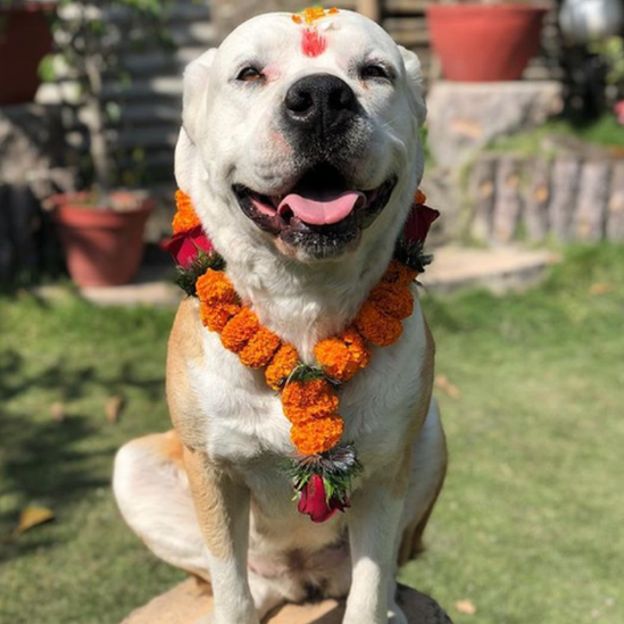
The Nepalese festival Kukur Tihar celebrates dogs by blessing them with a red mark on their forehead
Every dog has its day, and for canines in Nepal that phrase could not be more literal.
The five-day Nepalese Hindu festival of Tihar started this week and the second day is known as Kukur Tihar or “day of the dogs”.
Dogs are celebrated and blessed with a Tika – a red mark applied to their forehead.
The animals are also given flowers, garlands and offered food as part of the festival.
Scooby the Japanese Spitz enjoyed being decorated with garlands of fresh marigold flowers
Hindus believe that dog is the messenger of Yamaraj – the God of death – and by keeping the dogs in good humour they will be able to appease Yamaraj himself.
Sumnima Maudas said Kukur Tihar is one of her “favourite Nepalese festivals” and added the day was all about her chihuahua Sanu
The festival, which shares some traditions with Diwali in India, also celebrates cows and crows.
Dog owner Umid Pokharel celebrated with his labrador Frieza but said “worshipping them for a day is not enough”
It is not just beloved pets who are involved in the celebrations. Stray dogs are honoured on the day too.
Kelsang Ongmu Tamang’s cat Missy joined in with the tradition as well as dogs Sweetie and Milly
Treats given to dogs during Kukur Tihar can range from meat, milk, eggs and good quality dog food.
Pappu the pug has been enjoying the food element of the festival
Tihar is also called Deepavali or the festival of lights.
Throughout this festival, people in Nepal clean their houses and courtyards; light up lamps and pray to Laxmi – the Goddess of Wealth – urging her to visit their houses and bless them.
Daisy Pie certainly looked pleased to be the centre of attention
The 5-year-old, brown-and-white pup, named after the famed crooner, inexplicably turned up 1,200 miles from Canarsie around Nov. 6 and was taken in by the Verrill family.
They were able to hunt down Sinatra’s owner in Brooklyn, Lesmore Willis, who burst into tears when he heard his beloved family pet had been found.
On Sunday evening, friends of the Verrill family made their way from Florida to the Baltimore area to hand off Sinatra to a pal of Willis’, Glen O’Gilvie, who lives there. O’Gilvie will then drive the dog to New York, he told The Post on Monday.
CBS This Morning published a video of the event.
Just a lovely outcome, albeit one that doesn’t change the fact that dear, young Zion is never coming back!






 Learning from Dogs