It primarily featured a short video from the home page of Colin Potter’s Fight Parkinson’s website. That video explained how a strict regime of the right food and supported by supplements had made an incredible difference to his health, effectively putting his PD into remission.
Or in Colin’s words:
I am Colin Potter and I have a Parkinson’s diagnosis.
Only there’s one difference between me and virtually all other people with Parkinson’s
I no longer suffer from its symptoms. I don’t take conventional medications.
You’d hardly know I had Parkinson’s. How is this possible?
I’m not a doctor, I’m just an ordinary bloke diagnosed with Parkinson’s in 2011 who just didn’t like what he was being told by his doctors; that his condition was incurable and his health would go into permanent decline.
So, I started my own research, and found thousands of authoritative research studies that:
Showed that Parkinson’s mostly had its origins in our lifestyle and environment
Revealed the possible, specific causes behind Parkinson’s
Promoted the actions I could take to fix the problem
Allowed me to cease levodopa medication
I then made the necessary changes to my lifestyle and diet and here I am, two+ years later, healthy and recovered.
I know many of you will find it hard to dedicate a measurable amount of ‘viewing’ time to this post but that doesn’t stop me from recommending a subsequent video.
Namely, a longer (32 minutes) interview of Colin Potter that really explains his transformation
There’s even more to share with you but Jeannie and I have made a fundamental decision. That is that before we go any further it is only right that we seek the views of a local nutritionist in nearby Grants Pass.
We need to be certain that the major changes that we are planning in terms of diet and supplement intake are supported by local, qualified persons.
We will share those findings with you very soon.
But it does cross my mind that the following should be included in this post.
We do not offer advice and nothing on any website, email or any other communication is intended to treat, diagnose, prevent or cure any disease. It is not a substitute for consulting your doctor. You should consult a doctor for diagnosis of conditions, before beginning any diet, exercise or supplementation or if you suspect you have any health issue. You should not stop medication without consulting your doctor.
I was intending to write a longish post today returning to the theme of diet, nutrition and health following my post of the 16th. The Power of Good Food.
But events got in the way and it will be published tomorrow.
Getting to the truth of what is or is not good for our dogs.
As many will understand so very often I am acting more as a messenger than an authoritative source in this place. It is very difficult for me, almost impossible indeed, for me to verify the validity of what is posted here.
On January 11th, I published a guest post from Kathreen Miller. Her article was called Is Organic Food Really Good For Your Dog To Eat?
Yesterday, local good friend and neighbour, Jim Goodbrod, sent me an email pointing out a number of weaknesses in Kathreen’s article and giving me permission to republish what he wrote as a post on Learning from Dogs.
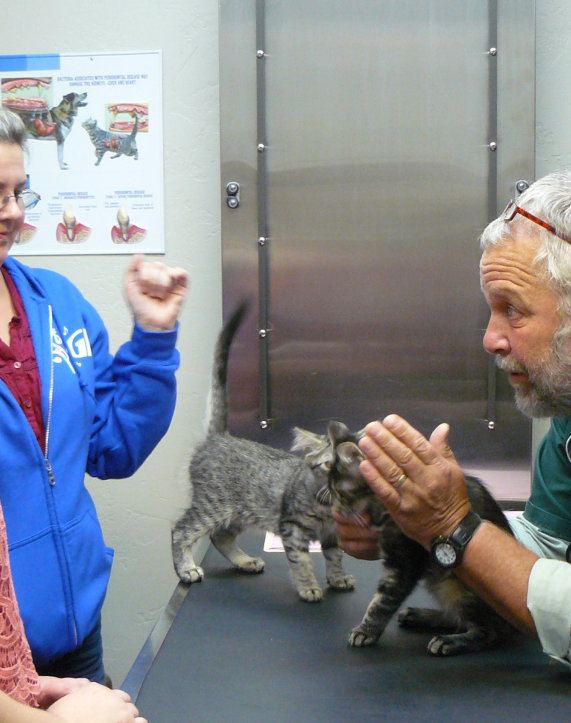
Jim is an experienced Doctor of Veterinary Medicine (DVM) and has frequently advised us, both professionally and informally, about our own dogs and cats. We trust him fully. Jim attends a couple of local vet clinics including Lincoln Road Veterinary Clinic in Grants Pass to where we take our pets when required.
Dr. Jim seeing a patient at Lincoln Road Vet.
Here is Jim’s update published with his kind permission and unchanged by me apart from some minor formatting amendments including italicising some phrases.
ooOOoo
Hey Paul …
Regarding your post of 1-11-18, a guest post by Kathreen Miller concerning canine diet, I feel the need (justified or not) to clarify a few points. She seems to be a big proponent of “organic diets” and lest your readers be misled, I think we need to define what is meant by “organic”.
The legal definition of “organic” is codified by the USDA National Organic Program (NOP) in 7 CFR 205. Pet foods and pet treats must comply with these regulations or they may not legally use the word “organic” on the label. If you read these regulations, you will find that “organic” refers only to the handling and processing of ingredients and products.
These regulations cover: ingredient sourcing, ingredient handling, manufacturing, and labeling & certification of products wanting to use the word “organic” in their labeling.
However, these rules are not considered by NOP as a means to ensure safer, healthier, or more nutritious foods. In fact, there is no regulatory distinction in the tolerable levels of pesticides, drugs, or other residues allowed in organic vs conventional products (even though lower residues may in fact be a result).
Rather, the “organic” label is viewed as a confirmation of the organic production process, and the purchaser is left to his or her own determination as to whether the costs merit the perceived benefits. The bottom line is that “organic” refers to the processing of a product, and makes no guarantees as to the quality or digestibility of ingredients, safety, nutritional value or health benefits of the product.
A savvy pet owner, in order to ensure her dog’s optimal nutritional health, would be better advised to follow guidelines outlined by WSAVA or AAHA (or other reputable source) rather than to reflexively reach for the dog food that says “organic” on the label. The “organic” label does not necessarily mean a diet is good or bad, but it has nothing to do with the nutritional adequacy of the diet and hence your dog’s health.
Another point: Kathreen seems to buy into the popular myth that plant-based ingredients (like corn) are poorly digested fillers that provide little nutritional value and can cause allergies. Corn provides a good source of carbohydrates, essential amino acids, protein, and essential fatty acids in the diets of dogs and cats. It is highly digestible and is not a common cause of allergies. It is actually a very good nutrient as an ingredient in pet food.
My last point is regarding the product “Pet Bounce” that Kathreen endorses as a treatment for arthritic pain in dogs. This product is labelled as homeopathic and as such is nothing more than a placebo.
It has been proven over and over and over again that homeopathic remedies are nothing but water and perform no better than placebos in numerous clinical trials. Reading the list of ingredients, one can see that it contains:
1) Belladonna 6X
2)Caulphyllum 6C
3) Colchicum autumnale 200C
4) Apis mellifica 30C
5) Rhus toxicodendron 200C
6) Ruta graveolens 6X.
Anyone familiar with homeopathic nomenclature knows that, for example, the Apis mellifica 30C designation means that this particular herb is diluted in water 1 to or (that’s 1 followed by 60 zeroes!).
To put it into perspective, that’s equivalent to 1 molecule of this substance in a sphere of water 90 million miles in diameter (approximately the distance of the earth to the sun). That’s a 30C dilution.
At a 200C dilution, the treating substance is diluted more than the total number of atoms in the known universe!
Regardless of any medicinal properties these herbs may have, they are so fantastically diluted that there is not one molecule present in the final solution.
I defy any reasonable person to tell me that this so-called remedy is effective to treat anything and consists of anything more than a water placebo.
My problem with this kind of snake oil is that well-meaning pet owners waste their money (~$50.00 per bottle!) on this useless product, believing all the hype and thinking that they are improving the quality of their dog’s life, meanwhile squandering the opportunity to actually help their dog with an effective and evidence-based treatment.
Kathreen seems to be a nice and well-intentioned woman, but I don’t know what qualifies her as a “pet health expert”, other than her own opinion. According to her profile (from your blog) she lives in Chicago with her daughter and dog “Buddy” and listens to music, watches TV, and travels. That’s it? Nothing more??
Sometime over the next few days I will write a post about an amazing connection that Jean made, via Richard in England, with Colin Potter. He is the founder of the site Fight Parkinson’s.
It is mentioned as an introduction to today’s post because Colin stresses the critical importance of the right diet for us humans.
Richard lives with his good lady, Julie, in Minety, a village in North Wiltshire. He and I go back many, many years and we have been close friends from the day that we first met. Richard was diagnosed with early-stage Parkinson’s Disease (PD) the same year and month as my Jeannie: December, 2015.
Last New Year’s Eve Richard and Julie were at a local party and the subject of PD came up. Richard subsequently told me that he was speaking to a fellow party guest who said that he was, in turn, an acquaintance of a Colin Potter. He went to add that Colin had also been diagnosed with PD but had decided not to ‘give in’ to the diagnosis but undertake comprehensive research into the causes and whether it was possible to go into remission. He later launched a website Fight Parkinsons.
This is Colin’s video that appears on the home page of Fight Parkinson’s.
Parkinson’s RecoveryThis is where you find the answers to the causes of Parkinson’s and the actions you can take which may bring about a recovery.
There are actions that I’ve taken which have required guidance from a doctor (of Functional Medicine) or special practitioner. Other steps, such as changing to a better diet, I have done independently based upon my research.
Nowadays, there are so many ways that we fall foul of nature and the kind of life we are built to lead. Industrialisation and technology expose our bodies to so much stress and toxic substances, it’s no wonder that chronic disease arises. It also means that there are many things to put right.
This has been a journey of learning over several years and, with subsequent knowledge, there are some things I did at the start that I would do differently now. Nevertheless, I did them and can’t turn the clock back.
I share this with you because the chances are that you know someone who knows someone with PD. The information on the Fight Parkinson’s website is too important not to be shared as far and wide as possible.
The subscription price for signing up to all the information is just $5/GBP3.60 per month. Both Jeannie and Richard are subscribers.







 This is where you find the answers to the causes of Parkinson’s and the actions you can take which may bring about a recovery.
 Learning from Dogs