More photographs courtesy of Neil Kelly, Devon.

oooo

oooo

oooo

oooo

oooo

oooo

oooo

oooo
Aren’t these stunningly wonderful pictures! Another set of eight next Sunday. Oh, and if you missed last Sunday’s set please drop in here and admire them.
Dogs are animals of integrity. We have much to learn from them.
Year: 2013
More photographs courtesy of Neil Kelly, Devon.
oooo
oooo
oooo
oooo
oooo
oooo
oooo
oooo
Aren’t these stunningly wonderful pictures! Another set of eight next Sunday. Oh, and if you missed last Sunday’s set please drop in here and admire them.
“Until one has loved an animal, a part of one’s soul remains unawakened.” Anatole France
This gorgeous video has been doing the rounds and came to me thanks to Suzann.
Enjoy!
Very Talented Russian Bear and His Awesome Friend
This unbelievably talented and cute Russian bear can roll over, play the trumpet, sit on a lawn chair, play the trumpet, you name it. Leave it to a random Russian guy to train such an awesome bear.
Bernie Krause: The voice of the natural world
Not going to do anything other than ask you to watch, or more pertinently listen, to this 14-minute video.
Published on Jul 15, 2013
Bernie Krause has been recording wild soundscapes — the wind in the trees, the chirping of birds, the subtle sounds of insect larvae — for 45 years. In that time, he has seen many environments radically altered by humans, sometimes even by practices thought to be environmentally safe. A surprising look at what we can learn through nature’s symphonies, from the grunting of a sea anemone to the sad calls of a beaver in mourning.
The Wikipedia entry explains that:
Bernie Krause was born in 1938. Somewhat of a musical prodigy, by age 3-1/2 he studied violin and by age 4 classical composition. He performed on a variety of stringed instruments (cello, bass, viola, harp) but fell in love with the guitar. He was disappointed when in 1955 not a single music school to which he applied would accept him with guitar as his primary instrument. Krause went on to work as a studio guitarist on jazz sessions and, occasionally, on early Motown sessions. He also worked as a recording engineer and producer in Ann Arbor while an undergraduate at the University of Michigan. He joined The Weavers in 1963, occupying the position created by co-founder Pete Seeger and stayed with them until they disbanded a year later.
More details here.
Do go across to Bernie Krause’s website Wild Sanctuary if only to listen to the sounds of birds on the ‘home page’!
Well at least it isn’t boring!
Last Friday, the 26th, the area where we live in Oregon, that is Merlin just to the North-West of Grants Pass, Oregon, experienced a significant thunder and lightning storm. The challenge was that the storm had very little associated rain and, as a consequence, a number of fires were started in the tinder-dry forest.
We were not really aware of these fires over the week-end.
Then on Monday morning, our microwave internet linked failed. I went next door to our neighbours (thanks Dordie and Bill) and borrowed their PC to post a Loss of Service notice around 2pm on that Monday. That’s also when I heard that one of the fires, named the Brimstone Fire, had started less than a couple of miles away from where we live – h’m-mm!

Later on that evening, the first of a great number of helicopter fire dousing flights flew by overhead.
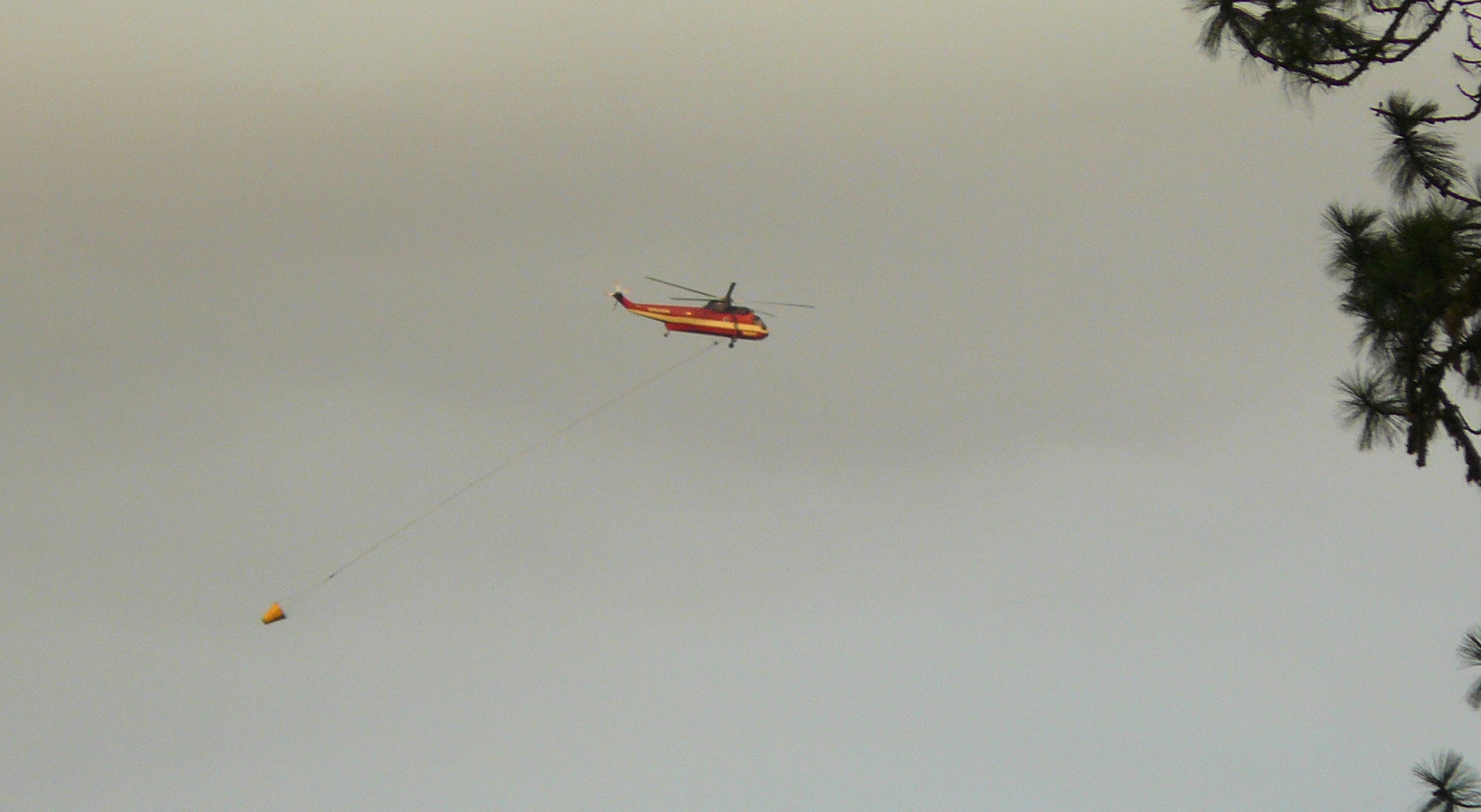
The wind was creating some interesting cloud waves in the smoke cover.

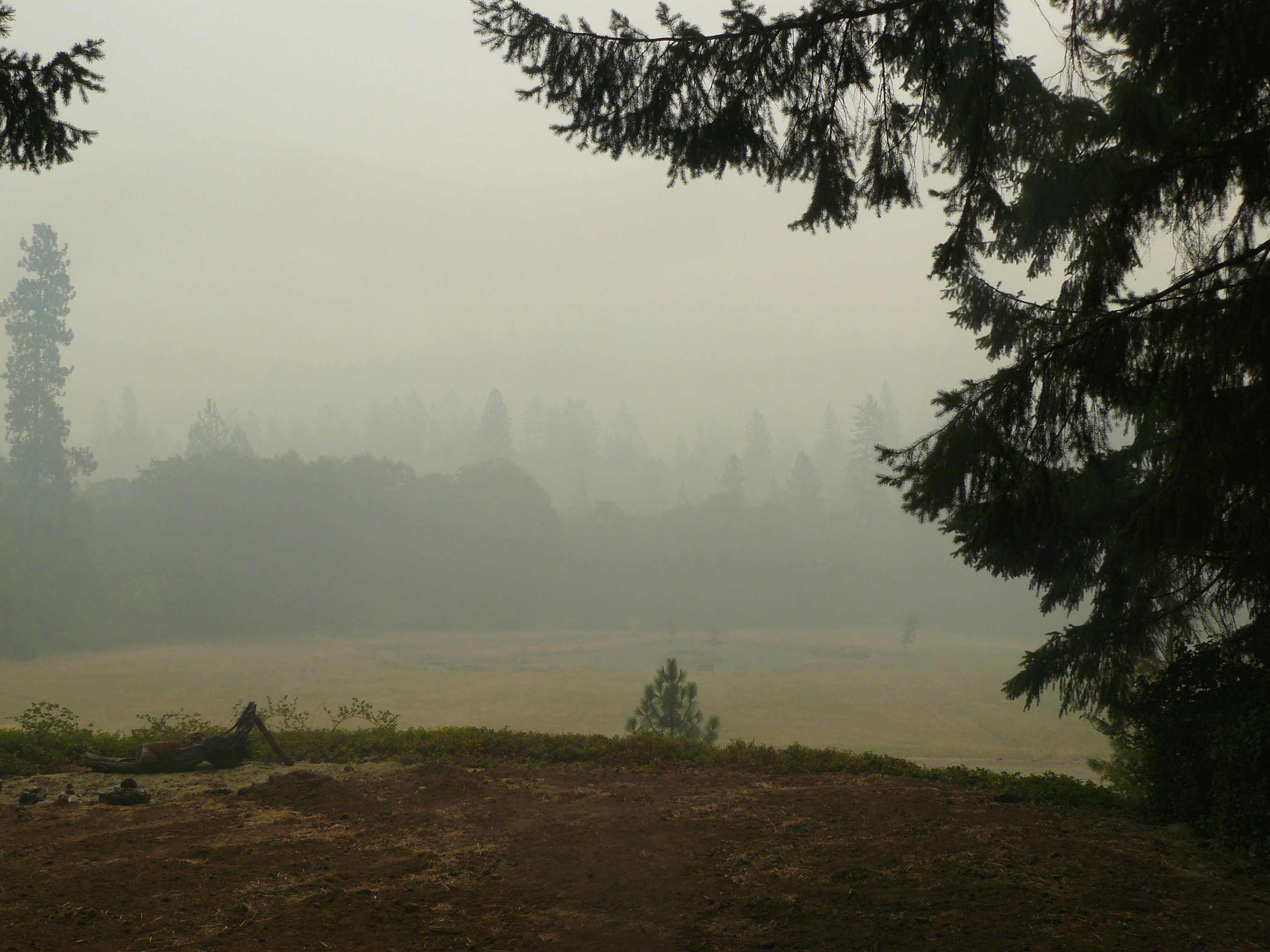
Then as each day passed the air became more and more smoke filled. Reliable reports had said that the smoke cover had expanded to Northern California.
Here’s a picture taken yesterday morning of the ground that drops away from the house!
But at least our internet service has been restored enabling me for the first time to access the Fire Incident website, from which I read at 4:40 pm yesterday, the following.
Incident Overview
The 1,600-acre Brimstone Fire, located 5 miles west of Sunny Valley, made no significant movement late Tuesday or overnight. Crews coming in from night shift said planned fireline improvement on the north and southeast corners was completed, and burnouts in those same areas were successful. Nearly 800 people are assigned to the Brimstone Fire’s suppression effort. Specifically, 29 crews, 26 wildland fire engines, seven bulldozers and nine water tenders are divided between the day and night shifts. The weather has been calm and this has helped reduce fire activity. However, the heavy smoke layer has made it impossible to use helicopters on the fire.No evacuations have been announced for residential areas around the fire area, but structural fire protection personnel have assessed homes should an evacuation become necessary. To find out more about evacuation planning, call the Josephine County Emergency Operations Center (EOC) at (541) 474-5305.Firefighters ask that the public not use roads in the Upper Quartz Creek Rd and Hogs Creek Rd areas because these roads are narrow and are being heavily used by fire engines, trucks hauling water, and bulldozers.
Basic Information
Incident Type: Wildfire
Cause: Lightning
Date of Origin: Monday July 29th, 2013 approx. 02:00 AM
Location: 10 miles northwest of Merlin, OR
Incident Commander: Chris Cline
Current Situation
Total Personnel: 773
Size: 1,600 acres
Percent Contained: 10%
Fuels Involved: Mixed conifer and hardwood trees of widely varied ages, snags (dead, standing trees), brush and logging slash.
Fire Behavior: Torching and short-range spotting. The fire is difficult to see due to smoky conditions.
Significant Events: Three roads are closed because fire engines and other equipment are using the roads. The closed roads are Hog Creek, Quartz Creek and Angora Creek.
Outlook
Planned Actions: Improve the fire line and strategically burn out unburned areas inside the fire line.
Growth Potential: High
Terrain Difficulty: High
Current Weather
Wind Conditions 10 mph NW
Temperature 85 degrees
Humidity 31%
Well at least I can settle down and work my way through 130+ emails!!
Crumbling edge techonology!
At around 11am local Pacific time today (Monday) we lost our internet connection at home. (I have borrowed neighbours Dordie and Bill’s connection to publish this.)
The engineers say it could be up to 48 hours before they attend to the issue.
So enjoy a couple of days peace!
Regards to all,
Paul
The science behind our fabulous dogs.
I was doing some research for another writing project about the history of the domestication of the dog and came across a peer-reviewed article on The National Center for Biotechnology Information website, here in the USA. The article was entitled: Genome-wide SNP and haplotype analyses reveal a rich history underlying dog domestication. The website link is here. (As an aside, if you drop in here and look at the NCBI sitemap it may well serve as an excellent resource.)
Anyway, the dog domestication article is, of necessity, highly scientific but nonetheless worth the read. Here’s a taste from the Abstract.
Advances in genome technology have facilitated a new understanding of the historical and genetic processes crucial to rapid phenotypic evolution under domestication 1,2. To understand the process of dog diversification better, we conducted an extensive genome-wide survey of more than 48,000 single nucleotide polymorphisms in dogs and their wild progenitor, the grey wolf. Here we show that dog breeds share a higher proportion of multi-locus haplotypes unique to grey wolves from the Middle East, indicating that they are a dominant source of genetic diversity for dogs rather than wolves from east Asia, as suggested by mitochondrial DNA sequence data 3
But what really caught my eye was Figure 1, a wonderful illustration of the links between all the breeds of dogs and the grey wolf.
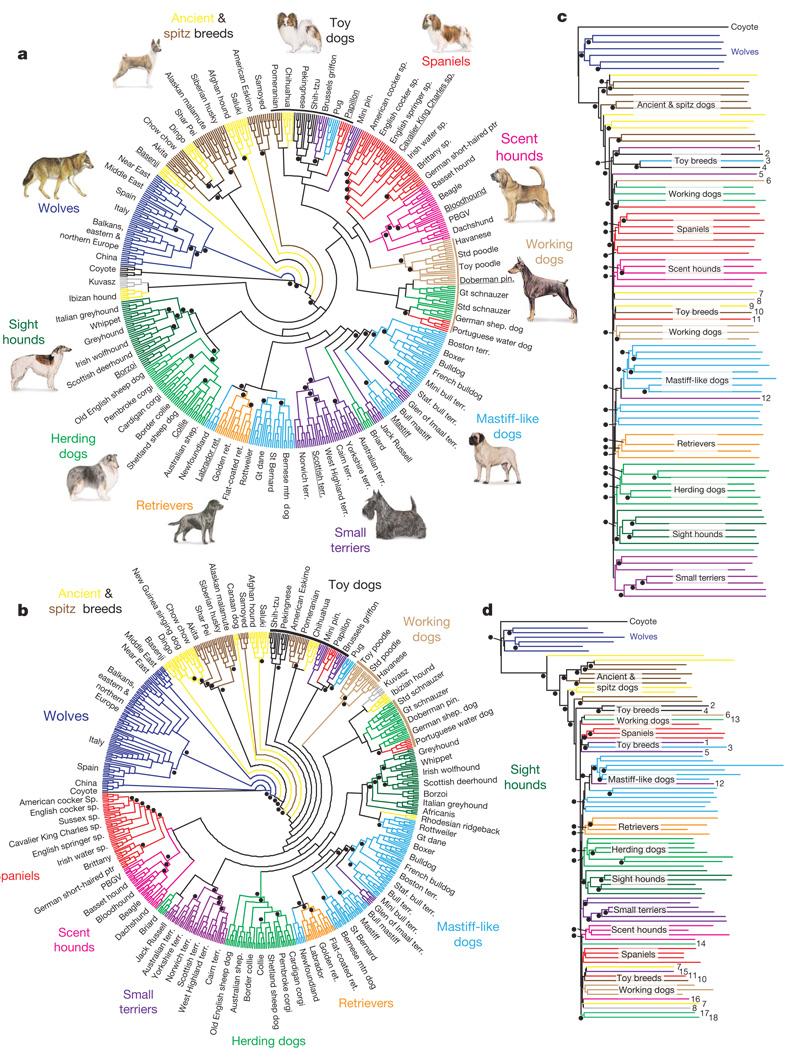
From:Nature. Author manuscript; available in PMC 2012 November 9.
Published in final edited form as: Nature. 2010 April 8; 464(7290): 898–902.
Published online 2010 March 17. doi: 10.1038/nature08837Branch colour indicates the phenotypic/functional designation used by dog breeders 8,9. A dot indicates ≥95% bootstrap support from 1,000 replicates. a, Haplotype-sharing cladogram for 10-SNP windows (n = 6 for each breed and wolf population). b, Allele-sharing cladogram of individuals based on individual SNP loci. c, Haplotype-sharing phylogram based on 10-SNP windows of breeds and wolf populations. d, Allele-sharing phylogram of individual SNPs for breeds and wolf populations. For c and d, we note breeds where genetic assignments conflict with phenotypic/functional designations as follows: 1, Brussels griffon; 2, Pekingese; 3, pug; 4, Shih-tzu; 5, miniature pinscher; 6, Doberman pinscher; 7, Kuvasz; 8, Ibizian hound; 9, chihuahua; 10, Pomeranian; 11, papillon; 12, Glen of Imaal; 13, German shepherd; 14, Briard; 15, Jack Russell; 16, dachshund; 17, great schnauzer; and 18, standard schnauzer. Gt, great; mtn, mountain; PBGV, petit basset griffon vendeen; pin., pinscher; ptr, pointer; ret., retriever; shep., shepherd; sp., spaniel; Staf., Staffordshire; std, standard; terr., terrier. Canine images not drawn to scale. Wolf image adapted from ref. 31; dog images from the American Kennel Club (http://www.akc.org).
The diagram on its own was a bit of a struggle but looked at in conjunction with the research paper was much better understood. Another reason for going to the original article on the NCBI website is the interesting range of links to other scientific papers that may be seen to the right-hand side of the screen. For example:
Coat variation in the domestic dog is governed by variants in three genes.
that included this in the Abstract:
The mean sequence distance to ancestral haplotypes indicates an origin 5,400-16,300 years ago (ya) from at least 51 female wolf founders. These results indicate that the domestic dog originated in southern China less than 16,300 ya, from several hundred wolves. The place and time coincide approximately with the origin of rice agriculture, suggesting that the dogs may have originated among sedentary hunter-gatherers or early farmers, and the numerous founders indicate that wolf taming was an important culture trait.
Ancient DNA evidence for Old World origin of New World dogs.
Abstract
Mitochondrial DNA sequences isolated from ancient dog remains from Latin America and Alaska showed that native American dogs originated from multiple Old World lineages of dogs that accompanied late Pleistocene humans across the Bering Strait. One clade of dog sequences was unique to the New World, which is consistent with a period of geographic isolation. This unique clade was absent from a large sample of modern dogs, which implies that European colonists systematically discouraged the breeding of native American dogs.
If you needed a reminder of the Pleistocene period, as I did, there’s a helpful Wikipedia entry here.
The final link that I wanted to highlight was this one, for all dog owners who worry about the health of our dogs.
The legacy of domestication: accumulation of deleterious mutations in the dog genome.
Abstract
Dogs exhibit more phenotypic variation than any other mammal and are affected by a wide variety of genetic diseases. However, the origin and genetic basis of this variation is still poorly understood. We examined the effect of domestication on the dog genome by comparison with its wild ancestor, the gray wolf. We compared variation in dog and wolf genes using whole-genome single nucleotide polymorphism (SNP) data. The d(N)/d(S) ratio (omega) was around 50% greater for SNPs found in dogs than in wolves, indicating that a higher proportion of nonsynonymous alleles segregate in dogs compared with nonfunctional genetic variation. We suggest that the majority of these alleles are slightly deleterious and that two main factors may have contributed to their increase. The first is a relaxation of selective constraint due to a population bottleneck and altered breeding patterns accompanying domestication. The second is a reduction of effective population size at loci linked to those under positive selection due to Hill-Robertson interference. An increase in slightly deleterious genetic variation could contribute to the prevalence of disease in modern dog breeds.
Have to say that there are some fabulous learning opportunities from the enormous range of websites available nowadays.
 Learning from Dogs