Back on the 10th we had a few days of cold, overcast weather that brought temperatures down below freezing and some snow.
Here’s a scene looking towards the North-East corner of the property, taken just before 11 am.
Then a few days later, on the 14th, the sun was out while the temperatures remained below freezing. Shown clearly as the sunlight catches the frost on the tree.
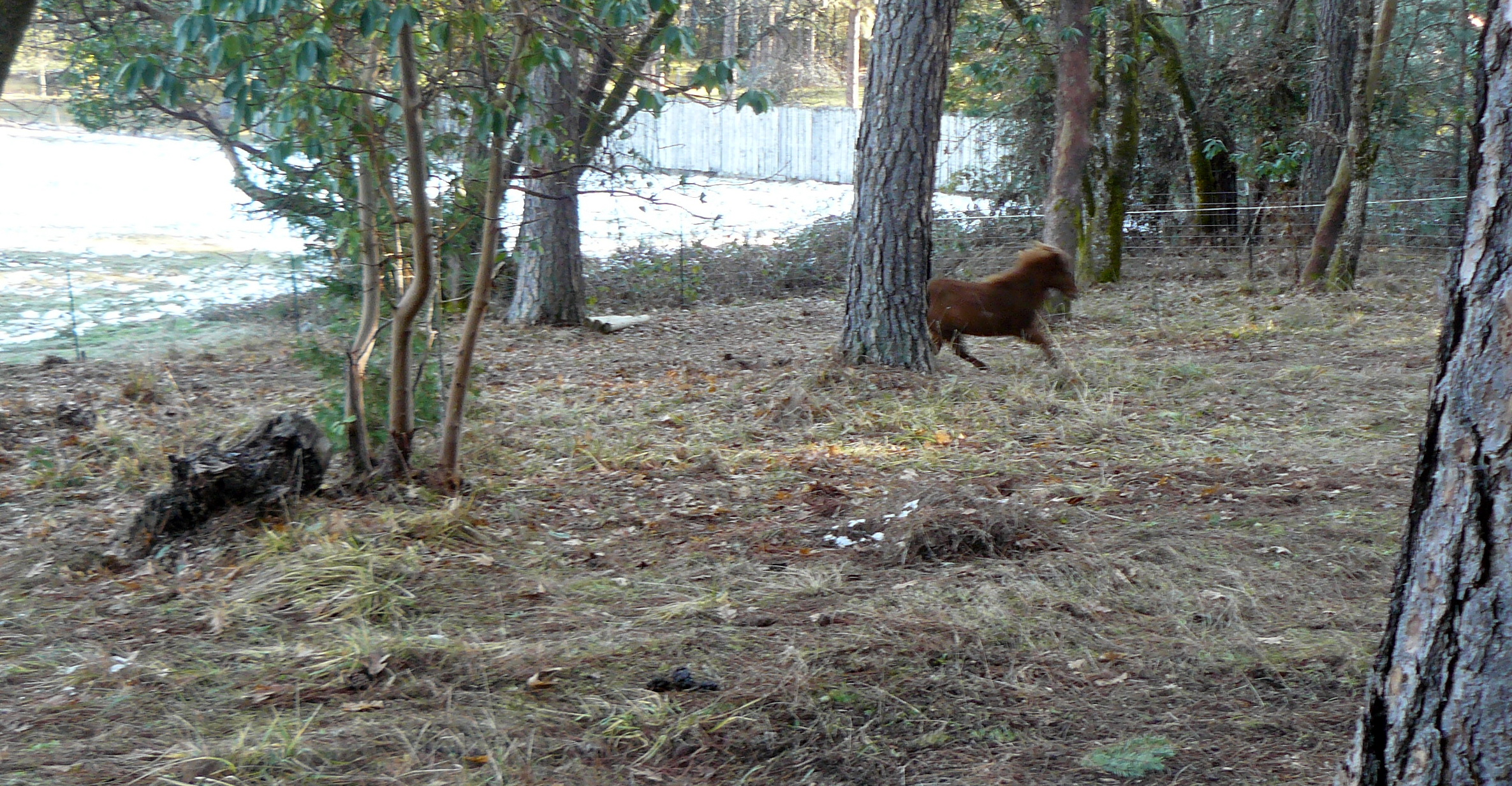
A few minutes later I swung the camera to take a picture of Dancer munching away in the morning sunshine, just a day after we collected her and Grace.
The horses settled in quickly, adapting to the dogs who were very curious.
Grace and Cleo being nonchalant with each other.
Jean unable to get her fill of her new companions.
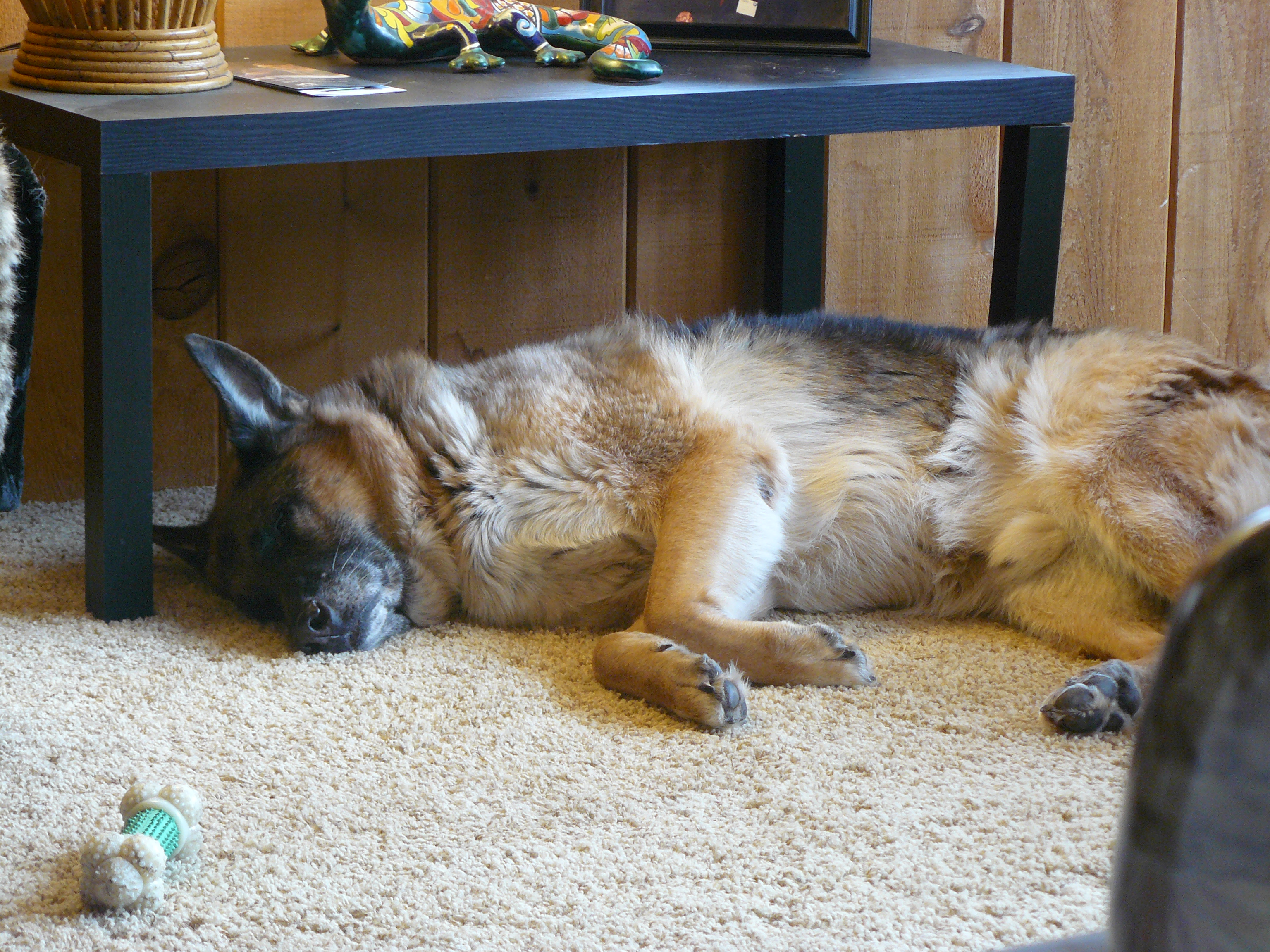
And in a very different vein, a sneak photograph taken of yours truly who had collapsed in front of the fire early evening last Friday, quickly becoming a cushion for Hazel.
Forwarded to me by Cynthia – a very brave lady indeed.
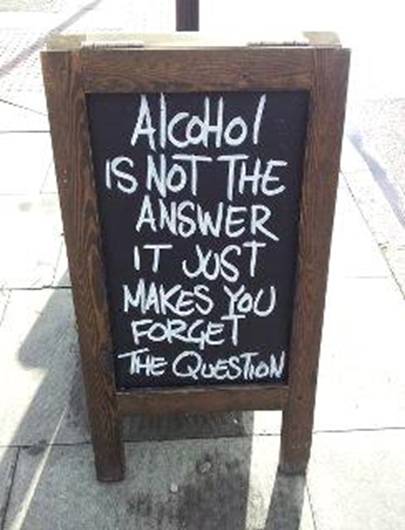
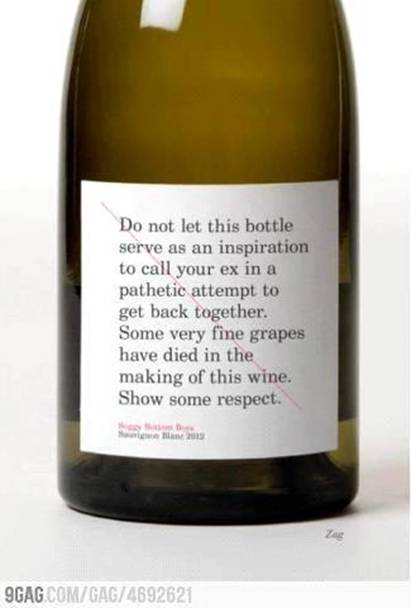
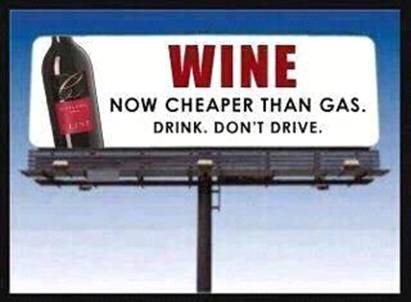
It seems to have been a tough week in various ways so why not open a bottle of your favourite vintage and raise a glass to all the brave persons in the world.
—-
—-
—-
—-
—-
—-
—-
—-
—-
—-
—-
—-
—-
oooOOOooo
Let me close with a quotation reputed to be from the lips of Joan Collins:
Age is just a number. It’s totally irrelevant unless, of course,
A week ago I published a post called On quietness. It was predominantly comprised of a republication of a much earlier item written by Jon Lavin.
However, in the way that things happen, shortly after that post (last Friday’s one) was published I came across this TED video of Andy Puddicome.
I’ll say no more – enjoy the video. (Beautifully delivered in ten minutes, by the way!)
When is the last time you did absolutely nothing for 10 whole minutes? Not texting, talking or even thinking? Mindfulness expert Andy Puddicombe describes the transformative power of doing just that: Refreshing your mind for 10 minutes a day, simply by being mindful and experiencing the present moment. (No need for incense or sitting in strange positions.)
oooOOOooo
“Most people assume that meditation is all about stopping thoughts, getting rid of emotions, somehow controlling the mind. But actually it’s … about stepping back, seeing the thought clearly, witnessing it coming and going.” (Andy Puddicombe)
Andy Puddicombe wants you to take a break — not just from work, but from your own mind, which is so full of anxieties about the world and anxieties about its own anxieties. To help you do that, Puddicombe, a former Buddhist monk, co-founded Headspace, a project to make meditation more accessible to more people in their everyday lives. Puddicombe also writes prolifically for the Huffington Post and the Guardian, on the benefits of mindful thinking for healthy living.
oooOOOooo
So as someone who seems to have real trouble relaxing, I mean real relaxation in the letting go sense, I’m flirting with the idea of committing 10 minutes of meditation each day. Andy offers a charmingly easy way of doing this, as you will discover if you go to his website Headspace. Here’s a quote from the ‘What is Headspace‘ page.
Here at Headspace we’re on a mission to get as many people in the world as possible to take 10 minutes out of their day, to practice a simple and easy-to-learn meditation technique. And if you like the way it makes you feel, then we’d love to show you how to make that a life-long skill.
This is meditation for modern life – simple, scientifically-proven techniques, that you can use every day to experience a healthier and happier mind.
Those articles published by the Guardian as referred to above may be found here: The Guardian, if you want to browse around some more.
Stay tuned as to the outcome of me and meditation; I’ll share with it you via Learning from Dogs. Let’s face it, dogs are very good at chilling out for ten minutes! Oh dear, something else to learn from our doggies!
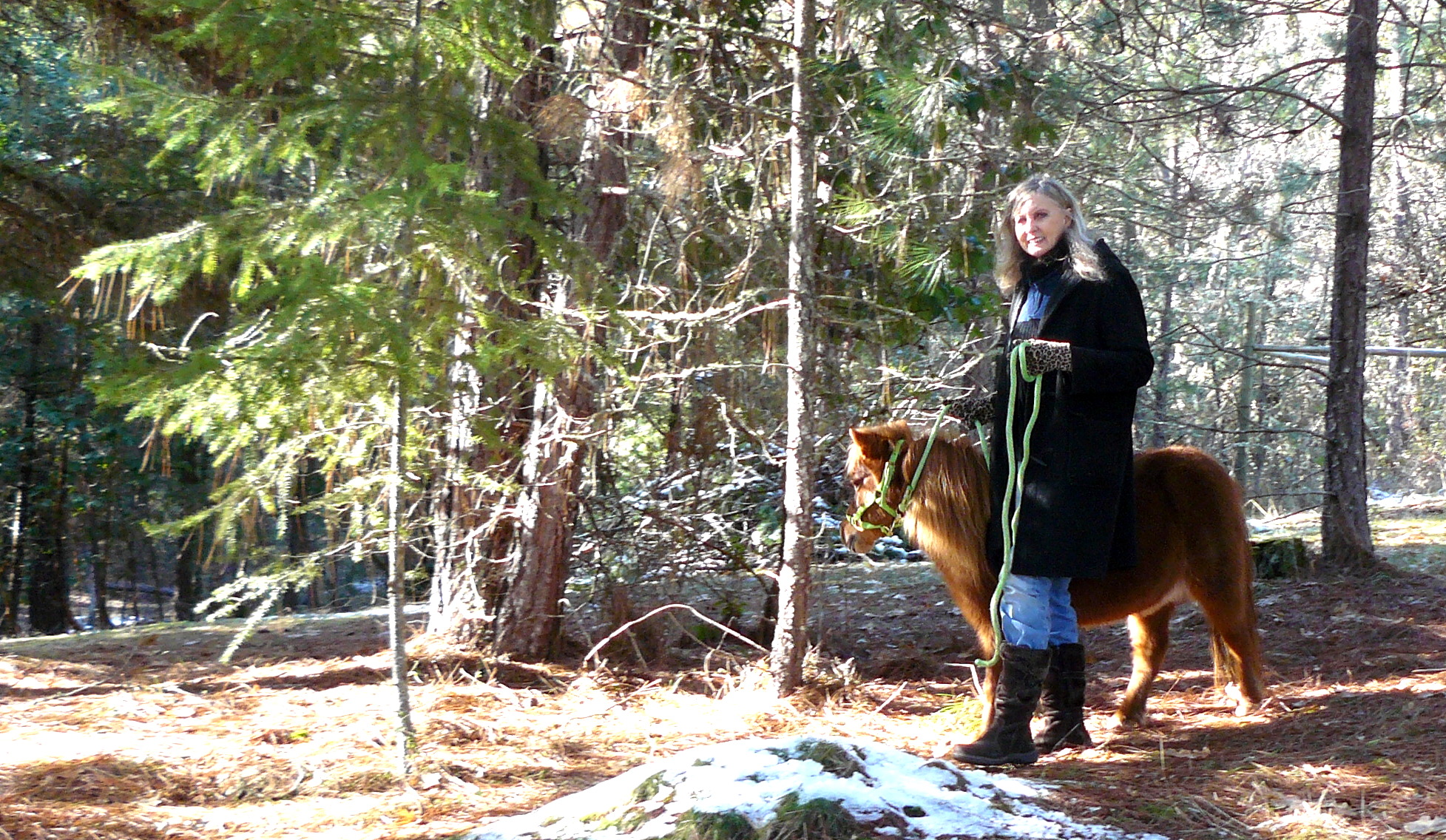
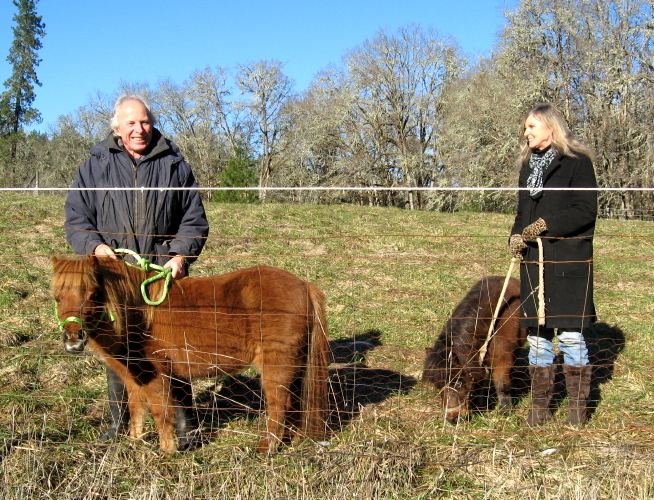
Today’s title came from a recent chat ‘across the garden fence’ with our neighbours, Dordie and Bill. At their request we had walked our two horses over to the fence-line between our two properties so Dordie and Bill could meet and fondle them. The warm afternoon sunshine was beautiful and while the horses munched the newly-found grass, we grown-ups talked about this and that and generally tried to put the world to rights!
Paul with Dancer; Jean with Grace.
We talked about the strangeness of present times. Not just in the USA but across the world. Bill thought 2013 would be the year of separation. I queried what he meant by that.
Bill replied, “I sense that by the end of the year, the vast majority of people will have decided if climate change is or is not a significant issue.” There would be few who remained neither unconcerned nor undecided.
That resonated with me and neatly put the framework to today’s post. Stay with me while I journey to the destination that this year will be the year of hope.
I am one of many who subscribe to the online magazine Grist. They describe themselves, thus:
Laugh now — or the planet gets it.
You know how some people make lemonade out of lemons? At Grist, we’re making lemonade out of looming climate apocalypse.
It’s more fun than it sounds, trust us!
Grist has been dishing out environmental news and commentary with a wry twist since 1999 — which, to be frank, was way before most people cared about such things. Now that green is in every headline and on every store shelf (bamboo hair gel, anyone?), Grist is the one site you can count on to help you make sense of it all.
The weekly Grist digest that arrived in my in-box that same day as when we were chatting with Dordie and Bill included a number of key stories.
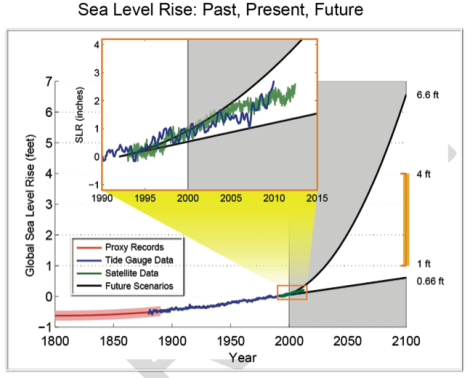
Now I’m not going to republish all 32 charts but will include just these two, because the message is clear.
It’s possible that sea levels could only rise eight inches. It is also possible that they could rise over six-and-a-half feet.
—-
Sea-level rise will affect different areas to different degrees — but note the map at lower right. On the Georgia coast, “hundred year” floods could happen annually.
OK, that first chart takes a while to absorb the full implications. The second one doesn’t!
The full range of charts is chilling. While they refer to the USA, the messages apply to the whole world.
Then in that same Grist weekly summary was this story.
If you aren’t alarmed about climate, you aren’t paying attention
There was recently another one of those (numbingly familiar) internet tizzies wherein someone trolls environmentalists for being “alarmist” and environmentalists get mad and the troll says “why are you being so defensive?” and everybody clicks, clicks, clicks.
I have no desire to dance that dismal do-si-do again. But it is worth noting that I find the notion of “alarmism” in regard to climate change almost surreal. I barely know what to make of it. So in the name of getting our bearings, let’s review a few things we know.
We know we’ve raised global average temperatures around 0.8 degrees C so far. We know that 2 degrees C is where most scientists predict catastrophic and irreversible impacts. And we know that we are currently on a trajectory that will push temperatures up 4 degrees or more by the end of the century.
David then works his way through those ‘things we know’ in a powerful manner. Do read the full article, please! This is his conclusion:
All this will add up to “large-scale displacement of populations and have adverse consequences for human security and economic and trade systems.” Given the uncertainties and long-tail risks involved, “there is no certainty that adaptation to a 4°C world is possible.” There’s a small but non-trivial chance of advanced civilization breaking down entirely.
Now ponder the fact that some scenarios show us going up to 6degrees by the end of the century, a level of devastation we have not studied and barely know how to conceive. Ponder the fact that somewhere along the line, though we don’t know exactly where, enough self-reinforcing feedback loops will be running to make climate change unstoppable and irreversible for centuries to come. That would mean handing our grandchildren and their grandchildren not only a burned, chaotic, denuded world, but a world that is inexorably more inhospitable with every passing decade.
Take all that in, sit with it for a while, and then tell me what it could mean to be an “alarmist” in this context. What level of alarm is adequate?
So am I stark staring mad for having hope in my mind? Stay with me for just a little longer. Then form your own judgment.
Recall the post that I published on Tuesday hitting out at the British newspaper The Daily Mail. Towards the end of that post, in discussing the recently released American National Climate Assessment, I wrote this:
That’s why this report is to be encouraged, nay embraced. Of all the nations in the world, the one that should be setting the lead is the United States of America. As the banner on that globalchange.gov website proclaims: Thirteen Agencies, One Vision: Empower the Nation with Global Change Science
So go and read the report. For your sake and all our sakes.
Because the more informed you and I are, the better the chances of real political leadership taking place in this fine nation.
Let’s just accept it: America’s current political and economic systems are incapable of responding adequately to climate change. As things stand, reducing carbon emissions — or more broadly, shifting to sustainability — is a kind of add-on, a second-tier consideration, bolted onto systems and institutions that were built for other purposes.
A little later, David writes:
So what would a new U.S. grand strategy built around sustainability look like? That’s the question tackled by “A New U.S. Grand Strategy,” a piece in Foreign Policy by Patrick Doherty, director of the Smart Strategy Initiative at the New America Foundation.
It’s a hugely ambitious and wide-ranging piece, far too much to even summarize adequately here. Bookmark it. Instapaper it. Pinterest it to your iCloud, or whatever kids do these days. But let’s take a quick look.
Doherty identifies four central challenges facing the U.S.:
Economic inclusion: People are swarming out of poverty around the world (especially in China). Over the next 20 years, the global middle class will welcome around 3 billion new members. That’s going to put intense stress on natural, economic, and political systems that are already showing signs of strain.
Ecosystem depletion: Pretty sure Grist readers are familiar with this one.
Contained depression: Rather than a recession, the U.S. faces a “constrained depression,” with the full effects of low aggregate demand and high debt being masked by policy. No amount of fiscal or economic stimulus will revive a system that has exhausted itself.
Resilience deficit: Our industrial supply lines and value chains are efficient, but lack redundancy; they are brittle. Our infrastructure is old and crumbling, $2.2 trillion in the hole, and that’s just for the aging Cold War stuff, never mind building water, power, and transportation systems suited to an era of climate disruption.
“These four challenges,” Doherty says, “are the four horsemen of the coming decades.” And they are inter-dependent. They must be solved together. It’s a rough situation.
With these in mind, Doherty proposes a new grand strategic concept: “The United States must lead the global transition to sustainability.“
What a vision for the United States of America. That this Nation will be the most wonderful example of how man can learn, adapt and change. David Roberts concludes:
Here are Doherty’s main suggestions for how to realign the U.S. economic engine:
Walkable communities: More and more Americans want to live in dense, walkable areas; get rid of regulations that hamper them and start building them.
Regenerative agriculture: Farmers can produce “up to three times the profits per acre and 30 percent higher yields during drought” with agricultural techniques that also clean water and restore soils. America must “adopt modern methods that will bring more land into cultivation, keep families on the land, and build regional food systems that keep more money circulating in local economies.”
Resource productivity: “Energy and resource intensity per person will have to drop dramatically.” That imperative can drive “innovation in material sciences, engineering, advanced manufacturing, and energy production, distribution, and consumption.”
Excess liquidity: Channel all the corporate cash that’s sitting around in funds into long-term investments in America by taxing waste and creating regional growth strategies.
Stranded hydrocarbon assets: Figure out how to devalue the immense amount of carbon that’s still sitting underneath the ground without unduly traumatizing the economy.
Obviously the devil is in the details on this stuff, but at a broad level, this is about as eloquent and forward-thinking as it gets. I love the idea of using sustainability in a muscular way, to revive regional economies and nurture the middle class. I recommend reading the whole thing.
I, too, recommend reading “A New U.S. Grand Strategy – Why walkable communities, sustainable economics, and multilateral diplomacy are the future of American power.” (NB: You will have to register with Foreign Policy before access to the report is possible, but it’s free.)
So, the wall-to-wall stream of information that is shouting out how quickly the planet is changing is the fuel that is going to feed the fires of hope.
Let me leave you with the most beautiful words of an ancient philosopher – Aristotle.
My reasoning was that the NCA report was such a stunning indictment of the madness, the myopic madness of mankind these last 100 years, that this appreciation of the wonder of dogs must act as a beacon for us all. I use the word ‘beacon’ because the qualities demonstrated by these nine dogs are just the qualities that we need to adopt.
Every living person on Planet Earth has to embrace the stark choice coming up on us like a runaway train. If we don’t change our values, our behaviours and our relationship with this one, finite planet, in the next ten years, at most, then the consequences will be beyond imagination; a world of unimaginable terror and chaos.
Forgive me if I repeat what the Home page of Learning from Dogs offers:
As man’s companion, protector and helper, history suggests that dogs were critically important in man achieving success as a hunter-gatherer. Dogs ‘teaching’ man to be so successful a hunter enabled evolution, some 20,000 years later, to farming, thence the long journey to modern man. But in the last, say 100 years, that farming spirit has become corrupted to the point where we see the planet’s plant and mineral resources as infinite. Mankind is close to the edge of extinction, literally and spiritually.
On the 30th December, 2012 The Week magazine published an item written by Editor Lauren Hansen. I ask Lauren if I might republish the article in full but that was denied. However, I was given permission to refer extensively to the piece. I will use it to underline just what we have to learn from dogs.
The 9 most newsworthy dogs of 2012
Dogs are the best. Here’s the proof… if you even need it
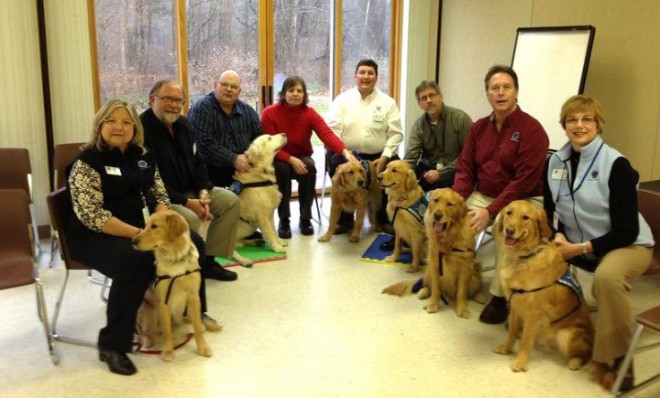
The K-9 Parish Comfort dogs (and their handlers) who helped the residents of Newtown, Conn., through their grief.
If you’re reading this, then you’re probably aware: Dogs rule. This year, a handful of canines rose above the rest, making headlines for their actions — whether facing imminent danger to save lives, enduring unimaginable physical hardships, or simply making us laugh. A look at nine of the year’s most newsworthy pups:
1. Chicago’s comfort dogs After the unimaginable events that befell Newtown, Conn., on Dec. 14 that left 27 people, including 20 children, dead at the hands of suspected gunman Adam Lanza, a team of golden retrievers was deployed from Chicago to the picturesque town. About 10 specially trained dogs, including Chewie, Ruthie, and Luther, made the 800-mile journey to sit with children and adults during masses and funerals. “Dogs are nonjudgmental. They are loving. They are accepting of anyone,” says one handler. “It creates the atmosphere for people to share.” The Chicago comfort dogs are notable not only for this caring venture but also for helping those who suffered through Hurricane Sandy and the tornado that hit Joplin, Mo., in 2011.
The next story was about the puppies that kept a lost boy warm.
That was followed by the hero dog that lost its snout saving two girls.
One dog’s heroism so disfigured her sweet little face that her photo is often preceded by a warning. This canine’s story started with a motorcycle careening through the streets of Zamboanga City, Philippines, earlier this year. Young cousins Dina Bunggal, 11, and Princess Diansing, 3, stepped unknowingly into its path. A mutt named Kabang came out of nowhere and jumped in front of the motorbike, stopping it in its tracks, and saving the little girls from serious injury. The driver and the girls emerged with superficial wounds, but Kabang wasn’t so lucky. Her head landed on the motorcycle’s front wheel and as the wheel rolled forward, Kabang’s upper snout was ripped right off. Her story quickly went viral and when local doctors could do no more to help her, specialty surgeons from the University of California, Davis, flew Kabang to their facilities, where she’ll endure six to eight weeks of treatment to repair her face. The cost of her surgeries, which could top $20,000, will be covered by her many supporters who have started an online fundraising campaign.
Vets at William R. Pritchard Veterinary Medical Teaching Hospital don’t plan to fullyy reconstruct Kabang’s snout, or fit her with a prosthetic. Instead, they are attempting to close the gaping wound on her face, preventing further infections.
Then my last dip into Lauren’s article is dog story eight.
8. The dog that saved its own life by calling the police
We’ve often heard the tale of the puppy that proves its “man’s best friend” status by saving its owner’s life. But this year, there was George, a 2-year-old basset hound in West Yorkshire, England, who reworked the well-worn script a bit, literally calling for help to save himself. Home alone, George had knocked the phone to the floor and was strangling himself with the handset’s cord when he apparently dialed 999 — England’s 911 equivalent — in a panic. The operator heard only frantic gasps and, assuming someone was desperately sick or reeling from an attack, sent police to the house. The dog was found and rescued from the cord. “Incredibly, you could see where his paw print was on the phone,” said the neighbor, “he literally saved his own life.”
Now, what fun-loving toddler can walk past a puddle without stopping for a little splash? Not this one!
Little Arthur was out for a stroll with his best mate, Watson the dog, when he noticed a tempting puddle. So he put down the leash and plunged straight in. And Watson? Well, he’s a more mature 12 years old, so he didn’t partake himself. But he was more than happy to wait while Arthur had his fun.
You know what this video is, don’t you? That’s right. Too. Cute. For. Words.
Here’s the video, seen over 4,800,000 times!
Finally, there’s the beautiful story of the dog befriending a Down’s Syndrome boy.
So what does this all add up to? That the qualities of the dog; integrity, unconditional love, patience, loyalty, and their ability to live in harmony with nature really do send us humans a message for the future.
PUBLISHED: 19:45 EST, 9 January 2013 | UPDATED: 02:56 EST, 10 January 2013
Was there ever a government quango quite so useless as the Met Office?
From its infamous ‘barbecue summer’ washout of 2009 to the snowbound winter it failed to predict in 2010 and the recent forecast-defying floods, our £200 million-a-year official weather forecaster has become a national joke.
But of all its recent embarrassments, none come close to matching the Met Office’s latest one.
Without fanfare — apparently in the desperate hope no one would notice — it has finally conceded what other scientists have known for ages: there is no evidence that ‘global warming’ is happening.
Needless to say the UK Met Office published a detailed rebuttal. One of the comments that I spotted following that rebuttal was this lovely one from MD Dalgleish:
The Daily Mail does not let the facts get in the way of a story! Nothing new there, they’ve been doing that since before the war. What baffles me is why so many people buy this paper.
Quite so!
It would all be a bit of a laugh if it were not for what follows.
Last Friday, Naked Capitalism, the fabulous blog run by Yves Smith published in her set of links this item, “Climate change set to make America hotter, drier and more disaster-prone.” Newly living here in Southern Oregon, that obviously caught my eye!
The item referred to a detailed account in the British Guardian newspaper by Suzanne Goldenberg, the newspaper’s US Environment Correspondent.
Climate change set to make America hotter, drier and more disaster-prone
Draft report from NCA makes clear link between climate change and extreme weather as groups urge Obama to take action
The report says steps taken by Obama to reduce emissions are ‘not close to sufficient’ to prevent the most severe consequences of climate change. Photo: Saul Loeb/AFP
Future generations of Americans can expect to spend 25 days a year sweltering in temperatures above 100F (38C), with climate change on course to turn the country into a hotter, drier, and more disaster-prone place.
The National Climate Assessment, released in draft form on Friday , provided the fullest picture to date of the real-time effects of climate change on US life, and the most likely consequences for the future.
The 1,000-page report, the work of the more than 300 government scientists and outside experts, was unequivocal on the human causes of climate change, and on the links between climate change and extreme weather.
“Climate change is already affecting the American people,” the draft report said. “Certain types of weather events have become more frequent and/or intense including heat waves, heavy downpours and in some regions floods and drought. Sea level is rising, oceans are becoming more acidic, and glaciers and Arctic sea ice are melting.”
Here’s a pithy question for Mr. James Delingpole of The Daily Mail, “Which part of this sentence are you having trouble with – The 1,000-page report, the work of the more than 300 government scientists and outside experts, was unequivocal on the human causes of climate change, and on the links between climate change and extreme weather.?” [my emphasis]
Suzanne goes on to say:
The report will be open for public comment on Monday.
Environmental groups said they hoped the report would provide Barack Obama with the scientific evidence to push for measures that would slow or halt the rate of climate change – sparing the country some of the worst effects.
The report states clearly that the steps taken by Obama so far to reduce emissions are “not close to sufficient” to prevent the most severe consequences of climate change.
“As climate change and its impacts are becoming more prevalent, Americans face choices,” the report said. “Beyond the next few decades, the amount of climate change will still largely be determined by the choices society makes about emissions. Lower emissions mean less future warming and less severe impacts. Higher emissions would mean more warming and more severe impacts.”
As the report made clear: no place in America had gone untouched by climate change. Nowhere would be entirely immune from the effects of future climate change.
One might argue that it won’t be very long before no sane person on this planet would swallow that crap from The Daily Mail. But when we get to that stage of every person being aware of the forces at work upon our fair planet it will be a tad too late.
The only home we have.
That’s why this report is to be encouraged, nay embraced. Of all the nations in the world, the one that should be setting the lead is the United States of America. As the banner on that globalchange.gov website proclaims: Thirteen Agencies, One Vision: Empower the Nation with Global Change Science
So go and read the report. For your sake and all our sakes.
Because the more informed you and I are, the better the chances of real political leadership taking place in this fine nation.
Download Chapters of the NCADAC DraftClimate Assessment Report!
Download the Full Report (warning, 147Mb. Very large file)Between chapters, there are some page numbers that are not used. This is intentional and does not reflect missing pages.or download each chapter separately:
Yesterday, Jean and I went across to our neighbour’s ranch to collect two miniature horses, Dancer and her daughter Grace. Jean was a keen horsewoman many years ago and when we became aware that our neighbour, Margo, was also a keen horse breeder, trainer and coach, the lure of getting two horses was too much! Two miniature horses seemed the perfect idea.
So just a few pictures to share the event.
Ready to leave
Jean is holding Dancer while Grace is waiting by the fence. Our original plans had been to take Dancer’s sister’s foal Allegra, but she was too stressed to leave her mother so soon; she is just six months old. As an interim, we borrowed Grace, Dancer’s last foal, until Allegra is ready to move homes.
Off we go
For Grace especially, the horse being led by Margo, this was quite an adventure, as the next photograph demonstrates.
Mummy, do I really have to cross this stream?
Then before they knew it, their new enclosure beckoned.
Welcome to your new home.
Jean opens her heart to the latest member of the Handover family!




















 Learning from Dogs