Year: 2013

Be in grace.

In memory of my elder sister, Corinne Grace Joiner, nee Handover, who died peacefully in her sleep at 7am yesterday, UK time.

The following video was sent to me a few days ago by John Hurlburt before me hearing the sad news of my sister’s graceful release from extreme dementia.  The video seemed a most fitting tribute to Corinne who was a loving friend to me for well over 60 years.

Published on May 5, 2012

Video by Scott Mckinley Productions, Produced for Rocky Mountain Elk Foundation for Ad campaign. Licensed music by Kenny G.. This short video won Best of Category at the International Wildlife Film Festival in Missoula Montana! The majority was shot on location in Yellowstone National Park, Grand Teton National Park and The National Elk Refuge in Jackson Hole, Wyoming.

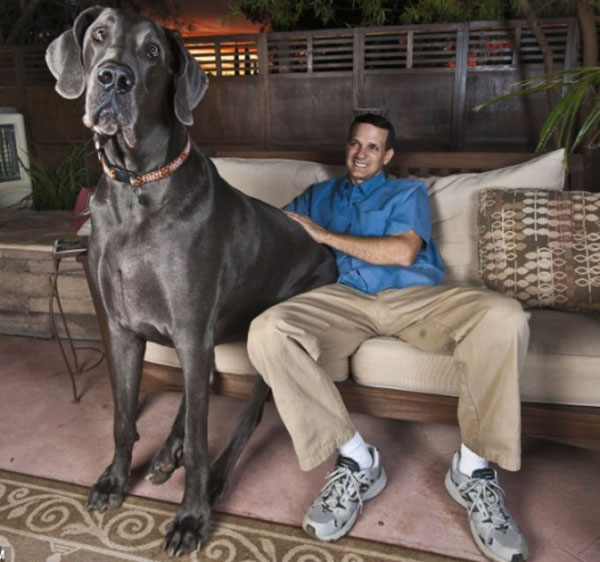
Now this is a dog!

Kindly sent to me by Chris Snuggs.

bigdogCS

Great Dane – Giant George.

With a spot in the Guinness World Records, George weighs 245 lbs (111 kg) and consumes

over 110 lbs (50 kg) of dog kibble a month.

The perils of self-reinforcing arguments.

Professor Mark Cochrane’s perspective on ‘certainty’!

I’m an avid follower of Mike Stasse’s blog Damn the Matrix.  So it was rather fortuitous that two days ago there was a guest post on Mike’s blog from Mark Cochrane. Dr. Mark Cochrane is a Senior Scientist and Professor at South Dakota State University where one can read:

Dr. Mark Cochrane conducts interdisciplinary work combining ecology , remote sensing, and other fields of study to provide a landscape perspective of the dynamic processes involved in land-cover change. He is an expert on wildfire, documenting the characteristics, behavior and severe effects of fire in tropical and temperate forests that are inherent to current systems of human land-use and management. His research focuses on understanding spatial patterns, interactions and synergisms between the multiple physical and biological factors that affect ecosystems. Recently published work has emphasized the climate change, human dimensions of land-cover change and the potential for sustainable development.

The guest post was called Doom and Denial two sides of the same coin; I’m extremely grateful to Mike Stasse for granting me permission to republish the essay.

oooOOOooo

Doom and Denial two sides of the same coin.

19th June 2013

Another guest post by Mark Cochrane……  and I hope Guy reads this, I’d like his feedback, no pun intended!

Mark CochraneMark Cochrane

I’ve been asked by several people to address the take of climate ‘doomists’ like McPherson and indicate how my views on what the science indicates differ. First, let me just say that my differences with the doomist views are similar to my differences with the ‘denialist’ views, namely one of actually examining the scientific findings and concluding what they signify versus beginning with a conclusion and looking for evidence to support a pre-concluded viewpoint.

Appropriate use of science (or any information), requires weighing anything being newly reported against the rest of the accumulated evidence on a subject (e.g. climate change) that we have amassed, to date, and using this knowledge to infer the most probable meaning and significance. How credible is the source, how relevant are the results to the larger question, do the new results substantially change our previous understanding? If someone is presenting new ideas that claim to massively shift what we think we know about the world, have they been vetted (e.g. peer-reviewed), do they adequately explain how their new claims better explain observed phenomena than previous studies did and also detail why previous explanations were somehow erroneous? If the results are truly stunning, can they be replicated by others? Although some may find it hard to believe, there is a lot of space between climate denial and climate doom.

I’ve only seen the one talk now by McPherson but where the ‘we are doomed and soon’ meme falls apart is on general logic. You cannot say, there are positive feedbacks A, B and C, therefore life on Earth is suddenly going to end without considering:

  1. what are the current rates of those feedbacks,
  2. what is the rate of change for the feedback,
  3. what is the area affected by the feedback,
  4. what natural limits exist for the feedback,
  5. what negative feedbacks might occur in response?

If you listen to McPherson’s talk, what you get is a litany of disturbing findings, especially feedbacks, and then an expectation that you must reach the same conclusion that we are doomed, and soon. If someone would like to outline the chain of logic used, I’d be happy to discuss it. Even if you accept the chain of logic though, where, in any of it, is there evidence for the timeline being suggested?

Guy McPherson

There is considerable amount of concern about the feedbacks in the Arctic, with good reason, but people do things like linking the large amount of carbon stocks in the Arctic with rapid warming, with increased rates of release, with increased rates of warming……with the obvious end of all life on Earth – near-term extinction!

As anyone who has followed this thread knows, I am usually the one pointing out feedbacks and how most are not even included in current climate projections, in contradiction to those who claim such dire projections are all because of such feedbacks (which ‘skeptics’ claim don’t exist). This does not mean though that the existence of feedbacks means that we can then make the leap to a runaway greenhouse that will soon lead us to having the climate of Venus (atmospheric acid bath at temperatures that would melt lead). Perhaps providing some perspective on the recent material posted about the NASA CARVE project and what it means for all of that carbon in the (not so) permafrost will help.

As NASA recently reported (site),

“Over hundreds of millennia, Arctic permafrost soils have accumulated vast stores of organic carbon – an estimated 1,400 to 1,850 petagrams of it (a petagram is 2.2 trillion pounds, or 1 billion metric tons). That’s about half of all the estimated organic carbon stored in Earth’s soils. In comparison, about 350 petagrams of carbon have been emitted from all fossil-fuel combustion and human activities since 1850. Most of this carbon is located in thaw-vulnerable topsoils within 10 feet (3 meters) of the surface.”

“Permafrost soils are warming even faster than Arctic air temperatures – as much as 2.7 to 4.5 degrees Fahrenheit (1.5 to 2.5 degrees Celsius) in just the past 30 years,” Miller said. “As heat from Earth’s surface penetrates into permafrost, it threatens to mobilize these organic carbon reservoirs and release them into the atmosphere as carbon dioxide and methane, upsetting the Arctic’s carbon balance and greatly exacerbating global warming.”

In other words, there is 4-5 times as much carbon sitting around in those frozen soils as we have already emitted that are becoming increasingly vulnerable to being thawed out for a portion of each year.

Once those soils thaw they become accessible to microorganisms that feed on the incompletely decomposed plant materials that they contain. If there is sufficient oxygen (warm relatively dry Arctic) the process is faster and the product is CO2, if the process is anaerobic (warm relatively wet Arctic), then the product is methane.

So warming leads to thawing, thawing leads to microbial decomposition, and microbial activity leads to carbon emissions. These emissions are a positive feedback that makes the current process of greenhouse gas warming worse since each degree of warming yields more greenhouse gases that speed up the warming process further. This is where the message of doom goes off the tracks and extrapolates erroneously that this somehow means that all of that carbon is going to suddenly find itself in the atmosphere.

Three meters (10ft) of soil carbon doesn’t just suddenly evaporate into the atmosphere in the next few years. Thawing permafrost is not synonymous with melting carbon.  Even once permafrost melts, it is still very cold. However, bacteria can start digesting it – until it freezes again. Melted permafrost does not mean permanently melted. The surface layer of the Arctic lands are already in the active layer that temporarily thaws each year and then refreezes. Now, we are making more of the Arctic soil active to greater depths and at higher latitudes. This means that there will be more emissions from those soils.

Taken out of context snippets like this (below) from that NASA press piece can be made to sound catastrophic.

“Some of the methane and carbon dioxide concentrations we’ve measured have been large, and we’re seeing very different patterns from what models suggest,” Miller said. “We saw large, regional-scale episodic bursts of higher-than-normal carbon dioxide and methane in interior Alaska and across the North Slope during the spring thaw, and they lasted until after the fall refreeze. To cite another example, in July 2012 we saw methane levels over swamps in the Innoko Wilderness that were 650 parts per billion higher than normal background levels. That’s similar to what you might find in a large city.”

Parsing the quote, please note that “episodic bursts of higher-than-normal carbon dioxide and methane” in two locations (regions) does not mean the end is nigh. Higher-than-normal is just that, but how much higher and how long did it last? The scientists are saying that the observations do not match existing ‘models’ (models are wrong, a favorite meme), it doesn’t mean that such events haven’t been happening up until now (only that we didn’t know about them). As for the 650ppb increase over a swamp, that equates to being 1/3 higher than the background level. Methane and swamps go together so some higher level is to be expected. The question is if and by how much 650ppb is higher than it would have been back around 1980 or so? If it used to be 10ppb higher than background then you have a big change (640ppb), however, if it used to be 640ppb, then not so much (10ppb difference). Even if that is all new carbon being emitted, the local change becomes very small when diluted globally. The point here is not to poo-poo the findings or the scientist’s work, they are doing very important stuff (!), it is to provide context.

Just how bad could things be? I do not work in the high Arctic but I do work in similar organic soils in the tropics (peat swamps) where, because of intentional draining, the several meter thick peat layer that is ‘active’ is increased in an analogous manner to the effects of melting permafrost. Microbial degradation is occurring, with the difference that the temperature is very warm instead of being very cold. Think of how fast fruit spoils in your refrigerator versus on a hot window sill. In these tropical peat soils we see large amounts of CO2 coming off into the atmosphere each year now, but even with such large rates of loss, this equates to taking about 20-25 years to lose 1 meter of organic soil. In the Arctic the microbial degradation will be much slower due to the relatively low temperatures. This doesn’t mean that it is not important. Slow rates of emissions over a large area is still a lot of extra carbon going into atmosphere but this is a problem that is going to take centuries to play out, not less than a decade. It makes things worse but it doesn’t suddenly end life on Earth.

Incidentally, all of that soil carbon in the Arctic isn’t a uniform petri dish either. Some of that carbon is easier to access by bacteria than other portions. Emissions will rise quickly as the bacteria chew through the cellulose, for example, but things like lignin get left behind. The point being that even for a given mass of carbon in the ‘active’ layer, there will be a dampening of the emissions growth rate as the quality of the bacteria buffet goes down when it gets picked over.

I do not pretend to know what the motivations of ‘doomists’ are, whether it be honest despair or simple misunderstanding but they are conveying the same message of do nothing as those who deny the existence or importance of climate change. Denial = don’t worry be happy, while Doom = don’t worry, you can’t do anything about it anyway. Both viewpoints are wrong in trying to turn climate change into a false dichotomy of either fantasy or inevitability. Both the science and our choices are much more complicated. It’s uncomfortable but your choices do matter now and for generations to come. There is no ‘fixing’ things at this point but you still have the ability to choose how you react to the predicament we have created. Doom and denial are respectively trying to tell you that you either have no choice or no need to choose. But, as Philip K. Dick wrote:

“Reality is that which, when you stop believing in it, doesn’t go away.”

oooOOOooo

Summer solstice

As old as time itself!

holding-the-sun

The point at which the sun reaches its farthest point north of the equator is the Summer Solstice, well it is for the Northern Hemisphere. This occurs annually on June 20 or June 21, depending on your time zone.

Here in Southern Oregon, the moment of the Summer Solstice will be 22:04 Pacific Daylight Time (PDT) on the evening of June 20th and at 05:04 GMT/UTC on June 21 2013 in the United Kingdom.

A quick web ‘look-up’ finds that the word solstice is from the Latin solstitium, from sol (sun) and stitium (to stop), reflecting the fact that the Sun appears to stop at this time, albeit momentarily.

At the ancient stone circle of Stonehenge in Southern England, the prehistoric monument that took Neolithic builders an estimated 1,500 years to erect, for many years the Druids have celebrated the Solstice and, undoubtedly, will be doing so again.

AMESBURY, UNITED KINGDOM - JUNE 21:  A man stands on top of Stonehenge as the sun rises over Salisbury Plain on June 21, 2006 in Amesbury, England.  Police estimated around 17,000 people travelled to watch the sun rise ove the 5,000 year old stone circle to start the longest day of the year. The all-night party to celebrate the Summer Solstice passed with only four arrests being made. (Photo by Daniel Berehulak/Getty Images)
AMESBURY, UNITED KINGDOM – JUNE 21: A man stands on top of Stonehenge as the sun rises over Salisbury Plain on June 21, 2006 in Amesbury, England. Police estimated around 17,000 people travelled to watch the sun rise over the 5,000 year old stone circle to start the longest day of the year. (Photo by Daniel Berehulak/Getty Images)

AGW – summing up.

“If there’s any doubt, there’s no doubt!”

I opened the first post on Monday with the sub-heading: “Certainty is perfect knowledge secure from error or doubt.” going on to write that, “Whatever your views on the effect of man’s behaviours on our planet’s climate, it’s a long way from the logical idea of ‘2 + 2‘!”

Within that very strict definition, I remain unmoved.  The argument that mankind is the cause of the present change in the climate of Planet Earth is not certain!

However, if only life was that simple! The change in our planet’s atmosphere is possibly the most emotionally-laden topic of all time.  For some reason that quotation attributed to Hiram Johnson comes to mind, “The first casualty when war comes is truth.” because the supporters and deniers of AGW are engaged in what amounts to a verbal war.

Each side can draw on much information.

For example, a very recent article in The New York Times by their Justin Gillis offered this:

The rise in the surface temperature of earth has been markedly slower over the last 15 years than in the 20 years before that. And that lull in warming has occurred even as greenhouse gases have accumulated in the atmosphere at a record pace.

The slowdown is a bit of a mystery to climate scientists. True, the basic theory that predicts a warming of the planet in response to human emissions does not suggest that warming should be smooth and continuous. To the contrary, in a climate system still dominated by natural variability, there is every reason to think the warming will proceed in fits and starts.

But given how much is riding on the scientific forecast, the practitioners of climate science would like to understand exactly what is going on. They admit that they do not, even though some potential mechanisms of the slowdown have been suggested. The situation highlights important gaps in our knowledge of the climate system, some of which cannot be closed until we get better measurements from high in space and from deep in the ocean.

As you might imagine, those dismissive of climate-change concerns have made much of this warming plateau. They typically argue that “global warming stopped 15 years ago” or some similar statement, and then assert that this disproves the whole notion that greenhouse gases are causing warming.

Rarely do they mention that most of the warmest years in the historical record have occurred recently. Moreover, their claim depends on careful selection of the starting and ending points. The starting point is almost always 1998, a particularly warm year because of a strong El Niño weather pattern.

Dan Gomez, a long-time friend of over 40 years and a regular contributor to items on Learning from Dogs, wrote in a recent email,

I’m not sure what is meant by “believer”, Paul.  The Universe unfolds as it should.  Because many have been led to “believe” that AGW is inevitable and that all the facts are the ‘Truth”, we’ve created a religious substitute, almost a new “industry” with significant “tithing” obligations, etc. (e.g. Cap and Trade). Presumptions and facts are being manipulated to fulfill the prophecy.

Interesting to note in our daily lives, that weather prediction is very good 24-36 hrs out.  This drops precipitously just a few days out.  More than 7-10 days is nearly impossible. Even though both Europe and the USA have decreased CO2 levels by multiple percentage points over the last 20 years, the rest of the world does not care and the impact is very problematic.  Recently, CO2 gas has increased overall but heat has not. In the past, warming has occurred followed by CO2 levels increasing. Global politics and redistribution of wealth schemes continue to interfere with common sense.

Let’s just deal with the facts as Science reveals its secrets. New information is discovered every day about the interaction of the  Earth/Sun/Atmosphere/Lithosphere/Hydrosphere. New information is learned every day about the Universe.  These are not closed subjects. Climatology, meteorology, geology and solar system dynamics will continue to shape the Earth’s future for millennia to come whether Man is involved or not.

There is much in what Dan writes that has me nodding my head; stimulates my recollection of what Luther Haave and Derek Alker wrote in 2009:

With the explosion of knowledge, particularly in the past 100 years, each of us has found it a requirement for being successful, and to being able to earn a living, to concentrate our knowledge in an ever increasingly narrow field. Just as we have come to expect others to defer to our expertise in our narrow area, we have come to assume that we need to defer to others who have a deeper comprehension of seemingly complex topics such as the science related to climate change. [Apologies, can’t find the web link for this.]

However, if we broaden the perspective from that tight definition of certainty to an analysis of probabilities, then it all changes for me and I can embrace the views so strongly put forward by Martin Lack.

For example, Martin left a comment on Monday, “ACD is not a matter of opinion or belief; it is a matter of probability. As such, all that matters now is the extremely high probability that the scientific consensus is real, reasonable and reliable.”  That comment included a link to a discussion on the website Skeptical Science, Is the science settled? Let me quote from that:

Some aspects of the science of AGW are known with near 100% certainty. The greenhouse effect itself is as established a phenomenon as any: it was discovered in the 1820s and the basic physics was essentially understood by the 1950s. There is no reasonable doubt that the global climate is warming. And there is also a clear trail of evidence leading to the conclusion that it’s caused by our greenhouse gas emissions. Some aspects are less certain; for example, the net effect of aerosol pollution is known to be negative, but the exact value needs to be better constrained.

What about the remaining uncertainties? Shouldn’t we wait for 100% certainty before taking action? Outside of logic and mathematics, we do not live in a world of certainties. Science comes to tentative conclusions based on the balance of evidence. The more independent lines of evidence are found to support a scientific theory, the closer it is likely to be to the truth. Just because some details are still not well understood should not cast into doubt our understanding of the big picture: humans are causing global warming.

In most aspects of our lives, we think it rational to make decisions based on incomplete information. We will take out insurance when there is even a slight probability that we will need it. Why should our planet’s climate be any different?

That, ultimately, delivers for me what truly counts.

I am not a scientist; just a Brit living in Southern Oregon trying to make sense of the world while I still have a functioning head and body – time is not on my side! 😉  The powerful common-sense in the sentence, “Outside of logic and mathematics, we do not live in a world of certainties.” is beyond argument.

In the year 2012, the total number of passengers carried by US Airlines and other carriers in and out of the USA was a staggering 815 million people. 815,000,000 people!

Remember the sub-heading from the start of this post!  “If there’s any doubt, there’s no doubt!” Years ago I heard that from Bob Derham, a long-time friend and a commercial airline Captain since the time God was a boy!  It’s that cautious, safety-focused attitude that has made airline transport such an amazing mode of transport for all those millions of passengers.

Should we not travel with the same cautious, safety-focused attitude on the ‘vehicle’ that carries every man, woman and child; every animal, plant and living thing: Planet Earth!

The answer is obvious – more than obvious!

AGW certainty, Part Two

Continuing the examination of two views on AGW.

Readers will recall that this post opened yesterday.  That Part One closed with Martin writing this:

Martin Lack

Much of what Oakwood writes is an attack upon the Hockey Stick graph of palaeoclimatic temperature reconstructions first produced in 1998 (MBH98).

However, the fatal flaws in Oakwood’s scepticism regarding MBH98 are as follows:

  1. MBH98 has been validated by at least 14 other reconstructions (as cited in IPCC AR4 in 2007) using a wide variety of other proxy data(see Wikipedia for relevant links)
  2. Hockey Stick-shaped graphs turn up in reconstructions of CO2 levels and temperature – now going back over thousands of years – because they are not ‘statistical noise’ –
  3. Arguments about splicing instrumental data onto proxy data only serve to challenge the extent to which the speed of late 20th Century warming is unprecedented.
  4. Such arguments do not invalidate the conclusion that it is now almost certainly warmer than it has been at any time since the last Ice Age (i.e. a period of relative climate and sea level stability that has made agriculture, urbanisation and civilisation possible).

However, this is no reason for us to be complacent because, as Oakwood must know, the 50 to 100 metres of sea level rise that will be caused by the melting of terrestrial ice sheets will necessitate the mass migration of millions of people. This makes his concerns about current poverty and starvation (i.e. the main reason he eventually cites for not believing action is yet necessary) look very trivial indeed.

So continuing ….

Oakwood

The argument that the ‘divergence problem’ does not bring into question proxy studies is just one example of supposed ‘settled’ evidence in the case for AGW. There are others which collectively bring down the case to one of opinion.

Martin Lack

After a lengthy attempt to assert that the “hide the decline” controversy was or is significant, Oakwood eventually moves onto attack the significance of MBH98; and to claim that ACD is no more than a matter of opinion. It is only possible to reach this conclusion by dismissing the majority of climate scientists as being stupid, sloppy, or sinister.

Oakwood

Here are a few others:

  • Mann et al’s original hockey stick (1998) (as well as a number of other studies) shows an unprecedented temperature rise in the first half of the 20th century, a temperature change that most climate scientists believe can be explained by natural phenomena, such as the Sun (while failing to reproduce the man-made rise in the 2nd half of the century, due to the divergence problem explained above).

Martin Lack

However, Climategate and, more especially Climategate 2.0 merely served to demonstrate how deliberate and organised are the attempts to discredit climate science and derail international attempts to tackle the ACD problem.

Oakwood

Thus, we are expected to believe there was both an unprecedented NATURAL temperature rise and unprecedented MAN-MADE rise in the same century. Not impossible, but statistically highly unlikely.

Martin Lack

Oakwood suggests that assertions about early 20th Century warming are statistically highly unlikely (i.e. that climate scientists are stupid to make them). However, the real statistically highly unlikely suggestion is that 30 years of monthly average temperatures exceeding their long-term average values could be a consequence of natural variation. Unlike early 20th Century warming, this is definitely not capable of being explained by natural causes (such as cyclical solar activity or random volcanic eruptions).

Oakwood

  • The ‘record’ (in just 35 years) of minimum summer ice in the Arctic is repeatedly presented as evidence for impending doom. However, the record MAXIMUM ice cover in the ANTarctic, at the same time, is dismissed with ‘we have another explanation for that’.

Martin Lack

Trying to shift the focus away from the accelerating rate of ice loss in the Arctic is very lame indeed. The Arctic is surrounded by land and (now) increasing amounts of warming water. The reasons for the ice loss are well understood and it is happening faster than was predicted even 5 years ago. The Antarctic is surrounded by a huge expanse of cold ocean and is also being kept cold by the human caused hole in the ozone layer. The reasons why its ice is not melting so fast are therefore also well understood. In addition, it should be noted that the Antarctic Peninsula is the fastest warming place in the southern hemisphere.

Oakwood

  • Whatever the weather, blame global warming. A few years ago, milder winters and earlier springs in the UK were hailed as evidence of AGW. But now we get lots of snow, and appalling spring, cooler summers, etc, and guess what, its due to global warming.
  • Hot/dry weather and floods around the world are routinely highlighted as ‘more evidence’ whereas as cold weather extremes and records are dismissed as ‘just natural variation’ – again, and again and again.

Martin Lack

Oakwood‘s remarks about extreme events are also very misleading. The number of records being broken for hot and/or dry events is many times greater than the number of records being broken for cold and/or wet events. As Hansen et al explained last year, in their review of historical data for the last five decades, natural variability does not explain the steady shift in average temperatures and the broadening of the range of conditions experienced in any one place.

I really can’t believe that Oakwood is so parochial in his outlook that he dares to mention the cold weather the UK has experienced recently. We may have had the coldest Spring for 50 years, but, that does not change the fact that global average temperatures are still the highest ever in recorded history. Furthermore, it does not change the fact that the analysis of Hansen et al (2012) continues to be validated by events such as those in Central Europe at the moment – where 1 in 100 year flood events have recurred after only 10 years. Not impossible – just statistically highly unlikely.

Oakwood

Those who highlight the lack of rising temperature for the past 10-15 years are routinely dismissed as deniers and liars. We’re told, ‘but the last decade is the warmest in a 100 years’. No-one disputes that. Given the world warmed by 0.8 degC in 100 years, that’s perfectly reasonable, and is not a defence against the fact that warming has at least paused.

  • We’re told: ‘but the heat is going into the ice caps and the deep oceans and atmospheric heat is just a small percentage of the total’, How convenient. In the 1980s and 1990s, atmospheric temperature was enough for ‘proof’ of serious AGW. We didn’t hear anything about ocean heat then. No-one suggested that perhaps the warming was due to a release of previously ‘hidden’ ocean heat. Or that we shouldn’t read too much into a small atmospheric temperature rise.
  • We see again and again, whatever happens, whatever the data show, the theory is revised to ‘show’ that nothing has changed. This is simply not plausible science.
  • We’re told, the physics of CO2-induced global warming is just that, ‘physics’, and we can’t change that however much we dispute it. No-one disputes the physics. But, the atmosphere (believe it or not) is very complicated. We have the physics that says aerosols reflect the Sun’s heat, that clouds may increase and also reflect more heat. We now hear the relationships with the oceans is very important (which we didn’t hear before). Thus the debate is not about the reality of the CO2-global warming physics. Its about the sensitivity of the system and which physical phenomena will dominate.

Martin Lack

Given the massive inertia in the climate system (which guarantees decades of future temperature rise even if CO2 emissions were completely halted today), there is no reason for us to be complacent about the fact that we have only seen a rise of 0.8C since the Industrial Revolution. The scientific consensus remains that equilibrium climate sensitivity is somewhere in excess of 2C and that such a rise in temperature will not be good for the vast majority of life on Earth. On the evidence of the ACD that we are already experiencing, I think there is very good reason to agree with that conclusion.

Again, I am astonished that Oakwood even dares to mention the ‘global warming has stopped’ canard. This misconception has been debunked so many times; there are even debates about who has written written the best rebuttals.  Here is a summary: Whilst surface warming may have paused, the warming of the ocean (which is driving the increased frequency of extreme weather events of all kinds) has continued. Given that oceans cover two thirds of the Earth’s surface, is this something really worth arguing about?

Climate scientists are therefore not changing their story to accommodate inconvenient new data. Only climate change sceptics do that. The only implausible science on offer today is that which seeks to explain all the data without acknowledging that CO2 is the main driver. Sure, CO2 does not explain everything but, you cannot explain all the data unless the primacy of CO2 is accepted.

Oakwood

Some will respond: ‘but all of these arguments have been debunked many times’. All they really mean is another opinion or speculation has been given by an AGW believer. Nothing wrong with these, but don’t claim they represent settled science.

Martin Lack

However, I should like to re-iterate the importance of the recently-published results of investigations at a lake in the NE of Arctic Russia. What this new 3.6 million year continuous palaeoclimatic record tells us is that current warmth is not unprecedented (if you go back to an era in which humans did not exist – 400 or 1,100 thousand years ago). This demonstrates that good scientists do not change their story when they get unexpected results.

Oakwood

I have no problem with scientists believing in AGW and believing it a serious threat. But when so much of their case is based on weak arguments, I do have a problem with claiming the case is ‘settled’ and that anyone who questions or challenges it is a liar, denier, conspiracy theorist, etc.

Both sides of the debate have their extremists and nutters. My interest is in the rational middle ground. To suggest an ‘eccentric’ like Christopher Monckton is ‘typical’ of all AGW-sceptics is just like claiming all Conservative voters are fascist and all Labour voters communist. It has no place in informed and educated debate.

Martin Lack

Oakwood claims arguments for concern over ACD are “weak” but, in making this assertion, the only information he has referred to is very much out-of-date (such as IPCC AR4 in 2007). Oakwood moves on to discuss unhelpful labels such as “liar” and “denier”.

I do not think I have ever suggested that anyone who professes to be ‘sceptical’ is lying. However, I do think that, just like the tobacco executives whose ‘modus operandi’ they are copying, the executives of fossil fuel companies know more than they care to admit. There is also a great deal of evidence to indicate that climate change ‘scepticism’ is in fact being driven by unscientific economists aided in their anti-science cause by a handful of friendly scientists who tell them what they want to hear. This is not scepticism, it is ideological prejudice.

Oakwood

The term “denier” was introduced with the intention of associating AGW-sceptics with Holocaust Deniers. That is to say, AGW-sceptics are putting millions of lives at risk through their lies and ignorance. Given the weakness of the AGW case, the use of the labels ‘denier’, ‘deny’, denial’ seems to represent an insult to every victim of the Holocaust.

Martin Lack

I agree that use of the term ‘denier’ is generally not helpful, but, given all the evidence that conflicts with their position, I do think that those who remain ‘sceptical’ about the primary cause of ongoing climate change are being irrational. If your beliefs require you to dismiss any and all evidence that conflicts with them, that is not scepticism, it is wilful blindness; it is what Young Earth Creationists have to do in order to protect themselves from wicked and ungodly scientific ideas.

Therefore, even if Oakwood does not do it, many who are ‘sceptical’ do rely upon conspiracy theories to dismiss all the evidence that conflicts with their beliefs. This includes dismissing most scientists as stupid, sloppy or sinister.

Oakwood

And why is it not time to act now? I am an environmentalist and see many environmental and social problems that need addressing. In particular, the need for ‘sustainability’ in all we do. There remain millions dying each year from such things as malnutrition, lack of safe drinking water, malaria, etc.

These are hard facts with zero room for any doubt. Given the weakness in the AGW-case, it is not a priority. I see some benefits in acting. For example, in many cases a reduction in CO2 emissions leads to much improved energy-efficiency, and less pollution. However, the case is not made for diverting money and effort from the more immediate priorities, covering pristine countryside in wind farms to satisfy urban energy demands, or using more biofuels at the expense of more hunger.

Martin Lack

Having wasted so much time trying to falsify MBH98, Oakwood finally gets round to the important bit of my question: Why does he think the time to act has not yet arrived?

Failing to address the point that a wide range of industrial, political and economic organisations now agree that it is time to act, Oakwood opts instead to simply re-state his belief that attempts to mitigate the ACD problem will do more harm than good. All the evidence I have seen suggests that he is mistaken. To-date, I think the most compelling evidence is that contained in the IIED’s 2009 report , ‘Assessing the costs of Adaptation to Climate Change: A review of UNFCCC and other recent estimates’ (PDF available here), which begins with the following very sobering executive summary:

Several recent studies have reported adaptation costs for climate change, including for developing countries. They have similar-sized estimates and have been influential in discussions on this issue.

However, the studies have a number of deficiencies which need to be transparent and addressed more systematically in the future. A re-assessment of the UNFCCC estimates for 2030 suggests that they are likely to be substantial under-estimates. The purpose of this report is to illustrate the uncertainties in these estimates rather than to develop new cost estimates, which is a much larger task than can be accomplished here.

The main reasons for under-estimation are that: (i) some sectors have not been included in an assessment of cost (e.g. ecosystems, energy, manufacturing, retailing, and tourism); (ii) some of those sectors which have been included have been only partially covered; and (iii) the additional costs of adaptation have sometimes been calculated as ‘climate mark-ups’ against low levels of assumed investment. In some parts of the world low levels of investment have led to a current adaptation deficit, and this deficit will need to be made good by full funding of development, without which the funding for adaptation will be insufficient. Residual damages also need to be evaluated and reported because not all damages can be avoided due to technical and economic constraints.

There is an urgent need for more detailed assessments of these costs, including case studies of costs of adaptation in specific places and sectors.

Oakwood

Thus, belief in AGW is not a simple moral argument which some would want to believe – good vs evil, or capitalist vs environmentalist, etc.

Martin Lack

Oakwood says he does not think this is a good-vs- evil or a capitalist-vs- environmentalist issue. I would agree. However:

  • I am not the one who is allowing my political beliefs to prejudice my approach to the science;
  • I am not the one who is accusing most scientists of being stupid, sloppy or sinister in order to dismiss what they are telling me; and
  • I am not the one changing my story or my preferred argument whenever something I have formerly relied upon is shown to be unreasonable.

Although it is a shame that he is part of a minority within the UK’s current Coalition Government, I will conclude by quoting from a recent speech by the Secretary of State for Energy and Climate Change, Edward Davey:

Of course there will always be uncertainties within climate science and the need for research to continue… We make progress by building on what we know, and questioning what we don’t. But some sections of the press are giving an uncritical campaigning platform to individuals and lobby groups who reject outright the fact that climate change is a result of human activity. Some who even deny the reality of climate change itself… By selectively misreading the evidence, they seek to suggest that climate change has stopped so we can all relax and burn all the dirty fuel we want without a care…

Oakwood says he opposes action to curb ACD because there are bigger problems we need to solve. If this were likely to be true, it would be an admirable position to take. Unfortunately, the bulk of the evidence suggests that ACD is a problem unlike any other and, unless we make serious attempts to minimise it, its consequences will dwarf all other problems we face.

This is because basic physics tells us that allowing the Earth to warm up will cause terrestrial ice to melt and sea levels to rise. It was predicted and it is now happening. The time to act to stop it is now. Millions of people cannot and will not adapt to having their land and their cities submerged under water.

oooOOOooo

Well I think that the agreement of Oakwood and Martin to set out their positions is fabulous and very worthy.

If readers will forgive me, tomorrow I will offer my own personal reflections on what has been offered by Martin and Oakwood today and yesterday.

Exploring the certainty of AGW!

“Certainty is perfect knowledge secure from error or doubt.”

You may wonder what this post is all about opening, as it does, with a definition of ‘certainty’.

What that definition might imply is that ‘certainty’ is a tantalising ‘will of the wisp’ creature.  Excepting for pure mathematics, of course! “Pure mathematics is, in its way, the poetry of logical ideas.” – Einstein quotation.

Whatever your views on the effect of man’s behaviours on our planet’s climate, it’s a long way from the logical idea of ‘2 + 2‘!  So when Oakwood, a reader of Learning from Dogs, submitted a long, carefully written comment rejecting Anthropogenic Global Warming (AGW), the idea came to me that perhaps this comment should stand on its own two feet, so to speak, as a separate post.  I asked Martin Lack, a passionate believer in AGW, to counter the points set out by Oakwood.  Both Martin and Oakwood are scientists; both hydrogeologists.

Now please take a moment to read and assimilate the next few sentences.  The length of the ‘dialogue’ runs to two posts.  Making it without question the longest post that has ever been published on Learning from Dogs.  It is also the most important!  If there is one question above all others for these times, it is the question of whether or not mankind is changing the climate of this planet; the only one we have.

These posts are not an easy read.  They can’t be skim read. They don’t have pictures! But I hope with all my heart that you will settle down today and tomorrow and read each post carefully to the end.

Now to some background information on the two gentlemen.  ‘Oakwood’ is a nom-de-plume.  However, he and I have exchanged emails and I support his need for anonymity. This is how Oakwood describes himself:

  • I am an Earth systems scientist
  • I have followed the AGW scientific arguments on both sides for many years
  • Hydrogeology (my field) and climate science have quite a lot in common, the main one being they require some knowledge and expertise in a wide range of disciplines. It’s not a simple case of saying ‘you are an expert or not’.
  • For example, I need to know quite a bit about chemistry, although I am not an ‘expert chemist’.
  • I am experienced in studying long-time period data, and judging its credibility (this also in common with climate science). Many of the key AGW arguments are based on data and statistics.
  • There are many reasons for being an AGW-sceptic, needing many pages. I give one main example: The ‘divergence problem’ applies to tree ring proxy temperature graphs. Most (perhaps all), proxy graphs cannot reproduce modern temperature data from about the 1980s onwards (in fact the very period of detectable man-made global warming). Because of this, we cannot rely on proxy graphs to conclude now is warmer than the past. Although climate scientists claim the divergence problem is only a modern thing, and does not affect historic data, this is purely a statement or belief. There is no convincing science to back that view.
  • For that reason, I am sceptical of the value of proxy graphs to show current temperatures are unprecedented.
  • I list a number of other brief examples.
  • I do not believe in conspiracy theories and have no problem with climate scientists believing in AGW. But in view of the examples I give, I do have a problem in them saying ‘the science is settled’.
  • There are some benefits from acting on the AGW scare now, such as improved energy efficiency and reduced pollution. There are also negatives, such as wind-farms on pristine countryside and biofuels causing increased hunger.
  • Too much focus on the AGW threat (based on relatively weak scientific arguments) diverts effort and money from more immediate and certain problems.
  • I am an environmentalist who cares about the future of our planet and sustainability. My views on AGW are based purely on the science.

Martin‘s background is encapsulated on his Blog, from which I extract:

I have 25 years of professional work experience, as a geologist and hydrogeologist, in both public and private sectors.

Education:
St Albans School, Hertfordshire, 1976-1983.
BSc (Hons) in Geology (Portsmouth), 1983-1986.
MSc in Hydrogeology (Birmingham), 1989-1990.
Postgrad. Cert. in Education (Keele), 1998-1999.
MA in Environmental Politics (Keele), 2010-2011.

Professional Qualifications:
Fellow of the Geological Society (FGS) since 1992.
Chartered Geologist (CGeol) since 1998.
Member of Chartered Institution of Water and Environmental Management (MCIWEM) since 2000.

Martin’s MA dissertation topic was “A Discourse Analysis of Climate Change Scepticism in the UK“  An abstract of that dissertation may be read here.

So two highly professional persons with diametrically different views.  Here’s the ‘debate’.

oooOOOooo

Oakwood

I have been posed a couple of questions [by Martin Lack, Ed.] which Paul has invited me to respond to.

  1. Why do you think the vast majority of relevantly-qualified and active researchers in earth systems science have reached the conclusion that we need to stop pumping CO2 into the atmosphere as fast as we possibly can because it will get harder to avoid excessive climate change the longer we take to do so?
  2.  Explain why you think the time to act has not yet arrived?

If I may, I’m going to treat those questions more like this:

  1. Why do the majority of climate scientists claim to believe man-made climate change (AGW)  is significant and serious?
  2. Why am I an AGW-sceptic?

Martin Lack

I am grateful to Paul for inviting me to respond to Oakwood’s thesis.

My carefully constructed question was:

Why do you think the vast majority of relevantly-qualified and active researchers in earth systems science have reached the conclusion that we need to stop pumping CO2 into the atmosphere as fast as we possibly can because it will get harder to avoid excessive climate change the longer we take to do so?

I am very pleased to see that Oakwood does not dispute the reality of a scientific consensus regarding AGW although I prefer – because it is more accurate – to call it anthropogenic climate disruption (ACD). Sadly, however, he does not appear to accept its validity. Although I asked Oakwood not to deconstruct the question, he clearly felt it necessary to both deconstruct it and re-word it (emphasis here is mine):

  1. Why do the majority of climate scientists claim to believe man-made climate change is significant and serious?
  2. Why am I an AGW-sceptic?

Right from the start, therefore, Oakwood appears to suggest that the majority of climate scientists are either being stupid, unprofessional, or deceitful. I say this because, by replacing my “have reached the conclusion” with his “claim to believe”, Oakwood would appear to think that the majority of climate scientists have reached a conclusion that is:

  1. Reasonable when it is in fact unreasonable; or
  2. Highly-probable when it is highly-improbable; or
  3. Near-certain when they know it is very uncertain.

Bearing this in mind, let us look at the arguments Oakwood then uses to justify his ‘scepticism’.

Oakwood

I am an ‘earth-systems’ scientist with degrees in Geophysics and Hydrogeology and around 25 years working experience in both those fields, but mostly hydrogeology.

Note: working scientists are every bit as important to our advancement as academics and researchers. Academia is a career choice available to the better scientists. (Though a few ‘duds’ manage to survive by playing the right games.) But many excellent scientists and engineers choose to work in the ‘real world’ where science is applied which often includes active research, written up in reports, but not necessarily in peer-reviewed journals. Those scientists and engineers often have a far more immediate level of responsibility in terms of the quality and implications of their work.

If an academic ‘gets it wrong’, the worst things that may happen are embarrassment, loss of research grant or even loss of job. If a working scientist or engineer gets it wrong, then bridges may collapse, planes may crash, people may be poisoned, etc. Also ‘peer review’ doesn’t mean its right, but just that it adds to the debate.

I have followed the scientific debate for many years, reading much that is written on both sides, including a big proportion of the IPCC reports.

Martin Lack

Oakwood starts by attacking academics for being detached from the real world and suggesting that some  may be “duds” that are just playing games, (although he does not say whom exactly)!

He then attacks the peer review process but fails to provide any reasonable explanation as to why only 24 out of nearly 14 thousand articles about ongoing climate change do not consider human activity to be its primary cause (unless the science is of course near certain).

Oakwood claims to have read a big proportion of IPCC reports (more than me I suspect) but, even so, fails to address the reality that IPCC reports have consistently under-reported the scale and urgency of the problems we face. The AR5 report due out later this year will also do this because it still does not include positive feedback mechanisms causing current rates of change to accelerate.

Oakwood

Very much like hydrogeology, climate science is a multi-disciplinary science dependent on a level of knowledge and expertise in a whole range of disciplines. For example, I need to understand quite a lot about chemistry, although I don’t have a degree in chemistry.

I have to keep learning; by reading, researching, learning from expert colleagues, etc. I also need to know something of maths, statistics, fluid mechanics, weather patterns, computer modelling, microbiology, water treatment, etc.

There are better experts in each one of those subject areas, but that’s their focus and they would not normally be able to pull things together to develop a ‘conceptual model’ of a hydrogeological system.

Martin Lack

Oakwood highlights the similarities between hydrogeology and climate science but fails to mention that both make extensive use of probabilistic computer models (of the kind used by climate scientists). These are models that deal with uncertainty in modelled parameters by being run hundreds if not thousands of times using parameter values picked at random from within user-defined ranges. This produces a range of modelled outcomes with accompanying probabilities of being realised.

Oakwood

There is much overlap between scientific disciplines, especially in ‘Earth systems’. Therefore, to suggest you must be a ‘climate scientist’ to understand all of the scientific and statistical arguments, is incorrect. For example, the hockey stick tree ring studies are principally statistical exercises rather than ‘climate science’, and require an understanding of how the Earth’s climate has changed in the past, which geologists are only too aware of.

As a hydrogeologist, I am very experienced in studying time-series data, and judging whether conclusions drawn from them are plausible and reliable. Of course, my conclusions may not always be correct. Others may disagree with me. But that’s how science develops.

It would take me pages to explain all my reasons for being an AGW-sceptic, so instead I will focus on one key example of where I find a key conclusion unreliable.

THE DIVERGENCE PROBLEM IN TREE-RING TEMPERATURE PROXY STUDIES

I will refer to a ‘typical’ paper by Michael Mann et al, 2008, Proxy-based reconstructions of hemispheric and global surface temperature variations over the past two millennia, Proceedings of the National Academy of Sciences of the United States of America – PNAS.

Its main conclusions are:

Recent warmth appears anomalous for at least the past 1,300 years whether or not tree-ring data are used. If tree-ring data are used, the conclusion can be extended to at least the past 1,700 years, but with additional strong caveats. The reconstructed amplitude of change over past centuries is greater than hitherto reported, with somewhat greater Medieval warmth in the Northern Hemisphere, albeit still not reaching recent levels.

Thus, they claim their work shows current temperatures are unprecedented in at least the past 1,300 years, including the Medieval Warm Period (MWP). This is extremely important. If current temperatures are not warmer than the MWP, then there is far less reason for alarm about the current climate. For example, we don’t have records of such things as droughts, hurricanes, tornadoes, etc.,  being noticeably worse or more common during the MWP. (I know, some will respond: ‘regardless of whether its warmer now, predictions are it will get much worse’. But that is a separate argument). Thus, it seems to be very important to the AGW-case that current temperatures are unprecedented, and changing more quickly than in the past 1,000 to 2,000 years.

Despite, their stated conclusions, their work does not show that now is warmer than the MWP. On their graphs in their Figure 3, current temperatures show as warmer. But the proxy data themselves do not show this. The only data that do are the instrumental data. So if proxy data do not align with instrumental data since the 1980’s onwards, how can we rely on them to show us the MWP was cooler than now? We can’t.

They try to address this with the following statement:

The observed warming rises above the error bounds [ie., the highest possible temperature indicated by proxy data – my words] of the estimates during the 1980s decade, consistent with the known ‘‘divergence problem’’, wherein the temperature sensitivity of some temperature-sensitive tree-ring data appears to have declined in the most recent decades. Interestingly, although the elimination of all tree-ring data from the proxy dataset yields a substantially smaller divergence bias, it does not eliminate the problem altogether. This latter finding suggests that the divergence problem is not limited purely to tree-ring data, but instead may extend to other proxy records.

If you look around at other literature, despite what we hear about ‘settled science’ nobody knows the cause of the ‘divergence’ problem. There is only speculation that it might be something to do with modern air pollution or perhaps CO2 itself.

Here’s what SkepticalScience says:

The divergence problem is a physical phenomenon – tree growth has slowed or declined in the last few decades, mostly in high northern latitudes. The divergence problem is unprecedented, unique to the last few decades, indicating its cause may be anthropogenic. The cause is likely to be a combination of local and global factors such as warming-induced drought and global dimming. Tree-ring proxy reconstructions are reliable before 1960, tracking closely with the instrumental record and other independent proxies.

So, the proxies are “reliable before 1960’s”. But back until when? Around 1880, when temperatures were cooler. There is no evidence whatsoever that the proxies were reliable at other periods of higher temperatures. And we are expected to accept this as ‘settled science’.

In fact, it is possible the divergence problem happens every time it’s warmer. They certainly don’t know this is not the case. The real answer is from very basic statistics:

If the proxy data cannot reproduce the higher temperatures of today, we cannot rely on them to compare with other warmer periods in the past. I don’t care if 99.9% of climate scientists tell me this is acceptable science, I will not agree with them, unless they can produce convincing scientific evidence (not just speculation) to back it up.

(I’ve seen one very comical response more than once: ‘We don’t need recent proxy data to be accurate because we have instrumental data to tell us the temperature.’ For example, a John Havery Samuel says: “A technical concern with one proxy since 1960, when we have perfectly good temperature records already, is an irrelevance.” This COMPLETELY misses the point (and I don’t know whether through ignorance or deliberate distortion). Accurate proxy data today are needed, not to tell us the temperature, but to demonstrate that proxy data are reliable for understanding historical temperatures. That’s simple, basic science. )

Martin Lack

Much of what Oakwood writes is an attack upon the Hockey Stick graph of palaeoclimatic temperature reconstructions first produced in 1998 (MBH98).

However, the fatal flaws in Oakwood’s scepticism regarding MBH98 are as follows:

  1. MBH98 has been validated by at least 14 other reconstructions (as cited in IPCC AR4 in 2007) using a wide variety of other proxy data(see Wikipedia for relevant links)
  2. Hockey Stick-shaped graphs turn up in reconstructions of CO2 levels and temperature – now going back over thousands of years – because they are not ‘statistical noise’ –
  3. Arguments about splicing instrumental data onto proxy data only serve to challenge the extent to which the speed of late 20th Century warming is unprecedented.
  4. Such arguments do not invalidate the conclusion that it is now almost certainly warmer than it has been at any time since the last Ice Age (i.e. a period of relative climate and sea level stability that has made agriculture, urbanisation and civilisation possible).

However, this is no reason for us to be complacent because, as Oakwood must know, the 50 to 100 metres of sea level rise that will be caused by the melting of terrestrial ice sheets will necessitate the mass migration of millions of people. This makes his concerns about current poverty and starvation (i.e. the main reason he eventually cites for not believing action is yet necessary) look very trivial indeed.

oooOOOooo

Part two continues tomorrow.